
6 Best Identity Resolution Software in 2026, Compared
Compare the 6 best identity resolution software on matching method, data scale, activation and real pricing, from Senzing's published tiers to CDP quotes.
 Shamim Mia, Founder, SerpAstraLast verified November 12, 20268 min read
We compare pricing pages, documentation and public reviews. We never accept payment for rankings.

Key takeaways
- Senzing is the only vendor here with a full public price list: entity resolution starts at $58,560 a year for 10 million records, with a free 500-record evaluation mode.
- FullContact publishes one entry point, an Enrich bundle at $499 a month for 5,000 matches, while its Resolve identity APIs are quote-only.
- Amperity, Twilio Segment and mParticle resolve identity inside a customer data platform, so you buy profiles, segmentation and activation together, by quote.
- LiveRamp is the pick when the goal is matching your customers to people on ad platforms and publisher networks, not just cleaning your own data.
On this page
Quick comparison
| Tool | Best for | Starting price | Free plan |
|---|---|---|---|
| Amperity | Consumer brands that want identity stitching inside a full customer data platform | Custom quote | No |
| Senzing | Data and risk teams that want an entity resolution engine with published, volume-based pricing | From $58,560/yr | Eval (500 records) |
| LiveRamp | Enterprise advertisers and publishers that need to match customers across ad platforms and partners | Custom quote | No |
| Twilio Segment | Product and growth teams that already collect events with Segment and want unified profiles on top | Custom quote | Partial (pipeline only) |
| mParticle | Consumer apps and retailers that want real-time identity tied directly to paid media audiences | Custom quote | No |
| FullContact | Marketing and data teams that want person-level identity resolution and enrichment through an API | $499/mo | No (free trial) |
Make one of these tools?
We re-check this list every quarter. Send a correction, request a review, or ask about a clearly labeled sponsored spot.
Request a listingThe best identity resolution software

Amperity
Best for: Consumer brands that want identity stitching inside a full customer data platform
Amperity is a customer data platform built around identity: its Stitch identity management unifies customer records from every source into one profile, and that profile feeds segments, predictive models, journeys and data sends. Both the Standard and Enterprise editions include the whole platform, and they differ in support hours, response SLAs and training rather than features. Customers include Wyndham and Catalyst Brands.
Pricing is usage-based in Amps, a unit covering processing, segmenting and activation. A dashboard and alerts show consumption, and up to 10% of unused Amps can roll over. Amperity advises budgeting separately for implementation, data engineering and warehouse costs, so ask for a full first-year figure.
What we like
- Identity Management (Stitch) included in both editions with full platform access
- Usage-based Amps pricing with a dashboard and automated spend alerts
- Up to 10% of unused Amps can roll over to the next contract term
- Enterprise Edition adds 24/7 support and private training
Watch out for
- No published price; you need a sales estimate of Amp consumption
- Implementation, data engineering and warehouse costs sit on top of the platform fee

Senzing
Best for: Data and risk teams that want an entity resolution engine with published, volume-based pricing
Senzing is entity resolution software in its purest form: an SDK you embed in your own systems to work out which records across CRM, ERP, KYC, support and watchlist data refer to the same person or company. Pricing is unusually open. Subscriptions are annual and priced by data source records loaded, from $58,560 a year for 10 million records up to $1,497,000 a year for 1 billion.
Support is included at every tier, and without a license Senzing runs in evaluation mode for up to 500 records, with a larger free evaluation license on request. It suits fraud, compliance and data teams with developers. Marketers wanting segments and campaigns should pair it with other tools or choose a CDP.
What we like
- Fully published pricing across 51 volume tiers
- Support included in every paid subscription
- Runs inside your own systems as an SDK
- Free evaluation mode for 500 records
Watch out for
- High entry price for small marketing teams
- An engine for developers, not a marketing interface

LiveRamp
Best for: Enterprise advertisers and publishers that need to match customers across ad platforms and partners

LiveRamp approaches identity resolution from the advertising side. Its data collaboration network resolves identity across a company's systems, enriches it, and then connects those customers to media partners such as Disney, Hulu, Pinterest, Snap, Spotify, Netflix and TikTok. Brands use it to plan and activate audiences and to measure campaign results across that network, often with partners in clean rooms.
LiveRamp says it is now part of Publicis Groupe. It publishes no prices and sells through its sales team, so it fits enterprise advertisers, retailers running retail media and large publishers. If you only need duplicate customer records merged in your own CRM, a lighter tool will cost less.
What we like
- Resolves identity across systems and enriches it for a connected customer view
- Reach across partners including Disney, Hulu, Pinterest, Snap, Spotify, Netflix and TikTok
- Data collaboration and clean-room tools for working with partners
Watch out for
- No published pricing
- Built for enterprise advertising, not small-business CRM cleanup

Twilio Segment
Best for: Product and growth teams that already collect events with Segment and want unified profiles on top
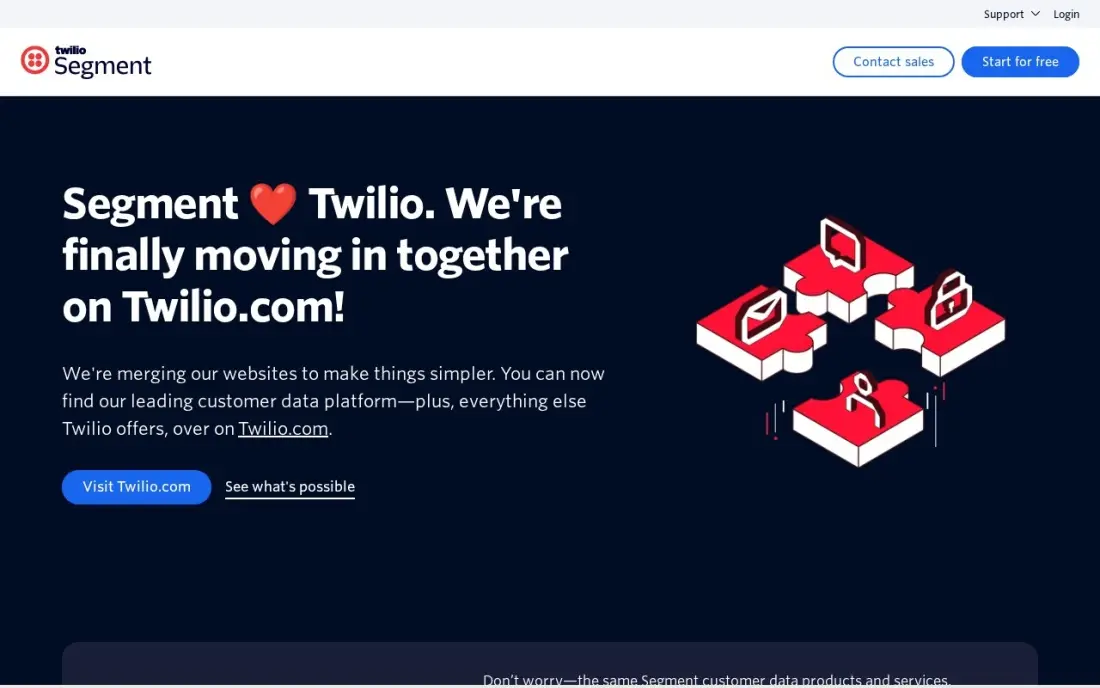
Twilio Segment is best known as a data pipeline, but its Customer Data Platform package adds Unify, which resolves events from websites, apps and servers into unified customer profiles, and Engage, which builds audiences and journeys from them. Connections, the pipeline underneath, collects first-party data and sends it to more than 550 destinations.
The catch for identity buyers is the split pricing. Connections has self-serve plans, including a free plan, but the profile and identity layer comes in the Customer Data Platform package, which is sold through sales. If your team already tracks events with Segment, adding Unify is the shortest path to resolved profiles.
What we like
- Unify builds unified customer profiles from web, app and server events
- Connections sends data to 550+ destinations
- Data pipeline can start on a free plan before you buy profiles
Watch out for
- Identity and profile features are sold through sales, not self-serve
- Pricing for the CDP package is not published

mParticle
Best for: Consumer apps and retailers that want real-time identity tied directly to paid media audiences

mParticle, now Rokt mParticle, is a customer data platform with advanced real-time identity at its core. Its newer features push that identity into marketing results: Probabilistic Reach links anonymous traffic to known customers, Match Boost aims to raise ad-platform match rates up to 2x, and Household Reach extends targeting and suppression across a buying household on supported destinations.
It also offers predictive audiences for churn and value, an AI agent for building audiences in plain language and more than 350 integrations. Customers include Marks & Spencer and Joe & The Juice. There is no published price, so it suits consumer brands with real media budgets.
What we like
- Advanced real-time identity in a hybrid customer data platform
- Probabilistic Reach links anonymous activity to known customers
- Match Boost aims to lift ad-platform match rates up to 2x
- 350+ integrations
Watch out for
- No published pricing
- Now part of Rokt, with a strong lean toward paid-media performance

FullContact
Best for: Marketing and data teams that want person-level identity resolution and enrichment through an API

FullContact resolves identity person by person. Its Person-Centered Graph maps scattered identifiers such as emails, phone numbers and device IDs into one profile, and the Enrich API returns more than 900 demographic and firmographic insights for each match. That makes it a good fit for merging duplicate CRM contacts and filling gaps in thin records through an API or batch file.
It publishes one entry price: an Enrich bundle at $499 a month for 5,000 demographic matches. Its Resolve identity APIs and other bundles are quote-only, and G2 reviewers report match rates near 50%. Billing is on successful matches, so plan volume around matches, not lookups.
What we like
- Identity graph unifies fragmented identifiers into one person profile from a single email
- You pay only on successful matches, so empty queries cost nothing on match-billed plans
- 900-plus demographic and firmographic insights per matched record
- Batch file processing for enriching a whole CRM export without an integration
Watch out for
- Core identity-resolution APIs are quote-only; only Acumen and one Enrich bundle carry a published price
- G2 reviewers report match rates near 50%, so half of queries can return nothing
- Annual or multi-year agreements for any serious volume, with usage billed per matched PersonID
The best identity resolution software works out that the newsletter subscriber, the app user and the in-store buyer are the same person, so your reports, segments and ad audiences stop counting one customer three times. We compared six tools on how they match records, the scale they handle, what you can do with the resolved profile and how they price, and every price below comes from the vendor's own pages as checked in November 2026.
How to choose the best identity resolution software
- Name the job first. Cleaning a CRM, building marketing audiences, matching customers on ad platforms and fraud screening need different tools.
- Check the matching method. Ask whether matches are deterministic, probabilistic or both, and whether you can see why two records were joined.
- Count your records. Several vendors price by records or usage, so your data volume decides the bill.
- Decide where the profile lives. Some tools keep it inside their platform; others run in your own systems or warehouse.
- Plan activation. A resolved profile only pays off when it reaches your email tool, ad platforms or analytics.
- Confirm consent handling. Deletion and opt-out requests must apply to every record that was merged into a profile.
Clean, joined-up customer data also makes attribution trustworthy, which matters when you judge which channels bring buyers. Our guide to the best customer data platforms covers the wider stack, and our monthly SEO service uses that attribution to show what organic search really contributes.
Identity resolution pricing: what you will actually pay
Two vendors publish prices, and they show how differently this market charges. Senzing prices by data source records loaded: 10 million records cost $58,560 a year, paid upfront, which is under 0.6 cents per record per year, and the top published tier is $1,497,000 a year for 1 billion records. Support is included. FullContact's published Enrich bundle costs $499 a month for 5,000 demographic matches, or $5,988 over a year, which is about 10 cents per match.
The customer data platforms price on usage or contract. Amperity charges in Amps for processing, segmenting and activation, and advises budgeting separately for implementation, data engineering and warehouse costs. Twilio Segment sells its Customer Data Platform package, which includes Unify profiles, through sales, while its Connections pipeline has self-serve plans. LiveRamp and mParticle are quote-only. For a fair comparison, ask each vendor for a first-year total at the same record count and the same number of activation destinations.
Know the difference: deterministic vs probabilistic matching
Deterministic matching joins records only when they share a hard identifier: the same email address, phone number, login or loyalty ID. It is precise and easy to explain, which is why it underpins CRM cleanup and compliance work. Its weakness is coverage, because many website visitors never log in and many customers use more than one email.
Probabilistic matching estimates that records belong together from softer signals such as device, network, location and behavior. It links far more anonymous activity, which is what tools such as mParticle's Probabilistic Reach are designed for, but each link is a likelihood, not a certainty. Most mature setups use deterministic matching for the customer record of truth and probabilistic matching only for reach and measurement.
Quick comparison: tool type by need
| Buyer | Best pick | Why |
|---|---|---|
| Consumer brands needing a full CDP | Amperity | Stitch identity plus segments and journeys, usage-based pricing |
| Data and risk teams | Senzing | Entity resolution SDK from $58,560/year for 10M records |
| Enterprise advertisers | LiveRamp | Identity matched across major media partners |
| Teams already on Segment | Twilio Segment | Unify adds unified profiles to the existing pipeline |
| Paid-media performance | mParticle | Real-time identity with Match Boost and Probabilistic Reach |
| CRM cleanup via API | FullContact | Person-level resolution and enrichment from $499/month |
Mistakes to avoid
- Merging too aggressively. Over-matching joins two real people into one profile, which is worse than a duplicate; ask how merges can be reviewed and undone.
- Buying a platform for a cleanup job. If you only need duplicate contacts merged, an API tool costs far less than a full CDP contract.
- Ignoring match rates. A low match rate means paying for lookups that return nothing; test on a sample of your own data first.
- Forgetting downstream tools. Resolved profiles that never reach your email, ads and analytics tools change nothing.
- Treating consent as an afterthought. A deletion request must remove every record merged into a profile, across every connected system.
How we chose
We read each vendor's own pricing, platform and homepage in November 2026 and recorded prices exactly as published; where a vendor shows no price, we list it as a custom quote. FullContact's details come from our tool database, checked against its pricing page earlier in November 2026. We compared matching approach, scale, activation options and pricing model, and covered the three main types of buyer: marketing teams, advertisers and data or risk teams. The FullContact match-rate note reflects G2 reviewer reports. No vendor paid for a place in this list, and none of the links here are affiliate links.
What to do next
Export a sample of 1,000 customer records from two or three systems, count the duplicates by hand, and ask two vendors to run the same sample so you can compare match quality before you sign. If you want cleaner data to show which marketing channels actually win customers, book a free strategy call.
Frequently asked questions
What is the best identity resolution software?
Amperity is the strongest choice for consumer brands that want identity inside a full customer data platform, and Senzing is best for data and risk teams that want an entity resolution engine with published pricing from $58,560 a year. LiveRamp is the pick for matching customers across advertising partners.
How much does identity resolution software cost?
Senzing publishes annual tiers from $58,560 for 10 million records to $1,497,000 for 1 billion. FullContact's Enrich bundle costs $499 a month for 5,000 matches. Amperity, LiveRamp, Twilio Segment's CDP package and mParticle are quote-only.
What is the difference between deterministic and probabilistic matching?
Deterministic matching links records only when a shared identifier, such as the same email or customer ID, proves they are the same person. Probabilistic matching uses signals such as device, location and behavior to estimate a likely match. Most platforms combine both.
Is identity resolution the same as a customer data platform?
No. Identity resolution is one function: deciding which records belong to the same person. A customer data platform such as Amperity, Segment or mParticle includes identity resolution, then adds profiles, segmentation and activation on top.
Is there free identity resolution software?
Not for production use in this list. Senzing runs free in evaluation mode for up to 500 records and offers a free evaluation license on request, FullContact offers a free trial with 1,000 test matches, and Segment's Connections pipeline has a free plan, though its profile layer is paid.
Does identity resolution need consent?
Yes, under most privacy laws. You need a lawful basis for collecting and combining personal data, and clear consent before using it for marketing. Check that the vendor supports consent flags and deletion requests across merged profiles.
Sources we checked (6)
- Amperity — amperity.com/pricing (checked November 21, 2026)
- Senzing — senzing.com/pricing (checked November 21, 2026)
- LiveRamp — liveramp.com (checked November 21, 2026)
- Twilio Segment — www.twilio.com/en-us/pricing/customer-data (checked November 21, 2026)
- mParticle — www.rokt.com/rokt-mparticle/platform (checked November 21, 2026)
- FullContact — www.fullcontact.com/enrich (checked November 12, 2026)
Make one of these tools?
We re-check this list every quarter. Send a correction, request a review, or ask about a clearly labeled sponsored spot.
Request a listingShamim
Founder of SerpAstra
A full-stack digital marketer and SEO strategist covering technical and local SEO, AI search visibility, paid ads and lead generation for local businesses, e-commerce brands and SaaS teams.
Free SEO and AI visibility audit
Find out what is holding your rankings back
Send us your site. Within 2 business days you get a written audit, an AI visibility check and a short fix list ranked by impact. Free, with no contract attached.
Request my free audit→Related buying guides
 Marketing7 Best Customer Data Platforms in 2026, ComparedCompare the 7 best customer data platforms on event collection, warehouse-native audiences, identity resolution and real cost, with prices from vendor pages.Read guide →
 Sales & CRM9 Best B2B Data Enrichment Tools for CRM Accuracy in 2026, ComparedCompare the 9 best b2b data enrichment tools for crm accuracy on price, free plans and data freshness, with every price checked November 12, 2026.Read guide →
 Data, Analytics & AI11 Best Real-Time Analytics Platforms in 2026, ComparedCompare the 11 best real-time analytics platforms on price, free plans and live reporting for 2026, with every price verified November 12, 2026.Read guide →