
Best AEO Tools for Ecommerce in 2026: 9 Picks Ranked by What You Need
9 best AEO tools for ecommerce compared on price, SKU-level tracking and AI shopping visibility for online stores, with prices checked October 31, 2026.
 Shamim Mia, Founder, SerpAstraLast verified October 31, 202614 min read
We compare pricing pages, documentation and public reviews. We never accept payment for rankings.

Key takeaways
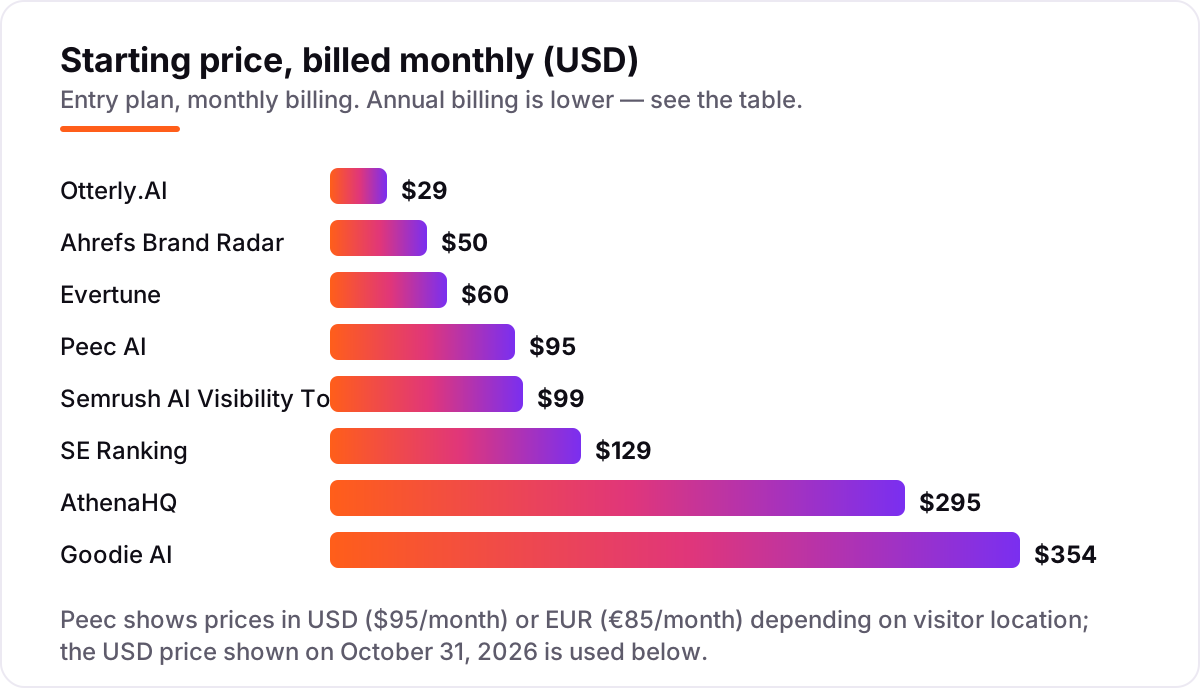
- Goodie AI is the strongest ecommerce pick at $354/month billed monthly ($295 billed annually), Peec AI brings SKU-level tracking for $95/month, and Evertune starts at $60/month with ChatGPT Shopping Insights on every plan.
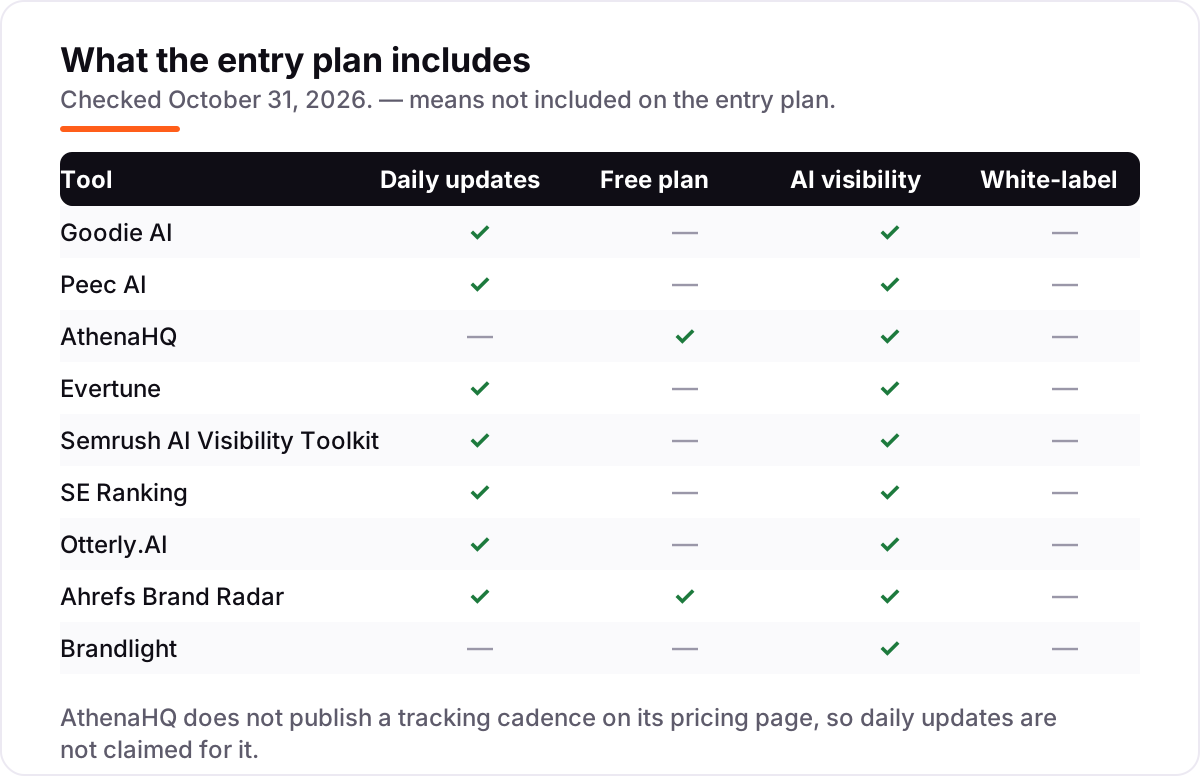
- Only three tools here track visibility at the product level: Goodie on Pro, Peec on every plan, and Brandlight on a custom quote.
- AthenaHQ has the only free plan, with 300 credits across five engines, and Otterly is the cheapest paid start at $29/month.
- The single most important buying factor is product-level tracking: brand mentions tell you the store was named, SKU data tells you which products were recommended.
- Every price below was checked on the vendor's own pricing page on October 31, 2026. No ratings are shown: G2 pages were rate-limited that day, so ratings were left out rather than estimated.
On this page
Quick comparison
| Tool | Best for | Starting price | Free plan |
|---|---|---|---|
| Goodie AI | Mid-size ecommerce brands that want product-level AI shopping visibility plus agents that fix what the data finds | $354/mo | No (7-day trial) |
| Peec AI | Shopify stores that want per-SKU AI shopping visibility without paying enterprise prices | $95/mo | No (7-day trial) |
| AthenaHQ | D2C brands on Shopify that need to show AI visibility affecting revenue | $295/mo | Yes (300 credits) |
| Evertune | Stores that want to watch AI shopping answers and run ChatGPT ads from the same tool | $60/mo | No (7 days free) |
| Semrush AI Visibility Toolkit | Ecommerce teams already paying for Semrush who want AI tracking inside the SEO suite they open daily | $99/mo | No (free checker) |
| SE Ranking | Small ecommerce teams that want AI visibility bundled with rank tracking, audits and keyword research in one subscription | $103.20/mo (annual) | No (14-day trial) |
| Otterly.AI | Small stores running their first AI visibility pilot on a tight budget | $29/mo | No (free trial) |
| Ahrefs Brand Radar | Ecommerce teams already paying for Ahrefs who want AI signals next to their backlink and keyword data | $50/mo | Yes (Ahrefs Free) |
| Brandlight | Enterprise ecommerce brands with large catalogs sold through many retailers | Custom quote | No (paid pilot) |
Make one of these tools?
We re-check this list every quarter. Send a correction, request a review, or ask about a clearly labeled sponsored spot.
Request a listingThe best aeo tools for ecommerce

Goodie AI
Best for: Mid-size ecommerce brands that want product-level AI shopping visibility plus agents that fix what the data finds
Goodie is the only tool in this list that watches what AI shopping assistants recommend at the product level. Core tracks 110 prompts a day across ChatGPT, Google AI Overviews, Perplexity, Google AI Mode and Microsoft Copilot, and the Pro plan adds SKU-level tracking across Amazon Rufus and Walmart Sparky as well. Every plan includes agents that write and optimize content, fix technical signals and repair llms.txt files.
The catch is the price curve: Core is brand-level tracking only, so a store that wants to know which products get recommended pays $999 a month for Pro. There is no free plan, only a 7-day trial. Buy Goodie when AI shopping already drives orders and you need to know which SKUs win; buy Peec when the budget is smaller and product-level tracking is the whole job.
What we like
- SKU-level agentic commerce visibility on Pro ($999/month), tracking products across ChatGPT, Google AI Mode, Perplexity, Amazon Rufus and Walmart Sparky
- Revenue attribution connects AI visibility to orders, which is the number a store owner actually needs
- Every plan includes the action layer: a content writer, technical fixes, llms.txt repair and outreach agents, not just monitoring
- Core covers 5 engines and 110 prompts a day for $295/month, with unlimited seats
Watch out for
- SKU-level tracking needs Pro at $999/month; Core is brand-level tracking only
- Gemini and Claude are not on the entry plan, and full 14-engine coverage needs Enterprise
- No free plan, and at $295/month it is the priciest self-serve entry here alongside AthenaHQ

Peec AI
Best for: Shopify stores that want per-SKU AI shopping visibility without paying enterprise prices
Peec is the value pick for ecommerce because its AI Shopping module is not an upsell. Even the $95 Starter plan imports a product catalog from Shopify, a CSV file or Google Merchant Center and tracks visibility, position and win rate per SKU. Shopping query fanouts show how one question branches into many, and top-merchant views show which retailers AI recommends beside your products.
The limits are model coverage and scale: self-serve plans track 3 of 6 models, so Perplexity and Claude need Enterprise or an add-on, and Starter covers one project in one country. For a single Shopify store selling in one market, that is enough. For an international catalog, budget for Pro at $245 a month.
What we like
- AI Shopping module is included on every plan, even Starter: product catalog upload from Shopify, CSV or Google Merchant Center, plus SKU-level visibility, position and win rate
- Shopping query fanouts and top-merchant views show which retailers AI recommends next to your products
- Daily tracking, unlimited users and unlimited competitors on all plans, with prompt-volume scoring
- Cheapest route to product-level tracking here at $95/month
Watch out for
- Only 3 of 6 models on self-serve plans; Perplexity and Claude need Enterprise or a paid add-on
- Starter covers 1 project and 1 country, so a store selling in several markets outgrows it fast
- No free plan, and the pricing page shows USD or EUR depending on visitor location

AthenaHQ
Best for: D2C brands on Shopify that need to show AI visibility affecting revenue
AthenaHQ pairs the category's only free plan with the integrations a D2C brand needs. The free Essential plan gives 300 credits across five engines, and Starter at $295 a month covers 11 models with unlimited prompts and competitors inside a 3,600-credit allowance. Shopify, Webflow, GA4 and Search Console integrations connect what AI says about the store to the traffic and orders that follow.
The awkward part is the credit math. One credit is one AI response, so a store tracking 100 prompts a day across six engines uses about 600 credits a day, which burns the monthly allowance in six days. Size the prompt list before buying, and use the free plan to learn how fast credits go.
What we like
- Only genuine free plan here: 300 credits across ChatGPT, Perplexity, AI Overviews, Gemini and Copilot
- Shopify, Webflow, GA4 and Search Console integrations connect AI visibility to store traffic and orders
- Starter covers 11 models with unlimited prompts and competitors inside the credit allowance
- Content optimization agent and on-page and off-page actions included on Starter
Watch out for
- Credit pricing is hard to forecast: one credit is one AI response, so 100 prompts a day across 6 engines burns about 600 credits a day
- API access and extra credits are paid add-ons on Starter, not included
- Multi-region and multi-language tracking are Enterprise-only, and Starter is single-region

Evertune
Best for: Stores that want to watch AI shopping answers and run ChatGPT ads from the same tool
Evertune is the only tool here that pairs shopping-answer tracking with an ads product. The $60 Starter plan includes ChatGPT Shopping Insights, 5,000 prompt credits a month and daily monitoring across five models, and the Ads Agent can buy placements inside ChatGPT answers. It is the cheapest paid route to shopping-specific data after Otterly.
The trade-off is focus. Evertune is built for brand and advertising teams, so there is no rank tracking or site audit in the subscription, and the full 11-model list with 100 samples per prompt needs Pro at $800 a month. Buy it when paid AI placements are part of the plan, not when you only need a tracker.
What we like
- ChatGPT Shopping Insights are included on every plan, including the $60 Starter
- Cheapest paid entry here after Otterly, with a 7-day free start and no sales call for Starter
- Ads Agent lets a store buy placements inside ChatGPT answers, not just track them
- Pro adds 100 samples per prompt for statistical reporting, the deepest sampling in this list
Watch out for
- Starter covers 5 models; the full 11-model list and 100-sample depth need Pro at $800/month billed annually
- Built for brand and ad teams rather than SEO workflows, so there is no rank tracking or site audit on Starter
- No free plan beyond the 7-day start, and the ads fee is a percentage of media on top of the subscription

Semrush AI Visibility Toolkit
Best for: Ecommerce teams already paying for Semrush who want AI tracking inside the SEO suite they open daily
The Semrush toolkit is the pragmatic add-on for stores already inside Semrush. For $99 a month per domain it tracks 25 prompts a day and benchmarks the store against competitors across ChatGPT, Google AI Mode, Gemini and Perplexity, and the free checker gives a first read on any domain three times a day. Prompt research draws on Semrush's keyword database, so the tracked questions reflect real demand.
The bill grows in straight lines: an extra domain is $99 a month, an extra user is $99 a month, and 50 more prompts are $60 a month. A single store with one user and 25 prompts pays $99; a three-store team with three users pays close to $300 before prompt packs. Do the multiplication before you commit.
What we like
- Standalone toolkit is $99/month per domain, and Semrush One Starter bundles it with the full SEO suite for $199/month
- Prompt research draws on Semrush's keyword database, so tracked questions reflect real search demand
- Brand Performance reports benchmark your store against competitors across ChatGPT, Google AI Mode, Gemini and Perplexity
- Free checker gives a first read on any domain three times a day without an account
Watch out for
- Only 25 prompts a day on the standalone toolkit; each extra 50 prompts costs $60/month
- Every extra domain and every extra user costs another $99/month, so multi-store teams pay per seat and per shop
- No Claude, Grok or Copilot tracking listed, and Perplexity appears only in weekly brand reports

SE Ranking
Best for: Small ecommerce teams that want AI visibility bundled with rank tracking, audits and keyword research in one subscription
SE Ranking is the suite value pick. AI visibility rides along with rank tracking, site audit, backlink research and keyword research for $103.20 a month billed annually, and the Core plan tracks 2,000 keywords a day with 25 AI prompts a day across five engines. It is the cheapest bundled route to AI visibility here, and the 14-day trial is fully functional.
What it cannot do is product-level tracking. SE Ranking watches brand mentions in AI answers; it does not report which SKUs get recommended or which retailers sit beside them. Buy it for the suite, and pair it with Peec or Goodie if SKU data matters.
What we like
- AI visibility is included in every plan, not an add-on: 25 prompts a day across 5 engines on Core
- Core is a full suite for $103.20/month billed annually: 2,000 keywords a day, site audit, backlink and keyword research
- Lowest cost per daily-tracked keyword in this list, and the trial is a full 14 days
- Standalone AI visibility is available from $71/month if the suite is more than the store needs
Watch out for
- No product-level or SKU-level AI shopping view; this tracks brand mentions, not which products get recommended
- 25 prompts a day is a small allowance for a store with a large catalog
- White-label reporting needs the Agency Pack add-on from $69/month

Otterly.AI
Best for: Small stores running their first AI visibility pilot on a tight budget
Otterly is the cheapest credible start in this list. Lite costs $29 a month for 15 prompts tracked daily across ChatGPT, Google AI Overviews, Perplexity and Microsoft Copilot, with unlimited team members and a free trial. Its GEO URL audits run on any page, so a store can check how AI reads each product page one at a time.
Fifteen prompts is a small list, and a store with more than a few hero products will need Standard at $189 a month for 100 prompts. Google AI Mode, Gemini and Claude are paid add-ons on every tier. Use Otterly to prove the channel matters, then move up when the prompt list grows.
What we like
- Cheapest paid entry in this list at $29/month, with daily tracking on 4 engines from day one
- GEO URL audits run on any URL, so a store can check how AI reads its product pages one by one
- Unlimited team members and unlimited countries and languages on every plan
- Self-serve signup with published prices and a free trial, no sales call
Watch out for
- 15 prompts is a small list; a store with more than a few hero products outgrows Lite fast
- Google AI Mode, Gemini and Claude are paid add-ons on every tier ($9 to $439 a month each)
- No SKU-level or shopping-feed tracking; this is brand monitoring, and product detail stops at URL audits

Ahrefs Brand Radar
Best for: Ecommerce teams already paying for Ahrefs who want AI signals next to their backlink and keyword data
Ahrefs Brand Radar is the research-first option. Its index holds more than 519 million prompts, so a store can look up a competitor's AI visibility today instead of collecting data for a month first. Custom prompt packages start at $50 a month and Brand Radar is sold standalone with an Ahrefs Free account, and paid Ahrefs plans already include 5 to 20 tracked AI prompts.
The pricing has layers. The full index costs $199 a month per engine, or $699 for all platforms, on top of a base plan, and there is no SKU-level view: Brand Radar measures brand mentions, not which products get recommended. It fits a team already paying for Ahrefs, not a store buying its first AI tool.
What we like
- Custom prompt packages start at $50/month and Brand Radar is sold standalone, with an Ahrefs Free account included
- The 519-million-plus prompt index lets a store research any brand or competitor without waiting for new tracking data
- Paid Ahrefs plans already include 5 to 20 tracked AI prompts, and Bot Analytics (free while in beta) shows which AI crawlers read your pages
- Prompt checks are grounded in real query data, so tracked questions reflect what buyers actually ask
Watch out for
- The full AI Visibility Index costs $199/month per engine index ($699 for all platforms) on top of a base plan
- No product-level or SKU-level shopping tracking; this measures brand mentions, not recommended products
- No free trial, and overage on custom prompt packages is billed per check

Brandlight
Best for: Enterprise ecommerce brands with large catalogs sold through many retailers
Brandlight has the deepest ecommerce fit in this list and the hardest buying process. It tracks visibility at SKU and retailer level, and a dedicated AI strategist, analyst and customer success lead do the catalog and retailer work with the brand instead of handing over a dashboard. For a company selling a large catalog through many retailers, that is the job.
Everything else is a warning sign for smaller stores: there is no published price — the pricing page returns a 404 — no self-serve signup and no free trial, and entry is a paid 3-month pilot. Brandlight itself says a single-brand DTC store is a poor fit. Shortlist it only at enterprise scale.
What we like
- Tracks visibility at SKU and retailer level, the closest any tool here gets to the product and the shelf
- A dedicated AI strategist, analyst and customer success lead do the catalog and retailer work with the brand
- Covers shopping surfaces and retailer pages, not just brand mentions in chat answers
- Multi-brand governance for companies running several store brands
Watch out for
- No published price anywhere; the pricing page returns a 404 and buyers need a demo and a quote
- Enterprise only, with a paid 3-month pilot as the entry point; a single-brand DTC store is a poor fit by Brandlight's own account
- No self-serve signup and no free trial, so there is no way to test it before a commercial commitment
What an AEO tool for ecommerce actually does
The best AEO tools for ecommerce answer one question: when a shopper asks an AI assistant for a product, does it recommend yours? The answer names three products with prices and a reason each.
The tools in this list watch those answers, record which products and brands get named, and show which pages the AI cited. That is the whole job: no guessing from rankings, no manual prompting.
A Snipp survey of 1,000 US adults who regularly use AI for search and shopping, published in October 2026, found 61.8% had bought a product after an AI recommendation, and 41.6% start a product search with an AI assistant. AI answers are now a shelf; the tools below show which products sit on it.
The products differ in how close they get to the sale. Some track brand mentions only; a few track the product itself: which SKU was recommended, at what price, and on which shopping surface. That difference decides this ranking.
Product-level tracking first
If your catalog is the business, start here. Goodie, Peec and Brandlight are the only tools here that report visibility per product rather than per brand, and they do it at very different prices.
Peec is the cheapest way to product data. Its AI Shopping module ships on every plan, including the $95 Starter: it imports a catalog from Shopify, a CSV file or Google Merchant Center, then reports visibility, position and win rate per SKU, plus which retailers AI recommends beside your products.
Goodie is the deeper version. Pro at $999 a month tracks products across ChatGPT, Google AI Mode, Perplexity, Amazon Rufus and Walmart Sparky, with revenue attribution connecting visibility to orders. The gap is the action layer: Goodie's agents write content, fix technical signals and repair llms.txt files, while Peec reports the gaps and leaves fixing to you.
Brandlight is the enterprise version: SKU and retailer-level tracking, with a dedicated strategist, analyst and success lead doing the catalog work. No published price, no self-serve tier — it belongs on a shortlist only at enterprise scale. For most stores the choice is Peec at $95 or Goodie Pro at $999, and the deciding question is whether you want the tool to do the fixing as well as the measuring.
Cheap ways in
A store need not pay $295 a month to learn whether AI answers matter. AthenaHQ has the only free plan here: 300 credits across ChatGPT, Perplexity, Google AI Overviews, Gemini and Copilot, with Shopify and GA4 integrations connecting the free test to real store data. Start there and pay only when the data proves the channel.
Otterly is the cheapest paid start at $29 a month for 15 prompts tracked daily across four engines; Evertune follows at $60 a month with ChatGPT Shopping Insights on every plan. Otterly's GEO URL audits run on any product page and show how AI reads it, and Evertune's Ads Agent can buy placements inside ChatGPT answers.
The honest limit on all three is product depth: none reports which SKU was recommended. Use them to prove the channel, then move to Peec or Goodie for product data.
Suites you may already pay for
Before buying a dedicated tool, check the subscription the store already has. Semrush, SE Ranking and Ahrefs all sell AI visibility now, and inside one of those suites the add-on is usually the cheapest route to brand-level data.
Semrush sells its AI Visibility Toolkit standalone at $99 a month per domain for 25 prompts a day, or bundled into Semrush One Starter at $199 a month. SE Ranking includes AI visibility in every plan: Core is $129 a month, or $103.20 billed annually, for 25 prompts a day across five engines plus 2,000 keywords a day of rank tracking. Ahrefs Brand Radar starts at $50 a month for custom prompt packages, sold standalone with an Ahrefs Free account.
The trade-off is the same in all three: suites measure the brand, not the product. None reports SKU-level recommendations, and each prices extras separately.
If the question is "does AI mention us," a suite answers it. If it is "which products does AI recommend," a suite does not, and that is when a dedicated shopping tool earns its price.
AI shopping visibility: what the engines actually show
An AI shopping answer is not a results page. It is a shortlist: two or three products, a price each, and a reason, usually with a product card the shopper can tap. The tools here differ in how much of that shortlist they capture.
Product cards are the unit that counts. SKU-level tools — Peec, Goodie on Pro, Brandlight — report which of your cards appeared and which rival cards sat beside them. Brand-level tools report only that the store was named: useful for reputation, useless for merchandising, since they cannot tell you that your running shoe lost to a competitor's.
The second gap is the feed. AI shopping surfaces read product feeds and catalogs, not just web pages. Peec imports from Shopify or Google Merchant Center directly, which is why its SKU data is the most practical here.
Before buying any tool, check the feed is clean: current prices, in-stock flags and accurate titles — a tool cannot fix a feed it cannot read. Our AI search optimization service starts from the same place: the feed and the product page, then the tracking.
Quick comparison: tool type by need
| Buyer | Best pick | Why |
|---|---|---|
| Mid-size store, product-level AI shopping data | Goodie AI | SKU tracking across Rufus and Sparky plus revenue attribution |
| Shopify store on a budget | Peec AI | SKU-level tracking with Shopify import, from $95/month |
| D2C brand proving AI affects revenue | AthenaHQ | Free plan plus Shopify and GA4 integrations |
| Store that also wants ChatGPT ads | Evertune | Shopping Insights and an Ads Agent from $60/month |
| Already paying for an SEO suite | Semrush or SE Ranking | AI visibility bundled or added for $99–$129/month |
| Small store, first pilot | Otterly.AI | Daily tracking on 4 engines from $29/month |
| Enterprise catalog across many retailers | Brandlight | SKU and retailer-level tracking with a dedicated team |
How to choose the best AEO tools for ecommerce: a short decision path
- Count your products first. Under 20 SKUs, brand-level tracking is enough; Otterly or a suite add-on covers you. Over 50 SKUs, you need product-level data: Peec, Goodie Pro or Brandlight.
- Check your feed. On Shopify or Google Merchant Center, Peec imports the catalog directly and AthenaHQ connects to Shopify. A tool that cannot read the feed cannot report per-product data.
- Decide tracker or fixer. If the team acts on the data itself, Peec or Otterly is enough. If nobody owns the fixes, Goodie's agents or Brandlight's team are worth the premium.
- Price the second year, not the first. AthenaHQ's 3,600 credits last about six days at 100 prompts a day across six engines; Semrush charges $99 per extra domain and user. Model the prompt list before signing.
- Try before you pay. AthenaHQ's free plan, Otterly's trial and Evertune's 7-day free start all run on real data. Run your hero products for two weeks and check whether AI answers name them.
Before you publish new product pages for the questions you track, run your titles through the free SERP snippet preview tool. If the store's organic foundation needs work first, our SEO for ecommerce guide covers that side, our guide to getting cited in ChatGPT explains what AI engines actually quote, and how to rank in AI overviews covers the Google side.
Mistakes to avoid
- Buying brand tracking when you need product tracking. A store with 200 SKUs learns nothing from "your brand was mentioned" — check whether the plan reports per-SKU data before paying.
- Comparing monthly prices without checking the unit. Peec sells prompts, AthenaHQ credits, Evertune prompt credits, Ahrefs checks. One prompt a day across six engines costs six units everywhere except on flat prompt plans.
- Ignoring the feed. AI shopping answers quote the product feed, and a stale price or an out-of-stock flag in Merchant Center will get quoted back to shoppers. No tracking tool fixes that, so keep the feed current before buying software.
- Paying for a suite when only AI shopping matters. A $129 suite is cheap only if the store uses the rank tracking and audits. If the only question is which products AI recommends, Peec at $95 does more for less.
- Trusting a directory price. Peec shows USD or EUR by visitor location, and older guides still quote Goodie at $399 and Profound at $99 — both changed. Always check the vendor's own pricing page and confirm the checkout currency.
How we chose
We checked each vendor's own pricing page on October 31, 2026 and recorded the starting price exactly as shown, including the annual-billing figure where the page lists one.
Two candidates did not make the list: Profound, whose self-serve plans were removed in September 2026, leaving a trial and a custom Enterprise quote with no verifiable ecommerce feature; and Scrunch, which has no ecommerce-specific feature beyond generic page audits. Brandlight publishes no price — its pricing page returns a 404 — so it is listed as a custom quote. No ratings are shown: G2's pages returned rate-limit errors that day, and estimating one would be worse than omitting it.
We ranked by fit for the most common buyer, a small or mid-size store tracking which products AI assistants recommend, not by brand size. No vendor paid for a place in this list, and none of the links here are affiliate links.
What to do next
Start above: count your products, check the feed, decide tracker or fixer. Then take AthenaHQ's free plan or Otterly's trial and run your hero products for two weeks.
If AI answers name them, size the prompt list and pick a product-level tool. If you'd rather have this set up and read for you, request a free SEO + AI visibility audit and get a ranked fix list in 2 business days.
Rather not run the tools yourself?
Tools show you the data. SerpAstra turns it into higher rankings, more map-pack calls and citations in AI answers.
Get a free SEO + AI visibility audit→Sources we checked (10)
- Goodie AI pricing — higoodie.com/pricing (checked October 31, 2026)
- Peec AI pricing — peec.ai/pricing (checked October 31, 2026)
- AthenaHQ pricing — athenahq.ai/pricing (checked October 31, 2026)
- Evertune pricing — evertune.ai/pricing (checked October 31, 2026)
- Semrush pricing — semrush.com/prices (checked October 31, 2026)
- SE Ranking pricing — seranking.com/subscription.html (checked October 31, 2026)
- Otterly.AI pricing — otterly.ai/pricing (checked October 31, 2026)
- Ahrefs pricing — ahrefs.com/pricing (checked October 31, 2026)
- Brandlight pricing — brandlight.ai/pricing returns 404, no published price (checked October 31, 2026)
- Snipp AI Shopping Habits and Brand Loyalty Survey — 61.8% of regular AI users bought a product after an AI recommendation (published October 6, 2026)
Shamim
Founder of SerpAstra
A full-stack SEO and digital marketer who spends most days on Local SEO for dental practices, AI search visibility and lead generation.
Frequently asked questions
What is the best AEO tool for ecommerce in 2026?
Goodie AI is the strongest ecommerce pick, because its Pro plan tracks products across ChatGPT, Google AI Mode, Perplexity, Amazon Rufus and Walmart Sparky, with revenue attribution. Peec AI is the value pick: SKU-level tracking from $95 a month with a Shopify catalog import. Stores already paying for Semrush or Ahrefs should add those suites' AI modules first.
How much does an AEO tool for ecommerce cost?
Between $29 and $295 a month at the entry level. Otterly starts at $29, Evertune at $60, Peec at $95 and Semrush's toolkit at $99. Goodie starts at $354 billed monthly ($295 billed annually) and AthenaHQ at $295, and Brandlight is a custom quote. Product-level tracking usually costs more: Goodie's SKU view needs Pro at $999 a month, while Peec includes it on every plan.
Is there a free AEO tool for ecommerce?
AthenaHQ has the only free plan here: 300 credits across ChatGPT, Perplexity, Google AI Overviews, Gemini and Copilot. Semrush's free AI Visibility Checker gives three checks a day without an account, and Ahrefs Free comes with standalone Brand Radar. The rest offer free trials of 7 to 14 days. Free plans suit a first test, not an ongoing program.
What is SKU-level AI visibility, and do I need it?
SKU-level visibility shows which individual products AI assistants recommend, not just whether they named your store. You need it when a catalog has many products and the recommendation decides the sale, which is most ecommerce. Peec includes it on every plan, Goodie on Pro, and Brandlight for enterprise catalogs. Brand-only tools cannot answer which product won.
Can I track AI shopping visibility without buying a dedicated tool?
Partly. If you already pay for Semrush, SE Ranking or Ahrefs, their AI modules cover brand mentions for $50 to $129 a month extra or bundled. What you cannot get from a suite is product-level shopping data: that needs Peec, Goodie or Brandlight. A free check on Semrush's AI Visibility Checker or AthenaHQ's free plan shows whether the channel matters before you pay.
How is AEO different from SEO for an ecommerce store?
SEO wins a position on a results page; AEO wins a mention inside an AI answer. The answer may recommend a product without the shopper ever seeing your site, which is why AI shopping tools track recommendations and citations rather than rankings. Our guide to SEO for ecommerce covers the organic side, and this list covers the AI-answer side.
What should I check on a product page before paying for an AEO tool?
Four things: the price and stock shown on the page are current, the product name and key specs appear in the first lines of text, the page loads fast and renders without JavaScript, and the product is in your feed or catalog where the tool can import it. AI assistants quote what they can read, so a page they cannot parse will not get recommended however good the tool is.
Free SEO and AI visibility audit
Find out what is holding your rankings back
Send us your site. Within 2 business days you get a written audit, an AI visibility check and a short fix list ranked by impact. Free, with no contract attached.
Request my free audit→Related guides
 StrategySEO for ecommerce: product and category pages that rankSEO for ecommerce: product and category pages that rank, with the structure, schema and internal links that turn search traffic into paying customers.Read guide →
 AI SearchHow to get your brand cited in ChatGPT and AI searchA practical guide to earning citations in ChatGPT, Perplexity and Google AI Overviews: crawler access, Bing indexing, answer-first pages and brand signals.Read guide →
 AI SearchHow to rank in Google AI Overviews: a practical guide for 2026How to rank in Google AI Overviews in 2026: what Google actually requires, query fan-out, answer-first pages, and how to track whether you are being cited.Read guide →