
10 Best Aerospace Companies to Work in 2026
Compare the 10 best aerospace companies to work for in 2026 — hiring, clearance, locations and AI roles, with every fact checked November 4, 2026.
 Shamim Mia, Founder, SerpAstraLast verified November 4, 202613 min read
We compare pricing pages, documentation and public reviews. We never accept payment for rankings.

Key takeaways
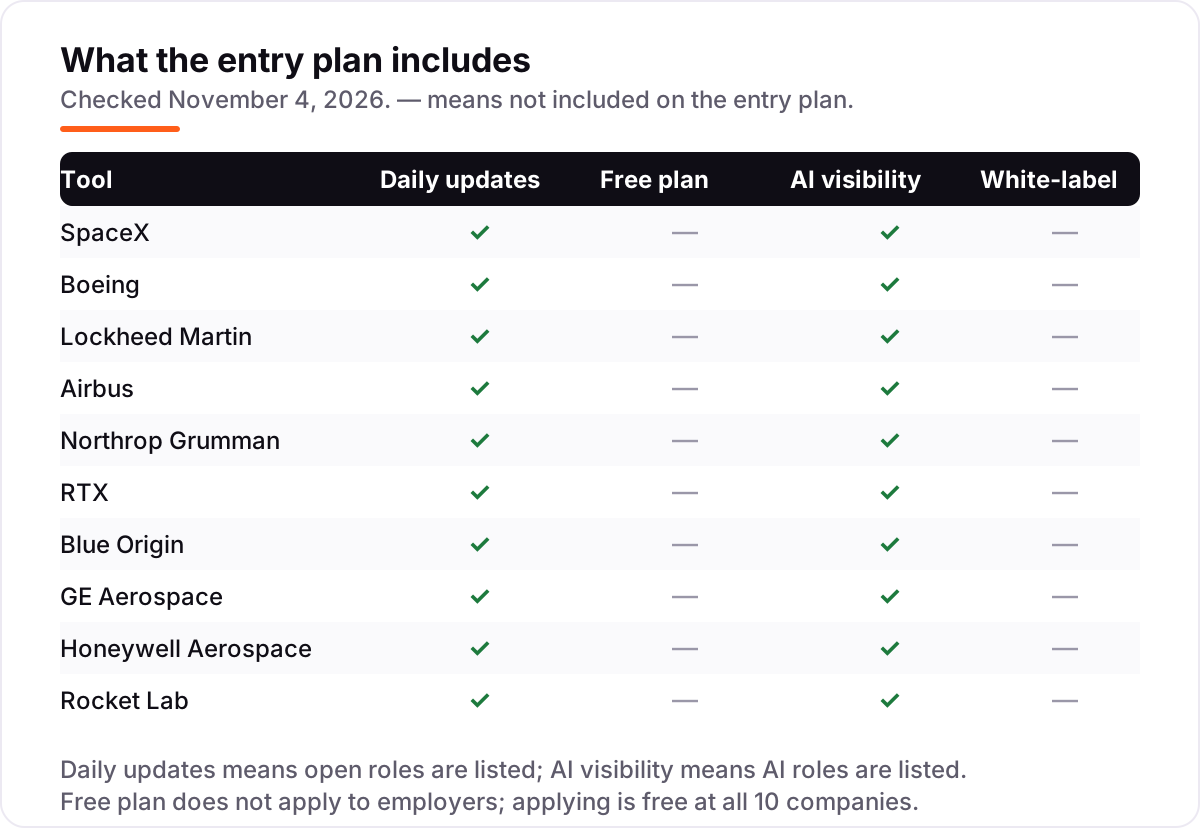
- SpaceX leads for mission-driven space work, Boeing for breadth across commercial and defense, and Lockheed Martin for defense and space programs — and applying costs nothing at any of the 10.
- The single most important factor is the clearance question: defense roles usually need US citizenship and a security clearance, while commercial and space roles often do not.
- Aerospace engineers earn a median $134,960 a year (BLS, May 2025), with about 3,800 openings a year and 8% job growth projected to 2035.
- Every company here lists AI and machine-learning roles, so AI skills are a real differentiator even outside software firms.
On this page
Quick comparison
| Tool | Best for | Starting price | Free plan |
|---|---|---|---|
| SpaceX | Engineers who want fast-paced space work on reusable rockets and satellite constellations | Custom quote | No (applying is free) |
| Boeing | Engineers who want the broadest mix of commercial, defense and space programs at one employer | Custom quote | No (applying is free) |
| Lockheed Martin | Engineers who want defense and space programs with structured development paths | Custom quote | No (applying is free) |
| Airbus | Engineers who want commercial aviation and defense work with a European base and global sites | Custom quote | No (applying is free) |
| Northrop Grumman | Engineers who want defense and space systems work with a 9/80 schedule option | Custom quote | No (applying is free) |
| RTX | Engineers who want defense electronics, engines or avionics across three big businesses | Custom quote | No (applying is free) |
| Blue Origin | Engineers who want space work at a steadier pace than the fastest launch startups | Custom quote | No (applying is free) |
| GE Aerospace | Propulsion engineers who want to work on jet engines and aviation systems | Custom quote | No (applying is free) |
| Honeywell Aerospace | Engineers who want avionics, engines and systems work across commercial and defense | Custom quote | No (applying is free) |
| Rocket Lab | Engineers who want small-launch and spacecraft work at a fast-growing space company | Custom quote | No (applying is free) |
Make one of these tools?
We re-check this list every quarter. Send a correction, request a review, or ask about a clearly labeled sponsored spot.
Request a listingThe best aerospace companies to work

SpaceX
Best for: Engineers who want fast-paced space work on reusable rockets and satellite constellations
SpaceX is the first name most aerospace engineers mention, and the work explains why: reusable Falcon 9 rockets, the Starship program and the Starlink constellation sit under one roof in Hawthorne, California, with launch and test sites in Texas and Florida. Machine-learning roles run through the same programs — Starshield satellite data, Starlink network operations and manufacturing — so AI engineers work on flight hardware, not a side project.
The trade-off is pace and place. Roles are tied to a site, most need US citizenship or permanent residence under export rules, and defense work adds a security clearance. Pay ranges are published on the job postings themselves. Pick SpaceX when the mission matters more to you than a gentle schedule; pick a prime contractor when you want structured hours and a slower climb.
What we like
- Reusable-rocket, Starlink and Starship programs put engineers on high-profile space work
- Machine-learning roles run through Starshield, Starlink and manufacturing, not a separate AI team
- Pay ranges are published on the job postings, so candidates see the band before applying
Watch out for
- US citizenship or permanent residence is required for most roles under ITAR export rules
- Roles are tied to a site — Hawthorne, Starbase or Cape Canaveral — so location flexibility is limited
- Defense-related roles require a security clearance, which lengthens the hiring process

Boeing
Best for: Engineers who want the broadest mix of commercial, defense and space programs at one employer
Boeing is the broadest employer in this list: commercial airplanes, defense and space systems, and a global services business, with career areas spanning engineering, manufacturing, cybersecurity and IT. Engineers can move between programs — one career story on the company's site describes rotations across four business units — and tuition assistance pays your institution directly for courses, certificates and degrees.
The scale cuts both ways. Defense roles usually need a security clearance, and large programs move slower than a startup's. AI and machine-learning roles exist across defense programs and the India engineering center, so software skills transfer in. Pick Boeing when you want the widest choice of programs at one employer; pick a space startup when you want one mission and a faster pace.
What we like
- Commercial airplanes, defense, space and services under one roof, with moves between programs
- Tuition assistance pays your institution directly for courses, certificates and degrees
- AI and machine-learning roles exist across defense programs and the India engineering center
- Veteran and military-spouse programs, including the SkillBridge fellowship
Watch out for
- Many defense roles need a US security clearance
- Large programs move slower than a startup, with more process around every decision
- Most engineering roles are tied to a plant or program site, with limited remote work

Lockheed Martin
Best for: Engineers who want defense and space programs with structured development paths
Lockheed Martin organizes its work into four business areas — Aeronautics, Missiles and Fire Control, Rotary and Mission Systems, and Space — which covers fighter jets, helicopters, missiles, satellites and missile defense. AI and machine-learning roles sit inside those programs, from the REALM AI research team in Colorado Springs to autonomy work on aircraft, and some programs run four 10-hour days with three days off.
Nearly every role needs US citizenship and a security clearance, and program locations follow defense sites in places like Fort Worth, Marietta and Huntsville. The work is mission-driven and the programs run for decades, which suits engineers who want depth in one domain. Pick Lockheed Martin when defense and space programs are the draw; pick Airbus or Boeing when you want commercial aviation in the mix.
What we like
- Four business areas — Aeronautics, Missiles and Fire Control, Rotary and Mission Systems, Space
- AI and machine-learning roles across missile defense, autonomy and the REALM AI research team
- Some programs run four 10-hour days with three days off
- Skunk Works and advanced development programs for cutting-edge work
Watch out for
- Nearly every role needs US citizenship and a security clearance
- Program locations follow defense sites, so relocation is often part of the deal
- Large-program process and hierarchy can slow individual impact

Airbus
Best for: Engineers who want commercial aviation and defense work with a European base and global sites
Airbus is the global pick in this list, with more than 180 locations worldwide and commercial aircraft, defence and space divisions. AI engineers work on aircraft systems, manufacturing and analytics in Toulouse, Hamburg, Bengaluru and the UK, and the graduate programme offers a two-year development path into AI engineering roles for recent graduates.
The trade-offs are geographic and administrative. Many roles need security clearance or eligibility for it, some postings offer no visa sponsorship, and pay and benefits vary by country. English is the working language on most international teams. Pick Airbus when you want commercial aviation with a European base; pick a US prime when you need a clearance-friendly career path at home.
What we like
- More than 180 locations worldwide, with commercial aircraft, defence and space divisions
- AI Engineer roles across Toulouse, Manching, Bengaluru and the UK, plus a graduate AI track
- Graduate programme offers a two-year development path into AI engineering roles
- Strong European base for candidates who want to work outside the US
Watch out for
- Many roles need security clearance or eligibility for it, such as UK SC clearance
- Some postings offer no visa sponsorship, so candidates need existing work authorization
- Pay and benefits vary by country across the company's 180-plus locations

Northrop Grumman
Best for: Engineers who want defense and space systems work with a 9/80 schedule option
Northrop Grumman employs about 100,000 people across air, cyber, land, sea, space and the connectivity between them, building everything from stealth bombers to missile defense and space systems. AI work has its own center of excellence, with staff AI software engineers and machine-learning specialists on missile defense and command-and-control programs, and many teams run a 9/80 schedule.
Most roles need a US security clearance — Top Secret for many AI positions — and the work clusters around defense hubs like Huntsville, Northern Virginia and San Diego. Hiring follows defense budgets, so programs can shift with contracts. Pick Northrop Grumman when you want defense and space work with schedule flexibility; pick a commercial-first employer when clearances are a deal-breaker.
What we like
- About 100,000 people across air, cyber, land, sea, space and the connectivity between them
- A 9/80 schedule on many teams — nine-hour days with every other Friday off
- An AI Center of Excellence with dedicated AI and machine-learning roles
- Total Rewards package and dedicated veteran hiring programs
Watch out for
- Most roles need a DoD clearance — Top Secret for many AI and machine-learning roles
- Work clusters around defense hubs such as Huntsville, Northern Virginia and San Diego
- Defense budgets drive hiring, so programs can shift with contracts

RTX
Best for: Engineers who want defense electronics, engines or avionics across three big businesses
RTX brings together three businesses — Collins Aerospace, Pratt & Whitney and Raytheon — and describes itself as the world's largest aerospace and defense company, with about 185,000 employees. That scale shows up in the roles: applied AI engineers in enterprise services, machine-learning engineers in defense, and research engineers at BBN working on generative AI, with hybrid roles alongside on-site defense work.
The breadth is also the complication: culture and pace vary a lot between Collins, Pratt & Whitney and Raytheon, and most defense roles need a security clearance. Pay ranges are published on the postings. Pick RTX when you want engines, avionics or defense electronics with a large employer's stability; pick a pure space company when you want a single mission.
What we like
- About 185,000 employees across RTX Corporate, Collins Aerospace, Pratt & Whitney and Raytheon
- Applied AI and machine-learning roles across enterprise services, Raytheon and BBN
- Hybrid roles exist alongside on-site defense work
- Pay ranges are published on the job postings
Watch out for
- Most defense roles need a security clearance
- Culture and pace vary a lot between Collins Aerospace, Pratt & Whitney and Raytheon
- Large-company process; internal moves cross business-unit lines

Blue Origin
Best for: Engineers who want space work at a steadier pace than the fastest launch startups
Blue Origin builds reusable rockets and space systems — New Shepard for suborbital flight, New Glenn for orbit, and the Blue Ring mobility platform — from its Kent, Washington headquarters, with engine work in Huntsville and launch operations in Texas and Florida. AI engineers work on Blue Ring's ground systems, New Glenn flight software and the Rocket Factory's manufacturing AI.
The benefits are concrete: a 401(k) match of 100% on the first 5% of pay, up to four weeks of paid time off a year, and a relocation team for specific roles. Applicants must be US citizens, nationals, permanent residents, refugees or asylees, and roles are concentrated in a handful of hubs. Pick Blue Origin when you want space work at a steadier pace than the fastest startups.
What we like
- 401(k) match of 100% on the first 5% of pay
- Up to four weeks of paid time off a year, plus a relocation team for specific roles
- AI and machine-learning roles on Blue Ring, New Glenn and the Rocket Factory
- Dog-friendly offices and an education support program for further study
Watch out for
- Applicants must be US citizens, nationals, permanent residents, refugees or asylees
- Roles are concentrated in Kent, WA, West Texas, Florida and Huntsville, so location choice is narrow
- On-site work in Kent, Renton, Reston and other hubs; remote roles are rare

GE Aerospace
Best for: Propulsion engineers who want to work on jet engines and aviation systems
GE Aerospace is the propulsion specialist in this list: a global leader in jet engines, services and integrated systems, with AI and machine-learning roles in engineering design, manufacturing and commercial engine services. Senior AI engineers lead projects from problem framing to deployment, and applied AI co-ops give students a way in during their degree.
The catches are familiar for this sector. Many openings require US work authorization with no visa sponsorship, defense work needs a security clearance, and relocation assistance is offered on some roles but not all. Pick GE Aerospace when propulsion and engine systems are the work you want; pick a prime contractor when you want airframes and mission systems too.
What we like
- A global leader in aerospace propulsion, services and integrated systems
- AI and machine-learning roles in engineering design, manufacturing and engine services
- Senior AI engineers lead projects from problem framing through deployment
- Co-op and internship paths for students, including Applied AI Engineer co-ops
Watch out for
- Many openings require US work authorization with no visa sponsorship
- Defense work needs an active security clearance
- Relocation assistance is offered on some roles but not all

Honeywell Aerospace
Best for: Engineers who want avionics, engines and systems work across commercial and defense
Honeywell Aerospace builds avionics, engines, auxiliary power units and flight systems for commercial and defense customers, and now operates as a standalone aerospace company after its 2026 spin-off from Honeywell. Its AI work is unusually concrete: physics-informed machine learning, digital twins and NVIDIA-accelerated simulation in Phoenix, plus early-career programs that onboard 450 interns and 250 university hires a year.
Most roles need US Person status under export-control rules, and hardware work is largely on-site. Phoenix is the hub, so many roles mean relocating to Arizona. Pick Honeywell Aerospace when avionics and systems engineering are your focus; pick GE Aerospace when engines are the draw.
What we like
- Avionics, engines, auxiliary power units and flight systems for commercial and defense
- Physics-informed machine learning, digital twins and NVIDIA-accelerated simulation in Phoenix
- Early-career programs onboard 450 interns and 250 university hires a year
- A standalone aerospace company after the 2026 spin-off from Honeywell
Watch out for
- Candidates must be US Persons for many roles under export-control rules
- Hardware work is largely on-site
- Phoenix is the hub, so many roles mean relocating to Arizona

Rocket Lab
Best for: Engineers who want small-launch and spacecraft work at a fast-growing space company
Rocket Lab is the small-launch specialist: Electron, which the company calls the world's most frequently launched small rocket, plus the Neutron rocket in development, Photon spacecraft and satellite components. Engineers work on launch vehicles, spacecraft and subsystems across Long Beach, California, and sites in New Zealand, including the private orbital launch site at Mahia.
Machine-learning engineers in the Optical Systems division build computer-vision models for defense and intelligence customers, and those roles need a security clearance. US roles need citizenship or permanent residence under export rules. Pick Rocket Lab when you want a fast-growing space company where teams are lean and roles cover more ground; pick a prime when you want scale and structure.
What we like
- Electron is the world's most frequently launched small rocket, per the company
- Neutron, Electron, Photon and space systems give engineers launch, spacecraft and component work
- Machine-learning roles in Optical Systems supporting Space Development Agency programs
- US and New Zealand sites, including the private orbital launch site at Mahia
Watch out for
- US roles need citizenship or permanent residence under ITAR export rules
- Some roles need an active TS/SCI security clearance
- Smaller than the primes, so teams are leaner and roles cover more ground
The best aerospace companies to work for in 2026 hire across the same three worlds — commercial aviation, defense and space — but the day-to-day job differs sharply between them. We ranked the 10 employers below by fit for the most common candidate, an engineer weighing offers, and every fact was checked on the company's own careers page on November 4, 2026.
How to choose the best aerospace companies to work
- Start with the clearance question. Defense roles usually need US citizenship and a security clearance; commercial and most space roles usually do not. If you cannot get a clearance, shortlist the commercial and space side first.
- Pick a world, not just a company. Boeing, Airbus and RTX all do commercial and defense work, so the program matters more than the logo. SpaceX, Blue Origin and Rocket Lab are space-first; Lockheed Martin and Northrop Grumman are defense-first.
- Check where the work lives. Aerospace jobs are tied to sites — Hawthorne, Fort Worth, Huntsville, Toulouse, Phoenix — and most engineering roles are on-site. Decide which cities you will actually move to before you apply.
- Weigh pace against structure. Space startups move fast and expect long hours; the big primes offer structured development, tuition help and steadier schedules. Neither is better in general — it depends on the stage of your career.
- Look for AI roles even if you are not a software engineer. Every company here lists AI and machine-learning roles, and engineers who can work with those teams have more options inside the company.
- Read the benefits, not just the salary band. A 401(k) match, tuition assistance and a 9/80 schedule can be worth thousands a year, and they differ far more between employers than base pay does.
Aerospace is one career decision in a bigger working life, and the same comparison habit helps elsewhere: if you run a company rather than applying to one, compare providers in our guide to B2B SEO companies before you sign anything. And if you keep a portfolio site to show your work, run its titles through the free SERP snippet preview tool — it shows exactly how the title and description will look in Google.
Whatever you shortlist, apply through the company's own careers page and tailor the application to the program, not the brand. A propulsion resume goes to GE Aerospace and Blue Origin's engine teams; an avionics resume goes to Honeywell Aerospace and Collins Aerospace inside RTX. The recruiters who read it work on one program, so name the program and the work you have done that matches it.

Aerospace companies to work pricing: what you will actually pay
Applying costs nothing at all 10 companies — there is no fee to apply, and the careers pages all warn that any demand for payment is fraud. The money that moves is on the pay side, and the US Bureau of Labor Statistics gives the anchor: the median annual wage for aerospace engineers was $134,960 in May 2025, with the lowest 10 percent earning under $86,700 and the highest 10 percent earning over $205,890. That is a spread of more than $119,000 inside one occupation, driven by industry, experience and location.
The industry you land in matters as much as the company. The same BLS figures put the median at $149,260 in research and development, $142,630 in the federal government and $137,030 in aerospace product and parts manufacturing — a $12,230 gap between research work and manufacturing work for the same occupation. The AI roles listed across this post sit mostly on the research side of that divide, which is one reason they pay toward the top of the range. If you want the full picture of which firms help companies show up in AI answers, see our guide to AI visibility companies.
Two other costs are real even though no one charges you a fee. First, relocation: the jobs cluster in a handful of hubs, and moving to Hawthorne, Huntsville or Toulouse costs money up front even when the employer offers a relocation team, as Blue Origin does. Second, time: a clearance can add months to a defense hiring process, and during those months you cannot start the cleared work. The job outlook is strong enough to justify the wait — the BLS projects 8 percent employment growth for aerospace engineers from 2025 to 2035, with about 3,800 openings a year.
Know the difference: defense work vs commercial work
The biggest confusion in this category is treating "aerospace" as one kind of job. It is at least two: defense work and commercial work, and the same company often does both. Boeing builds airliners and fighter support systems; Airbus builds passenger jets and military transports; RTX builds jet engines and missile systems. The employer name tells you little — the program tells you nearly everything.
Defense work usually needs US citizenship and a security clearance, runs on government contracts and long program timelines, and sits in defense hubs like Huntsville, Fort Worth and Northern Virginia. Commercial work usually needs no clearance, follows airline and manufacturing cycles, and sits near factories and design centers. The pace differs too: defense programs measure progress in years and decades, while commercial programs answer to production rates and delivery schedules.
There is a second distinction worth knowing: prime contractors versus suppliers. Lockheed Martin, Boeing and Northrop Grumman are primes — they deliver whole aircraft, spacecraft and systems to governments and airlines. GE Aerospace, Honeywell Aerospace and Collins Aerospace inside RTX are suppliers — they build the engines, avionics and systems that go inside someone else's aircraft. Supplier roles tend to be deeper in one technology and easier to carry between employers; prime roles give you the whole vehicle and the whole program.
Quick comparison: tool type by need
| Buyer | Best pick | Why |
|---|---|---|
| Engineer who wants space work above all | SpaceX | Reusable rockets, Starlink and Starship, with AI roles in the same programs |
| Engineer who wants the broadest choice | Boeing | Commercial, defense and space programs at one employer, with tuition paid |
| Engineer who wants defense and space depth | Lockheed Martin | Four business areas from fighter jets to space, with structured development |
| Engineer who wants to work in Europe | Airbus | More than 180 locations, commercial and defence divisions, graduate AI track |
| Engineer who wants engines or avionics | GE Aerospace | Propulsion specialist; Honeywell Aerospace is the avionics-first alternative |
| Engineer who wants a fast-growing space company | Rocket Lab | Small launch and spacecraft work where lean teams cover more ground |
Mistakes to avoid
- Applying to the company instead of the program. A generic application to Boeing or RTX lands nowhere. Name the program — F-35, Starship, Blue Ring, Neutron — and show work that matches it.
- Ignoring the clearance question until the offer stage. If a role needs a clearance and you cannot get one, the application was wasted effort. Check the citizenship and clearance lines on the posting before you apply.
- Assuming all 10 hire the same way. Space startups hire fast and on-site; primes run longer processes with more stages. A slow reply from Lockheed Martin is normal; a slow reply from Rocket Lab is a signal.
- Choosing on salary band alone. The BLS spread inside this occupation is more than $119,000, and benefits, schedule and location change the real value of an offer far more than a few thousand in base pay.
- Forgetting the location decision. Most of these jobs are on-site in a handful of hubs. Accepting an offer means moving to Hawthorne, Huntsville, Toulouse or Phoenix — price the move and the cost of living there before you accept.
How we chose
We checked each company's own careers page on November 4, 2026 and recorded what it actually lists: open roles, hiring requirements, locations and benefits, exactly as shown. We ranked the employers by fit for the most common candidate — an engineer weighing offers — not by brand size. This list carries no review ratings: the only allowed review sources are G2, Capterra and Trustpilot, and the pages that exist there measure customer experience, not employment — Trustpilot's Boeing page, for example, is mostly airline passengers rating flights, and G2's Lockheed Martin page holds a single review. The source that actually rates employers, Glassdoor, is outside the sources this list uses, so we show no rating rather than a misleading one. Pay figures come from the US Bureau of Labor Statistics, not from the companies, and no vendor paid for a place in this list.
What to do next
Start with the clearance question, then shortlist two or three employers whose programs match your skills and apply through their own careers pages. Run one real application properly — a resume tailored to the program, a cover note that names the work — before you spray applications across all 10. If you run a company rather than applying to one, compare providers in our guide to SEO companies for small business, and if your own site needs to be found, our monthly SEO service handles the visibility side. Once your tools are in place, find out what's holding your rankings back.
Your stack only works if people find you
SerpAstra fixes what keeps your site off page one and makes it easy for AI assistants to recommend.
Get a free audit→Sources we checked (11)
- SpaceX careers — spacex.com/careers (checked November 4, 2026)
- Boeing careers — boeing.com/careers (checked November 4, 2026)
- Lockheed Martin careers — lockheedmartin.com/en-us/careers.html (checked November 4, 2026)
- Airbus careers — airbus.com/en/careers (checked November 4, 2026)
- Northrop Grumman careers — northropgrumman.com/careers (checked November 4, 2026)
- RTX careers — rtx.com/careers (checked November 4, 2026)
- Blue Origin careers — blueorigin.com/careers (checked November 4, 2026)
- GE Aerospace careers — geaerospace.com/careers (checked November 4, 2026)
- Honeywell Aerospace careers — honeywellaerospace.com/us/en/company/careers (checked November 4, 2026)
- Rocket Lab careers — rocketlabusa.com/careers (checked November 4, 2026)
- BLS Occupational Outlook Handbook: Aerospace Engineers — bls.gov (checked November 4, 2026)
Shamim
Founder of SerpAstra
A full-stack SEO and digital marketer who spends most days on Local SEO for dental practices, AI search visibility and lead generation.
Frequently asked questions
What is the best aerospace company to work for?
SpaceX is the best fit for engineers who want mission-driven space work on reusable rockets and Starlink, while Boeing suits those who want the broadest mix of commercial, defense and space programs. Lockheed Martin leads for defense and space programs with structured development. The right pick depends on whether you want space, defense or commercial aviation work.
How much do aerospace engineers make?
The US Bureau of Labor Statistics puts the median annual wage for aerospace engineers at $134,960 in May 2025, with the lowest 10 percent earning under $86,700 and the highest 10 percent over $205,890. Pay varies by industry: research and development pays a median $149,260, while aerospace product and parts manufacturing pays $137,030.
Do I need a security clearance to work in aerospace?
It depends on the work. Defense roles at Lockheed Martin, Northrop Grumman, RTX and the defense arms of Boeing almost always need a US security clearance, which requires US citizenship. Commercial aviation and most space roles usually do not need a clearance, though export rules still limit some roles to US citizens and permanent residents.
Can I work in aerospace without an engineering degree?
Yes. Aerospace companies also hire technicians, machinists, software engineers, data specialists, manufacturing staff and business roles. The Bureau of Labor Statistics puts the median pay for aerospace engineering and operations technicians at $82,890 in May 2025. A degree helps for design roles, but skilled trades and software paths are real routes in.
Which aerospace company hires the most people?
The defense primes hire at the largest scale: RTX employs about 185,000 people and Northrop Grumman about 100,000, while Boeing, Lockheed Martin and Airbus each employ tens of thousands across many sites. Space startups like Rocket Lab and Blue Origin hire fewer people but are growing fast, so a single opening there can carry more responsibility.
Is SpaceX or Blue Origin better to work for?
SpaceX offers the fastest pace and the highest-profile programs — reusable rockets, Starship and Starlink — with on-site work and long hours as the trade-off. Blue Origin offers steadier space work on New Shepard, New Glenn and Blue Ring, with a 401(k) match of 100% on the first 5% of pay and up to four weeks of paid time off.
How do I get hired by an aerospace company?
Apply directly on the company's careers page — every company in this list hires through its own site, and applying is free. Tailor your resume to the program, not the company: propulsion, avionics, structures and AI are different hiring tracks. Internships and co-ops are the strongest route in for students and recent graduates.
Free SEO and AI visibility audit
Find out what is holding your rankings back
Send us your site. Within 2 business days you get a written audit, an AI visibility check and a short fix list ranked by impact. Free, with no contract attached.
Request my free audit→Related guides
 SEO & AI Search8 Best SEO Companies for Small Business in 20268 best SEO companies for small business compared on price, contracts and AI visibility, with prices checked on each agency's own site on November 1, 2026.Read guide →
 SEO & AI Search12 Best B2B SEO Companies (2026): Who to Hire and What It CostsThe 12 best b2b seo companies for mid-size B2B teams in 2026, compared on price, services and AI search. Only two publish prices — the rest quote custom.Read guide →
 SEO & AI Search8 Best AI Visibility Companies (2026): Who to Hire and What It Costs8 best AI visibility companies compared on price, services and fit, with real published fees. Find the right AI visibility partner for your budget and timeline.Read guide →