
10 Best Aerospace Companies (2026): Who to Hire and What It Costs
Compare the 10 best aerospace company options for airlines, governments and satellite operators, with real contract prices, checked November 4, 2026.
 Shamim Mia, Founder, SerpAstraLast verified November 4, 202613 min read
We compare pricing pages, documentation and public reviews. We never accept payment for rankings.

Key takeaways
- Boeing is the best fit for most buyers, Airbus leads on commercial jets and SpaceX is the only company here with a published starting price — rideshare from $350,000 for 50 kg. The other nine quote per contract.
- The single most important buying factor is the procurement route: airlines buy aircraft, governments buy through contracts and satellite operators buy launch slots, and each route has different pricing, lead times and paperwork.
- No aerospace prime publishes a price list. Boeing and Airbus stopped publishing list prices in 2018–2019, so every aircraft or defense deal is a negotiated quote.
- Budget for the whole program, not the unit price: an F-35A costs $92 million flyaway, but spares, training and decades of sustainment cost far more.
On this page
Quick comparison
| Tool | Best for | Starting price | Free plan |
|---|---|---|---|
| Boeing | Airlines and governments that want one supplier for commercial aircraft, defense systems and space hardware | Custom quote | No |
| Airbus | Airlines buying single-aisle jets, and operators that need helicopters or military transport from the same supplier | Custom quote | No |
| Lockheed Martin | Governments buying fighter aircraft, missile defense and satellites from the largest US defense contractor | Custom quote | No |
| Northrop Grumman | Governments buying stealth bombers, satellites and missile-defense systems | Custom quote | No |
| RTX | Airlines and governments that need jet engines, avionics and air-defense systems from one group | Custom quote | No |
| SpaceX | Satellite operators that need the cheapest published ride to orbit | From $350,000 (rideshare) | No |
| GE Aerospace | Airlines and airframers buying proven commercial and military jet engines | Custom quote | No |
| Safran | Airlines and airframers needing engines, landing gear, nacelles and cabin equipment from one supplier | Custom quote | No |
| Honeywell Aerospace | Airlines and business-jet operators needing avionics, auxiliary power units and cockpit systems | Custom quote | No |
| BAE Systems | Governments buying electronic warfare, combat vehicles and naval systems | Custom quote | No |
Make one of these tools?
We re-check this list every quarter. Send a correction, request a review, or ask about a clearly labeled sponsored spot.
Request a listingThe best aerospace company

Boeing
Best for: Airlines and governments that want one supplier for commercial aircraft, defense systems and space hardware
Boeing is the default name in aerospace for a reason: it builds the 737 MAX and 787 airliners, the F/A-18 and KC-46 for air forces, and satellites and space hardware besides. It is the only company in this list that covers commercial aviation, defense and space at full scale. The 737 family alone has passed 12,000 deliveries, so maintenance, parts and trained crews exist almost everywhere.
The catch is that nothing has a price tag. Boeing stopped publishing list prices in 2019, so an airline or government negotiates every order, and the final price depends on order size, configuration and delivery slots. Production delays have also stretched waiting times for new aircraft. Buy Boeing when breadth matters most; buy Airbus when the priority is the newest single-aisle jet.
What we like
- The broadest product range here: 737 MAX and 787 airliners, F/A-18 and KC-46 defense aircraft, satellites and space hardware
- 12,382 737s delivered to September 2026, so parts, training and maintenance support exist almost everywhere
- Global Services sells maintenance, parts and training separately, so an airline can buy support without buying an aircraft
- The 787 family spans three sizes, from the 787-8 to the 787-10, covering most long-haul routes
Watch out for
- No published prices: Boeing stopped publishing list prices in 2019, so every deal is a negotiation
- 737 MAX production and delivery delays have stretched waiting times for new aircraft
- Defense programs have run over budget and behind schedule, including the KC-46 tanker and Starliner spacecraft

Airbus
Best for: Airlines buying single-aisle jets, and operators that need helicopters or military transport from the same supplier
Airbus is the company to call when the job is a commercial jet. The A320neo family is the most popular aircraft in production — 12,512 delivered as of February 2026 — and the A321XLR stretches single-aisle economics onto routes that used to need a wide-body. Beyond airliners, Airbus builds helicopters, the A400M military transporter and satellites.
Like Boeing, Airbus publishes no prices: list prices stopped in 2018, and every order is negotiated, with discounts of 40% to 60% common on large orders. The other constraint is time: the order book stretches years ahead, so a new order can wait a long time for a delivery slot. Choose Airbus for the newest single-aisle fleet; choose Boeing when you also need defense aircraft and space hardware.
What we like
- The A320neo family is the most popular commercial aircraft in production, with 12,512 delivered as of February 2026
- Covers airliners, helicopters, military transport and satellites, so one supplier can equip an airline and an air force
- The A321XLR flies long-haul routes with a single-aisle aircraft, opening thin routes a wide-body cannot serve profitably
- Airbus states the A320neo burns about 20% less fuel per seat than the previous generation
Watch out for
- No published prices: Airbus stopped publishing list prices in 2018, so every deal is a negotiation
- Order backlog stretches years, so a new A320neo order can wait a long time for a delivery slot
- The A220 program is still working toward profitability, which keeps pricing and support under pressure

Lockheed Martin
Best for: Governments buying fighter aircraft, missile defense and satellites from the largest US defense contractor
Lockheed Martin is the company governments call first for air power. It builds the F-35 Lightning II — more than 1,000 delivered, flown by the US and its allies — plus the C-130, Sikorsky helicopters, THAAD missile defense and satellites. The F-35A costs $92 million flyaway in the latest production lots, including engine and radar, per the F-35 Joint Program Office.
The price of admission is the sustainment bill. An F-35A costs about $42,000 per flight hour to fly, against about $25,000 for an F-16, and the aircraft needs climate-controlled hangars and expensive spares. Nearly three-quarters of Lockheed's sales go to the US government, so the order book follows defense budgets. Buy Lockheed Martin when the requirement is a fifth-generation fighter or missile defense; buy Northrop Grumman when the priority is stealth bombers and space.
What we like
- Builds the F-35, with the F-35A's flyaway cost at $92 million in the latest production lots
- The broadest defense portfolio here: fighters, helicopters, missiles, missile defense and satellites
- More than 1,000 F-35s delivered, with operators in the US and allied nations sharing one supply chain
- Space division builds satellites and missile-warning systems for the US government
Watch out for
- F-35 sustainment is expensive: about $42,000 per flight hour, against about $25,000 for an F-16
- Nearly three-quarters of sales go to the US government, so budgets and politics drive the order book
- Procurement cycles run for years, and export sales need US government approval

Northrop Grumman
Best for: Governments buying stealth bombers, satellites and missile-defense systems
Northrop Grumman is the quietest giant in this list and the one behind the two most ambitious programs in American aerospace: the B-21 Raider stealth bomber and the James Webb Space Telescope, which it built and which now observes the early universe from a million miles out. Its portfolio runs from stealth aircraft and missile defense to satellites, unmanned systems and electronic warfare.
The trade-off is transparency. B-21 pricing is classified, so there is no public benchmark for what the bomber costs, and almost all of Northrop's revenue comes from government contracts that run on political and budget cycles. There is no commercial business to smooth the ups and downs. Buy Northrop Grumman for stealth, space and missile defense; buy Lockheed Martin when the requirement is fighters and the largest defense supply chain.
What we like
- Builds the B-21 Raider, the US Air Force's next stealth bomber, and the B-2 it replaces
- Built the James Webb Space Telescope, the largest space telescope ever flown
- Deep missile-defense and space portfolio, from interceptors to satellite constellations
- Strong position in unmanned systems and electronic warfare
Watch out for
- B-21 pricing is classified, so buyers get no public benchmark at all
- Almost entirely dependent on government contracts, with long sales cycles and political risk
- Fewer commercial products than Boeing or Airbus, so no civilian revenue to smooth defense cycles

RTX
Best for: Airlines and governments that need jet engines, avionics and air-defense systems from one group
RTX is three companies in one: Pratt & Whitney builds engines, Collins Aerospace builds avionics and aircraft systems, and Raytheon builds air-defense missiles and radars. That breadth is the point: the F135 in every F-35, the geared turbofan on many A320neos and the Patriot system defending allied airspace all come from RTX. An airline or government can buy the engine, the cockpit and the defense system from one group.
The weak spot has been the geared turbofan. Durability problems forced inspections and grounded A320neo-family aircraft in 2023 and 2024, and the fix has taken years to work through the fleet. Prices are also opaque: engines are sold through long-term service agreements priced per flight hour, not per unit. Buy RTX when you need engines and systems together; buy GE Aerospace when the job is engines alone.
What we like
- Pratt & Whitney's F135 powers the F-35, and its geared turbofan powers the A320neo
- Collins Aerospace supplies avionics, landing gear and cabin systems across Airbus and Boeing jets
- Raytheon builds the Patriot air-defense system, used by the US and allied nations
- One supplier can cover the engine, the avionics and the defense system on the same aircraft
Watch out for
- Geared-turbofan durability problems forced inspections and grounded aircraft in 2023 and 2024
- No published prices: engines and systems are sold through long-term service agreements
- Defense work is split across three businesses, so a buyer deals with more than one RTX unit

SpaceX
Best for: Satellite operators that need the cheapest published ride to orbit
SpaceX is the only company in this list with a published price, and the cheapest way to orbit on paper: a rideshare slot costs $350,000 for 50 kg to sun-synchronous orbit, $7,000 per kilogram, and the program has launched more than 1,800 payloads through October 2026. A dedicated Falcon 9 lists at $74 million in the company's 2026 launch-services document, and reusable first stages keep the schedule unusually predictable.
The catch is availability: industry reports say rideshare bookings are frozen beyond late 2028, with the manifest full of Starlink, national-security and crewed missions, so a new customer may wait years for a slot. Rideshare also means accepting SpaceX's orbit and date; only a dedicated launch lets you choose both. Buy SpaceX for the cheapest published ride to orbit; buy a traditional prime for a custom orbit or a government contract.
What we like
- The cheapest published way to orbit: $350,000 for 50 kg on a rideshare, or $7,000 per kilogram
- More than 1,800 rideshare payloads launched through October 2026, on a fixed quarterly schedule
- A dedicated Falcon 9 lists at $74 million in SpaceX's 2026 launch-services document
- Reusable first stages and the highest launch cadence in the industry keep schedules predictable
Watch out for
- Rideshare bookings are frozen beyond late 2028, according to industry reports, so new customers face a wait
- Rideshare flights go to sun-synchronous orbit on SpaceX's schedule, with no choice of orbit or date
- Starship is still in flight testing and has no published price

GE Aerospace
Best for: Airlines and airframers buying proven commercial and military jet engines
GE Aerospace is the engine company behind most of the world's long-haul flying. Its GE9X powers the Boeing 777X, its GEnx powers the 787, and the CFM LEAP — built with Safran through their CFM joint venture — powers the 737 MAX and the A320neo. That installed base is the selling point: with engines on nearly every commercial type, maintenance, parts and trained technicians are available almost anywhere an aircraft lands.
Engines are not bought like aircraft. GE sells through long-term service agreements priced per flight hour, so the buyer commits to years of payments rather than a single purchase, and no prices are published. Supply-chain delays have also slowed deliveries and spares. Buy GE Aerospace for proven engines with worldwide support; buy Safran when the order also needs landing gear, nacelles and cabin equipment from the same supplier.
What we like
- The GE9X powers the Boeing 777X and the GEnx powers the 787, the two newest wide-bodies
- CFM LEAP engines, built with Safran, power the 737 MAX and the A320neo
- The largest installed base of commercial engines here, with service centers worldwide
- Military engines power fighters and helicopters, including the F404 and F414 families
Watch out for
- Engines are sold through long-term service agreements priced per flight hour, not as a one-time purchase
- No published prices for engines or service agreements
- Supply-chain delays have slowed engine deliveries and spare-parts availability

Safran
Best for: Airlines and airframers needing engines, landing gear, nacelles and cabin equipment from one supplier
Safran is the supplier behind the suppliers. It co-owns CFM International with GE, so half of every LEAP engine on a 737 MAX or A320neo is Safran's, and it also builds landing gear, wheels, brakes, nacelles and cabin interiors across Airbus and Boeing programs. Few companies touch as many parts of one aircraft: an A320neo can carry a Safran engine, landing gear, nacelle and seats at the same time.
The structure has a cost. Engine pricing is shared with GE through the CFM joint venture, so Safran cannot set engine prices alone, and nothing in the catalog carries a published price. The LEAP production ramp has also strained suppliers and delayed deliveries. Buy Safran when the order spans engines and equipment; buy GE Aerospace when the job is engines alone and the buyer wants a single engine supplier.
What we like
- Co-owns CFM International with GE, building the LEAP engines on the 737 MAX and A320neo
- Supplies landing gear, wheels, brakes and nacelles across Airbus and Boeing programs
- Aircraft interiors and cabin equipment, from seats to galleys, come from the same group
- Defense and space work, including optronics and satellite propulsion, adds a second revenue line
Watch out for
- Engine pricing is shared with GE through the CFM joint venture, so Safran cannot price alone
- No published prices for engines, landing gear or interiors
- LEAP production ramp-up has strained the supply chain and delayed deliveries

Honeywell Aerospace
Best for: Airlines and business-jet operators needing avionics, auxiliary power units and cockpit systems
Honeywell Aerospace is the company inside the cockpit. Its 131-9 auxiliary power unit provides power on the ground for the 737 family and many other airliners, its Primus Epic avionics fly on business jets and regional aircraft, and its HTF7000 engines power popular business jets. The Forge software platform adds analytics and connectivity on top of the hardware, so Honeywell sells the data as well as the box.
The friction is certification. An avionics upgrade can need months of testing and paperwork before an aircraft is allowed to fly with it, and no prices are published for any of it — avionics, APUs and engines are all quoted per contract. Buy Honeywell Aerospace for cockpit systems and APUs across a fleet; buy Collins Aerospace when the avionics must come from the same group as the engines and defense systems.
What we like
- Its 131-9 auxiliary power unit powers the 737 family and many other airliners
- Primus Epic cockpit systems fly on business jets and regional aircraft
- HTF7000 engines power popular business jets, with worldwide service support
- Forge software adds analytics and connectivity on top of the hardware
Watch out for
- Avionics upgrades can need months of certification work before an aircraft can fly with them
- No published prices for avionics, APUs or engines
- Business-jet engines are a smaller market than commercial airliners, so volumes are lower

BAE Systems
Best for: Governments buying electronic warfare, combat vehicles and naval systems
BAE Systems is the defense electronics specialist in this list. It is a partner on the Eurofighter Typhoon, builds the CV90 combat vehicle and the US Army's Armored Multi-Purpose Vehicle, and supplies naval guns and submarine combat systems to the UK and allied navies. Its core strength is electronic warfare: the sensors and jammers that let an aircraft or ship operate while an adversary tries to blind it.
The constraint is paperwork. Export controls mean many BAE systems need UK and US government approval before they can be sold abroad, which slows deals and can block them outright, and no prices are published for anything. Major systems also take years from contract to delivery. Buy BAE Systems for electronic warfare and combat vehicles; buy Lockheed Martin or Northrop Grumman when the requirement is a complete aircraft or a stealth bomber.
What we like
- Partner on the Eurofighter Typhoon, with electronic warfare and flight systems across the jet
- Builds combat vehicles including the CV90 and the US Army's Armored Multi-Purpose Vehicle
- Naval systems from guns to submarine combat systems, for the UK and allied navies
- Electronic warfare and sensor work spans air, land and sea platforms
Watch out for
- Export controls slow deals: many systems need UK and US government approval before sale
- No published prices for any defense system
- Long program timelines: major systems take years from contract to delivery
Hiring an aerospace company is not like buying software: there is no pricing page, no free trial and no checkout. This list of the 10 best aerospace company options for airlines, governments and satellite operators ranks the firms by fit for the most common buyer, and every price was checked on November 4, 2026. Nine of the ten publish no starting price at all and quote per contract; SpaceX is the exception, with a published rideshare rate. Use the comparison table to shortlist by what you are buying — aircraft, engines, defense systems or a ride to orbit — then request quotes from two or three.
How to choose the best aerospace company
- Start with what you are buying. Aircraft, engines, defense systems and launch slots are different markets with different suppliers: Boeing and Airbus build airliners, GE Aerospace and Safran build engines, Lockheed Martin and Northrop Grumman build defense systems, and SpaceX sells launches.
- Check the procurement route. Airlines negotiate directly with the airframer, governments buy through contracts and export approvals, and satellite operators book a rideshare slot online. The route decides the timeline and the paperwork.
- Ask about delivery slots before price. An A320neo order can wait years for a slot, and defense programs take longer still, so the delivery date often matters more than the unit price.
- Price the whole program. An F-35A costs $92 million flyaway, but spares, training and sustainment run for decades after delivery. An engine bought without a service agreement is a different purchase from one with it.
- Talk to current operators. Airlines, air forces and satellite operators will tell you what the brochure does not: reliability, parts availability and how the supplier behaves when something breaks.
Choosing a supplier is only half the job; the company still needs to be found by the customers and partners it serves. Our guide to AI visibility companies covers the firms that track how a business shows up in AI answers, and before you publish new pages for the services you sell, run your titles through the free SERP snippet preview tool — it shows exactly how the title and description will look in Google.
Whatever you shortlist, ask for two or three quotes and compare them on the same basis: same configuration, same spares package, same training and the same delivery slot. A quote that leaves out spares or support looks cheaper until the first year of operations. Check the supplier's delivery record, not just its brochure, and confirm that export approvals — where they apply — are already in hand or clearly on a timeline.
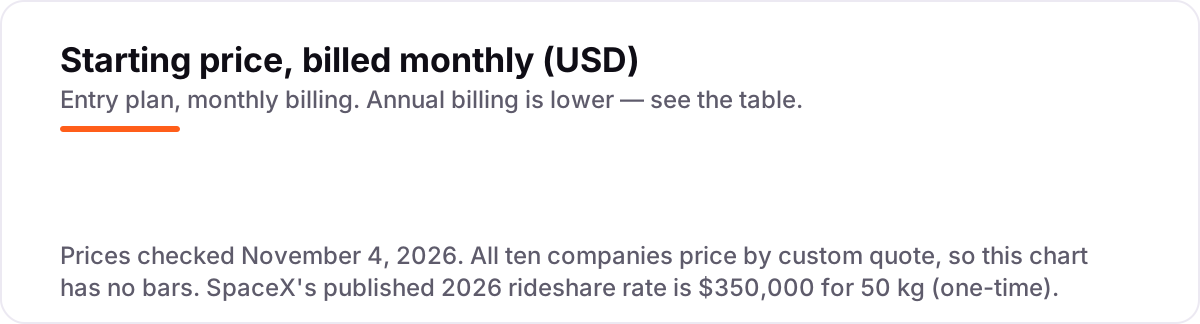
Aerospace company pricing: what you will actually pay
Take a government buying 12 F-35As. The flyaway cost is $92 million per aircraft in the latest production lots, according to the F-35 Joint Program Office, so 12 aircraft cost about $1.104 billion before anything else is added — and flyaway covers only the aircraft, engine and radar. Spares, training, support equipment and decades of sustainment sit on top, and the F-35A costs about $42,000 per flight hour to operate. The unit price is the smallest part of the program budget.
A satellite operator faces a simpler bill. A 50 kg smallsat rides a SpaceX Transporter mission for $350,000, and a 150 kg satellite costs about $1.05 million at the $7,000-per-kilogram rate. A dedicated Falcon 9 lists at $74 million in SpaceX's 2026 launch-services document, which is the price for buyers who need their own orbit and date. The rideshare is cheaper per kilogram by a wide margin, but it goes where SpaceX goes, when SpaceX goes.
Airlines pay the least transparent prices of all. Airbus last published an A320neo list price of $110.6 million in 2018, and industry estimates put the actual transaction price for a new A320neo at $50 million to $60 million in 2026, after discounts of 40% to 60% on large orders. Boeing's 737 MAX 8 carried a $121.6 million list price in 2019, and airlines pay well under that after negotiation. Neither company publishes a current price, so the only honest budget for an aircraft is a quote — and the quote depends on order size, configuration and delivery slot.
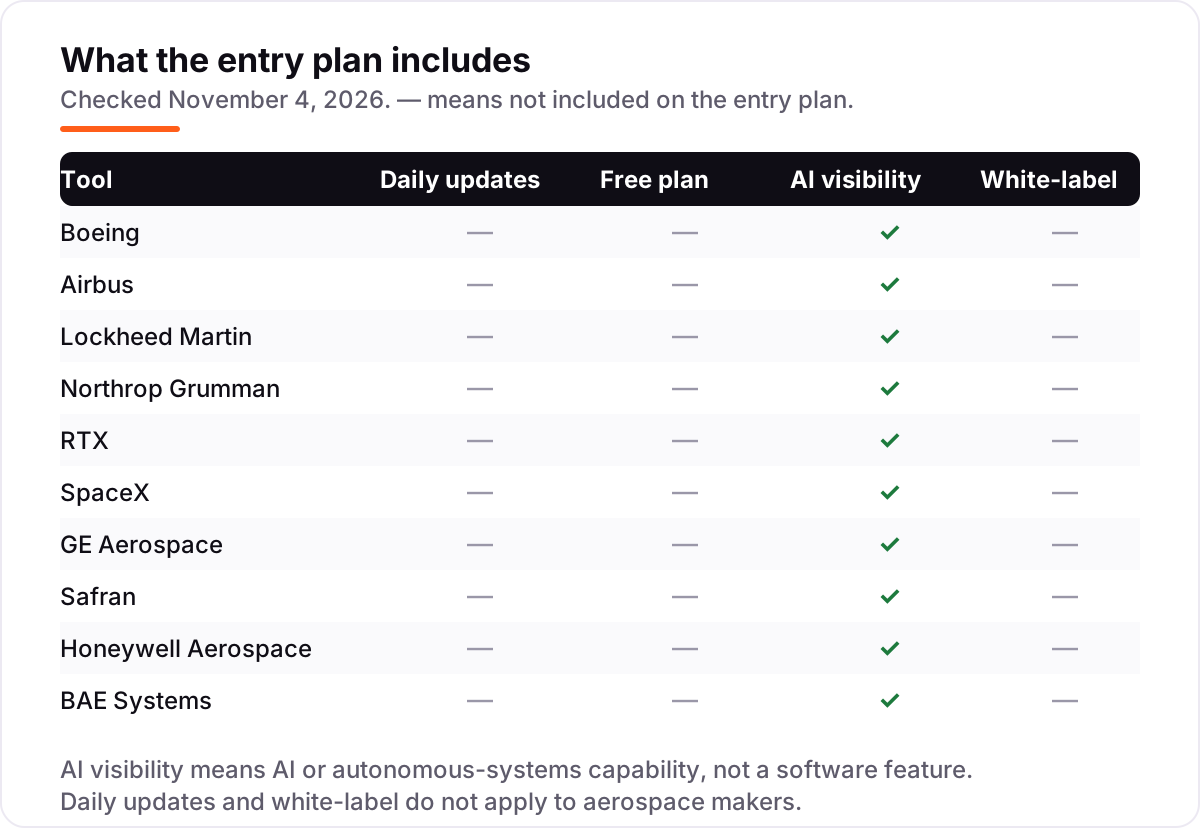
Know the difference: airframer, engine maker and prime contractor
The confusion in this category is between three kinds of company that all call themselves aerospace companies. An airframer — Boeing or Airbus — builds the aircraft itself: the fuselage, wings and systems integration. An engine maker — GE Aerospace, Safran or Pratt & Whitney — builds the powerplant, which is usually sold separately from the airframe. A prime contractor — Lockheed Martin, Northrop Grumman, RTX or BAE Systems — integrates a whole system for a government customer: aircraft, sensors, weapons and support, delivered as one program.
That distinction explains why the prices look so different. The old A320neo list price covered the airframe only, without engines, because the airline buys the engines from CFM or Pratt & Whitney under a separate deal. The F-35's $92 million flyaway cost includes the engine and radar, because the government buys the whole aircraft through the prime contractor. And a launch is neither: SpaceX sells the ride, not the satellite, so the $350,000 rideshare price buys a slot on a rocket, not a spacecraft.
A second confusion is between the manufacturer and the operator. Boeing builds the aircraft; the airline flies it. Lockheed Martin builds the fighter; the air force flies it. When a buyer says "we need an aerospace company," the first question is always which side of that line the job sits on — building, operating, maintaining or launching — because each side has different suppliers, different contracts and different prices.
Quick comparison: tool type by need
| Buyer | Best pick | Why |
|---|---|---|
| Airline buying single-aisle jets | Airbus | A320neo family, the most popular aircraft in production |
| Airline or government wanting one supplier | Boeing | Airliners, defense and space from one company |
| Government buying fighters | Lockheed Martin | F-35A at $92 million flyaway in the latest lots |
| Government buying stealth and space | Northrop Grumman | B-21 Raider and the James Webb Space Telescope |
| Satellite operator needing orbit | SpaceX | Rideshare from $350,000 for 50 kg, the only published price here |
| Airline buying engines | GE Aerospace | GE9X, GEnx and CFM LEAP across both airframers |
Mistakes to avoid
- Budgeting on list prices. Boeing and Airbus stopped publishing list prices in 2018–2019, and the old figures are ceilings, not prices. Airlines pay 40% to 60% less after negotiation, so budget on a quote, not a catalog.
- Comparing flyaway cost to total program cost. An F-35A at $92 million is the aircraft, engine and radar only. Spares, training, support equipment and decades of sustainment cost far more, and the aircraft costs about $42,000 per flight hour to fly.
- Ignoring the delivery slot. An A320neo order can wait years for a slot, and a defense program takes longer still. Lock the delivery date before finalizing the configuration, not after.
- Assuming rideshare means choosing your orbit. A SpaceX rideshare goes to sun-synchronous orbit on SpaceX's schedule, and industry reports say bookings are frozen beyond late 2028. A custom orbit or date needs a dedicated launch at $74 million.
- Forgetting export approvals. Fighters, missile defense and electronic warfare systems need US or UK government approval before sale, and approvals can take years or be refused. Confirm the approval path before budgeting the program.
How we chose
We checked each company's own website on November 4, 2026 and recorded the starting price exactly as shown — which, for nine of the ten, is no published price at all, only a custom quote. SpaceX is the one exception: its rideshare page, opened on November 4, 2026, describes the program and the booking flow but renders the price inside that flow, so the $350,000 figure for 50 kg is taken from SpaceX's published 2026 price list as reported by industry sources (SpaceNexus and New Space Economy), not read from the vendor's page text. The F-35A flyaway cost of $92 million comes from the F-35 Joint Program Office via Air & Space Forces Magazine, and the A320neo transaction estimates come from Simple Flying and Cirium. This list carries no review ratings: G2 and Capterra review software, not aerospace manufacturers, and the Trustpilot pages that exist rate the corporate website for consumers rather than the services a buyer hires, so we show no rating rather than a misleading one. We ranked the companies by fit for the most common buyer — an airline, a government or a satellite operator — not by brand size. No vendor paid for a place in this list, and none of the links here are affiliate links.
What to do next
Shortlist two or three companies by what you are buying — aircraft, engines, defense systems or a launch — and request quotes on the same basis: same configuration, same spares, same training and the same delivery slot. Check delivery slots and export approvals before you compare prices, and talk to a current operator of whatever you plan to buy. If the business is sorted but new customers are not finding you, our monthly SEO service handles the visibility side — or compare providers in our guide to SEO companies for small business. Once your tools are in place, find out what's holding your rankings back.
Your stack only works if people find you
SerpAstra fixes what keeps your site off page one and makes it easy for AI assistants to recommend.
Get a free audit→Sources we checked (16)
- Boeing — boeing.com (checked November 4, 2026)
- Airbus — airbus.com (checked November 4, 2026)
- Lockheed Martin — lockheedmartin.com (checked November 4, 2026)
- Northrop Grumman — northropgrumman.com (checked November 4, 2026)
- RTX — rtx.com (checked November 4, 2026)
- SpaceX rideshare — spacex.com/rideshare (checked November 4, 2026)
- GE Aerospace — geaerospace.com (checked November 4, 2026)
- Safran — safran-group.com (checked November 4, 2026)
- Honeywell Aerospace — aerospace.honeywell.com (checked November 4, 2026)
- BAE Systems — baesystems.com (checked November 4, 2026)
- What an F-35 costs right now — Air & Space Forces Magazine (September 3, 2026)
- How much the Airbus A320neo costs in 2026 — Simple Flying (March 20, 2026)
- How much does a rocket launch cost? — SpaceNexus (2026)
- SpaceX rideshare pricing as of February 2026 — New Space Economy
- Boeing plane costs: list prices, fleet and airline expenses — PilotPassion (October 15, 2026)
- SpaceX vs. Lockheed Martin: which aerospace stock is a better buy in 2026 — The Motley Fool (October 1, 2026)
Shamim
Founder of SerpAstra
A full-stack SEO and digital marketer who spends most days on Local SEO for dental practices, AI search visibility and lead generation.
Frequently asked questions
What is the best aerospace company?
Boeing is the best fit for most buyers: the widest range of aircraft, defense systems and space hardware from one supplier. Airbus leads for commercial jets, Lockheed Martin for fighters and missile defense, and SpaceX for the cheapest published ride to orbit. The right pick depends on what you are buying.
How much does it cost to hire an aerospace company?
There is no standard price: nine of the ten companies here quote per contract, and aircraft are negotiated with discounts of 40% to 60% off old list figures. The published exceptions are SpaceX rideshare from $350,000 for 50 kg, a dedicated Falcon 9 at $74 million, and an F-35A at $92 million flyaway.
Which aerospace company is best for commercial aircraft?
Airbus and Boeing are the only two makers of large commercial jets. Airbus leads on the single-aisle A320neo family, the most popular aircraft in production, while Boeing's 737 MAX and 787 cover the same market with a broader defense and space business behind them.
Can a small company buy a launch from SpaceX?
Yes, through the Smallsat Rideshare Program: $350,000 buys a 50 kg slot to sun-synchronous orbit, $7,000 per extra kilogram. The program has launched more than 1,800 payloads, but industry reports say bookings are frozen beyond late 2028, so a new customer may wait years for a slot.
What is the difference between an airframer, an engine maker and a prime contractor?
An airframer such as Boeing or Airbus builds the aircraft. An engine maker such as GE Aerospace or Safran builds the powerplant, usually sold separately. A prime contractor such as Lockheed Martin or Northrop Grumman integrates a whole system — aircraft, sensors and weapons — for a government customer.
Do aerospace companies publish prices?
Almost never. Boeing stopped publishing aircraft list prices in 2019 and Airbus in 2018, and defense and engine makers never published them. SpaceX is the exception, with a published rideshare rate. Everything else is a negotiated quote, so budget on the contract, not a catalog price.
How long does it take to buy an aircraft?
Years, usually. The A320neo order book stretches years ahead, so a new order waits a long time for a delivery slot, and defense programs take longer still: contracts run for years from signature to first delivery. Start the procurement process early and lock the delivery slot before finalizing the configuration.
Free SEO and AI visibility audit
Find out what is holding your rankings back
Send us your site. Within 2 business days you get a written audit, an AI visibility check and a short fix list ranked by impact. Free, with no contract attached.
Request my free audit→Related guides
 SEO & AI Search8 Best AI Visibility Companies (2026): Who to Hire and What It Costs8 best AI visibility companies compared on price, services and fit, with real published fees. Find the right AI visibility partner for your budget and timeline.Read guide →
 SEO & AI Search8 Best SEO Companies for Small Business in 20268 best SEO companies for small business compared on price, contracts and AI visibility, with prices checked on each agency's own site on November 1, 2026.Read guide →
 SEO & AI Search12 Best B2B SEO Companies (2026): Who to Hire and What It CostsThe 12 best b2b seo companies for mid-size B2B teams in 2026, compared on price, services and AI search. Only two publish prices — the rest quote custom.Read guide →