
7 Best AI Content Detectors for SEO in 2026: Top Picks Compared
7 best AI content detectors for SEO compared, with prices checked October 31, 2026. Find the right check for your workflow, from free scans to full-site audits.
 Shamim Mia, Founder, SerpAstraLast verified October 31, 202615 min read
We compare pricing pages, documentation and public reviews. We never accept payment for rankings.

Key takeaways
- Originality.ai is the best fit for most SEO teams: full-site scans plus AI, plagiarism, readability and fact checks from $14.95/month. GPTZero ($23.99/month) is the clearest for editor feedback, and Copyleaks ($16.99/month) leads on languages.
- Free checks are real: GPTZero covers 10,000 words a month free, ZeroGPT checks 15,000 characters per detection free, and QuillBot checks 1,200 words per scan free.
- The single most important buying factor is how you will act on a flag: a detector is a signal for human review, not proof of who wrote a passage.
- No detector here is 100% accurate, and every one of them can flag human writing. Run the same passage through two tools before you question a writer.
- Every price below was checked on the vendor's own pricing page on October 31, 2026. Ratings are G2, except Copyleaks (Capterra), with review counts shown.
On this page
Quick comparison
| Tool | Best for | Starting price | Free plan |
|---|---|---|---|
| Originality.ai | Publishers and content teams checking freelance and AI-assisted articles before publishing, who want AI, plagiarism, readability and fact checks in one scan | $12.95/mo (annual) | Yes (3 scans/day) |
| GPTZero | Content teams and editors who want sentence-level highlighting and a clear report they can share with a writer | $12.99/mo (annual) | Yes (10,000 words/mo) |
| Copyleaks | Teams publishing in several languages, or checking code and images as well as text | $13.99/mo (annual) | No (free scans only) |
| Winston AI | Small content teams that need shareable PDF reports and plagiarism checks in the same subscription | $10/mo (annual) | No (14-day trial) |
| ZeroGPT | Solo creators and small teams who want a free detector for quick checks and a low-cost paid plan | $8.99/mo (annual) | Yes (15,000 chars/check) |
| QuillBot | Writers already using QuillBot for paraphrasing and grammar who want detection in the same tab | $8.33/mo (annual) | Yes (1,200 words/scan) |
| Sapling | Developers and support teams who want to add detection to a product or check short messages at scale | $12/mo (annual) | Yes (2,000 chars/check) |
Make one of these tools?
We re-check this list every quarter. Send a correction, request a review, or ask about a clearly labeled sponsored spot.
Request a listingThe best ai content detectors for seo

Originality.ai
Best for: Publishers and content teams checking freelance and AI-assisted articles before publishing, who want AI, plagiarism, readability and fact checks in one scan
Originality.ai is the publisher's detector in this list. Pro costs $14.95 a month and covers 2,000 credits, which is about 200,000 words of AI-only scanning, plus plagiarism, readability and fact checks in the same report. The full-site scan is the feature that sets it apart for SEO work: paste a URL and check every page of a site in one job, which is how you audit a back catalogue or a batch of freelance submissions.
The credit system needs attention. Credits expire monthly, a combined AI and plagiarism scan costs double, and re-scanning after a small edit costs the full amount again. For a team checking a steady flow of articles, Pro is good value. For occasional checks, the free Basic plan covers three scans a day of up to 2,000 words each.
What we like
- Full-site scans check an entire website from a URL, useful for auditing a back catalogue
- One scan covers AI detection, plagiarism, readability and fact-checking
- Pro includes 2,000 credits a month, about 200,000 words of AI-only scanning
- Team management, scan tagging and a Chrome extension are included on Pro
Watch out for
- Subscription credits expire at the end of each month and do not roll over
- Re-scanning a piece after small edits costs the full credit amount again, per G2 reviewers
- A combined AI plus plagiarism scan costs 2 credits per 100 words, so it burns the allowance twice as fast as an AI-only scan

GPTZero
Best for: Content teams and editors who want sentence-level highlighting and a clear report they can share with a writer
GPTZero is the best-known detector, and its strength for SEO teams is clarity. Instead of one document score, it highlights individual sentences, so an editor can point a writer at the exact passage that needs a rewrite. The free plan covers 10,000 words a month, which is enough to check a few articles a week without paying. Premium adds plagiarism checking, writing feedback and downloadable reports.
The price is the honest drawback. Premium starts at $23.99 a month, and there is no cheaper paid tier listed on the pricing page. Batch scanning and API access sit on Professional at $45.99 a month. Buy GPTZero when you need to show a writer why a passage flagged, not when you only need a yes-or-no score.
What we like
- Sentence-level highlighting shows exactly which passages triggered a flag
- Free plan covers 10,000 words a month with no credit card required
- Writing Replay shows how a document was composed in supported editors
- Plagiarism checking and writing feedback are included on Premium
Watch out for
- The entry paid tier is Premium at $23.99/month; no cheaper paid tier is listed on the pricing page
- G2 reviewers report occasional false positives on polished human writing
- Batch scanning and API access need the Professional plan at $45.99/month

Copyleaks
Best for: Teams publishing in several languages, or checking code and images as well as text
Copyleaks is the multilingual pick. Its pricing page lists AI detection in more than 30 languages and plagiarism detection in more than 100, which no other tool here matches. One credit covers up to 250 words or one image, and the same pool pays for AI checks, plagiarism checks and image checks. Source-code checking and AI image detection are included, and the API and LMS integrations suit education and enterprise buyers.
The Personal plan is the catch. At $16.99 a month it covers only 100 credits, about 25,000 words, so a team checking dozens of articles a month will outgrow it fast. The next step is Pro at $99.99 a month. Copyleaks is the right buy for multilingual publishing; for English-only blogs, the cheaper tools cover the same job.
What we like
- Widest language coverage here: AI detection in 30+ languages, plagiarism detection in 100+ languages
- One credit pool covers AI detection, plagiarism and image checks (1 credit covers up to 250 words or one image)
- API and LMS integrations (Canvas, Moodle, Blackboard and others) for education and enterprise workflows
- AI image detection and source-code checking are included
Watch out for
- Personal covers only about 25,000 words a month, so heavy checking needs Pro at $99.99/month
- No permanent free plan, only a limited number of free scans
- Credit pricing makes monthly costs harder to predict than a flat word allowance

Winston AI
Best for: Small content teams that need shareable PDF reports and plagiarism checks in the same subscription
Winston AI is the reporting pick. Its sentence-level map shows which paragraphs pulled the score up, and the results export as shareable PDF reports that an editor can send to a writer or a client. Essential costs $18 a month for 100,000 credits, and every paid plan includes AI image and deepfake detection, OCR for scanned pages and handwriting, and writing feedback.
There is no permanent free plan, only a 14-day trial with 2,000 credits, so you cannot keep a free tier for occasional checks. Plagiarism checks cost twice as many credits as AI detection, which matters if you run both on every article. Winston suits a small team that reports results to others; solo checkers will get more from the free tiers elsewhere in this list.
What we like
- Sentence-level map plus shareable PDF reports, useful for giving feedback to writers
- OCR reads scanned pages and handwriting
- AI image and deepfake detection included on every paid plan
Watch out for
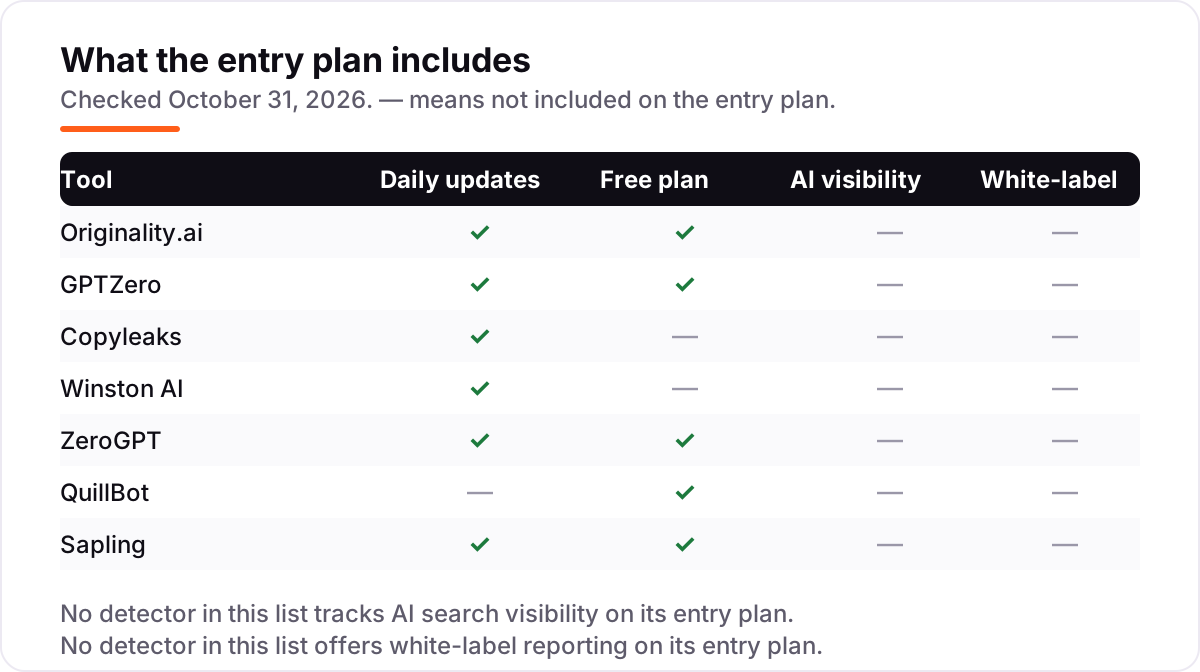
- No permanent free plan — only a 14-day trial with 2,000 credits
- Plagiarism checks cost 2 credits per word versus 1 for AI detection, so combined checks burn credits fast
- The pricing page showed a 50% promotional price at check time, so the checkout price may differ from the standard $18/month

ZeroGPT
Best for: Solo creators and small teams who want a free detector for quick checks and a low-cost paid plan
ZeroGPT is the budget pick. The free plan checks 15,000 characters per detection with no card, which covers a full blog post in one paste, and Pro costs $8.99 a month billed annually — the lowest annual entry price here. Pro adds 50 batch files and PDF reports, and the site bundles paraphrasing, summarizing, grammar and translation tools around the detector.
The limits show up on mixed text. G2 reviewers report inconsistent results on heavily edited or human-AI mixed passages, and the plagiarism allowance on Pro is small, so recurring plagiarism checks need Plus at $21.99 a month. ZeroGPT is a good first detector for a solo creator; a team that needs defensible reports should look at Winston AI or Originality.ai instead.
What we like
- Free plan checks 15,000 characters per detection with no credit card required
- Pro is $8.99/month billed annually, the lowest annual entry price in this list
- Batch file uploads (50 on Pro) and PDF reports are included on Pro
Watch out for
- Pro includes only a small one-time plagiarism allowance, so recurring plagiarism checks need Plus
- G2 reviewers report mixed results on heavily edited or mixed human-AI text
- The same site also sells an AI humanizer, which sits awkwardly next to a detector

QuillBot
Best for: Writers already using QuillBot for paraphrasing and grammar who want detection in the same tab
QuillBot is a writing suite first and a detector second, and that is both its appeal and its limit. The free detector checks up to 1,200 words per scan, up to six scans a day, and labels text as AI-generated, AI-refined or human-written — a useful split for drafts a person has edited. Premium adds unlimited detection, unlimited paraphrasing in nine modes, a plagiarism checker and a humanizer for $8.33 a month billed annually.
If you only need detection, QuillBot is the wrong buy: you pay for paraphrasing, grammar and summarising to get the full detector. QuillBot also warns plainly that its detector gives an estimate rather than certainty. It fits writers who already live in QuillBot; for detection alone, the dedicated tools above give more for less.
What we like
- Detector sits inside a full writing suite: paraphraser, grammar, plagiarism checker and humanizer in one subscription
- Free detector needs no payment and checks up to 1,200 words per scan
- Labels text as AI-generated, AI-refined or human-written, which helps with edited drafts
Watch out for
- Detection is not the main product — you pay for the whole writing suite to get full detector access
- QuillBot itself warns the detector gives an estimate, not certainty
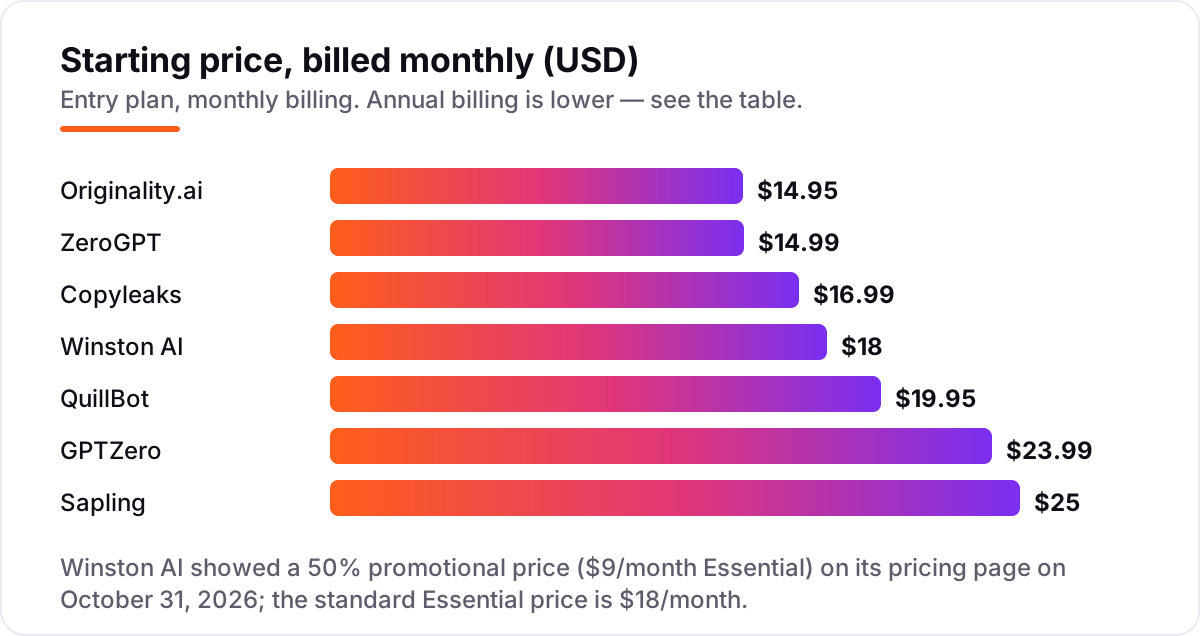
- Monthly billing ($19.95) costs more than double the annual equivalent ($8.33/month), so short subscriptions cost far more

Sapling
Best for: Developers and support teams who want to add detection to a product or check short messages at scale
Sapling is the developer's detector. Its API is priced per character from $0.005 per 1,000 characters, with a $5 one-time minimum, which is the cheapest way to check text at volume in this list. The web detector gives sentence-level highlighting with shareable result links, and Pro costs $25 a month for checks of up to 100,000 characters. It also works as a writing assistant, with grammar suggestions, autocomplete and CRM integrations for support teams.
For ordinary article checks, Sapling is the weakest fit here. Free checks cover only the first 2,000 characters, so a full article must be split into parts, and Pro is the highest entry price in the list. Buy Sapling when you are building detection into a product or checking thousands of short messages; for blog posts, start with Originality.ai or GPTZero.
What we like
- API is priced per character from $0.005 per 1,000 characters, the cheapest way to check at volume here
- Sentence-level highlighting with shareable result links
- Doubles as a writing assistant for support and sales teams, with browser extensions and CRM integrations
Watch out for
- Free checks cover only the first 2,000 characters, so full articles must be split into parts
- Pro at $25/month is the highest entry price in this list
- The detector is bundled with a writing assistant, so detection-only buyers pay for features they may not use
What an AI content detector actually does
An AI content detector estimates whether a passage of text resembles writing produced by a large language model. It compares the text against patterns the model learned from AI and human writing, then returns a score or a label such as AI-generated, AI-refined or human-written. The best AI content detectors for SEO are the ones that fit that job into a publishing workflow: checking drafts before they go live, giving a writer useful feedback, and keeping a record of the check.
That is all a detector does. It does not prove who wrote a passage, it does not judge whether the content is good, and it cannot tell you whether Google will rank it. A clean score on a thin, unhelpful article is still a thin, unhelpful article. The tools in this list are ranked by how well they serve an SEO team checking content before publishing, not by brand size or by who claims the highest accuracy.
One figure shows how widely these tools are used: GPTZero says it is trusted by over 10 million teachers and students and used in over 100 countries. That scale is why a detector result carries weight with writers and clients, and also why a wrong flag can do real damage. No detector is 100% accurate, and every tool in this list can flag human writing.
Most detectors give two kinds of result: a document score for the whole passage and sentence-level highlighting for the parts that look most AI-like. The sentence view is the more useful of the two for SEO work, because it tells you where to look instead of handing you a single number to argue about. Short passages are the weakest case for every detector: with only a few sentences to analyse, the model has little to work with, so a flag on a short product description means far less than a flag on a full article.
Free checks first
If you check a few articles a week, you may not need to pay at all. GPTZero covers 10,000 words a month free, ZeroGPT checks 15,000 characters per detection free, and QuillBot checks up to 1,200 words per scan free, up to six scans a day. Originality.ai allows three free scans a day of up to 2,000 words each, and Sapling checks the first 2,000 characters of any paste free.
The free tiers are honest products, not demos, but they cap out fast. A 2,000-word article is about 12,000 characters, so Sapling's free check covers only the opening of it, and QuillBot's free scan covers just over half. The moment you check a daily flow of articles, a paid plan is cheaper than the time you lose splitting text into pieces. For anything client-facing, skip the free tier: the reporting and batch features start on the paid plans.
For a single small blog, start with GPTZero's free plan and ZeroGPT's free checks side by side. If both agree a passage looks AI-written, it is worth a human read. If they disagree, that disagreement is itself the lesson: no single score settles the question.
What the free tiers do not give you is the workflow around the check. Batch uploads, downloadable reports, API access and team seats all sit on the paid plans, and so does any serious volume. A free check tells you about one passage; a paid plan lets you check a month of content, keep the results, and show them to the person who wrote it. That is the real difference, and it is worth paying for once checking becomes part of publishing rather than an occasional curiosity.
Dedicated detectors for publishers and SEO teams
Four tools in this list are dedicated detectors: Originality.ai, GPTZero, Copyleaks and Winston AI. They exist to check content, and their plans are built around that job. Originality.ai scans whole sites from a URL and bundles plagiarism, readability and fact checks into one report. GPTZero gives the clearest sentence-level feedback. Copyleaks covers the most languages and checks images and code too. Winston AI exports the results as shareable PDF reports.
The dedicated tools are the right camp when checking content is a regular part of publishing. They charge for the checking itself, so the price follows how much you check: credits, words or characters per month. The catch is that every one of them uses a different unit, so a straight price comparison misleads. A $14.95 plan that covers 200,000 words is cheaper per article than a $23.99 plan that covers 300,000 words only if you actually use the allowance.
Detectors inside a writing suite
Three tools in this list are detectors inside something bigger: QuillBot, Sapling and, to a lesser extent, ZeroGPT. QuillBot's detector sits beside a paraphraser, grammar checker, plagiarism checker and humanizer. Sapling's detector sits beside a writing assistant with autocomplete, snippets and CRM integrations. ZeroGPT wraps its detector in paraphrasing, summarizing, grammar and translation tools.
The suite camp makes sense when you already use the rest of the product. A writer who paraphrases in QuillBot every day gets detection in the same tab for no extra subscription. A support team that already uses Sapling for grammar gets detection as part of the same plan. The wrong reason to buy a suite is price alone: QuillBot Premium is $8.33 a month billed annually, but if you only want detection, a dedicated tool at $14.95 a month may still be the better buy, because you are not paying for features you will never open.
One warning applies to every suite detector. When detection is a side feature, it is not the product the vendor's reputation rests on. Check the detector's limits — words per scan, scans per day — rather than the suite's headline features. Our guide to how to write SEO content that ranks covers the editorial side of the same problem: detection is a check, not a content strategy.
AI visibility and what detectors do not do
A detector checks text. It does not check whether your brand shows up in AI answers, and none of the seven tools in this list tracks AI search visibility on its entry plan. That is a different product category, and it matters because the two questions get confused: a page can pass every detector and still never be cited by ChatGPT, and a page can be cited widely while flagging as AI-written.
If AI answers matter to your business, you need a separate tool for that job. Our list of the best AI SEO tools covers the tools that track AI visibility, and our guide to getting cited in ChatGPT explains what the AI engines actually quote. For the detection job itself, the right question is narrower: which tool gives you a result you can act on, at a price that fits how much you check?
The practical split is simple. Use a detector to check the text before you publish it, and use an AI visibility tool to check whether the published page gets cited afterwards. The two checks answer different questions, they run at different times, and no tool in this list does both. Buying a detector and expecting it to report on AI citations is the fastest way to be disappointed by a product that is doing exactly what it was built to do.
Quick comparison: tool type by need
| Buyer | Best pick | Why |
|---|---|---|
| Publisher checking freelance articles | Originality.ai | Full-site scans plus AI, plagiarism, readability and fact checks in one report |
| Editor who needs to show a writer why a passage flagged | GPTZero | Sentence-level highlighting and a free 10,000-word plan |
| Team publishing in several languages | Copyleaks | AI detection in 30+ languages, plagiarism in 100+ |
| Small team that needs shareable reports | Winston AI | PDF reports, OCR and plagiarism checks from $18/month |
| Solo creator on a tight budget | ZeroGPT | Free 15,000-character checks; Pro from $8.99/month billed annually |
| Writer already using a writing suite | QuillBot | Free detector plus paraphrasing and plagiarism checks in Premium |
| Developer adding detection to a product | Sapling | API from $0.005 per 1,000 characters |
How to choose the best AI content detectors for SEO: a short decision path
- Decide what you are checking. A batch of freelance articles needs full-site or batch scanning; a single draft needs only a free check. Originality.ai and GPTZero fit the first job, ZeroGPT and QuillBot fit the second.
- Run the same passage through two detectors. No detector is 100% accurate, and two tools disagree often enough that one score should never decide a writer's fate. Use the free tiers for this test before you pay.
- Check the unit you are paying for. Credits, words and characters are not the same thing. Work out what a month of your real checking costs in the vendor's unit: a 2,000-word article is 20 credits on Originality.ai, 8 credits on Copyleaks and about 12,000 characters on Sapling.
- Test the free tier on your real content. Paste your own published articles, not sample text. If the tool flags your human-written posts, it will flag your writers' posts too, and you need to know that before you build a workflow around it.
- Set a rule for flagged content before you buy. A flag should trigger a human read and a conversation with the writer, not an automatic rejection. If your team cannot agree on that rule, no detector will fix the workflow.
Before you publish the pages you check, run your titles through the free SERP snippet preview tool — it shows exactly how the title and description will look in Google. And if you want the checking to sit inside a wider review of your site, our AI search optimization service covers content quality as part of how your pages show up in AI answers.
Mistakes to avoid
- Treating a score as proof. A detector estimates likelihood; it cannot prove who wrote a passage. Never reject work or accuse a writer on one score alone.
- Paying for a suite when you only need checks. A $19.95 writing suite is a poor detector if you never open the paraphraser. A dedicated detector at $14.95 may cost less for the job you actually do.
- Comparing monthly prices without checking billing. Annual billing cuts most of these prices by 40% or more — GPTZero Premium drops from $23.99 to $12.99 a month, and Sapling Pro from $25 to $12.
- Ignoring credit math. A combined AI and plagiarism scan costs double credits on Originality.ai and Winston AI. If you run both checks on every article, budget for twice the allowance.
- Checking only long passages. Short text is where detectors are least reliable. A flagged paragraph in a 300-word product description is weaker evidence than a flagged section in a 2,000-word article.
How we chose
We checked each vendor's own pricing page on October 31, 2026 and recorded the starting price exactly as shown, including the annual-billing figure where the page lists one. Ratings come from G2, except Copyleaks, where G2 lists the product under its AI Image Detector profile — so we used its Capterra rating instead. We ranked the tools by fit for the most common buyer for this post — an SEO team or publisher checking content before it goes live — not by brand size. No vendor paid for a place in this list, and none of the links here are affiliate links.
What to do next
Start with the decision path above: decide what you are checking, run the same passage through two free tiers, and work out what a month of your real checking costs in each vendor's unit. Then take the free plan or trial of your top pick and run your own published articles through it — if it flags your human-written posts, you have learned something important before spending anything. If you'd rather have this set up and read for you, request a free SEO + AI visibility audit and get a ranked fix list in 2 business days.
Rather not run the tools yourself?
Tools show you the data. SerpAstra turns it into higher rankings, more map-pack calls and citations in AI answers.
Get a free SEO + AI visibility audit→Sources we checked (14)
- Originality.ai pricing — originality.ai/pricing (checked October 31, 2026)
- Originality.ai on G2 — 4.4/5, 253 reviews (checked October 31, 2026)
- GPTZero pricing — gptzero.me/pricing (checked October 31, 2026)
- GPTZero on G2 — 4.3/5, 101 reviews (checked October 31, 2026)
- Copyleaks pricing — copyleaks.com/pricing (checked October 31, 2026)
- Copyleaks on Capterra — 4.4/5, 91 reviews (checked October 31, 2026)
- Winston AI pricing — gowinston.ai/pricing (checked October 31, 2026)
- Winston AI on G2 — 4.4/5, 13 reviews (checked October 31, 2026)
- ZeroGPT pricing — zerogpt.com/pricing (checked October 31, 2026)
- ZeroGPT on G2 — 4.1/5, 50 reviews (checked October 31, 2026)
- QuillBot pricing — quillbot.com/premium (checked October 31, 2026)
- QuillBot on G2 — 4.4/5, 80 reviews (checked October 31, 2026)
- Sapling pricing — sapling.ai/pricing (checked October 31, 2026)
- Sapling on G2 — 4.2/5, 14 reviews (checked October 31, 2026)
Shamim
Founder of SerpAstra
A full-stack SEO and digital marketer who spends most days on Local SEO for dental practices, AI search visibility and lead generation.
Frequently asked questions
What is the best AI content detector for SEO in 2026?
Originality.ai is the best fit for most SEO teams: full-site scans plus AI, plagiarism, readability and fact checks from $14.95/month. GPTZero is better when you need to show a writer exactly which sentences flagged, and Copyleaks wins for multilingual publishing. All three have free or low-cost ways to try them first.
Can AI content detectors prove text was written by AI?
No. A detector estimates how likely a passage resembles AI-generated writing; it cannot prove who wrote it. Scores change as models are updated, and heavily edited or paraphrased AI text can pass while polished human writing can flag. Treat every result as a signal for human review, never as a verdict on a writer.
How much does an AI content detector cost?
Between $14.95 and $25 a month at the entry level, billed monthly. Originality.ai Pro is $14.95, Copyleaks Personal is $16.99, Winston AI Essential is $18, QuillBot Premium is $19.95, GPTZero Premium is $23.99 and Sapling Pro is $25. Annual billing cuts most of these by 40% or more.
Is there a free AI content detector?
Yes, with limits. GPTZero covers 10,000 words a month free, ZeroGPT checks 15,000 characters per detection free, QuillBot checks 1,200 words per scan free, and Originality.ai allows three free scans a day. Free tiers work for occasional checks; regular publishing needs a paid plan.
Why do AI detectors flag human writing?
Detectors look for statistical patterns common in AI text, such as predictable word choice and even sentence structure. Polished, formal or highly structured human writing can match those patterns, which is why false positives happen. Short passages are the worst: with little text to analyse, the model has less to work with.
Originality.ai or GPTZero: which is better for SEO?
Originality.ai fits SEO publishing better: it scans whole sites from a URL and bundles plagiarism, readability and fact checks with AI detection. GPTZero fits editorial feedback better, with sentence-level highlighting and Writing Replay. If you check freelance articles at volume, pick Originality.ai; if you coach writers, pick GPTZero.
Do I need a detector if I already use a plagiarism checker?
Yes, because they measure different things. A plagiarism checker finds copied text; a detector estimates whether text was AI-generated, even when it is original. Several tools in this list bundle both in one scan — Originality.ai, Copyleaks and Winston AI — so you may not need two subscriptions.
Free SEO and AI visibility audit
Find out what is holding your rankings back
Send us your site. Within 2 business days you get a written audit, an AI visibility check and a short fix list ranked by impact. Free, with no contract attached.
Request my free audit→Related guides
 AI SearchBest AI SEO tools in 2026: honest picks by jobBest AI SEO tools in 2026, picked by job: Semrush and Ahrefs for research, Surfer and Clearscope for content, Otterly for AI tracking, with 2026 prices.Read guide →
 ContentHow to write SEO content that ranks (and reads like a human wrote it)How to write SEO content that ranks: match search intent, structure before sentences, write like a person, and use AI honestly. A practical guide for 2026.Read guide →
 AI SearchHow to get your brand cited in ChatGPT and AI searchA practical guide to earning citations in ChatGPT, Perplexity and Google AI Overviews: crawler access, Bing indexing, answer-first pages and brand signals.Read guide →