
11 Best AI Lead Generation Software in 2026, Compared
Compare the 11 best ai lead generation software tools for small sales teams on price, free plans and AI features, with every price checked November 12, 2026.
 Shamim Mia, Founder, SerpAstraLast verified November 12, 202613 min read
We compare pricing pages, documentation and public reviews. We never accept payment for rankings.

Key takeaways
- Apollo leads for most small teams: a 210M+ contact database plus sequencing from $49/user/month billed annually, with a free plan to start.
- The single most important buying factor is the pricing unit: per-seat, per-credit, per-contact and flat-fee plans turn the same team into very different bills.
- Seven of the 11 tools start free — Apollo, Lusha, Snov.io, HubSpot, Clay, Seamless.AI and ZoomInfo Lite — but credits and sending caps decide whether free is usable.
- Every price below was checked on November 12, 2026 against the vendor's pricing page or, where the vendor publishes no prices, against independent reads of that page. Ratings are G2, with review counts shown.
On this page
Quick comparison
| Tool | Best for | Starting price | Free plan |
|---|---|---|---|
| Apollo | Small sales teams that want contact data plus sequencing in one subscription | $65/user/mo | Yes (75 credits/mo) |
| Instantly | Small teams and agencies sending high-volume cold email from many inboxes | $47/mo | No (14-day trial) |
| Snov.io | Solo founders and small teams that want finding, verifying and sending in one tool | $39/mo | Yes (50 credits/mo) |
| Lemlist | Email-first teams that want flat pricing for unlimited users and senders | $69/mo | Yes (no sending) |
| Lusha | Reps who find leads on LinkedIn and need verified emails and phones fast | $49.90/mo | Yes (40 credits/mo) |
| Smartlead | Agencies and teams running many mailboxes that want unlimited warmup included | $39/mo | No (14-day trial) |
| Woodpecker | Small teams that care most about inbox placement and clean deliverability | $35/mo | No (7-day trial) |
| HubSpot Sales Hub | Teams already running HubSpot CRM that want AI prospecting inside it | $20/seat/mo | Yes (free CRM) |
| Clay | Growth and RevOps teams building enriched lead lists from many data sources | $185/mo | Yes (free plan) |
| Seamless.AI | Reps who want real-time contact search from a Chrome extension | ~$147/user/mo | Yes (50 credits) |
| ZoomInfo | Mid-market and enterprise teams buying intent data at scale | Custom quote | Yes (Lite, 10 credits) |
Make one of these tools?
We re-check this list every quarter. Send a correction, request a review, or ask about a clearly labeled sponsored spot.
Request a listingThe best ai lead generation software

Apollo
Best for: Small sales teams that want contact data plus sequencing in one subscription
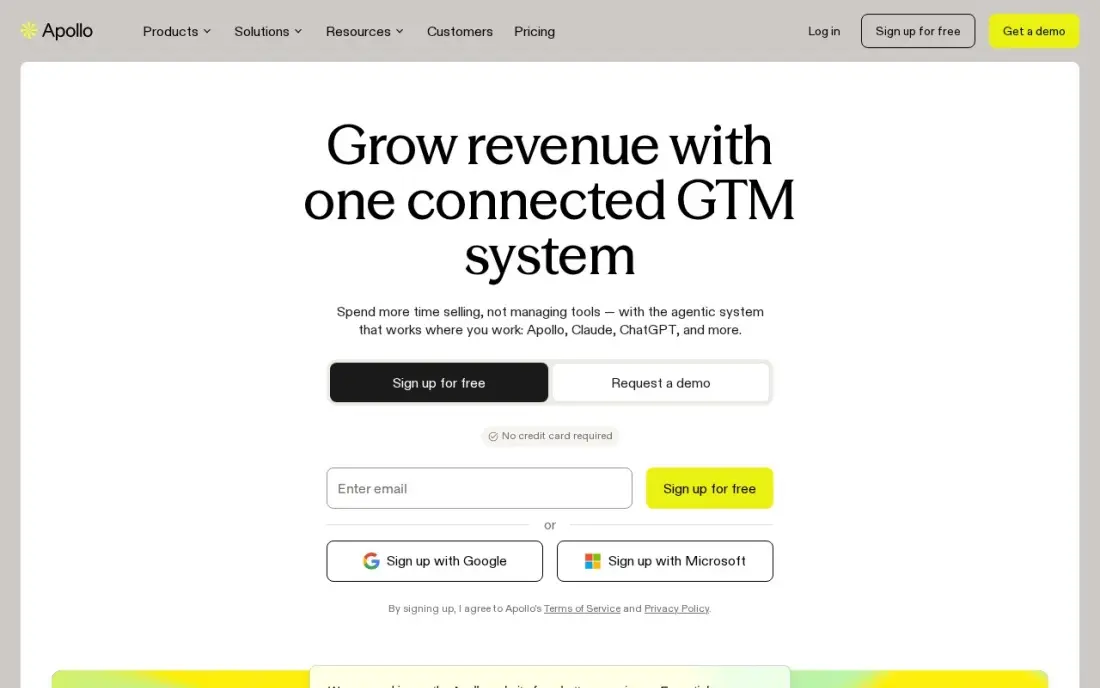
Apollo is the all-in-one in this list: a contact database of more than 210 million people sits next to email sequences, a dialer and CRM integrations, so a small team can find a lead, enrich it and email it without a second subscription. Basic costs $65 a user a month, or $49 billed annually, and includes 30,000 credits a year with unlimited email sequences.
The catch is the credit meter. Every email reveal costs 1 credit and every phone number costs 8, credits expire at the end of each billing cycle, and the dialer waits for Professional at $79 a user a month. If your team mostly needs emails and sends from a few inboxes, Apollo is the simplest buy here; if you need phones at volume, price the credits before you commit.
What we like
- A 210M+ contact database and sequencing in one login, so one subscription covers finding and sending
- Basic includes 30,000 credits a year with unlimited email sequences and CRM integrations
- Free plan with 75 credits a month lets a small team test data quality before paying
- Per-seat pricing is predictable: every seat on the account is on the same plan
Watch out for
- Credits expire at the end of each billing cycle and do not roll over
- A phone number costs 8 credits, so mobile-heavy prospecting burns the allowance fast
- The built-in dialer starts on Professional at $79/user/month billed annually, not Basic

Instantly
Best for: Small teams and agencies sending high-volume cold email from many inboxes
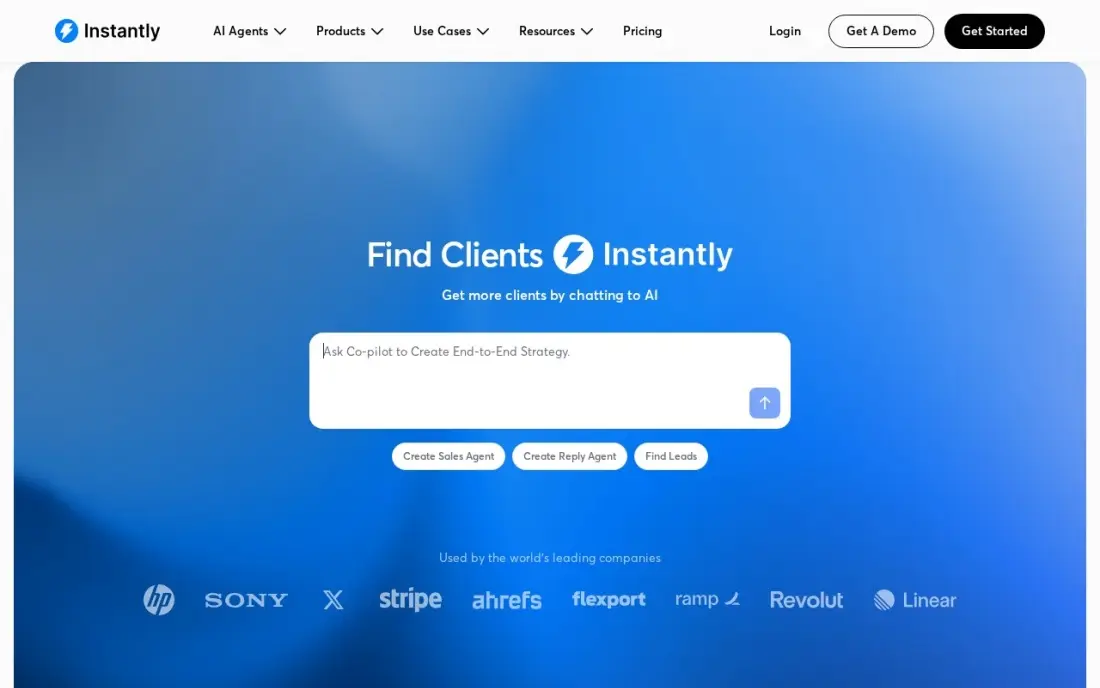
Instantly is the sender in this list: connect as many email accounts as you like, warm them all up, and send from one flat $47-a-month Growth plan with no per-seat charge. That shape suits agencies and small teams running many inboxes, because adding a rep or a domain never raises the bill — only the sending volume does.
What it does not do is find leads. Contact data is a separate Credits subscription from $47 a month, so a team that needs both sending and data pays $94 before domains and mailboxes. Growth also caps at 5,000 emails a month. Buy Instantly when you already have a list; pair it with Snov.io or Apollo when you do not.
What we like
- Flat $47 a month covers unlimited email accounts and warmup, with no per-seat charge
- Growth includes 5,000 emails a month and 1,000 uploaded contacts
- Unlimited warmup on every plan protects sender reputation from day one
- Highest G2 score in this list at 4.8 out of 5, with 91% of reviewers giving five stars
Watch out for
- Lead data is a separate Credits subscription from $47 a month — sending alone does not find leads
- Growth caps at 5,000 emails a month, so volume teams step up to Hypergrowth at $97 a month
- All fees are non-refundable and non-cancellable once a billing period starts

Snov.io
Best for: Solo founders and small teams that want finding, verifying and sending in one tool
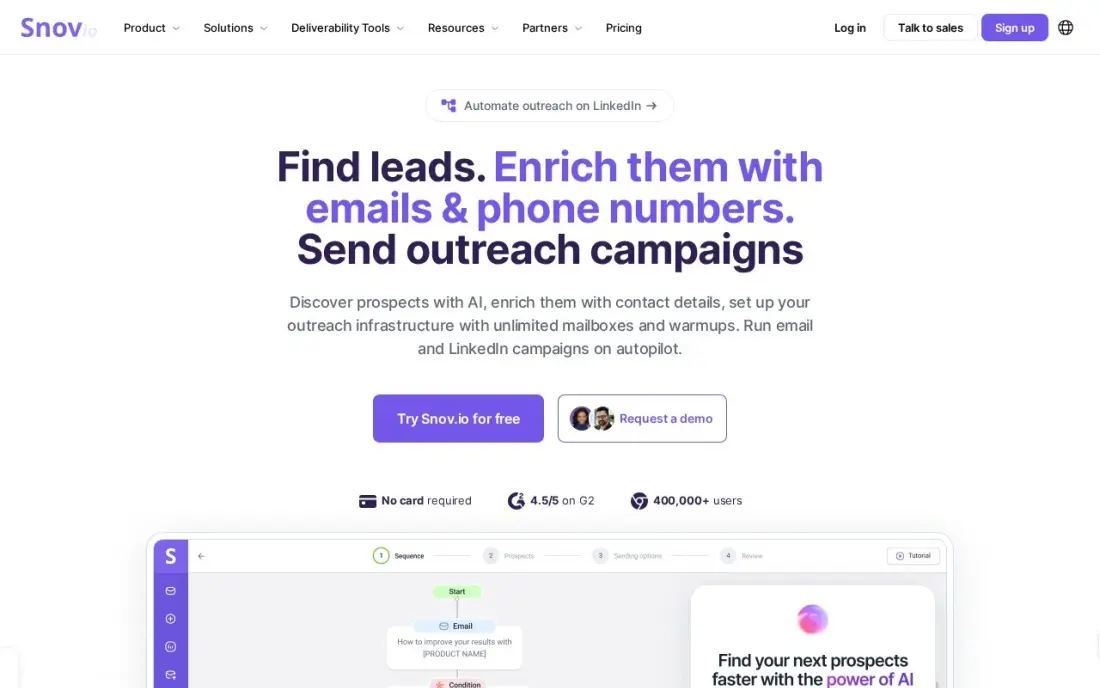
Snov.io is the cheapest all-in-one here: email finder, verifier, drip campaigns and a small CRM for $39 a month, or $29.25 billed annually. Starter includes 1,000 credits and 5,000 campaign recipients a month, and seats are unlimited, so a three-person team pays the same as a solo founder.
The shared credit pool is the thing to count. Finding an email costs 1 credit and verifying it costs another, so 1,000 credits yield about 500 verified contacts, and LinkedIn automation is a separate $69-per-account add-on. For a solo founder sending under 1,000 emails a month, it is the best value in this list; for larger volumes, Apollo's bigger allowance wins.
What we like
- Finder, verifier, drip campaigns and a lightweight CRM in one $39 plan
- Starter includes 1,000 credits and 5,000 campaign recipients a month, with unlimited seats
- Free Trial renews monthly with 50 credits, so solo users can keep prospecting at $0
- Annual billing cuts every plan by 25%, taking Starter to $29.25 a month
Watch out for
- Finding an email costs 1 credit and verifying it costs another, so a verified contact costs 2 credits
- LinkedIn automation is a separate $69-per-account add-on, not in any plan
- Email tracking issues are the top G2 complaint cluster, with 39 mentions

Lemlist
Best for: Email-first teams that want flat pricing for unlimited users and senders
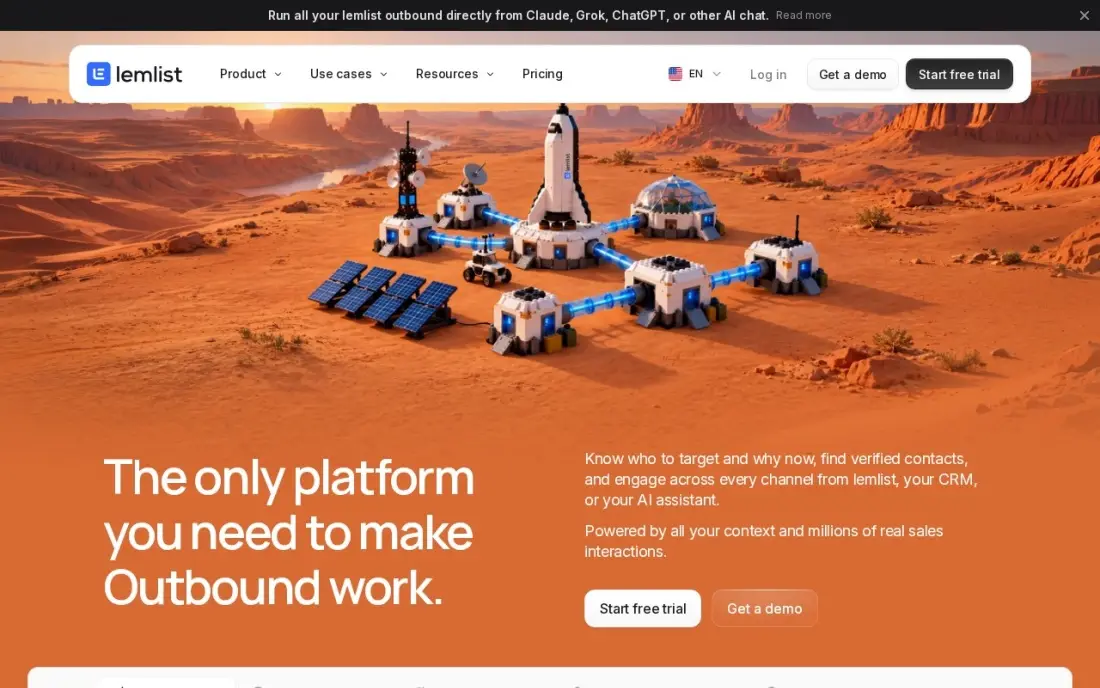
Lemlist prices by volume, not by people: the Email plan is a flat $69 a month for unlimited users and senders, covering 50,000 emails a month with warmup, a 650M+ lead database and lemAgent AI agents included. A five-person team pays the same as a solo founder, which is rare in this category.
The flat price has a hole: no data credits are included, so finding emails costs $20 a month extra for 2,000 credits, and LinkedIn automation needs Multichannel at $109 per user a month. Lemlist is the best buy for an email-first team with a list already in hand; teams that need LinkedIn steps should price Multichannel per seat first.
What we like
- Email plan is a flat $69 a month for unlimited users and senders, priced by volume instead of seats
- 50,000 emails a month on the entry plan, with warmup and a 650M+ lead database included
- lemAgent AI agents and MCP access come with the Email plan
- Multichannel adds LinkedIn, SMS and a dialer in the same sequence builder
Watch out for
- No data credits are included on Email — finding emails is a $20-a-month add-on for 2,000 credits
- LinkedIn automation needs Multichannel at $109 per user a month
- The Freemium plan cannot send campaigns, so the only way to test sending is the 14-day trial

Lusha
Best for: Reps who find leads on LinkedIn and need verified emails and phones fast
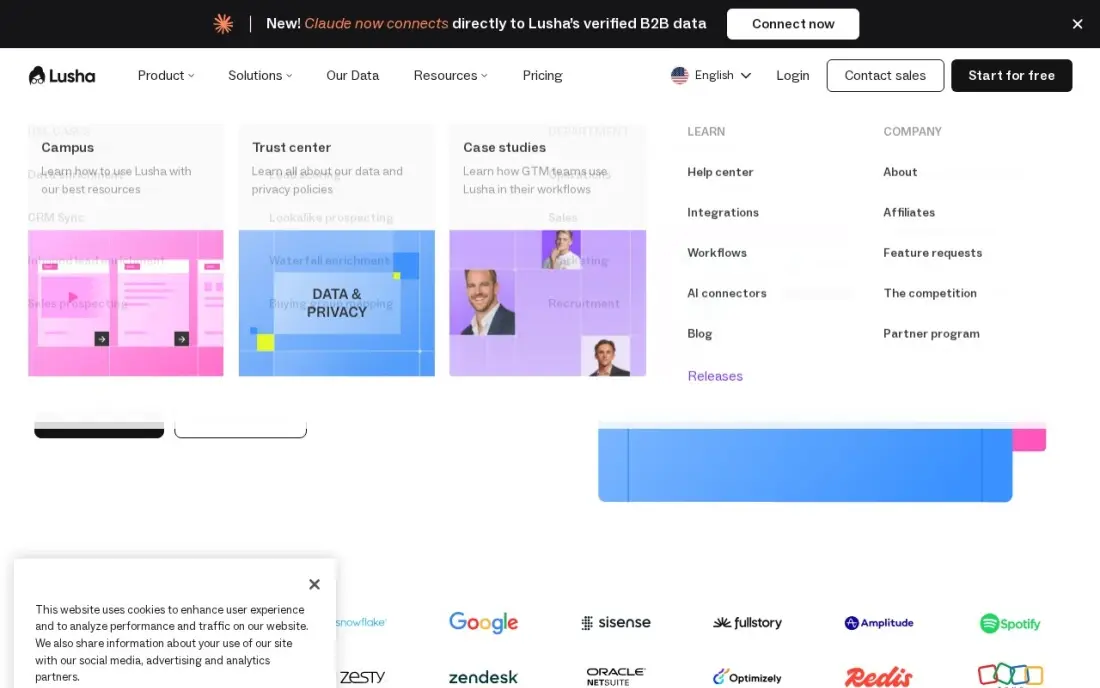
Lusha is the fastest lookup in this list: open a LinkedIn profile or a company site, click the Chrome extension, and a verified email or phone appears in seconds. The free plan gives 40 credits a month forever, and Starter at $49.90 a month, or $37.45 billed annually, adds 400 credits a month plus an AI assistant and lookalike audiences.
It is a single-seat tool at heart. Starter covers one user, so three reps need three plans, and a phone number costs 5 credits — 400 credits cover only 80 phones a month. Data accuracy is also the top G2 complaint. Buy Lusha when one rep needs quick lookups; buy Apollo when the whole team needs the same data.
What we like
- Free plan gives 40 credits a month forever, and Starter adds an AI assistant and lookalikes
- Chrome extension reveals verified emails and phones on LinkedIn, Gmail and company sites
- 1 credit per email and 5 per phone keeps the cost of each contact visible
- Prices are published and monthly plans cancel at month-end, with no annual lock-in
Watch out for
- Starter covers 1 user only, so a team of three pays for three Starter plans
- Data accuracy is the top G2 complaint: outdated or missing contacts lead the cons
- Phone reveals cost 5 credits each, so 400 monthly credits cover only 80 phone numbers

Smartlead
Best for: Agencies and teams running many mailboxes that want unlimited warmup included
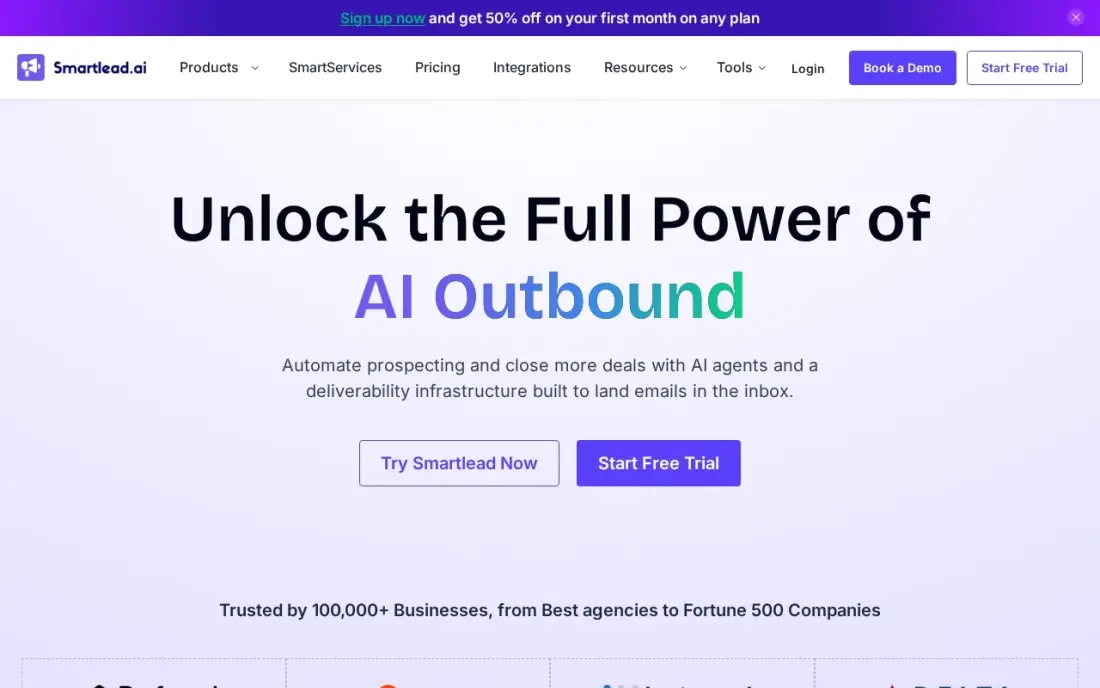
Smartlead is built for teams that send from many mailboxes: unlimited email accounts and unlimited warmup come with every plan, including Base at $39 a month, or $32.50 billed annually. Replies from all of them land in one master inbox, and pricing is by contacts stored, not by seats, so adding inboxes never raises the bill.
The limits sit on the contact count and the integrations. Base stores 2,000 contacts — one SDR adding 500 leads a week outgrows it in a month — and API access and CRM integrations wait for Pro at $94 a month. Smartlead suits an agency juggling client inboxes; a team that needs CRM sync from day one should look at Apollo or HubSpot instead.
What we like
- Unlimited email accounts and unlimited warmup on every plan, including Base
- Base covers 2,000 contacts and 6,000 emails a month for $39, with no per-seat charge
- A unified master inbox collects replies from every mailbox in one place
- AI warmup and reply classification come with every plan
Watch out for
- API access and CRM integrations start on Pro at $94 a month, not Base
- The 2,000-contact cap on Base fills fast — one SDR adding 500 leads a week outgrows it in a month
- White-label client workspaces cost $29 each a month on Pro and above

Woodpecker
Best for: Small teams that care most about inbox placement and clean deliverability
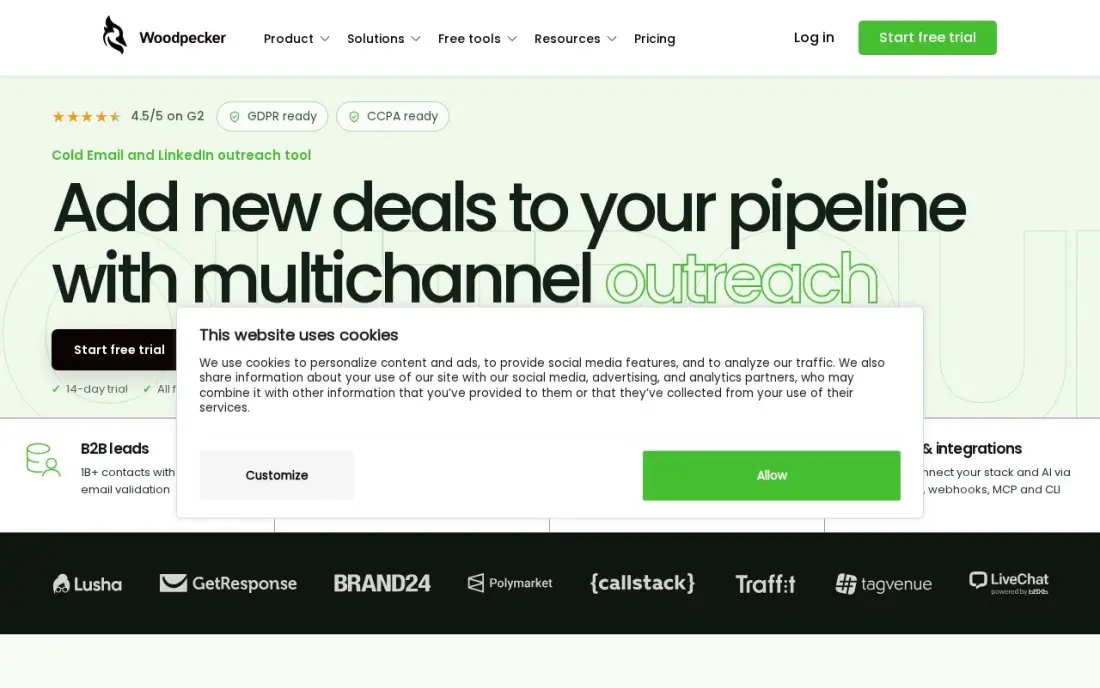
Woodpecker is the deliverability pick: free warmup, inbox rotation and adaptive sending come with every plan, and pricing is per contacted prospect rather than per seat, so unlimited team members and email accounts cost nothing extra. Starter is $35 a month, or $24 billed annually, for 500 contacted prospects and 6,000 emails.
It sends email and nothing else. There is no prospect database, no native AI drafting and no LinkedIn automation in the base plan — that is a $29-a-month add-on per account. Woodpecker is the right buy when the list is already clean and the inbox is the risk; when you still need to find the leads, pair it with Lusha or Snov.io.
What we like
- Deliverability-first: free warmup, inbox rotation and adaptive sending on every plan
- Priced per contacted prospect, not per seat — unlimited team members and email accounts
- Starter covers 500 contacted prospects and 6,000 emails a month for $35
- G2 reviewers praise setup speed and support response time most
Watch out for
- No built-in prospect database — you bring your own contact lists
- No native AI drafting tools, unlike newer sequencers
- LinkedIn automation is a $29-a-month add-on per connected account

HubSpot Sales Hub
Best for: Teams already running HubSpot CRM that want AI prospecting inside it
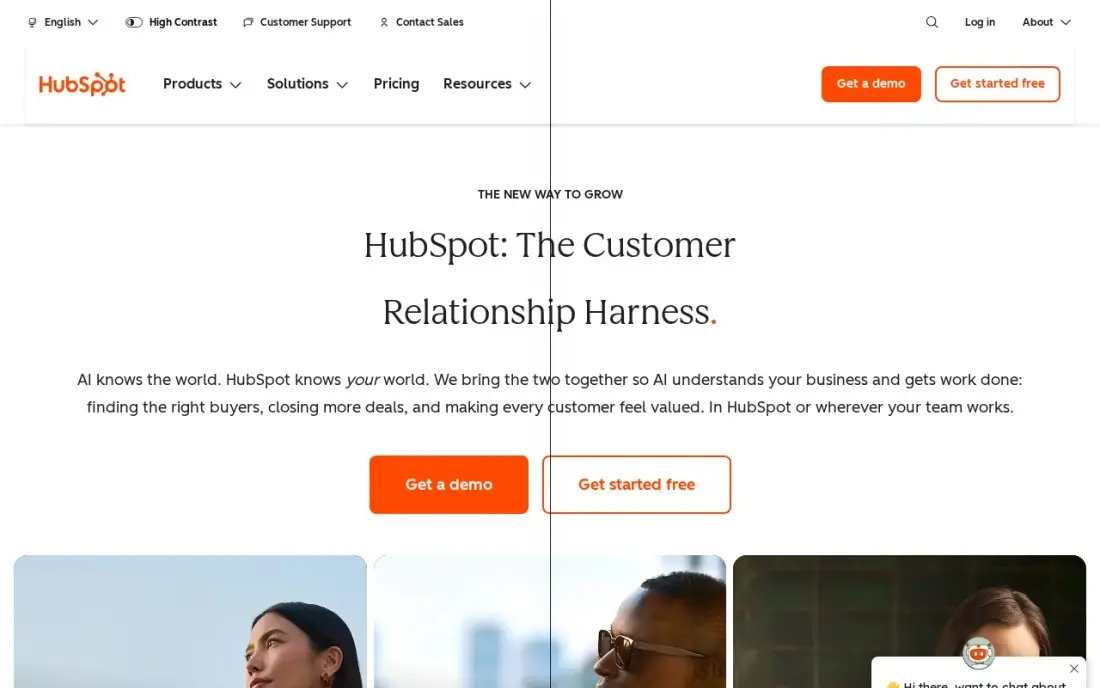
HubSpot Sales Hub is the CRM-native option: the free CRM covers two users, and Starter at $20 a seat a month adds a second pipeline, 500 HubSpot Credits a month and the Prospecting Agent, which researches accounts and drafts outreach inside the CRM your team already uses. Nothing needs to be synced anywhere, because the leads, deals and emails live in one place.
The price to watch is the list price, not the promotion. New customers see $7 a seat a month billed annually, but the standing rate is $20, and Professional jumps to $90 a seat plus a $1,500 onboarding fee. HubSpot is the right pick for a team already on HubSpot; a team buying lead generation alone will get more data per dollar from Apollo or Lusha.
What we like
- Free CRM for up to 2 users, and Starter removes HubSpot branding and adds a second pipeline
- Prospecting Agent and Breeze AI agents are included from Starter
- 500 HubSpot Credits a month and 50 workflows come with Starter
- Deepest native CRM in this list: deals, sequences and reporting in one place
Watch out for
- Starter is $20 a seat a month at list — the $7 figure is a new-customer promotion only
- Professional jumps to $90 a seat plus a mandatory $1,500 onboarding fee
- Per-seat pricing scales fast: ten seats on Starter cost $2,400 a year at list

Clay
Best for: Growth and RevOps teams building enriched lead lists from many data sources
Clay is a data workshop, not a sender: build a table, filter by 300+ attributes, then run waterfall enrichment across 150+ data providers until each lead is complete, with Claygent AI writing the research and the messages. Launch costs $185 a month, or $167 billed annually, for 2,500 Data Credits and 15,000 Actions a month, and seats are unlimited.
It is the most powerful tool here and the hardest to learn. One G2 reviewer spent five to six hours building a single workflow, and the dual credit system — Data Credits plus Actions — takes a week to understand. Clay suits a RevOps team that builds lists all day; a small team that just needs emails and phones will move faster on Apollo or Lusha.
What we like
- 150+ data providers and 300+ filter attributes in one spreadsheet-style workspace
- Launch includes 2,500 Data Credits and 15,000 Actions a month, with Claygent AI
- Free plan with 100 credits a month, and all paid plans include unlimited seats
- Waterfall enrichment pulls from several providers until it finds a match
Watch out for
- Launch at $185 a month is the priciest entry here, and credits run out fast on big lists
- The learning curve is the top G2 complaint — one reviewer spent 5–6 hours building a single workflow
- API access sits on the $495-a-month Growth plan, not Launch

Seamless.AI
Best for: Reps who want real-time contact search from a Chrome extension
Seamless.AI is a real-time contact search engine with a Chrome extension: search 1.7 billion contacts, pull emails and direct dials off LinkedIn and company sites, and push them to the CRM. The free plan gives 50 lifetime credits, and the Basic plan is reported at about $147 a user a month billed annually, with roughly 250 credits a month.
The price is the problem, because Seamless.AI publishes none of it. The $147 figure comes from buyer reports and in-app pricing, not a public rate card, and contracts auto-renew unless you cancel 60 days before renewal. It is a capable finder with a billing model to read carefully; Apollo gives you a published price and a sequencer for less.
What we like
- Real-time search across 1.7B+ contacts with a Chrome extension for LinkedIn and company sites
- Free plan with 50 lifetime credits and no card required to start
- 4.4 out of 5 on G2 from more than 5,400 reviews
- Basic includes about 250 credits a month for email and phone reveals
Watch out for
- No published prices — the ~$147 Basic figure comes from buyer reports, not a rate card
- Annual contracts auto-renew unless you give 60 days' cancellation notice
- Trustpilot sits at 1.4 out of 5, with billing and cancellation complaints the recurring theme

ZoomInfo
Best for: Mid-market and enterprise teams buying intent data at scale
ZoomInfo is the enterprise database in this list: verified contact and company data plus intent signals that flag which accounts are actively researching a purchase, all inside a workspace that ties CRM data, engagement history and buying signals together. Buyer reports put the entry Professional plan at about $14,995 a year for three seats and 5,000 credits, with extra seats at $1,500 to $2,500 a year each.
There is no published price, no monthly billing and no self-serve checkout — every contract is negotiated with sales and runs a year, and most teams end up paying $30,000 to $60,000 a year all-in. ZoomInfo Lite is free at 10 credits a month for the occasional lookup. Buy it when intent data decides the quarter; below that scale, Apollo covers the same ground for a tenth of the price.
What we like
- Extensive verified contact and company data with intent signals and buying triggers
- Chrome extension and deep Salesforce and HubSpot integrations
- 4.5 out of 5 on G2 from more than 9,100 reviews
- ZoomInfo Lite is free at 10 credits a month for occasional lookups
Watch out for
- Quote-only pricing with annual contracts — buyer reports put Professional at ~$14,995 a year
- No monthly billing and no self-serve checkout; every deal runs through sales
- Most teams pay $30,000–$60,000 a year all-in once seats and add-ons are counted
The best ai lead generation software finds the right people, verifies their contact details and gets your first message into their inbox — and the right one depends on whether you need data, sending or both. The 11 tools below are ranked by fit for the most common buyer, a small US sales team of one to five people doing outbound, and every price was checked on November 12, 2026.
How to choose the best ai lead generation software
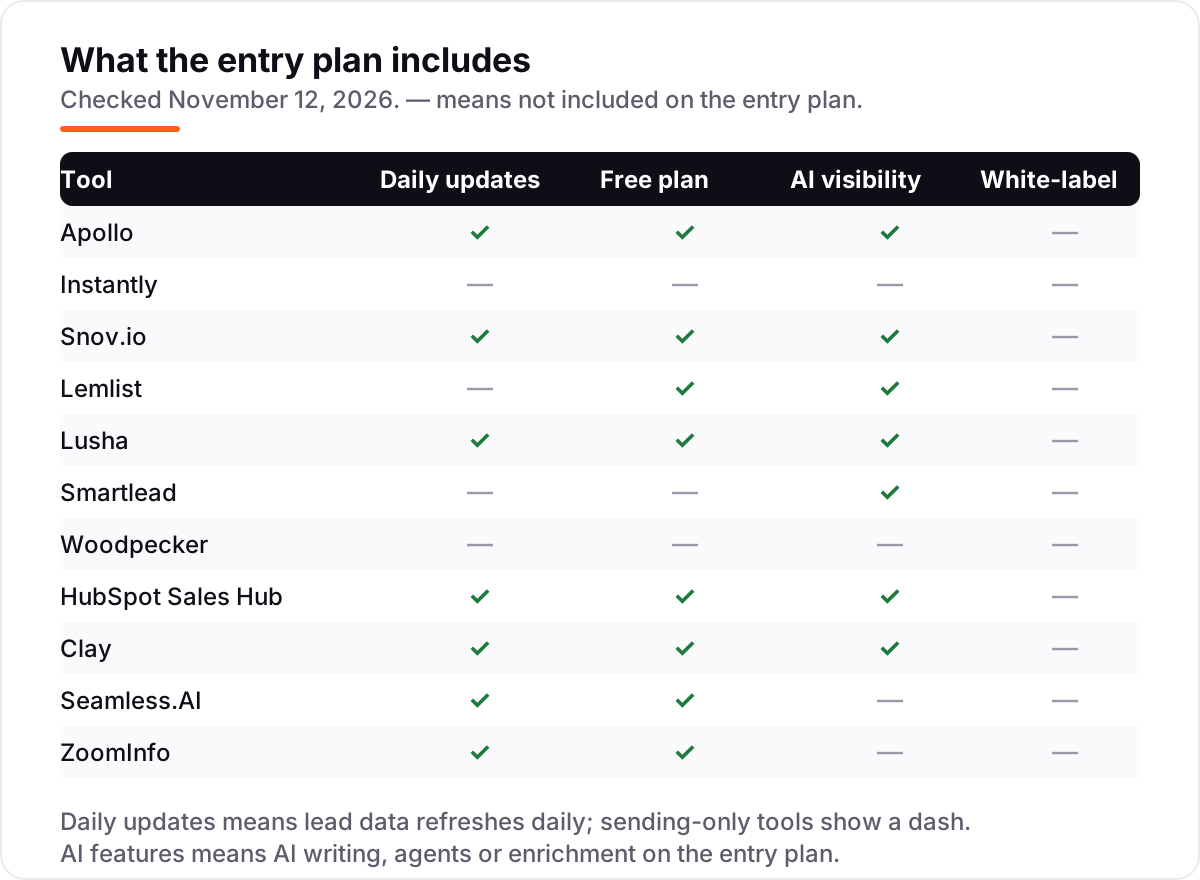
- Decide data or sending first. Lusha, Seamless.AI, ZoomInfo and Clay find contacts; Instantly, Lemlist, Smartlead and Woodpecker send the emails. Apollo, Snov.io and HubSpot do both — buy one job at a time if you only need one.
- Count the pricing unit, not the headline. Apollo and HubSpot charge per seat, Lemlist and Instantly charge flat, and the rest charge per credit or per contact. The same three-person team costs $720 a year on HubSpot Starter at list and $1,764 on Apollo Basic.
- Check what a credit buys. One email costs 1 credit almost everywhere, but a phone number costs 5 credits on Lusha and 8 on Apollo, and Snov.io charges twice for a verified email — once to find it, once to verify it.
- Check the free plan's real cap. Apollo gives 75 credits a month and Lusha 40, but Lemlist's Freemium cannot send campaigns at all. A free plan that cannot send is a demo, not a plan.
- Check which AI is actually included. lemAgent comes with Lemlist's Email plan and Claygent with Clay's Launch plan, but Instantly's deliverability agent and Woodpecker's AI drafting sit on higher tiers or do not exist.
- Think about the CRM you already use. HubSpot is the obvious pick inside HubSpot, and Apollo, Snov.io and ZoomInfo all sync to Salesforce and HubSpot — but a second CRM is a second bill.
Finding leads is only half the job: the leads still have to find you. If your site does not show up when prospects search, our AI search optimization service covers that side. And before you send a campaign, tag every link with the free UTM builder so you can see which emails actually bring replies.
Whatever you shortlist, try it with your real list before you pay. The trials in this list run 7 to 14 days, which is long enough to find 50 contacts, verify them and send one sequence. Check two things in the trial: that the emails you find actually deliver, and that the replies land in one inbox instead of five.
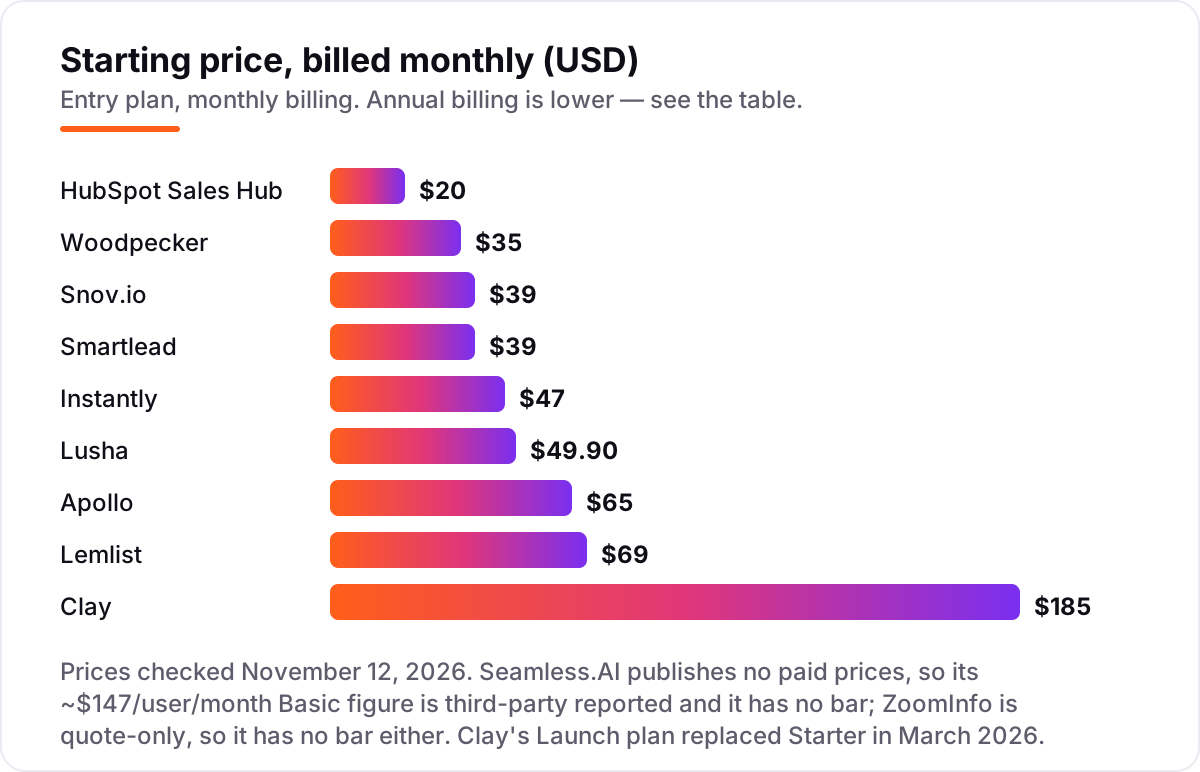
AI lead generation software pricing: what you will actually pay
Take a three-person sales team that sends 5,000 emails a month and needs 1,000 verified contacts a month. On annual billing, the subscription costs $288 a year on Woodpecker Starter, $351 on Snov.io Starter, $390 on Smartlead Base, $451.20 on Instantly Growth, $660 on Lemlist Email, $720 on HubSpot Starter at list, $1,347.30 on Lusha Starter for three seats, $1,764 on Apollo Basic for three seats, $2,004 on Clay Launch and $5,292 on Seamless.AI Basic for three users at the reported $147 rate. ZoomInfo Professional is reported at about $14,995 a year for three seats.
The cheapest stack that covers both jobs is Snov.io Starter plus Instantly Growth: $351 plus $451.20 is $802.20 a year for finding, verifying and sending. Apollo alone costs $1,764 a year for the same team, and Lusha plus Woodpecker costs $1,347.30 plus $288, or $1,635.30. The stack is cheaper, but it is two logins, two bills and a CSV export between them — Apollo costs more and removes the handoff.
Three costs sit outside every number above. First, phone numbers: at 8 credits each on Apollo, 100 phone reveals a month cost 800 of the 2,500 monthly credits on Basic, while Lusha charges 5 credits each. Second, data add-ons: Lemlist charges $20 a month for 2,000 finding credits, Instantly Credits start at $47 a month, and Woodpecker charges $29 a month per LinkedIn account. Third, the annual-billing gap: monthly billing costs $420 a year on Woodpecker Starter against $288 annual, $468 on Snov.io against $351, and $2,340 on Apollo Basic for three seats against $1,764.
Know the difference: a lead database, a sequencer and a CRM
The confusion in this category is that three different jobs share one name. A lead database finds and verifies contact details: Lusha, Seamless.AI, ZoomInfo and Clay sell data, and their price is really a price per contact. A sequencer sends the emails and manages follow-ups: Instantly, Lemlist, Smartlead and Woodpecker sell sending, and their price is really a price per email or per inbox. A CRM stores the deal after the reply: HubSpot Sales Hub is the CRM here, and its price is really a price per seat.
Apollo and Snov.io blur the lines by doing both jobs in one subscription, which is why they top this list for small teams — one bill covers finding and sending. But the blur is also the trap: a team that buys Apollo for its database and never sends from it is paying sequencer money for a finder, and a team that buys Instantly expecting lead data will find an empty address book. Name the job first — find, send or store — then buy the tool that does that job cheapest, and only pay for all three when you genuinely need all three.
Quick comparison: tool type by need
| Buyer | Best pick | Why |
|---|---|---|
| Solo founder on a budget | Snov.io | $39/month, finder plus verifier plus sender in one plan |
| Small team that wants one tool | Apollo | $65/user/month, database plus sequencing |
| Agency sending at volume | Instantly | $47/month flat, unlimited inboxes and warmup |
| Rep who lives on LinkedIn | Lusha | $49.90/month, verified emails and phones from the browser |
| Team that already uses HubSpot | HubSpot Sales Hub | $20/seat/month, AI prospecting inside the CRM |
| Enterprise buying intent data | ZoomInfo | Custom quote, deepest coverage and intent signals |
Mistakes to avoid
- Comparing monthly prices without checking billing. Annual billing cuts 17–25% off most tools here — Woodpecker Starter drops from $35 to $24 a month, Snov.io from $39 to $29.25 and Apollo Basic from $65 to $49 a user.
- Ignoring what a credit buys. A phone number costs 5 credits on Lusha and 8 on Apollo, and Snov.io charges 2 credits for one verified email. Count the phones and the verifications, not just the credits.
- Paying for a database when you need sending, or the reverse. Instantly has no lead data on its sending plan, and Lusha has no sequencer at all. Name the job before you buy the tool.
- Trusting a directory price. Clay's old $149 Starter plan was replaced by Launch at $185 in March 2026, and several directories still list Apollo Basic at $59 a month against the $65 the pricing page shows. Always check the vendor's own page.
- Forgetting the add-ons. Lemlist's data credits, Instantly Credits, Woodpecker's LinkedIn automation and Smartlead's white-label workspaces are all billed on top of the headline price, and together they can double the bill.
How we chose
We checked each vendor's pricing page on November 12, 2026 and recorded the starting price exactly as shown, including the annual-billing figure where the page lists one, and we ranked the tools by fit for the most common buyer — a small US sales team of one to five people doing outbound — not by brand size. Two prices need extra care. Seamless.AI publishes no paid prices, so its ~$147/user/month Basic figure is the one buyer reports and third-party guides quote, not a rate-card price. ZoomInfo is quote-only, so its Professional figure of ~$14,995 a year comes from buyer-reported contracts, not the vendor. The vendor pages would not load directly from our connection on the day — direct fetches timed out and the page reader failed — so the figures above rest on multiple independent reads of each vendor's own pricing page dated October to November 2026, and on the program's verified price facts where they match. Ratings come from G2 pages in the search index, crawled within three days of November 12, 2026: Apollo 4.7 from 9,662 reviews, Instantly 4.8 from 4,165, Snov.io 4.5 from 500, Lemlist 4.6 from 2,699, Lusha 4.3 from 1,674, Smartlead 4.4 from 477, Woodpecker 4.5 from 105, HubSpot Sales Hub 4.4 from 13,909, Clay 4.6 from 234, Seamless.AI 4.4 from 5,431 and ZoomInfo 4.5 from 9,101. No vendor paid for a place in this list, and none of the links here are affiliate links.
What to do next
Start with the free plan or trial of your top pick and run one real week of prospecting through it: find 50 contacts, verify them, send the sequence and check the replies. If the data bounces or the emails land in spam, the tool is wrong, not the list. If the business is sorted but new leads are not finding it, our monthly SEO service handles the visibility side. Once your tools are in place, find out what's holding your rankings back.
Frequently asked questions
What is the best AI lead generation software?
Apollo is the best fit for most small teams: a 210M+ contact database plus sequencing from $49/user/month billed annually, with a free plan. Teams that only need sending should look at Instantly at $47 a month, and teams on a tight budget should look at Snov.io at $29.25 a month billed annually.
How much does AI lead generation software cost?
Most small teams pay $20 to $185 a month for the subscription. Entry plans run $20 a seat on HubSpot Starter, $35 on Woodpecker, $39 on Snov.io and Smartlead, $47 on Instantly and $65 a user on Apollo. Clay starts at $185, Seamless.AI is reported near $147, and ZoomInfo is quote-only at roughly $14,995 a year.
Is there free AI lead generation software?
Yes, with limits. Apollo gives 75 credits a month free, Lusha 40, Snov.io 50, Clay 100, Seamless.AI 50 lifetime credits, HubSpot a free CRM for two users and ZoomInfo Lite 10 credits a month. Free plans work for testing data quality; once you prospect daily, a paid plan is cheaper than the time lost to caps.
What is the difference between a lead database and an outreach tool?
A lead database finds and verifies contact details — Lusha, Seamless.AI, ZoomInfo and Clay do this. An outreach tool sends the emails and manages follow-ups — Instantly, Lemlist, Smartlead and Woodpecker do this. Apollo, Snov.io and HubSpot do both. Buying one when you need the other is the most common mistake in this category.
Are credits or flat pricing better for lead generation?
Flat pricing wins when volume is steady: Lemlist charges $69 a month for unlimited users and 50,000 emails, and Instantly $47 for unlimited inboxes. Credits win when volume is spiky, because you pay only for contacts you reveal. Count how many emails and phone numbers you need each month, then price both models for that volume.
What should I check before paying for AI lead generation software?
Check what a credit buys — one email costs 1 credit on most tools, but a phone costs 5 on Lusha and 8 on Apollo — whether the free plan can actually send, and whether the AI features sit on the entry plan or a higher tier. Then run the trial with your real list: find 50 contacts, verify them and send the sequence before you pay.
Sources we checked (22)
- Apollo pricing — apollo.io/pricing (November 2026)
- Apollo on G2 — 4.7/5, 9,662 reviews (checked November 12, 2026)
- Instantly pricing — instantly.ai/pricing (November 2026)
- Instantly on G2 — 4.8/5, 4,165 reviews (checked November 12, 2026)
- Snov.io pricing — snov.io/pricing (November 2026)
- Snov.io on G2 — 4.5/5, 500 reviews (checked November 12, 2026)
- Lemlist pricing — lemlist.com/pricing (November 2026)
- Lemlist on G2 — 4.6/5, 2,699 reviews (checked November 12, 2026)
- Lusha pricing — lusha.com/pricing (November 2026)
- Lusha on G2 — 4.3/5, 1,674 reviews (checked November 12, 2026)
- Smartlead pricing — smartlead.ai/pricing (November 2026)
- Smartlead on G2 — 4.4/5, 477 reviews (checked November 12, 2026)
- Woodpecker pricing — woodpecker.co/pricing (November 2026)
- Woodpecker on G2 — 4.5/5, 105 reviews (checked November 12, 2026)
- HubSpot Sales Hub pricing — hubspot.com/pricing/sales (November 2026)
- HubSpot Sales Hub on G2 — 4.4/5, 13,909 reviews (checked November 12, 2026)
- Clay pricing — clay.com/pricing (November 2026)
- Clay on G2 — 4.6/5, 234 reviews (checked November 12, 2026)
- Seamless.AI pricing — seamless.ai/pricing (November 2026)
- Seamless.AI on G2 — 4.4/5, 5,431 reviews (checked November 12, 2026)
- ZoomInfo pricing — zoominfo.com/pricing (November 2026)
- ZoomInfo on G2 — 4.5/5, 9,101 reviews (checked November 12, 2026)
Make one of these tools?
We re-check this list every quarter. Send a correction, request a review, or ask about a clearly labeled sponsored spot.
Request a listingShamim
Founder of SerpAstra
A full-stack SEO and digital marketer who spends most days on Local SEO for dental practices, AI search visibility and lead generation.
Free SEO and AI visibility audit
Find out what is holding your rankings back
Send us your site. Within 2 business days you get a written audit, an AI visibility check and a short fix list ranked by impact. Free, with no contract attached.
Request my free audit→Related buying guides
 Sales & CRMBest Marketing CRM Software for 2026: 11 Options Compared by Use CaseCompare the 11 best marketing crm software options for 2026 on price, free plans, automation and AI features, with every price checked November 5, 2026.Read guide →
 Sales & CRM10 Best Email Finder Tools for Sales Teams in 2026, ComparedCompare the 10 best email finder tools for sales teams on price, credits and verification, with every price checked November 6, 2026, before you buy.Read guide →
 Sales & CRM8 Best CRM Software Affiliate Programs in 2026, Compared8 best CRM software affiliate programs compared on commission, cookie length and payout terms, with real CRM prices checked November 4, 2026.Read guide →