
7 Best AI Spanish Learning Apps in 2026: Free and Paid Apps Ranked
The 7 best ai spanish learning apps of 2026, ranked with real prices, free plans and AI conversation features — pick the app that fits how you actually study.
 Shamim Mia, Founder, SerpAstraLast verified November 2, 202612 min read
We compare pricing pages, documentation and public reviews. We never accept payment for rankings.
Key takeaways
- Duolingo (free, Super from $12.99/month), Babbel (from $17.95/month) and Memrise Pro (from $19.99/month) are the short list: free daily practice, structured grammar, and unlimited AI conversation, in that order.
- The single most important buying factor is speaking practice: an app is only worth paying for if it gets you talking — AI conversation, speech recognition or human feedback — not just tapping answers.
- Every price below was checked November 2, 2026. Only Babbel's annual price was read on the vendor's own pricing page; the rest are third-party sourced because these vendors show prices only in-app or at checkout.
- Free plans are real here: Duolingo, Memrise, Busuu and Mondly all teach Spanish free, so try the free tier for a week before paying.
On this page
Quick comparison
| Tool | Best for | Starting price | Free plan |
|---|---|---|---|
| Duolingo | Beginners and casual learners who want a free daily Spanish habit with light AI help | $12.99/mo | Yes (full course) |
| Babbel | Self-disciplined adults who want a structured grammar-led Spanish course with AI speaking practice | $17.95/mo | No (free lessons) |
| Memrise | Learners who want unlimited AI conversation practice and native-speaker video on a small budget | $19.99/mo | Yes (core lessons) |
| Busuu | Learners who want a CEFR-structured course with community feedback and AI conversation on the top tier | $12.49/mo | Yes (basic lessons) |
| Mondly | Learners who want to start speaking quickly with a chatbot and like short game-like lessons | $12.90/mo | Yes (limited) |
| Lingvist | Intermediate learners who already know some Spanish and want to grow vocabulary fast with AI repetition | €9.99/mo | No (14-day trial) |
| Rosetta Stone | Patient beginners who want immersion learning and careful pronunciation practice | $19.99/mo | No (3-day trial) |
Make one of these tools?
We re-check this list every quarter. Send a correction, request a review, or ask about a clearly labeled sponsored spot.
Request a listingThe best ai spanish learning apps

Duolingo
Best for: Beginners and casual learners who want a free daily Spanish habit with light AI help
Duolingo is the easiest way to start learning Spanish because the whole course is free, and the paid Super plan only removes ads and the daily Energy limit. The app's AI shows up as adaptive practice that repeats the words you miss, plus Explain My Answer, which now explains mistakes on the free plan too. Roleplay and video-call conversation practice exist, but they sit in the Max tier, which Duolingo may retire.
What keeps people coming back is the streak: short daily lessons, a game-like league and reminders that make five minutes a day feel doable. The trade-off is depth. Grammar is rarely explained in full, and the free plan's Energy cap stops you mid-session, so serious learners usually pair Duolingo with a structured course or a tutor once they pass the basics.
What we like
- Full Spanish course free with ads, including Explain My Answer AI explanations
- Adaptive practice repeats the words you miss, and streaks keep daily study going
- More than 100 language courses and more than 500 million learners, per Duolingo
- Super trial is 1 week free, and the Family plan covers up to 6 accounts
Watch out for
- Free plan caps daily study with an Energy limit, and ads interrupt lessons
- Duolingo's CEO said in August 2026 that Max may be retired, and it was not offered to some new accounts in September 2026
- Grammar is rarely explained in depth, so advanced learners outgrow it
Babbel
Best for: Self-disciplined adults who want a structured grammar-led Spanish course with AI speaking practice
Babbel is the structured option: short 10 to 15 minute lessons built by language experts that teach grammar and recycle it in review sessions. Its AI feature, Babbel Speak, is an AI conversation partner that is included in every paid plan, so you can practise ordering food or checking into a hotel before you try it yourself. The subscription covers all 14 Babbel languages, and the 12-month plan is the sensible buy at $8.95 a month.
The lessons feel like a real course, with dialogues recorded by native speakers and a review manager that schedules what you are about to forget. The catch is that there is no real free plan, only the first lesson of each course, and there are no live classes for individual learners any more. Babbel suits self-disciplined learners who want a syllabus, not a game.
What we like
- Babbel Speak AI conversation practice is included in every paid plan
- Structured 10 to 15 minute lessons built by language experts, with grammar explained
- Review manager schedules revision of words you are about to forget
- One subscription covers all 14 languages
Watch out for
- No real free plan — only the first lesson of each course is free
- No live classes for individual learners any more
- Monthly billing at $17.95 is twice the annual monthly rate, so short commitments cost more

Memrise
Best for: Learners who want unlimited AI conversation practice and native-speaker video on a small budget
Memrise teaches Spanish through short videos of native speakers using phrases in real situations, then drills them with spaced repetition until they stick. Pro unlocks unlimited AI conversation practice with AI Buddies, which role-play everyday scenes and correct you as you speak. At $61.99 a year, the annual plan is one of the cheapest ways to get unlimited AI speaking practice in this list.
The free plan is generous, with core lessons and native-speaker videos available without paying, so you can test the style for a week first. The weakness is structure: Memrise does not teach grammar in a systematic way, and the monthly plan at $19.99 is poor value next to the annual price. Use it as your speaking and listening supplement, not your only course.
What we like
- Unlimited AI conversation practice with AI Buddies on Pro
- Native-speaker videos show phrases used in real situations
- Annual plan is $61.99 a year, about $5.17 a month, one of the cheapest here
- Free plan includes core lessons and native-speaker videos
Watch out for
- Does not teach grammar in a systematic way at any price
- Monthly Pro at $19.99 is nearly four times the annual monthly rate
- Community courses were removed from the main app, so older shared content is gone

Busuu
Best for: Learners who want a CEFR-structured course with community feedback and AI conversation on the top tier
Busuu is the most course-like app here after Babbel, with CEFR-aligned Spanish lessons from A1 to B2 and a review section that revisits your weak spots. Premium Plus adds AI Conversations, guided speaking practice in realistic situations, plus pronunciation feedback and Mistake Repair exercises built from your errors. Native speakers in the community can also correct your written and spoken exercises.
Premium is good value at $72.99 a year, and the free plan covers basic lessons in one language, so you can try the method before paying. Two things to know: the AI conversation tools sit on Premium Plus, not the cheaper Premium plan, and Busuu runs discounts so often that few people pay the list price. Check the checkout total, not the headline.
What we like
- CEFR-aligned Spanish course from A1 to B2 with grammar and vocabulary review
- Premium Plus adds AI Conversations, pronunciation feedback and Mistake Repair
- Native speakers in the community correct your written and spoken exercises
Watch out for
- AI conversation tools need Premium Plus, not the cheaper Premium plan
- Discounts are frequent, so the list price is rarely what anyone pays
- Course library is smaller than Duolingo's, with fewer languages overall

Mondly
Best for: Learners who want to start speaking quickly with a chatbot and like short game-like lessons
Mondly leans on conversation from the first lesson, with a chatbot that plays the other side of everyday dialogues and speech recognition that scores your pronunciation. Lessons are short and visual, with verb tables built in for checking conjugations as you go, and the Premium plan covers all 41 Mondly languages. The annual plan is cheap on sale at $61.92, against a $154.80 list price.
It is a good pick for learners who want to start speaking quickly and like a game-like routine of daily lessons, quizzes and challenges. The limits are real: grammar is rarely explained, the free version is very thin, and Mondly publishes no refund policy, so the annual plan is a commitment. Try the free lessons first and pay monthly until you are sure.
What we like
- Chatbot conversations and speech recognition from the first lesson
- Annual plan is $61.92 on sale, and one plan covers all 41 languages
- Verb tables and daily lessons, quizzes and challenges keep practice varied
Watch out for
- No public refund policy, so an annual purchase is a commitment
- Grammar is rarely explained, and the free version is very limited
- Annual sale price changes often; the $154.80 list price is the fallback

Lingvist
Best for: Intermediate learners who already know some Spanish and want to grow vocabulary fast with AI repetition
Lingvist is the most purely AI-driven app in this list: an adaptive algorithm watches what you remember and serves the next word just before you would forget it. Its Spanish course teaches vocabulary inside real sentences, with listening and reading practice built around the words you are learning. There are no games and no chat partner, just focused repetition that moves fast.
That focus is both the strength and the limit. If your goal is to understand more Spanish quickly, Lingvist builds usable vocabulary faster than any app here. But it does not teach you to hold a conversation, and there is no free plan, only a 14-day trial. Pair it with a conversation app or a tutor for speaking practice.
What we like
- Adaptive AI algorithm schedules each word just before you would forget it
- Spanish vocabulary taught inside real sentences, with listening and reading practice
- 14-day free trial with no credit card required, and a clean ad-free interface
Watch out for
- No conversation practice and no speaking partner — vocabulary only
- No free plan, and the Spanish course has no structured grammar lessons
- Priced in euros (9.99 euros a month), so US buyers see the charge converted

Rosetta Stone
Best for: Patient beginners who want immersion learning and careful pronunciation practice
Rosetta Stone teaches Spanish the immersion way, with pictures, audio and no translations, so you learn words by seeing and hearing them in context. TruAccent speech recognition scores your pronunciation after every phrase, and live tutoring sessions with native speakers are available for extra practice. Subscriptions cover one language, while the lifetime plan opens all 25 languages.
The method suits patient beginners who like a calm, structured routine and want to build a solid accent from day one. The trade-offs are price and depth: at $19.99 a month it is the joint priciest app here, grammar is never explained directly, and the course tops out around low-intermediate level. Buy it for immersion and pronunciation, not for AI conversation.
What we like
- TruAccent speech recognition scores pronunciation after every phrase
- Immersion method with pictures and audio, and no translation crutch
- Live tutoring sessions with native speakers, plus a 30-day money-back guarantee
Watch out for
- Joint highest monthly price here at $19.99, and grammar is never explained directly
- Course tops out around low-intermediate level, per independent reviews
- AI is pronunciation scoring only — there is no AI conversation partner
The best ai spanish learning app for you depends on how you actually study: five minutes a day on the bus, or a focused half hour with a notebook. We ranked seven apps that use AI in a real way — conversation partners, adaptive repetition or speech recognition — by fit for the most common buyer, an adult beginner who wants to speak Spanish, not just collect streaks.
How to choose the best ai spanish learning app
- Speaking practice first. An app earns its price when it makes you speak: AI conversation, speech recognition or human corrections. Tapping multiple-choice answers builds recognition, not speech.
- How the AI actually works. Conversation partners and adaptive repetition are real AI help. A streak counter and a points league are not AI, however smart the marketing sounds.
- Grammar, or the lack of it. Spanish verbs change with person and tense, so an app that never explains grammar will stall you at the beginner plateau. Check whether explanations exist before you pay.
- Free tier honesty. Four apps here teach Spanish free. Use the free tier for a week and pay only when you hit a limit that actually bothers you.
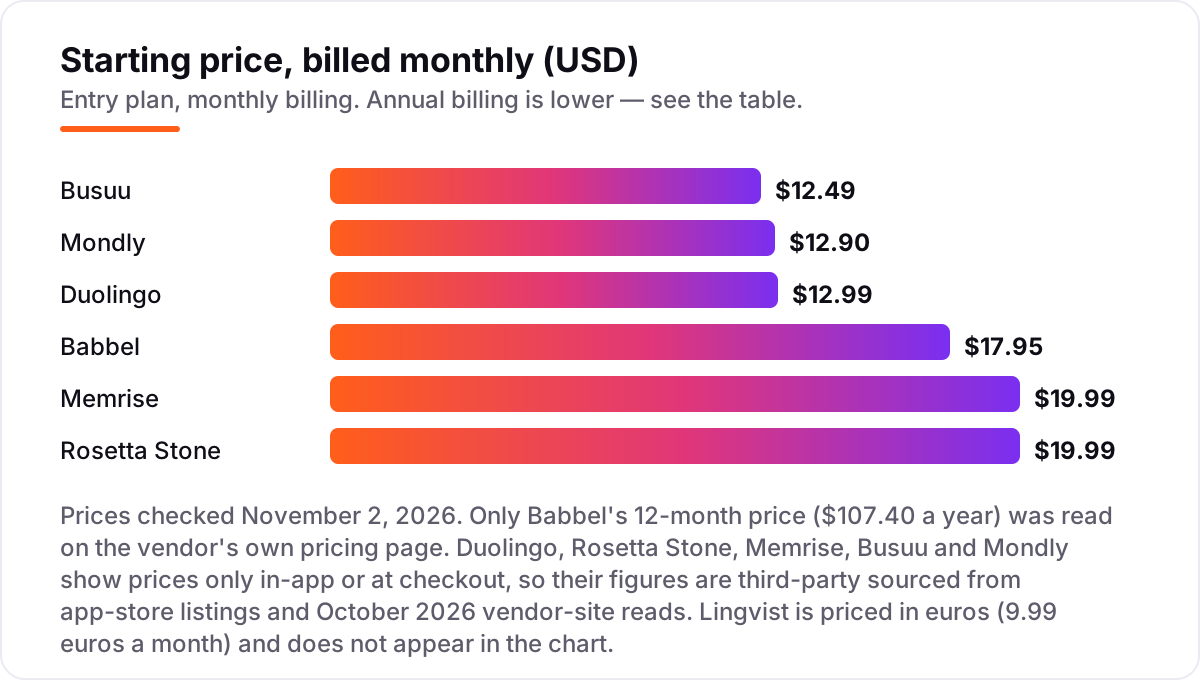
- The billing trap. Monthly prices run $12.49 to $19.99, but annual plans cut that to about $5 to $13 a month. A cheap-looking monthly rate usually means a full year charged up front.
- Your level. Complete beginners need a guided course; intermediate learners get more from vocabulary tools like Lingvist and conversation practice like Memrise.
If you teach Spanish for a living and want AI assistants to recommend your school, our AI search optimization service works on exactly that problem.
Quick comparison: tool type by need
| Buyer | Best pick | Why |
|---|---|---|
| Complete beginner, free first | Duolingo | Full course free, AI explanations included, streaks keep you going |
| Structured course with grammar | Babbel | Expert-built lessons, Babbel Speak AI conversation in every paid plan |
| Cheapest AI conversation | Memrise | Unlimited AI Buddies on Pro, $61.99 a year |
| Course plus community feedback | Busuu | CEFR-aligned lessons, native-speaker corrections, AI on Premium Plus |
| Speaking from day one | Mondly | Chatbot dialogues and speech recognition, $61.92 a year on sale |
| Vocabulary catch-up | Lingvist | Adaptive AI repetition in real sentences |
| Pronunciation and immersion | Rosetta Stone | TruAccent scoring, no-translation method, live tutoring |
AI Spanish learning apps pricing: what you will actually pay
Take a learner who studies for a year. On monthly billing, Babbel costs $17.95 a month, or $215.40 over 12 months; the 12-month plan costs $107.40 up front, saving about $108. Memrise Pro is the same shape: $19.99 a month is $239.88 over a year, while the annual plan is $61.99, saving about $178. Duolingo Super is $12.99 a month, or $155.88 over a year, against an $83.99 annual plan. Add it up before you subscribe: the cheapest monthly price is rarely the cheapest year. A realistic first-year budget for one app is $62 to $107 on annual billing, or $150 to $240 if you pay month to month — and the free tiers of Duolingo, Memrise, Busuu and Mondly cost nothing at all.
Lifetime plans are worth a look if you plan to study for years. Babbel's lifetime plan is $299.99 once, against $107.40 a year, so it pays for itself in under three years if you stick with it. Rosetta Stone's lifetime plan opens all 25 languages, though its price moves with promotions and was reported between $199 and $399 in 2026. Duolingo and Memrise have no lifetime option, and Mondly sometimes sells one for around $90 to $120. A lifetime plan only saves money if you are still studying in year three — be honest about that before you buy.
AI conversation vs AI flashcards: know the difference
The biggest confusion in this category is the word AI itself. Two very different things hide behind it. An AI conversation partner — Babbel Speak, Memrise AI Buddies, Busuu AI Conversations, Mondly's chatbot — plays a role, listens to your answer and responds, so you practise producing Spanish. An adaptive flashcard system — Lingvist, and Duolingo's practice queue — picks what to show you next based on what you forgot, so you learn words faster. Both help, but only the first teaches you to speak. Rosetta Stone sits in a third group: its AI scores your pronunciation, which improves your accent without teaching you to hold a conversation. Before you pay, open the app and check which kind of AI you are buying: a partner you talk to, a scheduler that picks your next word, or a judge that scores how you sound.
What the AI actually does in each app
AI means something different in every app here, so here is the plain version. Duolingo's AI adapts your practice queue and explains your mistakes, and its Max tier adds role-play and video-call conversation. Babbel's AI is a conversation partner, Babbel Speak, that role-plays everyday scenes and is included in every paid plan. Memrise's AI Buddies hold open-ended conversations and correct you as you speak, with no script to follow. Busuu's AI Conversations guide you through realistic situations on Premium Plus, and Mistake Repair turns your errors into new exercises. Mondly's chatbot plays the other side of a dialogue and its speech recognition scores your pronunciation. Lingvist's AI is a scheduler: it predicts which word you are about to forget and shows it first. Rosetta Stone's TruAccent scores your pronunciation after each phrase. None of these replaces a human conversation, but the conversation partners come closest — and they are the feature worth paying for.
Free vs paid: what the free tiers actually include
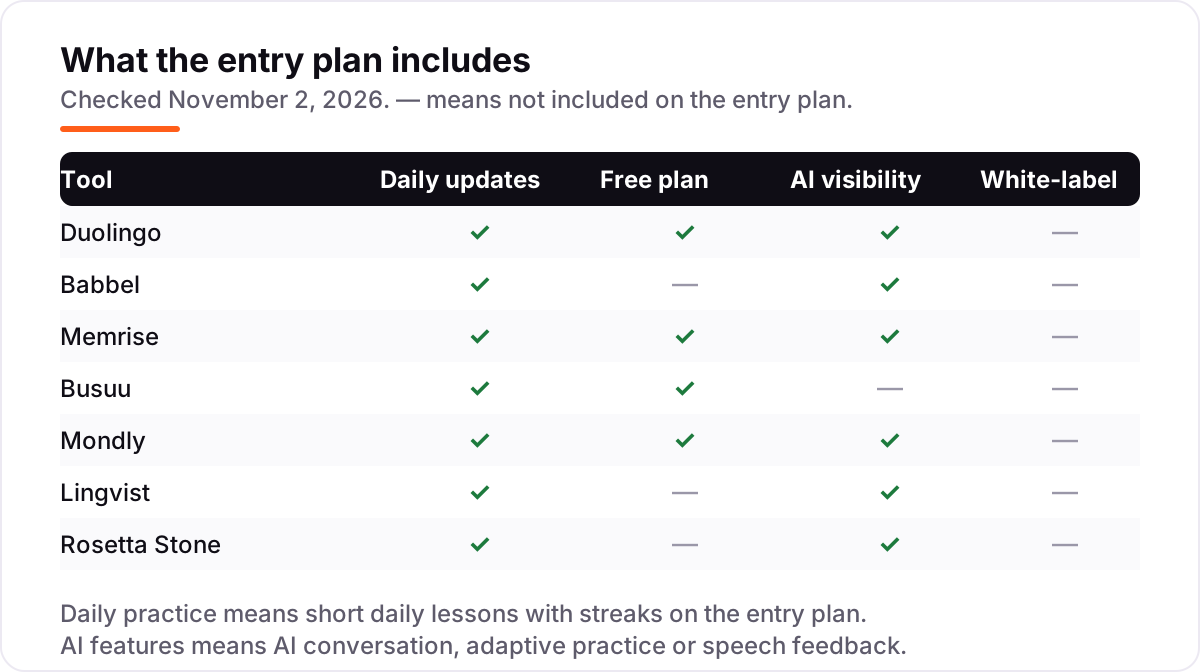
Four of the seven apps teach Spanish without charging you. Duolingo's free plan is the most complete: the whole Spanish course, with ads and a daily Energy limit that stops you after a few mistakes. Memrise's free plan covers core lessons and native-speaker videos, holding back only unlimited AI conversation and offline mode. Busuu's free plan is narrower, with basic lessons in one language and community feedback, while Mondly's free version is the thinnest, with one daily lesson, the introductory section and a single chatbot lesson. Babbel, Lingvist and Rosetta Stone have no free plan at all: Babbel gives you the first lesson of each course, Lingvist gives you 14 days free, and Rosetta Stone gives you a 3-day trial of one language. The honest test is a week on the free tier. If you hit the paywall on day two and it annoys you, that is the app working as designed — and it is worth paying for only if the thing behind the paywall is the thing you need, usually unlimited speaking practice or offline lessons.
How long until you can hold a conversation
A daily 15-minute habit on any of these apps builds basic vocabulary in about a month, and simple present-tense sentences in two to three months, if you study most days. That is the honest pace for a beginner starting from zero. The apps that move you faster are the ones with speaking practice: Babbel Speak, Memrise AI Buddies and Mondly's chatbot all force you to produce sentences instead of recognising them, which is the skill that transfers to a real conversation. The fastest route is to combine one app with one weekly speaking habit, such as a language exchange or a tutor session, from the first month rather than waiting until you feel ready. You will feel unready for a long time; the exchange is what fixes that. If you only have five minutes a day, Duolingo's streak will keep you going, but expect slower progress than the 15-minute daily routine the structured apps assume.
How we chose
We checked each vendor's pricing page on November 2, 2026, and recorded the starting price exactly as shown. Only Babbel's 12-month price came from the vendor's own pricing page: Duolingo publishes no price list on its website, and Rosetta Stone, Memrise, Busuu and Mondly show prices only in the app or at checkout, so their figures come from app-store listings and independent reads of the vendors' sites in October 2026, and they vary by platform and promotion. Ratings come from G2 pages we opened on November 2, 2026; Babbel, Busuu, Mondly and Lingvist carry no rating here because G2 lists only Babbel for Business, and the Busuu and Lingvist G2 pages returned rate-limit errors when we tried to open them. We ranked the apps by fit for the most common buyer — an adult beginner who wants to speak Spanish — not by brand size. No vendor paid for a place in this list, and none of the links here are affiliate links.
What to do next
Start with the free tier of your top pick and study every day for a week: if you open the app without dreading it, you have your app, so pay annually, not monthly — the annual plans here cost roughly half as much. Add one speaking habit outside the app, such as a weekly conversation exchange, because no app alone makes you fluent. If you run a language school, check your pages with the free SERP snippet preview tool before spending on ads. Once your tools are in place, find out what's holding your rankings back.
Your stack only works if people find you
SerpAstra fixes what keeps your site off page one and makes it easy for AI assistants to recommend.
Get a free audit→Sources we checked (12)
- Babbel pricing — babbel.com/prices (checked November 2, 2026)
- Duolingo Super — duolingo.com/super (checked November 2, 2026)
- Duolingo on G2 — 4.5/5, 145 reviews (checked November 2, 2026)
- Rosetta Stone on G2 — 4.2/5, 113 reviews (checked November 2, 2026)
- Memrise on G2 — 4.6/5, 22 reviews (checked November 2, 2026)
- Mondly vs Rosetta Stone pricing, read on both vendors' sites October 14, 2026
- Memrise review, November 2026 — Spanish Pro pricing
- Busuu review, November 2026 — Premium pricing
- Mondly review, November 2026 — Premium pricing
- Duolingo cost, September 2026 — Max possibly discontinued
- Mondly vs Babbel vs Duolingo pricing, October 2026
- Lingvist pricing and best Spanish apps — lingvist.io
Shamim
Founder of SerpAstra
A full-stack SEO and digital marketer who spends most days on Local SEO for dental practices, AI search visibility and lead generation.
Frequently asked questions
What is the best AI Spanish learning app in 2026?
Duolingo is the best free start, with a full course and AI explanations at no cost. Babbel is the best structured course, with grammar lessons and an AI conversation partner in every paid plan. Memrise is the best cheap route to unlimited AI conversation, at $61.99 a year. Pick by how you study, not by brand size.
How much does an AI Spanish learning app cost?
Monthly billing runs $12.49 to $19.99 a month across the seven apps here. Annual billing is far cheaper: $61.99 to $159 a year, or about $5 to $13 a month. Duolingo, Memrise, Busuu and Mondly also teach Spanish free, so you can start without paying anything.
Is there a free AI Spanish learning app?
Yes, with limits. Duolingo's free plan covers the whole Spanish course, and Memrise, Busuu and Mondly all have free tiers. The catch is that unlimited AI conversation is usually paid: it sits in Memrise Pro, Babbel's paid plans and Busuu Premium Plus. Try the free tier for a week first.
Duolingo vs Babbel: which is better for Spanish?
Duolingo wins if you want a free daily habit with game-like lessons and light AI help. Babbel wins if you want a real course: grammar explained, structured lessons and an AI conversation partner. Self-disciplined learners who finish what they start usually get further with Babbel; casual learners stick longer with Duolingo.
Can an AI app make me fluent in Spanish?
No app alone makes you fluent. Apps build vocabulary, listening and pronunciation, and AI conversation partners help you practise producing sentences. Real fluency needs real conversation, so pair any app with a weekly exchange partner, tutor or class. Treat the app as daily training, not the whole plan.
What should I look for in an AI Spanish app?
Four things: whether the AI makes you speak or only picks your next flashcard, whether speech recognition scores your pronunciation, whether grammar is explained or only drilled, and what the price is on annual billing rather than monthly. Check the free tier first, and confirm the checkout total before you pay.
Do I need the paid plan, or is the free plan enough?
The free plan is enough for the basics and for building a daily habit. Pay when you hit a limit that bothers you: the Energy cap on Duolingo, locked AI conversation on Memrise and Babbel, or offline lessons. When you do pay, choose annual billing — it costs roughly half as much as paying month to month.
Free SEO and AI visibility audit
Find out what is holding your rankings back
Send us your site. Within 2 business days you get a written audit, an AI visibility check and a short fix list ranked by impact. Free, with no contract attached.
Request my free audit→Related guides
 AI SearchBest AI SEO tools in 2026: honest picks by jobBest AI SEO tools in 2026, picked by job: Semrush and Ahrefs for research, Surfer and Clearscope for content, Otterly for AI tracking, with 2026 prices.Read guide →
 SEO & AI Search11 Best AI Tools for SEO Optimization in 2026, Compared11 best ai tools for seo optimization compared on price, content scoring and AI visibility, with prices verified November 1, 2026, sorted by use case.Read guide →
 AI SearchHow to get your brand cited in ChatGPT and AI searchA practical guide to earning citations in ChatGPT, Perplexity and Google AI Overviews: crawler access, Bing indexing, answer-first pages and brand signals.Read guide →