
7 Best AI Tools for Pi Attorneys in 2026 (Free and Paid, Compared)
Compare the 7 best ai tools for pi attorneys on PI fit, research quality and demand drafting, with every vendor price checked November 7, 2026.
 Shamim Mia, Founder, SerpAstraLast verified November 7, 202613 min read
We compare pricing pages, documentation and public reviews. We never accept payment for rankings.

Key takeaways
- EvenUp is the only PI-native platform here; Filevine's LOIS agents are the best fit for firms choosing a case system, and CoCounsel leads on cited research — and all seven tools are custom-quoted.
- No vendor here publishes a starting price. Third-party reports put CoCounsel full-coverage plans at $637–$784 per user per month and Harvey seats near $1,200 — treat both as negotiation anchors, not prices.
- The single most important buying factor is whether the AI understands PI work — medical chronologies and demand drafting — or only general legal research.
- Filevine's LOIS Explore is the only free tier in this list; every other tool starts with a demo and a sales quote.
On this page
Quick comparison
| Tool | Best for | Starting price | Free plan |
|---|---|---|---|
| EvenUp | PI firms that want one AI platform from intake to trial, with demands built from medical records | Custom quote | No |
| Filevine | PI firms already on Filevine, or choosing a case system with AI agents across the whole caseload | Custom quote | Yes (LOIS Explore) |
| CoCounsel | PI firms that need cited research, briefs and document review grounded in Westlaw content | Custom quote | No |
| Clio Duo | Solo and small PI firms already running on Clio that want AI inside their practice management | Custom quote | No (7-day trial) |
| Lexis+ AI | PI firms that already subscribe to LexisNexis and want AI research on that content | Custom quote | No (2-day trial) |
| Harvey | Large PI firms that want firm-wide AI agents for research, review and drafting at scale | Custom quote | No |
| Everlaw | PI firms that litigate document-heavy cases and need review, analytics and trial preparation | Custom quote | No |
Make one of these tools?
We re-check this list every quarter. Send a correction, request a review, or ask about a clearly labeled sponsored spot.
Request a listingThe best ai tools for pi attorneys

EvenUp
Best for: PI firms that want one AI platform from intake to trial, with demands built from medical records
EvenUp is the only tool in this list built end to end for personal injury. Its AI reviews a new file at intake and assesses case potential, tracks treatment and chases missing records, then drafts the demand package — letter, medical chronology, billing summary and valuation analysis — in the firm's tone. Negotiation, discovery and trial tools carry the same case facts forward, so nothing is retyped between stages.
The trade-off is price and scope. EvenUp publishes no rate and prices per case, with third-party estimates around $300 to $800 per demand, so a low-volume firm pays a high per-case cost. It also serves PI only: a mixed practice still needs general tools for other areas. For a PI-heavy firm that sends demands every week, EvenUp should be the first tool trialled.
What we like
- Built only for personal injury: intake, treatment tracking, demands, negotiation, discovery and trial prep in one place
- Medical records become interactive chronologies with treatment timelines and billing summaries
- Demands draw on verdict and settlement data, and human-reviewed tiers are available
- Per-case pricing means a firm pays for the cases it runs, not per seat
Watch out for
- No published price: every firm gets a custom quote, and per-case costs punish low volume
- PI-only focus means it does not serve other practice areas in a mixed firm
- Reported per-demand figures run $300-$800 (third-party estimates, July 2026) — confirm in writing before signing

Filevine
Best for: PI firms already on Filevine, or choosing a case system with AI agents across the whole caseload
Filevine has rebuilt its platform around LOIS, its legal AI layer, which runs agents across every matter instead of handling one task for one user. For a PI firm that means the AI can read across the caseload, surface missing documents, set tasks, move deadlines and generate documents, with each action traceable to its source. DemandsAI drafts demand letters from the firm's own files, and MedChron builds medical chronologies.
The commitment is real: LOIS works best inside Filevine case management, so a firm must be willing to run its practice on that platform, and every package is custom quoted. Implementation runs through certified partners, and G2 reviewers report about four months to implement. Try the free LOIS Explore tier first, then trial LOIS against real matters before signing.
What we like
- LOIS agents run across every matter, not one task at a time, and trace actions to source documents
- DemandsAI drafts demand letters from the firm's own case files, and MedChron builds medical chronologies
- LOIS Explore is a free tier, so a firm can try the AI before buying case management
- Case management, intake, depositions and e-signatures sit in the same platform
Watch out for
- No published price: every package is custom built and quoted per firm
- Works best inside Filevine, so a firm must commit to its case management platform
- Implementation runs through certified partners and G2 reviewers report about four months to implement

CoCounsel
Best for: PI firms that need cited research, briefs and document review grounded in Westlaw content
CoCounsel is the research and drafting backbone for a PI firm that also handles complex liability, coverage or damages questions. It reasons from Westlaw content, Practical Law guidance and the firm's own documents, building a step-by-step plan the attorney can inspect before accepting the result. That traceability matters in personal injury work, where a wrong citation or a missed authority on comparative fault can cost a case.
For day-to-day PI tasks such as reading medical records or drafting a demand letter, CoCounsel is less specialised than EvenUp or Filevine, which understand treatment timelines directly. Its role is the firm's research department: use it for legal questions, brief building and document review at scale, and pair it with a PI-specific tool for demands. Confirm pricing in the vendor's configurator, since rates depend on firm size and coverage.
What we like
- Reasons from Westlaw and Practical Law content, with linked citations an attorney can verify
- Step-by-step reasoning that can be inspected before accepting the result
- Covers research, drafting, deposition prep and document review in one assistant
- Workspaces keep matter documents and history together
Watch out for
- No public price list: prices appear in an online configurator after firm details are entered
- Third-party readings put full-coverage plans at $637-$784 per user per month (Costbench, November 2026)
- Built for general legal work, not PI-specific demand writing or treatment tracking

Clio Duo
Best for: Solo and small PI firms already running on Clio that want AI inside their practice management
Clio Duo is the AI layer inside Clio's practice management platform, and its advantage is context: it works from the matters, clients, communications and financial data a PI firm already keeps in Clio. A small firm can ask for a client update, a matter summary or drafting help without copying files into a separate AI tool, and billing and deadlines stay in the same system as the AI work.
Duo will not replace a PI-specific demand tool, and it will not build a medical chronology from records the way EvenUp does. Its value is as the everyday AI for a small PI practice: intake, matter management, communication and billing, with AI assistance woven through each step. Note the name change: Clio now sells this AI as Manage AI, a quoted add-on on most plans.
What we like
- AI works from the matters, clients, communications and billing already in Clio
- Practice management, intake and billing stay in the same system as the AI work
- The most accessible option here for solo and small firms, with a 7-day free trial
- No separate AI system to learn or feed with files
Watch out for
- The AI itself is a quoted add-on (now called Manage AI) on most plans, and is not available on EasyStart
- Only Clio's entry tier publishes a price ($49/user/month); higher tiers are quoted
- Not a PI-specific demand or medical record tool

Lexis+ AI
Best for: PI firms that already subscribe to LexisNexis and want AI research on that content
Lexis+ AI, now sold as Lexis+ with Protégé, is a generative legal AI built on LexisNexis content, with answers backed by sources that can be checked. That matters for PI attorneys researching negligence standards, damages caps, insurance bad faith or procedural rules, where an invented citation is worse than no answer at all. The platform combines legal research, practical guidance and drafting in one workspace.
Like CoCounsel, Lexis+ AI is a research tool first, not a PI case management or demand system. It will not track a client's treatment or draft a demand from medical records. Use it where authority matters most — research, motion drafting and checking the law behind a demand — and confirm the subscription covers your jurisdiction before buying, since the AI is a quoted add-on.
What we like
- Answers are backed by LexisNexis sources that can be checked, including Shepard's citations
- Protégé workflows cover research, drafting and document analysis in one assistant
- LexisNexis states customer data is never used to train its AI models
- Practical Guidance and Shepard's sit alongside the AI in the same workspace
Watch out for
- No published price: the AI is a quoted add-on to a Lexis+ subscription
- Recent G2 reviews include billing and contract complaints from a solo-firm subscriber
- Third-party estimates put the add-on at $125-$275 per user per month on top of the base subscription

Harvey
Best for: Large PI firms that want firm-wide AI agents for research, review and drafting at scale
Harvey gives a firm a single AI platform for the work that usually spreads across several tools: research, document review, drafting and custom agent workflows. Its agent capabilities can handle multi-step work in a firm's preferred style, which helps a PI firm that wants consistent demand letters, discovery responses and memos across many attorneys. The platform is built for high-stakes legal work, with adoption and usage tracking for firm leadership.
The trade-off is fit and price. Harvey is sold to firms and legal departments at enterprise scale, with no published price, no trial and reported seat minimums of 20 to 25. It does not ship PI-specific features such as treatment timelines or verdict datasets. A large PI firm with many attorneys can benefit from its breadth; a small firm will usually get more direct value from EvenUp or Filevine.
What we like
- One platform for research, drafting, document review and custom agent workflows
- Adopted by most of the Am Law 100, by Harvey's own count
- Agent workflows can be tailored to a firm's way of working, with usage tracking for firm leadership
- Vault and knowledge tools keep firm documents inside the platform
Watch out for
- No published price and no trial: demo and custom quote only, with reported seat minimums of 20-25
- Reported pricing around $1,200 per seat per month is disputed — the figure was first reported per year (2024)
- General legal focus: no PI-specific treatment timelines or verdict data

Everlaw
Best for: PI firms that litigate document-heavy cases and need review, analytics and trial preparation
Everlaw is the tool for the PI case that becomes a document-heavy fight: thousands of pages of medical records, employment records, expert reports and correspondence that must be reviewed, coded and turned into a trial story. Its AI and analytics surface patterns in complex data, predictive coding helps prioritise review, and trial preparation tools keep the evidence organised from discovery through the courtroom.
Everlaw is not a replacement for case management, intake or billing, and a straightforward soft-tissue case that settles before suit will not need its full power. Pricing is quoted on hosted data volume, with unlimited users, and third-party reports put platform fees around $2,000 to $5,000 a month plus hosting. For PI firms that litigate regularly, it pairs well with a PI demand tool for the pre-suit phase.
What we like
- AI and analytics built for litigation, grounded in the evidence, with predictive coding and clustering
- Unlimited user licences: adding reviewers or co-counsel adds no seat fee
- Trial preparation tools (Storybuilder) sit in the same system as review
- Highest review volume here: 4.7/5 on G2 from 755 reviews
Watch out for
- No published price: custom quote priced on peak hosted data volume
- Reported platform fees run $2,000-$5,000+ a month plus $18-$35 per GB hosted (third-party reports)
- A straightforward case that settles before suit will not need its full review power
The best ai tools for pi attorneys split into two kinds: PI-native platforms that run the case from intake to demand, and general legal AI that researches and drafts on trusted content. This list ranks seven tools by fit for a working PI practice — a firm that lives on medical records, treatment timelines and demand letters — and every price was checked on the vendor's own pricing page on November 7, 2026. The honest headline: none of the seven publishes a starting price, so this guide ranks on PI fit and tells you exactly what each quote should cover.
How to choose the best ai tools for pi attorneys
- Start with the demand. If most of your revenue comes from demand packages, a PI-native tool (EvenUp, Filevine's DemandsAI) earns its keep first; a research tool alone will not write demands from medical records.
- Check the medical record handling. Ask whether the tool builds a chronology with page citations to the records, or only summarises them — a summary without sources cannot support a demand.
- Ask how citations work. For research and briefs, the answer must be traceable to a real authority. CoCounsel and Lexis+ AI both show their sources; a tool that hides them should not draft your filings.
- Price the stack, not the add-on. CoCounsel assumes Westlaw, Lexis+ AI assumes a Lexis+ subscription, and Clio Duo assumes a Clio plan. The quote that matters is the total, not the AI line alone.
- Confirm data handling before uploading records. Ask how case data is stored, whether it trains models, and whether the vendor will sign a business associate agreement.
- Trial with a real closed file. Run one finished case through the trial — records, bills, demand — and compare the output with the file you already settled.
A PI firm's clients find it the same way other local clients do: on Google Maps and in AI answers. If the practice also needs to be found online, our local SEO service covers the visibility side. And before you publish new pages for the practice areas you sell, run your titles through the free SERP snippet preview tool — it shows exactly how the title and description will look in Google.
Whatever you shortlist, get the quote in writing before you compare tools. A verbal per-seat figure means nothing until the contract states the term, the seat count, the modules included and the renewal uplift. Two firms buying the same product can pay very different prices, so the only number worth budgeting on is the one on your own order form.
AI tools for pi attorneys pricing: what you will actually pay
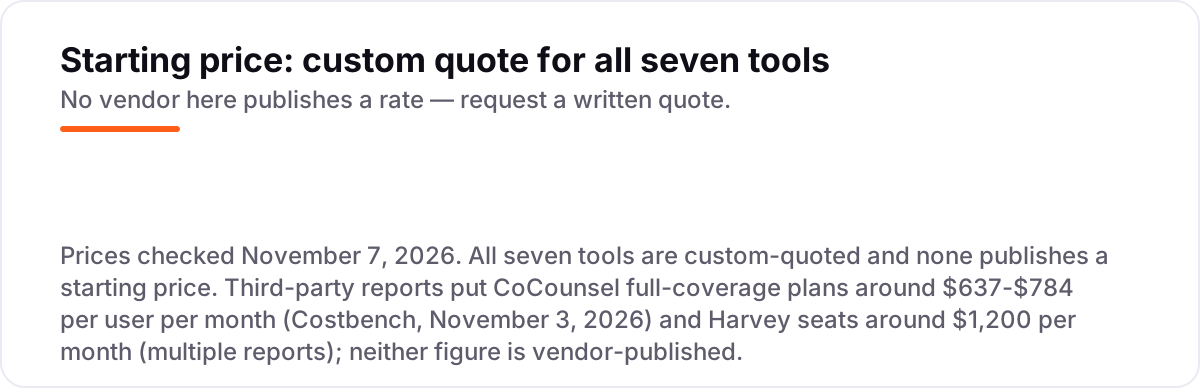
Take a five-attorney PI firm that sends about 20 demands a month. The only published number in this list is Clio's: EasyStart at $49 per user per month, or $245 a month for five seats — but Duo's AI is a quoted add-on on top, so even that is only the floor. Everything else must be quoted, and third-party reports give the shape of the quotes: CoCounsel full-coverage plans are reported at $637–$784 per user per month, which is $3,185–$3,920 a month for five seats; EvenUp is reported at roughly $300–$800 per demand, which is $6,000–$16,000 a month at 20 demands; Everlaw platform fees are reported at $2,000–$5,000 a month plus $18–$35 per gigabyte hosted.
Those reported figures are negotiation anchors, not prices, and they measure different things: per seat, per demand and per gigabyte. A firm that sends 20 demands a month will feel EvenUp's per-case model most, while a firm with five heavy users will feel CoCounsel's per-seat model most. The honest way to compare is to ask every vendor for the same thing: a 12-month quote for your headcount and your demand volume, in writing, with the renewal terms stated.
Three costs sit outside every quote above. First, the stack: CoCounsel assumes a Westlaw subscription and Lexis+ AI assumes a Lexis+ subscription, so the AI quote sits on top of a research bill you may already pay. Second, implementation: Filevine runs setup through certified partners, and G2 reviewers report about four months to implement. Third, the review time your own attorneys spend checking AI output — a demand that goes out with a wrong medical date costs far more than the software that drafted it. If the firm also buys visibility work, see our guide to the best SEO company for attorneys.
Know the difference: a PI tool vs a general legal AI
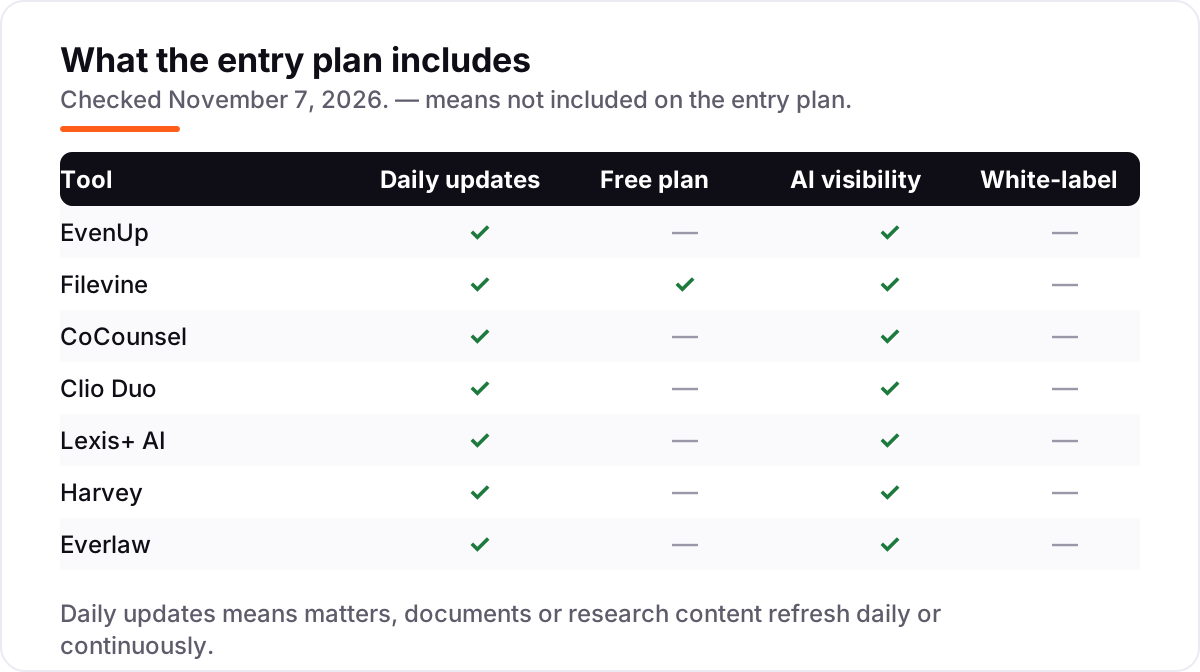
The confusion in this category is between software that understands personal injury and software that understands law in general. A PI-native tool — EvenUp, and Filevine's DemandsAI and MedChron — works from medical records, treatment timelines and verdict data, and its output is a demand package. A general legal AI — CoCounsel, Lexis+ AI and Harvey — works from case law and secondary sources, and its output is research, a memo or a brief. Both are useful, but they solve different problems, and buying the second when you need the first leaves the demand work undone.
There is a third kind hiding in this list: AI inside practice management. Clio Duo does not research the law or draft demands from records; it works from the matters, clients and billing already in Clio, and makes the running of the firm faster. Everlaw is a fourth kind again: a litigation review platform for the case that becomes a document fight, not a tool for the pre-suit phase at all. Match the tool to the job — demand, research, firm-running or litigation — before you match it to a price.
A related trap is treating a reported price as a quote. The figures in this guide that come from third parties — CoCounsel at $637–$784, Harvey near $1,200 a seat, Everlaw's platform fee — are reported by buyers and analysts, not published by the vendors. They tell you the order of magnitude to expect in a negotiation, and they are labelled as reported wherever they appear. The vendor's own number is the one on your order form.
Quick comparison: tool type by need
| Buyer | Best pick | Why |
|---|---|---|
| PI-only firm that lives on demands | EvenUp | PI-native from intake to trial; custom quote, priced per case |
| Firm choosing a case system with AI | Filevine | LOIS agents across the caseload; custom quote, free LOIS Explore tier |
| Research and briefs on trusted content | CoCounsel | Cited Westlaw research with inspectable reasoning; custom quote |
| Solo or small firm already on Clio | Clio Duo | AI inside practice management; EasyStart from $49/user/month |
| Firm already on LexisNexis | Lexis+ AI | AI research on Lexis content with Shepard's citations; custom quote |
| Large firm wanting firm-wide agents | Harvey | One platform for research, drafting and agents at enterprise scale; custom quote |
| Document-heavy litigation | Everlaw | Review, analytics and trial prep with unlimited users; custom quote |
Mistakes to avoid
- Budgeting on a reported price. The leaked and estimated figures in this guide are not quotes. Two firms can pay very different amounts for the same product, so budget only on the written quote for your firm.
- Buying a general legal AI and expecting PI demand work. CoCounsel, Lexis+ AI and Harvey research and draft well, but they do not build medical chronologies or demand packages. If demands are the job, buy a PI-native tool.
- Uploading medical records before reading the data terms. Check storage, model training and retention before any client file leaves the firm, and confirm whether the vendor will sign a business associate agreement.
- Skipping the trial on a real file. A demo on the vendor's sample data proves nothing. Run one closed case — records, bills and the settled demand — through the trial and compare the output line by line.
- Forgetting the stack cost. The AI add-on is only one line of the bill. CoCounsel assumes Westlaw, Lexis+ AI assumes Lexis+, and Clio Duo assumes Clio — price the whole stack before you sign.
How we chose
We checked each vendor's own pricing page on November 7, 2026 and recorded the starting price exactly as shown: all seven tools are custom-quoted, so none carries a dollar figure in this list. Where a dollar figure appears in this guide — CoCounsel, Harvey, Lexis+ AI, EvenUp and Everlaw — it is a third-party-reported figure, labelled as reported and sourced, never presented as a vendor price. Ratings come from the vendors' G2 pages, checked November 7, 2026. Clio Duo carries no rating because G2 lists Clio Manage, not Duo as a separate product, and we would rather show no rating than attribute another product's score to it. We ranked the tools by fit for the most common buyer — a PI firm that lives on medical records and demands — not by brand size. No vendor paid for a place in this list, and none of the links here are affiliate links.
What to do next
Shortlist two tools — one PI-native and one research tool — and trial each on the same closed case, then ask both vendors for a written 12-month quote for your headcount and demand volume. Compare the quotes on the same basis: term, seats, modules and renewal uplift, not headline figures. If the practice is sorted but new clients are not finding it, our local SEO service handles the visibility side — or compare providers in our guide to SEO companies for law firms. Once your tools are in place, find out what's holding your rankings back.
Your stack only works if people find you
SerpAstra fixes what keeps your site off page one and makes it easy for AI assistants to recommend.
Get a free audit→Sources we checked (13)
- EvenUp — evenuplaw.com (checked November 7, 2026)
- Filevine pricing — filevine.com/pricing (checked November 7, 2026)
- CoCounsel pricing — thomsonreuters.com/cocounsel (checked November 7, 2026)
- Clio pricing — clio.com/pricing (checked November 7, 2026)
- Lexis+ AI — lexisnexis.com (checked November 7, 2026)
- Harvey — harvey.ai (checked November 7, 2026)
- Everlaw pricing — everlaw.com/pricing (checked November 7, 2026)
- CoCounsel Legal reviews — g2.com/products/cocounsel-legal/reviews (checked November 7, 2026)
- Harvey AI reviews — g2.com/products/harvey-ai/reviews (checked November 7, 2026)
- LexisNexis Lexis+ AI reviews — g2.com/products/lexisnexis-lexis-ai/reviews (checked November 7, 2026)
- Everlaw reviews — g2.com/products/everlaw/reviews (checked November 7, 2026)
- Filevine reviews — g2.com/products/filevine/reviews (checked November 7, 2026)
- EvenUp reviews — g2.com/products/evenup/reviews (checked November 7, 2026)
Shamim
Founder of SerpAstra
A full-stack SEO and digital marketer who spends most days on Local SEO for dental practices, AI search visibility and lead generation.
Frequently asked questions
What is the best AI tool for PI attorneys?
EvenUp is the best fit for most PI firms because it is the only platform built end to end for personal injury, from intake and treatment tracking to demands and trial prep. Filevine is the better pick when a firm is choosing a case system, and CoCounsel leads on cited research.
How much do AI tools for PI attorneys cost?
None of the seven tools here publishes a starting price — all are custom-quoted. Third-party reports put CoCounsel full-coverage plans at $637–$784 per user per month and Harvey seats near $1,200, but those are reported figures, not vendor prices. Get a written quote before budgeting.
Is there a free AI tool for PI attorneys?
Filevine's LOIS Explore is the only free tier in this list: it lets a firm try the AI tools without a card, but it does not include case management. Lexis+ AI advertises a 2-day free trial, and Clio offers a 7-day free trial of its practice platform. Every other tool starts with a demo and a sales quote.
CoCounsel or Lexis+ AI for a PI firm?
Pick the one that matches the research library you already pay for. CoCounsel reasons from Westlaw and Practical Law content, while Lexis+ AI works on LexisNexis content with Shepard's citations. Both are quoted add-ons, so price the stack — research subscription plus AI — not the AI alone.
Can AI write a demand letter I can send?
AI can draft a demand letter, but no draft should go out unchecked. Verify every medical date, treatment gap and billing figure against the source records, and confirm every citation in the original authority. Keep a human attorney responsible for every demand that leaves the firm.
Do I still need case management software if I buy an AI tool?
Usually yes. Only Filevine and Clio Duo include practice management — Filevine as a case platform, Clio Duo inside Clio. EvenUp, CoCounsel, Lexis+ AI, Harvey and Everlaw do not replace case management, intake or billing, so budget for both systems.
What should I check before uploading medical records to an AI tool?
Read the data terms first: how records are stored, who can see them, whether they train models, and how long they are kept. Confirm whether the vendor will sign a business associate agreement. Never upload sensitive records to a tool whose data terms you have not reviewed.
Free SEO and AI visibility audit
Find out what is holding your rankings back
Send us your site. Within 2 business days you get a written audit, an AI visibility check and a short fix list ranked by impact. Free, with no contract attached.
Request my free audit→Related guides
 SEO & AI Search9 Best SEO Companies for Attorneys in 2026Best seo company for attorneys: 9 firms compared on published starting prices, legal-only focus and AI visibility, with prices checked November 1, 2026.Read guide →
 SEO & AI Search9 Best SEO Companies for Law Firms in 20269 best SEO companies for law firms compared on price, focus and fit, with starting prices checked November 1, 2026 and ranked by fit for your firm.Read guide →
 Digital Marketing & AdsBest Legal Marketing Software for 2026: 7 Options Compared by Use CaseCompare the 7 best legal marketing software options for 2026 on price, intake, automation and reviews, with prices checked November 4, 2026.Read guide →