
7 Best B2B Ecommerce Platforms in 2026, Compared
Compare the 7 best B2B ecommerce platforms on company accounts, price lists, ERP links and real cost, with every price checked on the vendor's own pricing page.
 Shamim Mia, Founder, SerpAstraLast verified November 1, 20268 min read
We compare pricing pages, documentation and public reviews. We never accept payment for rankings.

Key takeaways
- Adobe Commerce is the most complete B2B e-commerce platform here, with company accounts, shared catalogs, quotes and approvals built in, but it is quote-only and needs developers.
- Shopify Plus is the fastest route for a brand adding wholesale to a retail store, from €2,100 a month on Shopify's pricing page, with unlimited B2B catalogs.
- OroCommerce and Sana Commerce publish no prices; Sana is the pick when the ERP (SAP Business One or Dynamics 365 Business Central) must drive prices and stock.
- WooCommerce and PrestaShop cost nothing to license, so a small distributor can start a B2B portal for the price of hosting and a few extensions.
On this page
Quick comparison
| Tool | Best for | Starting price | Free plan |
|---|---|---|---|
| Adobe Commerce | Manufacturers and distributors with complex catalogs, negotiated pricing and approval workflows | Custom quote | No (demo only) |
| Shopify Plus | Retail brands adding a wholesale channel without running a second platform | From €2,100/mo | No |
| BigCommerce | Mid-size wholesalers that want a hosted store with no staff-account limits | $39/mo | No (15-day trial) |
| OroCommerce | B2B companies that want commerce, CRM and product data in one platform | Custom quote | No |
| Sana Commerce | Distributors on SAP or Microsoft Dynamics that want the ERP to drive the web store | Custom quote | No |
| WooCommerce | Small distributors on WordPress that want a low-cost trade portal they fully own | Free | Yes (free plugin) |
| PrestaShop | European wholesalers selling across languages and currencies on a free platform | Free (Classic) | Yes (free download) |
Make one of these tools?
We re-check this list every quarter. Send a correction, request a review, or ask about a clearly labeled sponsored spot.
Request a listingThe best B2B ecommerce platforms

Adobe Commerce
Best for: Manufacturers and distributors with complex catalogs, negotiated pricing and approval workflows
Adobe Commerce, formerly Magento Commerce, has the deepest native B2B toolset in this list. Company accounts with buyer roles, shared catalogs that show each customer only their products and prices, quote requests and purchase approvals all ship with the platform rather than as add-ons, and it handles very large catalogs and order volumes.
The price is the barrier. Adobe publishes no list price and licenses by gross merchandise value, so budgeting starts with a sales call, and third-party estimates put licences well into five figures a year before hosting and development. Every change needs a developer. It is the right choice when the B2B rules are complex enough to justify an engineering team.
What we like
- The deepest customization in this list: custom product types, pricing logic, checkout flows and B2B workflows like quotes and approvals
- Handles very large catalogs and high traffic, with company accounts, shared catalogs and personalized pricing built in
- Full control of URLs, metadata and schema, with no platform-imposed structure
Watch out for
- No published price — you need a sales consultation, and third-party estimates put licences well into five figures a year before hosting and development
- Needs developers for setup and ongoing maintenance; routine changes are slower and more expensive than on a hosted platform

Shopify Plus
Best for: Retail brands adding a wholesale channel without running a second platform
Shopify Plus suits a brand that already sells direct to consumers and wants to open wholesale without a second system. Business customers, B2B catalogs and retail orders share one admin and one inventory, and Shopify's comparison table lists unlimited B2B catalogs on Plus against up to three on the lower plans, plus custom user groups and managing business customers by market.
Shopify's Ireland pricing page lists Plus from €2,100 a month, with 1- and 3-year terms that can be cancelled when the term ends. Card rates start at 1.4% plus €0.25 for standard online cards, and orders through a third-party gateway carry a 0.2% fee. It is fast to launch, but buyers with complex approval chains may need apps on top.
What we like
- Unlimited B2B catalogs on Plus, against up to 3 on Shopify's lower plans
- Wholesale and retail run from one admin, one product catalog and one inventory
- Custom user groups and managing business customers by market are Plus-only features
- The same app and theme ecosystem as standard Shopify
Watch out for
- From €2,100 a month is a large jump for a small wholesaler
- A 0.2% fee applies to orders through third-party payment gateways
- Deep quote and approval logic still needs apps or custom work

BigCommerce
Best for: Mid-size wholesalers that want a hosted store with no staff-account limits
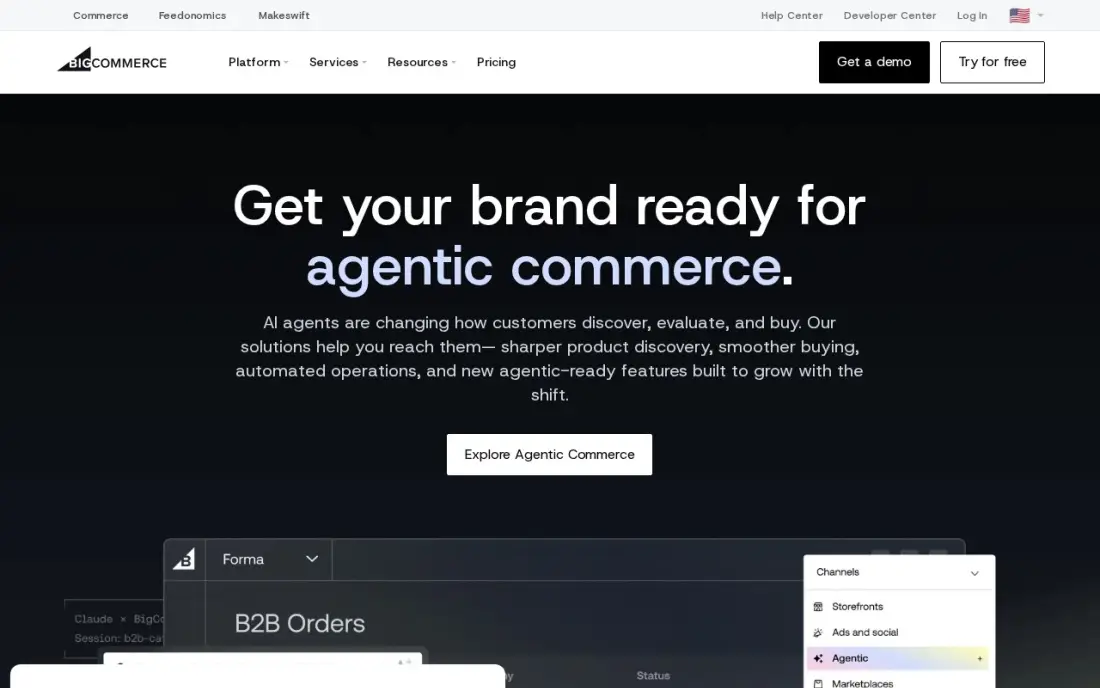
BigCommerce is the hosted middle ground between Shopify and Adobe Commerce. Every plan includes unlimited products, staff accounts and storage, which matters for a wholesaler whose sales reps, warehouse staff and customer service all need logins, and multi-currency selling is built into Core. Approved embedded payment providers such as Stripe and PayPal carry no platform fee.
Core costs $39 a month, or $29 billed annually, but it covers only $30,000 in trailing 12-month sales and auto-upgrades when you pass that line, so a wholesale store will move up the plans quickly. Ask BigCommerce sales which plan carries the B2B tools you need, such as customer-specific pricing and quotes, before you compare it with Shopify Plus.
What we like
- Unlimited products, staff accounts and storage on every plan, with real-time shipping quotes
- Multi-currency selling and gift cards are included on Core, not held for a higher tier
- No platform fee on orders through approved embedded payment providers such as Stripe and PayPal
- Built-in SEO and product filtering that skin care catalogs with many variants need
Watch out for
- The plan auto-upgrades when trailing 12-month sales pass $30,000, so growth raises the bill
- A 2% fee applies on orders through payment gateways outside BigCommerce's approved list
- Abandoned cart recovery is not included on the entry Core plan

OroCommerce
Best for: B2B companies that want commerce, CRM and product data in one platform
OroCommerce was built for B2B selling rather than adapted from a consumer store, and its licence bundles commerce with CRM, a marketplace module, product information management and a CMS. Oro says one licence covers unlimited sites and all enterprise features, which suits a manufacturer that runs separate portals for distributors, dealers and direct accounts.
Oro publishes no price. Its pricing page says cost depends on gross merchandise value and admin users, that enterprise packages start with 25 admin users, and that OroCloud hosting is quoted to each customer's needs. That puts it in the same buying process as Adobe Commerce, so ask for a three-year total including hosting and implementation.
What we like
- Built for B2B from the start rather than adapted from a retail platform
- One licence covers unlimited sites and all enterprise features
- Commerce, CRM, marketplace, PIM and CMS sit in one platform
Watch out for
- No published price; cost depends on gross merchandise value and users
- Enterprise packages start at 25 admin users, more than a small team needs
- OroCloud hosting is priced separately to each customer

Sana Commerce
Best for: Distributors on SAP or Microsoft Dynamics that want the ERP to drive the web store
Sana Commerce takes a different approach from every other platform here: the web store reads prices, stock, order history and documents straight from the ERP instead of syncing copies of them. Its pricing page lists SAP Business One and Microsoft Dynamics 365 Business Central on every plan, with real-time stock and shipping rates on Essential, and quote-to-order conversion, returns and customer segments on Pro.
All three plans, Essential, Pro and Advanced, show request pricing only. The ERP lists differ between the plan cards and the page text, so confirm your exact ERP version before a demo. If your prices already live in SAP or Dynamics, Sana removes the sync work that other platforms need.
What we like
- Native ERP integration with SAP Business One and Dynamics 365 Business Central on every plan
- Real-time stock, shipping rates and order history pulled from the ERP
- Pro adds quote-to-order conversion, returns and customer segments
Watch out for
- No published prices on any of the three plans
- Only useful if you run one of the supported ERPs
- PIM, payments and analytics are paid add-ons below the Advanced plan

WooCommerce
Best for: Small distributors on WordPress that want a low-cost trade portal they fully own
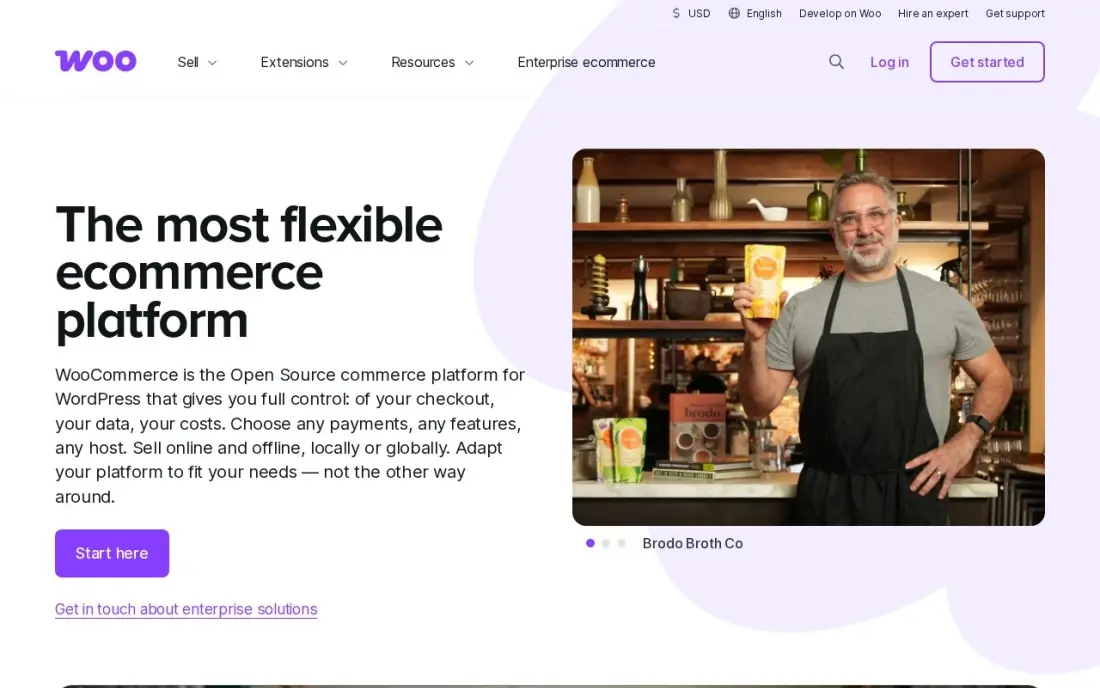
WooCommerce is the cheapest way to open a trade portal: the plugin is free, open source and takes no share of revenue, and it runs on the WordPress site many small manufacturers already have. Wholesale price tiers, minimum order quantities, login-only catalogs and invoice payment terms are all available through extensions, so a small distributor can start with what it needs.
The work is yours. Hosting runs $25 to $350 a month on WooCommerce's own estimate, extensions cost $29 to $299 a year each, and security, backups and updates are the owner's job. A B2B portal usually needs three or four extensions, so budget for them and for a developer who can keep them working together.
What we like
- The plugin itself is free and open source, with no licence fee and 0% revenue share
- More than 7 million active installations, so almost every skin care tool already integrates with it
- Full control over design, checkout and customer data, with no platform branding anywhere
- Subscriptions, bundles and memberships are available through extensions
Watch out for
- Hosting, security and updates are the owner's job, not the platform's
- The real cost is hosting at $25-$350 a month plus paid extensions at $29-$299 a year each
- No hosted support team to call when checkout breaks at midnight

PrestaShop
Best for: European wholesalers selling across languages and currencies on a free platform
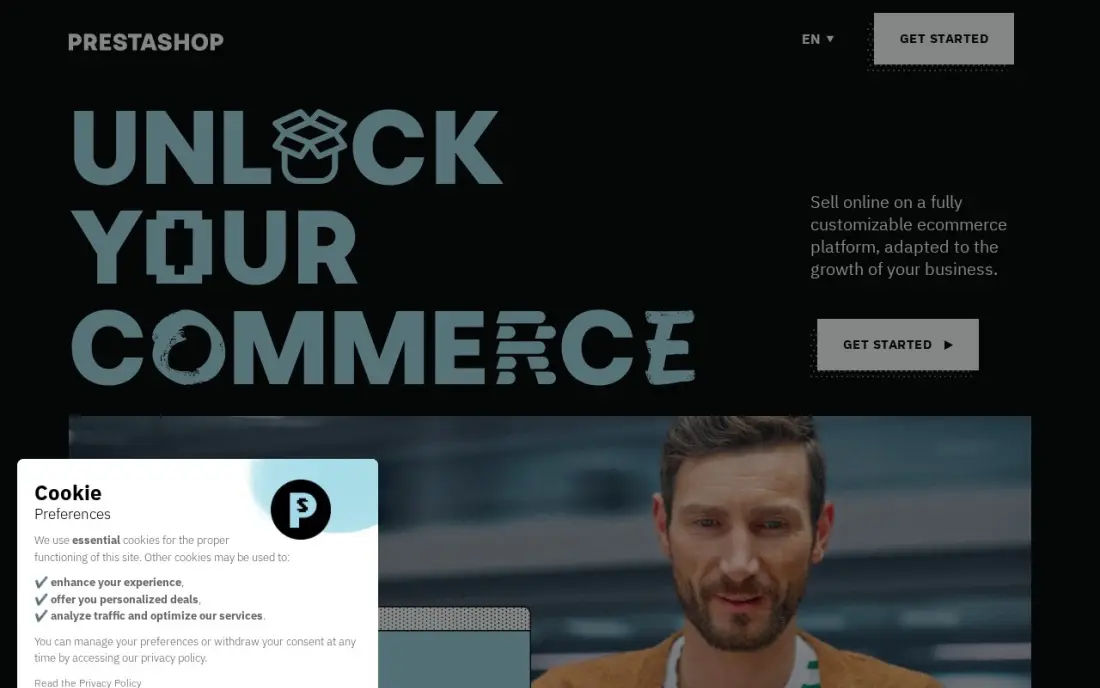
PrestaShop is free, open-source software with no subscription and no commission on sales, and it ships with multilingual and multi-currency selling, which suits a European wholesaler with trade customers in several countries. Customer groups with their own prices and more than 4,000 modules in the Addons Marketplace cover most B2B needs.
Like WooCommerce, you run the infrastructure. Hosting, security, updates and performance are your job, support is community-led unless you buy a plan, and the modules a production B2B store needs are usually paid. The hosted plan starts at €24 a month excluding tax if you would rather not manage servers yourself.
What we like
- Free open-source software with no subscription fees and no commission on sales — you own the store and the data
- Strong native SEO and catalog tools, with multilingual and multi-currency selling built in for international stores
- More than 4,000 modules and themes in the Addons Marketplace for extending the store
Watch out for
- You handle hosting, security, updates and performance yourself, or pay an expert — support is community-led unless you buy a plan
- Advanced modules and themes are paid, so a production store often costs more than the free download suggests
The best B2B ecommerce platforms let a trade buyer log in, see their own prices, reorder in a few clicks and pay on account, without a sales rep keying the order. We compared seven B2B e-commerce platforms, from enterprise suites to free open-source options, on company accounts, customer-specific pricing, ERP connections and the real cost of running them. Every price comes from the vendor's own pricing page, checked in November 2026.
How to choose the best B2B ecommerce platforms
- Map your pricing rules first. List how prices are set today: price lists by customer group, contract prices, volume breaks or negotiated quotes. The platform must support your most complex rule natively or through a tested extension.
- Check company accounts and roles. A trade customer usually has several buyers and an approver. Look for company accounts with roles, spending limits and approval steps.
- Decide where the truth lives. If prices, stock and credit limits sit in an ERP, the platform must read from it in real time or sync it reliably; otherwise you will rekey orders.
- Price the full three years. Licence, hosting, implementation and extensions together decide the cost, and quote-only platforms often include a multi-year term.
- Plan for payment on terms. Invoices, purchase-order numbers and net-30 terms are standard in B2B; check they work at checkout without a workaround.
- Keep the public side searchable. Hiding prices behind a login is normal, but product pages should stay indexable so new buyers can find you.
A trade portal that search engines cannot read wins no new accounts. Our SEO audit checks whether login walls, faceted navigation and duplicate catalogs are hiding your product pages, and our guide to SEO for ecommerce covers the fixes.
B2B ecommerce platform pricing: what you will actually pay
Take a wholesaler with 2,000 products and ten staff who need logins. BigCommerce Core costs $39 a month billed monthly or $29 billed annually, with unlimited staff accounts, but it auto-upgrades once trailing 12-month sales pass $30,000, so a wholesale business will pay for a higher plan almost at once. Shopify Plus starts from €2,100 a month on Shopify's pricing page, or €25,200 a year.
WooCommerce and PrestaShop cost nothing to license. On WooCommerce's own estimate, hosting runs $25 to $350 a month, so a year of hosting costs $300 to $4,200 before extensions at $29 to $299 a year each. PrestaShop's hosted plan starts at €24 a month excluding tax. Adobe Commerce, OroCommerce and Sana Commerce publish no prices, and OroCommerce enterprise packages start at 25 admin users, so get a written three-year total that includes hosting and implementation.
Know the difference: B2B suite vs B2C platform with B2B features
A B2B suite such as Adobe Commerce, OroCommerce or Sana Commerce is built around the company account. Each buyer belongs to a business with its own catalog, price list, credit terms and approval chain, and quotes and requisition lists are part of the core product. These platforms cost more and need implementation partners, but they model how trade buying actually works.
A B2C platform with B2B features, such as Shopify Plus, BigCommerce or WooCommerce with extensions, starts from a consumer checkout and adds wholesale catalogs, customer groups and payment terms on top. That suits a brand selling to stockists alongside consumers, where orders are simple and speed to launch matters more than deep approval rules.
Quick comparison: tool type by need
| Buyer | Best pick | Why |
|---|---|---|
| Complex manufacturers | Adobe Commerce | Company accounts, shared catalogs, quotes and approvals built in |
| Retail brands adding wholesale | Shopify Plus | Unlimited B2B catalogs alongside retail, from €2,100/month |
| Hosted mid-market wholesalers | BigCommerce | Unlimited staff accounts, Core from $39/month |
| All-in-one B2B suite | OroCommerce | Commerce, CRM, PIM and CMS in one licence, quote-only |
| SAP or Dynamics users | Sana Commerce | Prices and stock read straight from the ERP |
| Small WordPress distributors | WooCommerce | Free plugin, wholesale features by extension |
| Multilingual EU wholesalers | PrestaShop | Free software, multi-currency and multilingual built in |
Mistakes to avoid
- Choosing on the demo storefront. Every platform looks good with sample products; test your hardest pricing rule with your own data before you sign.
- Ignoring the ERP until launch. Integration is usually the longest part of a B2B project, so scope it before you pick the platform, not after.
- Hiding the whole catalog behind a login. Trade buyers search too; keep product pages public and gate only prices and ordering.
- Underestimating extension costs. On open-source platforms, wholesale pricing, quotes and payment terms often come from separate paid extensions that must be kept compatible.
- Skipping buyer training. Long-standing accounts used to phoning orders in need a reason and a walkthrough to switch, or the portal sits empty.
How we chose
We checked each vendor's pricing page in November 2026 and recorded the starting price exactly as shown, including annual-billing rates where listed. Adobe Commerce, OroCommerce and Sana Commerce publish no prices, so we list them as custom quotes and do not repeat third-party estimates as list prices. We scored each platform on native B2B features, ERP fit, hosting model and total cost for a typical wholesaler. Ratings come from G2 pages checked on the dates shown in the sources, and tools without a rating we checked show none. No vendor paid for a place in this list, and none of the links here are affiliate links.
What to do next
Write down your three hardest B2B rules, such as contract pricing, approvals and payment terms, and ask each shortlisted vendor to show them working with your own products. Before launch, make sure new buyers can still find your catalog in search. Book a free SEO review of your store.
Frequently asked questions
What is the best B2B ecommerce platform?
Adobe Commerce has the most complete native B2B features, including company accounts, shared catalogs, quotes and approvals, but it is quote-only. Shopify Plus, from €2,100 a month on Shopify's pricing page, is the fastest route for a brand adding wholesale to retail.
What is the difference between B2B and B2C e-commerce platforms?
A B2B platform handles company accounts with several buyers, customer-specific prices and catalogs, quotes, purchase approvals and payment on terms. A B2C platform is built for one shopper paying by card at a single public price.
Is there a free B2B e-commerce platform?
WooCommerce and PrestaShop are free to license and charge no commission, but you pay for hosting and for the extensions or modules that add wholesale pricing and trade accounts. WooCommerce estimates hosting at $25 to $350 a month.
How much does a B2B ecommerce platform cost?
On published prices, BigCommerce Core costs $39 a month or $29 billed annually, and Shopify Plus starts from €2,100 a month on Shopify's pricing page. Adobe Commerce, OroCommerce and Sana Commerce publish no prices and quote each customer.
Do I need ERP integration for B2B e-commerce?
If customer prices, stock and credit limits live in an ERP, yes — otherwise staff end up rekeying orders. Sana Commerce is built around SAP Business One and Dynamics 365 Business Central; the other platforms connect through apps or custom integrations.
Can Shopify handle B2B?
Yes. Shopify's comparison table lists up to 3 B2B catalogs on its lower plans and unlimited B2B catalogs on Plus, along with custom user groups and managing business customers by market.
Sources we checked (10)
- Adobe Commerce — business.adobe.com/products/magento/magento-commerce.html (checked November 1, 2026)
- Adobe Commerce reviews on G2 (checked November 1, 2026)
- Shopify Plus — www.shopify.com/ie/plus/pricing (checked November 16, 2026)
- BigCommerce — www.bigcommerce.com/pricing (checked November 12, 2026)
- OroCommerce — www.oroinc.com/b2b-ecommerce/orocommerce-pricing (checked November 16, 2026)
- Sana Commerce — www.sana-commerce.com/pricing (checked November 16, 2026)
- WooCommerce — woocommerce.com/pricing (checked November 12, 2026)
- WooCommerce reviews on G2 (checked November 12, 2026)
- PrestaShop — prestashop.com/start (checked November 1, 2026)
- PrestaShop reviews on G2 (checked November 1, 2026)
Make one of these tools?
We re-check this list every quarter. Send a correction, request a review, or ask about a clearly labeled sponsored spot.
Request a listingShamim
Founder of SerpAstra
A full-stack SEO and digital marketer who spends most days on Local SEO for dental practices, AI search visibility and lead generation.
Free SEO and AI visibility audit
Find out what is holding your rankings back
Send us your site. Within 2 business days you get a written audit, an AI visibility check and a short fix list ranked by impact. Free, with no contract attached.
Request my free audit→Related buying guides
 Ecommerce7 Best Ecommerce Platforms for SEO in 2026 (Pros, Cons and Pricing)The 7 best ecommerce platform for SEO picks compared on price, SEO controls and ease of use, with real 2026 prices checked on each vendor's pricing page.Read guide →
 StrategySEO for ecommerce: product and category pages that rankSEO for ecommerce: product and category pages that rank, with the structure, schema and internal links that turn search traffic into paying customers.Read guide →
 Marketing7 Best B2B Content Marketing Companies in 20267 best B2B content marketing companies compared on price, services and fit for B2B teams, with real published prices checked November 4, 2026.Read guide →