
12 Best Blogging Platforms for SEO in 2026 (Pros, Cons and Pricing)
Compare the best blogging platform for SEO for your budget: 12 platforms ranked on price, SEO controls and ownership, from free WordPress to Ghost and Webflow.
 Shamim Mia, Founder, SerpAstraLast verified November 1, 202614 min read
We compare pricing pages, documentation and public reviews. We never accept payment for rankings.

Key takeaways
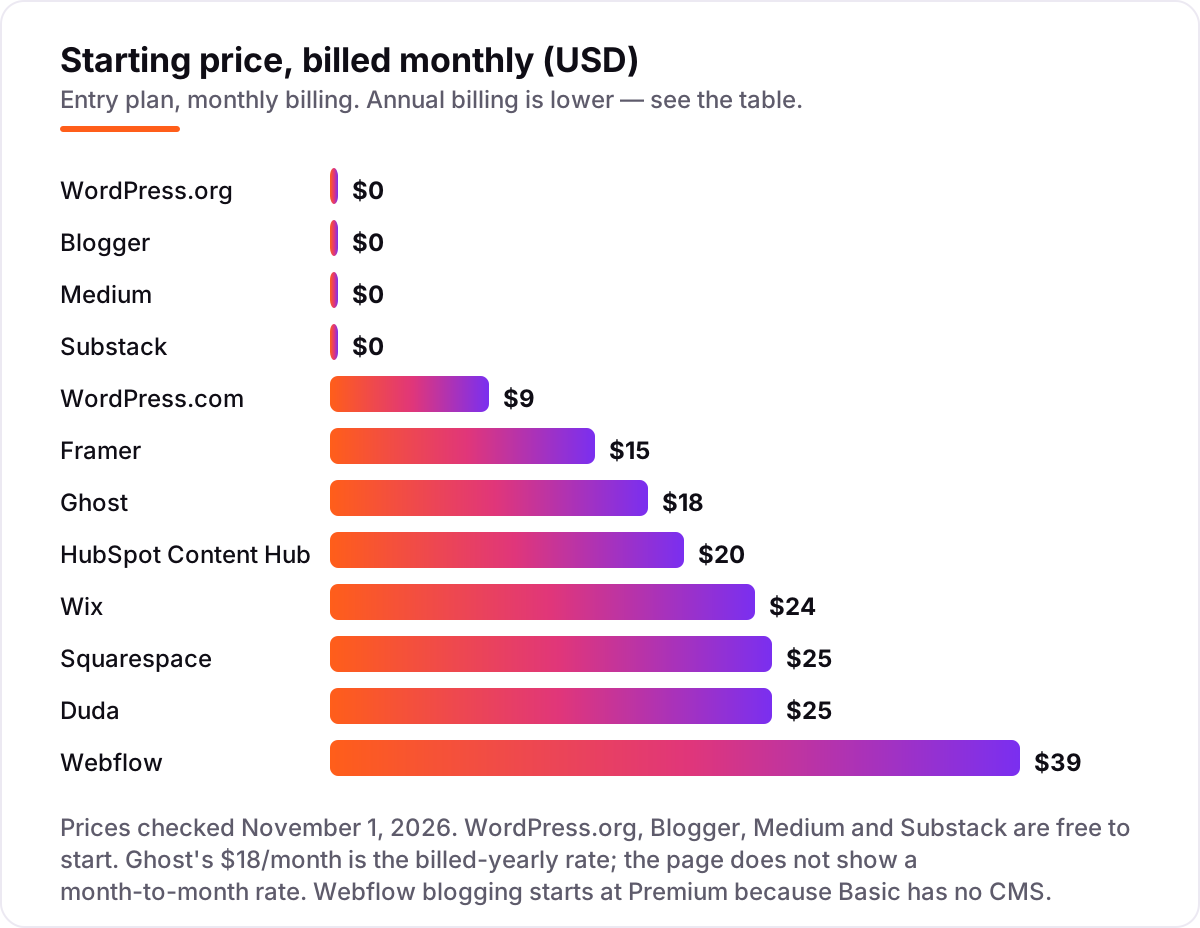
- WordPress.org is the top pick for most blogs: free software with the highest SEO ceiling. WordPress.com Personal is the cheapest hosted route at $9/month billed monthly ($4 billed annually), and Ghost starts at $15/month billed annually ($18 billed monthly).
- The single most important buying factor is ownership: your own domain and exportable content. A platform that keeps your audience and your rankings is a rental, not an asset.
- Free options are real: WordPress.org, Blogger, Medium and Substack all cost $0 to start, but only WordPress.org and Blogger let you put that free blog on your own domain without paying.
- Watch the plan names — Squarespace renamed Personal to Basic and raised it to $19/month billed annually, and Webflow blogging needs Premium ($25/month billed annually) because Basic has no CMS.
- Every price below was checked on the vendor's own pricing page on November 1, 2026. Ratings are G2, except Blogger and Medium, which have no usable G2 rating, so no rating is shown for them.
On this page
Quick comparison
| Tool | Best for | Starting price | Free plan |
|---|---|---|---|
| WordPress.org | Bloggers and small businesses that want full SEO control, any plugin and any host, and do not mind setup and maintenance | Free (+ hosting) | Yes (software free) |
| WordPress.com | Bloggers who want WordPress without managing hosting, and a custom domain from the cheapest paid plan | $4/mo (annual) | Yes (free plan) |
| Ghost | Independent publishers and newsletter writers who want a fast, clean blog with paid memberships built in | $18/mo | No (14-day trial) |
| Webflow | Design-led marketing teams that want pixel-level control over a fast blog and can pay for the CMS plan | $25/mo (annual) | Yes (Starter) |
| Squarespace | Creative and service businesses that want a polished blog and website with no setup or maintenance | $19/mo (annual) | No (14-day trial) |
| Wix | Beginners and small businesses that want a drag-and-drop blog with hosting and support included | $17/mo (annual) | Yes (free plan) |
| HubSpot Content Hub | B2B marketing teams already running HubSpot CRM who want the blog tied to contacts, email and reporting | $20/mo per seat | Yes (free tools) |
| Framer | Designers and small teams who want a fast, visual blog and publish from Figma-style canvas editing | $10/mo (annual) | Yes (free plan) |
| Duda | Agencies and freelancers who build and manage client blogs and want client accounts and white-label tools | $19/mo (annual) | No (14-day trial) |
| Blogger | Hobby bloggers and anyone who wants a free blog with a custom domain and no monthly bill | Free | Yes (free) |
| Medium | New writers who want readers from day one and will trade domain ownership for distribution | Free | Yes (free) |
| Substack | Writers building a paid email list who want to monetise subscriptions without a monthly bill | Free (10% fee) | Yes (free) |
Make one of these tools?
We re-check this list every quarter. Send a correction, request a review, or ask about a clearly labeled sponsored spot.
Request a listingThe best blogging platforms for SEO

WordPress.org
Best for: Bloggers and small businesses that want full SEO control, any plugin and any host, and do not mind setup and maintenance
WordPress.org is the free, open-source software behind more than 40% of all websites, and it is the top pick here because no SEO control is gated behind a plan. You choose the host, the theme and the plugins, so you can set URL structure, redirects, schema, sitemaps and caching exactly as you want them. Rank Math and Yoast SEO add on-page checks, internal-link suggestions and structured data without a monthly subscription.
The trade-off is responsibility. You pay for hosting and a domain, and you handle updates, backups and security — or pay a managed host to do it. A cheap shared host or a bloated theme can undo the SEO advantage, so budget for decent hosting. If you want the highest SEO ceiling and full ownership of your content, start here.
What we like
- Free open-source software with the largest plugin and theme ecosystem of any platform here, including Rank Math and Yoast SEO
- Full control of technical SEO: URL structure, redirects, schema, sitemaps, robots.txt and server-level speed settings
- Your content and data are fully portable — export the whole site and move hosts at any time
Watch out for
- No hosting, support or backups included — you choose and pay for a host, and you handle updates and security
- SEO quality depends on your theme and plugins; a bad theme or plugin can slow the site and hurt rankings

WordPress.com
Best for: Bloggers who want WordPress without managing hosting, and a custom domain from the cheapest paid plan
WordPress.com is the hosted version of WordPress, and it is the easiest way to get a WordPress blog on your own domain without touching a server. Personal costs $9/month billed monthly or $4/month billed annually, and it includes a custom domain free for the first year, 6 GB of storage and no WordPress.com ads. Since April 2026, every paid plan can install plugins and upload third-party themes, which used to need the Business plan.
The gap to self-hosted WordPress is control. There is no server access, and SFTP, staging and one-click backups sit on Business at $25/month billed annually. Monetisation is also more restricted on the lower plans. Pick WordPress.com when you want WordPress plugins without server work; pick WordPress.org when you want the server too.
What we like
- Cheapest hosted route to a WordPress blog on your own domain: Personal is $9/month billed monthly, $4/month billed annually
- Since April 2026 every paid plan, Personal included, can install plugins and upload third-party themes
- Hosting, SSL, backups and security are handled, and the free plan lets you start before paying
Watch out for
- Less control than self-hosted WordPress: no server access, and SFTP, staging and backups need Business ($25/month billed annually)
- WordPress.com takes a cut of some payments and limits monetisation options on lower plans

Ghost
Best for: Independent publishers and newsletter writers who want a fast, clean blog with paid memberships built in
Ghost is a publishing platform first and a website builder second, and that focus shows in the writing experience and the speed of the sites it produces. Ghost(Pro) is the managed service: Starter costs $15/month billed annually ($18 billed monthly) and includes your own website, a free custom domain, a newsletter and 1,000 members. Paid subscriptions, custom themes and advanced analytics need Publisher at $29/month billed annually, and Ghost takes 0% of subscription revenue on those plans.
The SEO story is strong but narrow. Sitemaps, structured data, canonical tags and RSS are built in, and the output is fast without plugins to maintain. The limits are the smaller theme ecosystem and member-based pricing that climbs as your list grows. Choose Ghost when the publication is the business; choose WordPress when the blog is one part of a bigger site.
What we like
- Publishing-first design: a fast editor, built-in newsletters and memberships, and 0% Ghost transaction fees on paid subscriptions
- Clean, fast output with built-in SEO basics — XML sitemaps, structured data, canonical tags and RSS — and no plugin maintenance
- Self-hosting is free open-source software, so you can leave Ghost(Pro) without losing the platform
Watch out for
- Starter ($15/month billed annually; $18 billed monthly) has no paid subscriptions, custom themes or advanced analytics — those need Publisher ($29/month billed annually)
- Pricing rises with member count, so a growing list raises the bill even if traffic does not

Webflow
Best for: Design-led marketing teams that want pixel-level control over a fast blog and can pay for the CMS plan
Webflow is the design-led pick in this list. In May 2026 it replaced the old CMS and Business site plans with a single Premium plan at $25/month billed annually, or $39 billed monthly, and Basic at $15/month billed annually has no CMS at all — so a blog starts at Premium. That plan includes 20,000 CMS items across 40 collections, site search and 50 GB of bandwidth, plus the visual Designer that gives pixel-level control over every page.
The SEO controls are built in rather than bolted on: meta titles and descriptions, Open Graph settings, redirects, sitemaps and clean code output all come standard. The cost is the learning curve and the lock-in — exporting a Webflow site means rebuilding the CMS elsewhere. Buy Webflow when design quality is the priority and the team can learn the Designer.
What we like
- Strong built-in SEO controls: editable meta titles and descriptions, Open Graph settings, redirects, sitemaps and clean, fast code output
- Premium includes 20,000 CMS items across 40 collections, site search and 50 GB of bandwidth — room for a large blog
- Visual CMS with scheduled publishing, so editors can run the blog without a developer
Watch out for
- Blogging needs the Premium plan ($25/month billed annually; $39 billed monthly) because Basic ($15/month billed annually) has no CMS
- Steep learning curve — the Designer is powerful but takes weeks to learn well

Squarespace
Best for: Creative and service businesses that want a polished blog and website with no setup or maintenance
Squarespace is the easiest route to a blog that looks designed. Every plan includes blogging — scheduled posts, categories and tags, comments, contributor management and content paywalls — plus hosting, SSL, analytics and SEO basics, with a free custom domain for the first year on annual plans. Basic costs $25/month billed monthly or $19/month billed annually, after a 2026 price rise and a rename from the old Personal plan.
The trade-off is flexibility. There is no plugin ecosystem, so technical SEO control is limited to what Squarespace exposes, and Basic allows only two contributors. The price is also higher than the $16 Personal plan many older guides still quote — check the live pricing page, not a directory. Pick Squarespace when the look of the blog matters as much as the words.
What we like
- The strongest templates here — a design-led blog looks finished without hiring a designer
- Blogging is built in on every plan: scheduled posts, categories and tags, comments, contributor management and content paywalls
- Hosting, SSL, analytics and SEO basics are included, with a free custom domain for the first year on annual plans
Watch out for
- Prices rose in 2026: Basic is now $19/month billed annually ($25 billed monthly), up from the $16 Personal plan many guides still quote
- Basic allows only 2 contributors and charges a 2% transaction fee on store sales plus 7% on digital products and memberships

Wix
Best for: Beginners and small businesses that want a drag-and-drop blog with hosting and support included
Wix is the lowest-friction builder in this list: a blog can be live the same afternoon you sign up, on a free plan with a wixsite.com address or on Light at $24/month billed monthly, $17/month billed annually, with a custom domain free for the first year. The blog tools cover scheduled posts, categories, per-post SEO settings and an app market for extra features, and every paid plan includes unlimited bandwidth.
The limits show up as the blog grows. Light cannot take payments and has only 2 GB of storage, so a serious blog needs Core at $29/month billed annually. You also cannot switch templates without rebuilding the site. Pick Wix when ease matters more than depth; pick WordPress or Ghost when the blog will grow into a publication.
What we like
- The easiest builder to learn: drag-and-drop editing, an AI site builder and hundreds of templates, with a free plan to start
- Blog tools cover scheduled posts, categories, SEO settings per post and an app market for extra features
- Unlimited bandwidth on every paid plan, and a free domain for the first year on yearly plans
Watch out for
- Light ($17/month billed annually) cannot take payments and has only 2 GB of storage, so a growing blog outgrows it fast
- No way to switch templates without rebuilding, and the blog tools are simpler than WordPress or Ghost

HubSpot Content Hub
Best for: B2B marketing teams already running HubSpot CRM who want the blog tied to contacts, email and reporting
HubSpot Content Hub is the only platform here where a blog post can feed your CRM directly. Starter costs $20/month per seat billed monthly, or $7/month per seat billed annually for new customers at a limited-time rate, and it removes HubSpot branding, adds a custom domain and includes website pages and a blog. Hosting, CDN and SSL are included, along with built-in SEO recommendations, content remix and AI writing help.
The catch is the jump to the features that make HubSpot worth it. A/B testing, smart content and full content remix need Professional at $450/month billed annually with three seats included, and leaving HubSpot means rebuilding the site elsewhere. Choose Content Hub when HubSpot is already your CRM; otherwise the same money buys more blog elsewhere.
What we like
- The blog plugs straight into HubSpot CRM: every reader can become a contact with lead capture, email and reporting in one place
- Built-in SEO recommendations, content remix and AI writing help, with hosting, CDN and SSL included
- Starter removes HubSpot branding and adds a custom domain, so a small team can start cheaply inside the CRM
Watch out for
- Starter is $20/month per seat billed monthly, and the $7/month billed-annually figure is a limited-time rate for new customers
- Real blogging power — A/B testing, smart content, content remix — needs Professional at $450/month billed annually with 3 seats

Framer
Best for: Designers and small teams who want a fast, visual blog and publish from Figma-style canvas editing
Framer is the quickest path from a design to a live, fast blog. Basic costs $15/month billed monthly or $10/month billed annually, and it includes a custom domain free on yearly billing, 30 pages, 2 CMS collections, 1,000 CMS items, 50 GB of bandwidth and 1,000 AI credits a month. The canvas editing feels like Figma, and the output is fast without any performance plugins.
The limits are the CMS caps and the young ecosystem. Two collections cover a blog and one more content type; a blog plus case studies plus a changelog needs Pro at $30/month billed annually, and extra editors cost $20/month each. Pick Framer for a solo blog or a small marketing site; pick Webflow when the CMS needs to hold much more.
What we like
- The fastest setup here for a good-looking blog: design on a canvas, publish, and the site is fast out of the box
- Built-in SEO settings, automatic sitemaps and clean code, with AI credits included for drafting and translation
- Cheapest paid entry with a custom domain of the design-led builders: Basic is $15/month billed monthly, $10 billed annually
Watch out for
- Basic ($10/month billed annually) allows only 2 CMS collections and 1,000 CMS items, so a blog plus a second collection needs Pro ($30/month billed annually)
- Younger plugin and integration ecosystem than Webflow or WordPress, and no native ecommerce checkout

Duda
Best for: Agencies and freelancers who build and manage client blogs and want client accounts and white-label tools
Duda is built for people who sell websites to clients, and its pricing shows it. Basic costs $25/month billed monthly or $19/month billed annually and covers one published site, with each extra site at $17–$19/month. In return you get client accounts, team seats, site comments, an AI site generator and 150 AI credits a month, plus strong per-site SEO controls: meta settings, redirects, structured data and an AI SEO assistant from the Agency plan.
For a single personal blog, Duda is overkill and overpriced — the plan structure assumes you manage many sites. Full white-label branding needs the White Label plan at $149/month billed annually. Pick Duda when you build blogs for clients; pick almost anything else in this list when the blog is your own.
What we like
- Built for managing many client sites: client accounts, team seats, site comments and an AI site generator are included
- Strong SEO controls per site — meta settings, redirects, structured data and an AI SEO assistant from the Agency plan
- Fast, mobile-first output with hosting, SSL and CDN included, and 150 AI credits a month on listed plans
Watch out for
- Agency pricing: Basic is $25/month billed monthly ($19 billed annually) and covers only 1 published site — each extra site costs $17–$19/month
- Full white-label branding needs the White Label plan at $199/month billed monthly ($149 billed annually)

Blogger
Best for: Hobby bloggers and anyone who wants a free blog with a custom domain and no monthly bill
Blogger is the only truly free blog in this list: hosting, SSL and even a custom domain cost nothing, and there is no paid plan to upgrade to. It is Google-hosted, so posts are indexed fast and AdSense plugs in directly if you want to earn from ads. Signup is a Google account, and publishing takes minutes — there is no setup, no theme shopping and no bill.
The price of free is stagnation. Google has barely updated Blogger in years, the templates and editor feel dated, and there is no plugin ecosystem, limited SEO control and no real support beyond forums. It is a fine home for a hobby blog. For a blog that earns money or builds a brand, the free price is not worth the limits.
What we like
- Completely free, including hosting, SSL and a custom domain — the only platform here with no paid plan at all
- Google-hosted, so posts are indexed fast and AdSense plugs in directly for monetisation
- Simple to start: a Google account is the whole signup, and publishing takes minutes
Watch out for
- Google has barely updated Blogger in years, and the templates and editor feel dated next to every other platform here
- No plugin ecosystem, limited SEO controls and no real support — help comes from forums only

Medium
Best for: New writers who want readers from day one and will trade domain ownership for distribution
Medium is the best place to be read quickly. It is free to publish, the writing experience is the cleanest in this list — no setup, no themes, no maintenance — and the recommendation feed and human-curated Boost put new writers in front of millions of readers. A $5/month membership, or $50 a year, unlocks the Partner Program, which pays from member reading time, and a custom domain.
The cost is ownership. You publish on medium.com, so the SEO value builds Medium's authority rather than yours, and every publication looks much the same. Earnings depend on reading time you cannot predict. Use Medium to find readers for your ideas; use your own domain when you want those readers and that authority to belong to you.
What we like
- Built-in audience of millions of readers, with recommendations and human-curated Boost surfacing new writers
- The cleanest writing experience here — no setup, no theme choices, no maintenance
- Free to publish, and the Partner Program pays from member reading time with no upfront cost
Watch out for
- You publish on medium.com, not your own domain, so the SEO value builds Medium's authority, not yours
- A custom domain and the Partner Program need a $5/month membership, and earnings depend on member reading time you cannot predict

Substack
Best for: Writers building a paid email list who want to monetise subscriptions without a monthly bill
Substack is the cheapest way to start a paid newsletter: publishing and email are free at any size, and you pay only when readers pay you — 10% of paid subscriptions plus Stripe's fees. You set your own price, with a minimum of $5 a month or $30 a year, and keep about 83% of a $10 subscription after fees. Recommendations between publications bring new subscribers without any marketing spend.
The 10% never stops, and at scale it costs far more than a flat monthly plan — at $10,000 a month in subscriptions, Substack takes $1,000. A custom domain is a one-time $50, but the site still carries Substack branding, and the SEO tools are thin next to WordPress or Ghost. Start on Substack to prove the audience exists; move when the fee outgrows the convenience.
What we like
- Free to start with no monthly bill — you pay only when readers pay you, 10% of paid subscriptions plus Stripe fees
- Email list and publication in one product, with recommendations between publications bringing new subscribers
- You set your own subscription price (minimum $5/month or $30/year) and keep about 83% of a $10 subscription after fees
Watch out for
- Substack keeps 10% of every paid subscription forever, plus Stripe fees — at scale that costs far more than a flat monthly plan
- A custom domain costs a one-time $50, and the site still carries Substack branding and design limits
What the best blogging platform for SEO actually does
A blogging platform gives you three things: a place to write, a site that publishes what you write, and the technical setup that lets Google find it. The best blogging platform for SEO is the one that does all three without getting in your way — it publishes fast pages, lets you edit titles and descriptions, builds a sitemap automatically, and puts the post on a domain you own.
The scale of the market shows why the choice matters. WordPress runs 40.8% of all websites and 59.0% of the content management market, according to W3Techs data from August 14, 2026. That share is why WordPress has the deepest SEO plugin ecosystem: every SEO problem has already been solved by someone, usually for free. The other platforms in this list trade some of that depth for speed, design or a built-in audience.
This list is organised by what you actually need: free ways to start, hosted builders that handle everything, design-led platforms, and audience-first networks. The product cards carry the prices and the details; the sections below explain which group fits which blogger.
Free options first
Four platforms in this list cost $0 to start: WordPress.org, Blogger, Medium and Substack. They are not the same kind of free. WordPress.org is free software — you pay a host, typically $3–$12 a month for starter hosting, and the domain. Blogger is free end to end, including hosting, SSL and a custom domain. Medium and Substack are free to publish, and they charge only when you want membership features or paid subscriptions.
For a new blog, start free and upgrade when the blog earns its keep. WordPress.org is the free start with the best ending, because the same free software scales to a business site. Blogger is the free start with the weakest ending — it costs nothing, but it has barely changed in years. Medium and Substack are free starts with a different ending: an audience, not a website.
Owned platforms vs rented audiences
The 12 platforms split into two camps, and the split matters more than the price. The owned camp — WordPress.org, WordPress.com, Ghost, Webflow, Squarespace, Wix, HubSpot, Framer, Duda and Blogger — puts the blog on your own domain, under your own brand. The rented camp — Medium and Substack — puts your writing inside someone else's audience network, where discovery is easier to start but harder to fully own.
A rented audience is not a bad deal at the start. Medium's recommendation feed and Substack's recommendations between publications can bring readers a new blog cannot reach on its own. The cost comes later: the SEO value of every post builds the platform's domain authority, not yours, and you cannot take the design, the brand or the recommendation traffic with you. Own the domain when the blog is the business; rent the audience when the writing is the experiment.
SEO controls that actually matter
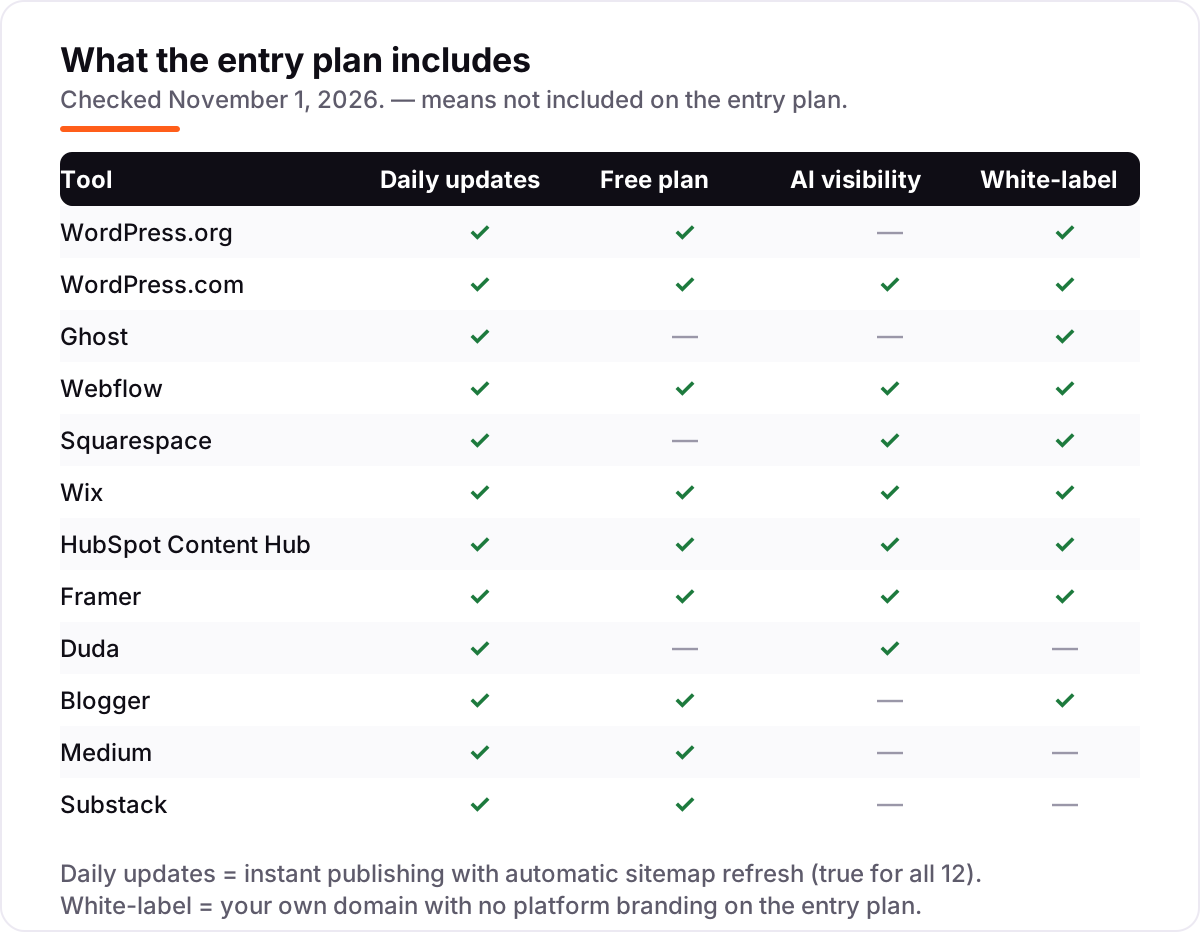
A blogging platform earns its SEO reputation on a short list of controls. First, your own domain with clean URLs you can edit. Second, editable meta titles and descriptions on every post. Third, an automatic XML sitemap and an RSS feed, so Google finds new posts fast. Fourth, fast pages — hosting, image handling and clean code all count. Fifth, redirects, so old URLs keep their rankings when you restructure.
WordPress.org gives you all five with no ceiling, through plugins if not in the core software. Ghost and Webflow give you all five built in. The hosted builders — WordPress.com, Squarespace, Wix, Framer and Duda — cover the first four well and the fifth adequately, with redirects available on paid plans. Medium and Substack cover almost none of them: you get the platform's speed and authority, and you give up the controls. That is the real SEO trade-off in this list, and it is worth more than any single feature.
Our monthly SEO service starts from exactly this audit: which of those five controls your blog is missing, and what fixing them is worth in traffic.
Quick comparison: tool type by need
| Buyer | Best pick | Why |
|---|---|---|
| Solo blogger, full control, lowest cost | WordPress.org | Free software, every SEO control, content fully portable |
| WordPress without server work | WordPress.com | Plugins from Personal at $4/month billed annually |
| Paid newsletter and publication | Ghost | Blog, newsletter and memberships in one, 0% revenue cut |
| Design-led marketing blog | Webflow or Framer | Pixel-level design with built-in SEO; Framer starts cheaper |
| Small business, no setup | Squarespace or Wix | Polished templates, hosting included, blog built in |
| Blog tied to a CRM | HubSpot Content Hub | Posts feed contacts, email and reporting in one place |
| Readers first, own site later | Medium or Substack | Free to publish with built-in distribution |
How to choose: a short decision path
- Decide who owns the audience. If the blog is a business asset, it needs your own domain and exportable content — WordPress.org, Ghost or a hosted builder. If it is an experiment, Medium or Substack is fine for now.
- Count what you will publish. A few posts a month fits any plan. Hundreds of posts need a real CMS with collections — WordPress, Webflow Premium or Ghost — not a builder's entry tier.
- Check the SEO controls. Make sure the plan you pick includes a custom domain, editable meta titles and descriptions, an automatic sitemap and redirects. On several builders, redirects and advanced SEO sit on higher plans.
- Price the second year, not the first. Introductory rates, free first-year domains and limited-time rates all end. WordPress.com Personal is $4/month billed annually but $9 billed monthly, and HubSpot's $7 Starter rate is a limited-time offer for new customers.
- Try before you pay. Every platform here has a free plan or a free trial. Publish three real posts, check the page speed, and look at how the post appears in search before committing.
Before you publish, run your titles through the free SERP snippet preview tool — it shows exactly how the title and description will look in Google.
Mistakes to avoid
- Comparing monthly prices without checking billing. The annual price is usually 20–30% lower, and a few platforms show yearly rates by default — Ghost's page does not show a month-to-month figure at all.
- Trusting an old guide's price. Squarespace renamed Personal to Basic and raised it from $16 to $19/month billed annually; Webflow merged its CMS and Business plans into Premium in May 2026. Always check the vendor's own page.
- Picking a platform for its free plan, then outgrowing it. Wix Light has 2 GB of storage and no payments; Framer Basic has 2 CMS collections. Check the next tier's price before you commit.
- Publishing on someone else's domain and calling it your blog. Medium and Substack posts rank, but the authority belongs to the platform. Keep your best work on your own domain.
- Forgetting the export test. Before you commit, check that you can export posts, images and subscribers. WordPress, Ghost and Substack export cleanly; the builders make you rebuild.
How we chose
We checked each vendor's own pricing page on November 1, 2026 and recorded the starting price exactly as shown, including the annual-billing figure where the page lists one. Ratings come from G2, except Blogger and Medium, which have no usable G2 rating — no rating is shown for them rather than an estimate. We ranked the platforms by fit for the most common buyer — a blogger or small business that wants search traffic on a site they own — not by brand size. No vendor paid for a place in this list, and none of the links here are affiliate links.
What to do next
Start with the decision path above: own or rent, count your posts, check the SEO controls, price the second year, then try the free plan or trial of your top pick and publish three real posts. If the pages are fast, the titles look right in search and the writing flow suits you, you have your platform. If you'd rather have this set up and read for you, request a free SEO + AI visibility audit and get a ranked fix list in 2 business days.
Rather not run the tools yourself?
Tools show you the data. SerpAstra turns it into higher rankings, more map-pack calls and citations in AI answers.
Get a free SEO + AI visibility audit→Sources we checked (23)
- WordPress.org — free open-source software (checked November 1, 2026)
- WordPress.org on G2 — 4.4/5, 9,546 reviews (checked November 1, 2026)
- WordPress.com pricing — wordpress.com/pricing (checked November 1, 2026)
- WordPress.com on G2 — 4.4/5, 2,717 reviews (checked November 1, 2026)
- Ghost pricing — ghost.org/pricing (checked November 1, 2026)
- Ghost on G2 — 4.0/5, 40 reviews (checked November 1, 2026)
- Webflow pricing — webflow.com/pricing (checked November 1, 2026)
- Webflow on G2 — 4.4/5, 996 reviews (checked November 1, 2026)
- Squarespace pricing — squarespace.com/pricing (checked November 1, 2026)
- Squarespace on G2 — 4.4/5, 1,137 reviews (checked November 1, 2026)
- Wix pricing — wix.com/plans (checked November 1, 2026)
- Wix on G2 — 4.2/5, 1,889 reviews (checked November 1, 2026)
- HubSpot Content Hub pricing — hubspot.com/pricing/content (checked November 1, 2026)
- HubSpot Content Hub on G2 — 4.5/5, 2,012 reviews (checked November 1, 2026)
- Framer pricing — framer.com/pricing (checked November 1, 2026)
- Framer on G2 — 4.5/5, 144 reviews (checked November 1, 2026)
- Duda pricing — duda.com/pricing (checked November 1, 2026)
- Duda on G2 — 4.6/5, 790 reviews (checked November 1, 2026)
- Blogger — blogger.com (checked November 1, 2026)
- Medium membership — medium.com/membership (checked November 1, 2026)
- Substack — substack.com (checked November 1, 2026)
- Substack on G2 — 4.3/5, 17 reviews (checked November 1, 2026)
- W3Techs market share via Ueni — WordPress runs 40.8% of all websites (August 14, 2026)
Shamim
Founder of SerpAstra
A full-stack SEO and digital marketer who spends most days on Local SEO for dental practices, AI search visibility and lead generation.
Frequently asked questions
What is the best blogging platform for SEO in 2026?
WordPress.org is the best blogging platform for SEO for most people: free software, full control of technical SEO, and the largest plugin ecosystem, including Rank Math and Yoast SEO. If you do not want to manage hosting, WordPress.com Personal is the closest hosted option. Ghost is the best pick when the blog is also a paid newsletter.
Is WordPress.org or WordPress.com better for SEO?
WordPress.org is better for SEO because nothing is gated: you control the server, the theme, the plugins, redirects, schema and caching. WordPress.com is close on paid plans — since April 2026 every paid plan can install plugins — but it has no server access, and SFTP and staging need the Business plan at $25/month billed annually.
Can I blog for free and still rank on Google?
Yes. Google ranks pages, not price tags, and free blogs on Blogger, Medium and WordPress.org can all rank. The catch is ownership: a free blog on a subdomain builds the platform's authority, not yours. A custom domain on WordPress.org or Blogger costs nothing extra beyond the domain itself and keeps the SEO value on your own site.
Is Ghost better than WordPress for SEO?
Ghost is faster out of the box and needs no SEO plugins — sitemaps, structured data and canonical tags are built in. WordPress.org has a higher ceiling because plugins add anything Ghost lacks, from advanced schema to internal-link tools. Pick Ghost for a clean publication with memberships; pick WordPress when you need the deepest SEO toolkit.
What is the cheapest blogging platform with a custom domain?
Blogger and WordPress.org are the cheapest: both are free, and a custom domain costs only the domain registration, roughly $10–$15 a year. WordPress.com Personal is the cheapest hosted option at $4/month billed annually with a free domain for the first year. Framer Basic at $10/month billed annually is the cheapest design-led option.
Do Medium and Substack hurt or help SEO?
They help you get read, not help your own site rank. Posts on Medium and Substack can rank well because those domains are strong, but the authority belongs to the platform, not to you. If your goal is traffic to your own site, publish on your own domain and use Medium or Substack to republish or to reach new readers.
Can I move my blog to another platform later?
Usually yes, but the effort varies a lot. WordPress.org exports everything and imports almost anywhere, and Ghost and Substack export posts and subscribers cleanly. Wix, Squarespace and Webflow are harder: content exports, but the design and CMS structure must be rebuilt. Check the export options before you commit, not after.
Free SEO and AI visibility audit
Find out what is holding your rankings back
Send us your site. Within 2 business days you get a written audit, an AI visibility check and a short fix list ranked by impact. Free, with no contract attached.
Request my free audit→Related guides
 ContentHow to write SEO content that ranks (and reads like a human wrote it)How to write SEO content that ranks: match search intent, structure before sentences, write like a person, and use AI honestly. A practical guide for 2026.Read guide →
 StrategyHow to track your Google ranking (and what the numbers actually mean)Track your Google ranking the right way: Search Console, free checkers and rank trackers explained, and what average position and CTR really mean today.Read guide →
 TechnicalTechnical SEO audit checklist: the 25 checks that matterRun a technical SEO audit that finds real problems: crawl, indexation, speed, mobile and structured data — 25 checks in priority order for business sites.Read guide →