
Best Chiropractic Software for 2026: 8 Options Compared by Use Case
Compare the 8 best chiropractic software options on price, SOAP notes, billing and patient engagement, with every price checked November 7, 2026.
 Shamim Mia, Founder, SerpAstraLast verified November 7, 202612 min read
We compare pricing pages, documentation and public reviews. We never accept payment for rankings.

Key takeaways
- ChiroTouch is the best fit for most insurance-billing practices at $159/month; ChiroFusion follows at $129/month for the lowest transparent flat price, and ChiroSpring at $149/month for the fastest AI-assisted notes.
- Atlas and ChiroFusion charge one flat monthly fee no matter how many providers you add, while ChiroSpring and PracticeEHR charge per provider — so the cheapest headline price is rarely the cheapest bill.
- The single most important buying factor is the billing unit: flat rate, per provider or per visit decides what a growing practice actually pays, not the headline price.
- Two prices here come from third-party directories, not the vendor: Genesis and EZBIS publish no pricing page, so confirm both figures on a demo before signing.
On this page
Quick comparison
| Tool | Best for | Starting price | Free plan |
|---|---|---|---|
| ChiroTouch | Solo and multi-provider practices billing insurance that want one established platform | $159/mo | No (demo) |
| ChiroFusion | Solo doctors and small insurance practices wanting EHR plus billing at one fixed low price | $129/mo | No (free trial) |
| ChiroSpring | Solo and two-provider practices wanting modern AI-assisted documentation | $149/mo | No (free trial) |
| Atlas Chiropractic System | Solo doctors and multi-provider clinics wanting one flat fee for every seat | $99/mo | No (free trial) |
| Genesis Chiropractic Software | Insurance practices that want billing automation and the option to hand claims to the vendor's team | $97/mo | No (no trial) |
| ChiroHD | Growing multi-provider practices prioritizing patient engagement and recalls | $339/mo | No (demo) |
| EZBIS | Solo practitioners and small clinics wanting a buy-it-once billing-plus-EHR workhorse | $225/mo | No (free trial) |
| PracticeEHR | Multi-disciplinary clinics (chiro plus PT or mixed specialties) needing one EHR | $179/mo | No (free demo) |
Make one of these tools?
We re-check this list every quarter. Send a correction, request a review, or ask about a clearly labeled sponsored spot.
Request a listingThe best chiropractic software

ChiroTouch
Best for: Solo and multi-provider practices billing insurance that want one established platform
ChiroTouch is the category incumbent, and its note-to-claim pipeline is the reason practices stay: rapid SOAP notes with pre-built macros feed directly into claims scrubbing and an integrated clearinghouse, cutting rework on denials. Core costs $159 a month flat for cash practices, and Advanced costs $299 a month for insurance billing, with flat-rate pricing that stays the same as the doctor count grows.
The honest catch is modular pricing. Engagement tools such as reminders, two-way text and digital intake are add-ons, so an insurance practice should budget beyond the $299 headline. Reviewers also mention slow support hold times and analytics that break without warning. For a practice that wants one established vendor instead of stitched-together tools, the breadth justifies the quote — just price the add-ons before signing.
What we like
- Separate Core and Advanced editions, so cash-only practices skip claims tooling they do not need
- Advanced bundles an integrated clearinghouse with claim scrubbing, ERA auto-posting and eligibility checks
- AI charting helpers and a dedicated onboarding specialist on every plan
- Flat-rate pricing, so adding providers does not raise the monthly bill
Watch out for
- Patient engagement features (reminders, two-way text, digital intake) are separate add-ons
- Insurance billing requires the Advanced jump from Core
- Reviewers mention slow support hold times and unreliable analytics

ChiroFusion
Best for: Solo doctors and small insurance practices wanting EHR plus billing at one fixed low price
ChiroFusion's pitch is the note-to-claim loop at a flat price. You document the visit, the claim file generates automatically, and auto payment posting fires when the ERA returns, compressing the billing cycle at a price no rival matches. Essentials costs $129 a month on a 12-month commitment and includes free unlimited e-claims with a free integrated clearinghouse; Complete costs $299 a month and bundles the engagement add-ons.
The ceiling is simplicity: one plan ladder, so you cannot add AI charting, advanced engagement or multi-location tooling later the way rivals allow. Setup costs $299 at signup and each extra provider costs $49 a month. For a solo doctor or small insurance practice, $129 flat for the practice undercuts every per-provider rival — just confirm the current tier on the vendor page, since the $99 figure in older directories is stale.
What we like
- Single flat entry price with free unlimited e-claims and a free integrated clearinghouse
- Note-to-claim automation: claims generate automatically from each documented encounter
- Macro-driven SOAP notes with a vendor-stated 30-second compliant-note flow
- 100% cloud-based, so the practice runs from any browser with no servers to maintain
Watch out for
- One plan ladder means no upgrade path to advanced engagement or multi-location tooling
- Patient engagement and marketing tooling are thin next to ChiroHD
- Setup costs $299 at signup and extra providers cost $49 a month each

ChiroSpring
Best for: Solo and two-provider practices wanting modern AI-assisted documentation
ChiroSpring leads on documentation. AI charting turns conversations into structured SOAP notes with a visual spine tool, customizable templates, macros and AI claim-risk detection before submission. The 360 plan is $149 a month for 1 provider; 360 Pro is $249 and Pro+ is $299 for 2 providers. Two-way text reminders and patient and provider mobile apps come with the entry plan.
The $149 base is scheduling plus notes; real insurance billing needs Pro plus the $149-a-month clearinghouse add-on, so a one-doctor insurance practice is really looking at $400-plus a month. GrowthHub engagement runs $99 to $249 a month and AI charting costs $49. If documentation speed is your bottleneck, the AI charting is the argument — just price the full add-on stack before comparing.
What we like
- AI-assisted charting turns conversations into structured SOAP notes with a visual spine tool
- Clear tiered ladder with Pro+ covering 2 providers at $299/month
- Optional integrated clearinghouse with claim scrubbing and one-click insurance verification
- Two-way texting reminders and patient and provider mobile apps on the entry plan
Watch out for
- Real insurance billing needs Pro plus the $149/month clearinghouse add-on
- AI charting costs $49 a month extra and engagement runs $99-$249 a month
- Messaging overages are metered at 2 cents per message past 150 a month

Atlas Chiropractic System
Best for: Solo doctors and multi-provider clinics wanting one flat fee for every seat
Atlas wins the per-doctor math at scale: $99 to $199 a month flat regardless of provider count, so a five-doctor, ten-staff clinic pays what a solo practice pays. The suite covers an automated check-in kiosk, care plans, super-bills and CMS-1500 forms, charting with outcome tracking, and your choice of insurance clearinghouse. Professional at $199 adds two-way texting, review requests and campaign tools for retention.
The caveats are age and transparency. The product is a mature desktop-era system from a Canadian vendor with weaker third-party integrations, and the pricing page itself leaves some details to a sales call, so get the number in writing. Documentation lacks AI assistance. For a growing clinic where per-provider pricing would punish every hire, the flat unlimited model is the cheapest real option.
What we like
- Unlimited users on a flat monthly price, so staff and providers never raise the bill
- Full paperless suite with check-in kiosk, care plans, super-bills and charting
- Professional tier adds two-way SMS, review requests and email marketing for $199/month
- Vendor states no price rises in 10 years: still $99 Essential and $199 Professional
Watch out for
- Pricing page is ambiguous in places, so get the quote in writing before signing
- Older desktop-heritage product with less modern UX than cloud-first rivals
- Documentation lacks AI assistance and third-party integrations are thin

Genesis Chiropractic Software
Best for: Insurance practices that want billing automation and the option to hand claims to the vendor's team
Genesis organizes itself around your practice type: Kickstart at a reported $97 a month for up to 400 visits, Cash at $177 for unlimited visits, and insurance tiers up to Claim360 at $327, with bundled full-service billing above that. The standout is task automation around documentation quality: the system flags unbilled visits, unsigned notes and expired care plans, which directly protects revenue.
The $97 headline is the entry tier only; insurance practices land on the higher tiers, and full-service billing adds cost. Setup is described as complex with limited tutorials, and the vendor publishes no pricing page, so confirm the current tiers on a demo. Pricing is flat rate per month, not per provider, so the math favors multi-doctor clinics that bill insurance.
What we like
- Tiered structure mapping to practice type, from a low cash tier to full-service billing
- Billing automation flags unbilled visits, unsigned notes and expired care plans automatically
- Multi-location support with role-based permissions for larger clinics
- ONC-certified EHR with claims scrubbing and an optional outsourced billing team
Watch out for
- Vendor publishes no pricing page, so every figure here comes from third-party directories
- Listings disagree on the Cash tier: $97 Kickstart is capped at 400 visits a month for 2 years
- Setup is described as complex with limited tutorials, and the interface looks dated to some reviewers

ChiroHD
Best for: Growing multi-provider practices prioritizing patient engagement and recalls
ChiroHD sells engagement: two-way texting, automated appointment reminders and a mobile patient app with X-ray viewing keep schedules full without separate engagement software. The platform is browser-based with inventory management and a marketed 30-second SOAP workflow on a drag-and-drop scheduling calendar. Entry costs $339 a month on the yearly plan.
The entry ticket is the catch: roughly $1,300 in setup and migration fees before the first month, so budget about $5,400 for year one. The $339 Entry price favors multi-doctor practices; a solo doctor pays the full $339 while a three-doctor office pays $113 per doctor. For a growing practice where recalls and reminders drive revenue, the engagement depth earns the upfront cost.
What we like
- $339/month Entry on the yearly plan, with engagement tools built in
- Patient engagement is a headline strength: two-way texting, automated reminders and a patient mobile app
- Browser-based with no software to install, plus inventory management
- Drag-and-drop scheduling calendar with a marketed 30-second SOAP workflow
Watch out for
- Steep upfront costs: $799 setup plus $499 data migration before the first month
- Patient app costs $50 a month extra and reviewers note gaps in it
- A solo doctor pays the full $339 while a three-doctor office pays $113 per doctor

EZBIS
Best for: Solo practitioners and small clinics wanting a buy-it-once billing-plus-EHR workhorse
EZBIS is the longevity play. A one-time license, $995 for the Basic billing system up to $3,995 for the complete office with 3 users, keeps long-run costs far below subscription competitors, with modules for EHR, patient accounting, billing, collections, scheduling and self-check-in. The vendor has sold chiropractic software since 1980, and reviewers consistently praise responsive support.
The trade is age. The interface reflects a Windows-desktop heritage, documentation is simpler than AI-assisted rivals, and the cloud plan at a reported $225 a month is priced per user, so a 5-user office pays far more than on flat-rate competitors. Billing includes claims management with clearinghouse and eligibility integrations. For a cash-heavy solo practice that wants to buy once and run for a decade, nothing else on this list offers the option.
What we like
- Rare one-time purchase option ($995-$3,995) eliminating endless subscriptions
- ONC-ATCB certified with EHR, billing, collections and scheduling modules
- Vendor selling chiropractic software since 1980 with support reviewers consistently praise
- Modular design, so you buy only the features the office actually needs
Watch out for
- On-premise product feels dated next to cloud-first rivals
- Cloud plan is priced per user, so staff-heavy offices pay far more than flat-rate rivals
- Documentation is simpler than AI-assisted rivals and the interface reflects a Windows-desktop heritage

PracticeEHR
Best for: Multi-disciplinary clinics (chiro plus PT or mixed specialties) needing one EHR
PracticeEHR is the generalist on a specialist list. For a clinic running chiropractic plus physical therapy or behavioral health, one EHR across disciplines beats a chiro-only system: scheduling, e-prescribing, telehealth, patient portal, self-scheduling and claims tooling come together at $179 per provider per month billed annually for EHR only, with practice management at $199 and the bundle at $299.
The trade is fit. Chiropractors get generic charting rather than chiro-native documentation: no segmental SOAP macros, no spine charts, no PI narratives. Pricing is per provider, so a five-doctor clinic pays five times the solo rate, making flat-rate chiro tools cheaper as the doctor count rises. For pure chiropractic practices, the purpose-built tools above document faster; for mixed clinics, the single system wins.
What we like
- One EHR across disciplines: scheduling, e-prescribing, telehealth, patient portal and claims tooling
- Built-in HIPAA-compliant tele-visit with charting during the call
- No long-term commitment at the entry price, with per-provider pricing that is easy to budget
- Named to the Capterra Shortlist 2026 for Electronic Medical Records
Watch out for
- Chiropractors get generic charting rather than chiro-native documentation: no segmental SOAP macros or spine charts
- Pricing is per provider, so a five-doctor clinic pays five times the solo rate
- Bundled suite pricing is higher and less clearly published than the EHR-only entry price
The best chiropractic software does one job well: it documents the visit the way a chiropractor works, turns the note into a clean claim, and keeps the schedule full — without making the doctor learn a generic hospital system. We ranked the eight tools below by fit for the most common buyer, a small practice that bills insurance, starting with the established all-rounder and ending with the multi-disciplinary generalist, and every price was checked on November 7, 2026.
How to choose the best chiropractic software
- Check the billing unit first. Atlas and ChiroFusion charge one flat monthly fee no matter how many providers you add, while ChiroSpring and PracticeEHR charge per provider. A flat-rate tool gets cheaper per doctor as you hire; a per-provider tool gets dearer.
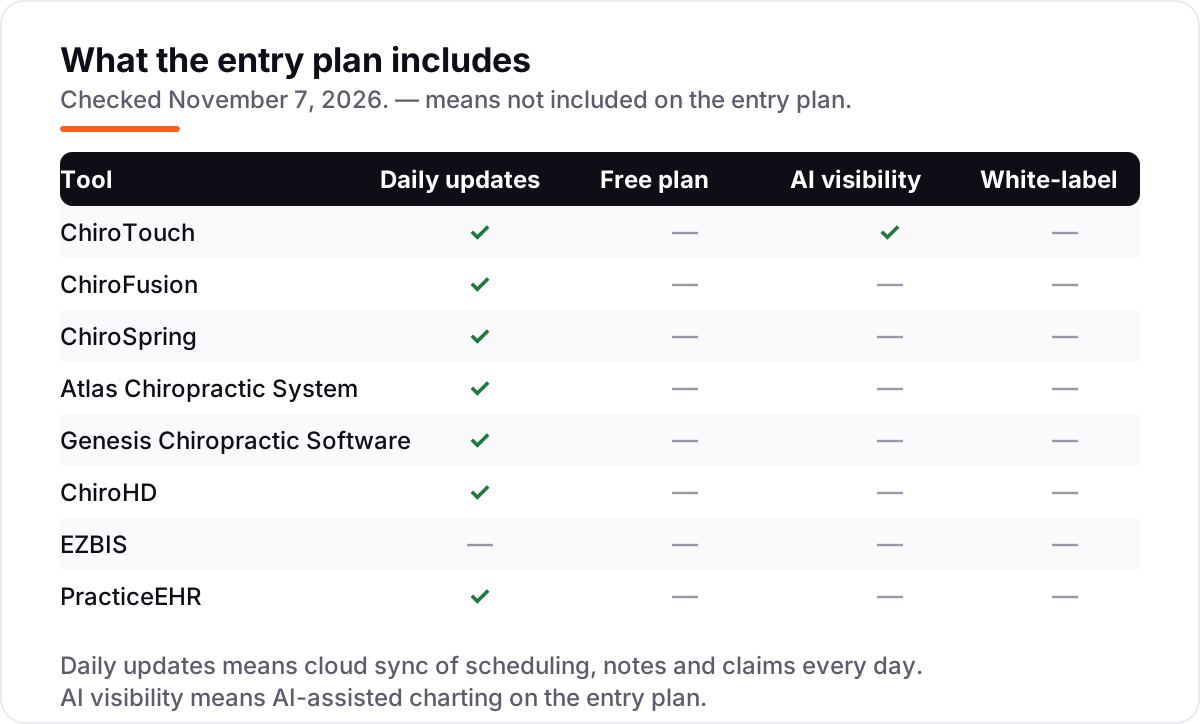
- Match the edition to how you get paid. Cash-only practices can skip claims tooling entirely — ChiroTouch Core at $159 a month exists for exactly that — while insurance practices need the clearinghouse, claim scrubbing and ERA posting that live on the higher tiers.
- Count the add-ons before you compare prices. ChiroSpring's $149 base is scheduling plus notes; the clearinghouse, AI charting and engagement each cost extra. ChiroTouch's engagement tools are add-ons too, so the headline price is rarely the whole bill.
- Test the SOAP note with a real visit. The note is where the hours go: macros, templates and AI charting decide whether a visit takes 30 seconds or 10 minutes to document. Run one genuine clinic day in the trial, not a demo script.
- Ask who owns the reminders. Missed visits cost more than software. ChiroHD and ChiroSpring include two-way texting and reminders in the price; on ChiroTouch they are paid extras.
Software runs the clinic, but it does not fill the calendar. If new patients are not finding the practice, our local SEO service covers the visibility side — see also our guide to chiropractor SEO. And before you ask patients for reviews, generate a one-tap link with the free Google review link generator so every happy patient can leave one in seconds.
Whatever you shortlist, try it with real data before you pay. The trials and demos in this list are long enough to run one genuine clinic week — your patients, your care plans, your payer mix — and that week tells you more than any review can. Check two things in the trial: that a note becomes a clean claim without retyping, and that the front desk can reschedule a full day without calling support. Every tool here offers a trial or a demo, so there is no reason to buy before the team has touched it.
Chiropractic software pricing: what you will actually pay
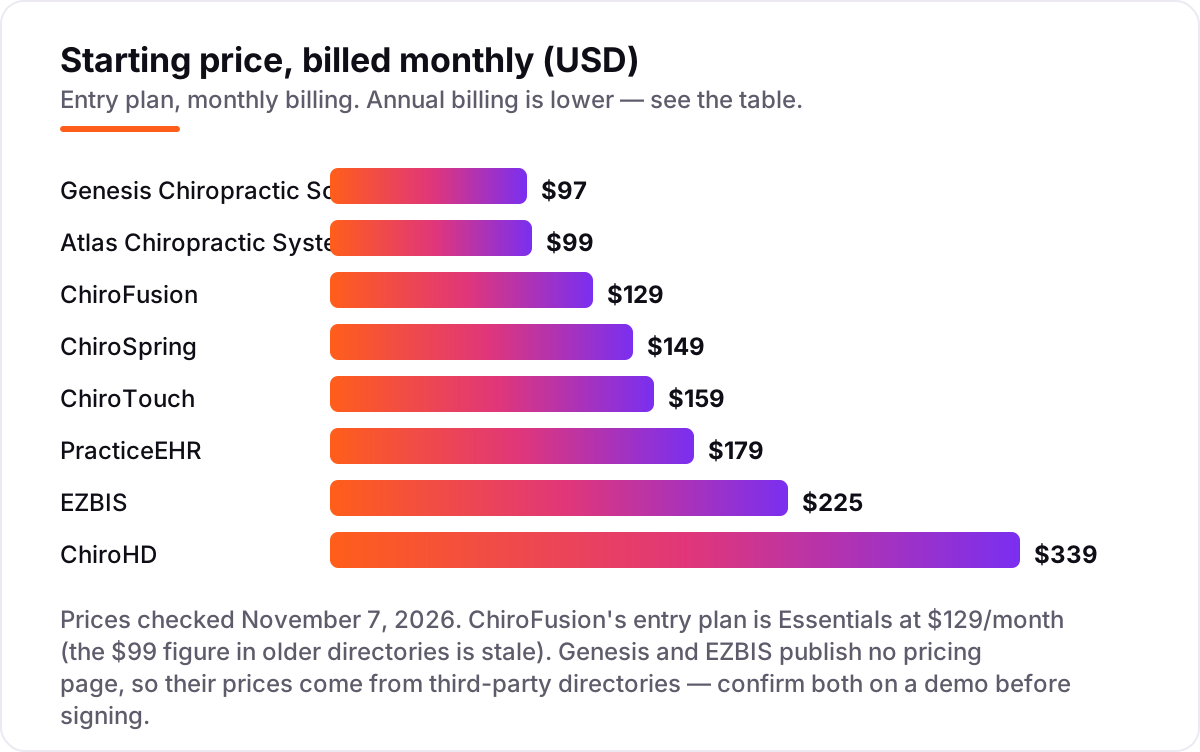
Take a two-provider practice that bills insurance. On list prices, the subscription costs $178 a month on ChiroFusion Essentials ($129 plus $49 for the second provider), $199 on Atlas Professional, $299 on ChiroTouch Advanced or $339 on ChiroHD Entry, $358 on PracticeEHR EHR-only ($179 per provider), and $448 on ChiroSpring 360 Pro+ ($299 for 2 providers) plus the $149 clearinghouse add-on. Genesis Claim Control at a reported $177 a month is the cheapest insurance tier in this list, but the vendor publishes no pricing page, so treat that figure as unconfirmed until a demo.
Over a year, that is $2,124 on Genesis Claim Control, $2,136 on ChiroFusion, $2,388 on Atlas Professional, $3,588 on ChiroTouch Advanced, $4,296 on PracticeEHR EHR-only and $5,376 on ChiroSpring with the clearinghouse. ChiroHD costs $3,588 for the subscription plus $799 setup and $499 migration, so year one is $4,886 before the $50-a-month patient app. The same two doctors and the same insurance mix cost $2,124 a year at the cheap end and $5,376 at the dear end — a $3,252 gap that comes entirely from billing units and add-ons, not from features.
Three costs sit outside every number above. First, the one-time fees: ChiroFusion charges $299 setup at signup, ChiroHD charges $799 setup plus $499 migration, and EZBIS sells one-time licences from $995 to $3,995 instead of a subscription at all. Second, the per-message and per-claim charges: ChiroSpring bills 2 cents per message past 150 a month, and ChiroHD texts cost 3 cents each on the entry tier. Third, the engagement stack: ChiroSpring GrowthHub runs $99 to $249 a month and AI charting $49, so a practice that wants the full ChiroSpring experience pays far more than the $149 entry price. If the practice is cash-only rather than insurance, the math changes completely — ChiroTouch Core at $159 and Atlas Essential at $99 cover the job with no clearinghouse at all.
Know the difference: chiropractic software vs a generic medical EHR
The confusion in this category is between a tool built for the adjustment table and a tool built for every specialty at once. Chiropractic software documents the way chiropractors work: segmental SOAP macros, spine charts with listings and laterality, care plans, super-bills and PI narratives, with billing built to speak to a clearinghouse. A generic medical EHR such as PracticeEHR covers many specialties in one system, but its charting is generic — the chiropractor types more, templates less, and bills slower.
There is a second, quieter confusion: an EHR is not a billing service. Every tool in this list includes billing, but only some include the people: Genesis offers full-service billing where the vendor's team follows up failed claims, and ChiroTouch Advanced bundles claim scrubbing and ERA auto-posting. If the practice is short on admin staff, the outsourced option can matter more than any feature checkbox.
A third distinction worth knowing is the visit itself versus the business around it. Scheduling, notes and claims are the core job; reminders, review requests and recall campaigns are the growth job. ChiroHD and Atlas Professional bundle the growth job into the monthly price, while ChiroTouch and ChiroSpring sell it as add-ons. Decide which job you are buying before you compare prices, or you will compare a core price against a bundled one.
Quick comparison: tool type by need
| Buyer | Best pick | Why |
|---|---|---|
| Most insurance-billing practices | ChiroTouch | The established all-rounder, Core $159/month, Advanced $299/month |
| Solo doctor on a budget | ChiroFusion | Full EHR plus billing with free unlimited e-claims, $129/month |
| Doctor who hates slow notes | ChiroSpring | AI-assisted SOAP notes with a visual spine tool, $149/month |
| Growing multi-doctor clinic | Atlas | Flat $99/month with unlimited users, whatever the headcount |
| Practice that wants billing handled | Genesis | Billing automation plus optional full-service billing, from a reported $97/month |
| Practice that lives on recalls | ChiroHD | Two-way texting, reminders and a patient app, $339/month |
Mistakes to avoid
- Comparing headline prices across different billing units. A $149 per-provider price and a $159 flat price are not $10 apart for a two-doctor practice — the per-provider tool costs $298. Multiply every price by your provider count before ranking.
- Forgetting the clearinghouse. Insurance billing needs a clearinghouse, and on ChiroSpring it costs $149 a month on top of the plan. ChiroFusion and Atlas include it; ChiroTouch bundles it only on Advanced. Price the claim path, not the plan.
- Buying on the entry tier, then finding the notes cost extra. ChiroSpring's AI charting costs $49 a month extra, and ChiroHD's patient app costs $50. If fast notes or patient messaging are the reason you are buying, count those add-ons in the price from day one.
- Trusting a directory price for a vendor with no pricing page. Genesis and EZBIS publish no prices, so directory figures can be stale or tier-confused — Genesis listings disagree on whether Cash is $97 or $177. Get the quote in writing on a demo.
- Paying for engagement before you have the notes right. Reminders and recall campaigns only help if the visit is documented and billed cleanly. Buy the EHR first, prove the note-to-claim loop works, then add the engagement tier.
How we chose
We checked each vendor's own pricing page on November 7, 2026 where one exists — ChiroSpring, Atlas, ChiroHD and ChiroFusion publish theirs — and used vendor-supplied G2 pricing for ChiroTouch. Genesis and EZBIS publish no pricing page, so their prices come from third-party directories (FindEMR and SourceForge) and are flagged as such wherever they appear; ChiroFusion's $129 entry price supersedes the $99 figure still shown in older directories. Ratings come from G2 or Capterra pages checked the same day. We ranked the tools by fit for the most common buyer — a small practice that bills insurance — not by brand size. No vendor paid for a place in this list, and none of the links here are affiliate links.
What to do next
Start with the demo or trial of your top pick and run one real clinic week through it. Check that a note becomes a clean claim without retyping and that the front desk can reschedule a full day without calling support before you commit to a year. If the software is sorted but new patients are not finding the practice, our local SEO service handles the visibility side — or compare providers in our guide to chiropractic marketing companies. Once your tools are in place, find out what's holding your rankings back.
Your stack only works if people find you
SerpAstra fixes what keeps your site off page one and makes it easy for AI assistants to recommend.
Get a free audit→Sources we checked (16)
- ChiroTouch pricing — G2 pricing page, figures supplied by ChiroTouch (checked November 7, 2026)
- ChiroFusion pricing — chirofusionsoftware.com/pricing (checked November 7, 2026)
- ChiroSpring pricing — chirospring.com/pricing (checked November 7, 2026)
- Atlas Chiropractic System pricing — atlaschirosys.com/pricing (checked November 7, 2026)
- Genesis Chiropractic Software pricing — FindEMR, third-party directory (checked November 7, 2026)
- ChiroHD pricing — chirohd.com/ch/pricing (checked November 7, 2026)
- EZBIS pricing — SourceForge comparison, third-party directory (checked November 7, 2026)
- PracticeEHR pricing — SelectHub comparison, third-party directory (checked November 7, 2026)
- ChiroTouch reviews — G2, 3.6/5, 74 reviews (checked November 7, 2026)
- ChiroFusion reviews — Capterra, 4.7/5, 590 reviews (checked November 7, 2026)
- ChiroSpring reviews — Capterra, 4.9/5, 186 reviews (checked November 7, 2026)
- Atlas Chiropractic System reviews — G2, 3.8/5, 6 reviews (checked November 7, 2026)
- Genesis Chiropractic Software reviews — Capterra, 4.5/5, 265 reviews (checked November 7, 2026)
- ChiroHD reviews — Capterra, 4.8/5, 132 reviews (checked November 7, 2026)
- EZBIS reviews — G2, 4.0/5, 12 reviews (checked November 7, 2026)
- PracticeEHR reviews — G2, 4.8/5, 4 reviews (checked November 7, 2026)
Shamim
Founder of SerpAstra
A full-stack SEO and digital marketer who spends most days on Local SEO for dental practices, AI search visibility and lead generation.
Frequently asked questions
What is the best chiropractic software?
ChiroTouch is the best fit for most insurance-billing practices: the established all-rounder with separate cash and insurance editions from $159/month flat. ChiroFusion is the better value pick at $129/month, and ChiroSpring is the best choice when AI-assisted SOAP notes are the priority.
How much does chiropractic software cost per month?
Entry prices run from $97 to $339 a month. Atlas starts at $99 flat and Genesis at a reported $97, while ChiroHD starts at $339 with about $1,300 in one-time setup and migration fees. Per-provider tools cost more as you add doctors; flat-rate tools do not.
Is there free chiropractic software?
No tool in this list has a free plan. ChiroFusion, ChiroSpring and EZBIS offer free trials, and ChiroTouch, ChiroHD and PracticeEHR offer demos. EZBIS is the only buy-it-once option, with one-time licences from $995 to $3,995 instead of a monthly subscription.
What is the difference between chiropractic software and a generic medical EHR?
Chiropractic software documents the way chiropractors work: segmental SOAP macros, spine charts, care plans and PI narratives, with billing built for clearinghouses. A generic EHR covers many specialties but charts generically, so chiropractors type more and bill slower. Mixed clinics may still prefer one generic EHR.
Do chiropractors need separate billing software?
Usually not. Every tool here includes billing, and most bundle an integrated clearinghouse: ChiroTouch Advanced, ChiroFusion, Atlas and ChiroSpring with its clearinghouse add-on. Practices that want to hand billing off entirely can use Genesis full-service billing or an outside billing service instead.
Can I switch chiropractic software later?
Yes, but budget for migration. ChiroHD charges $499 for data migration, and most vendors charge setup fees. Plan the move for a slow month, export patients, care plans, open balances and appointment history first, and run the old system in parallel for two weeks before going live.
Does chiropractic software include patient reminders?
Mostly yes, but the depth varies. ChiroHD leads with two-way texting, automated reminders and a patient app, and ChiroSpring includes two-way text reminders on the entry plan. On ChiroTouch, reminders and digital intake are paid add-ons, so check what the entry price actually covers.
Free SEO and AI visibility audit
Find out what is holding your rankings back
Send us your site. Within 2 business days you get a written audit, an AI visibility check and a short fix list ranked by impact. Free, with no contract attached.
Request my free audit→Related guides
 Local SEO10 Best Chiropractic Marketing Companies in 202610 best chiropractic marketing companies compared on price, services and contracts, with prices checked November 4, 2026 — from $99/month to custom quotes.Read guide →
 Local SEOSEO for chiropractors: a practical patient-growth guideSEO for chiropractors: win the map pack, build service pages patients trust, earn reviews, and turn searches into booked appointments. A practical guide.Read guide →
 SEO & AI Search9 Best Medical SEO Companies (2026): Who to Hire and What It Costs9 best medical SEO companies compared on price, specialty and AI visibility, with real starting prices where published and custom-quote warnings where not.Read guide →