
9 Best Cloud Based Chiropractic Software in 2026, Compared
Compare the 9 best cloud based chiropractic software options on price, AI notes, billing and free trials, with every price checked November 7, 2026.
 Shamim Mia, Founder, SerpAstraLast verified November 7, 202612 min read
We compare pricing pages, documentation and public reviews. We never accept payment for rankings.

Key takeaways
- ChiroTouch leads for established insurance-billing practices, ChiroFusion is the value pick at $149 a month, and Noterro is the cheapest published price at $33 a month — with ChiroHD at $339 a month for practices that want retention tools built in.
- Four of the nine tools publish no price at all, so budget on a quoted range and ask what the quote includes: setup fees, extra providers and clearinghouse access are usually separate.
- The single most important buying factor is how the practice bills: per-provider pricing punishes multi-doctor offices, while flat pricing rewards them — check the billing unit before the feature list.
- Every tool here is cloud-based, so the real differences are documentation depth, claims handling and how fast staff learn it — not where the data lives.
On this page
Quick comparison
| Tool | Best for | Starting price | Free plan |
|---|---|---|---|
| ChiroTouch | Established multi-doctor practices that bill insurance and want the deepest chiropractic feature set | Custom quote | No (demo) |
| ChiroFusion | Solo and small practices that want full EHR features at one published flat price | $149/mo | No (free trial) |
| Jane | Multi-discipline clinics that mix chiropractic with physio, massage or acupuncture | $59/mo | No (demo) |
| ChiroSpring | Practices that want to customize SOAP templates, macros and workflows deeply | $149/mo | No (demo) |
| ChiroHD | One-to-three-doctor practices that want a simple cloud EHR with patient retention built in | $339/mo | No (demo) |
| Genesis Chiropractic Software | Owner-operators who want the EHR bundled with a billing service from one vendor | Custom quote | No (demo) |
| Noterro | Solo chiropractors and small clinics that want the cheapest published price with AI notes included | $33/mo | No (14-day trial) |
| EZBIS | Practices that value a 45-year track record and buying only the modules they need | Custom quote | No (free trial) |
| PayDC | Insurance-heavy practices where documentation compliance drives what gets paid | Custom quote | No (demo) |
Make one of these tools?
We re-check this list every quarter. Send a correction, request a review, or ask about a clearly labeled sponsored spot.
Request a listingThe best cloud-based chiropractic software

ChiroTouch
Best for: Established multi-doctor practices that bill insurance and want the deepest chiropractic feature set
ChiroTouch is the default choice in chiropractic for a reason: scale. The vendor counts 12,500-plus practices and 36,000 providers, which means integrations, clearinghouse relationships and payer-specific billing knowledge are battle-tested. The current platform pushes AI hard: the Rheo assistant turns conversation into SOAP notes, smart macros speed up documentation, and a compliance scan flags missing documentation before claims go out.
The price of leadership is opacity. ChiroTouch publishes no prices — its pricing page lists Start, Grow and Scale plans with no figures — and third-party directories estimate around $159 a month, which the vendor never confirms. Expect a demo-led sales process, and budget separately for the Billing Suite and clearinghouse. For a multi-doctor practice that needs every workflow covered, the depth justifies it; for a solo cash practice, the lighter tools below cost less and set up faster.
What we like
- Largest installed base in chiropractic: 12,500-plus practices and 36,000 providers, per the vendor
- Rheo AI Scribe turns conversations into SOAP notes, and smart macros speed up documentation
- Integrated payments, claim scrubbing and ERA auto-posting keep billing inside one system
- Compliance scans flag missing documentation before claims go out
Watch out for
- No published pricing — every deal goes through a demo and a sales quote
- The depth can overwhelm a solo practice, and reviewers report slow support responses
- Insurance billing needs the separate Billing Suite and clearinghouse plan

ChiroFusion
Best for: Solo and small practices that want full EHR features at one published flat price
ChiroFusion wins on honesty. The vendor's own pricing page states the starting price plainly: Essentials costs $149 a month on a month-to-month basis, or $129 a month with a 12-month commitment, and covers scheduling, reporting, billing and claims, payment processing and patient check-in, with updates, backups and storage included. Free unlimited e-claims with an integrated clearinghouse is genuinely rare at this price.
The software shows its age in places: reviewers praise ease of use but note the interface is not the prettiest, and heavy customizers hit walls. Implementation typically takes two to three weeks with an account manager, and a $299 setup fee applies on every plan. If the budget is fixed and the must-haves are scheduling, SOAP notes and clean claims, this is the rational pick.
What we like
- Published $149 a month starting price — no sales call needed to learn the cost
- Free unlimited electronic claims with automatic payment posting through the integrated clearinghouse
- 100 percent cloud-based, so there is no hardware to install or maintain
- Complete plan at $299 a month adds the features that cost $196 a month as Essentials add-ons
Watch out for
- A $299 one-time setup fee applies on every plan, and extra providers cost $49 a month each
- The interface feels dated next to newer competitors
- No listed AI scribe for clinical notes, and data migration options are limited

Jane
Best for: Multi-discipline clinics that mix chiropractic with physio, massage or acupuncture
Jane is the generalist that chiropractors keep choosing anyway. Built for health and wellness clinics broadly, it handles scheduling, charting, billing, payments and patient communication in one connected system. The online booking experience is the best in this set, and a 240,000-plus practitioner community means answers to workflow questions are easy to find. Support has a strong reputation.
The trade-off is specificity. Jane does not speak chiropractic billing natively the way ChiroTouch or PayDC do: US insurance billing is a $20-a-month add-on plus a separate Claim.MD account, and the Balance plan caps at 20 appointments a month, so most practices need Practice at $79. For a clinic mixing chiropractic with physio or massage, where one system must serve every discipline, Jane is usually the right answer.
What we like
- The best online booking experience in this list, with a clinic-branded booking page patients actually use
- Charting, scheduling, billing and telehealth in one system across 40 disciplines
- AI Scribe included, with five free notes a month on every plan
- A 240,000-plus practitioner community and support reviewers consistently praise
Watch out for
- Not chiropractic-specific, so insurance billing and Medicare checks need careful testing
- US insurance billing is a $20-a-month add-on plus a separate Claim.MD account
- Balance caps at 20 appointments a month — most practices need Practice at $79

ChiroSpring
Best for: Practices that want to customize SOAP templates, macros and workflows deeply
ChiroSpring's pitch is flexibility: the first multi-flex app built for chiropractors, with customizable SOAP templates, macros and workflows. AI is woven in, turning conversation into structured notes and flagging claim risks before submission. The 360 plan costs $149 a month per provider and includes scheduling, SOAP notes, a virtual front desk, integrated payments and two-way text reminders.
Customization cuts both ways. Practices that know exactly how they want to work will love the control; practices that want to be up and running tomorrow may find the options overwhelming. The clearinghouse costs another $149 a month, and the AI add-on is $49 a month, so the headline price grows fast. Bring your must-have list to the demo and ask what is included versus add-on.
What we like
- Highly customizable templates, macros and workflows — the first multi-flex app built for chiropractors
- AI-assisted documentation and billing risk checks flag claim problems before submission
- Rated 4.9 out of 5 on Capterra across 186 reviews, with particular praise for support
- Clearinghouse, GrowthHub and AI are priced as separate add-ons, so you buy only what you need
Watch out for
- Priced per provider, so a three-doctor practice pays $447 a month before add-ons
- Clearinghouse integration costs another $149 a month on top of the plan
- The customization depth means more setup decisions before the first patient

ChiroHD
Best for: One-to-three-doctor practices that want a simple cloud EHR with patient retention built in
ChiroHD sells simplicity: an EHR engineered for the cloud that runs in a single browser tab, with scheduling, notes, billing and patient engagement in clean workflows. Reviewers consistently praise how fast staff learn it, and the vendor claims 4.9 out of 5 for support satisfaction across 1,500-plus practitioners. Patient outreach campaigns and diagnostic reporting are built in.
The scope is narrower than the market leaders, which is the point: fewer features, less to learn, faster go-live. The Entry bundle costs $339 a month on the yearly plan, plus a $799 setup fee and $499 for data migration, and texts cost 3 cents each unless you step up to Scale at $549. For a one-to-three-doctor practice that wants modern cloud software without a month of training, it deserves a demo.
What we like
- Runs entirely in the browser with nothing to install, and staff learn it fast
- SKED texting, reminders and reactivation campaigns are built in, not bolted on
- No per-provider charges — unlimited providers and users are included at no extra cost
- Rated 4.8 out of 5 on Capterra across 132 reviews, with 4.9 for customer service
Watch out for
- Entry at $339 a month costs more than most rivals before a single text is sent
- A $799 setup fee and $499 data migration fee apply on top of the subscription
- No listed AI scribe, so notes are manual where rivals draft them automatically

Genesis Chiropractic Software
Best for: Owner-operators who want the EHR bundled with a billing service from one vendor
Genesis, from Billing Precision and now sold as ClinicMind EHR, pairs cloud practice management with an optional billing service, which appeals to owners who would rather outsource the revenue cycle entirely. The vendor counts 9,000-plus users. Automation covers patient relationship management, revenue cycle, compliance and office management, and the system was designed by chiropractic business owners.
The bundling is also the limitation: if you already have a biller you trust, you are paying for overlap. Pricing is quote-based — directories list $97 a month, but the vendor's own site publishes no price, so do not budget on that figure. For an owner-operator who wants one vendor accountable for both the software and the collections, the combined offer is worth comparing against separate EHR plus billing-service contracts.
What we like
- ONC-certified cloud platform built specifically for chiropractic, with automation across scheduling, billing and compliance
- Optional billing service from the same vendor, so one company owns both the software and the collections
- The vendor counts 9,000-plus users and a G2 Leader position held since fall 2022
- Designed by chiropractic business owners, with care-plan tools built for the way clinics actually work
Watch out for
- No published pricing — directory figures of $97 a month are not confirmed by the vendor
- The billing-service bundle overlaps if you already have a biller you trust
- Now sold as ClinicMind EHR, so the Genesis name is being retired

Noterro
Best for: Solo chiropractors and small clinics that want the cheapest published price with AI notes included
Noterro is the cheapest published price in this list, and it does not feel cheap. Core costs $33 a month billed monthly, or $28.05 a month billed annually, and covers charts and forms, scheduling, online booking, billing and a clinic-branded booking app, with 300 free AI credits for Scribe and form summaries on every plan. There is no setup fee, and extra practitioners cost $13.20 a month each.
The limits are scope, not price. Advanced insurance billing waits for Max at $77 a month, US claims run through third-party compatibility rather than a built-in clearinghouse, and AI use beyond the free credits is charged a cent per credit. For a solo chiropractor or a small clinic that wants scheduling, charting and AI notes at the lowest published price, Noterro is hard to beat.
What we like
- The cheapest published starting price here at $33 a month, with no setup fee
- AI Scribe and form summaries included on every plan, with 300 free credits
- Clinic-branded booking app and online booking included on the entry plan
- Unlimited locations and assistant seats at no extra cost
Watch out for
- Advanced insurance billing waits for Max at $77 a month, and US claims need third-party compatibility
- AI features beyond the free credits are usage-priced at a cent per credit
- Built for small clinics first — multi-location enterprises will outgrow it

EZBIS
Best for: Practices that value a 45-year track record and buying only the modules they need
EZBIS has been selling chiropractic software since 1980, longer than anyone else on this list, and thousands of practices still run on it. The modular design is the differentiator: buy EHR, billing, scheduling or the combination that fits, rather than paying for an all-or-nothing suite. Support has a strong reputation among long-time users, and the system is ONC-certified for MIPS.
The honest catch is age. The interface looks like software with a 45-year history, because it is, and cloud access exists but the experience is not as modern as ChiroFusion or ChiroHD. Pricing is quote-based, so the cost is unknown until the sales conversation. For a practice that values stability and a vendor that has survived every industry cycle, that trade is often acceptable.
What we like
- Serving chiropractors since 1980 — the longest track record in this list
- Modular design lets you buy only the pieces you need instead of an all-or-nothing suite
- Strong reputation for customer support among long-time users
- ONC-certified for MIPS, with photo-realistic body views for treatment charting
Watch out for
- No published pricing, so every deal starts with a sales conversation
- The interface looks like software with a 45-year history, because it is
- Cloud access exists, but the experience is less modern than ChiroFusion or ChiroHD

PayDC
Best for: Insurance-heavy practices where documentation compliance drives what gets paid
PayDC is built around one belief: clean documentation is what gets claims paid. Its SOAP note engine is chiropractic-specific, generates CMS-1500 claims directly from notes, and checks coding against CPT guidelines before submission. Care-plan tools build compliant plans fast and present out-of-pocket costs clearly to patients, which helps plan acceptance. The Genie AI layer summarizes care and converts conversations into notes.
This is a compliance-first tool, and it shows in the marketing and the workflow. Practices that live on insurance reimbursement and worry about audits will get the most value. Pricing is quote-based, and the integration ecosystem is narrower than the giants. If your write-offs come from documentation problems rather than volume problems, start here.
What we like
- SOAP note engine built specifically for chiropractic compliance, with CPT edit checks before submission
- Claims generate directly from documentation, including CMS-1500 forms
- Care-plan tools build compliant plans fast and show patients their out-of-pocket costs
- Genie AI summarizes care and converts conversations into notes
Watch out for
- No published pricing, so the cost is unknown until the sales call
- A narrower ecosystem of integrations than the market leaders
- Review scores are the weakest here, so test the workflow on a trial before committing
The best cloud based chiropractic software turns a busy clinic day into a routine: the schedule fills itself, SOAP notes write themselves from the visit, and claims go out clean the first time. We compared nine cloud-based platforms — from the 12,500-practice market leader to a $33-a-month budget option — and every price below was checked on the vendor's own pricing page on November 7, 2026, or marked as a custom quote where the vendor publishes no price.
How to choose the best cloud based chiropractic software
- Start with how you bill. Cash practices need care plans and payment plans; insurance practices need claim scrubbing, ERA posting and a clearinghouse. The billing model decides the shortlist before the feature list does.
- Count providers, not just patients. ChiroSpring charges $149 a month per provider and ChiroFusion $49 a month per extra provider, while ChiroHD includes unlimited providers in its $339 a month. A three-doctor office can pay triple on the wrong plan.
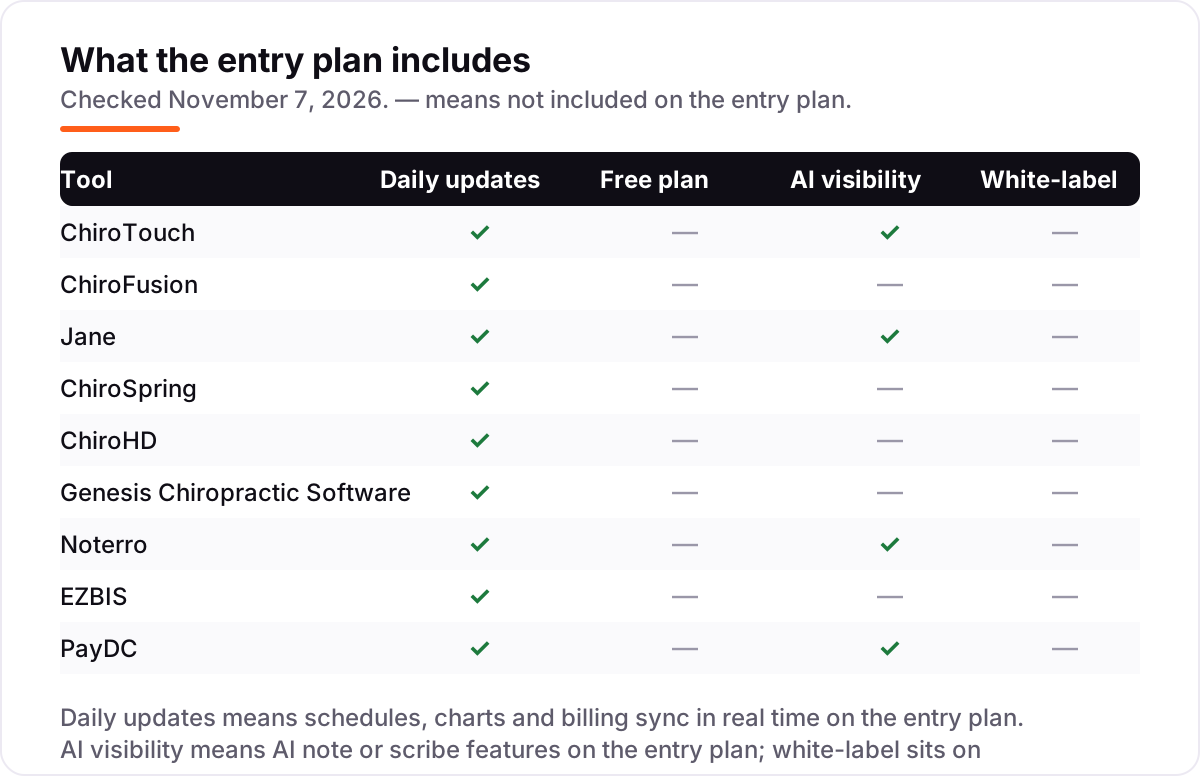
- Check the note workflow. Ask whether the AI scribe is included or a paid add-on: Jane and Noterro include it, ChiroSpring charges $49 a month extra, and ChiroHD lists no AI scribe at all.
- Ask about setup and migration fees. ChiroHD charges $799 to set up and $499 to move your data, and ChiroFusion charges $299 — fees that never appear in the monthly price.
- Test the patient experience. Online booking, reminders and a patient app decide whether patients come back, so run a demo booking as a patient before you buy.
- Confirm HIPAA and data export. Every tool here is cloud-based, so ask where data lives, how backups work, and how you get your records out if you leave.
Choosing software is one decision; getting found is another. Our local SEO service helps chiropractic clinics show up on Google Maps and in AI answers, and the free local business schema generator builds the structured data that helps Google understand your clinic. Both matter more than most owners expect: the best software in the world does not fill a calendar that nobody can find.
Cloud-based chiropractic software pricing: what you will actually pay
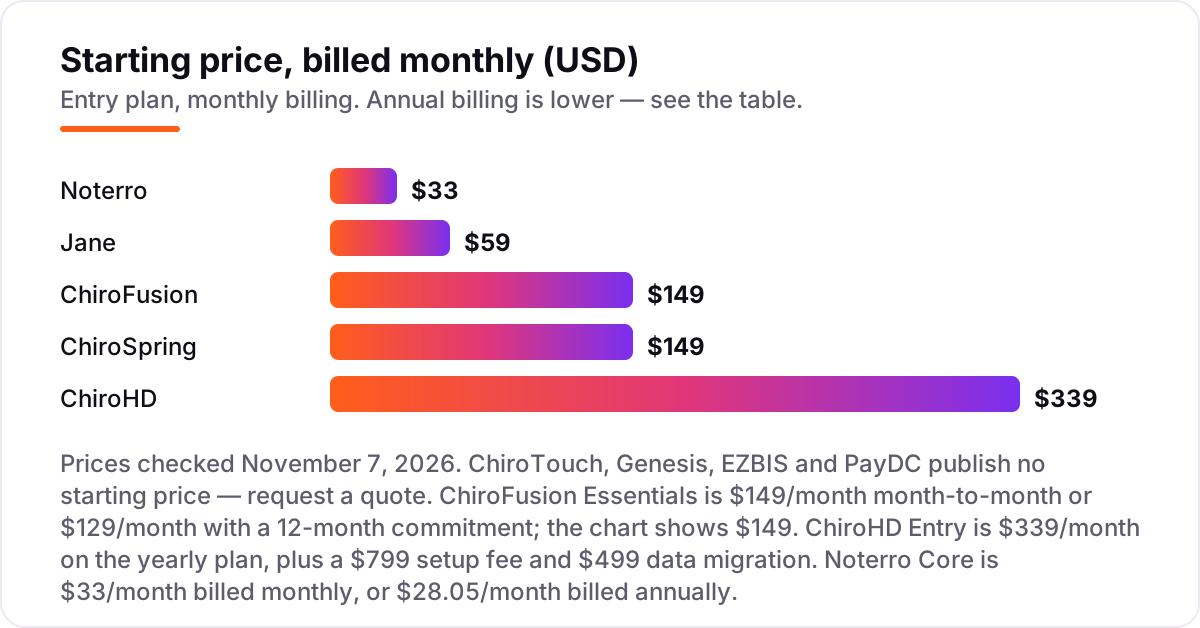
Take a solo chiropractor who bills insurance, on one provider, paying monthly. Noterro Core costs $33 a month, or $396 a year — $336.60 a year if you pay annually at $28.05 a month. Jane Practice costs $79 a month plus $20 for the insurance billing add-on, or $99 a month, which is $1,188 a year before Claim.MD fees. ChiroFusion Essentials costs $149 a month, or $1,788 a year, plus a $299 setup fee — $2,087 in the first year, or $1,847 if you take the 12-month commitment at $129 a month.
The bigger numbers come with bigger bundles. ChiroSpring 360 costs $149 a month per provider, or $1,788 a year; add the clearinghouse at $149 a month and the year costs $3,576. ChiroHD Entry costs $339 a month on the yearly plan, or $4,068 a year, plus $799 for setup and $499 for data migration — $5,366 in the first year. The four quote-only tools — ChiroTouch, Genesis, EZBIS and PayDC — have no number to put in this math at all: third-party directories estimate $159 to $299 a month for ChiroTouch, but the vendor never confirms a figure, so get the quote in writing before you compare.
Two costs sit outside every number above. First, extra providers: ChiroFusion charges $49 a month per extra provider, ChiroSpring $149, and Jane $35 on Practice — while ChiroHD includes unlimited providers at no extra cost, which is why its $339 a month looks dearer than it is for a three-doctor office. Second, the add-ons that turn a base plan into a working system: clearinghouse access, AI scribes and text messaging are all billed separately on at least one tool here, so price the whole workflow, not the headline plan.
Know the difference: cloud EHR vs practice management vs billing service
The confusion in this category is between three jobs that vendors bundle under one name. An EHR is the clinical record: SOAP notes, exams, care plans and the chart. Practice management is the office: scheduling, intake, billing, claims and payments. Most tools in this list do both, which is why the labels blur — but the depth differs, and that is what you are actually buying.
There is a third job, and it is a service, not software: a billing service employs people who submit and chase your claims. Genesis is the only tool here that bundles one, and ChiroTouch sells its Billing Suite as a separate service. If you already have a biller you trust, a bundled service is overlap you pay for twice; if you do not, it can be the reason to pick Genesis over a cheaper EHR.
A second distinction is cloud versus server. Every tool here is cloud-based: updates, backups and security happen on the vendor's side, and the doctor can check the schedule from home. Server-based systems keep data in the office, which some owners prefer for control, but they need IT maintenance, backups and hardware replacement. For most practices the cloud wins on total cost once IT time is counted — the exception is a rural office with unreliable internet, which should ask about offline access before signing.
Quick comparison: tool type by need
| Buyer | Best pick | Why |
|---|---|---|
| Solo cash practice on a budget | Noterro | $33/month with AI Scribe included and no setup fee |
| Most established practices | ChiroTouch | The deepest feature set and largest installed base, priced by quote |
| Best value with a published price | ChiroFusion | $149/month with free unlimited e-claims |
| Multi-discipline clinic | Jane | Booking and charting across disciplines from $59/month |
| Practice that wants deep customization | ChiroSpring | Custom templates and workflows from $149/month per provider |
| Simple setup with retention tools | ChiroHD | $339/month with texting and reactivation built in |
Mistakes to avoid
- Budgeting on the monthly price alone. Setup fees run $299 to $799, data migration adds $499 on ChiroHD, and per-provider and clearinghouse charges can double the headline number.
- Buying per-provider pricing for a growing team. ChiroSpring at $149 a month per provider costs $447 a month for three doctors; ChiroHD includes unlimited providers for $339. Price the team you will have next year, not the team you have today.
- Assuming the AI scribe is included. Jane and Noterro include it, ChiroSpring charges $49 a month extra, and ChiroHD lists no AI scribe at all. Ask before you sign, not after the first week of manual notes.
- Ignoring the clearinghouse cost. Claims do not go out for free: ChiroFusion includes unlimited e-claims, ChiroSpring charges $149 a month for clearinghouse access, and ChiroTouch needs a separate clearinghouse plan.
- Choosing a generalist tool for an insurance-heavy practice without testing claims. Jane is excellent for booking and charting, but its insurance billing is an add-on routed through a third party — run a real claim through the trial before committing.
How we chose
We checked each vendor's own pricing page on November 7, 2026 and recorded the starting price exactly as shown, including the annual-billing figure where the page lists one, and we marked four tools as custom quote because their vendors publish no price. Jane's US pricing page was verified through fresh search-index crawls of the vendor's own page, because the page would not load directly on November 7, 2026; two independent October 2026 reads agree on Balance at $59 a month in US dollars. We did not use the $97-a-month figure directories list for Genesis, because the vendor's own site publishes no price. Ratings come only from G2 or Capterra pages verified on November 7, 2026: PayDC, Genesis and Noterro carry no rating because their review pages could not be verified that day, and we would rather show no rating than a stale or estimated one. No vendor paid for a place in this list, and none of the links here are affiliate links.
What to do next
Start with the demo or trial of your top pick and run one real week of visits through it: book patients, write notes, send a claim and check that it posts. Ask for the quote in writing, including setup, extra providers and clearinghouse fees, so the first-year cost is a number and not a surprise. If the software is sorted but new patients are not finding the clinic, our local SEO service handles the visibility side — or compare providers in our guide to chiropractic marketing companies. Once your tools are in place, find out what's holding your rankings back.
Your stack only works if people find you
SerpAstra fixes what keeps your site off page one and makes it easy for AI assistants to recommend.
Get a free audit→Sources we checked (15)
- ChiroTouch pricing — chirotouch.com/pricing (checked November 7, 2026; no published prices)
- ChiroFusion pricing — chirofusionsoftware.com/pricing (checked November 7, 2026)
- Jane pricing — jane.app/pricing (checked November 7, 2026)
- ChiroSpring pricing — chirospring.com/pricing (checked November 7, 2026)
- ChiroHD pricing — chirohd.com/ch/pricing (checked November 7, 2026)
- Genesis by ClinicMind — clinicmind.com/genesis (checked November 7, 2026; no published price)
- Noterro pricing — noterro.com/pricing (checked November 7, 2026)
- EZBIS — ezbis.com (checked November 7, 2026; no published price)
- PayDC — paydc.com (checked November 7, 2026; no published price)
- ChiroTouch reviews — G2 (checked November 7, 2026)
- ChiroFusion reviews — Capterra (checked November 7, 2026)
- Jane reviews — Capterra (checked November 7, 2026)
- ChiroSpring reviews — Capterra (checked November 7, 2026)
- EZBIS reviews — G2 (checked November 7, 2026)
- ChiroHD reviews — Capterra (checked November 7, 2026)
Shamim
Founder of SerpAstra
A full-stack SEO and digital marketer who spends most days on Local SEO for dental practices, AI search visibility and lead generation.
Frequently asked questions
What is the best cloud based chiropractic software?
ChiroTouch is the best fit for most established insurance-billing practices: the largest installed base, AI SOAP notes and deep billing, priced by quote. ChiroFusion is the best value at $149 a month with a published price, and Jane is the best pick for clinics that mix chiropractic with physio or massage.
How much does cloud-based chiropractic software cost?
Published starting prices run from $33 a month for Noterro to $339 a month for ChiroHD, with Jane at $59 and ChiroFusion and ChiroSpring both at $149. Four of the nine tools publish no price and quote per practice. Add setup fees — $299 to $799 — and per-provider or clearinghouse charges on top of the monthly rate.
Is there any free cloud-based chiropractic software?
No tool in this list offers a free plan. Noterro has a 14-day free trial, and ChiroFusion and EZBIS offer free trials too. The other six offer demos only. A trial is the honest way to test the note workflow and the claims process before signing a contract.
ChiroTouch vs ChiroFusion: which is better?
ChiroTouch is better for established multi-doctor practices that bill insurance: deeper features, a larger installed base and AI documentation, priced by quote. ChiroFusion is better for solo and small practices on a fixed budget: a published $149 a month, free unlimited e-claims and no sales call to learn the price.
Do I need a separate billing service with chiropractic software?
Usually not. Most tools here include billing and claims, and ChiroFusion includes free unlimited e-claims. Genesis is the exception that bundles an optional billing service from the same vendor. ChiroTouch needs its separate Billing Suite and clearinghouse plan, so ask what the quote actually includes.
What should I look for in a cloud chiropractic EHR?
Look for chiropractic-specific SOAP notes, scheduling with online booking, claims with scrubbing and ERA posting, integrated payments, and patient reminders. Confirm HIPAA compliance, where your data lives, and how you export your records if you leave. Test the note workflow on a trial — it is where your day is won or lost.
Does cloud-based chiropractic software work without internet?
No — every tool here needs a connection, since records, scheduling and claims live on the vendor's servers. That is the trade for automatic updates and backups. Rural practices should ask each vendor about offline access and what happens to the schedule during an outage before signing.
Free SEO and AI visibility audit
Find out what is holding your rankings back
Send us your site. Within 2 business days you get a written audit, an AI visibility check and a short fix list ranked by impact. Free, with no contract attached.
Request my free audit→Related guides
 Local SEOSEO for chiropractors: a practical patient-growth guideSEO for chiropractors: win the map pack, build service pages patients trust, earn reviews, and turn searches into booked appointments. A practical guide.Read guide →
 Local SEO10 Best Chiropractic Marketing Companies in 202610 best chiropractic marketing companies compared on price, services and contracts, with prices checked November 4, 2026 — from $99/month to custom quotes.Read guide →
 SEO & AI SearchBest Local SEO Tools for 2026: 11 Picks Ranked by What You Need11 best local SEO tools with real prices checked November 1, 2026 — from $14/month trackers to quote-only enterprise platforms, sorted by what you need.Read guide →