
9 Best Composable Commerce Platforms in 2026, Compared
Compare the 9 best composable commerce platforms for commerce engines, headless content and editing on APIs, free plans and cost, checked on vendor sites.
 Shamim Mia, Founder, SerpAstraLast verified November 1, 20268 min read
We compare pricing pages, documentation and public reviews. We never accept payment for rankings.

Key takeaways
- A composable commerce stack has at least two parts: a commerce engine for products and checkout, and a headless CMS for content, joined by a custom front end.
- Adobe Commerce is the most customizable commerce engine here but quote-only; BigCommerce and Shopify are the hosted engines with published prices, both from $39 a month or $29 billed annually.
- Contentful, Sanity, Storyblok and Hygraph all have free plans; Hygraph's content federation can pull commerce and PIM APIs into one GraphQL API.
- Builder.io lets marketers edit pages built from your own components, from $24 a user a month billed annually, which removes a common bottleneck in composable builds.
On this page
Quick comparison
| Tool | Best for | Starting price | Free plan |
|---|---|---|---|
| Adobe Commerce | Enterprise and B2B brands that need a deeply customizable commerce engine | Custom quote | No (demo only) |
| BigCommerce | Mid-size brands that want a hosted commerce engine with more built in | $39/mo | No (15-day trial) |
| Shopify | Brands that want the largest app ecosystem behind a custom storefront | $39/mo | No (trial) |
| Contentful | Mid-size teams that want the most widely adopted headless CMS with published prices | $300/mo | Yes (free plan) |
| Sanity | Developer-led commerce teams that want content schemas in code | $15/seat/mo | Yes (free plan) |
| Storyblok | Merchandising teams that want to build campaign pages visually on a headless CMS | $99/mo | Yes (free plan) |
| Hygraph | API-first teams that want commerce, PIM and content unified in one GraphQL API | $199/mo | Yes (free plan) |
| Builder.io | Composable teams whose marketers need to edit pages built from developer components | $30/user/mo | Yes (free plan) |
| Sitecore XM Cloud | Enterprises on Microsoft and .NET stacks that need multi-site personalization | Custom quote | No (dev trial) |
Make one of these tools?
We re-check this list every quarter. Send a correction, request a review, or ask about a clearly labeled sponsored spot.
Request a listingThe best composable commerce platforms

Adobe Commerce
Best for: Enterprise and B2B brands that need a deeply customizable commerce engine
Adobe Commerce is the most customizable commerce engine in this list: custom product types, pricing logic, checkout flows and native B2B workflows such as company accounts, shared catalogs, quotes and approvals. In a composable stack it supplies catalog, cart and order logic to a custom front end, and it handles very large catalogs and traffic.
Adobe publishes no list price and licenses by gross merchandise value, so a composable build starts with a sales consultation, and third-party estimates put licences well into five figures a year before hosting and development. Every change needs developers, which composable teams have anyway.
What we like
- The deepest customization in this list: custom product types, pricing logic, checkout flows and B2B workflows like quotes and approvals
- Handles very large catalogs and high traffic, with company accounts, shared catalogs and personalized pricing built in
- Full control of URLs, metadata and schema, with no platform-imposed structure
Watch out for
- No published price — you need a sales consultation, and third-party estimates put licences well into five figures a year before hosting and development
- Needs developers for setup and ongoing maintenance; routine changes are slower and more expensive than on a hosted platform

BigCommerce
Best for: Mid-size brands that want a hosted commerce engine with more built in
BigCommerce is a hosted commerce engine that includes more than most at entry level: unlimited products, staff accounts and storage, multi-currency selling, gift cards and real-time shipping quotes on Core. Approved payment providers such as Stripe and PayPal carry no platform fee, which keeps the transaction stack open.
Core costs $39 a month, or $29 billed annually, but covers only $30,000 in trailing 12-month sales and auto-upgrades past that, so composable-scale brands will be on a higher plan. Gateways outside the approved list carry a 2% fee. Confirm the plan and API limits for your traffic with sales.
What we like
- Unlimited products, staff accounts and storage on every plan, with real-time shipping quotes
- Multi-currency selling and gift cards are included on Core, not held for a higher tier
- No platform fee on orders through approved embedded payment providers such as Stripe and PayPal
- Built-in SEO and product filtering that skin care catalogs with many variants need
Watch out for
- The plan auto-upgrades when trailing 12-month sales pass $30,000, so growth raises the bill
- A 2% fee applies on orders through payment gateways outside BigCommerce's approved list
- Abandoned cart recovery is not included on the entry Core plan

Shopify
Best for: Brands that want the largest app ecosystem behind a custom storefront

Shopify brings the largest app and theme ecosystem to a composable build, and its catalog, checkout and payments can sit behind a custom front end. Unlimited products, hosting, SSL and checkout are included, Shopify Payments charges 2.9% + 30c online with no extra platform fee, and POS covers in-person sales.
Basic costs $39 a month, or $29 billed annually, but brands going composable usually need higher plans, and apps add to the bill. Third-party gateways carry a 2% fee on Basic, and Basic allows only one staff account. It is the fastest engine to launch on, with the least control over checkout logic.
What we like
- The largest app and theme ecosystem here, with skin care and beauty themes ready to install
- Unlimited products, hosting, SSL and checkout included, with AI-chat selling on the entry plan
- Shopify Payments charges 2.9% + 30c online with no extra platform fee
- POS for in-person sales at markets and pop-ups is included on Basic
Watch out for
- Apps and a paid theme push the real bill well above the $39 headline price
- A 2% fee applies on sales through a third-party payment gateway on Basic
- Only the store owner gets a staff account on Basic, so a small team must upgrade

Contentful
Best for: Mid-size teams that want the most widely adopted headless CMS with published prices
Contentful is the most widely adopted composable content platform here. Structured entries feed the storefront, apps, email and in-store screens through an API, and marketplace apps connect it to commerce engines, digital asset management and analytics. The free plan includes 10 users and 100,000 API calls a month.
Lite costs $300 a month with scheduled publishing, live collaboration and comments, but AI Actions, Personalization and SSO are Enterprise features. Content modeling has a learning curve, and reviewers warn that costs rise with usage. It is the safe, well-documented choice for the content layer.
What we like
- The most widely adopted composable DXP here, with a free plan and published prices instead of a sales call
- Structured content with a real API-first model: the same entry feeds a website, app, email and IoT screens
- Lite includes scheduled publishing, live collaboration and comments for $300/month
- Marketplace apps and a large integration library connect it to commerce, DAM and analytics tools
Watch out for
- AI Actions and Personalization are Enterprise add-ons, so the entry plan is content-only
- Content modeling has a real learning curve, and reviewers warn pricing climbs fast as usage grows
- No white-label or custom domain on Lite; SSO and governance wait for Enterprise

Sanity is the highest-rated content platform here on G2, and it suits engineering-led commerce teams: schemas live in the repository, go through pull requests and deploy with the storefront. Editors get real-time collaboration, live previews and visual editing, and the free plan covers up to 20 seats with unlimited content types and locales.
Growth costs $15 a seat a month, but the step to Enterprise is large and the Media Library is Enterprise-only. Non-technical editors depend on developers for structural changes, and G2 reviewers mention API rate limits during bulk operations, which matters for large product catalogs.
What we like
- Highest-rated tool in this list on G2 at 4.7/5 from 968 reviews
- Schema-as-code means content rules live in the repo, go through pull requests and deploy with the app
- Real-time multiplayer editing with live previews and visual editing tools included
- The free plan is the most generous here: 20 seats, unlimited content types and locales
Watch out for
- The gap between Growth at $15 a seat and Enterprise is huge — the Media Library is Enterprise-only
- Schema is code, so non-technical editors depend on developers for every structural change
- Add-on prices are steep, and the API rate limit can bite during bulk operations, per G2 reviewers

Storyblok
Best for: Merchandising teams that want to build campaign pages visually on a headless CMS
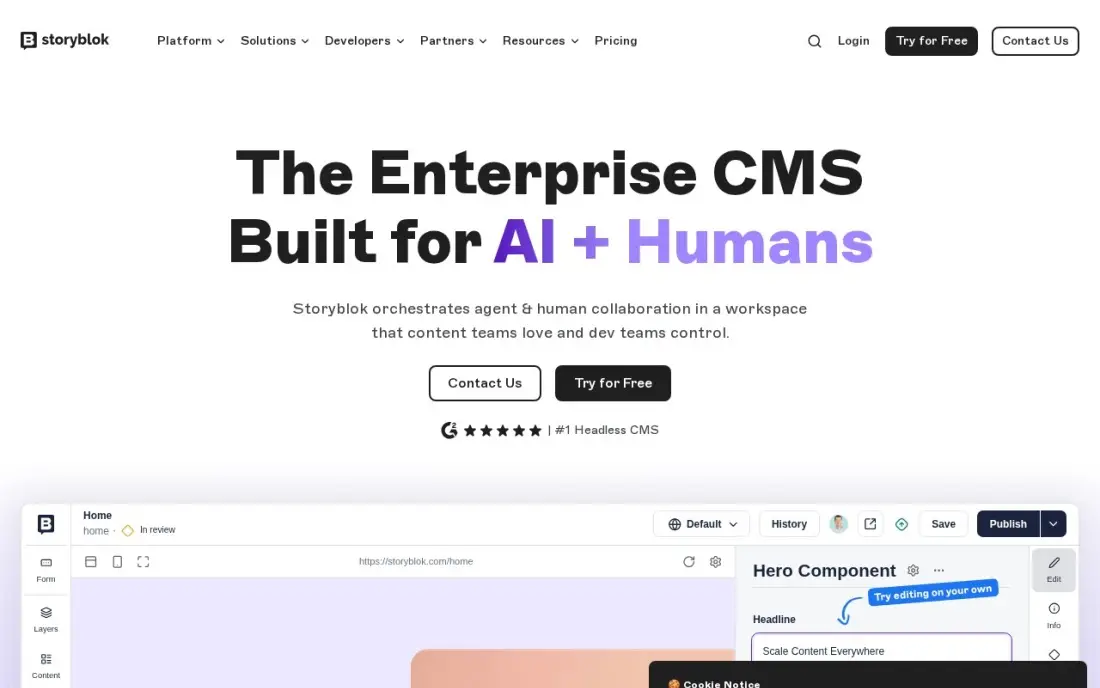
Storyblok gives merchandisers a visual editor on a headless CMS, so campaign pages, lookbooks and buying guides are built from approved blocks without a developer, while the content still flows to the custom storefront through an API. The free Starter plan covers one space and one seat.
Growth costs $99 a month, or $90.75 billed annually, with 1 million API requests, 400 GB of traffic and 100,000 AI credits, plus a 45-day trial of Growth Plus. Component schemas live in the UI, so keeping them in sync with code takes discipline, and bandwidth limits can force an upgrade at peak traffic.
What we like
- The visual editor lets non-technical editors build pages from reusable blocks without developer help
- Highest-rated composable tool here on G2 at 4.5/5 from 633 reviews
- Growth includes 1M API requests, 400 GB traffic and 100K AI credits for $99/month
- A 45-day free trial of Growth Plus — the longest trial in this list — plus a free Starter plan
Watch out for
- Component schemas live in the UI, not in code, so keeping them in sync with the frontend takes manual work
- Bandwidth limits and Enterprise-only features such as S3 backups can force a big plan jump
- Reviewers report slow support ticket resolution when production incidents do occur

Hygraph
Best for: API-first teams that want commerce, PIM and content unified in one GraphQL API
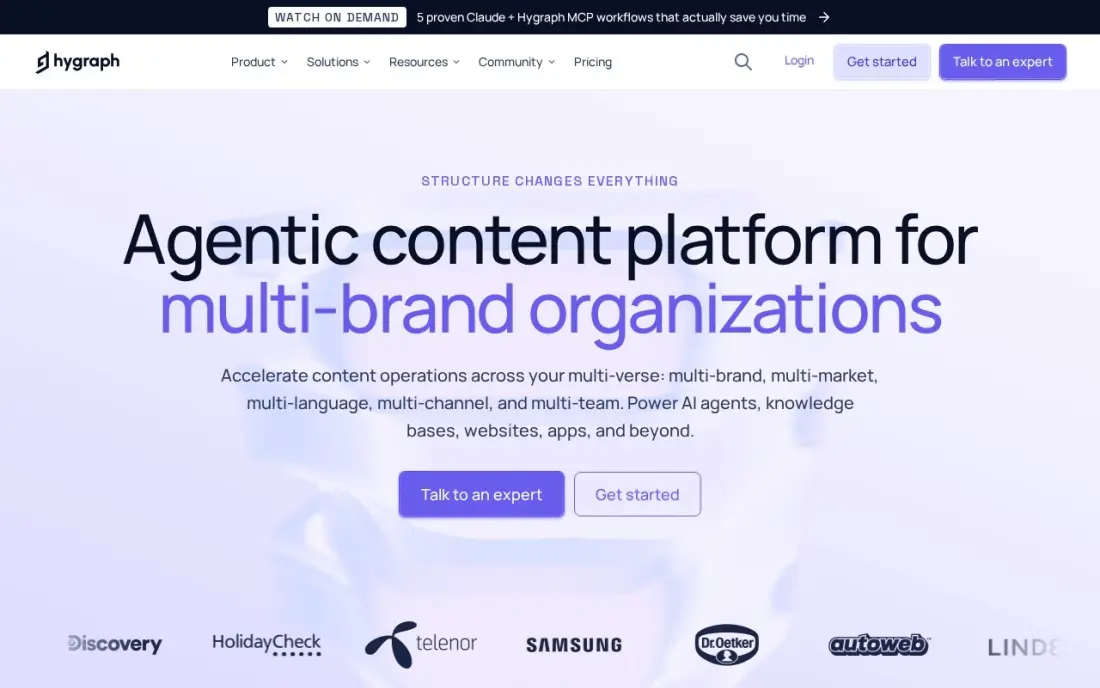
Hygraph's distinguishing feature for composable commerce is content federation: it pulls data from commerce engines, PIM systems and other APIs into one GraphQL content graph, so the front end queries a single endpoint. Live preview, AI Assist and commenting are on Growth, and the free Hobby plan covers 1,000 entries.
Growth starts at $199 a month, the steepest jump from free in this list, and scheduled publishing and custom roles wait for Enterprise. Delivery is GraphQL-only, with no basic REST option. A full-featured 30-day Enterprise trial makes it easy to test federation with your own systems.
What we like
- Content federation pulls commerce, PIM and other APIs into one unified GraphQL content graph
- GraphQL-native delivery is fast, and reviewers praise the responsive support team
- Hobby plan is genuinely free with 1,000 entries, and the 30-day Enterprise trial is full-featured
- Live preview, AI Assist and commenting are included on the Growth plan
Watch out for
- Scheduled publishing and custom roles wait for Enterprise — Growth has neither
- GraphQL-only delivery has a learning curve, and there is no basic REST option
- The jump from the $0 Hobby plan to Growth at $199/month is the steepest in this list

Builder.io
Best for: Composable teams whose marketers need to edit pages built from developer components
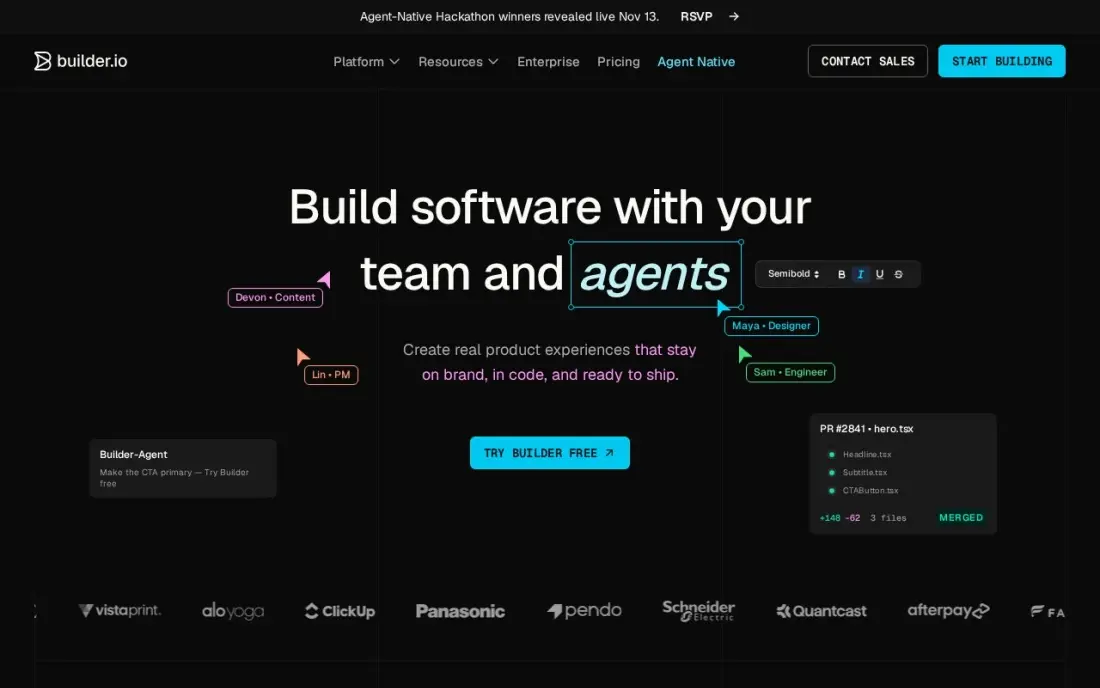
Builder.io solves a common problem with composable builds: marketers cannot change a page without an engineering ticket. It adds drag-and-drop editing over your own components, so pages stay on-brand and fast, and Visual Copilot turns Figma designs into framework code. A/B testing and personalization are built in, and the free plan covers up to 5 users.
Pro costs $30 a user a month, or $24 billed annually, plus AI-credit usage. It has only 27 G2 reviews, and some recent ones report slow support and outdated documentation. Setup is developer work first, since the editor sits on your codebase.
What we like
- Drag-and-drop editing over your own components: marketers ship pages without engineering tickets
- Visual Copilot turns Figma designs into framework code that matches your design system
- A/B testing and personalization are built in, not a separate product to buy
- Free plan covers up to 5 users, so a small team can evaluate it on a real project
Watch out for
- Pricing is per seat plus AI-credit usage, so the bill grows with both team size and AI use
- Only 27 G2 reviews, and recent ones report slow, unhelpful support and outdated documentation
- Setup is developer work first: the visual editor sits on top of your own codebase, not a blank canvas

Sitecore XM Cloud
Best for: Enterprises on Microsoft and .NET stacks that need multi-site personalization
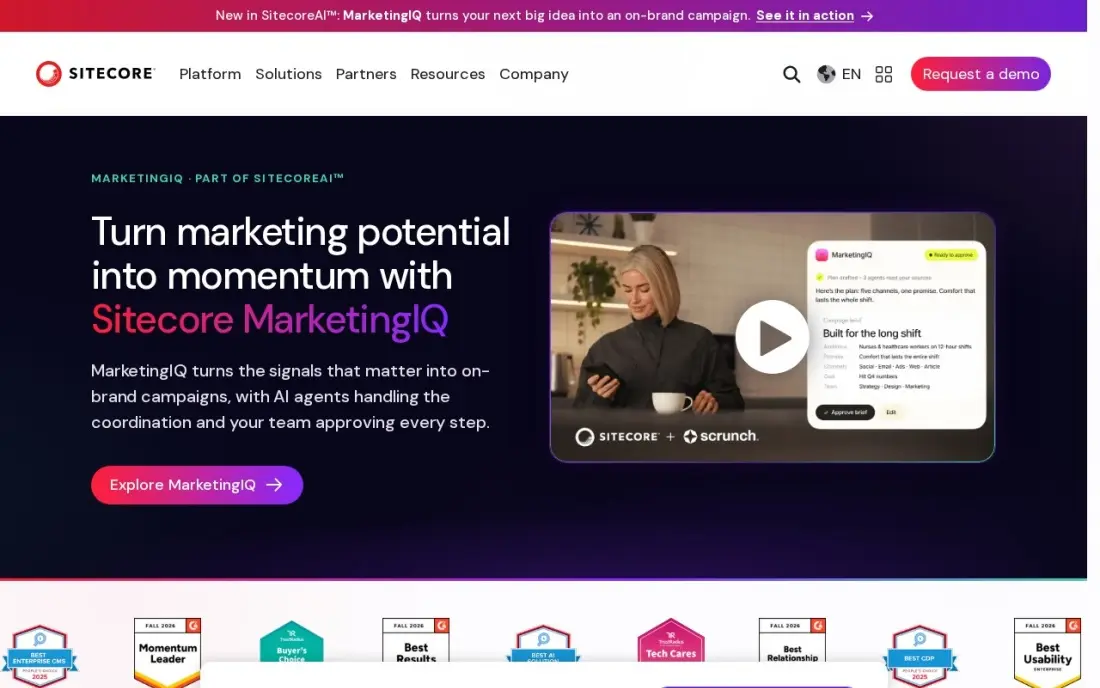
Sitecore XM Cloud is composable by design: the SaaS content platform is sold alongside separate modules for customer data, personalization, search and content operations, so an enterprise can assemble the pieces it needs. Multi-site governance and personalization suit brands running many storefronts across languages, and Sitecore AI is built into the 2026 platform.
There is no published price; quotes are enterprise-only, and CDP, Personalize and Content Hub are sold separately. Implementation typically takes three to six months with .NET developers and a partner, and reviewers say it is hard for new users to learn.
What we like
- SaaS hosting removes the infrastructure work of the old on-premises Sitecore installs
- Composable by design: XM Cloud plus CDP, Personalize, Search and Content Hub as modules
- Strong multi-site governance and personalization for brands running many sites and languages
- Sitecore AI is built into the 2026 platform for content suggestions and personalization
Watch out for
- No published price — custom enterprise quotes only, with CDP, Personalize and Content Hub sold separately
- Implementation typically takes 3–6 months and needs .NET developers and partner help
- Reviewers say the platform is hard for new users to learn and configure at first
The best composable commerce platform is rarely one product. A composable store joins a commerce engine for products, carts and orders with a headless CMS for content and a front end your developers control, so each part can be swapped as the business grows. We compared nine platforms that teams use to build composable commerce stacks, three commerce engines, four content platforms and two experience layers, on APIs, editing, free plans and cost. Every price comes from the vendor's own pricing page, checked in November 2026.
How to choose the best composable commerce platform
- Start with the problem. Go composable only for a reason an all-in-one platform cannot meet, such as complex catalogs, many markets or a custom checkout.
- Pick the commerce engine first. Catalog, pricing and checkout logic are the hardest parts to replace later.
- Match the CMS to the editors. Marketers need visual editing; developer-led teams may prefer schemas in code.
- Check API limits and pricing. Request quotas, bandwidth and seat counts decide the bill at peak traffic.
- Budget for the front end. The custom storefront and its upkeep usually cost more than any licence.
- Plan SEO from day one. Metadata, structured data, sitemaps and redirects must be built into a headless front end.
Headless storefronts often launch without the SEO basics that all-in-one platforms include. Our SEO audit checks rendering, metadata, canonical tags and redirects on composable builds, and the free JSON-LD validator confirms product schema is output correctly.
Composable commerce pricing: what you will actually pay
Take a mid-size brand assembling a stack. On the commerce side, BigCommerce Core and Shopify Basic both list at $39 a month or $29 billed annually, though a brand at composable scale will sit on a higher plan, and BigCommerce Core auto-upgrades past $30,000 in yearly sales. Adobe Commerce is quoted by gross merchandise value.
On the content side, Contentful Lite costs $300 a month, or $3,600 a year; Storyblok Growth $99 a month, or $1,089 a year at $90.75 billed annually; Hygraph Growth from $199 a month, or $2,388 a year; and Sanity Growth $15 a seat a month, $900 a year for five editors. Builder.io Pro adds $24 a user a month billed annually, $1,440 a year for five users plus AI credits. Sitecore XM Cloud is quote-only, with modules sold separately.
Know the difference: composable vs all-in-one commerce
An all-in-one platform runs the storefront, content, checkout and hosting as one product. Themes and apps extend it, upgrades arrive automatically and a small team can run it, but you accept its page builder, checkout limits and data model.
A composable stack connects separate services through APIs. You choose the best commerce engine, CMS, search and payments for your needs and build your own front end, so you can change one part without replacing the rest. The cost is engineering: someone must integrate the services, keep them in sync and own performance and SEO.
Quick comparison: tool type by need
| Buyer | Best pick | Why |
|---|---|---|
| Complex and B2B commerce | Adobe Commerce | Deepest customization, quote-only |
| Hosted engine, more built in | BigCommerce | Unlimited staff accounts, Core from $29/month billed annually |
| Largest app ecosystem | Shopify | Fastest to launch, Basic from $29/month billed annually |
| Proven headless CMS | Contentful | Free plan, Lite $300/month |
| Developer-led content | Sanity | Schemas in code, free for 20 seats |
| Visual merchandising | Storyblok | Visual editor, Growth $99/month |
| Unified commerce and PIM data | Hygraph | Content federation into one GraphQL API |
| Marketer page editing | Builder.io | Drag-and-drop over your own components |
| .NET enterprises | Sitecore XM Cloud | Composable modules and multi-site personalization |
Mistakes to avoid
- Going composable for its own sake. If an all-in-one platform meets your needs, the extra engineering buys little.
- Forgetting the editors. A headless CMS without visual editing or previews leaves marketers waiting on developers.
- Launching without SEO basics. Check titles, canonical tags, structured data, sitemaps and server rendering before go-live.
- Underestimating integration upkeep. Every API connection needs monitoring and updates as vendors change.
- Ignoring usage limits. API calls and bandwidth spike during sales; check what happens to the bill and the site at peak.
How we chose
We checked each vendor's pricing page in November 2026 and recorded starting prices exactly as shown, with annual-billing rates where listed. Adobe Commerce and Sitecore XM Cloud publish no prices, so we list them as custom quotes. We grouped the nine platforms by their role in a composable stack and compared them on APIs, editing, free plans, scale limits and cost. Ratings come from G2 pages checked on the dates shown in the sources; platforms without a rating we verified show none. No vendor paid for a place in this list, and none of the links here are affiliate links.
What to do next
Write down the one thing your current platform cannot do, then build a small proof of concept that solves it with one commerce engine and one CMS from this list. Include SEO checks in the proof of concept. Book a free headless SEO review.
Frequently asked questions
What is the best composable commerce platform?
There is no single platform; composable commerce combines parts. Adobe Commerce, BigCommerce and Shopify are commerce engines, Contentful, Sanity, Storyblok and Hygraph are headless content platforms, and Builder.io adds visual editing on top.
What is composable commerce?
It is an approach where a store is built from separate, API-connected services, such as a commerce engine, a headless CMS, search and payments, instead of one all-in-one platform, so each part can be replaced without rebuilding the rest.
How much does composable commerce cost?
Licences range from free plans on Contentful, Sanity, Storyblok and Hygraph to $300 a month for Contentful Lite and quote-only enterprise engines. The biggest cost is usually the developers who build and run the custom front end.
Is composable commerce the same as headless commerce?
Headless commerce separates the front end from the commerce engine. Composable commerce goes further, swapping in separate best-of-breed services for content, search, payments and more.
When should a brand go composable?
When an all-in-one platform blocks growth: complex catalogs, many markets or brands, custom checkout logic or content needs its page builder cannot meet. Smaller stores usually move faster on an all-in-one platform.
Does composable commerce help SEO?
It can, through faster pages and full control of markup, but only if developers build metadata, structured data, sitemaps and redirects into the front end; a headless build starts with none of them.
Sources we checked (17)
- Adobe Commerce — business.adobe.com/products/magento/magento-commerce.html (checked November 1, 2026)
- Adobe Commerce reviews on G2 (checked November 1, 2026)
- BigCommerce — www.bigcommerce.com/pricing (checked November 12, 2026)
- Shopify — shopify.com/pricing (checked November 12, 2026)
- Shopify reviews on G2 (checked November 12, 2026)
- Contentful — www.contentful.com/pricing (checked November 12, 2026)
- Contentful reviews on G2 (checked November 12, 2026)
- Sanity — www.sanity.io/pricing (checked November 12, 2026)
- Sanity reviews on G2 (checked November 12, 2026)
- Storyblok — www.storyblok.com/pricing (checked November 12, 2026)
- Storyblok reviews on G2 (checked November 12, 2026)
- Hygraph — hygraph.com/pricing (checked November 12, 2026)
- Hygraph reviews on G2 (checked November 12, 2026)
- Builder.io — www.builder.io/pricing (checked November 12, 2026)
- Builder.io reviews on G2 (checked November 12, 2026)
- Sitecore XM Cloud — www.sitecore.com (checked November 12, 2026)
- Sitecore XM Cloud reviews on G2 (checked November 12, 2026)
Make one of these tools?
We re-check this list every quarter. Send a correction, request a review, or ask about a clearly labeled sponsored spot.
Request a listingShamim
Founder of SerpAstra
A full-stack SEO and digital marketer who spends most days on Local SEO for dental practices, AI search visibility and lead generation.
Free SEO and AI visibility audit
Find out what is holding your rankings back
Send us your site. Within 2 business days you get a written audit, an AI visibility check and a short fix list ranked by impact. Free, with no contract attached.
Request my free audit→Related buying guides
 Website Builders & Hosting7 Best Headless CMS Software in 2026, ComparedCompare the 7 best headless CMS software on free plans, editor experience, APIs, self-hosting and real monthly cost, with every price checked on vendor pages.Read guide →
 Ecommerce7 Best Enterprise Ecommerce Platforms in 2026, ComparedCompare the best enterprise ecommerce platform options on B2B tools, multi-store control, GMV fees and annual cost, with every price checked on vendor pages.Read guide →
 Marketing9 Best Digital Experience Platforms for 2026 (Pros, Cons and Pricing)Compare the 9 best digital experience platform options for 2026 on price, free plans and features, with 5 published prices and 4 quote-only enterprise suites.Read guide →