
10 Best Content Marketing Software in 2026, Compared
10 best content marketing software tools compared on price, planning, optimization and publishing, with starting prices and the right pick for every team size.
 Shamim Mia, Founder, SerpAstraLast verified November 4, 202610 min read
We compare pricing pages, documentation and public reviews. We never accept payment for rankings.

Key takeaways
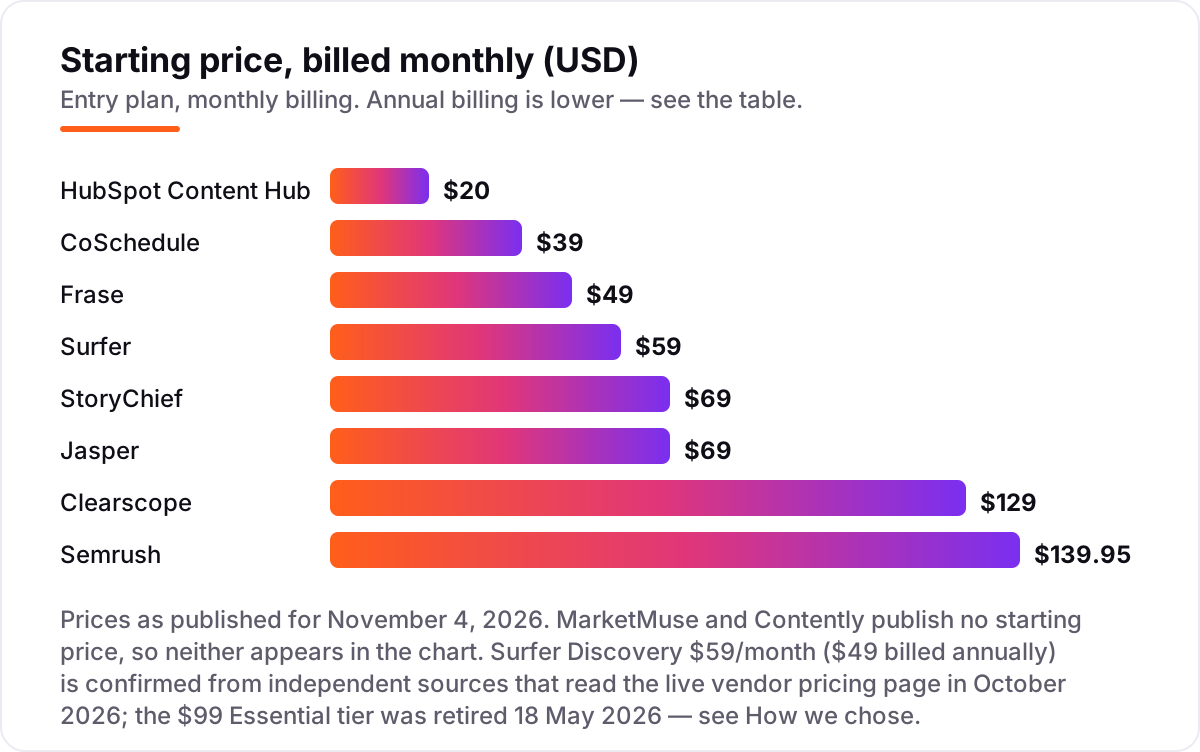
- HubSpot Content Hub is the best starting point for most teams at $20 per seat a month, Semrush is the deepest suite at $139.95 a month, and Frase is the best-value optimizer at $49 a month.
- The single most important buying factor is the job you are hiring the tool for: planning, optimizing, writing or publishing — no tool here does all four equally well.
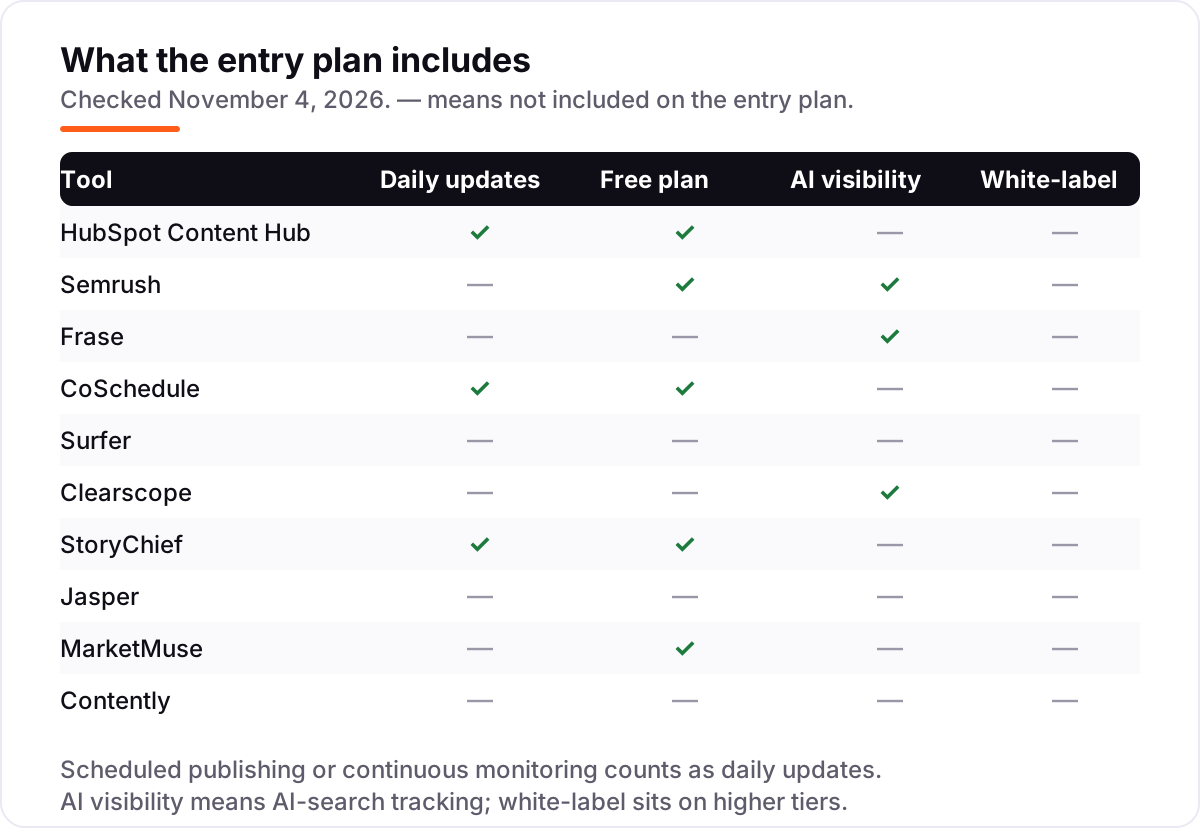
- Free plans exist — HubSpot, CoSchedule, StoryChief and MarketMuse all have one — but paid plans start at $29 to $49 a month billed annually.
- Prices below are the vendors' published starting prices as cross-checked on November 4, 2026; Surfer's Discovery price is confirmed from independent sources that read the live vendor pricing page in October 2026, and MarketMuse and Contently publish no price at all.
On this page
Quick comparison
| Tool | Best for | Starting price | Free plan |
|---|---|---|---|
| HubSpot Content Hub | Small marketing teams already running on HubSpot that want the website, blog and CRM in one system | $20/seat/mo | Yes (free tools) |
| Semrush | Growing marketing teams that want keyword research, content briefs and rank tracking in one deep suite | $139.95/mo | Yes (limited) |
| Frase | Solo creators and small teams publishing up to 10 articles a month who want research to publish in one tool | $49/mo | No (7-day trial) |
| CoSchedule | Solo marketers and small teams that plan blog and social content on one shared calendar | $39/mo | Yes (free plan) |
| Surfer | Writers and small SEO teams that want live content scores against the pages already ranking | $59/mo | No (money-back only) |
| Clearscope | Editorial teams and agencies that need one clear grading standard every writer can follow | $129/mo | No (14-day trial) |
| StoryChief | Small content teams that publish the same article to the blog, social and email from one workflow | $69/mo | Yes (free plan) |
| Jasper | Solo content creators and freelancers who need on-brand AI drafts without word-count limits | $69/mo | No (7-day trial) |
| MarketMuse | Large publishers and in-house teams managing hundreds of pages who plan content by topic authority | Custom quote | Yes (10 queries/mo) |
| Contently | Enterprise marketing teams that need managed content creation plus a vetted freelance network | Custom quote | No (demo only) |
Make one of these tools?
We re-check this list every quarter. Send a correction, request a review, or ask about a clearly labeled sponsored spot.
Request a listingThe best content marketing software

HubSpot Content Hub
Best for: Small marketing teams already running on HubSpot that want the website, blog and CRM in one system
HubSpot Content Hub is the website layer of the HubSpot CRM. Blog posts, landing pages and website pages live in the same system as contacts and deals, so a page view can be traced to a pipeline, and the free tools cover a blog, landing pages and the CRM at no cost. Starter at $20 per seat a month removes HubSpot branding and adds SEO recommendations and AI-assisted drafting in the same editor.
The catch is the jump to Professional. A/B testing, smart content and custom reporting start at $500 a month with three seats included, and per-seat pricing stacks when a team uses several HubSpot products. If your company already lives in HubSpot, Content Hub is the home for your content; if it does not, the value only appears once the CRM data starts flowing through it.
What we like
- Website, blog and landing pages share data with the CRM, so page views connect to contacts and deals
- Free tools cover a real blog and landing pages, and Starter removes HubSpot branding at $20 per seat
- Built-in SEO recommendations and AI-assisted drafting sit in the same editor as publishing
Watch out for
- The content features that matter most — A/B testing, smart content and custom reporting — start on Professional at $500 a month
- Per-seat pricing stacks across hubs, so a team using several HubSpot products pays per seat in each
- Less design freedom than a dedicated CMS such as Webflow or WordPress

Semrush
Best for: Growing marketing teams that want keyword research, content briefs and rank tracking in one deep suite
Semrush is the deepest bench in this list. The entry SEO plan pairs keyword research with a site audit, backlink analysis and rank tracking, and Content Audit scores your existing pages and flags what to rewrite, update or delete. If your content plan starts with research — which topics to cover, what competitors rank for, where the gaps are — no other tool here gives you as much data to work from.
The honest limitation is the paywall inside the product. The full Content Marketing Toolkit, with topic research, the SEO Writing Assistant and ContentShake AI, sits on the Guru plan at $249.95 a month, not the $139.95 entry plan. Buy the entry plan for research and tracking; budget for Guru if the content workflow itself is the reason you are buying.
What we like
- The largest keyword database in this list backs topic research, briefs and the SEO Writing Assistant
- Content Audit scores existing pages and flags what to rewrite, update or delete
- Bundles content tools with rank tracking, site audits, backlinks and PPC research in one login
Watch out for
- The full Content Marketing Toolkit sits on the Guru plan at $249.95 a month, not the $139.95 entry plan
- Extra users cost $45 a month on the entry plan, and the interface takes time to learn

Frase
Best for: Solo creators and small teams publishing up to 10 articles a month who want research to publish in one tool
Frase is the best-value optimizer in this list because it closes the loop. One subscription takes an article from SERP research to a brief, a draft, an optimized score and a published post, for $49 a month or $39 on annual billing. Content Guard watches your pages for ranking drops, and AI visibility tracking covers ChatGPT and Google AI even on Starter.
The limit is volume. Starter covers one seat, one site and ten articles a month, so a second writer or an eleventh article pushes you to Professional at $129 a month. There is also no social scheduling, so publishing beyond WordPress and the supported CMS tools needs another product. For a solo creator or a two-person team, Frase is the cheapest complete workflow here.
What we like
- Research, briefs, drafting, optimization and publishing close the loop in one subscription from $49 a month
- Content Guard watches pages for ranking drops and flags content that needs a refresh
- AI visibility tracking covers ChatGPT and Google AI on Starter, with more engines on higher plans
Watch out for
- Starter covers 1 seat, 1 site and 10 articles a month, so a second writer means Professional at $129
- No built-in social scheduling or multi-channel publishing beyond WordPress and the supported CMS tools

CoSchedule
Best for: Solo marketers and small teams that plan blog and social content on one shared calendar
CoSchedule is the planning pick in this list. Everything is built around one shared calendar: blog posts, campaigns, projects and social promotion sit on the same screen, so the whole team sees what is going out and when. ReQueue refills quiet gaps with evergreen posts automatically, and the free plan covers one user and fifteen scheduled posts, which is enough for a solo marketer to test the workflow.
The pricing needs attention beyond the headline. Posting to X costs $16 per profile a month on every paid plan, and Professional caps at three users — a fourth person means the custom Suite plan. CoSchedule plans content rather than writing or grading it, so pair it with an optimizer such as Frase if your drafts also need scoring.
What we like
- Calendar-first planning puts blog posts, campaigns and social promotion on one shared screen
- ReQueue automatically refills gaps in the schedule with evergreen posts
- Free plan covers 1 user and 15 scheduled posts, so a solo marketer can start without paying
Watch out for
- Posting to X costs $16 per profile a month on every paid plan, on top of the subscription
- Professional caps at 3 users, so a fourth team member means the custom Suite plan

Surfer
Best for: Writers and small SEO teams that want live content scores against the pages already ranking
Surfer built its name on one thing: telling writers exactly what the top-ranking pages do, while they write. The Content Editor grades a draft live on word count, headings, structure and terms, and Content Audit shows which existing pages to update first. Keyword research and topical maps sit in the same workflow.
The entry plan is lean. Discovery covers 120 Content Editor articles a year for one user, and the AI Tracker for ChatGPT and AI Overviews is not included — it sits on a higher tier. There is no free plan or trial — only a 7-day money-back guarantee. At $59 a month, Surfer is the cheapest optimizer here after Frase, and it earns its place only if your writers actually write to the score.
What we like
- The Content Editor scores drafts live against the pages already ranking for the keyword
- Content Audit shows which existing pages to update first
- Keyword research and topical maps sit in the same workflow
Watch out for
- The AI Tracker for ChatGPT and AI Overviews is not on the entry plan
- No free plan and no free trial — a 7-day money-back guarantee is the only way to test it
- The entry plan covers 120 Content Editor articles a year for one user — small for teams publishing daily

Clearscope
Best for: Editorial teams and agencies that need one clear grading standard every writer can follow
Clearscope is the editorial teams' optimizer. It grades drafts on topic coverage with a clear A to F scale that freelance writers understand without SEO training, which is why content teams with outside contributors like it. Every plan includes unlimited users and projects, and tracked queries now cover ChatGPT and Gemini, so the grading connects to AI visibility as well as search.
The price is the trade. At $129 a month with no annual discount published, Clearscope is the most expensive single-purpose optimizer in this list, and drafts are capped at 20 a month on every paid plan — even Business at $399. It does no keyword research, rank tracking or publishing, so it fits teams that already have those tools and need one trusted standard for draft quality.
What we like
- A–F content grades are easy for freelance writers to follow without SEO training
- Unlimited users and projects on every plan, so a growing team never pays per seat
- Tracked queries now cover ChatGPT and Gemini, tying optimization to AI visibility
Watch out for
- Drafts are capped at 20 a month on every paid plan, including the $399 Business tier
- No keyword research, rank tracking or publishing tools — it grades drafts and stops there

StoryChief
Best for: Small content teams that publish the same article to the blog, social and email from one workflow
StoryChief is the multi-channel publisher in this list. One workflow takes an article from brief to writing, approval and publishing across the blog, social channels and email, with SEO and readability suggestions appearing in the editor while writers work. The free plan covers social media analytics, and Starter at $69 a month includes 25 articles, four social channels and 15,000 AI credits.
The limits sit on the higher tiers. Starter tracks no AI prompts, so AI visibility reporting needs Growth at $339 a month, and AI image and video generation is a separate $60 a month add-on. StoryChief is the right pick when distribution is the bottleneck — one article, many channels, no copy-paste — and the wrong pick if you only need grading or research.
What we like
- One workflow covers briefing, writing, approval and multi-channel publishing, including social and email
- SEO and readability suggestions appear in the editor while writers work
- Free plan includes social media analytics, and paid plans start at $69 a month
Watch out for
- Starter tracks no AI prompts, so AI visibility reporting needs the Growth plan at $339 a month
- AI image and video generation sits behind a separate $60 a month add-on

Jasper
Best for: Solo content creators and freelancers who need on-brand AI drafts without word-count limits
Jasper is the AI drafting pick in this list. It is built for marketing content rather than generic chat: campaign, blog, ad and email templates, a document editor, Jasper Chat and a browser extension, with unlimited word generation on every paid plan. Brand Voice keeps drafts in a consistent tone, which matters when several writers produce content for one brand.
Jasper writes and stops there. There is no SEO scoring, no content calendar and no publishing workflow, so it pairs with an optimizer such as Frase or Surfer rather than replacing one. Pro at $69 a month per seat covers one user and one Brand Voice (the retired Creator tier was $49); teams pay per seat. If drafting speed is your bottleneck, Jasper is the fastest way to fill a blank page.
What we like
- Unlimited word generation on every paid plan, with 50 templates and a browser extension
- Brand Voice keeps drafts in a consistent tone across writers and clients
- Built for marketers: campaign, blog, ad and email templates rather than generic chat
Watch out for
- Pro is priced per seat at $69 a month, so a team of five pays $345 a month
- No SEO scoring, content calendar or publishing workflow — it writes, and other tools do the rest
- Creator is retired for new users, so the $49 entry price in older reviews no longer applies

MarketMuse
Best for: Large publishers and in-house teams managing hundreds of pages who plan content by topic authority
MarketMuse works a level above the document. It inventories your existing content, models topic coverage against competitors and tells you which clusters to build, update or drop to own a subject, with difficulty scores based on your site's actual authority. Content briefs come from competitive gap analysis rather than a keyword list, which is why large publishers use it to plan whole libraries.
Access is the trade. MarketMuse stopped publishing dollar amounts on its paid plans, so pricing comes through a sales demo, and the free plan covers one user and ten queries a month. For a site with a few dozen pages there is nothing to inventory, and an optimizer costs far less. MarketMuse fits teams managing hundreds or thousands of pages, where planning errors are expensive.
What we like
- Inventories the whole site and scores topical authority, showing which clusters to build or fix
- Content briefs are built from competitive gap analysis, not just keyword lists
- Free plan gives 10 queries a month, enough to test the analysis on a real domain
Watch out for
- No published prices — paid plans are quoted through a sales demo, which slows evaluation
- Strategy depth is overkill below a few hundred pages, where an optimizer costs far less

Contently
Best for: Enterprise marketing teams that need managed content creation plus a vetted freelance network
Contently is the enterprise option in this list: a content marketing platform, a talent marketplace and a content service provider in one. Its vetted freelance network covers writing, design and strategy, so a company without a dedicated content team can still publish at scale, with workflow, approvals and analytics on the same platform.
Everything about Contently is enterprise-sized, including the buying process. There is no public pricing — quotes come through sales, with implementation fees on top — and the minimums put it out of reach for small teams. If you need managed creation at volume and can fund it, Contently removes the hiring problem; if you need software alone, every other tool here costs less and starts faster.
What we like
- A large vetted freelance network covers writing, design and strategy without hiring in-house
- Content strategy services and analytics sit beside the talent marketplace on one platform
- Enterprise-grade workflow, approvals and reporting for large content operations
Watch out for
- Quote-only pricing with no public starting price, and implementation fees on top
- Built for enterprise budgets — small teams will find the sales process and minimums a barrier
The best content marketing software is the one that matches the job you actually do every week: planning the calendar, briefing writers, optimizing drafts or publishing everywhere at once. This list sorts 10 tools by that job, with real starting prices, so you can skip the ones built for a different team than yours.
Most buyers shop this category the wrong way round: they compare feature lists before naming the bottleneck. A team that cannot publish on time needs a calendar, not a better content score, and a team whose drafts never rank needs an optimizer, not a bigger writer network. Read the list by job, not by brand.
How to choose the best content marketing software
- Name the job first. Planning, optimizing, writing or publishing — pick the tool built for your bottleneck, not the one with the longest feature list.
- Count the seats and the volume. Per-seat pricing on HubSpot and per-article caps on Frase, Surfer and Clearscope change the bill more than the headline price does.
- Check what the entry plan leaves out. Semrush's content toolkit, Surfer's AI Tracker and CoSchedule's white-label reports all sit above the cheapest tier.
- Test the workflow, not the demo. Every tool here offers a free plan or a trial, so run one real article through it before you pay. Before you publish, run your titles through the free SERP snippet preview tool to see exactly how they will look in Google.
- Ask where the content goes. If you publish to WordPress, HubSpot or social channels, the publishing integrations matter as much as the editor — and local teams should also read content marketing for local business before choosing.
Content marketing software pricing: what you will actually pay
A solo creator publishing 10 articles a month pays $39 a month for Frase Starter on annual billing, or $49 month to month — and that covers the whole loop from research to publish. A 3-person team on CoSchedule Professional pays $49 a month billed annually plus $29 for the third seat, so $78 a month before the $16 per X profile add-on. The same team on HubSpot Content Hub Starter pays $60 a month at the $20 list price for three seats, or $21 a month on the $7 new-customer annual offer.
The expensive surprise is Semrush. The $139.95 entry plan buys research, tracking and audits, but the full Content Marketing Toolkit needs the Guru plan at $249.95 a month — a $110 a month difference that catches buyers who assumed the toolkit was included. Annual billing saves roughly 17 to 20% on most tools here, Clearscope publishes no annual rate, and MarketMuse and Contently are quote-only, so there is no number to compare. If the bill still looks unclear, our monthly SEO service plans and publishes content for teams that would rather not run the stack themselves.
Know the difference: content platform vs content optimizer vs calendar
The biggest buyer confusion in this category is the word "platform" — it hides three different tools. All-in-one platforms such as HubSpot, Semrush, StoryChief, MarketMuse and Contently run the whole operation: planning, creation, publishing and measurement in one subscription. Optimizers such as Surfer, Clearscope and Frase do one layer superbly: they grade and improve drafts against what already ranks, and they assume you already have a way to plan and publish. Calendars such as CoSchedule plan and schedule the work but neither write nor grade it, and writers such as Jasper draft fast but score and publish nothing.
Buying the wrong type is the most expensive mistake here. An optimizer cannot fix a team that never publishes on time, and a platform wastes money on a solo writer who only needs grading. Match the type to the bottleneck first, then compare tools inside that type. If you only need the optimization layer, start with our content optimization tools for beginners guide; if writing is the bottleneck, compare the best AI writing tools for SEO before you buy a platform.
Quick comparison: tool type by need
| Buyer | Best pick | Why |
|---|---|---|
| Solo creator on a budget | Frase | $49 a month, research to publish in one tool |
| Team already on HubSpot | HubSpot Content Hub | $20 a seat, website and CRM in one place |
| Deepest research data | Semrush | Largest keyword database here; content toolkit on Guru |
| Editorial team grading drafts | Clearscope | A–F grades writers understand, unlimited users |
| Planning and publishing | CoSchedule or StoryChief | Calendar-first scheduling and multi-channel publishing |
| Enterprise content operation | MarketMuse or Contently | Topic strategy and a vetted writer network, quoted |
How we chose
Prices below are the vendors' published starting prices, cross-checked on November 4, 2026 against the program's verified price list and independent pricing roundups from October and November 2026. Our browser could not load the vendors' pricing pages directly that day, so Surfer's $59 a month Discovery price ($49 billed annually) is confirmed from several independent sources that read the live vendor pricing page in October 2026 — the $99 Essential tier many roundups still quote was retired on 18 May 2026 — and MarketMuse and Contently publish no starting price, so both are listed as custom quote. No review ratings appear in this post because no G2 or Capterra page could be opened on the day of writing. We ranked the tools by fit for the most common buyer — a small marketing team publishing a few articles a week — not by brand size. No vendor paid for a place in this list, and none of the links here are affiliate links.
What to do next
Start with the job, not the tool: write down whether planning, optimizing, writing or publishing is your bottleneck, then take the free plan or trial of the top pick for that job and run one real article through it. If the draft scores, the calendar holds and the publish step works without a workaround, you have your tool. Once your tools are in place, find out what's holding your rankings back.
Your stack only works if people find you
SerpAstra fixes what keeps your site off page one and makes it easy for AI assistants to recommend.
Get a free audit→Sources we checked (10)
- HubSpot Content Hub pricing — hubspot.com/pricing/content (checked November 4, 2026)
- Semrush pricing — semrush.com/prices (checked November 4, 2026)
- Frase pricing — frase.io/pricing (checked November 4, 2026)
- CoSchedule pricing — coschedule.com/pricing (checked November 4, 2026)
- Surfer pricing — surferseo.com/pricing (verified from independent sources that read the live pricing page, October 2026)
- Clearscope pricing — clearscope.io/pricing (checked November 4, 2026)
- StoryChief pricing — storychief.io/pricing (checked November 4, 2026)
- Jasper pricing — jasper.ai/pricing (checked November 4, 2026)
- MarketMuse pricing — marketmuse.com/pricing (no pricing published; checked November 4, 2026)
- Contently — contently.com (no pricing published; checked November 4, 2026)
Shamim
Founder of SerpAstra
A full-stack SEO and digital marketer who spends most days on Local SEO for dental practices, AI search visibility and lead generation.
Frequently asked questions
What is the best content marketing software in 2026?
HubSpot Content Hub is the best starting point for most teams: website, blog and CRM in one system from $20 per seat a month, with a free plan to start. Semrush is the deepest suite for research-led teams, and Frase is the best value for solo creators at $49 a month. The right pick depends on whether planning, optimizing, writing or publishing is your bottleneck.
How much does content marketing software cost?
Between $29 and $139.95 a month at the entry level on annual billing: CoSchedule Starter is $29, Frase is $39 and Jasper is $59, and Semrush is $117.33. Clearscope is $129 with no annual discount, and MarketMuse and Contently are quote-only. Per-seat pricing and article caps change the real bill, so check both before comparing headline prices.
Is there a free content marketing software?
Yes, with limits. HubSpot, CoSchedule, StoryChief and MarketMuse all offer free plans, and Semrush has a limited free account. The free tiers cover a single user or a small volume — a real team workflow needs a paid plan. Every paid tool in this list also offers a free trial or a money-back guarantee, so you can test before paying.
What is the difference between Surfer and Clearscope?
Both grade drafts against ranking pages, but they work differently. Surfer scores drafts live in the editor and adds keyword research and AI drafts, while Clearscope gives A to F grades that freelance writers follow easily and includes unlimited users. Surfer starts at $59 a month ($49 billed annually); Clearscope costs $129. Pick Surfer for live scoring, Clearscope for editorial teams.
Do I need HubSpot Content Hub or Semrush for content marketing?
HubSpot if your website and CRM already live there: content, contacts and deals share one system from $20 a seat. Semrush if research leads your content: the keyword database, briefs and audits are deeper, but the full content toolkit needs the $249.95 Guru plan. Many teams end up with both — HubSpot to publish, Semrush to plan.
Can content marketing software replace a writer?
No. Tools like Jasper draft fast and optimizers like Surfer and Clearscope grade well, but every draft still needs a human to check facts, add experience and keep the brand voice honest. The software removes the slow parts — research, briefs, scheduling and publishing — and leaves the judgment to the writer. That is where the time saving actually comes from.
Free SEO and AI visibility audit
Find out what is holding your rankings back
Send us your site. Within 2 business days you get a written audit, an AI visibility check and a short fix list ranked by impact. Free, with no contract attached.
Request my free audit→Related guides
 SEO & AI Search10 Best Content Optimization Tools for Beginners in 2026, Compared10 best content optimization tools for beginners compared on price, free plans and live scoring, with prices checked on each vendor's page November 1, 2026.Read guide →
 SEO & AI SearchBest AI Writing Tools for SEO in 2026: 7 Picks Ranked by What You Need7 best ai writing tools for seo compared on price, live scoring, and drafting power. Prices checked on each vendor pricing page, November 1, 2026.Read guide →
 ContentContent marketing for local businesses: a practical guideContent marketing for local businesses: which formats earn calls, a simple 90-day plan, how to write pages that rank and convert, and how to measure it.Read guide →