
8 Best CRM Tools for B2B Startups in 2026, Compared
Compare the 8 best CRM tools for B2B startups on free plans, founder-led sales, pipeline and price per seat, with every price checked on vendor pages.
 Shamim Mia, Founder, SerpAstraLast verified November 12, 20268 min read
We compare pricing pages, documentation and public reviews. We never accept payment for rankings.

Key takeaways
- HubSpot is the best CRM for most B2B startups: free for two users, a clean path to marketing and sales automation, and the most integrations in this list.
- Pipedrive suits founder-led sales teams that want a simple deal board from $14 a user a month billed annually; Close suits startups that sell by phone.
- Zoho CRM and Freshsales are the cheapest ways to give a three-person team a real CRM, both with free plans for up to three users.
- Startups should buy for the next 18 months, not the next five years — a CRM you can set up in a day beats one that needs an admin.
On this page
Quick comparison
| Tool | Best for | Starting price | Free plan |
|---|---|---|---|
| HubSpot CRM | B2B startups that want a free CRM now and marketing plus sales automation later | Free; Starter $20/seat/mo | Yes (free CRM) |
| Pipedrive | Founder-led sales teams that want a simple deal board they will keep updated | $24/mo | No (14-day trial) |
| Close | Startups that sell by phone, with an inside sales motion from day one | $49/mo | No (14-day trial) |
| Zoho CRM | Bootstrapped startups that need a full CRM for three people at no cost | $20/mo | Yes (3 users) |
| Freshsales | Cost-conscious startups that want built-in phone and email on a cheap paid plan | $11/mo | Yes (3 users) |
| Salesforce Sales Cloud | Venture-backed startups planning to scale a large sales team quickly | $25/user/mo | No (30-day trial) |
| Copper | Google Workspace startups that want the CRM to fill itself from Gmail | $29/mo | No (14-day trial) |
| Capsule | Very early teams that want the simplest shared contact list with a free start | $22/user/mo | Yes (free, 250 contacts) |
Make one of these tools?
We re-check this list every quarter. Send a correction, request a review, or ask about a clearly labeled sponsored spot.
Request a listingThe best CRM tools for B2B startups

HubSpot CRM
Best for: B2B startups that want a free CRM now and marketing plus sales automation later
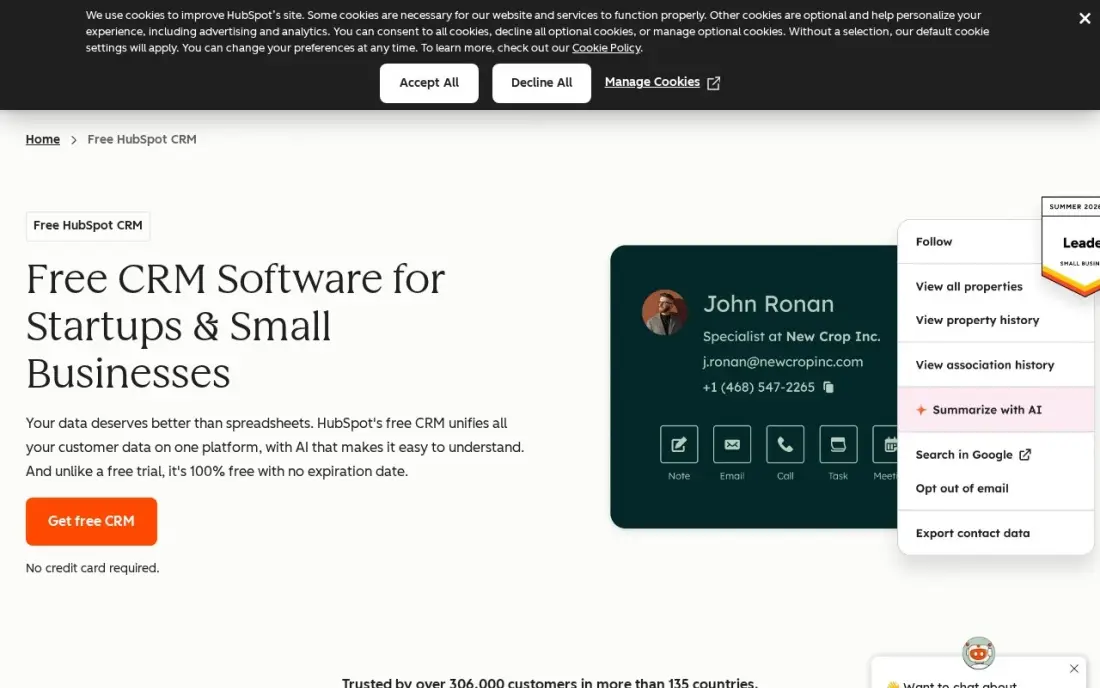
HubSpot is the default CRM for early B2B startups for a practical reason: the free CRM covers two users with unlimited contacts, a deal pipeline, email tracking and meeting links, and it never expires. Founders can log every investor, design partner and first customer in one place before spending a dollar, and marketing forms, email and the website chat all write into the same contact records.
The cost arrives with the team. A third user needs a Starter seat at $20 a month, and sequences, workflows and forecasting live on Professional at $90 a seat. Plan that jump into the seed budget so the startup is not surprised by it at the first sales hire.
What we like
- Free CRM with unlimited contacts and companies, one deal pipeline and email tracking
- Every contact carries its full history — emails, calls, meetings and deals — on one timeline
- Apps on iOS, Android, Windows and Mac, plus a web app that syncs everywhere
Watch out for
- Two free users only — a third teammate forces a paid Starter seat at $20/month
- Automation and reporting live on Professional at $90/seat/month, a steep step up

Pipedrive
Best for: Founder-led sales teams that want a simple deal board they will keep updated
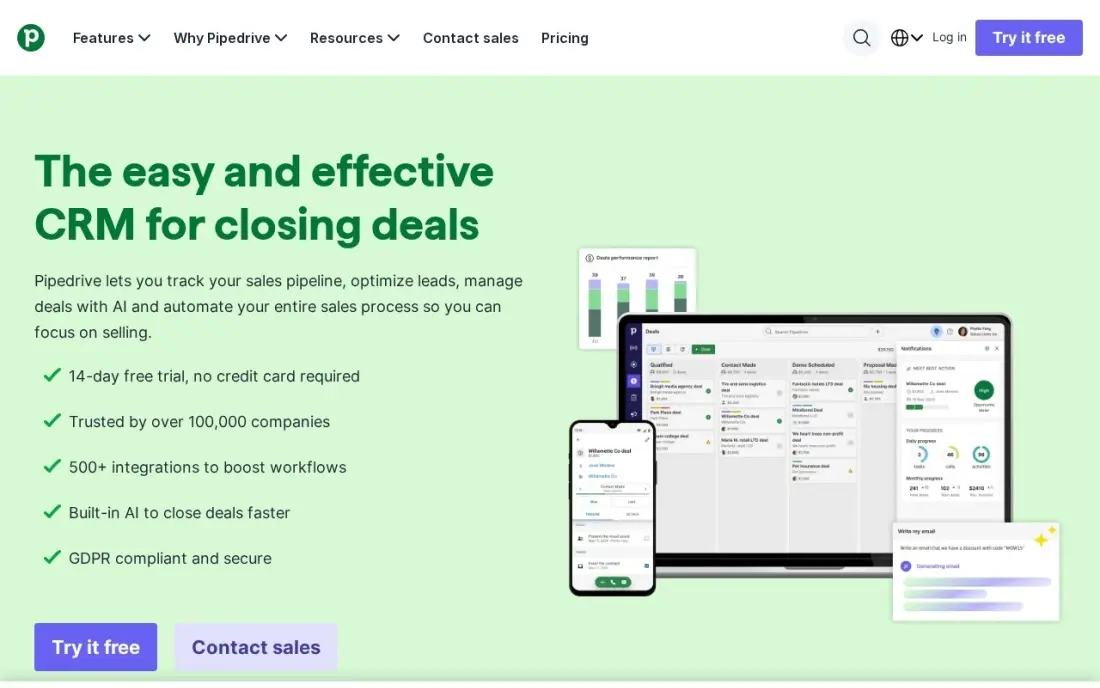
Pipedrive fits the founder who sells between product sprints. Every deal is a card on a board, every card has a next step, and the mobile app makes updating a deal after a call a ten-second job. Lite costs $14 a user a month billed annually, with no onboarding fee and no seat minimum, so two founders pay for two seats.
Startups usually move to Growth at $39 a seat billed annually for two-way email sync and the Nova AI assistant. There is no free plan, only a 14-day trial, but it is the CRM first sales hires are most likely to know already.
What we like
- The clearest visual pipeline in this list: drag-and-drop deals, custom stages and a mobile app reps actually use
- AI assistant Nova briefs reps before calls and keeps deal records current from the Growth plan up
- No onboarding fees and no seat minimums, so a two-person team pays for two seats and nothing else
Watch out for
- Lite has no two-way email sync and no AI — Nova starts on Growth at $39 a user a month billed annually
- LeadBooster, Smart Docs and Projects are paid add-ons, so the real bill is higher than the plan price
- No free plan, only a 14-day trial, and monthly billing costs $24 against $14 on annual billing

Close
Best for: Startups that sell by phone, with an inside sales motion from day one
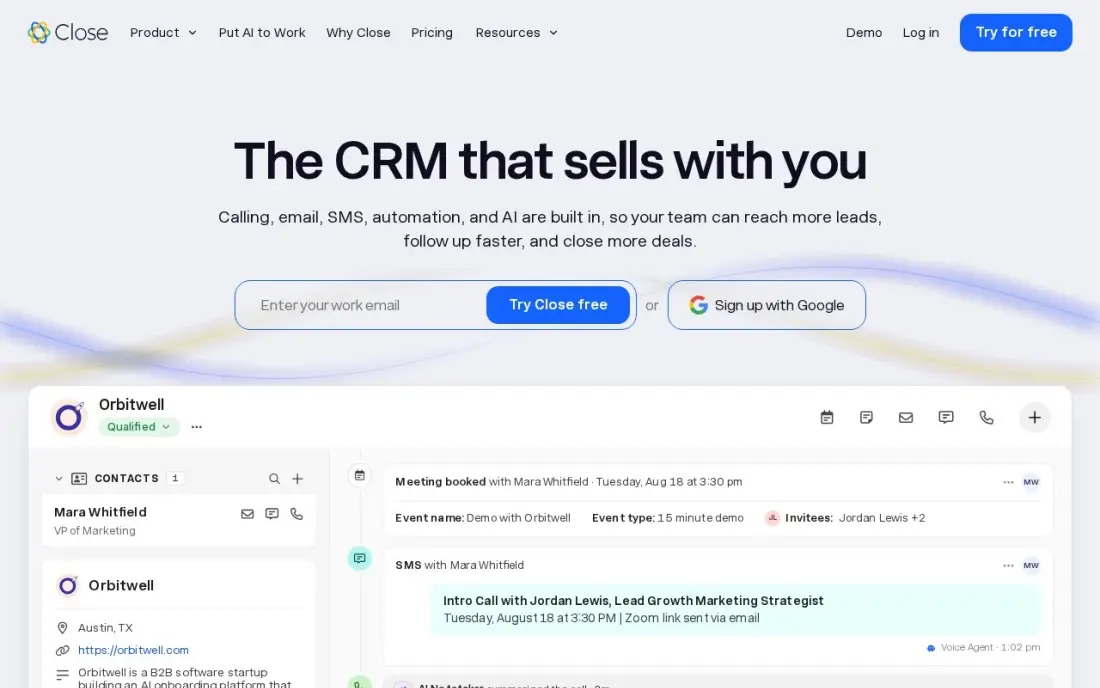
Close was built by a sales team for sales teams, and it shows in the dialer, SMS and email sitting on every lead. A startup running outbound calls gets every touch logged automatically, and Close AI drafts follow-ups and summarizes calls. Essentials costs $35 a user a month billed annually and carries the highest G2 score here at 4.7.
Power dialing and workflows start on Growth at $99 a user a month billed annually, and calls and texts are metered on top. For a startup whose growth plan is outbound, the time saved logging calls pays for the seat.
What we like
- Built-in calling, SMS and email on every team plan, with 1,000 AI credits a user a month on Essentials
- Close AI drafts emails, summarizes call transcripts and flags deal risk, so reps spend less time on notes
- Unlimited contacts and leads on every plan, with no seat cap and no onboarding fee
Watch out for
- Essentials has no workflows and no power dialer — automation starts on Growth at $99 a user a month billed annually
- Calling minutes and texts are metered on top of the subscription, so a high-volume team pays usage on top of seats
- Reporting is the most-cited weakness in G2 reviews, and the Solo plan at $9 caps at one user

Zoho CRM
Best for: Bootstrapped startups that need a full CRM for three people at no cost
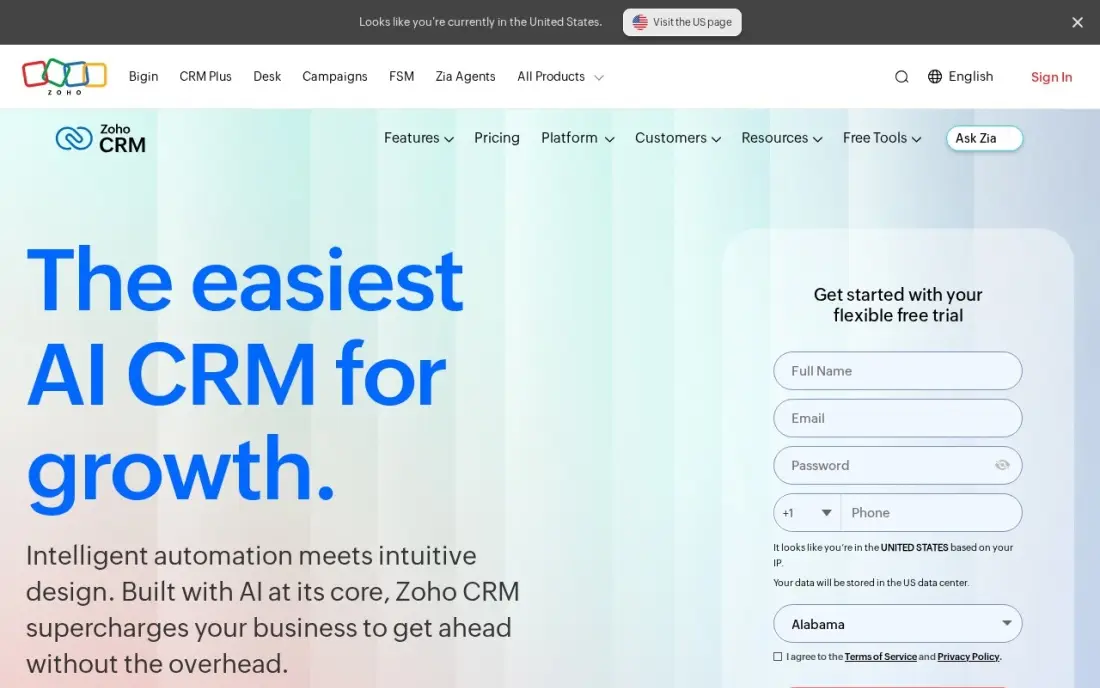
Zoho CRM's free plan covers up to three users with leads, deals, workflows, reports and a mobile app, which is enough for a founding team running its first sales. When the startup pays, Standard costs $14 a user a month billed annually and already includes forecasting, cadences and assignment rules.
Setup takes more effort than HubSpot or Pipedrive, and the AI assistant sits on Enterprise at $40. For a bootstrapped startup that will stay lean, few CRMs give more for less, and the Zoho suite adds invoicing, support desk and email tools on the same login if you need them later.
What we like
- Free plan covers up to 3 users with pipelines, leads and contacts — the only free tier here that fits a tiny team, not just a solo user
- Zia, Zoho's AI assistant, predicts deal outcomes, flags anomalies and suggests the best time to contact a lead on Enterprise and the top tier
- The cheapest full-featured ladder here: Standard $14, Professional $23 and Enterprise $40 a user a month billed annually
Watch out for
- Zia's predictions and AI features need Enterprise at $40 a user a month — Standard buyers get scoring rules, not the AI assistant
- G2 reviewers rate ease of setup 8.0, the lowest here, and support scores trail HubSpot and Pipedrive
- Add-ons for support tiers, storage and training sit outside the seat price, so the invoice can exceed the plan price

Freshsales
Best for: Cost-conscious startups that want built-in phone and email on a cheap paid plan
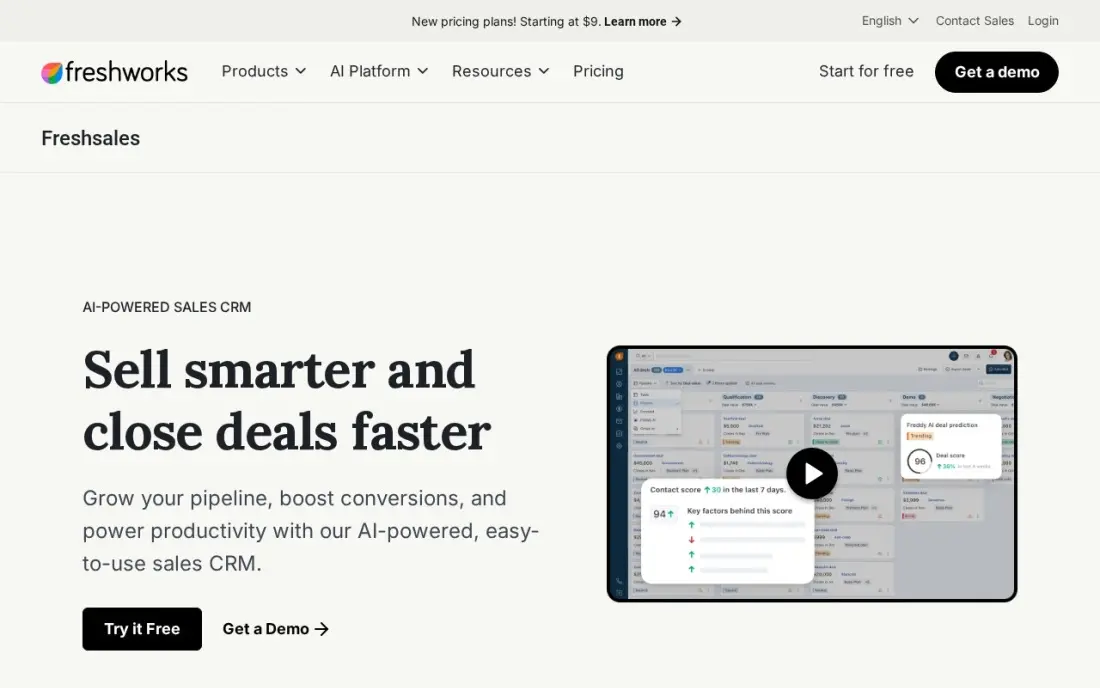
Freshsales has a free plan for up to three users and the cheapest paid seat here: Growth at $9 a user a month billed annually, with a Kanban pipeline, built-in phone, email and chat, and contact lifecycle stages. The 21-day trial runs the full product.
Growth has one pipeline only, and Freddy AI scoring and sequences need Pro at $39. For a startup that wants calling and email in the CRM without Close's price, it is the value option, and the free plan lets a founding team start before anyone signs off a budget.
What we like
- The lowest paid price in this list: $11 a user a month billed monthly ($9 billed annually) on Growth, with a Kanban pipeline, lifecycle stages and built-in chat, email and phone
- Freddy AI scores contacts, drafts sales emails and surfaces deal insights from the Pro plan at $39 a user a month
- No onboarding fee on any tier, and 500 Freddy AI Agent sessions come free once per account on paid plans
Watch out for
- Growth allows only one sales pipeline — multiple pipelines need Pro at $39 a user a month
- Freddy's scoring, sequences and AI sales emails need Pro at $39 — Growth is the pipeline, not the AI
- Branded documents cost $19 a user a month extra, and the Freddy AI Agent is $49 per 100 sessions beyond the free allowance

Salesforce Sales Cloud
Best for: Venture-backed startups planning to scale a large sales team quickly
Salesforce makes sense for a startup only when it plans to build a large sales team fast, because migrating off a smaller CRM later costs time. Starter costs $25 a user a month billed annually and covers accounts, contacts, leads and opportunities, and the platform scales to thousands of users without a move.
For a pre-revenue team it is usually too much: there is no free plan or monthly billing, and configuration often needs an admin or partner. Most startups start on HubSpot or Pipedrive and move only if the sales organisation demands it.
What we like
- The deepest customization in this list, with the largest app marketplace (AppExchange) behind it
- Starter covers accounts, contacts, leads and opportunities for $25/user/month billed annually
- Scales from a 5-person team to thousands of users on one platform, with no migration later
Watch out for
- No free plan and no monthly billing — annual contracts only, so the first invoice is a full year
- Einstein AI and workflow automation sit on higher tiers, not on Starter
- Setup usually needs an admin or a partner, so small teams pay for implementation help on top of the licence

Copper
Best for: Google Workspace startups that want the CRM to fill itself from Gmail
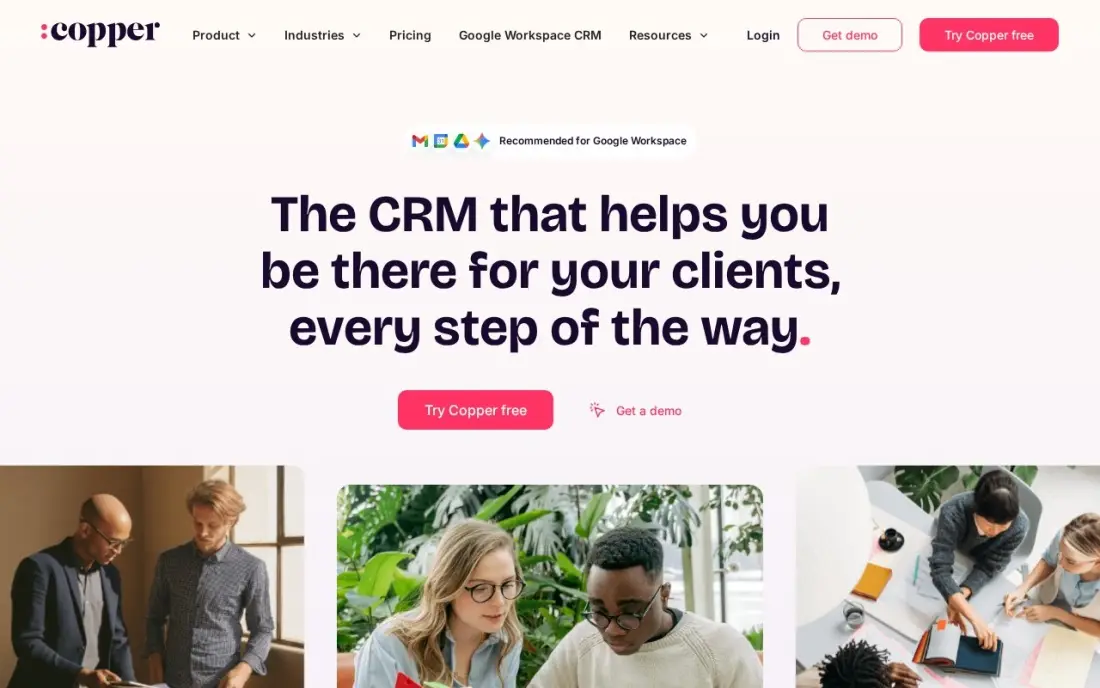
Copper lives inside Gmail and pulls contacts, emails, meetings and Drive files into the CRM automatically, which suits founders who will not do data entry. Basic costs $23 a seat a month billed annually and covers pipelines, contact enrichment and team collaboration.
Basic caps at 2,500 contacts, and automation needs Professional at $59. It is a poor fit for Microsoft 365 teams, but for a Google-first startup it removes the biggest reason CRMs go stale: nobody has to remember to log the email they just sent, because Copper has already done it.
What we like
- The only CRM here built for Google Workspace: contacts, emails, meetings and Drive files flow in automatically from Gmail
- Basic covers pipelines, contact enrichment and team collaboration for $23 a seat a month billed annually
- The highest ease-of-setup score among the Google-first tools, with a 14-day trial and no credit card required
Watch out for
- Basic caps at 2,500 contacts, so a business with history outgrows the entry plan fast
- Real automation and reporting need Professional at $59 a seat a month billed annually
- A poor fit outside Google Workspace — Microsoft 365 teams get little of the value Copper is built on

Capsule
Best for: Very early teams that want the simplest shared contact list with a free start
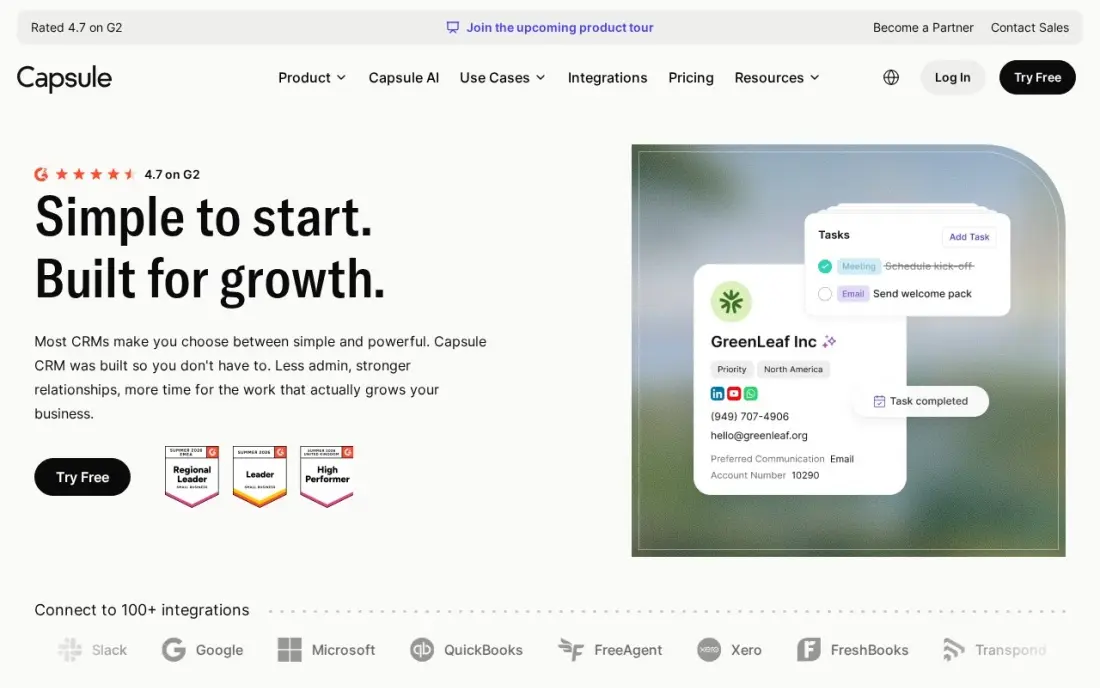
Capsule is the lightest CRM here: contacts, a visual pipeline and project boards in one clean view, with setup in under two hours. The free plan covers two users and 250 contacts, and Starter costs $18 a user a month billed annually with up to 30,000 contacts.
Workflow automation, email sync and a second pipeline wait for Growth at $36 a user. It suits a two-person startup tracking a few dozen design partners, less so a team about to scale outbound. Support is email-only with next-business-day replies, which is fine for a small team that rarely needs help.
What we like
- Contact-first design: contacts, a visual pipeline and project boards in one clean view
- Free plan for 2 users and 250 contacts; Starter raises the cap to 30,000 contacts
- AI Pipeline Generator included on Starter, with email templates and a shared mailbox
Watch out for
- Workflow automation, email sync and a second pipeline wait for Growth at $36/user/month
- No two-way email sync on any plan, and support is email-only with next-business-day replies
The best CRM tools for B2B startups get out of the founder's way: quick to set up, free or cheap at the start, and able to grow into a real sales system without a migration. We compared eight CRMs on what matters at seed and Series A — free plans, founder-led sales, email logging and the cost of the first sales hire — and every price below comes from the vendor's own pricing page as checked in November 2026.
How to choose the best CRM tools for B2B startups
- Start free if you can. HubSpot is free for 2 users, Zoho and Freshsales for 3, Capsule for 2 — enough for a founding team to build the habit.
- Buy for 18 months. Pick a CRM that will hold your first five sales hires; migrating later is painful, but so is paying for an enterprise system now.
- Insist on automatic email logging. Founders will not type notes; a CRM that captures email and meetings stays current.
- Check the price at the first hire. Look at what seat four costs and which plan holds sequences and forecasting.
- Match the selling motion. Outbound calling needs a dialer, inbound needs forms and marketing, partnerships need contact history.
- Keep integrations simple. Make sure it connects to your email, calendar, billing and product analytics without paid middleware.
A CRM organises demand; it does not create it. For the inbound side, our AI search optimization service helps startups get cited when buyers ask AI assistants for tools in their category, and our guide to the best B2B lead generation software covers outbound.
CRM tools for B2B startups pricing: what you will actually pay
For a founding team of three, the CRM can cost nothing: Zoho and Freshsales are free for 3 users, and HubSpot is free for 2 with a third Starter seat at $20 a month. On annual entry plans, three seats cost $324 a year on Freshsales, $504 on Pipedrive or Zoho, $648 on Capsule, $828 on Copper, $900 on Salesforce Starter and $1,260 on Close.
The real decision comes at five to ten seats, when the team needs sequences, automation and forecasting. Ten seats a year cost $4,680 on Pipedrive Growth or Freshsales Pro, $4,800 on Zoho Enterprise, $11,880 on Close Growth and $10,800 on HubSpot Sales Professional, before onboarding fees. Monthly billing costs more on most tools, so switch to annual once the team is settled.
Know the difference: startup CRM vs enterprise CRM
A startup CRM is opinionated: it ships with a sensible pipeline, works within a day and charges per seat with no implementation project. An enterprise CRM is a platform: custom objects, territories, approval chains and an admin to run it. Salesforce and Dynamics are platforms; Pipedrive, Close, Copper and Capsule are opinionated tools; HubSpot and Zoho sit between, starting simple and adding depth by tier.
Most startups need the opinionated kind until they have a sales manager and a repeatable process. Buying a platform early means paying for configuration before the startup knows what its sales process is.
Quick comparison: tool type by need
| Startup | Best pick | Why |
|---|---|---|
| Most B2B startups | HubSpot CRM | Free for 2 users, grows into marketing and sales automation |
| Founder-led sales | Pipedrive | Simple deal board from $14/user/month billed annually |
| Outbound by phone | Close | Built-in calling and SMS, from $35/user/month |
| Bootstrapped team | Zoho CRM | Free for 3 users, forecasting on Standard |
| Cheapest paid seat | Freshsales | Growth from $9/user/month with built-in phone |
| Scaling fast | Salesforce Sales Cloud | Starter from $25/user/month, no migration later |
| Google Workspace | Copper | CRM inside Gmail, from $23/seat/month |
| Very early team | Capsule | Free for 2 users, simplest setup |
Mistakes to avoid
- Running sales from a spreadsheet too long. By the time deals slip, history is already lost — start a free CRM early.
- Buying the enterprise platform at seed. Configuration time is founder time; start opinionated and move when a sales leader asks for it.
- Ignoring the price at seat four. Free plans end at 2 or 3 users; check the cost of the plan your first sales hire will need.
- Mixing investors, partners and customers in one pipeline. Use separate pipelines or tags so sales reports stay clean.
- Letting each founder keep their own list. Put every customer conversation in the shared CRM from the first week.
How we chose
We checked each vendor's own pricing page in November 2026 and recorded the starting price exactly as shown, including the annual-billing figure where the page lists one. We ranked the tools by fit for the most common buyer — a seed-stage B2B startup with founder-led sales and a first sales hire coming — weighting setup time, free plans, email logging and the cost of growing to ten seats. Ratings come from G2 pages checked on the dates shown in the sources. No vendor paid for a place in this list, and none of the links here are affiliate links.
What to do next
Open a free HubSpot, Zoho or Freshsales account today and log your last 20 conversations; within a week you will know whether you need more. When it is time to add inbound demand, our SEO audit shows which buyer searches your startup already shows up for. Get your free audit.
Frequently asked questions
What is the best CRM for a B2B startup?
HubSpot is the best fit for most B2B startups, with a free CRM for 2 users and a clear path to automation. Pipedrive suits founder-led sales, Close suits phone-heavy outbound, and Zoho and Freshsales are the cheapest for small teams.
When should a startup buy a CRM?
As soon as more than one person talks to prospects, or when deals start slipping through a spreadsheet. A free plan from HubSpot, Zoho or Freshsales costs nothing to start, so there is little reason to wait.
Is HubSpot free for startups?
HubSpot's free CRM is free forever for up to 2 users. A third user needs a Sales Hub Starter seat at $20 a month, and automation sits on Professional at $90 a seat.
Should a startup use Salesforce?
Only if it expects to build a large sales team quickly. Salesforce Starter costs $25 a user a month billed annually with no free plan, and setup usually needs an admin, so most startups begin on a lighter CRM.
How much should a startup spend on a CRM?
Early on, nothing: free plans cover 2 to 3 users. A five-person sales team on annual entry plans pays roughly $540 a year on Freshsales to $2,100 on Close, and more once automation tiers are needed.
What CRM features matter most for startups?
Fast setup, automatic email logging, a simple pipeline, integrations with the tools the team already uses, and a pricing ladder that does not jump sharply at the first sales hire.
Sources we checked (15)
- HubSpot CRM — www.hubspot.com/products/crm (checked November 12, 2026)
- HubSpot CRM reviews on G2 (checked November 12, 2026)
- Pipedrive — www.pipedrive.com/pricing (checked November 12, 2026)
- Pipedrive reviews on G2 (checked November 12, 2026)
- Close — www.close.com/pricing (checked November 12, 2026)
- Close reviews on G2 (checked November 12, 2026)
- Zoho CRM — www.zoho.com/crm/pricing (checked November 12, 2026)
- Zoho CRM reviews on G2 (checked November 12, 2026)
- Freshsales — www.freshworks.com/crm/pricing (checked November 12, 2026)
- Freshsales reviews on G2 (checked November 12, 2026)
- Salesforce Sales Cloud — www.salesforce.com/sales/pricing (checked November 12, 2026)
- Salesforce Sales Cloud reviews on G2 (checked November 12, 2026)
- Copper — www.copper.com/pricing (checked November 12, 2026)
- Copper reviews on G2 (checked November 12, 2026)
- Capsule — capsulecrm.com/pricing (checked November 12, 2026)
Make one of these tools?
We re-check this list every quarter. Send a correction, request a review, or ask about a clearly labeled sponsored spot.
Request a listingShamim
Founder of SerpAstra
A full-stack SEO and digital marketer who spends most days on Local SEO for dental practices, AI search visibility and lead generation.
Free SEO and AI visibility audit
Find out what is holding your rankings back
Send us your site. Within 2 business days you get a written audit, an AI visibility check and a short fix list ranked by impact. Free, with no contract attached.
Request my free audit→Related buying guides
 Sales & CRM7 Best B2B CRM Software in 2026: Pricing, Features and Pros & ConsCompare the 7 best B2B CRM software options for sales teams on price, free plans and features, with every price checked on November 12, 2026.Read guide →
 Sales & CRM8 Best CRM Software for Sales Teams in 2026, ComparedCompare the 8 best CRM software for sales teams on pipelines, forecasting, automation and per-seat price, with every price checked on vendor pages.Read guide →
 Sales & CRMBest CRM for Small Business in 2026: 10 Options Ranked and ReviewedCompare the 10 best crm for small business options on starting price, free plans and AI features, with every price checked on November 12, 2026.Read guide →