
7 Best Daily Rank Software Serps in 2026, Compared
7 best daily rank software serps compared on price, keyword limits, update speed and AI visibility. Prices checked on the vendor pricing page, November 1, 2026.
 Shamim Mia, Founder, SerpAstraLast verified November 1, 202614 min read
We compare pricing pages, documentation and public reviews. We never accept payment for rankings.

Key takeaways
- SE Ranking is the best value for most teams: 2,000 keywords tracked daily, a full SEO suite and AI visibility from $103.20/month billed annually.
- Wincher is the cheapest daily tracker here at $49/month, and AccuRanker is the fastest, with on-demand refresh on every plan.
- Nightwatch and ProRankTracker include AI visibility on their entry plans; Semrush and Advanced Web Ranking bundle the deepest research data.
- The single most important buying factor is what counts as a keyword: per-keyword, per-term and per-unit pricing change the real cost completely.
- Every price below was checked on the vendor's own pricing page on November 1, 2026. Ratings are G2, with review counts shown.
On this page
Quick comparison
| Tool | Best for | Starting price | Free plan |
|---|---|---|---|
| SE Ranking | Small agencies and in-house teams tracking up to 2,000 keywords a day who want a full SEO suite for about $103/month | $103.20/mo (annual) | No (14-day trial) |
| Wincher | Solo site owners and small teams who want simple daily Google rank tracking | $49/mo | Yes (5 keywords) |
| AccuRanker | SEO agencies and in-house teams tracking 2,000+ keywords who need daily updates and on-demand refreshes | $224/mo (annual) | No |
| Nightwatch | Small agencies and SEO teams that want unlimited seats plus AI-visibility tracking | €79/mo (annual) | No (14-day trial) |
| ProRankTracker | Agencies and freelancers who need daily local rank data and white-label client reports | $89/mo (annual) | No (7-day trial) |
| Semrush | Small teams and agencies that want rank tracking plus keyword research, audits, backlinks, PPC and AI visibility in one subscription | $117.33/mo (annual) | Yes (10 keywords) |
| Advanced Web Ranking | SEO agencies tracking thousands of keywords across many client sites | $139/mo | No (7-day trial) |
Make one of these tools?
We re-check this list every quarter. Send a correction, request a review, or ask about a clearly labeled sponsored spot.
Request a listingThe best daily rank software

SE Ranking
Best for: Small agencies and in-house teams tracking up to 2,000 keywords a day who want a full SEO suite for about $103/month
SE Ranking earns the top spot on value. Core tracks 2,000 keywords every day, covers 10 projects, and adds a 250,000-page site audit, keyword and backlink research, and AI visibility across five engines — all for $103.20 a month billed annually. A small agency gets the full workflow in one subscription instead of paying for three tools.
The catch is the learning curve. Some reviewers report small differences in rank data and search volume next to the bigger suites, and the reporting takes a few days to master. If daily tracking at scale for the lowest per-keyword cost is the goal, this is the pick; if the backlink index matters most, Semrush goes deeper.
What we like
- Lowest cost per daily-tracked keyword here — 2,000 keywords a day from $103.20/month billed annually
- Full suite in one plan: rank tracking, site audit, keyword and backlink research, content and local marketing, plus AI visibility on 5 engines
- White-label reporting and guest links for client work, with an Agency Pack add-on from $69/month
Watch out for
- Some G2 reviewers report occasional minor discrepancies in rank-tracking accuracy and search-volume estimates versus larger competitors
- Reviewers note the interface can feel less intuitive, and complex reports take getting used to

Wincher
Best for: Solo site owners and small teams who want simple daily Google rank tracking
Wincher is the simplest tool in this list, and that is the point. The Basic plan tracks 500 keywords daily for $49 a month across up to 10 websites, with one user seat and alerts when positions move. G2 reviewers mention ease of use more than any other quality, and the dashboard stays out of your way.
The limits are real: Google only, no Bing, and on-demand refreshes, the API and white-label reports start on Standard at $89 a month. Wincher is the right pick for a solo site owner or a small team that wants positions, alerts and a clean chart without learning a suite. Agencies tracking thousands of keywords will outgrow it.
What we like
- Daily rank updates on every plan, including the free plan
- G2 reviewers cite ease of use most, with a clean dashboard and email alerts
- Unlimited websites from the Standard plan up, with GSC integration and AI keyword tools on all plans
Watch out for
- Google-only tracking — no Bing or other search engines
- API access, white-label reports and Looker Studio start on Standard; Basic is capped at 500 keywords, 10 websites and 1 user

AccuRanker
Best for: SEO agencies and in-house teams tracking 2,000+ keywords who need daily updates and on-demand refreshes
AccuRanker is a pure-play rank tracker, and it shows: daily updates and on-demand refresh come standard on every plan, and pricing scales by keyword volume alone. At $224 a month billed annually for 2,000 keywords, it is not cheap — but for an agency that checks positions several times a day after publishing or during a migration, the refresh button is the feature that matters.
What you do not get is everything else. There is no site audit, no backlink index and no content tool in the subscription, and AI visibility is sold separately as AccuLLM. Choose AccuRanker when tracking accuracy and speed are the job; choose a suite when you need research bundled in.
What we like
- Daily keyword updates with on-demand refresh on every plan
- Pricing scales by keyword volume alone, from 2,000 keywords on Professional to 25,000+ on Expert and Enterprise
- GSC and GA integrations plus reporting and export on the entry plan; Expert adds AI CTR, AI search volume estimates and an unlimited read API
Watch out for
- No free plan and no free trial — entry starts at $249/month, the highest starting price in this list
- Rank tracking only — no site audit, backlink or content tools bundled in; AI visibility is a separate product (AccuLLM)

Nightwatch
Best for: Small agencies and SEO teams that want unlimited seats plus AI-visibility tracking
Nightwatch is built for teams: unlimited seats come with every plan, white-label reports start on Professional, and the Starter plan tracks 500 keywords daily for €79 a month billed annually. Its standout feature is Citation Intelligence, which ties each ranking change to the AI citations behind it in ChatGPT, Claude, Gemini and Perplexity.
The pricing curve is the thing to watch. The jump from 500 keywords to 7,500 costs €499 a month, so a growing agency should price the next tier before committing. Nightwatch is priced in euros, which US buyers should note. Pick it when seats and AI citations matter more than raw keyword volume.
What we like
- Unlimited seats on every plan, with white-label reports and API access from Professional up
- Citation Intelligence links each ranking change to AI citations in ChatGPT, Claude, Gemini and Perplexity
- ZIP-code-level local tracking across 107,000+ locations in 190+ countries
Watch out for
- Price climbs steeply with keyword volume — €499/month for 7,500 keywords
- No free plan, and keyword-research runs are capped at 100/month on Starter
ProRankTracker
Best for: Agencies and freelancers who need daily local rank data and white-label client reports
ProRankTracker pairs daily Top-100 organic tracking with AI prompt tracking across ChatGPT, Gemini, Copilot and Perplexity from the $89-a-month Starter plan billed annually. Local and mobile tracking are included on every plan, and the 1,000-term Starter allowance covers a surprising amount of ground for a small agency.
The pricing model needs attention: one term is a keyword plus a URL plus an engine plus a location and device, and each AI prompt costs two terms. Tracking the same keyword in five cities costs five terms. Count your locations before you count your keywords, or the bill will surprise you.
What we like
- Daily Top-100 Google rank updates on every plan, including local and mobile tracking
- AI visibility tracking included from Starter: AI Overviews, AI Mode, ChatGPT, Gemini, Copilot and Perplexity
- White-label reports and the MyRanks client app on Pro ($149/month) and above
Watch out for
- Term-based pricing: each keyword + URL + engine + location/device combination counts as one term, and each AI prompt costs 2 terms, so costs scale with locations tracked
- No free plan and no built-in site audit or backlink tools — it is a pure rank tracker

Semrush
Best for: Small teams and agencies that want rank tracking plus keyword research, audits, backlinks, PPC and AI visibility in one subscription
Semrush is the deepest bench in this list. The entry SEO plan tracks 500 keywords daily and pairs Position Tracking with a keyword database Semrush puts at more than 27 billion keywords, plus site audits, backlink analysis and PPC research. If your team already lives in Semrush for research, the tracker is a natural extension rather than another subscription to manage.
It is also the priciest way in among the suites, and the extras add up: additional users start at $45 a month and white-label reports are paid add-ons. The free account is genuinely useful for a single small site, but ten tracked keywords will not cover a real client. Buy Semrush when you need the research depth, not just the positions.
What we like
- 500 keywords tracked daily on the entry SEO plan, with tracking down to ZIP-code level and up to 20 competing domains per campaign
- Bundles rank tracking with a 27-billion-plus keyword database, site audits, backlink analysis and PPC research in one login
- AI visibility reports included on the SEO plan, covering ChatGPT, Perplexity, Gemini and Google AI Overviews
Watch out for
- Highest entry price among the full suites here, and extra users start at $45/month with white-label reports as paid add-ons
- The free account caps at 10 tracked keywords and 10 reports a day, so meaningful tracking requires a paid plan

Advanced Web Ranking
Best for: SEO agencies tracking thousands of keywords across many client sites
Advanced Web Ranking has tracked rankings for more than 20 years, and the Pro plan shows it: 7,000 keyword units for $139 a month, unlimited projects and users, and coverage of more than 4,000 search engines plus AI visibility across ChatGPT, Gemini, Perplexity, Claude and Google AI Overviews. Every rank check stores the SERP behind it, so any position can be audited.
Two honest caveats. A keyword unit is one keyword checked weekly on one engine and device, so daily tracking costs more units than the headline suggests. And the interface feels dated next to newer tools, with white-label reports and API access held for the $279-a-month Agency plan. It is a workhorse for high-volume agencies, not a beauty contest winner.
What we like
- Pro plan includes 7,000 keyword units for $139/month
- Unlimited projects and users on every plan at no extra cost
- Tracks 4,000+ search engines plus AI visibility across ChatGPT, Gemini, Perplexity, Claude and Google AI Overviews
Watch out for
- Interface feels dated next to newer tools, per multiple G2 and Capterra reviewers
- White-label reports and API access sit on the Agency plan ($279/month), not Pro
What the best daily rank software serps actually do
A daily rank tracker checks where your pages sit in Google for the keywords you care about, every day, then reports the movement over time. That is the whole job: no guessing from Search Console averages, no manual searching in an incognito window. You add keywords, the tool checks them on a daily schedule, and you get a chart, an alert when a page drops, and a record you can show a client.
The best daily rank software serps in this guide are organised by what you actually need: the cheapest way to start, dedicated trackers that do one job well, and all-in-one suites that bundle tracking with research. People search for this category several ways — daily rank software, rank tracking tools and SERP tracking software — and they all mean the same thing. The products differ in what else they bundle around the tracking, and the price follows the bundle, not just the tracking.
One number that shows the scale of the data behind these tools: Semrush says its keyword database holds more than 27 billion keywords. That database is what its Position Tracking draws on, and it is why the suites cost more than the dedicated trackers — you are paying for the research index as well as the position checks.
Daily data earns its keep in three situations. First, after you publish or change a page, a daily check shows the effect within a day or two instead of leaving you guessing for a week. Second, when a Google update rolls out, daily tracking shows exactly which pages moved and when, so you can separate an update hit from a normal wobble. Third, when you report to clients, a daily series gives you a chart with a real shape to it — weekly points hide the drops and recoveries that explain what happened. If none of those three apply to your site, weekly tracking is enough and a cheaper tool will do.
Free options first
If you track a handful of keywords for one site, you may not need to pay at all. Wincher tracks 5 keywords free with daily updates, and the Semrush free account tracks 10 keywords. The free tiers are honest products, not demos — but they cap out fast, and the moment you track a second site or a few dozen keywords, a paid plan is cheaper than the time you lose checking positions by hand.
For a single small site, start with one of these free plans and upgrade when the keyword list grows past the limit. For anything client-facing, skip the free tier: the reporting and white-label features start on the paid plans, and five or ten keywords will not cover a real client.
The free plans also teach you what to look for before you pay. Add your five or ten most important keywords, watch them for a week, and check whether the numbers match what Google Search Console shows for the same pages. If the tool's positions sit within a place or two of Search Console's average positions, the data is sound; if they disagree wildly, try another tool before spending anything. That one-week test costs nothing and tells you more than any feature list.
When daily updates pay for themselves
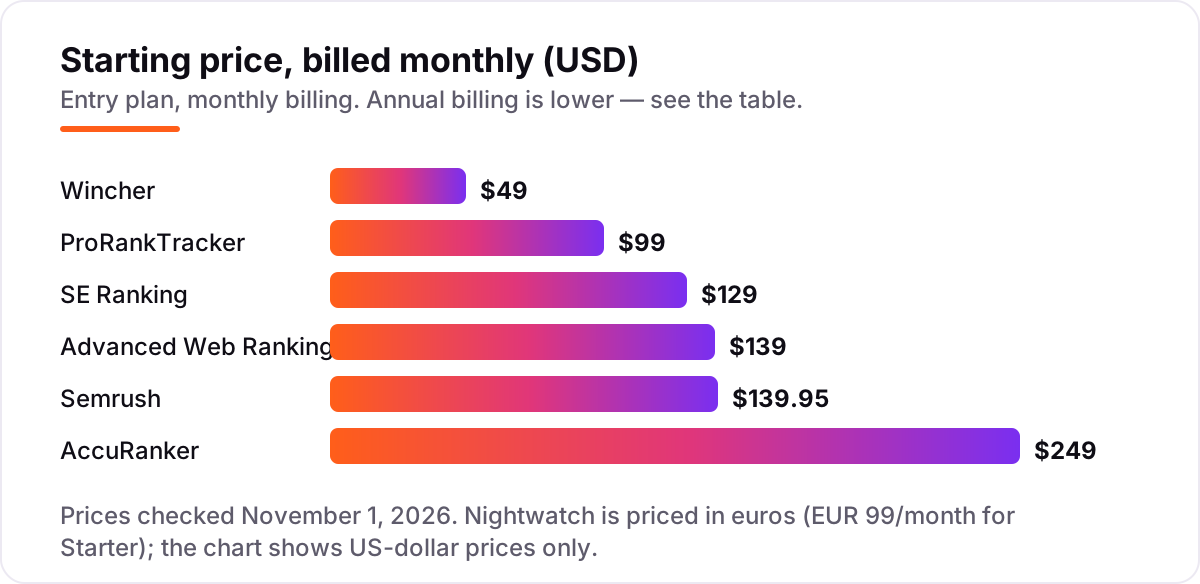
Daily tracking is worth paying for when rankings move often enough that a week-old number misleads you. That covers local businesses fighting for the map pack, sites in competitive niches where positions shift after every publish, and any site going through a migration, a redesign or a round of fixes after a Google update. In those cases the cheapest daily plan in this list, Wincher at $49 a month, costs less than one hour of an SEO's time — and it catches a drop days before a weekly check would.
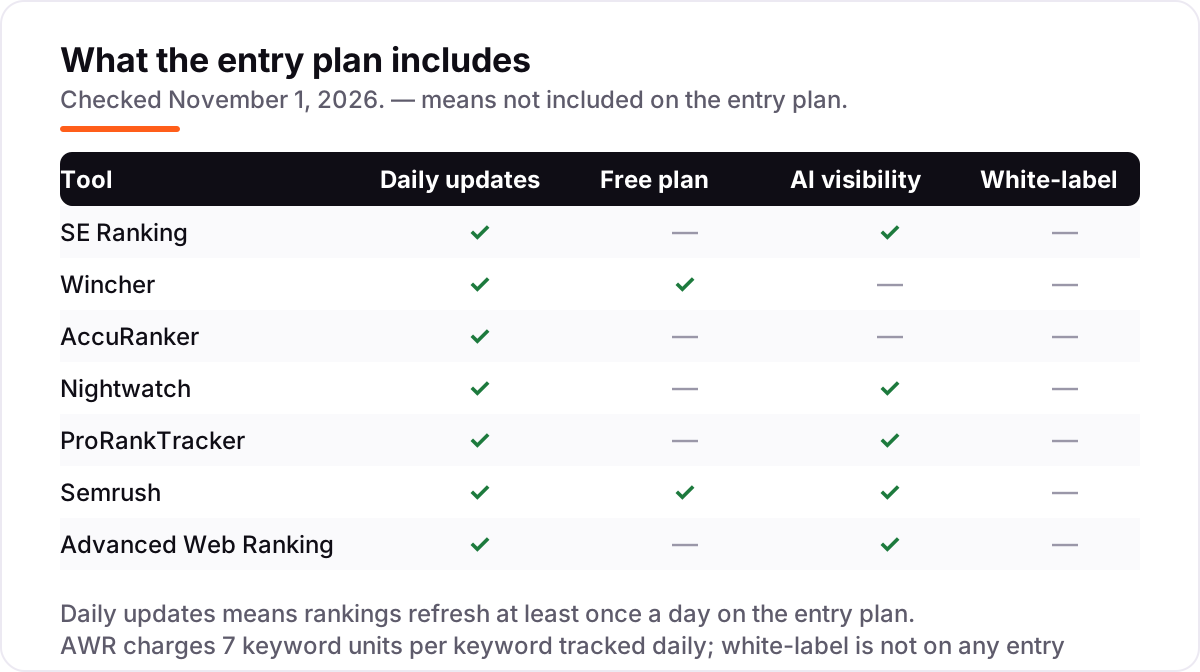
Daily tracking is not worth paying for when your site is stable and your keywords barely move. A brochure site, a local business in a quiet market, or a blog you update once a month will learn nothing new from a daily check that a weekly one would miss. In that case pick the cheapest plan that covers your keyword count and spend the difference on content. The tools in this list all update daily from the entry plan, so the question is never whether daily is available — it is whether your site moves fast enough to need it.
Dedicated trackers vs all-in-one suites
The 7 tools in this list split into two camps. The dedicated trackers — AccuRanker, Advanced Web Ranking, Nightwatch, ProRankTracker and Wincher — do one job and do it well. They check positions, they report them, and they stay out of the way. They are usually cheaper per keyword and faster to learn, and four of the five include AI visibility on their entry plans.
The suites — SE Ranking and Semrush — bundle tracking with keyword research, site audits, backlinks and content tools. You pay more, but you replace two or three subscriptions. The right camp depends on what you already pay for: if you own a suite, use its tracker; if you only need positions, a dedicated tracker costs less. The one number to watch in either camp is the counting unit: a keyword, a term and a keyword unit are three different things, and they decide the real monthly cost.
A worked example makes the unit problem concrete. Take a small agency tracking 200 keywords for one client in 5 cities on desktop and mobile. On SE Ranking that is 200 keywords across 5 projects — one per city, since Core allows one location per project — inside the 2,000-keyword Core allowance. On ProRankTracker it is 200 keywords times 5 cities times 2 devices, or 2,000 terms — double the 1,000-term Starter plan. On Advanced Web Ranking it is 200 keywords times 5 cities times 2 devices times 7 units for daily checks, or 14,000 units — double the 7,000-unit Pro plan. Same keywords, same client, three very different bills. Always model your real setup before you buy.
Local and AI search tracking
Rank tracking used to mean one number per keyword. Now it means three: the organic position, the local map-pack position, and whether your brand shows up in AI answers. ProRankTracker and Nightwatch include AI visibility on their entry plans, SE Ranking bundles it across five engines, and Advanced Web Ranking covers ChatGPT, Gemini, Perplexity, Claude and Google AI Overviews. Semrush includes AI visibility reports on its SEO plan, and AccuRanker sells it as a separate product.
If your clients are local businesses, local tracking is not optional — the map pack is where the calls come from. Every dedicated tracker in this list includes local and mobile tracking on its entry plan, and our local SEO service is built around exactly that data. If you want to see how the AI side looks for your own site, our guide to getting cited in ChatGPT explains what the AI engines actually quote.
One practical note on AI tracking: the prompt allowance is usually the real limit, not the price. Nightwatch Starter includes 50 AI prompts a day, SE Ranking Core includes 25, and ProRankTracker draws AI prompts from the same term pool at two terms each — so 1,000 terms buys 500 AI prompts and no organic tracking, or any mix in between. Before you pick a plan for AI visibility, list the questions your clients actually ask AI assistants and count them; the prompt count decides the tier, not the keyword count.
Quick comparison: tool type by need
| Buyer | Best pick | Why |
|---|---|---|
| Solo site owner on a budget | Wincher | $49/month, daily updates, free plan for 5 keywords |
| Small agency, best value | SE Ranking | 2,000 keywords a day plus a full suite from $103.20/month |
| Fastest data, on-demand refresh | AccuRanker | Daily updates plus refresh in seconds, from $224/month |
| Team with many seats and AI clients | Nightwatch | Unlimited seats and AI citations from €79/month |
| Agency reporting and local tracking | ProRankTracker | Daily Top-100 plus AI prompts from $89/month |
| Deepest research data | Semrush | 27-billion-keyword database behind 500 daily keywords |
| Tracking thousands of keywords | Advanced Web Ranking | 7,000 keyword units for $139/month, unlimited users |
How to choose: a short decision path
- Count your keywords first. Under 100, the free plans and the cheapest paid plans cover you. Over 1,000, the per-keyword price decides — SE Ranking and Advanced Web Ranking win on volume.
- Check what counts as one keyword. ProRankTracker charges per term (keyword plus URL plus engine plus location and device), and Advanced Web Ranking charges per keyword unit (one weekly check). Tracking one keyword in five cities can cost five terms or five units.
- Pick your update speed. Daily if your rankings move fast or you report to clients weekly; weekly is fine for stable sites. Every tool in this list updates daily from the entry plan, so the choice here is between daily and on-demand refresh.
- Decide suite or tracker. If you already pay for research tools, buy a dedicated tracker. If you need keyword research and audits too, a suite is cheaper than the tools separately.
- Try before you pay. Every tool in this list has a free plan, a free trial or a money-back guarantee. Run your real keyword list for a week and compare the numbers against Search Console before committing.
Before you publish new pages for the keywords you track, run your titles through the free SERP snippet preview tool — it shows exactly how the title and description will look in Google.
Mistakes to avoid
- Comparing monthly prices without checking billing. The annual price is usually 10–20% lower, and a few tools have no annual option at all.
- Ignoring what counts as a keyword. Some tools charge per keyword, others per term or per keyword unit. Tracking one keyword in five cities can cost five units.
- Paying for a suite when you only need positions. A dedicated tracker at $49–$99/month beats a $139 suite you only use for rankings.
- Trusting a directory price. Several directories still show old prices — Wincher at $29, Nightwatch in dollars. Always check the vendor's own page.
- Forgetting the trial ends. Set a reminder for the day the trial converts, and check the numbers against how to track your Google ranking so you know what the tool should be showing.
How we chose
We checked each vendor's own pricing page on November 1, 2026 and recorded the starting price exactly as shown, including the annual-billing figure where the page lists one. Ratings come from G2, with review counts shown. We ranked the tools by fit for the most common buyer — a small agency or in-house team tracking a few hundred to a couple of thousand keywords daily — not by brand size. No vendor paid for a place in this list, and none of the links here are affiliate links.
What to do next
Start with the decision path above: count your keywords, check what counts as one, and decide suite or tracker. Then take the free plan or trial of your top pick and run your real keyword list for a week. If the numbers match Search Console and the reports make sense to a client, you have your tool. If you'd rather have this set up and read for you, request a free SEO + AI visibility audit and get a ranked fix list in 2 business days.
Rather not run the tools yourself?
Tools show you the data. SerpAstra turns it into higher rankings, more map-pack calls and citations in AI answers.
Get a free SEO + AI visibility audit→Sources we checked (15)
- SE Ranking pricing — seranking.com/subscription.html (checked November 1, 2026)
- SE Ranking on G2 — 4.7/5, 1,619 reviews (checked November 1, 2026)
- Wincher pricing — wincher.com/pricing (checked November 1, 2026)
- Wincher on G2 — 4.6/5, 458 reviews (checked November 1, 2026)
- AccuRanker pricing — accuranker.com/pricing (checked November 1, 2026)
- AccuRanker on G2 — 4.8/5, 233 reviews (checked November 1, 2026)
- Nightwatch pricing — nightwatch.io/pricing (checked November 1, 2026)
- Nightwatch on G2 — 4.7/5, 64 reviews (checked November 1, 2026)
- ProRankTracker pricing — proranktracker.com/plans_and_pricing (checked November 1, 2026)
- ProRankTracker on G2 — 4.6/5, 60 reviews (checked November 1, 2026)
- Advanced Web Ranking pricing — advancedwebranking.com/pricing (checked November 1, 2026)
- Advanced Web Ranking on G2 — 4.3/5, 22 reviews (checked November 1, 2026)
- Semrush pricing — semrush.com/prices (checked November 1, 2026)
- Semrush on G2 — 4.4/5, 4,304 reviews (checked November 1, 2026)
- Semrush keyword database — more than 27 billion keywords (Semrush, via G2 product description)
Shamim
Founder of SerpAstra
A full-stack SEO and digital marketer who spends most days on Local SEO for dental practices, AI search visibility and lead generation.
Frequently asked questions
What is the best daily rank tracking software in 2026?
SE Ranking is the best value for most teams: 2,000 keywords a day, a full suite and AI visibility from $103.20/month billed annually. Wincher is the cheapest daily tracker at $49/month, and AccuRanker is the fastest, with on-demand refresh. Agencies that live in rank data should also look at Nightwatch and ProRankTracker.
How much does daily rank tracking software cost?
Between $49 and $249 a month at the entry level. Wincher starts at $49, ProRankTracker at $99, SE Ranking at $129 billed monthly, and AccuRanker at $249 — but the cheapest plan is not always the cheapest tracking. Check how many keywords you get and what counts as one before comparing prices.
Is there a free daily rank tracker?
Yes, with limits. Wincher tracks 5 keywords free with daily updates, and the Semrush free account tracks 10 keywords. Free plans work for a single small site; once you track more than a handful of keywords, a paid plan is cheaper than the time you lose to manual checks.
Do I need daily or weekly rank updates?
Daily if your rankings move fast — local businesses, competitive niches and sites you are actively optimizing. Weekly is enough for stable sites and long-term tracking. Every tool in this list updates daily from the entry plan, which is what sets them apart from suites that default to weekly checks.
What is the difference between a rank tracker and an SEO suite?
A rank tracker does one job: it checks where your pages rank and reports the movement. An SEO suite bundles tracking with keyword research, site audits, backlinks and content tools. If you only need positions, a dedicated tracker is cheaper; if you need the research too, a suite costs less than buying the tools separately.
Can daily rank trackers show AI visibility, like ChatGPT and Google AI Overviews?
Most of the tools in this list now can. SE Ranking, ProRankTracker, Nightwatch and Advanced Web Ranking include AI visibility on their entry plans, and Semrush includes AI visibility reports on its SEO plan. AccuRanker sells it as a separate product, AccuLLM. If AI answers matter to your clients, check this before you buy.
What should I check before paying for a daily rank tracker?
Four things: how many keywords the plan includes and what counts as one, whether updates are daily or weekly, whether local and mobile tracking cost extra, and whether the price is monthly or annual billing. All four vary widely — the comparison table at the top of this guide shows the starting price and free plan for each tool.
Free SEO and AI visibility audit
Find out what is holding your rankings back
Send us your site. Within 2 business days you get a written audit, an AI visibility check and a short fix list ranked by impact. Free, with no contract attached.
Request my free audit→Related guides
 StrategyHow to track your Google ranking (and what the numbers actually mean)Track your Google ranking the right way: Search Console, free checkers and rank trackers explained, and what average position and CTR really mean today.Read guide →
 AI SearchBest AI SEO tools in 2026: honest picks by jobBest AI SEO tools in 2026, picked by job: Semrush and Ahrefs for research, Surfer and Clearscope for content, Otterly for AI tracking, with 2026 prices.Read guide →
 AI SearchHow to get your brand cited in ChatGPT and AI searchA practical guide to earning citations in ChatGPT, Perplexity and Google AI Overviews: crawler access, Bing indexing, answer-first pages and brand signals.Read guide →