
10 Best Display Advertising Software in 2026, Compared
The 10 best display advertising software tools compared on price, reach and ease of use, from Google Ads to The Trade Desk. Checked November 4, 2026.
 Shamim Mia, Founder, SerpAstraLast verified November 4, 202614 min read
We compare pricing pages, documentation and public reviews. We never accept payment for rankings.

Key takeaways
- Google Ads (no minimum spend), Meta Ads Manager (no published minimum) and AdRoll (no subscription fee, pay only for media) are the short-list for most buyers — all three let you start without a platform fee.
- The serious DSPs — The Trade Desk, StackAdapt, Criteo, Choozle and Simpli.fi — all charge custom quotes, not list prices, so you cannot compare them on a pricing page.
- The single most important buying factor is whether you are buying placements or making creative: DSPs and networks buy the space, Viewst makes the banners — most teams need one of each.
- Every price below was checked on November 4, 2026. Ratings are G2, except Meta, StackAdapt and Criteo, which carry no rating in this list.
On this page
Quick comparison
| Tool | Best for | Starting price | Free plan |
|---|---|---|---|
| Google Ads | Small businesses and marketers who want the largest display reach with no minimum spend | No minimum | No |
| Meta Ads Manager | Brands that sell visually and want display-style ads inside Facebook and Instagram feeds | No minimum | No |
| AdRoll | Ecommerce brands that want retargeting across the web plus Facebook, Instagram, TikTok and Pinterest | Pay for media | No |
| StackAdapt | Mid-market agencies and brands that want a self-serve DSP without enterprise minimums | Custom quote | No |
| Criteo | Ecommerce and retail brands that want AI retargeting across the open web | Custom quote | No |
| The Trade Desk | Large brands and agencies running omnichannel programmatic at serious scale | Custom quote | No |
| Choozle | Small and mid-market agencies that want a self-serve DSP with hands-on support | Custom quote | No |
| Simpli.fi | Agencies and local advertisers that need hyperlocal and addressable display targeting | Custom quote | No |
| Taboola (Realize) | Content and ecommerce advertisers that want native display reach beyond search and social | $50/day recommended | No |
| Viewst | Small design and marketing teams that produce HTML5 display banners in bulk | $110/user/mo (annual) | No (14-day trial) |
Make one of these tools?
We re-check this list every quarter. Send a correction, request a review, or ask about a clearly labeled sponsored spot.
Request a listingThe best display advertising software
Google Ads
Best for: Small businesses and marketers who want the largest display reach with no minimum spend
Google Ads is the default starting point for display because the Display Network puts your banners on millions of websites and apps, plus YouTube and Gmail, and there is no minimum spend to get in. You set a daily budget, choose CPC or viewable-CPM bidding, and let Smart Bidding adjust bids toward conversions. For a small business testing display for the first time, that mix of reach and no entry cost is unmatched.
The catch is intent. People seeing a display ad are browsing, not searching, so prospecting campaigns convert far below search, and you will spend real money learning which audiences and placements work. Keep placement exclusions and frequency caps tight, and treat the automated recommendations with suspicion: they usually point toward spending more, not less.
What we like
- Display Network reaches millions of sites and apps, plus YouTube and Gmail inventory, from one account
- No minimum spend — you set a daily budget and pay per click or per 1,000 viewable impressions
- Smart Bidding and audience targeting (remarketing, in-market, custom segments) built in at no extra cost
Watch out for
- Display clicks are low-intent, so prospecting campaigns need tight audience and placement controls
- The interface is deep, and the automated recommendations often push toward higher spend

Meta Ads Manager
Best for: Brands that sell visually and want display-style ads inside Facebook and Instagram feeds
Meta Ads Manager is where display-style advertising meets social feeds: the same campaign can run image and video ads across Facebook, Instagram and Messenger, and Advantage+ AI handles targeting and placement while you test creative. There is no published minimum spend, so a small budget gets you in, and the reporting shows exactly which ad and audience drove each result.
The trade-off is that Meta gives you no fixed floor to plan against: the minimum moves with country, objective and bid strategy, and Ads Manager only warns you when a budget is too low. Creative quality decides everything here — a tired image stalls delivery fast — so budget for fresh creative, not just media, and expect the first week to be a learning exercise.
What we like
- Reaches Facebook, Instagram and Messenger placements from one campaign
- Advantage+ AI automates targeting and placement, and creative testing is built into the workflow
- No published minimum spend — you set the budget, and Ads Manager warns you if it is too low
Watch out for
- No fixed minimum means the floor moves by country, objective and bid strategy, so budgeting is guesswork at first
- Performance leans heavily on creative quality; weak images and video stall delivery fast

AdRoll
Best for: Ecommerce brands that want retargeting across the web plus Facebook, Instagram, TikTok and Pinterest
AdRoll is the retargeting specialist in this list, and its pitch is simple: the self-service Ads plan has no subscription fee, so you pay only for the media you buy. One dashboard runs retargeting and brand-awareness campaigns across display, native, video and connected TV, and dynamic ads pull products straight from your store feed, so a shopper who abandons a cart sees that exact product again.
The base plan is deliberately thin: social ads and cross-channel attribution are paid add-ons, and the Advanced Package with managed services needs a sales conversation. G2 reviewers also warn that the reporting can look rosier than their own CRM numbers. Even so, for an ecommerce store that wants to win back visitors without a platform fee, AdRoll is the cheapest serious option here.
What we like
- Pay-as-you-go Ads plan with no subscription fee — you pay only for the media you buy
- Retargeting, brand-awareness, display, native, video and connected TV campaigns in one dashboard
- Dynamic ads pull products from your store feed, and Shopify and WooCommerce integrations are native
Watch out for
- Social ads and cross-channel attribution are paid add-ons, not included in the base Ads plan
- G2 reviewers say reporting can feel optimistic next to their own CRM numbers

StackAdapt
Best for: Mid-market agencies and brands that want a self-serve DSP without enterprise minimums
StackAdapt is the most accessible serious DSP in this list: a self-serve platform that buys display, native, video, CTV, audio, digital out-of-home and in-game inventory from one login, with AI bid optimization and creative tools built in. There is no published minimum spend, accounts open after approval, and the Basic tier takes card payment — a far lower barrier than the enterprise DSPs.
The price is the open question: StackAdapt publishes no figures at all, and cost is negotiated as a percentage of media spend, so you only learn your rate in a sales conversation. Third-party data segments add their own usage-based costs on top. If you want self-serve programmatic without an enterprise contract, start here — but get the percentage in writing before you commit spend.
What we like
- Self-serve DSP covering display, native, video, CTV, audio, DOOH and in-game from one login
- No published minimum spend, with approval-based self-serve accounts and card payment on Basic
- Built-in creative tools and AI bid optimization, plus first-party data onboarding
Watch out for
- No published price of any kind — cost is negotiated as a percentage of media spend
- Third-party data segments from Bombora and others add their own usage-based costs

Criteo
Best for: Ecommerce and retail brands that want AI retargeting across the open web
Criteo is the commerce retargeting specialist: its AI is trained on shopper data from its retail media network, and its dynamic ads pull products from your catalog and update as prices and stock change. One platform covers web, social, video and CTV, so a retailer can run the whole retargeting program — prospecting included — without stitching tools together.
The catch is access: Criteo publishes no pricing, costs are CPC/CPM-based and negotiated, and small budgets get little attention from the sales team. It is also built for retailers — if you do not sell products online, most of its advantage disappears. For an ecommerce brand with real volume, though, the catalog-driven dynamic ads are hard to match.
What we like
- Commerce-focused AI retargeting built on first-party shopper data from its retail media network
- Dynamic product ads update automatically from your catalog as prices and stock change
- Runs across web, social, video and CTV from one commerce platform
Watch out for
- No published pricing — costs are CPC/CPM-based and negotiated, so small budgets get little attention
- Built for retailers; it is a weaker fit if you do not sell products online

The Trade Desk
Best for: Large brands and agencies running omnichannel programmatic at serious scale
The Trade Desk is the largest independent DSP, and independence is the whole pitch: it owns no media of its own, so it never steers your budget toward inventory it profits from selling. Kokai, its AI platform, handles bidding and optimization, UID2 covers cookieless identity, and the platform reaches display, video, audio, native and CTV across the open internet.
The barrier is the budget: there is no published price and no public minimum, and third-party reports put entry far above what a small business spends — this is a tool for brands and agencies with serious programmatic volume. The learning curve is steep too; G2 reviewers say new traders take weeks to get comfortable. Buy it when scale and control matter more than simplicity.
What we like
- The leading independent DSP — it owns no media, so it never steers your budget toward its own inventory
- Koa AI bidding and UID2 identity, with access to display, video, audio, native and CTV
- Deep transparency: log-level data and custom algorithms for teams that want control
Watch out for
- No published price and enterprise-grade minimums — third-party reports put entry far above small budgets
- Steep learning curve; new traders take weeks to get comfortable, per G2 reviewers

Choozle
Best for: Small and mid-market agencies that want a self-serve DSP with hands-on support
Choozle is a self-serve DSP built for small and mid-market agencies: display, video, CTV, audio, native and digital out-of-home from one platform, with managed-service help when a campaign needs it. It connects to premium DSPs including The Trade Desk, Amazon Ads and Walmart Connect, and G2 reviewers consistently praise the support team and the absence of minimums.
Pricing is the weak spot: Choozle publishes no prices, so every comparison starts with a demo and a negotiation, and you cannot benchmark it against the DSPs it connects to. Reviewers also say reporting is thin for analysts and that occasional glitches interrupt campaign work. Even so, for an agency that wants programmatic without an enterprise contract, the support team is a real differentiator.
What we like
- Self-serve DSP with display, video, CTV, audio, native and DOOH, plus managed-service options
- Connects to premium DSPs including The Trade Desk, Amazon Ads and Walmart Connect
- G2 reviewers praise the support team and the lack of minimums on the platform
Watch out for
- No published price — you request a demo and negotiate, so comparing costs takes a sales call
- Reviewers say reporting is thin for analysts, and some features arrive with glitches

Simpli.fi
Best for: Agencies and local advertisers that need hyperlocal and addressable display targeting
Simpli.fi is the DSP for local: its signature is addressable targeting down to the household, ZIP code and radius, with geo-fencing and geo-conversion tracking that ties store visits back to ads. Display, mobile, video, native and CTV run from one platform, and G2 reviewers highlight the absence of campaign budget minimums — unusual for a DSP — as the reason they chose it.
The honest complaint is pricing opacity: there are no published plans, everything is a custom quote, and reviewers mention fees they did not expect. The interface also feels cluttered to newcomers, with a steep learning curve for anyone without programmatic experience. For agencies running local campaigns for many clients, though, the household-level targeting is the feature that decides the shortlist.
What we like
- Addressable targeting down to household, ZIP and radius, with geo-fencing and geo-conversion tracking
- G2 reviewers report no campaign budget minimums, unusual for a DSP
- Display, mobile, video, native and CTV in one platform, with managed-service and self-service tiers
Watch out for
- No published pricing — custom quotes only, and reviewers flag unexpected fees
- The interface feels cluttered to new users, with a steep learning curve

Taboola (Realize)
Best for: Content and ecommerce advertisers that want native display reach beyond search and social
Taboola's advertiser platform is now called Realize, and it buys native display placements across premium publisher sites — the content-recommendation boxes at the bottom of news articles. Taboola says the network reaches 600 million daily active users, and Realize adds Maximize Conversions automated bidding plus GenAI AdMaker creative tools, so campaigns can run largely on autopilot once the pixel is in.
Budget honestly: there is no fixed minimum, but Taboola recommends $50 a day per campaign, and its own guidance says the automation needs ten to fifteen times your target CPA to work properly. Traffic quality also varies by placement, and reviewers say the worst placements need manual blocking. Treat Realize as a reach play for content and ecommerce, not a precision tool.
What we like
- Realize reaches 600 million daily active users across premium publisher sites, per Taboola
- Maximize Conversions automated bidding and GenAI AdMaker creative tools are built in
- Self-serve signup with CPC or CPM billing and site-level placement controls
Watch out for
- No fixed minimum, but Taboola recommends $50 a day per campaign, so small daily budgets starve the automation of data
- Traffic quality varies by placement; reviewers say poor placements need manual blocking

Viewst
Best for: Small design and marketing teams that produce HTML5 display banners in bulk
Viewst is the only tool here that makes the ads instead of buying the placements: a browser-based HTML5 builder that turns one master design into animated banners in every standard IAB size, with static and video exports too. Paid plans include unlimited HTML5 downloads and animations, AI background removal and copy tools, and direct export to Google Ads, Meta and DV360.
The price is per seat: Standard costs $110/user/month billed annually, so the bill grows with every teammate, and real-time collaboration only starts on Plus. There is also no live dynamic creative optimization once an ad is serving. Even so, a team that ships dozens of banner sizes a week will save more hours than the subscription costs.
What we like
- Design once and generate every IAB size instantly, with animated HTML5, static and video exports
- Unlimited HTML5 downloads and animations on paid plans, with AI background removal and copy tools
- Direct export to Google Ads, Meta and DV360, plus a 14-day trial with no credit card
Watch out for
- Standard is $110/user/month billed annually — per-seat pricing adds up fast for larger teams
- Real-time collaboration starts on Plus, and there is no live dynamic creative optimization once ads serve
What the best display advertising software actually does
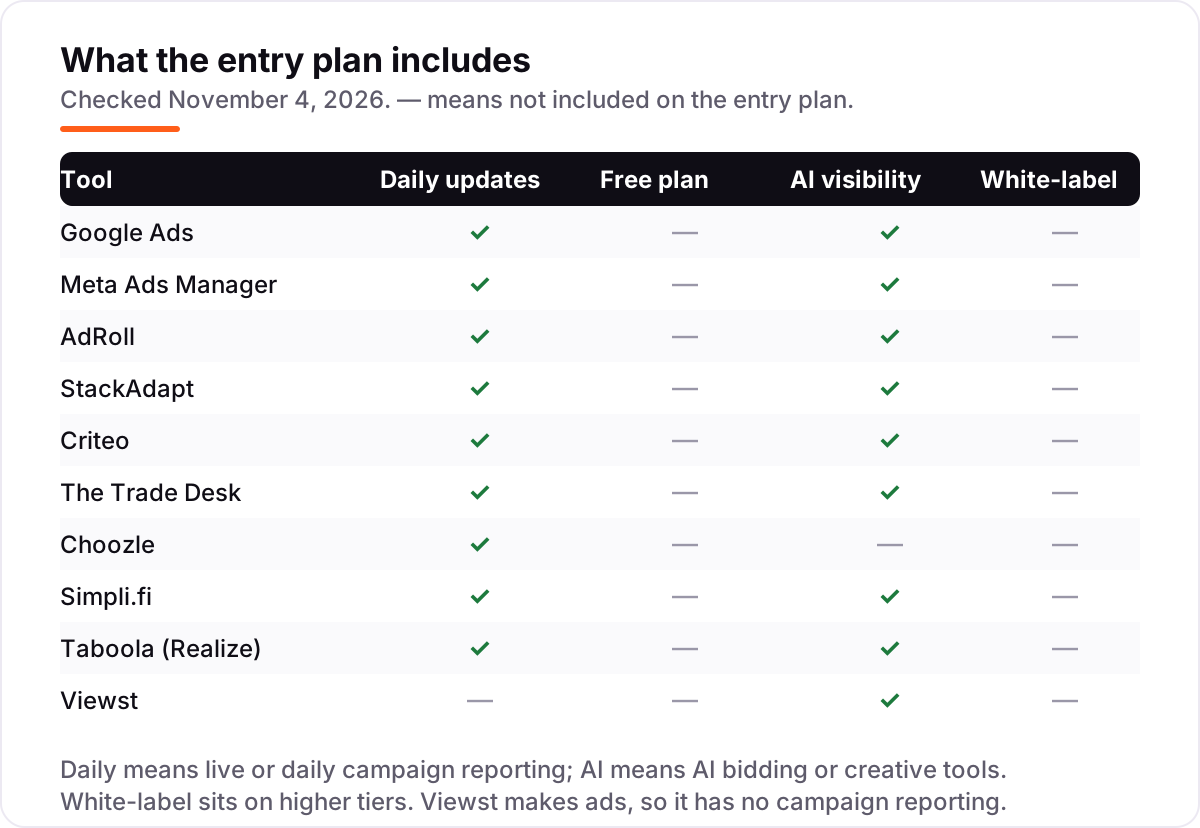
The best display advertising software buys attention on other people's pages: it puts your banner, image or video ad in front of people who are browsing, not searching. That is the core difference from search ads — nobody asked for your product, so the software's job is targeting (who sees it), placement (where it appears) and creative (whether anyone notices). The ten tools in this list are sorted by who they fit, from no-minimum starting points to enterprise DSPs, and the cards carry the prices.
The scale of the inventory is what makes display worth doing at all. Taboola says its Realize network reaches 600 million daily active users across premium publisher sites, and Google's Display Network spans millions of websites and apps plus YouTube and Gmail. No single advertiser could negotiate that reach site by site; the software does it through auctions that clear in milliseconds, which is why the buying model matters as much as the tool.
Display advertising pricing: what you will actually pay
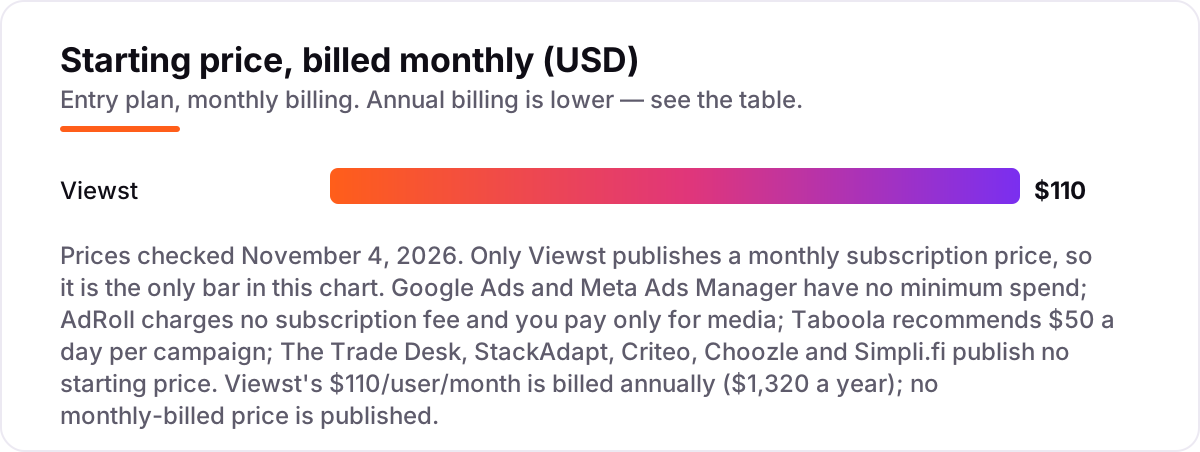
Most display software has no subscription price, so the honest way to budget is media first, platform fees second. Take a $1,000 test month: put $500 into Google Ads display, $300 into Meta, and $200 into AdRoll retargeting. All three charge no platform fee, so the full $1,000 buys media — the only fixed cost is whatever you spend making the banners. If you make them in Viewst, add $110 per user per month billed annually for the Standard plan.
Contrast that with the DSPs. The Trade Desk, StackAdapt, Criteo, Choozle and Simpli.fi publish no starting price, so your first cost conversation is a quote, not a checkout — and the quote is usually a percentage of media spend, plus data and verification fees on top. Before you sign, ask for a worked sample invoice showing the platform fee, every data charge and the amount subject to any minimum commitment.
Know the difference: buying ads vs making ads
The most common confusion in this category is mixing up the two jobs. Buying software — Google Ads, Meta, the DSPs, AdRoll, Criteo, Taboola — purchases placements and decides who sees your ad. Making software — Viewst in this list — produces the banner itself: the HTML5 animation, the sizes, the resized variants. One does not replace the other, and the best-performing campaigns pair a strong buying platform with creative made for the placements it buys.
That is also why the price chart looks the way it does. The buying platforms charge for media, so their "price" is your budget, not a subscription. The making tool charges a subscription, so it has the only bar in the chart. If you compare tools only by subscription price, you will conclude display advertising is free — it is not; the media is the cost.
The no-minimum way in
If you have never run display ads, start where there is no minimum and no sales call: Google Ads, Meta Ads Manager or AdRoll. Google Ads gives you the largest reach in the category and charges nothing to open an account — you set a daily budget and pay per click or per thousand viewable impressions. Meta is the same shape with a different audience: image and video ads inside feeds, with Advantage+ AI doing the targeting work. AdRoll adds the retargeting layer both of them lack as a specialty, still with no subscription fee.
The discipline at this end of the market is creative and exclusion. All three platforms will happily spend a small budget fast, so cap frequency, exclude placements that never convert, and refresh creative before fatigue sets in. A $20-a-day test on Google Ads is a real test; a $20-a-day test with one tired banner is a donation.
Self-serve DSPs for agencies
Once you manage display for several clients, a self-serve DSP earns its place: one login buys across exchanges, and the targeting goes deeper than any single walled garden. StackAdapt is the most accessible of the serious DSPs, with seven channels and no published minimum. Choozle is the agency-friendly one, with a support team G2 reviewers keep praising and connections into larger DSPs. Simpli.fi is the local specialist, with household-level targeting and geo-fencing that the others cannot match.
All three share the same weakness: no published prices. You cannot compare them on a pricing page, only in sales conversations, so judge them on a trial campaign instead — same budget, same creative, same week — and compare cost per result, not the pitch.
Enterprise buying: The Trade Desk and Criteo
The Trade Desk and Criteo sit at the enterprise end, and they solve different problems. The Trade Desk is the independent DSP for omnichannel scale: it owns no media, so it never steers budget toward its own inventory, and Kokai AI plus UID2 give it the deepest control in this list. Criteo is the commerce specialist: AI retargeting driven by retail shopper data, with dynamic product ads that update from your catalog.
Both demand a serious budget and a sales relationship, and neither publishes a price. The Trade Desk fits brands and agencies running programmatic across many channels at volume; Criteo fits retailers with real catalog depth. If neither describes you, the self-serve DSPs above do the same job at a smaller scale.
Native reach and the ads themselves
Taboola and Viewst close the list because they cover the two ends the buying platforms leave open. Taboola's Realize buys native display — content-recommendation placements on premium publisher sites — reaching audiences that never see your Google or Meta ads. Viewst makes the banners those placements need: one master design becomes every IAB size, animated, with direct export to the buying platforms.
Buy reach first, then fix creative. A campaign with strong placements and weak banners underperforms a campaign with average placements and strong banners, because nobody clicks an ad they do not notice.
Quick comparison: tool type by need
| Buyer | Best pick | Why |
|---|---|---|
| First display campaign, small budget | Google Ads | No minimum spend, largest reach, pay per click or viewable impression |
| Visual brand selling on social | Meta Ads Manager | Facebook and Instagram feeds, Advantage+ AI, no published minimum |
| Ecommerce store winning back visitors | AdRoll | No subscription fee, dynamic product ads, retargeting across web and social |
| Agency buying programmatic self-serve | StackAdapt or Choozle | Multi-channel DSPs with no published minimums; Choozle adds hands-on support |
| Local and multi-location advertiser | Simpli.fi | Household-level targeting, geo-fencing, no campaign minimums |
| Enterprise omnichannel at scale | The Trade Desk | Independent DSP, Kokai AI, UID2, full transparency |
| Native reach beyond search and social | Taboola (Realize) | 600M daily users on premium publishers, AI bidding built in |
| Teams producing banners in bulk | Viewst | One master design becomes every IAB size, $110/user/month billed annually |
How to choose: a short decision path
- Start with the budget you actually have. Under $1,000 a month, use Google Ads, Meta or AdRoll — no platform fee, no sales call. Over $5,000 a month, a DSP starts to earn its keep.
- Pick your buying model. Walled garden (Google, Meta) for reach and simplicity; DSP (StackAdapt, Choozle, Simpli.fi, The Trade Desk) for the open web, CTV and deeper targeting; native (Taboola) for publisher reach.
- Check the creative question. If you have no banners, budget for making them — Viewst at $110 per user per month billed annually, or a designer — before you budget media.
- Ask for the real price. For every custom-quote DSP, get the platform percentage, data charges and any minimum in writing before you commit.
- Test one thing at a time. Run your top pick for two weeks with one audience and one creative set, then compare cost per result against your current channel. If you want a second opinion on the numbers, our monthly SEO service includes paid-media reviews alongside search work.
Before you launch, run your landing page titles through the free SERP snippet preview tool — the ad gets the click, but the page has to earn the conversion.
Mistakes to avoid
- Comparing subscription prices and ignoring media. Nine of these ten tools charge for media, not software — the subscription chart is not the budget.
- Running display like search. Browsing audiences need tighter frequency caps and placement exclusions; search intent does not exist here.
- Trusting a directory price. Criteo still shows $1 a month on some directories; it publishes no price at all. Always check the vendor's own page, as our guide to PPC vs SEO explains for paid channels generally.
- Letting one creative run for months. Banner fatigue is real — refresh creative every few weeks or delivery quietly stalls.
- Signing a DSP quote without the fee breakdown. Platform percentage, data segments and verification fees stack up; get a sample invoice first.
How we chose
We checked each vendor's own pricing page on November 4, 2026 and recorded the starting price exactly as shown — which, for most of this category, means no published price at all. Google Ads and Meta Ads Manager publish no minimum spend; AdRoll charges no subscription fee; Taboola recommends $50 a day per campaign; The Trade Desk, StackAdapt, Criteo, Choozle and Simpli.fi publish no starting price, so they are listed as custom quote and no minimum figure from third parties is asserted. Viewst is the only tool here with a published monthly subscription price, $110 per user per month billed annually. Ratings come from G2, checked November 4, 2026. Meta, StackAdapt and Criteo carry no rating here: G2's Meta for Business listing has a single review, and the StackAdapt and Criteo G2 pages did not load on the check date. We ranked the tools by fit for the most common buyer — a small business or agency buying its first serious display campaigns — not by brand size. No vendor paid for a place in this list, and none of the links here are affiliate links.
What to do next
Start with the decision path above: pick your budget band, choose walled garden or DSP, and sort out creative before you spend on media. Then take the no-minimum route — Google Ads, Meta or AdRoll — and run a two-week test with one audience and one creative set. If the cost per result beats your current channel, scale it; if it does not, the test cost you a small budget and taught you exactly why. Once your tools are in place, find out what's holding your rankings back.
Your stack only works if people find you
SerpAstra fixes what keeps your site off page one and makes it easy for AI assistants to recommend.
Get a free audit→Sources we checked (17)
- Google Ads pricing — ads.google.com/home/pricing (no minimum spend, checked November 4, 2026)
- Google Ads on G2 — 4.3/5, 2,048 reviews (checked November 4, 2026)
- Meta Ads Manager — facebook.com/business/ads (no published minimum, checked November 4, 2026)
- AdRoll pricing — adroll.com/pricing (no subscription fee, checked November 4, 2026)
- AdRoll on G2 — 4.1/5, 809 reviews (checked November 4, 2026)
- StackAdapt — stackadapt.com (no published price, checked November 4, 2026)
- Criteo — criteo.com (no published price, checked November 4, 2026)
- The Trade Desk — thetradedesk.com (no published price, checked November 4, 2026)
- The Trade Desk on G2 — 4.4/5, 194 reviews (checked November 4, 2026)
- Choozle pricing — choozle.com/pricing (no published price, checked November 4, 2026)
- Choozle on G2 — 4.1/5, 210 reviews (checked November 4, 2026)
- Simpli.fi — simpli.fi (no published price, checked November 4, 2026)
- Simpli.fi on G2 — 4.5/5, 154 reviews (checked November 4, 2026)
- Taboola Realize — taboola.com/advertise ($50/day recommended, checked November 4, 2026)
- Taboola (Realize) on G2 — 3.8/5, 123 reviews (checked November 4, 2026)
- Viewst pricing — viewst.com/pricing (Standard $110/user/month billed annually; figure as shown on the vendor page in October 2026 checks)
- Viewst on G2 — 4.7/5, 20 reviews (checked November 4, 2026)
Shamim
Founder of SerpAstra
A full-stack SEO and digital marketer who spends most days on Local SEO for dental practices, AI search visibility and lead generation.
Frequently asked questions
What is the best display advertising software in 2026?
Google Ads is the best starting point for most buyers: the largest display reach with no minimum spend. Meta Ads Manager is the visual alternative, and AdRoll is the cheapest retargeting route with no subscription fee. Agencies that need programmatic scale should look at StackAdapt, Choozle or Simpli.fi first.
How much does display advertising software cost?
Most of it has no subscription price at all — you pay for the media. Google Ads and Meta have no minimum spend, AdRoll charges no subscription fee, and Taboola recommends $50 a day per campaign. The DSPs (The Trade Desk, StackAdapt, Criteo, Choozle, Simpli.fi) are custom quote only. Viewst is the one monthly subscription here, at $110 per user per month billed annually.
Is there free display advertising software?
Not really — there is no free plan for any buying platform in this list, because you pay for the media, not the software. The closest thing to free is the no-minimum model: Google Ads, Meta and AdRoll let you start with whatever budget you choose. Viewst is the only tool here with a free trial, 14 days with no credit card.
What is the difference between a DSP and an ad network?
A DSP (demand-side platform) like The Trade Desk or StackAdapt buys ad space for you across many exchanges and publishers through real-time auctions. An ad network like Taboola sells you its own publisher inventory directly. Google Ads and Meta sit in between: walled gardens where you buy their inventory through their own tools.
Do I need a DSP, or is Google Ads enough?
Google Ads is enough for most small and mid-size advertisers — it has the largest display reach and no minimum spend. You need a DSP when you want inventory Google does not sell (the open web, premium publishers, CTV), household-level targeting, or log-level transparency. Start with Google Ads and add a DSP when you outgrow it.
What is the difference between display ads and native ads?
Display ads are banner-style units that stand out from the page content — images, HTML5 animations and video in standard sizes. Native ads blend into the editorial content, like Taboola's content-recommendation boxes at the bottom of articles. Native usually gets higher click rates but lower-intent traffic; display gives you more control over exactly how the ad looks.
Free SEO and AI visibility audit
Find out what is holding your rankings back
Send us your site. Within 2 business days you get a written audit, an AI visibility check and a short fix list ranked by impact. Free, with no contract attached.
Request my free audit→Related guides
 MarketingPPC vs SEO: which should a local business choose first?PPC vs SEO for a local business: how they differ on speed, cost and staying power, when each one wins, and a 90-day plan to test both without wasting money.Read guide →
 MarketingGoogle Ads vs Local Services Ads: which wins local jobs?Google Ads vs Local Services Ads: pay per click or pay per lead, placement, verification, and cost compared, so you can pick the one that wins local jobs.Read guide →
 AI SearchBest AI SEO tools in 2026: honest picks by jobBest AI SEO tools in 2026, picked by job: Semrush and Ahrefs for research, Surfer and Clearscope for content, Otterly for AI tracking, with 2026 prices.Read guide →