
9 Best Football Sports Analytics Companies in 2026
9 best football sports analytics companies compared on price, data depth and fit for clubs, coaches and analysts. Prices checked November 2, 2026.
 Shamim Mia, Founder, SerpAstraLast verified November 2, 202613 min read
We compare pricing pages, documentation and public reviews. We never accept payment for rankings.

Key takeaways
- Hudl is the short list for most clubs: video, StatsBomb data and Wyscout scouting in one platform, with football plans from $500 a year per team. Stats Perform leads on data depth, and StatsBomb is the best route to advanced event data.
- Seven of the nine companies publish no starting price — expect an enterprise quote that depends on leagues, seats and data depth, and ask for hardware, onboarding and support in writing.
- The single most important buying factor is the data type you need: event data, tracking data, video or physical load data. Each company sells a different one, and no single platform covers all four well.
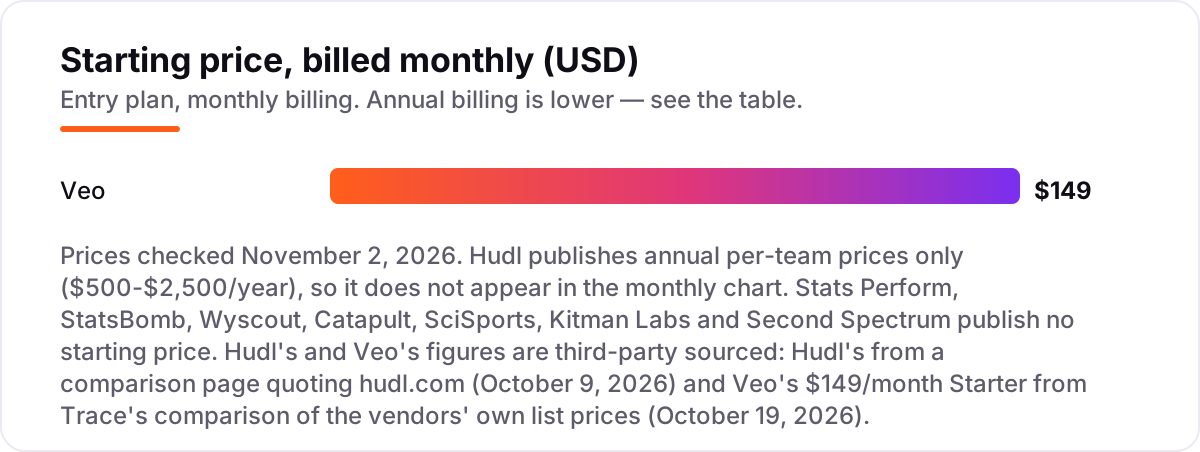
- Every price below was checked on November 2, 2026. Veo is the only tool with a monthly-billed starting price ($149/month); Hudl's published prices are annual per-team figures.
On this page
Quick comparison
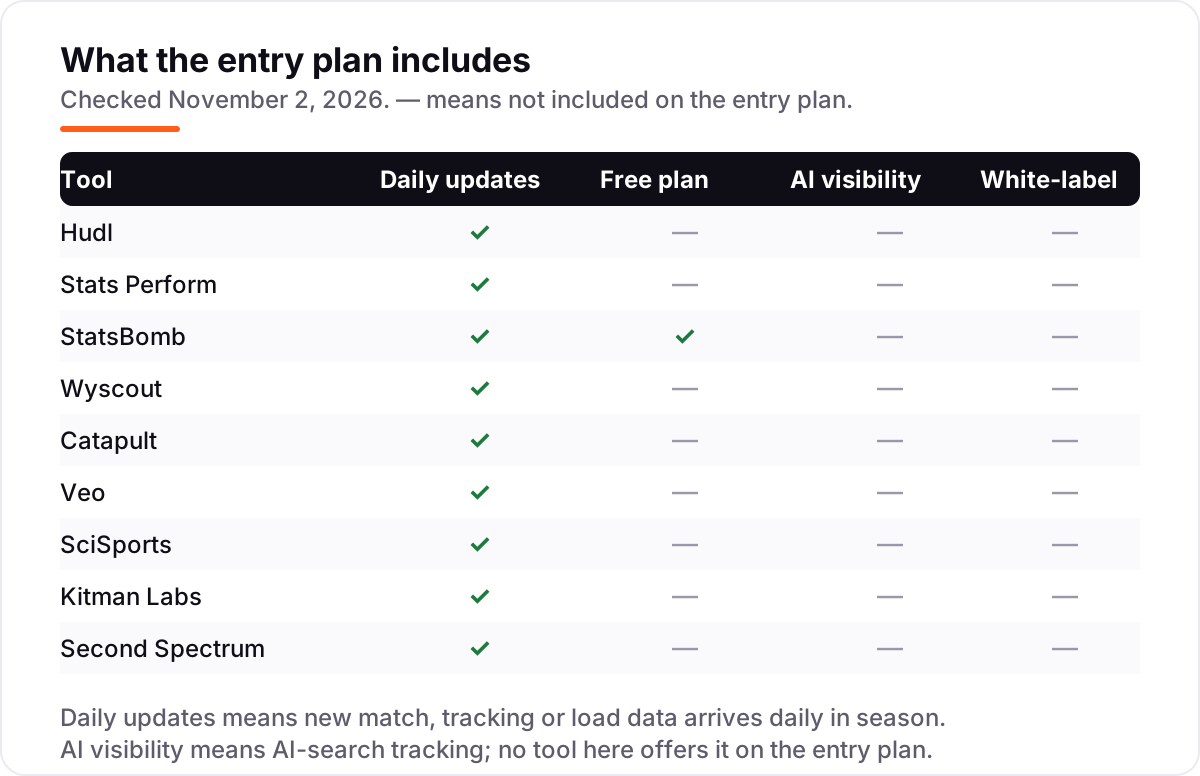
| Tool | Best for | Starting price | Free plan |
|---|---|---|---|
| Hudl | Clubs and schools that want video, data and scouting in one platform instead of buying three separate tools | $500/yr (Core) | No (14-day trial) |
| Stats Perform | Elite clubs, leagues, broadcasters and media teams that need the deepest event data and predictions | Custom quote | No |
| StatsBomb | Analysts and recruitment teams that want the most detailed event data and a free dataset to learn on | Custom quote | Yes (open data) |
| Wyscout | Scouts, agents and analysts who need video of almost any player in almost any league | Custom quote | No (trial) |
| Catapult | Performance staff at pro and semi-pro clubs who manage training load and injury risk with GPS data | Custom quote | No |
| Veo | Youth and amateur clubs that want every match filmed automatically without a camera operator | $149/mo | No |
| SciSports | Recruitment departments at pro clubs that rank players with data before watching the video | Custom quote | No (trial) |
| Kitman Labs | Elite clubs and federations that want medical, performance and wellness data in one athlete record | Custom quote | No |
| Second Spectrum | Leagues, broadcasters and top-flight clubs that need optical player tracking for every match | Custom quote | No |
Make one of these tools?
We re-check this list every quarter. Send a correction, request a review, or ask about a clearly labeled sponsored spot.
Request a listingThe best football sports analytics companies

Hudl
Best for: Clubs and schools that want video, data and scouting in one platform instead of buying three separate tools
Hudl is the broadest platform in this list because it covers the whole workflow: Focus cameras film the match, Hudl Assist breaks down the stats, Wyscout handles scouting and Sportscode lets analysts code every moment. A club that buys into Hudl stops stitching together separate tools for video, data and recruitment, and players already know the highlight reels because more than 230,000 teams use the platform.
The catch is that the value comes from the bundle, not from one product. Football plans are annual, paid in full at the start, and the cameras are a separate quote from the sales team. For a club that wants one system for everything, Hudl is the short list; for a team that only needs one job done, a single-purpose tool costs less.
What we like
- One platform covers video sharing, Hudl Assist stat breakdowns, Wyscout scouting and Sportscode coding
- Focus cameras record matches automatically, so coaches stop relying on a parent with a phone on the touchline
- Used by more than 230,000 teams, so players, scouts and recruiters already know the platform and its highlight reels
Watch out for
- Football plans are annual and paid in full at the start, so there is no monthly option to try for a single month
- The full value needs several Hudl products at once — video, Assist stats, Wyscout and Sportscode — and each adds cost
- Cameras such as Focus Flex are priced by the sales team, so the hardware bill is a separate quote

Stats Perform
Best for: Elite clubs, leagues, broadcasters and media teams that need the deepest event data and predictions
Stats Perform is the reference point for football data. Its Opta feed records every on-ball action in hundreds of competitions, and its models turn those events into expected goals, pressure indexes and match predictions. Broadcasters build graphics on it, elite clubs build recruitment and opposition analysis on it, and media teams use it to tell stories the raw scoreline cannot.
It is also the hardest company in this list to buy from. There is no price list, no trial and no self-serve signup — every deal is a negotiated enterprise contract shaped by leagues, depth and rights. If your work is professional analysis at the highest level, this is the data to beat; if you run one club, the price and the learning curve will both be too much.
What we like
- Owns Opta, the benchmark for event-level football data, with advanced metrics such as expected goals and pressure indexes
- Covers live and historical data across hundreds of competitions, plus predictions and content tools for media
- Official data partner for FIFA events through 2029, including the 2026 World Cup
Watch out for
- Enterprise contracts only — there is no self-serve plan, trial or published price to compare against
- Pricing depends on leagues, data depth and rights, so two buyers rarely pay the same figure
- The data is deep enough to need a trained analyst; smaller clubs will pay for coverage they never use

StatsBomb
Best for: Analysts and recruitment teams that want the most detailed event data and a free dataset to learn on
StatsBomb built its name on detail. Where a basic feed records a pass, StatsBomb records the pass, the pressure on the passer, the positions of all 22 players and the outcome — about 500 attributes per match. Its expected-goals model is one of the most respected in the game, and its IQ platform turns that detail into recruitment shortlists and opposition reports.
The free open dataset is the honest way in: 3,961 matches across 80 competition-seasons, free for non-commercial use, and the data behind much of the public analysis you read. Paid access is a different world — quote-only contracts for clubs, media and betting companies. Learn on the open data first, then ask for a quote when you know which competitions you need.
What we like
- Event data with about 500 attributes per match, including pressure events and 360 player-position frames
- Free open dataset covers 3,961 matches across 80 competition-seasons, so analysts can learn the data before paying
- Now part of Hudl, so its data feeds directly into Hudl video and Wyscout scouting workflows
Watch out for
- Paid data and the IQ platform are quote-only, with annual contracts that third-party estimates put at five figures and up
- The free open data covers selected competitions only, so most current leagues need a paid licence
- Working with the raw event data needs Python or R skills — it is not a point-and-click dashboard

Wyscout
Best for: Scouts, agents and analysts who need video of almost any player in almost any league
Wyscout is the tool scouts open first. Its library holds video and data on players from more than 250 competitions, with over 2,000 new matches added every week, so a scout can watch a left-back in the second tier of a league they have never visited and compare him with three alternatives before lunch. Player profiles pair the clips with the numbers, which is what turns watching into shortlisting.
The price is the problem for smaller clubs: licences are quoted per club, and third-party estimates put a single club licence at roughly 15,000 to 25,000 euros a year. It also does one job — video and data for scouting — so physical tracking and match analysis need other tools. For a recruitment department, it is close to essential; for a single coach, it is more than the job needs.
What we like
- The largest scouting video library in football, with more than 2,000 new matches uploaded every week
- Player profiles combine video with event data, so a scout can watch and measure the same player in one place
- Owned by Hudl, so it pairs with Hudl video, StatsBomb data and Sportscode for a full recruitment workflow
Watch out for
- Club licences are quote-only and third-party estimates put them at roughly 15,000 to 25,000 euros a year
- The video library is the product — it does not collect physical tracking data or GPS load data
- Adding seats usually means upgrading the tier, so a growing scouting department pays more than the first quote suggests

Catapult
Best for: Performance staff at pro and semi-pro clubs who manage training load and injury risk with GPS data
Catapult answers a different question from the rest of this list: not what happened with the ball, but what the players' bodies did. Its GPS pods sit in a vest between the shoulder blades and record distance, sprint distance, top speed, accelerations and training load ten times a second. Performance staff use that data to set training loads, manage return-to-play and flag injury risk before a hamstring goes.
The pro system is priced for pro clubs — quote-only contracts that published estimates put around $100,000 a year for a team deal. The consumer route is far cheaper: Catapult One costs $180 a year with the kit included, which suits an individual player or a small academy. Buy Catapult for physical data; pair it with video or event data for the tactical picture.
What we like
- 10 Hz GPS pods track sprint distance, top speed, load and intensity ten times a second, with FIFA EPTS certification on the pro line
- Used by about 2,970 teams across 39 sports in 137 countries, so the benchmarks come from elite football
- Catapult One brings the same GPS approach to individual players for $180 a year, with the kit included in year one
Watch out for
- The pro Vector team system is quote-only, and published estimates put team deals around $100,000 a year
- GPS vests measure physical output only — no video, no event data and no tactical analysis
- The consumer Catapult One pod stops showing data if the membership lapses, so the hardware is rented in effect

Veo
Best for: Youth and amateur clubs that want every match filmed automatically without a camera operator
Veo solves the most basic problem in club football: nobody wants to film the match. The Cam 3 sits on a tall tripod, records the whole pitch with dual 4K lenses, and the AI reframes the footage to follow the ball, tags goals and corners, and builds highlight reels in the cloud editor. One adult is freed up to coach instead of holding a phone for 90 minutes.
The price needs reading in full. Starter is $149 a month or $999 a year, but the Cam 3 hardware costs $1,299 on top, and player analytics and livestreaming are paid add-ons. Veo Go is the cheaper entry point, using two iPhones instead of a dedicated camera. For a club that films every week, it pays for itself in saved time; for a team that films twice a season, it does not.
What we like
- Dual 4K lenses film the whole pitch and the AI follows the ball, so nobody stands behind a tripod for 90 minutes
- Starter covers 10 recording hours a month for one team and up to 15 users, which fits a single squad's weekly matches
- Veo Go turns two iPhones into a recording setup, giving smaller clubs a cheaper way to try the workflow
Watch out for
- The camera is a separate purchase — Cam 3 costs $1,299 — and it cannot be used without an active subscription
- Player stats and livestreaming are paid add-ons, so the Starter price is not the full cost for most clubs
- Upload and AI processing take time after the match, so clips are not instant on a slow connection

SciSports
Best for: Recruitment departments at pro clubs that rank players with data before watching the video
SciSports is built for one decision: which player to sign. Its Recruitment platform holds data on more than 260,000 players across 250 leagues, and its SciSkill index, player roles and AI-powered valuations let a scout screen hundreds of candidates down to a shortlist before watching a single clip. For a recruitment department working a transfer window, that screening step is the whole value.
The buying experience is the weak point. SciSports publishes no current price list — its last advertised subscriptions started at 99 euros a month in 2021 — so every deal starts with a sales conversation. It is also a recruitment tool first, not a coaching tool. Buy it to find players; buy video and tracking tools to analyse the ones you already have.
What we like
- Recruitment platform covers more than 260,000 players across 250 leagues and 3,700 clubs
- SciSkill index, player roles and AI-powered valuations let scouts screen a shortlist in minutes
- Performance analysis tools accept data from any provider, so it fits clubs that already buy GPS or event data
Watch out for
- No current public price list — the vendor last advertised subscriptions from 99 euros a month in 2021
- Built for recruitment first, so coaches who want match analysis and video coding need another tool
- The SciSkill index and player valuations are proprietary models, so clubs must trust a black-box rating

Kitman Labs
Best for: Elite clubs and federations that want medical, performance and wellness data in one athlete record
Kitman Labs is the operating system behind the performance department. Its Intelligence Platform pulls medical records, GPS load, wellness scores and test results into one profile per athlete, so the physio, the fitness coach and the head coach all look at the same picture. Its Risk Advisor model flags players whose load patterns point toward injury, which is the feature clubs cite most when they renew.
Everything about it is enterprise: custom pricing, configured modules, and integration work with more than 150 data providers. A single team with one physio and a spreadsheet will not use a tenth of it. For a club or federation with a real performance department — medical staff, sports scientists and analysts — it replaces a shelf of disconnected tools with one record per player.
What we like
- Unifies medical records, GPS load, wellness and performance data into one 360-degree athlete profile
- Integrates with more than 150 third-party data providers, so existing wearables and systems feed straight in
- Risk Advisor uses AI to flag injury risk, and the platform is used by more than 700 elite and youth organisations
Watch out for
- Enterprise pricing only, configured per organisation, so there is no way to compare the cost before talking to sales
- Built for elite organisations — a single team will pay for scale, integrations and modules it never uses
- Setup needs a performance team to configure it; it is not a tool a lone coach switches on in a day

Second Spectrum
Best for: Leagues, broadcasters and top-flight clubs that need optical player tracking for every match
Second Spectrum is the tracking layer of professional football. Its optical system watches the match through stadium cameras and records the position of every player many times a second, which makes possible the analysis event data cannot do: spacing, off-ball runs, pressing shapes and the geometry of a defence. It is the official tracking provider for the Premier League, and its data also powers the broadcast graphics fans see on screen.
It is also the least buyable product in this list. Second Spectrum sells to leagues and federations, not to individual clubs, and the system needs a permanent multi-camera install in the stadium. A club gets this data through its league, not through a checkout page. It belongs in this list because it defines what tracking data is — not because most buyers can purchase it directly.
What we like
- Official tracking provider for the Premier League, NBA and MLS, using machine learning to index every moment of play
- Optical tracking records every player's position many times a second, enabling spacing and movement analysis no event feed can match
- Powers broadcast graphics and augmented content, so the same data serves coaches, analysts and fans
Watch out for
- Sold to leagues and federations, not to individual clubs, so a single team cannot simply buy a licence
- Needs a permanent multi-camera install in the stadium, which rules out most clubs on cost and logistics
- No published price, trial or self-serve route — every deal is a negotiated contract
What a football sports analytics company actually does
The best football sports analytics companies turn a match into numbers a coach can act on, and this list is organised by what you actually need: video and scouting, event data, physical tracking or automated filming. A football analytics company collects data from a match — video, on-ball events, player positions or GPS load — and turns it into reports, rankings and video clips that help a club coach better, scout smarter and keep players fit.
The four data types matter more than the brand names. Event data records actions such as passes and shots. Tracking data records where every player is, many times a second. Video shows the action itself. GPS data shows what the players' bodies did. A club that buys event data when it needed video has bought the wrong tool, however good the vendor is.
One number shows how open this field has become: StatsBomb's free open dataset covers 3,961 matches across 80 competition-seasons, free for non-commercial use, and it is the data behind much of the public analysis you read online. You can learn real football analytics on that dataset before spending anything — and you should, because the paid tools in this list start at hundreds of dollars a year and rise into six figures.
Video, data and scouting in one place
Hudl is the only company in this list that tries to cover the whole workflow, and for most clubs that is the right starting point. Focus cameras film the match, Hudl Assist produces the stat breakdown, Wyscout covers scouting and Sportscode lets analysts code every moment. The pieces share one login and one library, so a clip tagged in Sportscode can sit next to the StatsBomb numbers for the same passage of play.
Wyscout deserves its own mention here because it is the scouting half of that workflow. Its library is the largest in football, with more than 2,000 new matches uploaded every week, and it is the first place most scouts look when a name lands on a shortlist. If your club's main job is finding players rather than analysing your own team, Wyscout is the tool and Hudl is the bundle around it. Our SEO audit service is a different kind of review, but the principle is the same: start from what you actually need, then buy the tool that fits.
Event data and advanced metrics
Stats Perform and StatsBomb sell the deepest data in football, and they sell it to different buyers. Stats Perform owns Opta, the event feed that broadcasters, betting companies and elite clubs treat as the benchmark, and it pairs that feed with predictions and content tools. StatsBomb sells finer detail — about 500 attributes per match, including pressure events and 360 player-position frames — and its expected-goals model is one of the most respected in the game.
The practical difference is access. StatsBomb gives you a free dataset to learn on and a quote-only contract when you are ready to pay. Stats Perform gives you a sales conversation from the start. Both are enterprise products; neither is a sensible buy for a youth club. If you are an analyst building a portfolio, start with StatsBomb's open data and build the habit of checking your work against a free tool before you pay for a professional one — the same habit our free SERP snippet preview tool encourages for titles and descriptions.
Physical tracking and athlete health
Catapult and Kitman Labs measure the player, not the ball. Catapult's GPS pods record sprint distance, top speed, load and intensity ten times a second, which is how performance staff set training loads and manage return-to-play after injury. Kitman Labs joins that physical data with medical records, wellness scores and test results into one profile per athlete, and its Risk Advisor model flags players whose load patterns point toward injury.
These two tools only make sense once a club has performance staff to use them. A GPS vest without a fitness coach is an expensive pedometer, and an athlete-management platform without a physio is an empty database. Buy them when load and injury risk are real problems with real staff attached — not before the club has a filming habit and a weekly review routine.
Filming and tracking for clubs and leagues
Veo, SciSports and Second Spectrum sit at three very different levels of the same idea: capture the match, then analyse it. Veo is the club-level answer — a camera on a tripod that films automatically and an AI editor that builds highlights, priced from $149 a month plus the camera. SciSports is the recruitment-level answer, screening more than 260,000 players with its SciSkill index before a scout watches a clip. Second Spectrum is the league-level answer, with optical tracking in the stadium recording every player's position for the Premier League.
Do not confuse the levels. A youth club that buys league-grade tracking has bought a stadium install it cannot use; a pro club that buys a single Veo camera has bought a filming tool when it needed a data feed. Match the tool to the level you play at, and the price will usually follow.
Quick comparison: tool type by need
| Buyer | Best pick | Why |
|---|---|---|
| Club that wants one system for everything | Hudl | Video, Assist stats, Wyscout and Sportscode from $500 a year per team |
| Elite club or broadcaster needing the deepest data | Stats Perform | Opta event data and predictions, official FIFA partner through 2029 |
| Analyst who wants the finest event detail | StatsBomb | About 500 attributes per match, plus a free open dataset to learn on |
| Scout who needs video on any player | Wyscout | Largest scouting library, over 2,000 new matches a week |
| Performance staff managing load and injury risk | Catapult or Kitman Labs | GPS load data, or one joined medical and performance record |
| Youth or amateur club that films every week | Veo | Automatic filming and AI highlights from $149 a month |
How to choose the best football sports analytics companies
- Name the data type first. Event data, tracking data, video or GPS load data — each company in this list sells mainly one of them. Pick the type before you pick the vendor.
- Match the tool to your level. Youth and amateur clubs should look at Veo and Hudl; semi-pro clubs add Catapult One or Wyscout; pro clubs, leagues and broadcasters are the market for Stats Perform, StatsBomb, Second Spectrum and Kitman Labs.
- Count the total cost, not the licence. Cameras, hardware, onboarding, training and support are separate lines for most vendors. Ask for all of them in writing before you sign.
- Check who owns the data. Confirm which leagues are included, how many seats the price covers, and whether your club keeps the data it generates. Rights and territories are contract items in this category.
- Try the free route first. Run StatsBomb's open data for a month, trial Hudl, Wyscout or SciSports, and film a few matches with a borrowed camera. If the workflow does not survive a month of real use, the tool will not survive a season.
Mistakes to avoid
- Buying event data when you needed video. A spreadsheet of passes does not show a coach why the press broke down. Film the match first, then add data.
- Comparing a monthly price with an annual one. Veo quotes $149 a month; Hudl quotes $500 a year per team; the rest quote annually by contract. Put every figure on the same yearly basis before you compare.
- Forgetting the hardware. Veo's Cam 3 costs $1,299 on top of the subscription, Catapult needs pods and vests, and Second Spectrum needs a stadium install. The licence is rarely the whole bill.
- Paying for coverage you will never use. A single club does not need hundreds of competitions, and a youth team does not need league-grade tracking. Buy the competitions and seats you actually need.
- Trusting a directory price. Several directories still show old figures for Wyscout and SciSports. Always check the vendor's own page — and when there is no price on it, treat the product as quote-only.
How we chose
We checked each vendor's own website on November 2, 2026 and recorded the starting price exactly as shown — or as custom quote where the vendor publishes no price. Hudl's football prices ($500, $1,000 and $2,500 a year per team) and Veo's Starter price ($149 a month, $999 a year) are third-party sourced: Hudl's from a comparison page quoting hudl.com on October 9, 2026, and Veo's from Trace's comparison of the vendors' own list prices on October 19, 2026, because neither vendor shows a monthly-billed figure on its public pricing page. We list no review scores in this post: the G2 pages for these companies carry very few reviews or none at all, so a score would mislead more than it helps. We ranked the companies by fit for the most common buyer — a club, coach or analyst choosing their first football analytics tool — not by brand size. No vendor paid for a place in this list, and none of the links here are affiliate links.
What to do next
Start with the decision path above: name the data type, match the tool to your level, and count the total cost including hardware. Then take the free route — StatsBomb's open data, or a trial of Hudl, Wyscout or SciSports — and run it on real matches for a month. If the workflow survives the month and the numbers answer questions your coaches actually ask, you have your tool. If you'd rather have this set up and read for you, request a free SEO + AI visibility audit and get a ranked fix list in 2 business days.
Rather not run the tools yourself?
Tools show you the data. SerpAstra turns it into higher rankings, more map-pack calls and citations in AI answers.
Get a free SEO + AI visibility audit→Sources we checked (14)
- Hudl pricing for football clubs — tacticam.app comparison quoting hudl.com (checked November 2, 2026)
- Veo pricing — Trace vs Veo comparison of the vendors' own list prices (checked November 2, 2026)
- StatsBomb open data — 3,961 matches across 80 competition-seasons (checked November 2, 2026)
- SciSports subscriptions from 99 euros a month — vendor announcement, August 2021 (checked November 2, 2026)
- European football scouting platform pricing — third-party estimates for Wyscout, SciSports, StatsBomb and Opta (checked November 2, 2026)
- Stats Perform — statsperform.com (checked November 2, 2026)
- Hudl — hudl.com (checked November 2, 2026)
- Catapult — catapult.com (checked November 2, 2026)
- StatsBomb — statsbomb.com (checked November 2, 2026)
- Wyscout — wyscout.com (checked November 2, 2026)
- SciSports — scisports.com (checked November 2, 2026)
- Kitman Labs — kitmanlabs.com (checked November 2, 2026)
- Second Spectrum — secondspectrum.com (checked November 2, 2026)
- Veo — veo.co (checked November 2, 2026)
Shamim
Founder of SerpAstra
A full-stack SEO and digital marketer who spends most days on Local SEO for dental practices, AI search visibility and lead generation.
Frequently asked questions
How much do football sports analytics companies cost?
Most of them do not publish a price. Seven of the nine companies in this list sell by enterprise quote, with third-party estimates ranging from roughly 10,000 to 25,000 euros a year for a scouting licence to around $100,000 a year for a pro GPS team deal. The exceptions are Hudl, from $500 a year per team, and Veo, from $149 a month plus the camera.
Which football analytics company is best for a small club?
Hudl or Veo, depending on the job. Hudl is the better pick when a club wants video, stats and scouting in one place and can pay an annual per-team fee. Veo is the better pick when the club mainly needs every match filmed automatically and wants a monthly subscription. Both are built for club level; the other seven tools in this list target pro clubs, leagues or broadcasters.
What is the difference between event data and tracking data?
Event data records actions: passes, shots, tackles and fouls, with a time and a location for each one. Stats Perform and StatsBomb sell event data. Tracking data records where every player is, many times a second, which shows spacing, off-ball movement and pressing shapes. Second Spectrum and SkillCorner sell tracking data. Most pro clubs buy both, because each answers questions the other cannot.
Is there a free football analytics platform?
StatsBomb's open data is the best free option: 3,961 matches across 80 competition-seasons, free for non-commercial use, with the official Python client reading it without an API key. It covers selected competitions, not current leagues, and working with it needs Python or R. No paid platform in this list offers a free plan beyond that dataset and the free trials on Hudl, Wyscout and SciSports.
Do I need GPS trackers or video analysis first?
Video first, in almost every case. Video shows what happened and why, and a coach can use it in a team meeting the same evening. GPS data shows physical load — distance, sprints and intensity — which matters once a club has a fitness coach managing training load and return-to-play. Buy Catapult when load and injury risk are the problem, not before the club has a filming habit.
What should I ask for in an enterprise quote?
Ask for the licence fee, the hardware, onboarding, training and support as separate lines, and ask what happens at renewal — price rises, seat limits and data rights. Confirm which leagues and competitions are included, how many seats the price covers, and who owns the data your club generates. Get the quote in writing before a trial, because headline licence fees rarely cover the total cost.
Free SEO and AI visibility audit
Find out what is holding your rankings back
Send us your site. Within 2 business days you get a written audit, an AI visibility check and a short fix list ranked by impact. Free, with no contract attached.
Request my free audit→Related guides
 SEO & AI Search11 Best Rank Tracking Tools in 2026 (Free and Paid, Compared)11 best rank tracking tools compared on price, keyword limits, update speed and AI visibility. Prices checked on the vendor pricing page, October 31, 2026.Read guide →
 SEO & AI SearchBest SEO Audit Software for 2026: 10 Options Compared by Use Case10 best SEO audit software tools compared on price, crawl depth and AI visibility. Prices checked on vendor pricing pages, November 1, 2026.Read guide →
 AI SearchBest AI SEO tools in 2026: honest picks by jobBest AI SEO tools in 2026, picked by job: Semrush and Ahrefs for research, Surfer and Clearscope for content, Otterly for AI tracking, with 2026 prices.Read guide →