
10 Best Free Keyword Planner Tools in 2026 (Free and Paid, Compared)
10 best free keyword planner tools compared with real prices and free-plan limits, checked November 1, 2026 — from Google Keyword Planner to Ahrefs and Semrush.
 Shamim Mia, Founder, SerpAstraLast verified November 1, 202614 min read
We compare pricing pages, documentation and public reviews. We never accept payment for rankings.

Key takeaways
- Google Keyword Planner is free and the best starting point for volume data straight from Google; Ahrefs' free generator is the fastest way to expand a seed keyword into 150 ideas.
- Ubersuggest ($29/month) and AnswerThePublic ($20/month) are the cheapest paid upgrades when the free daily limits run out.
- Free plans all cap out fast — 3 searches a day is the norm — so the single most important buying factor is the daily limit on the plan you will actually use.
- Every price below was checked on November 1, 2026, on the vendor's pricing page where it loaded; ratings are G2 with review counts shown.
On this page
Quick comparison
| Tool | Best for | Starting price | Free plan |
|---|---|---|---|
| Google Keyword Planner | Site owners and advertisers who want search-volume data straight from Google at no cost | $0 (free) | Yes (free) |
| Ahrefs | SEOs who want fast keyword idea dumps with volume and difficulty, without signing up | $29/mo | Yes (generator) |
| Ubersuggest | Solo site owners who want one cheap tool for keyword ideas, audits and competitor checks | $29/mo | Yes (3/day) |
| AnswerThePublic | Content writers who plan blog topics and FAQ sections from the questions people ask | $20/mo | Yes (3/day) |
| Keyword Tool | Marketers who need long-tail keyword ideas from autocomplete across Google, YouTube and Amazon | $89/mo | Yes (no volume) |
| Semrush | Small teams that want the largest keyword database plus audits, backlinks and PPC research in one subscription | $117.33/mo (annual) | Yes (10/day) |
| Mangools | Beginners and bloggers who want low-difficulty long-tail keywords with a readable difficulty score | $37.70/mo (annual) | Yes (5/day) |
| Moz Pro | Small in-house teams that want Domain Authority metrics and a beginner-friendly keyword workflow | $49/mo | Yes (10/mo) |
| WordStream | Advertisers and small businesses who want concrete search volumes for PPC keywords without an account | $0 (free) | Yes (free) |
| Keyword Surfer | Bloggers who want quick volume checks inside Google results while they browse | $0 (free) | Yes (free) |
Make one of these tools?
We re-check this list every quarter. Send a correction, request a review, or ask about a clearly labeled sponsored spot.
Request a listingThe best free keyword planner tools

Google Keyword Planner
Best for: Site owners and advertisers who want search-volume data straight from Google at no cost
Google Keyword Planner is the only tool here whose volume data comes straight from Google, which makes it the reality check for every other estimate on this list. It finds keyword ideas from a seed term or a URL, shows average monthly searches and competition, and adds top-of-page bid ranges for paid campaigns. There is no subscription and no usage cap on ideas.
The catch is precision. Accounts without recent ad spend see volume as wide ranges, such as 1K to 10K, instead of exact figures, and Google asks for billing information during account setup. There is also no keyword difficulty score and no SERP analysis. Use it to size demand, then check difficulty elsewhere.
What we like
- Volume data comes straight from Google, the most authoritative source available
- Completely free with a Google Ads account — no subscription and no cap on keyword ideas
- Shows bid estimates alongside volume, so the same list serves PPC planning
Watch out for
- Accounts without recent ad spend see volume as wide ranges, such as 1K to 10K, instead of exact figures
- No keyword difficulty score and no SERP analysis — it is built for advertisers, not SEOs

Ahrefs
Best for: SEOs who want fast keyword idea dumps with volume and difficulty, without signing up
Ahrefs' free Keyword Generator is the fastest way to turn one seed term into a long list: up to 150 ideas per search, split across the top 100 keywords and the top 50 questions, with volume and a difficulty score for the first results. It draws on a database Ahrefs puts at more than 8 billion keywords, and it works for Google, Bing, YouTube and Amazon without an account.
The free generator is a one-off lookup, not a workspace: there is no saving, no tracking and no export of the full list without a paid plan. Full keyword research starts at Starter, $29 a month, which is monthly-only and caps credits. Use the generator for fast idea dumps, then pay when you need the research behind the ideas.
What we like
- Free generator returns up to 150 ideas per search — top 100 keywords plus top 50 questions
- Draws on a keyword database Ahrefs puts at more than 8 billion keywords
- Covers Google, Bing, YouTube and Amazon from one query, with a difficulty score
Watch out for
- The free generator is a one-off lookup — no saving, no tracking and no full export without a paid plan
- Full keyword research starts at Starter ($29/month), which is monthly-only and caps report credits

Ubersuggest
Best for: Solo site owners who want one cheap tool for keyword ideas, audits and competitor checks
Ubersuggest is the simplest paid step up from the free tools. The free plan gives 3 searches a day, 1 project and 25 tracked keywords, with keyword ideas, content ideas, a site audit and competitor overviews in one dashboard. Paid plans start at $29 a month for Individual, with a $290 lifetime option for owners who would rather pay once.
Three searches a day runs out fast, so the free plan suits occasional checks rather than daily research. Reviewers also note that volume and difficulty figures can differ from the larger suites, so cross-check any keyword you plan a page around. For a solo site owner who wants one cheap tool, it is the easiest upgrade here.
What we like
- Free plan with keyword ideas, content ideas, site audit and competitor overviews in one dashboard
- Individual plan is $29/month with a $290 one-time lifetime option
- AI Search Visibility tracking included from the Individual plan
Watch out for
- Free plan allows only 3 searches a day, so it suits occasional checks rather than daily research
- Reviewers note volume and difficulty figures can differ from the larger suites

AnswerThePublic
Best for: Content writers who plan blog topics and FAQ sections from the questions people ask
AnswerThePublic turns one seed keyword into a visual map of the questions, prepositions and comparisons people actually search for. That makes it the best tool here for blog topics and FAQ sections, where the phrasing of the question matters as much as the keyword itself. The free plan needs no signup and gives 3 searches a day.
The free plan shows no search volume or CPC data, and exports are capped, so you cannot rank the ideas it finds without a second tool. Paid plans start at $20 a month for Starter, or $13.33 a month billed annually, and add volume data and more searches. Pair it with Keyword Planner and you cover both questions and volumes for free.
What we like
- Turns one seed keyword into a visual map of questions, prepositions and comparisons people search for
- Free plan needs no signup and gives 3 searches a day
- Starter plan is $20/month ($13.33/month billed annually) and adds volume and CPC data
Watch out for
- Free plan shows no search volume or CPC data, so ideas cannot be ranked without a second tool
- Exports are capped on the free plan, and paid plans start at $20/month for only 30 credits

Keyword Tool
Best for: Marketers who need long-tail keyword ideas from autocomplete across Google, YouTube and Amazon
Keyword Tool generates hundreds of long-tail suggestions from autocomplete data across Google, YouTube, Bing, Amazon, eBay and Instagram, all without an account. It is the widest net in this list for finding the exact phrases people type, including product and video searches the Google-focused tools miss. The free version shows the keywords themselves, which is enough for brainstorming.
Volume, CPC, competition and trend data all sit behind Pro plans, which start at $89 a month for Pro Basic — the highest entry price here. There is no free trial, only a 30-day money-back guarantee, and billing complaints appear in third-party reviews, so read the cancellation terms before paying. Use the free version for ideas, not for prioritising them.
What we like
- Generates hundreds of long-tail suggestions from autocomplete across Google, YouTube, Bing, Amazon, eBay and Instagram
- Free version needs no account and shows the keywords themselves
- Covers product and video searches the Google-focused tools miss
Watch out for
- Volume, CPC, competition and trend data all sit behind Pro plans starting at $89/month
- No free trial — only a 30-day money-back guarantee — and third-party reviews report billing and cancellation friction

Semrush
Best for: Small teams that want the largest keyword database plus audits, backlinks and PPC research in one subscription
Semrush's Keyword Magic Tool draws on a database Semrush puts at more than 25 billion keywords, grouping ideas by topic and intent and tying each one to the questions people ask. The free account gives 10 reports a day, which is enough to test the data on your core keywords before paying. The entry SEO plan tracks 500 keywords daily and adds audits, backlinks and PPC research.
The entry price is the highest among the suites here at $139.95 a month, or $117.33 a month billed annually, and the free account's daily caps run out quickly. AI visibility is a separate toolkit from $199 a month, not part of the entry plan. Buy Semrush when you need the research depth; for keyword ideas alone, the free tools above do the job.
What we like
- Keyword Magic Tool draws on a database Semrush puts at more than 25 billion keywords, grouped by topic and intent
- Free account gives 10 reports a day — enough to test the data on core keywords
- Entry SEO plan tracks 500 keywords daily and adds site audit, backlink analysis and PPC research
Watch out for
- Highest entry price among the suites here at $139.95/month, and the free account's daily caps run out fast
- AI visibility is a separate toolkit from $199/month, not part of the entry SEO plan

Mangools
Best for: Beginners and bloggers who want low-difficulty long-tail keywords with a readable difficulty score
KWFinder, the keyword tool inside Mangools, is built for one job: finding long-tail keywords with low difficulty. It shows volume, CPC and a difficulty score for more than 65,000 locations, and the free plan gives 5 lookups every 24 hours with no card required. Paid plans start at $61 a month, or $37.70 a month billed annually, and add the other four Mangools tools.
Five lookups a day covers a post or two, not a full site map, and rank tracking on Basic updates weekly rather than daily. KWFinder cannot be bought on its own, so you pay for the bundle even if you only want keywords. For beginners who want a difficulty score they can read at a glance, it is the friendliest paid option here.
What we like
- KWFinder shows volume, CPC and a difficulty score for more than 65,000 locations
- Free plan needs no card, and AI Search Watcher PRO is included in every plan
- Five tools in one subscription — Basic has the same features as Agency, only limits differ
Watch out for
- Free plan allows only 5 KWFinder lookups per 24 hours — a post or two, not a full site map
- Rank tracking on Basic updates weekly, not daily, and KWFinder cannot be bought on its own

Moz Pro
Best for: Small in-house teams that want Domain Authority metrics and a beginner-friendly keyword workflow
Moz's Keyword Explorer groups suggestions by how closely they match your seed term and scores each one for volume, difficulty and opportunity with a single Priority score. A free Moz account gives 10 Keyword Explorer queries a month, plus Link Explorer and MozBar, which is enough to research a handful of topics. The paid suite starts at $49 a month for Starter.
Ten queries a month is the tightest free allowance in this list, and the Starter plan covers only one campaign with 50 tracked keywords. Keyword Explorer's database is also smaller than Ahrefs' or Semrush's, so volumes can differ. Buy Moz for the beginner-friendly workflow and Domain Authority metrics, not for the deepest keyword data.
What we like
- Keyword Explorer groups suggestions by match and scores each one with a single Priority score
- Domain Authority, Page Authority and Spam Score built into every plan
- Free Moz account also gives Link Explorer and MozBar access
Watch out for
- Free account allows only 10 Keyword Explorer queries a month — the tightest free allowance here
- Starter covers one campaign with 50 tracked keywords, and the keyword database is smaller than Ahrefs' or Semrush's

WordStream
Best for: Advertisers and small businesses who want concrete search volumes for PPC keywords without an account
WordStream's Free Keyword Tool shows the first 25 keywords for a seed term or a competitor URL right on the page, with volume, competition and estimated CPC drawn from Google's keyword API. Enter an email address and it sends the full list as a CSV, and you can run it as many times as you like. Unlike Keyword Planner, it shows concrete volumes instead of ranges.
The trade-off is the email gate: the full list only arrives by email, and the tool is built for PPC keywords first, so intent and difficulty scoring are thinner than in a dedicated SEO tool. WordStream's paid platform is sold on custom pricing, not a published plan. For a fast, free volume check with real numbers, it is hard to beat.
What we like
- Shows concrete search volumes instead of ranges, using data from Google's keyword API
- Free and unlimited — run it as many times as you like, from a seed term or a competitor URL
- Shows competition level and estimated CPC alongside volume
Watch out for
- The full keyword list only arrives by email, and the tool is built for PPC keywords first
- Intent and difficulty scoring are thinner than in a dedicated SEO tool, and paid WordStream plans use custom pricing

Keyword Surfer
Best for: Bloggers who want quick volume checks inside Google results while they browse
Keyword Surfer is a free Chrome extension from Surfer that puts search volume, CPC and related keyword ideas beside your Google results, so research happens while you browse instead of in a separate dashboard. It needs no account and no Surfer plan, covers 70 countries, and also estimates the traffic and word count of ranking pages.
The numbers are estimates, not precise figures, and there is no keyword difficulty score, no bulk export and no history — it is a quick-check tool, not a research database. Surfer's paid plans start at $49 a month billed annually for Discovery, if you later want content optimisation. Use it to sanity-check volumes as you search, then verify shortlisted keywords elsewhere.
What we like
- Puts search volume, CPC and related keyword ideas beside Google results — no separate dashboard
- Free with no account, covering 70 countries, plus traffic and word-count estimates for ranking pages
- Works in Chrome and other Chromium browsers with one install
Watch out for
- Volumes are estimates, not precise figures, and there is no keyword difficulty score
- No bulk export and no history — it is a quick-check tool, not a research database
A good best free keyword planner tool answers three questions before you write a word: what do people actually search for, how often, and how hard will it be to rank for it. The ten tools below are organised by what you actually need — free volume data, fast idea lists, question research, or a full suite — so you can start free and pay only when a daily limit slows you down.
What a free keyword planner tool actually does
A keyword planner turns a seed term — a word or phrase about your topic — into a list of related keywords, each with an estimate of how many times it is searched each month. The better tools add a difficulty score, so you can tell a keyword you might rank for from one that belongs to a site ten times your size, and some add cost-per-click data, which hints at how commercial the intent behind a search is.
The reason the list matters is that people do not search the way writers write. AnswerThePublic notes on its pricing page that 20% of daily Google searches have never been seen before, which is why guessing keywords from your own vocabulary misses most of the demand. A planner shows you the phrasing real searchers use, including the long-tail variations — three- and four-word phrases with lower volume and lower competition — where a small site can actually win.
Free planners differ from paid ones in one main way: limits. A free plan usually caps how many searches you can run each day, hides volume or difficulty data, or both. That is a fair trade for occasional research, and the whole point of this guide is to show exactly where each free plan ends, so you never pay for a limit you do not need.
The best free keyword planner tools for each job
The ten tools in this list fall into four groups, and the group matters more than the brand. The free-only tools — Google Keyword Planner, WordStream and Keyword Surfer — cost nothing at all and cover volume checks, but they do not score difficulty or organise your research. Use them every day, even after you pay for something else, because they are the fastest way to check a single keyword.
The idea generators — Ahrefs' free Keyword Generator and Keyword Tool — exist to expand one seed term into hundreds of related phrases. They are at their best at the start of a content plan, when you need breadth: fifty ways to say the same thing, questions included. They are at their worst when you need to choose between those fifty, because the free versions hide or limit the volume and difficulty data that would settle the choice.
The question tool is AnswerThePublic, on its own in this list. It does not compete on volume or difficulty; it competes on phrasing. If your content plan is built on blog posts and FAQ sections that answer real questions, its visual map of what people ask is worth more than another thousand keyword rows.
The suites — Ubersuggest, Semrush, Mangools and Moz Pro — bundle keyword research with audits, rank tracking, backlinks or content tools. Their free plans are samples of the paid product, with daily caps that run out fast. They earn their price when you use the bundle every week; they waste money when you only open the keyword tool once a month.
Free plans, paid upgrades and AI search
Every tool here has a free way in, but the free tiers are not equal, and the difference is the daily limit. Ubersuggest and AnswerThePublic both stop at 3 searches a day. Mangools allows 5 KWFinder lookups per 24 hours. Semrush gives 10 reports a day. Moz gives 10 Keyword Explorer queries a month, which is the tightest allowance in this list — fine for one topic a month, useless for a weekly publishing schedule.
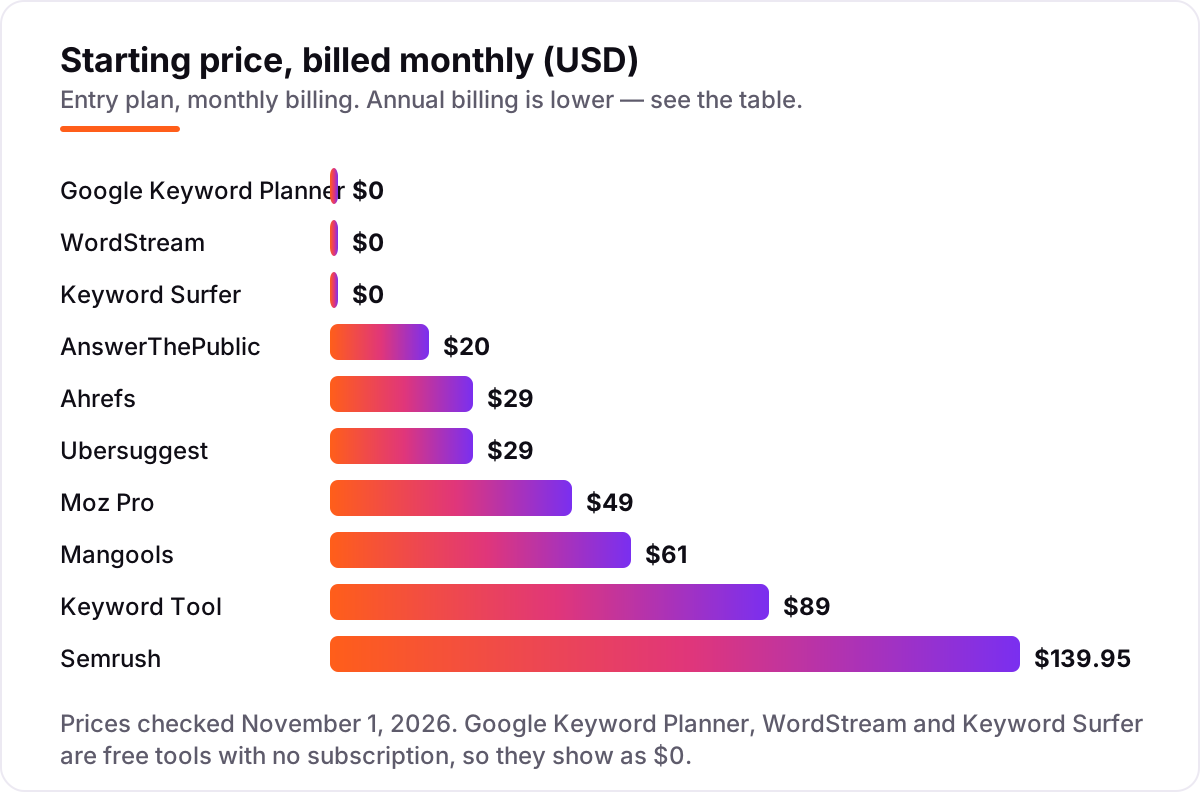
The genuinely unlimited free options are Google Keyword Planner, WordStream and Keyword Surfer, plus the Ahrefs free generator, which has no account and no stated daily cap. If your research habit is a few searches a week, those four cover you without a subscription. If you research daily, budget for the cheapest paid plan that removes the cap that bites you: AnswerThePublic at $20 a month for question research, Ubersuggest at $29 for a general-purpose tool, or Mangools at $37.70 a month billed annually for difficulty scores.
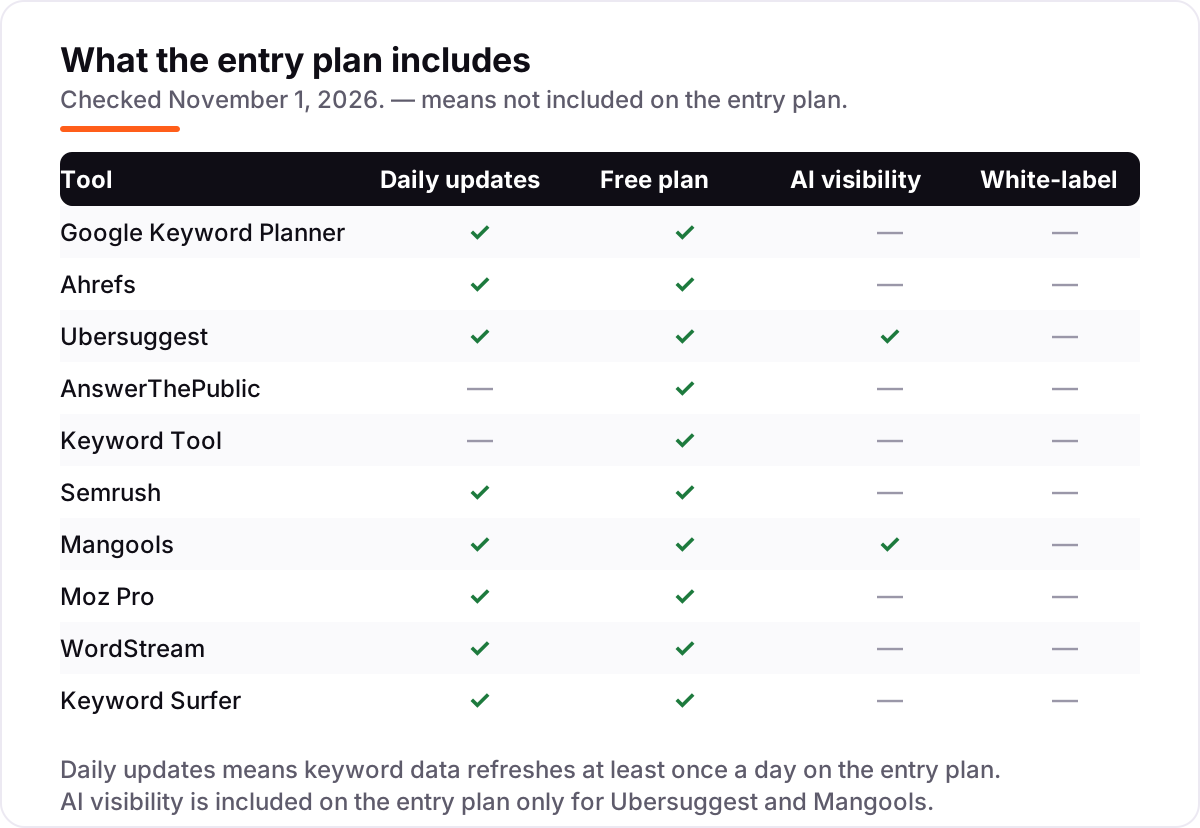
AI search changes what a keyword planner is for, but it does not replace it. When an AI answer quotes your page, the query behind it is still a keyword, and the questions people ask are still the raw material for content. Ubersuggest and Mangools include AI visibility tracking on their entry plans, and our AI search optimisation service is built around exactly that shift — tracking whether your brand shows up in AI answers, not just in the ten blue links. Our guide to ranking in AI Overviews explains what the AI engines actually quote.
Quick comparison: tool type by need
| Buyer | Best pick | Why |
|---|---|---|
| Free volume data, no account fuss | Google Keyword Planner | Free, with volume straight from Google |
| Fast idea lists, no signup | Ahrefs | 150 ideas per search from the free generator |
| Cheapest all-round paid tool | Ubersuggest | $29/month, or $290 once for life |
| Blog topics and FAQ ideas | AnswerThePublic | Question maps, free for 3 searches a day |
| Long-tail ideas across platforms | Keyword Tool | Autocomplete ideas from Google, YouTube and Amazon |
| Deepest keyword database | Semrush | 25-billion-plus keywords, 10 free reports a day |
| Beginner-friendly difficulty scores | Mangools | KWFinder, 5 free lookups a day, no card |
| Exact volumes, no daily cap | WordStream | Free and unlimited, concrete volumes from Google's API |
| Volumes while you browse | Keyword Surfer | Free Chrome extension, no account needed |
How to choose: a short decision path
- Start with the free stack. Open Google Keyword Planner for volume, run the Ahrefs free generator for ideas, and check WordStream for concrete numbers. If those three answer your questions, you do not need to pay yet.
- Find the limit that bites first. Track one week of research and note which cap you hit: searches per day, lookups per day, or queries per month. The tool whose cap you hit is the one worth paying for.
- Match the tool to the job. Question-led content goes to AnswerThePublic, long-tail product keywords go to Keyword Tool, and difficulty scoring for beginners goes to Mangools. A suite only earns its price if you use the rest of it.
- Check volume precision before you commit. Planner ranges and Surfer estimates are directional; if a keyword decides a whole page, confirm the volume in a second tool before you build around it.
- Try the paid plan on a real topic. Every paid tool here has a free plan or trial. Run one real content plan through it — seed to shortlist to outline — and check the numbers against Search Console before the trial ends. Before you publish for the keywords you pick, run your titles through the free keyword density checker to keep the page focused on the term you chose.
Mistakes to avoid
- Paying for a suite when you only need ideas. A $139.95 Semrush plan used twice a month costs more than the free generator plus Keyword Planner, which cover the same job for nothing.
- Trusting one volume figure. Planner shows ranges, Surfer shows estimates, and the suites disagree with each other. A keyword that decides a page deserves a second source — see how to track your Google ranking to confirm what the tool should be showing.
- Ignoring the daily cap. A plan that allows 3 searches a day is not a research tool for a daily publisher; it is a taster. Count your searches for a week before you judge a free plan.
- Choosing by database size alone. A 25-billion-keyword database does not help if you only research ten topics a month. Difficulty data and a readable workflow matter more than the headline number.
- Forgetting the export trap. Some free tools show ideas on screen but charge for the export, and some send the full list only by email. Check how the data leaves the tool before you build a workflow around it.
How we chose
We checked each vendor's own pricing page on November 1, 2026 and recorded the starting price exactly as shown, including the annual-billing figure where the page lists one. Two pages did not render their prices in our check: AnswerThePublic's pricing page loaded without price cards, so its $20 Starter price rests on multiple October 2026 reads of the same page, and Keyword Tool's pricing URL returned a 404, so its $89 Pro Basic price rests on multiple October 2026 reads including Capterra. Ratings come from G2, with review counts shown; Google Keyword Planner, WordStream and Keyword Surfer have no G2 rating for the free tool itself, so no rating is shown for them. We ranked the tools by fit for the most common buyer — a small site owner or solo marketer doing keyword research on a tight budget — not by brand size. No vendor paid for a place in this list, and none of the links here are affiliate links.
What to do next
Start with the free stack: Keyword Planner for volume, the Ahrefs generator for ideas, WordStream for concrete numbers. When a daily cap slows you down, pay for the one tool whose cap you keep hitting — usually Ubersuggest at $29 a month or AnswerThePublic at $20. Then build one content plan end to end and check the results in Search Console before you commit to a second subscription. If you'd rather have this set up and read for you, request a free SEO + AI visibility audit and get a ranked fix list in 2 business days.
Rather not run the tools yourself?
Tools show you the data. SerpAstra turns it into higher rankings, more map-pack calls and citations in AI answers.
Get a free SEO + AI visibility audit→Sources we checked (17)
- Google Keyword Planner — ads.google.com/home/tools/keyword-planner (checked November 1, 2026)
- Ahrefs pricing — ahrefs.com/pricing (checked November 1, 2026)
- Ahrefs on G2 — 4.5/5, 723 reviews (checked November 1, 2026)
- Ubersuggest pricing — neilpatel.com/ubersuggest/pricing (checked November 1, 2026)
- Ubersuggest on G2 — 4.2/5, 160 reviews (checked November 1, 2026)
- AnswerThePublic pricing — answerthepublic.com/pricing (checked November 1, 2026)
- AnswerThePublic on G2 — 4.5/5, 38 reviews (checked November 1, 2026)
- Keyword Tool pricing — keywordtool.io (checked November 1, 2026)
- Keyword Tool on G2 — 4.5/5, 19 reviews (checked November 1, 2026)
- Semrush pricing — semrush.com/prices (checked November 1, 2026)
- Semrush on G2 — 4.4/5, 4,304 reviews (checked November 1, 2026)
- Mangools pricing — mangools.com/plans-and-pricing (checked November 1, 2026)
- Mangools on G2 — 4.7/5, 97 reviews (checked November 1, 2026)
- Moz Pro pricing — moz.com/products/pro/pricing (checked November 1, 2026)
- Moz Pro on G2 — 4.3/5, 608 reviews (checked November 1, 2026)
- WordStream Free Keyword Tool — wordstream.com/keywords (checked November 1, 2026)
- Keyword Surfer extension — docs.surferseo.com (checked November 1, 2026)
Shamim
Founder of SerpAstra
A full-stack SEO and digital marketer who spends most days on Local SEO for dental practices, AI search visibility and lead generation.
Frequently asked questions
Is Google Keyword Planner really free?
Yes. Keyword Planner is a free tool inside Google Ads, and Google describes it as a free resource. You need a Google Ads account, and Google asks for billing information during account setup, but you do not need to run ads or spend money to use it. Accounts without recent ad spend see volume as ranges rather than exact figures.
What is the best free keyword planner tool?
Google Keyword Planner is the best free starting point because its volume data comes straight from Google. Pair it with Ahrefs' free Keyword Generator for idea expansion and WordStream's free tool for concrete volumes, and you cover volume, ideas and CPC without paying. Pay only when the daily limits slow you down.
How many free keyword searches do I get per day?
It depends on the tool. Ubersuggest and AnswerThePublic give 3 searches a day free, Mangools gives 5 KWFinder lookups per 24 hours, and Semrush's free account gives 10 reports a day. WordStream, Keyword Surfer and the Ahrefs free generator have no stated daily cap, though the Ahrefs generator is rate-limited.
Do free keyword planner tools show search volume?
Most do, with limits. Keyword Planner shows volume ranges without ad spend, WordStream shows concrete volumes from Google's API, and the Ahrefs generator shows volume for the seed term and the first results. AnswerThePublic and the free version of Keyword Tool show no volume at all — they are idea tools, not measurement tools.
Should I use Keyword Planner or Ahrefs for keyword research?
Use both, for different jobs. Keyword Planner gives the most authoritative volume data because it comes from Google, but it has no difficulty score. Ahrefs adds difficulty, a much larger keyword database and competitor data, starting at $29 a month for Starter. Start free with Planner, then pay for Ahrefs when difficulty decides your topics.
What should I check before paying for a keyword tool?
Four things: the daily search or lookup limit on the plan you would actually buy, whether volume figures are exact or ranges, whether keyword difficulty is included or costs extra, and whether the price is monthly or annual billing. A cheap plan with a 3-search daily cap costs more in lost time than a $29 plan you can use all day.
Free SEO and AI visibility audit
Find out what is holding your rankings back
Send us your site. Within 2 business days you get a written audit, an AI visibility check and a short fix list ranked by impact. Free, with no contract attached.
Request my free audit→Related guides
 On-PageKeyword research for local businesses, step by stepA practical, step-by-step keyword research process for local businesses: find what customers search, map terms to pages, and skip vanity keywords.Read guide →
 StrategyHow to track your Google ranking (and what the numbers actually mean)Track your Google ranking the right way: Search Console, free checkers and rank trackers explained, and what average position and CTR really mean today.Read guide →
 AI SearchHow to rank in Google AI Overviews: a practical guide for 2026How to rank in Google AI Overviews in 2026: what Google actually requires, query fan-out, answer-first pages, and how to track whether you are being cited.Read guide →