
8 Best GEO Tools for Ecommerce in 2026 (Free and Paid, Compared)
The 8 best geo tools for ecommerce, compared on price, AI engines, SKU tracking and free trials. Every price checked on the vendor page, November 1, 2026.
 Shamim Mia, Founder, SerpAstraLast verified November 1, 202614 min read
We compare pricing pages, documentation and public reviews. We never accept payment for rankings.

Key takeaways
- Goodie AI is the best overall pick for ecommerce: tracking, optimization actions and revenue attribution from $354/month billed monthly ($295/month billed annually). Peec AI is the value pick — SKU-level shopping tracking from $95/month.
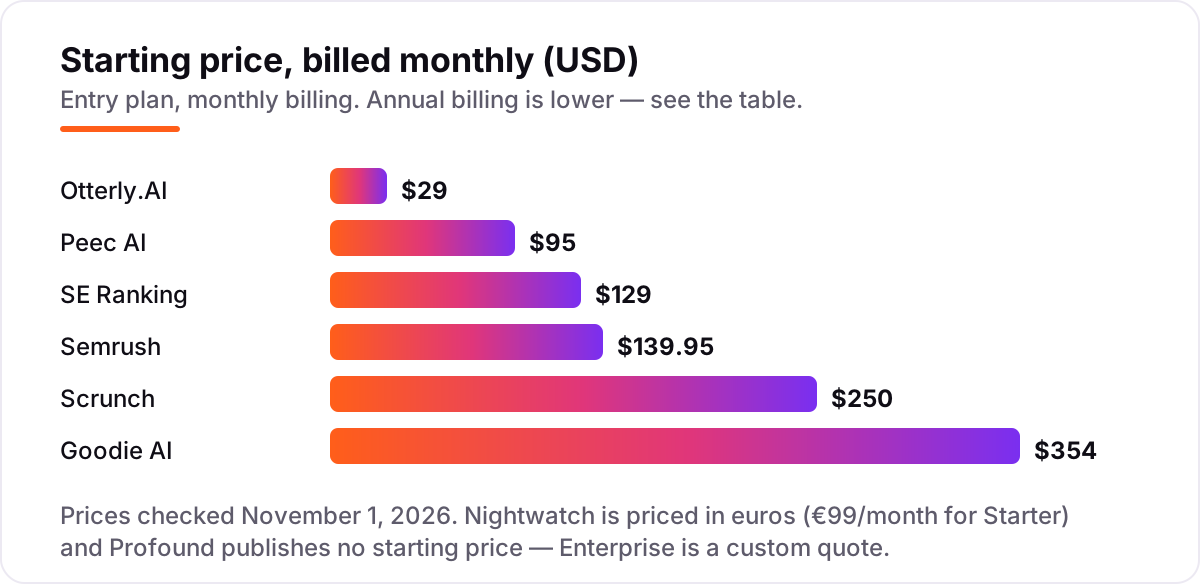
- Otterly.AI is the cheapest way in at $29/month for 15 prompts tracked daily; Profound is the enterprise end, with no published price past its free trial.
- The single most important buying factor is prompt coverage per product: a tool that tracks 15 prompts cannot cover a 500-SKU catalog — count your products before you count the price.
- Every price below was checked on the vendor's own pricing page on November 1, 2026. Ratings are G2, with review counts shown.
On this page
Quick comparison
| Tool | Best for | Starting price | Free plan |
|---|---|---|---|
| Goodie AI | Ecommerce brands that want AI visibility tracking wired to content fixes and revenue attribution | $295/mo (annual) | No (7-day trial) |
| Peec AI | Ecommerce teams that want per-product (SKU) visibility in AI shopping answers without an enterprise contract | $80/mo (annual) | No (trial) |
| Scrunch | Mid-market ecommerce brands that want prompt tracking plus audits of how AI crawlers read their site | $250/mo | No (7-day trial) |
| Otterly.AI | Small ecommerce stores running their first AI visibility pilot on a tight budget | $25/mo (annual) | No (trial) |
| Profound | Large ecommerce brands that need the deepest prompt data and enterprise controls | Custom quote | No (7-day trial) |
| SE Ranking | Ecommerce teams that want AI visibility bundled into a full SEO suite for about $103/month | $103.20/mo (annual) | No (14-day trial) |
| Nightwatch | Small agencies and ecommerce teams that want unlimited seats plus AI-citation tracking | €79/mo (annual) | No (14-day trial) |
| Semrush | Ecommerce teams already paying for Semrush that want AI visibility as an add-on to the deepest suite | $117.33/mo (annual) | Yes (10 keywords) |
Make one of these tools?
We re-check this list every quarter. Send a correction, request a review, or ask about a clearly labeled sponsored spot.
Request a listingThe best GEO tools for ecommerce

Goodie AI
Best for: Ecommerce brands that want AI visibility tracking wired to content fixes and revenue attribution
Goodie AI is the most complete ecommerce GEO platform here because it does not stop at measurement. Core tracks 110 prompts a day across five engines — ChatGPT, Google AI Overviews, Perplexity, AI Mode and Copilot — then its agents act on the findings, with 50 optimization actions a month included. Revenue attribution through Google Analytics ties those actions to sales, the number an ecommerce team actually reports on.
The price is the honest catch: $354 a month billed monthly is the highest entry price here, and the page loads with annual billing selected, so the $295 most people see first is the annual rate. SKU-level commerce tracking needs Pro at $999 a month. Buy Goodie when you want one platform to measure, fix and prove revenue; buy a tracker when you only need the numbers.
What we like
- 110 prompts tracked daily across 5 engines — ChatGPT, AI Overviews, Perplexity, AI Mode and Copilot
- Closed-loop platform: it researches gaps, then its agents create or optimize content to close them, with 50 optimization actions a month on Core
- Revenue attribution through Google Analytics ties AI visibility to sales, not just mentions
- Unlimited seats on every plan, with MCP server access from Core
Watch out for
- Highest entry price here — $354/month billed monthly, and the page loads with annual billing selected
- Claude, Gemini, Grok and other models beyond the five core engines need Enterprise
- 110 prompts is tight for a large catalog — SKU-level tracking needs Pro ($999/month)

Peec AI
Best for: Ecommerce teams that want per-product (SKU) visibility in AI shopping answers without an enterprise contract
Peec AI is the value pick for ecommerce because it puts SKU-level tracking on the cheapest plan. Upload a catalog from Shopify, a CSV or Google Merchant Center and Peec reports visibility, position and win rate per product — so you can see which products ChatGPT recommends and which it never mentions. Starter tracks 50 prompts a day across three models you choose, with unlimited users on every plan.
The limits are scope, not quality. Three models per plan means extra engines cost extra, and 50 prompts covers a small catalog — a 500-SKU store will need Pro at $245 a month. There is no page-level readiness check, so content fixes need a second tool. For a store with a focused catalog that wants to know which products AI shoppers see, Peec is the cheapest honest answer.
What we like
- SKU-level AI shopping tracking included on Starter — catalog upload from Shopify, CSV or Google Merchant Center, with visibility, position and win rate per product
- Unlimited users on every plan, so the whole team can use one subscription
- Daily tracking of visibility, position, sentiment and share of voice across your chosen models
- MCP access and CSV exports included on Starter
Watch out for
- Only 3 models per plan — extra engines are paid add-ons, priced per tier
- No page-level AEO readiness check, so content fixes need a second tool
- 50 prompts covers a small catalog only — a 500-SKU store outgrows Starter fast

Scrunch
Best for: Mid-market ecommerce brands that want prompt tracking plus audits of how AI crawlers read their site
Scrunch starts from your site, not from the answers. Its audits show how AI models crawl and describe your pages, and its prompt monitoring then checks whether your brand appears in the answers on ChatGPT, Perplexity, Google AI Overviews and Copilot. Core covers 125 prompts and five user licenses for $250 a month, and the agent-traffic data shows which AI bots visit your store and what they read.
Two things to check before you buy. Core tracks only four engines — Claude, Gemini, AI Mode and Grok need the custom Enterprise plan — and Scrunch publishes no refresh cadence for Core, so ask how often your prompts actually rerun. The API is Enterprise-only too. Pick Scrunch when the technical side matters: how AI crawlers read your store is half the visibility problem, and no other tool here audits it.
What we like
- Five site audits a month flag pages AI crawlers cannot read or describe properly
- 125 prompts and 5 user licenses for $250/month — the most seats per dollar here
- Agent-traffic data shows which AI bots visit your site and what they read
- Citation and source reports show exactly which pages AI answers link to
Watch out for
- Core covers only 4 engines — Claude, Gemini, AI Mode and Grok need Enterprise
- No published refresh cadence for Core prompt data
- API access and the Agent Experience Platform are Enterprise-only

Otterly.AI
Best for: Small ecommerce stores running their first AI visibility pilot on a tight budget
Otterly.AI is the cheapest way to start measuring AI visibility, and it is honest about what $29 buys: 15 prompts tracked daily across ChatGPT, Google AI Overviews, Perplexity and Microsoft Copilot, with unlimited team members and a GEO audit that checks whether any URL is crawlable and readable by AI. Setup takes minutes, and the prompt research tool suggests the buyer questions worth tracking first.
Plan for the jump. Fifteen prompts cover a handful of hero products, and the next plan is Standard at $189 a month — a sixfold increase — while Claude, Gemini and Google AI Mode are paid add-ons on top. There is no API access on Lite. Otterly is the right first pilot for a small store; once the prompt list grows past a few dozen, price the Standard plan before you commit.
What we like
- Cheapest real entry point here — $29/month with daily tracking across 4 engines
- Unlimited team members on every plan, including Lite
- GEO audit checks crawlability and content readiness for any URL, 1,000 checks a month on Lite
- Prompt research tool helps find the questions buyers actually ask AI assistants
Watch out for
- 15 prompts is tight — the next step is Standard at $189/month, a 6x jump
- Claude, Gemini and Google AI Mode are paid add-ons, not included
- No API or MCP access on Lite — those start on Standard

Profound
Best for: Large ecommerce brands that need the deepest prompt data and enterprise controls
Profound is the deepest tracker in this list. Enterprise covers up to nine engines and adds prompt-volume data drawn from 1.5 billion real user prompts and answers, so you can see which questions shoppers actually ask — not just the ones you guessed. Agent Analytics shows how AI crawlers read your site, and the platform includes an API, SSO and SOC 2 for large teams.
There is no published price for brands: a free 7-day trial runs 50 preset prompts a day on three engines, and everything after that is a custom Enterprise quote. Trial prompts are set by Profound and cannot be changed, so your own product questions wait for the demo. Buy Profound when you are a large brand with a team to act on the data; everyone else should start cheaper.
What we like
- Up to 9 engines on Enterprise — the widest coverage in this list
- Prompt-volume data drawn from 1.5 billion real user prompts and answers shows which questions actually get asked
- Agent Analytics shows how AI crawlers read your site, from server and CDN logs
- API, SSO/SAML and SOC 2 on Enterprise, with unlimited seats on every plan
Watch out for
- No published price for brands — every paid plan is a custom Enterprise quote
- Trial prompts are preset by Profound and cannot be changed, so your own questions wait for the demo
- The deepest data needs a team to act on it — small stores will pay for depth they cannot use

SE Ranking
Best for: Ecommerce teams that want AI visibility bundled into a full SEO suite for about $103/month
SE Ranking is the cheapest way to get AI visibility inside a full SEO suite. Core costs $103.20 a month billed annually and bundles 2,000 keywords tracked daily, a site audit and backlink research with AI visibility tracking — 25 prompts a day across five engines. For an ecommerce team that already needs rank tracking and audits, the AI tracking is effectively an extra feature rather than a second subscription.
The AI allowance is the limit to watch: 25 prompts a day covers a handful of categories, not a full catalog, and white-label reports need the $69-a-month Agency Pack add-on. Some G2 reviewers also report small accuracy differences in rank data. Buy SE Ranking when you want one subscription for SEO and AI visibility; buy a dedicated tracker when prompt volume is the job.
What we like
- Cheapest route to AI visibility inside a full suite — 25 prompts a day on Core
- 2,000 keywords tracked daily plus site audit and backlink research in the same plan
- AI visibility covers 5 engines, including ChatGPT and Perplexity
- White-label reporting available with the Agency Pack add-on from $69/month
Watch out for
- 25 AI prompts a day is thin for a large product catalog
- White-label reports need the $69/month Agency Pack add-on — not included on Core
- Some G2 reviewers report minor discrepancies in rank data and search-volume estimates

Nightwatch
Best for: Small agencies and ecommerce teams that want unlimited seats plus AI-citation tracking
Nightwatch pairs daily rank tracking with AI visibility in one subscription, and it is built for teams: unlimited seats come with every plan. Its Citation Intelligence feature links each ranking change to the AI citations behind it in ChatGPT, Claude, Gemini and Perplexity, so you can see which answers moved a product page. Starter tracks 500 keywords a day for €79 a month billed annually, with ZIP-code-level local tracking included.
Two things to note before you buy. Nightwatch is priced in euros, so US buyers pay the exchange rate on top, and the price climbs steeply with keyword volume — €499 a month for 7,500 keywords. White-label reports start on Professional, not Starter. Pick Nightwatch when seats and AI citations matter more than raw keyword volume; a growing catalog should price the next tier first.
What we like
- Unlimited seats on every plan, with white-label reports and API access from Professional up
- Citation Intelligence links each ranking change to AI citations in ChatGPT, Claude, Gemini and Perplexity
- ZIP-code-level local tracking across 107,000+ locations in 190+ countries
Watch out for
- Priced in euros, which US buyers should note
- Price climbs steeply with keyword volume — €499/month for 7,500 keywords
- No free plan, and white-label reports start on Professional, not Starter

Semrush
Best for: Ecommerce teams already paying for Semrush that want AI visibility as an add-on to the deepest suite
Semrush is the deepest bench in this list, and for teams already paying for it, AI visibility is an add-on decision. The entry SEO plan tracks 500 keywords daily and pairs Position Tracking with a keyword database Semrush puts at more than 27 billion keywords, plus site audits and backlink analysis. The AI Visibility Toolkit is a separate add-on from Starter at $199 a month, tracking brand mentions across ChatGPT, Perplexity, Gemini and Google AI Overviews.
That add-on structure is the honest limitation: the $139.95 SEO plan buys no AI visibility on its own, so the real starting price for GEO work is higher than the headline. Extra users start at $45 a month. Buy Semrush when you need the research depth behind the positions; buy a dedicated GEO tracker when AI answers are the job.
What we like
- 500 keywords tracked daily on the entry SEO plan, with tracking down to ZIP-code level
- Bundles rank tracking with a 27-billion-plus keyword database, site audits and backlink analysis in one login
- AI Visibility Toolkit tracks brand mentions across ChatGPT, Perplexity, Gemini and Google AI Overviews (paid add-on from Starter, $199/month)
Watch out for
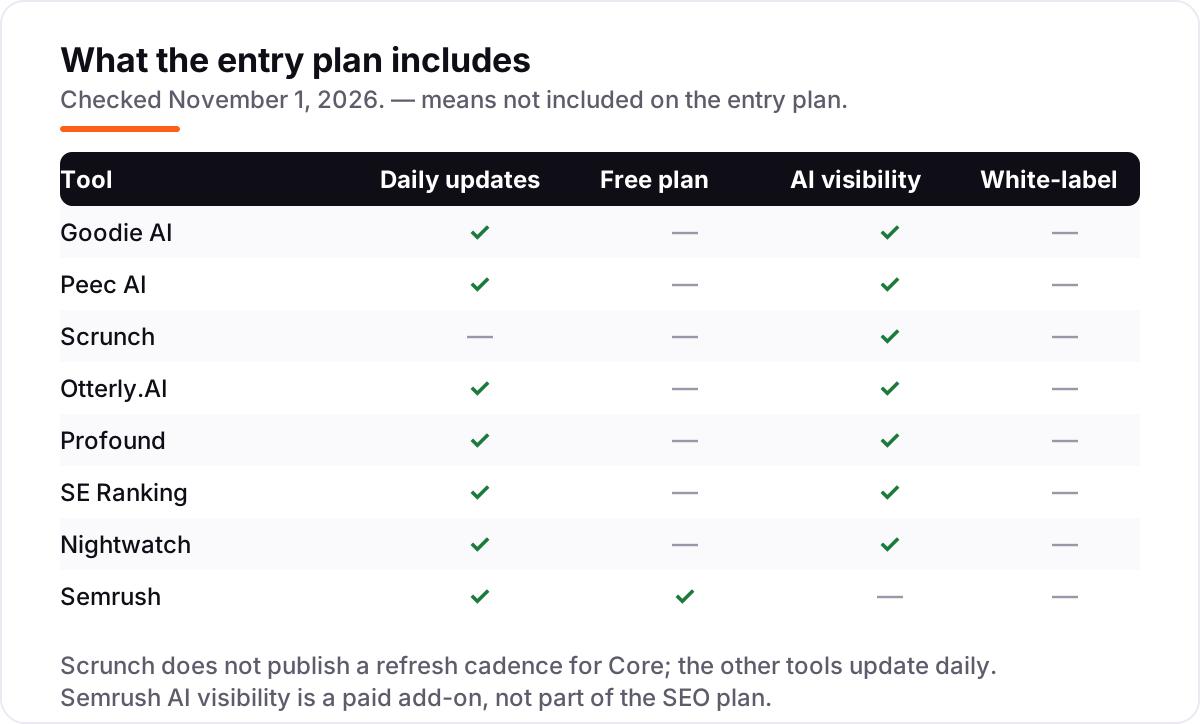
- AI visibility is NOT included on the SEO plan — it needs the paid AI Visibility Toolkit add-on
- Highest entry price among the suites here, and extra users start at $45/month
- The free account caps at 10 tracked keywords and 10 reports a day
What a GEO tool actually does
The best geo tools for ecommerce answer one question: when a shopper asks an AI assistant for a product recommendation, does it mention your store — and your products? A GEO tool runs the questions your buyers actually ask through ChatGPT, Perplexity, Gemini, Google AI Overviews and the other answer engines, then reports how often your brand appears, where it ranks against competitors, and which pages the assistant cites as its source.
That question is worth money now. Adobe Analytics found AI-referred traffic to US retail sites rose 393% year over year in the first quarter of 2026, and by March those visitors converted 42% better than non-AI traffic (Adobe Analytics, reported by TechCrunch, April 16, 2026). The shoppers arriving from AI answers have already done their research — they are closer to buying than a casual browser, which is why getting recommended matters more than getting clicked.
GEO here means Generative Engine Optimization: improving how your products and brand appear in AI answers. It is not geographic targeting, and these tools do not buy ads or place products — they measure visibility, then show you what to fix so the assistants cite you more often. Our AI search optimization service does the same work hands-on for stores that would rather not run the tools themselves.
Every tool in this list reports the same four numbers, and it helps to know them before you compare plans. Mention rate is how often your brand appears when the assistant answers a prompt. Position is where you sit in the answer — first, mentioned in passing, or only as a comparison. Sentiment is whether the assistant describes you positively, neutrally or negatively. Share of voice is your slice of all the mentions across you and your competitors. A prompt is simply one buyer question, run once per engine per day, and it is the unit every tool bills on — so prompt counts, not seat counts, decide what a plan really costs.
Full platforms that track and fix
Three tools in this list do more than report. Goodie AI, Scrunch and Profound all pair tracking with something that changes the result — Goodie with agents that write and optimize content, Scrunch with audits of how AI crawlers read your site, and Profound with agents plus the deepest prompt data in the category. They are also the three most expensive ways in, from $250 a month to a custom quote, so they fit stores that already treat AI search as a channel worth staffing, not a curiosity. If you only need to know where you stand, the dedicated trackers below cost less and answer faster.
Within the three, the fit splits by what you want done for you. Goodie suits a store that wants the loop closed — measure, fix, attribute — without hiring for it. Scrunch suits a team with technical SEO skills that wants to see how AI crawlers read the store before it worries about the answers. Profound suits a large brand that already has people to act on deep data and needs procurement-grade controls like SSO and SOC 2. All three offer a free trial, so run the same ten product questions through each before you commit to one.
The best geo tools for ecommerce catalogs
Peec AI and Otterly.AI are the two dedicated trackers in this list, and they are built for stores that think in products, not keywords. Peec's edge is SKU-level tracking: it follows each product through AI shopping answers, which is the level a catalog actually lives at. Otterly's edge is price: $29 a month buys daily tracking across four engines, the cheapest real entry point here. Both are honest about their ceilings — Peec covers 50 prompts on Starter, Otterly 15 — so count your hero products before you pick. A store with 20 bestsellers fits either; a store with 500 SKUs needs a bigger prompt budget or a higher tier.
A worked example helps with the budgeting. Say your store has 40 hero products and each needs three prompts — best in its category, best value, and a direct comparison with the leading rival. That is 120 prompts, which already exceeds Peec's Starter and dwarfs Otterly's Lite. Most stores solve this by tracking the top 20 products first and rotating the rest in monthly, or by paying for the next tier up. Either way, write the prompt list before you buy the plan, not after.
Suites that add AI visibility to SEO
SE Ranking, Nightwatch and Semrush are SEO suites first and GEO tools second, which is exactly the point for teams that already pay for one. SE Ranking bundles 25 AI prompts a day into its $103.20-a-month Core plan, Nightwatch ties AI citations to rank changes, and Semrush sells AI visibility as an add-on to the deepest research suite here. The trade-off is focus: a suite's AI tracking is usually thinner than a dedicated tool's — fewer prompts, fewer engines — but you get rank tracking, audits and backlinks in the same subscription. If AI answers are a side question for you, a suite is the cheaper answer; if they are the main question, buy a dedicated tracker.
The other question a suite answers is whether you already have the data habits to use it. A suite only pays off if someone on the team opens it weekly — checking rank movements, reading the audit, acting on the AI visibility numbers. If nobody will, a dedicated tracker with a weekly email summary is the better buy, even if the suite looks cheaper per feature. Nightwatch's unlimited seats help here: the whole team can look without adding to the bill, which is the one thing the suites charge for fastest.
Quick comparison: tool type by need
| Buyer | Best pick | Why |
|---|---|---|
| Small store, first pilot | Otterly.AI | $29/month, daily tracking, 15 prompts |
| Focused catalog, best value | Peec AI | SKU-level shopping tracking from $95/month |
| Want tracking plus fixes | Goodie AI | Agents act on findings; revenue attribution from $354/month |
| Mid-market, technical depth | Scrunch | Site audits plus 125 prompts for $250/month |
| Large brand, deepest data | Profound | Up to 9 engines; custom Enterprise quote |
| One subscription for SEO + AI | SE Ranking | Full suite with AI visibility from $103.20/month |
| Rank tracking plus AI citations | Nightwatch | Unlimited seats; Citation Intelligence from €79/month |
| Already on the deepest suite | Semrush | AI visibility as an add-on to the $139.95 SEO plan |
How to choose: a short decision path
- Count your products, not your keywords. A GEO tool meters prompts, and one product needs several prompts (best, cheapest, for X, vs competitor). Fifteen prompts cover a handful of hero products; a 500-SKU catalog needs hundreds. Write the list down before you shop — a plan that covers 120 prompts costs very differently from one that covers 15.
- Pick your engines. ChatGPT and Google AI Overviews matter most for shoppers; Perplexity and Copilot add reach. Check which engines your plan actually includes — several tools charge extra for Claude, Gemini and AI Mode.
- Decide tracker or platform. If you only need to know where you stand, a dedicated tracker costs $29–$250 a month. If you want the fixes done too, a platform like Goodie costs more but closes the loop.
- Check the trial terms. Every tool here offers a free trial. Run your real product questions for the full trial and compare the answers against what you see when you ask the assistants yourself. A trial that only runs preset prompts, like Profound's, tests the dashboard, not your market — weigh that before you judge it.
- Price the next tier before you buy. The jump from entry to the next plan is steep everywhere — Otterly goes $29 to $189, Peec $95 to $245. Make sure the tier you will need in six months is one you can afford.
Before you publish new product pages for the questions you track, run your llms.txt through the free llms.txt generator — it helps AI engines read your store correctly.
Mistakes to avoid
- Comparing monthly prices without checking billing. Goodie's page loads with annual billing selected, so the $295 figure is the annual rate — monthly is $354. Peec's $80 is annual too.
- Buying prompts you cannot fill. A 125-prompt plan is wasted if you only have 20 products worth tracking; start small and upgrade when the prompt list grows.
- Assuming every engine is included. Claude, Gemini and Google AI Mode are add-ons or Enterprise-only on several tools here — check the engine list against your buyers' habits, not the marketing page.
- Expecting a recommendation guarantee. No tool can make ChatGPT recommend your product. The tool shows you what to fix; the recommendation follows the fix.
- Tracking brand prompts only. Shoppers ask "best running shoes under $100", not your brand name. Non-branded, category prompts are where most recommendations are won or lost.
How we chose
We checked each vendor's own pricing page on November 1, 2026 and recorded the starting price exactly as shown, including the annual-billing figure where the page lists one. Ratings come from G2, opened the same day, with review counts shown. We ranked the tools by fit for the most common buyer — an ecommerce brand that wants to know whether AI assistants recommend its products — not by brand size. No vendor paid for a place in this list, and none of the links here are affiliate links.
What to do next
Start with the decision path above: count your products, pick your engines, and decide tracker or platform. Then take the free trial of your top pick and run your real product questions for a week — keep the prompt list small at first, ten products and three questions each, and expand it only once the reporting habit sticks. If the answers match what you see when you ask the assistants yourself, you have your tool. If you'd rather have this set up and read for you, request a free SEO + AI visibility audit and get a ranked fix list in 2 business days.
Rather not run the tools yourself?
Tools show you the data. SerpAstra turns it into higher rankings, more map-pack calls and citations in AI answers.
Get a free SEO + AI visibility audit→Sources we checked (17)
- Goodie AI pricing — higoodie.com/pricing (checked November 1, 2026)
- Goodie AI on G2 — 4.9/5, 10 reviews (checked November 1, 2026)
- Peec AI pricing — peec.ai/pricing (checked November 1, 2026)
- Peec AI on G2 — 4.7/5, 21 reviews (checked November 1, 2026)
- Scrunch pricing — scrunch.com/pricing (checked November 1, 2026)
- Scrunch AI on G2 — 4.6/5, 74 reviews (checked November 1, 2026)
- Otterly.AI pricing — otterly.ai/pricing (checked November 1, 2026)
- Otterly.AI on G2 — 4.7/5, 54 reviews (checked November 1, 2026)
- Profound pricing — tryprofound.com/pricing (checked November 1, 2026)
- Profound on G2 — 4.5/5, 1,133 reviews (checked November 1, 2026)
- SE Ranking pricing — seranking.com/subscription.html (checked November 1, 2026)
- SE Ranking on G2 — 4.7/5, 1,619 reviews (checked November 1, 2026)
- Nightwatch pricing — nightwatch.io/pricing (checked November 1, 2026)
- Nightwatch on G2 — 4.7/5, 64 reviews (checked November 1, 2026)
- Semrush pricing — semrush.com/prices (checked November 1, 2026)
- Semrush on G2 — 4.4/5, 4,304 reviews (checked November 1, 2026)
- Adobe Analytics Q1 2026 retail data, reported by TechCrunch (April 16, 2026) — AI traffic to US retail sites rose 393% year over year
Shamim
Founder of SerpAstra
A full-stack SEO and digital marketer who spends most days on Local SEO for dental practices, AI search visibility and lead generation.
Frequently asked questions
What is the best GEO tool for ecommerce in 2026?
Goodie AI is the best overall pick: tracking, optimization actions and revenue attribution from $354/month billed monthly. Peec AI is the best value for catalogs, with SKU-level shopping tracking from $95/month. Otterly.AI is the cheapest start at $29/month. Large brands with a team to act on the data should look at Profound.
How much does a GEO tool cost?
Entry prices run from $29/month (Otterly.AI Lite) to $354/month (Goodie AI Core), with Peec AI at $95, SE Ranking at $129 and Scrunch at $250 in between. Profound publishes no price — Enterprise is a custom quote. The headline price is only half the story: compare how many prompts and engines each plan includes before you compare prices.
Is there a free GEO tool for ecommerce?
No free plan exists among the eight tools in this list — every one is a paid plan or a free trial. Goodie, Scrunch, Otterly and Peec offer 7-day trials, and SE Ranking and Nightwatch offer 14-day trials. Semrush has a free account, but it does not include AI visibility. Use a trial to run your real product questions before you pay.
What is SKU-level tracking, and do I need it?
SKU-level tracking reports visibility, position and win rate for each individual product, not just your brand — so you can see which products AI assistants recommend and which they ignore. Peec AI includes it from $95/month and Goodie adds it on Pro. If your catalog has more than about 50 products, SKU-level tracking is the feature that makes the data useful.
Do GEO tools replace SEO tools?
No. A GEO tool tells you whether AI assistants mention and recommend your products; an SEO tool tells you where you rank in Google and what is wrong with your site. SE Ranking and Nightwatch bundle both jobs in one subscription, and Semrush adds AI visibility to its suite. Most stores end up needing one of each, or one suite that does both.
Can a GEO tool get my products recommended by ChatGPT?
No tool can guarantee a recommendation — the AI assistant decides what to cite. What a GEO tool does is show you which of your products appear in answers, which competitors appear instead, and which pages the assistant cites. That tells you what to fix: product data, reviews, comparison pages and the pages that earn citations. The recommendation follows the fix, not the subscription.
Free SEO and AI visibility audit
Find out what is holding your rankings back
Send us your site. Within 2 business days you get a written audit, an AI visibility check and a short fix list ranked by impact. Free, with no contract attached.
Request my free audit→Related guides
 StrategySEO for ecommerce: product and category pages that rankSEO for ecommerce: product and category pages that rank, with the structure, schema and internal links that turn search traffic into paying customers.Read guide →
 AI SearchHow to rank in Google AI Overviews: a practical guide for 2026How to rank in Google AI Overviews in 2026: what Google actually requires, query fan-out, answer-first pages, and how to track whether you are being cited.Read guide →
 AI SearchHow to get your brand cited in ChatGPT and AI searchA practical guide to earning citations in ChatGPT, Perplexity and Google AI Overviews: crawler access, Bing indexing, answer-first pages and brand signals.Read guide →