
11 Best Growth Stage SAAS Accounting Software in 2026, Compared
11 best growth stage saas accounting software options compared on price, revenue recognition and multi-entity support. Prices checked November 2, 2026.
 Shamim Mia, Founder, SerpAstraLast verified November 2, 202611 min read
We compare pricing pages, documentation and public reviews. We never accept payment for rankings.

Key takeaways
- Sage Intacct is the pick for most growth-stage SaaS teams: multi-entity consolidation, ASC 606 revenue recognition and audit trails, on a custom quote.
- QuickBooks Online Advanced ($340/month) and Xero Established ($97/month) are the best bridges off starter accounting, but neither is a real ERP.
- Puzzle ($30/month) is the cheapest Stripe-native ledger, and Pilot Core ($399/month billed monthly) is the best done-for-you option for venture-backed teams.
- The single most important buying factor is revenue recognition: annual prepayments, upgrades and usage fees need ASC 606 schedules, multi-entity books and an audit trail, not just invoicing.
- Prices below were cross-checked against the vendors' own pricing pages in late October and early November 2026. Sage Intacct and Oracle NetSuite publish no prices, so both are custom quotes.
On this page
Quick comparison
| Tool | Best for | Starting price | Free plan |
|---|---|---|---|
| Sage Intacct | SaaS companies from $1M to $50M in revenue that need multi-entity consolidation, ASC 606 revenue recognition and audit-ready books | Custom quote | No (demo only) |
| Oracle NetSuite | SaaS companies past $10M in revenue that want one ERP for finance, CRM, inventory and global subsidiaries | Custom quote | No (demo only) |
| QuickBooks Online Advanced | SaaS teams of 6 to 25 finance and operations users that have outgrown QuickBooks Plus but are not ready for an ERP | $340/mo | No (30-day trial) |
| Xero | Small SaaS finance teams that want unlimited users, multi-currency billing and project tracking for under $100 a month | $97/mo | No (1-month trial) |
| Puzzle | Early-stage SaaS startups on Stripe that want an AI-native ledger with burn rate and runway reporting | $30/mo | Yes (free to $20K/mo) |
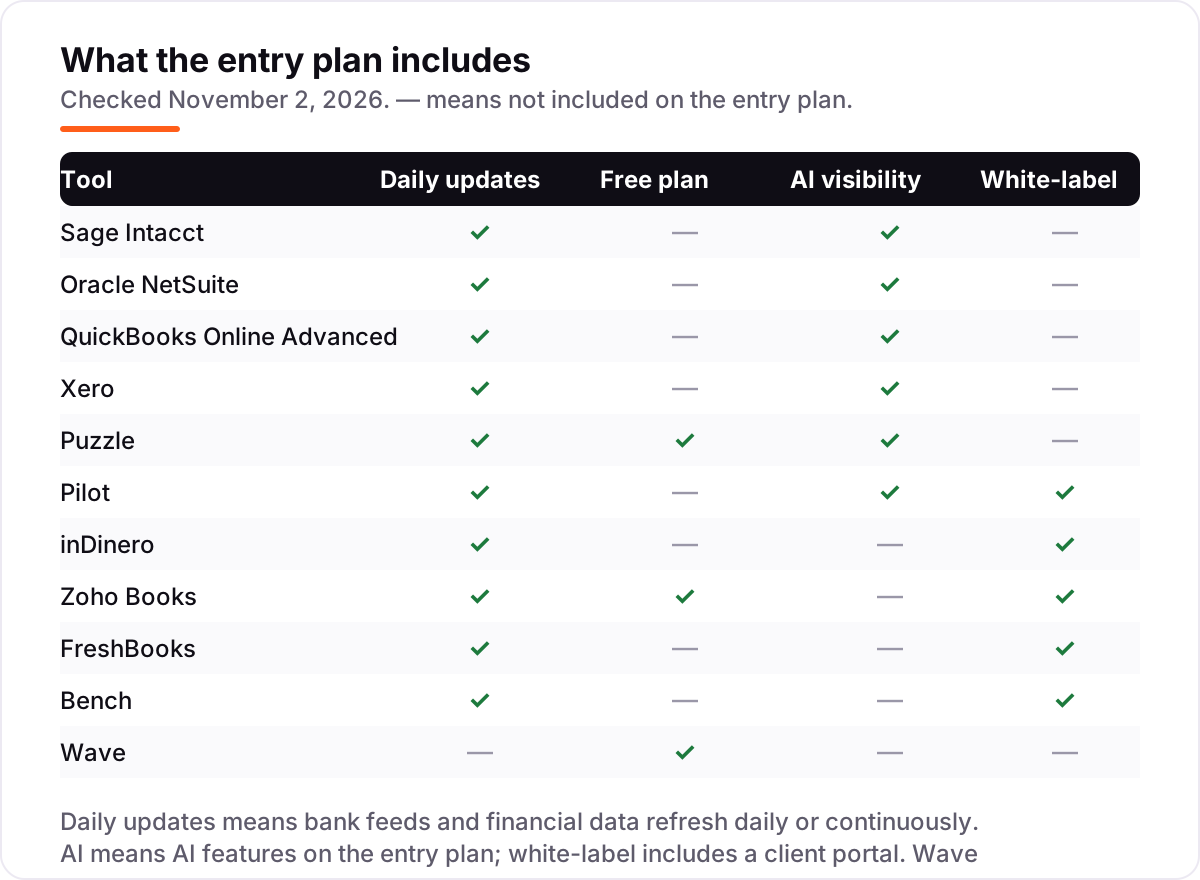
| Pilot | Venture-backed SaaS startups that want a US bookkeeper, accrual books and investor-ready reports without hiring | $299/mo (annual) | No |
| inDinero | Growth-stage SaaS companies at $1M to $20M in revenue that want bookkeeping, tax and fractional CFO under one engagement | $750/mo | No |
| Zoho Books | SaaS teams that want multi-currency billing, inventory and project accounting for $50 a month | $40/mo (annual) | Yes (free plan) |
| FreshBooks | Service-led SaaS teams that bill clients by the hour and want proposals, retainers and time tracking in the ledger | $38.70/mo (annual) | No (30-day trial) |
| Bench | Small SaaS teams that want a human bookkeeper to keep the books clean without hiring one | $199/mo | No |
| Wave | Pre-revenue SaaS founders who need a free double-entry ledger before they can justify a paid plan | $0 (free Starter) | Yes (free Starter) |
Make one of these tools?
We re-check this list every quarter. Send a correction, request a review, or ask about a clearly labeled sponsored spot.
Request a listingThe best growth stage saas accounting software

Sage Intacct
Best for: SaaS companies from $1M to $50M in revenue that need multi-entity consolidation, ASC 606 revenue recognition and audit-ready books
Sage Intacct is the system most SaaS finance teams graduate to, and the reason is structural: it consolidates multiple entities, converts multiple currencies and recognises revenue under ASC 606 in one ledger, with dimensions that slice every transaction by customer, project or location. For a company selling annual contracts across two or three entities, that replaces a stack of spreadsheets and a month-end scramble.
The cost is real and mostly hidden behind a quote: subscriptions are commonly reported around $15,000 a year for a small deployment and $25,000 to $35,000 for mid-market teams, with implementation adding a similar amount again. Buy it when the audit, the board pack or the second entity forces the move, not before.
What we like
- Multi-entity consolidation and multi-currency conversion built in, with dimensional reporting by customer, project or location
- ASC 606 revenue recognition module handles subscriptions, usage fees and bundled services
- Audit trails, role-based approvals and segregation of duties that auditors accept, endorsed by the AICPA
- Real-time dashboards and more than 150 standard reports without exporting to spreadsheets
Watch out for
- Quote-only pricing with implementation that typically costs as much as the first-year subscription
- A 3 to 6 month implementation, so it is not a quick switch from QuickBooks or Xero
- Revenue recognition and multi-entity consolidation are add-on modules, not part of the base subscription

Oracle NetSuite
Best for: SaaS companies past $10M in revenue that want one ERP for finance, CRM, inventory and global subsidiaries
NetSuite is the bigger bet in this list: a full ERP that puts the general ledger, billing, CRM and inventory in one database, so a subscription sale flows from quote to cash to recognised revenue without re-keying. For a SaaS company past $10M in revenue with subsidiaries in several countries, that single source of truth is the point of the purchase.
Oracle publishes no price list, and third-party estimates commonly put the base platform around $999 a month plus $99 to $199 per user, before modules and implementation. Expect a six-month rollout and a dedicated administrator. Choose NetSuite when the business needs operations in the same system as finance, not just a better ledger.
What we like
- One system for the general ledger, billing, CRM, inventory and order management, with consolidated reporting across subsidiaries
- Advanced Revenue Management automates ASC 606 schedules for subscriptions, usage and multi-element arrangements
- Runs in more than 200 countries with multi-currency, multi-language and local tax support
- SuiteScript and SuiteFlow let teams automate approvals, billing and reporting without leaving the platform
Watch out for
- Quote-only pricing with implementation commonly running $25,000 to $100,000 for a small deployment
- G2 reviewers report a steep learning curve and a roughly 6 month implementation
- Advanced revenue recognition and several modules are licensed separately from the base platform

QuickBooks Online Advanced
Best for: SaaS teams of 6 to 25 finance and operations users that have outgrown QuickBooks Plus but are not ready for an ERP
QuickBooks Online Advanced is the most common next step for a SaaS company that has outgrown Plus: it adds straight-line revenue recognition for annual contracts, 25 users with custom permissions, batch transactions and workflow automation, all in the ledger your accountant already knows. At $340 a month it costs nearly two and a half times Plus, which now lists at $140.
The honest limit is the entity wall. Advanced covers one legal entity, so a second subsidiary means a second $340 subscription and a consolidation spreadsheet. It is the right buy for a single-entity SaaS team that needs revenue schedules and controls now; it is the wrong buy the month you open entity number two.
What we like
- Built-in revenue recognition with straight-line schedules for annual SaaS contracts
- 25 users with custom roles and permissions, plus batch transactions and workflow automation
- Bill Pay Elite and advanced reporting are now bundled into the Advanced plan
- The largest accountant and app ecosystem of any SMB ledger, so migrations and integrations are easy to staff
Watch out for
- At $340 a month it is the most expensive SMB ledger here, and the price rose from $275 in August 2026
- One subscription covers one legal entity, so a second entity needs a second paid subscription
- G2 reviewers cite frequent price increases and support that varies by plan
Xero
Best for: Small SaaS finance teams that want unlimited users, multi-currency billing and project tracking for under $100 a month
Xero Established is the cheapest credible bridge for a small SaaS team: $97 a month buys unlimited users, multi-currency billing, project tracking and expense claims, with Stripe and more than 1,000 other apps connected. For a team of three to five people selling in two currencies, it is hard to beat on price, and the interface stays out of the way.
The gap is revenue recognition. Xero has no native ASC 606 schedules, so annual prepayments and usage fees need a spreadsheet or a connected subledger like Stripe Revenue Recognition. If your contracts are simple monthly or annual plans, that is fine; the moment they include upgrades, bundles or usage, budget for the add-on.
What we like
- Unlimited users on every plan, so the whole finance team works in one file at no extra seat cost
- Established adds multi-currency, project tracking, expense claims and a 180-day cash-flow forecast
- More than 1,000 connected apps, including Stripe, and bank feeds that reconcile daily
- Clean interface that non-accountants can learn in days, with a 1-month free trial
Watch out for
- No native revenue recognition schedules, so ASC 606 work needs a spreadsheet or a connected app
- One organisation per subscription, so each legal entity is a separate $97 a month
- US payroll is a separate Gusto add-on, not part of any plan

Puzzle
Best for: Early-stage SaaS startups on Stripe that want an AI-native ledger with burn rate and runway reporting
Puzzle is accounting software designed in the 2020s rather than the 2000s: AI categorises transactions, checks accuracy continuously and syncs natively with Stripe, while the dashboard reports burn rate, runway and MRR the way a founder actually thinks. Starter costs $30 a month and is free until $20,000 in monthly transaction volume.
It is young, and that shows in the pricing history: plan names and prices have shifted during 2026, and custom revenue recognition sits on the Scale plan from $360 a month. For a pre-seed or seed-stage SaaS startup that lives on Stripe, it is the most modern ledger here; for a company with complex contracts, it is a stepping stone, not the destination.
What we like
- AI categorises transactions and checks accuracy continuously, so the books stay close to real time
- Native Stripe sync with burn rate, runway and MRR reporting built for founders
- Flat pricing per company, not per user, so the whole team can work in the ledger
- Starter is free until $20,000 in monthly transaction volume
Watch out for
- Young platform with tier names and prices that have shifted during 2026, so confirm the current lineup before signing
- Custom revenue recognition sits on the Scale plan from $360 a month, not on Starter or Core
- US entities only, and it does not file income taxes

Pilot
Best for: Venture-backed SaaS startups that want a US bookkeeper, accrual books and investor-ready reports without hiring
Pilot is a service, not software: a dedicated US bookkeeper closes your accrual-basis books every month, on a custom chart of accounts, with reports by the 10th business day and bill management for up to 10 vendor bills. Core starts at $299 a month billed annually ($399 month to month) at the lowest expense band, and the price steps up with monthly expenses.
The $99 Essentials plan is the cheap way in, but it is AI-led and cash-basis only, so growth-stage teams should price Core. Pilot holds the highest G2 score in this list at 4.7 out of 5 from 143 reviews. Choose it when you want investor-ready books without hiring a bookkeeper; choose software instead when you want to keep the ledger in-house.
What we like
- A dedicated US-based bookkeeper closes accrual-basis books on a custom chart of accounts
- Reports land by the 10th business day, with bill management for up to 10 vendor bills a month
- Pilot AI answers finance questions from your own books, and the portal replaces QuickBooks for day-to-day viewing
- Built for startups: investor-ready financials, burn reporting and a year-end tax package
Watch out for
- Core pricing rises with monthly expenses, so the $299 a month starting figure climbs as the company grows
- Tax filing and CFO services are separate add-ons, not included in bookkeeping
- Some G2 reviewers say monthly closes can land later in the month than they would like

inDinero
Best for: Growth-stage SaaS companies at $1M to $20M in revenue that want bookkeeping, tax and fractional CFO under one engagement
inDinero sells a finance team, not a tool: one monthly engagement starting at $750 covers bookkeeping, GAAP financial statements, the monthly close, basic tax and fractional CFO work, with ASC 606 revenue recognition and multi-entity consolidation inside the same scope. It is aimed squarely at growth-stage operators between $1M and $20M in revenue.
The trade-off is ownership. Your books live in QuickBooks Online or Xero under your own billing, which keeps them portable, but inDinero is not selling you its own ledger. At 4.0 out of 5 from 34 G2 reviews, satisfaction is solid rather than stellar. Buy it when you need controller-level judgement, not just clean transactions.
What we like
- One monthly engagement covers bookkeeping, GAAP financial statements, tax and fractional CFO work
- ASC 606 revenue recognition and multi-entity consolidation are inside the same scope
- CPA-led team with SOC 2 compliance and continuous operations since 2009
- Month-to-month engagements, so the commitment does not outrun the need
Watch out for
- Starts at $750 a month, so it costs more than a software-only ledger before any value is added
- Your books live in QuickBooks Online or Xero, so the general ledger itself is not inDinero's own software
- G2 reviewers cite higher pricing for small businesses and mixed responsiveness on support

Zoho Books
Best for: SaaS teams that want multi-currency billing, inventory and project accounting for $50 a month
Zoho Books Professional is the cheapest way to get multi-currency billing, inventory tracking, sales orders and project accounting in one ledger: $50 a month billed monthly, or $40 a month billed annually, for 5 users and 10,000 invoices a year. A client portal and time tracking are included, and the free plan stays free while revenue is under $50,000 a year.
The limits match the price. There are no native revenue recognition schedules, so ASC 606 work needs a connected app, and Zia AI insights start on Premium at $70 a month. Zoho Books is the right pick for a cost-conscious SaaS team that bills in several currencies; it is not an ERP, and it does not pretend to be one.
What we like
- Professional adds multi-currency, inventory tracking, sales orders and project accounting for $50 a month
- Client portal, time tracking and 5 users included on Professional, with 10,000 invoices a year
- Deep integration with the rest of Zoho, including CRM, Inventory and Analytics
- Free plan stays free while annual revenue is under $50,000
Watch out for
- Multi-currency and inventory only start on Professional, so the $20 Standard plan is too thin for most SaaS teams
- No native revenue recognition schedules, so ASC 606 work needs a connected app
- Zia AI insights start on Premium ($70 a month), not on Professional

FreshBooks
Best for: Service-led SaaS teams that bill clients by the hour and want proposals, retainers and time tracking in the ledger
FreshBooks is a billing tool that grew into an accounting tool, and it shows in the best way: proposals, retainers, recurring invoices and time tracking are built in, and the Plus plan at $43 a month adds the general ledger, trial balance, balance sheet and bank reconciliation. For a service-led SaaS team that bills by the hour, that combination is genuinely useful.
The pricing catch is seats. Every plan includes one user, and each extra team member costs $11 a month, so a five-person team on Plus pays $87 a month, not $43. There is no inventory tracking and no native revenue recognition, so product-led SaaS teams with subscription billing should look at Xero or Puzzle instead.
What we like
- Plus adds the general ledger, trial balance and balance sheet, plus bank reconciliation and free accountant access
- Proposals, retainers, recurring invoices and time tracking are built in, not add-ons
- Client portal with online payments at 2.9% plus $0.30 per card transaction
- 30-day free trial with no credit card required, and 10% off for annual billing
Watch out for
- Plus is the first plan with double-entry reports and bank reconciliation, so Lite at $23 a month is too thin for real accounting
- Every plan includes one user, and each extra team member costs $11 a month
- No inventory tracking and no native revenue recognition for subscription billing

Bench
Best for: Small SaaS teams that want a human bookkeeper to keep the books clean without hiring one
Bench pairs software with a dedicated bookkeeping team that categorises transactions, reconciles accounts and delivers tax-ready financials every month, from $199 a month on the Bookkeeping Light plan. For a small SaaS team that hates bookkeeping, handing the whole job to humans for less than the cost of a part-time hire is the appeal.
Know what you are buying: Bench is bookkeeping, not accounting software. There is no native invoicing, bill pay or revenue recognition, and the 2024 shutdown and acquisition by Employer.com mean buyers should confirm the current service terms before signing. It fits simple, single-entity books; it does not fit a company that needs ASC 606.
What we like
- A dedicated bookkeeping team categorises transactions and reconciles accounts every month
- Year-end tax-ready financials, profit and loss, balance sheet and 1099 reporting included
- Unlimited communication with the bookkeeping team and a simple client dashboard
- Current-year catch-up bookkeeping is free on an annual plan
Watch out for
- Bookkeeping only: no native invoicing, bill pay or revenue recognition in the software itself
- Plan names and prices changed during 2026, and G2 still lists the older $249 Essential plan
- Bench shut down in December 2024 and was acquired by Employer.com, so buyers should confirm the current service terms

Wave
Best for: Pre-revenue SaaS founders who need a free double-entry ledger before they can justify a paid plan
Wave is the only genuinely free ledger in this list: the Starter plan costs nothing and covers unlimited invoicing, bills and double-entry bookkeeping with no cap on records. Pro at $19 a month adds automatic bank imports, receipt capture and unlimited users. For a pre-revenue founder, that is a real general ledger for zero dollars.
It is also the clearest example of a tool to outgrow. Wave has no revenue recognition, no multi-entity support and no multi-currency invoicing at any price, and it only serves the US and Canada. Use it while the company is one founder and one bank account; move to Xero or Puzzle the month the first annual contract is signed.
What we like
- Genuinely free double-entry accounting and invoicing with no cap on invoices, bills or records
- Pro at $19 a month adds automatic bank imports, receipt capture and unlimited users
- Simple enough for a non-accountant founder to run without training
- Payroll is a separate add-on at $40 a month plus $6 per person, with tax filing in all 50 states
Watch out for
- No revenue recognition, no multi-entity support and no multi-currency invoicing at any price
- Automatic bank imports need Pro at $19 a month; the free Starter plan is manual entry only
- US and Canada only, with no inventory tracking and limited support on the free plan
Growth-stage SaaS companies outgrow starter accounting fast: the moment you sell annual contracts, recognise revenue over time or open a second entity, a simple ledger starts lying to you. This list of the best growth stage saas accounting software ranks 11 options — from ERP-grade systems to Stripe-native ledgers and done-for-you services — by how well they handle revenue recognition, multi-entity books and audit readiness, with real prices.
How to choose the best growth stage saas accounting software
- Revenue recognition first. If you sell annual contracts, upgrades or usage-based pricing, you need ASC 606 schedules. Only Sage Intacct, NetSuite and QuickBooks Online Advanced have them built in.
- Count your entities. One legal entity fits any ledger here; two or more need multi-entity consolidation, which only the ERP-grade systems do natively.
- Decide software or service. Software (Xero, Puzzle, Zoho Books) keeps the ledger in-house; a service (Pilot, Bench, inDinero) hands the close to humans and costs more per month.
- Check the audit question. If an audit or a fundraise is coming, you need role-based approvals, segregation of duties and a full audit trail — ask for those by name on the demo.
- Price the whole stack. The subscription is one line; add payroll, payment processing, a revenue subledger and implementation before comparing totals. Finance teams comparing platforms should also read our guide to the best SEO platform for finance, since the same shortlist discipline applies.
- Trial on real data. Run your actual Stripe transactions and your ugliest contract through the trial before you commit, and check how the tool will present itself in search with the free SERP snippet preview tool.
Growth stage SaaS accounting software pricing: what you will actually pay
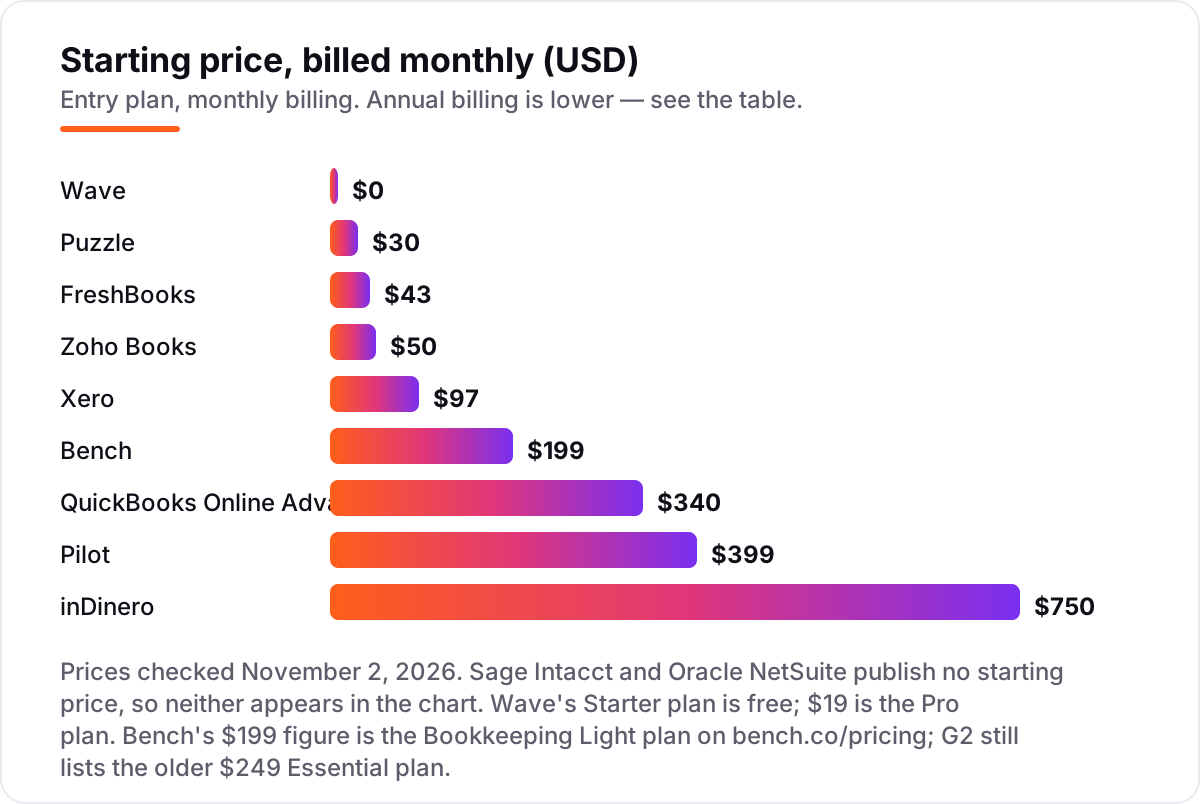
Take a SaaS company at $2M in annual revenue with a five-person finance team, one entity and mostly annual contracts. Xero Established costs $97 a month, or $1,164 a year, before add-ons. The same team on QuickBooks Online Advanced pays $340 a month, or $4,080 a year — $2,916 more — for 25 users, batch transactions and workflow automation. Puzzle Starter at $30 a month is $360 a year, and its Complete plan at $120 a month is $1,440 a year.
Now add the human layer. Pilot Core at $299 a month billed annually is $3,588 a year; paired with Xero Established, the combined stack is $4,752 a year with a US bookkeeper closing the books. inDinero Essential starts at $750 a month, or $9,000 a year, but bundles tax and fractional CFO work that Pilot charges separately for. At the top end, Sage Intacct and NetSuite are custom quotes, and third-party estimates put Intacct subscriptions around $15,000 a year and NetSuite around $999 a month before users — treat those as starting points for a quote, not prices. One more line to budget: card payment processing typically runs 2.9% plus $0.30 to $0.60 per transaction, which dwarfs the subscription itself once invoice volume grows. The pattern to remember: software is cheap, people are expensive, and implementation is the line most buyers forget.
Know the difference: SMB accounting vs ERP-grade systems for scaling SaaS
Small-business accounting tools — QuickBooks Online, Xero, Zoho Books, FreshBooks and Wave — are single-entity ledgers. They invoice, reconcile bank feeds, track expenses and produce a profit and loss statement, and they do it well for one company with straightforward contracts. What they do not do is consolidate multiple entities, enforce segregation of duties, or schedule revenue under ASC 606 without help.
ERP-grade systems — Sage Intacct and Oracle NetSuite — are built for the moment that stops being enough. They consolidate entities and currencies, recognise revenue across multi-element contracts, keep a full audit trail and let an auditor test controls instead of trusting a spreadsheet. The trade-off is a quote-only price, a three to six month implementation and a dedicated administrator.
Between the two camps sit the bridges: Puzzle gives a Stripe-native ledger with real revenue schedules at a startup price, while Pilot, Bench and inDinero sell the humans who close the books for you. The rule of thumb is simple — move off QuickBooks or Xero when you open a second entity, face an audit, or start billing usage on top of subscriptions, and read our SEO guide for SaaS companies for the growth side of the same decision. Our monthly SEO service covers that demand side once the finance stack is settled.
Quick comparison: tool type by need
| Buyer | Best pick | Why |
|---|---|---|
| SaaS team ready for an ERP | Sage Intacct | Multi-entity, ASC 606 and audit trails in one system |
| Scaling past $10M ARR | Oracle NetSuite | Full ERP with CRM, inventory and global consolidations |
| Best bridge off starter tools | QuickBooks Online Advanced | $340/month, 25 users, revenue schedules and automation |
| Best value for a small finance team | Xero | $97/month, unlimited users, multi-currency and projects |
| Cheapest Stripe-native ledger | Puzzle | $30/month, AI categorisation and burn-rate reporting |
| Done-for-you books for startups | Pilot | $299/month billed annually, US bookkeeper and accrual books |
How we chose
We checked each vendor's pricing page and public G2 reviews on November 2, 2026, cross-checking every figure against at least two independent sources that read the same vendor pages in late October 2026, because the vendor pages themselves were unreachable from our research environment that day. Sage Intacct and Oracle NetSuite publish no starting price, so both are listed as custom quotes, and the dollar estimates for them in this guide come from third-party research, not from a vendor price list. Bench's plan names and prices changed during 2026: its pricing page lists Bookkeeping Light from $199 a month, while G2 still shows the older Essential plan at $249, so we used the pricing-page figure. We ranked the tools by fit for the most common buyer — a SaaS company between $1M and $10M in annual revenue that needs revenue recognition, multi-entity books and audit-ready reports — not by brand size. No vendor paid for a place in this list, and none of the links here are affiliate links.
What to do next
Start with the decision above: if you have one entity and simple annual contracts, trial Xero Established or Puzzle for a month on your real Stripe data. If you already run two entities or need an audit trail your auditors will accept, book demos with Sage Intacct and NetSuite and ask each for a quote scoped to your user count, entities and revenue-recognition needs. If you publish a comparison page of your own shortlist, check how it will look in search with the free SERP snippet preview tool, and once the books are clean, our guide to the best SaaS link building service covers the growth work that follows. Once your tools are in place, find out what's holding your rankings back.
Your stack only works if people find you
SerpAstra fixes what keeps your site off page one and makes it easy for AI assistants to recommend.
Get a free audit→Sources we checked (21)
- Sage Intacct — sage.com (custom quote; no published price list, checked November 2, 2026)
- Sage Intacct on G2 — 4.3/5, 4,524 reviews (checked November 2, 2026)
- Oracle NetSuite — netsuite.com (custom quote; no published price list, checked November 2, 2026)
- Oracle NetSuite on G2 — 4.1/5, 5,234 reviews (checked November 2, 2026)
- QuickBooks Online pricing — quickbooks.intuit.com/pricing (checked November 2, 2026)
- QuickBooks Online Advanced on G2 — 4.4/5, 562 reviews (checked November 2, 2026)
- Xero pricing — xero.com/us/pricing (checked November 2, 2026)
- Xero on G2 — 4.4/5, 1,740 reviews (checked November 2, 2026)
- Puzzle pricing — puzzle.io/pricing (checked November 2, 2026)
- Pilot pricing — pilot.com/pricing (checked November 2, 2026)
- Pilot on G2 — 4.7/5, 143 reviews (checked November 2, 2026)
- inDinero pricing — indinero.com/pricing (checked November 2, 2026)
- inDinero on G2 — 4.0/5, 34 reviews (checked November 2, 2026)
- Zoho Books pricing — zoho.com/us/books/pricing (checked November 2, 2026)
- Zoho Books on G2 — 4.4/5, 329 reviews (checked November 2, 2026)
- FreshBooks pricing — freshbooks.com/pricing (checked November 2, 2026)
- FreshBooks on G2 — 4.5/5, 975 reviews (checked November 2, 2026)
- Bench pricing — bench.co/pricing (checked November 2, 2026)
- Bench by Employer.com on G2 — 4.2/5, 77 reviews (checked November 2, 2026)
- Wave pricing — waveapps.com/pricing (checked November 2, 2026)
- Wave on G2 — 4.3/5, 328 reviews (checked November 2, 2026)
Shamim
Founder of SerpAstra
A full-stack SEO and digital marketer who spends most days on Local SEO for dental practices, AI search visibility and lead generation.
Frequently asked questions
What is the best accounting software for a growth-stage SaaS company?
Sage Intacct is the best fit for most growth-stage SaaS teams because it handles multi-entity consolidation, ASC 606 revenue recognition and audit trails in one system. If you are not ready for an ERP, QuickBooks Online Advanced at $340 a month is the strongest bridge, and Xero Established at $97 a month is the best value.
How much does growth-stage SaaS accounting software cost?
Between $0 and $750 a month for the tools in this list, before implementation. Wave is free, Puzzle starts at $30 and Xero Established at $97 a month, while Sage Intacct and Oracle NetSuite are custom quotes. Implementation for the ERP-grade systems commonly costs as much as the first-year subscription, so budget for it separately.
Do I need revenue recognition software for my SaaS business?
Yes, once you sell annual contracts paid up front. Under ASC 606 you must recognise that revenue over the contract term, not when the cash arrives, and spreadsheets break as soon as contracts include upgrades, usage fees or bundles. Sage Intacct, NetSuite and QuickBooks Online Advanced have revenue schedules built in; Xero and Zoho Books need a connected app.
When should a SaaS company move from QuickBooks or Xero to an ERP?
Move when one of four triggers appears: a second legal entity, multi-currency consolidation, an audit that needs segregation of duties and a full audit trail, or usage-based and multi-element contracts your ledger cannot schedule. Most teams hit the first trigger between $5M and $10M in annual revenue, though complex billing can force the move earlier.
Is there free accounting software for SaaS startups?
Yes. Wave's Starter plan is a genuinely free double-entry ledger with unlimited invoicing, and Puzzle is free until $20,000 in monthly transaction volume. Zoho Books also has a free plan while annual revenue stays under $50,000. Free plans work before revenue starts; once annual contracts arrive, budget for a paid plan with revenue recognition.
What is the difference between Pilot, Bench and inDinero?
All three are services, not software. Pilot puts a US bookkeeper on accrual books from $299 a month billed annually. Bench is the cheapest human bookkeeping, from $199 a month, but has no tax filing on the entry plan. inDinero is the fullest service at $750 a month, bundling bookkeeping, tax and fractional CFO work under one engagement.
Can QuickBooks Online Advanced handle ASC 606 revenue recognition?
Partly. QuickBooks Online Advanced has built-in revenue recognition with straight-line schedules, which covers simple annual SaaS contracts paid up front. It does not handle usage-based pricing, multi-element arrangements or complex allocations the way Sage Intacct or NetSuite do, so companies with those contract types still need an ERP-grade system.
Free SEO and AI visibility audit
Find out what is holding your rankings back
Send us your site. Within 2 business days you get a written audit, an AI visibility check and a short fix list ranked by impact. Free, with no contract attached.
Request my free audit→Related guides
 SEO & AI Search8 Best SEO Platforms for Finance in 2026 (Pros, Cons and Pricing)8 best SEO platform for finance options compared on price, YMYL content tools, branch tracking and AI visibility. All prices checked November 1, 2026.Read guide →
 AI SearchSEO for SaaS: how to win 'best tool for' searchesSEO for SaaS: how to win best tool for searches with comparison, alternatives, integration and pricing pages — plus AI search, tracking and measurement.Read guide →
 SEO & AI Search10 Best SAAS Link Building Services in 202610 best SaaS link building services compared on price, model and white-hat method, with prices checked November 1, 2026 — from $75 a post to $8,000 a month.Read guide →