
8 Best Insurance Analytics Software in 2026, Compared
The 8 best insurance analytics software tools for carriers in 2026, compared on price, AI features and data depth — every price checked November 2, 2026.
 Shamim Mia, Founder, SerpAstraLast verified November 2, 202612 min read
We compare pricing pages, documentation and public reviews. We never accept payment for rankings.

Key takeaways
- Guidewire Predict, Duck Creek and Earnix lead for most carriers — all three sell on custom annual quotes, and none of the eight tools here publishes a starting price.
- Shift Technology and FRISS are the fraud specialists: Shift reports property insurers stop $60,000 in fraud for every 1,000 claims analyzed.
- The single most important buying factor is the data behind the model: Verisk's ClaimSearch holds 1.9 billion claims, and no general BI tool can match that coverage.
- Every price below was checked on the vendor's own site on November 2, 2026. All eight tools are custom quote, so budget for an annual contract plus implementation.
On this page
Quick comparison
| Tool | Best for | Starting price | Free plan |
|---|---|---|---|
| Guidewire | P&C carriers on Guidewire (or moving to it) who want predictive scores inside underwriting and claims | Custom quote | No (demo only) |
| Duck Creek | P&C carriers modernizing policy, billing and claims who want analytics embedded across the whole lifecycle | Custom quote | No (demo only) |
| Earnix | Pricing and actuarial teams at P&C and life carriers who need to move rates from spreadsheet to production fast | Custom quote | No (demo only) |
| Shift Technology | P&C carriers and SIU teams fighting claims fraud, premium leakage and missed subrogation | Custom quote | No (demo only) |
| Gradient AI | Group health and workers' comp insurers pricing renewals and new business on member-level risk | Custom quote | No (demo only) |
| FRISS | P&C insurers who want fraud scoring at both underwriting and claims, backed by industry claims data | Custom quote | No (demo only) |
| Akur8 | Actuarial teams at P&C insurers who build pricing models in-house and need them production-ready | Custom quote | No (demo only) |
| Verisk | P&C carriers and SIU teams who need industry-wide prior-loss data to score claims for fraud | Custom quote | No (demo only) |
Make one of these tools?
We re-check this list every quarter. Send a correction, request a review, or ask about a clearly labeled sponsored spot.
Request a listingThe best insurance analytics software

Guidewire
Best for: P&C carriers on Guidewire (or moving to it) who want predictive scores inside underwriting and claims
Guidewire Predict is the analytics layer of the P&C core platform most large carriers already run. It builds predictive models — neural networks, decision trees, GLM and GAM — or imports models your team built in R or Python, then deploys them through an API into underwriting and claims. Scores arrive where the work happens, so underwriters see the risk signal on the application, not in a separate report.
The platform also watches its own models, running health checks and flagging data and feature drift in real time, and HazardHub adds more than 1,000 property risk factors for any address. The catch is the ecosystem: Predict is priced as part of a Guidewire deal, so carriers outside the platform get less from it, and there is no published price or trial — buying starts with a demo.
What we like
- Models deploy into PolicyCenter and ClaimCenter with codeless configuration, so scores reach underwriters without a separate workflow
- Builds models with neural networks, decision trees and GLM/GAM, or imports ready-made models from R and Python
- Real-time health checks and drift detection keep models honest as conditions change
- HazardHub adds over 1,000 property risk factors for any address
Watch out for
- No published price — enterprise quote only, with implementation scoped per carrier
- Built for the Guidewire ecosystem, so standalone value is limited outside it
- No free plan or self-serve trial; evaluation runs through a demo and scoping call

Duck Creek
Best for: P&C carriers modernizing policy, billing and claims who want analytics embedded across the whole lifecycle
Duck Creek is a full core suite — policy, billing, rating, claims — with analytics and Agentic AI embedded in the workflows rather than bolted on as reporting. Its Intelligent Core triggers actions inside live transactions, and its Clear Box approach pairs neural learning with symbolic logic so every automated decision leaves a traceable, defensible trail for regulators. Configuration is low-code, and open APIs bring in outside data.
That breadth is also the commitment: Duck Creek is a suite-scale purchase, and replacing a core system is a multi-quarter project with licensing, implementation and maintenance as separate costs. There is no published price and no trial. Buy it when you are modernizing the core and want the analytics to live inside it; buy a specialist when you only need one job done.
What we like
- Analytics and Agentic AI run inside policy, billing and claims workflows instead of a separate reporting tool
- Clear Box neuro-symbolic AI gives a traceable decision trail for regulators, with human-in-the-loop controls
- Cloud-native SaaS with low-code configuration and open APIs for outside data
Watch out for
- No published price — quote only, with licensing, implementation and maintenance as separate line items
- A suite-scale purchase; overkill if you only need an analytics layer
- Replacing a core system is a multi-quarter project, not a quick install

Earnix
Best for: Pricing and actuarial teams at P&C and life carriers who need to move rates from spreadsheet to production fast
Earnix Price-It is built for one job: getting rates out of spreadsheets and into production. Pricing teams build models with data science and AI, simulate strategies against demand and revenue goals, and deploy rates in real time, with governed workflows and a full audit trail behind every change. The Filing Accelerator and ISO Electronic Rating Content integration cut the manual work of regulatory filings, and a Guidewire accelerator plugs it into Guidewire cores.
Earnix also sells a Copilot agent for decision support and an Elevate Data module that prepares insurer data for modeling. The trade-off is focus and price: this is a premium, enterprise product sold on custom quote, with no published price and no self-serve trial. Smaller carriers will find the sales process heavy, but pricing teams at large carriers get a platform built around their exact workflow.
What we like
- Rates deploy in real time and can be monitored against demand and revenue goals as they run
- One platform covers pricing, rating, personalization and governed deployment
- Filing Accelerator and ISO ERC integration cut the manual work of rate filings
Watch out for
- No published price — enterprise quote only
- Premium-priced and enterprise-focused, so the sales process is heavy for smaller carriers
- No self-serve trial; evaluation runs through a demo

Shift Technology
Best for: P&C carriers and SIU teams fighting claims fraud, premium leakage and missed subrogation
Shift Technology applies AI across the whole policy lifecycle, from application fraud to claims fraud, document checks, network detection, subrogation and liability. Its models score claims and applications in real time and explain each alert, so investigators get evidence they can act on rather than a bare number. Shift's own analysis of millions of claims puts the payoff at $60,000 stopped per 1,000 property claims analyzed, and $43,000 per 1,000 auto claims.
Subrogation detection is the quiet earner: Shift's research says insurers can recoup up to 7% more of a claim's value. The limits are scope and price. Shift is a fraud tool, not a pricing or reserving platform, and it is sold on custom quote scaled by claim volume and lines. It also needs your claims history to perform — thin data means weaker scores in the first months.
What we like
- Scores claims and applications in real time, with network detection that finds organized fraud rings
- Every alert explains its reasoning, so investigators get evidence, not just a score
- Subrogation detection can recoup up to an additional 7% of a claim's value, per Shift's research
Watch out for
- No published price — quote only, scaled by volume and lines of business
- Fraud-focused: it does not build pricing models or handle reserving
- Needs your claims history to perform; thin data means weaker scores at first

Gradient AI
Best for: Group health and workers' comp insurers pricing renewals and new business on member-level risk
Gradient AI serves two lines — group health and workers' compensation — and it serves them deeply. Its SAIL suite prices new group health business, while Renewal Analytics turns claims experience into 12-month risk forecasts at portfolio, group and member level, then connects them to renewal pricing through a built-in rate calculator. IBNR adjustments, peer benchmarking and a group termination model add context that raw claims history misses.
The data edge is freshness: Gradient AI refreshes third-party data every two weeks, against a typical claims lag of two to three months. In its own customer survey, 90% of insurers said they plan to increase AI investment. The limits are scope and price — no P&C lines, no published price, no trial. Group health and workers' comp carriers get a specialist; everyone else should look at the P&C tools above.
What we like
- Member-level risk scores and 12-month projections feed straight into renewal pricing with a built-in rate calculator
- IBNR adjustments, peer benchmarking and a group termination model add context beyond raw claims
- Third-party data refreshes every two weeks, versus the typical 2–3 month claims lag
Watch out for
- No published price — quote only
- Group health and workers' comp only; no personal or commercial P&C lines
- No free plan or trial; evaluation runs through a demo

FRISS
Best for: P&C insurers who want fraud scoring at both underwriting and claims, backed by industry claims data
FRISS scores fraud risk from the first quote through the final claim investigation, covering underwriting, claims and investigations in one platform. Its models combine business rules, AI scoring, text mining and network analysis to link related parties across policies, and it now integrates Verisk's ClaimSearch data in real time — the world's largest P&C claims database, with more than 1.7 billion claims — so prior-loss history feeds every score.
The fraud context is large: FRISS cites US insurance fraud at $309 billion a year in higher premiums and costs, with the FBI estimating P&C fraud alone at around $40 billion. The catch is scope and price. FRISS is a fraud specialist, not a pricing or reserving tool, and pricing is available only on request. There is no free plan or trial, so evaluation runs through a demo.
What we like
- Scores risk at application and at claim, so fraud is caught before the policy is bound and before it is paid
- Network analysis and text mining link related parties across policies and claims
- Real-time ClaimSearch integration adds industry prior-loss history to every score
Watch out for
- No published price — pricing available only on request
- Fraud-focused scope: no pricing models or reserving analytics
- No free plan or trial; evaluation runs through a demo

Akur8
Best for: Actuarial teams at P&C insurers who build pricing models in-house and need them production-ready
Akur8 is built for actuaries. Its Transparent AI automates the generation of production-ready GAM and GLM pricing models, covering data preparation, modeling, validation and regulatory exhibits in one collaborative workflow. The transparency is the point: every model can be explained to management and regulators, which is why it has caught on with pricing teams — more than 1,300 actuaries use it daily across 120-plus customers in 40-plus countries.
The proof point is Georgia Farm Bureau, where a five-person actuarial team cut a three-year territorial rating overhaul down by a full year. The limits are scope and price. Akur8 prices risk; it does not score claims or detect fraud, and it is sold on custom quote with no trial. It also assumes actuarial skill in-house — it accelerates actuaries rather than replacing them.
What we like
- Automates production-ready GAM/GLMs with full transparency, so models can be defended to management and regulators
- Collaborative workflow covers data prep, modeling, validation and regulatory exhibits in one place
- Works for small teams: 120+ customers in 40+ countries, with 1,300+ actuaries using it daily
Watch out for
- No published price — quote only
- Pricing-only scope: no claims, fraud or reserving analytics in the core product
- Needs actuarial skill in-house; it accelerates actuaries rather than replacing them

Verisk
Best for: P&C carriers and SIU teams who need industry-wide prior-loss data to score claims for fraud
Verisk is the data backbone of US P&C insurance. ClaimSearch holds 1.9 billion claims from more than 95% of the industry, with 175,000 new claims added daily, and its scoring models turn that history into claim scores with reason codes at first notice of loss. Essentials bundles scoring, a research hub, digital media forensics and compliance reporting under one contract, while Complete adds provider scoring, network analysis and coverage identification.
No other tool in this list can match the coverage: a prior-loss check against the whole industry catches repeat claims that your own data never would. The limits are focus and price. ClaimSearch is a claims and fraud platform, not a pricing or underwriting tool, its data is US-centric, and it is sold on custom annual quote with no published price or trial.
What we like
- Access to 1.9 billion claims, with 175,000 new claims added daily, for prior-loss checks at first notice of loss
- Claim scoring gives reason codes with every score, plus digital media forensics for doctored photos
- Two tiers (Essentials and Complete) let carriers start with the basics and expand
Watch out for
- No published price — quote only, sold as an annual contract
- Claims-focused: no pricing models or underwriting analytics
- Data is US-centric; international carriers get less coverage
This guide compares the best insurance analytics software for carriers that need more than dashboards: tools that score risk, detect fraud, and price policies from real insurance data. The eight tools below are ranked for the most common buyer — a P&C carrier or insurer that needs analytics inside live underwriting and claims work — with every vendor's pricing checked on its own site on November 2, 2026.
How to choose the best insurance analytics software
- Start with the job, not the vendor. Pricing, fraud detection, reserving and reporting are different jobs. Guidewire Predict and Earnix price risk, Shift and FRISS fight fraud, and Verisk supplies the claims data they all draw on. Pick the job first and the shortlist writes itself.
- Check the data behind the model. A model is only as good as its training data. Verisk's 1.9 billion claims and Guidewire's HazardHub risk factors are the kind of coverage a general tool cannot match, so ask each vendor what data its scores actually rest on.
- Ask where the score lands. A score that lives in a report gets ignored; a score inside the underwriting or claims workflow gets used. That is the real difference between Guidewire Predict, Duck Creek and a standalone model that nobody opens.
- Plan for the implementation, not just the license. These are annual contracts with implementation, data onboarding and training as separate costs, and core-system analytics take months to wire into live workflows.
- Test with your own data. Every vendor here sells through a demo, so bring a sample of your own claims and policies and compare the scores before you sign. AI features are table stakes now — see how AI tools are changing search in our best AI SEO tools for 2026 guide.
If you publish pages explaining your analytics stack, run the titles through the free SERP snippet preview tool so they read well in search results.

Insurance analytics software pricing: what you will actually pay
None of the eight vendors publishes a starting price. Every one sells on a custom annual quote, and the quote scales with lines of business, policy and claim volume, the modules you buy, and the data you need. Implementation, data onboarding and training are usually separate line items, and the contract is annual. That is the honest answer to what it costs: it depends on your book, and you will not know until you get a quote.
You can still model the return before you buy. Shift Technology publishes that property insurers stop an incremental $60,000 in fraud for every 1,000 claims analyzed with AI fraud detection, and auto insurers stop $43,000 per 1,000. Take a property insurer analyzing 20,000 claims a year: 20 times $60,000 is $1.2 million in stopped fraud a year, before the vendor's fee. The same 20,000 auto claims would be 20 times $43,000, or $860,000. Those are Shift's published figures from its own analysis of millions of claims — useful for sizing the prize, not a guarantee, and the subscription itself is quoted separately.
Two more things to budget for. First, the quote is only the start: ask each vendor to break it into annual license, implementation, data onboarding and support, then compare the totals over three years. Second, third-party directories list prices for these tools — Capterra shows a $1 placeholder for FRISS, and SelectHub puts Duck Creek at $1,000 or more a month — but none of those numbers comes from the vendor, so we do not repeat them as prices. Finance teams face the same quote-only pattern elsewhere — see our best SEO platform for finance guide. Insly's own pricing page is the clearest example of the pattern: its MGA and Insurer tiers both say "Get a tailored quote".
Insurance analytics vs. general BI vs. actuarial workbenches: know the difference
Three kinds of tool get confused here. Insurance analytics software is built on insurance data and insurance decisions: it scores risk, flags fraud, and builds rates from claims history, rating content and third-party data. General BI tools such as Tableau or Power BI visualize whatever data you feed them, but they do not score a claim or price a policy — they show you the loss ratio after the fact. Actuarial workbenches, including spreadsheets and open-source GLM tools, build the models, but they do not operationalize them: the model stays a file until someone wires it into underwriting.
Akur8 sits between the last two: it builds production-ready pricing models, but it still needs a core system or a rating engine to run them. Guidewire Predict and Earnix close the loop by deploying models into live workflows. If you already pay for a BI tool, keep it for reporting — but do not expect it to catch a fraud ring or reprice a book. And if your actuaries still build rates in spreadsheets, the bottleneck is not the math, it is the deployment.
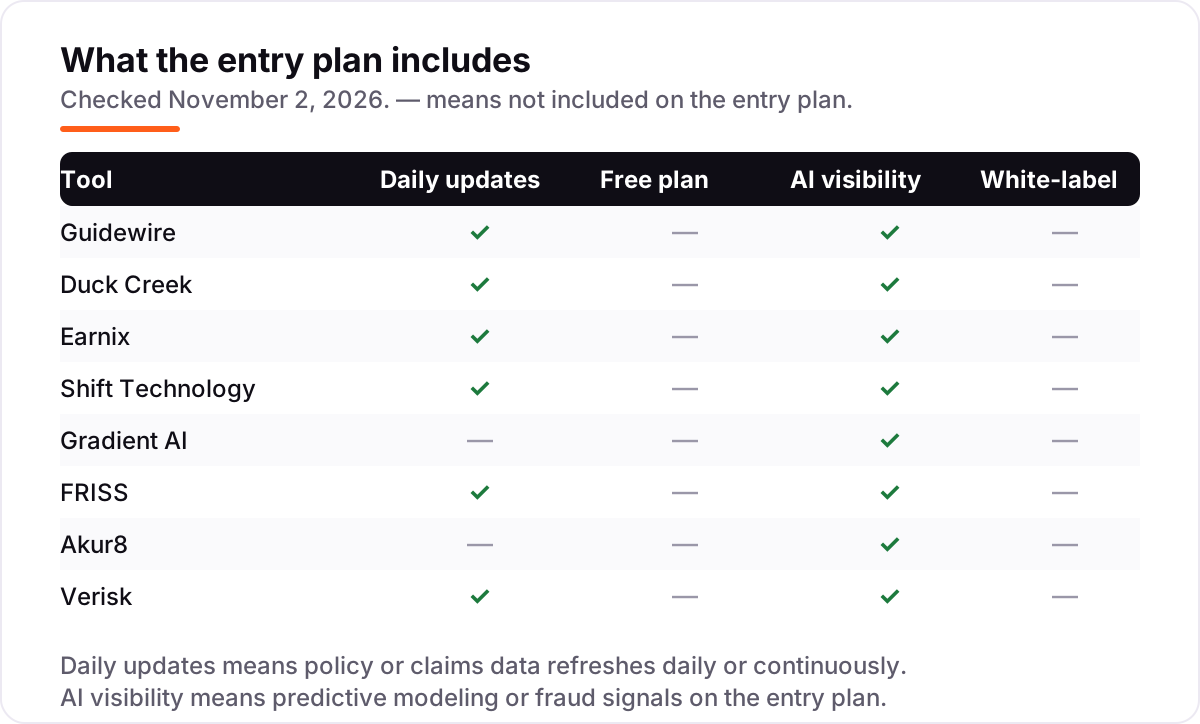
Quick comparison: tool type by need
| Buyer | Best pick | Why |
|---|---|---|
| P&C carrier on (or moving to) a modern core | Guidewire Predict | Predictive scores inside underwriting and claims, no separate workflow |
| Carrier modernizing policy, billing and claims | Duck Creek | Analytics embedded across the whole lifecycle on one cloud platform |
| Pricing or actuarial team rebuilding rates | Earnix or Akur8 | Real-time rate deployment (Earnix) or transparent GLMs (Akur8) |
| SIU team fighting claims fraud | Shift Technology or FRISS | Fraud scoring with explained alerts and network detection |
| Group health or workers' comp insurer | Gradient AI | Member-level risk scores tied to renewal pricing |
| Carrier that needs industry claims data | Verisk | 1.9 billion claims of prior-loss history for fraud scoring |
Mistakes to avoid
- Comparing directory prices. Capterra lists a $1 placeholder for FRISS and SelectHub puts Duck Creek at $1,000 or more a month. Neither number comes from the vendor, so neither belongs in your budget.
- Buying the model and skipping the data work. Fraud and pricing models are only as good as the claims and policy data behind them. Budget time to clean and connect your data before the vendor's team arrives.
- Letting the score live in a report. A model that nobody opens changes nothing. Insist on a demo that shows the score inside the underwriting or claims screen your team actually uses.
- Signing before you see the full quote. License, implementation, data onboarding and support are usually separate lines. Get the three-year total in writing before you commit.
- Forgetting the regulator. Predictive models and fraud scores get questioned by regulators. Ask how the vendor documents its models — Duck Creek's Clear Box trail and Akur8's transparent models exist for exactly this reason.
How we chose
We checked each vendor's own site on November 2, 2026 and recorded the starting price exactly as published — in this category, that means recording that no vendor publishes one. We opened product and pricing pages for all eight tools, plus Insly's pricing page, and found "Get a tailored quote" or no pricing page at all in every case. We ranked the tools by fit for the most common buyer, a P&C carrier that needs analytics inside underwriting and claims, not by brand size. No ratings appear in this list: the G2 and Capterra pages for these enterprise tools could not be opened for verification on November 2, 2026, so we left every rating out rather than repeating second-hand scores. No vendor paid for a place in this list, and none of the links here are affiliate links.
What to do next
Shortlist two vendors from the table above and book a demo with each, using the same sample of your own claims data so the scores are comparable. Enterprise buyers weighing big annual contracts face the same quote-only pattern in other software — see our best enterprise SEO tools guide for how we compare those. While the demos run, check that the product pages explaining your offering are easy to find — our SEO audit shows where your site stands. Once your tools are in place, find out what's holding your rankings back.
Your stack only works if people find you
SerpAstra fixes what keeps your site off page one and makes it easy for AI assistants to recommend.
Get a free audit→Sources we checked (9)
- Guidewire Predict product page — guidewire.com/en/products/analytics/predict (checked November 2, 2026)
- Duck Creek Suite — duckcreek.com/product/duck-creek-suite/ (checked November 2, 2026)
- Earnix Price-It — earnix.com/our-solutions/products/pricing/ (checked November 2, 2026)
- Shift Technology: The role of AI in insurance — shift-technology.com (checked November 2, 2026)
- Gradient AI customer survey — gradientai.com (checked November 2, 2026)
- FRISS and Verisk partnership — friss.com/blog/how-verisk-partners-with-friss (checked November 2, 2026)
- Akur8: Georgia Farm Bureau case study — akur8.com (checked November 2, 2026)
- Verisk ClaimSearch Essentials — verisk.com/products/claimsearch/claimsearch-essentials/ (checked November 2, 2026)
- Insly pricing — insly.com/pricing/ (checked November 2, 2026)
Shamim
Founder of SerpAstra
A full-stack SEO and digital marketer who spends most days on Local SEO for dental practices, AI search visibility and lead generation.
Frequently asked questions
What is the best insurance analytics software in 2026?
Guidewire Predict is the best fit for most P&C carriers, because its models deploy straight into underwriting and claims workflows. Duck Creek is the better pick when you are replacing the core system too, and Earnix leads for pricing teams. Fraud-focused buyers should start with Shift Technology or FRISS instead.
How much does insurance analytics software cost?
None of the eight vendors publishes a price — all sell on custom annual quotes, so there is no starting figure to compare. Expect the quote to scale with lines of business, policy and claim volume, and the modules you buy, with implementation and data onboarding as separate line items. Get at least two quotes before budgeting.
Is there a free insurance analytics software?
No. None of the eight tools in this list offers a free plan or a free trial; evaluation runs through a demo and a scoping call. If you only need dashboards, a general BI tool can visualize your own data, but it will not score risk, detect fraud, or build pricing models.
What is the difference between insurance analytics software and BI tools?
BI tools visualize data you already have. Insurance analytics tools score risk, detect fraud, and build pricing models on insurance-specific data such as claims history and rating content. A BI dashboard can show your loss ratio; only an insurance analytics tool can tell you which claims to investigate or which risks to reprice.
Do I need insurance analytics software if I already run Guidewire or Duck Creek?
The core system stores your policies and claims, but the analytics layer turns that data into decisions. Guidewire Predict and Duck Creek's analytics add-ons sit on top of the core and push scores into underwriting and claims. If you run either core, start with its own analytics before buying a separate tool.
How long does it take to implement insurance analytics software?
Weeks for a focused fraud or pricing module, months for a platform. Shift Technology reports that French insurer L'olivier deployed its fraud detection in under five months. Core-system analytics such as Guidewire Predict or Duck Creek take longer, because the models must be wired into live underwriting and claims workflows.
What data do these tools need to work?
Your own policy and claims history first — thin data means weak scores. Most tools then enrich it with third-party data: Verisk contributes industry claims history, Guidewire adds HazardHub property risk factors, and FRISS pulls in device and network data. Ask each vendor what data it needs before you sign, not after.
Free SEO and AI visibility audit
Find out what is holding your rankings back
Send us your site. Within 2 business days you get a written audit, an AI visibility check and a short fix list ranked by impact. Free, with no contract attached.
Request my free audit→Related guides
 SEO & AI Search8 Best SEO Platforms for Finance in 2026 (Pros, Cons and Pricing)8 best SEO platform for finance options compared on price, YMYL content tools, branch tracking and AI visibility. All prices checked November 1, 2026.Read guide →
 AI SearchBest AI SEO tools in 2026: honest picks by jobBest AI SEO tools in 2026, picked by job: Semrush and Ahrefs for research, Surfer and Clearscope for content, Otterly for AI tracking, with 2026 prices.Read guide →
 SEO & AI Search8 Best Enterprise SEO Tools in 2026 (Free and Paid, Compared)8 best enterprise seo tools compared on price, scale and AI visibility, from $29/month suites to custom enterprise platforms. Prices checked November 1, 2026.Read guide →