
9 Best Keyword Difficulty Software in 2026, Compared
9 best keyword difficulty software tools compared on price, difficulty scores and data depth. Real prices checked November 1, 2026, sorted by use case.
 Shamim Mia, Founder, SerpAstraLast verified November 1, 202613 min read
We compare pricing pages, documentation and public reviews. We never accept payment for rankings.
Key takeaways
- Ahrefs is the best overall pick at $29/month, Semrush is the deepest suite at $139.95/month, and Mangools' KWFinder is the easiest dedicated difficulty tool at $37.70/month billed annually.
- The single most important buying factor is how the difficulty score is calculated — every vendor's 0–100 scale measures something different.
- Free options exist — Ahrefs Free, Semrush's free account and Mangools' free plan all show difficulty scores — but real keyword research starts around $24–$49/month.
- Every price below was checked on the vendor's own pricing page on November 1, 2026. Ratings are G2, except KeySearch, which has no G2 or Capterra rating.
- Difficulty scores are estimates, not promises: a low score on a keyword with no search volume still brings no traffic.
On this page
Quick comparison
| Tool | Best for | Starting price | Free plan |
|---|---|---|---|
| Ahrefs | In-house SEOs and small agencies that want the most trusted keyword difficulty score, backed by the largest backlink index | $29/mo | Yes (no Rank Tracker) |
| Semrush | Small teams and agencies that want difficulty scores plus keyword research, audits, backlinks and PPC in one subscription | $117.33/mo (annual) | Yes (10 keywords) |
| Mangools | Bloggers and niche-site owners who want a clear 0–100 difficulty score and local data without suite pricing | $37.70/mo (annual) | Yes (free lifetime) |
| Moz Pro | Small in-house teams that want Domain Authority metrics and a plain 0–100 difficulty score in one beginner-friendly suite | $49/mo | Yes (free account) |
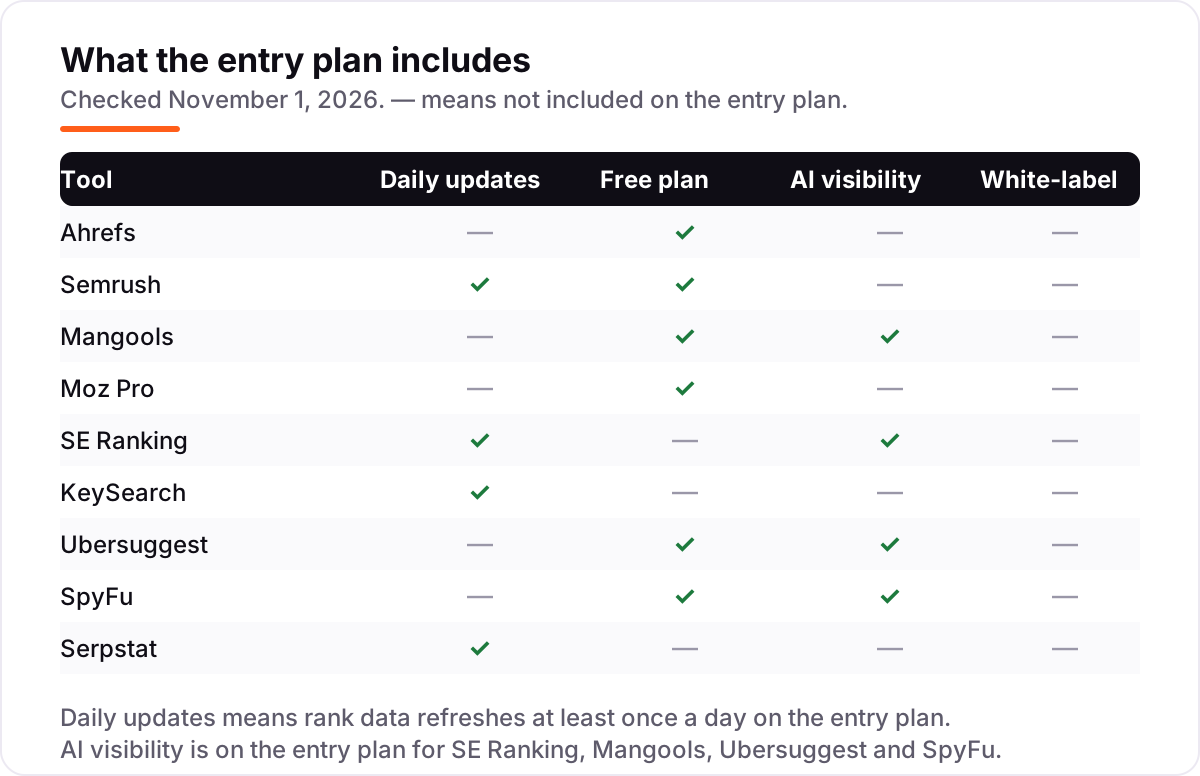
| SE Ranking | Small agencies and in-house teams that want difficulty scores plus rank tracking, audits and AI visibility for about $103/month | $103.20/mo (annual) | No (14-day trial) |
| KeySearch | Bloggers and niche-site builders who want honest difficulty scores and live SERP analysis for $24/month | $24/mo | No (1st month free) |
| Ubersuggest | Solo site owners who want simple difficulty scores, audits and rank tracking in one low-cost dashboard | $29/mo | Yes (3 searches/day) |
| SpyFu | Small teams that judge difficulty by what competitors already rank for, and want PPC data in the same login | $29/mo (annual) | Yes (free searches) |
| Serpstat | Freelancers and small teams that want difficulty scores inside a budget all-in-one with generous daily search limits | $50/mo (annual) | No (7-day trial) |
Make one of these tools?
We re-check this list every quarter. Send a correction, request a review, or ask about a clearly labeled sponsored spot.
Request a listingThe best keyword difficulty software

Ahrefs
Best for: In-house SEOs and small agencies that want the most trusted keyword difficulty score, backed by the largest backlink index
Ahrefs sets the standard other difficulty scores are judged against. Its Keyword Difficulty score runs 0 to 100 and is built from the referring domains of the pages already ranking in the top 10, which makes it a direct read on how much link building a keyword will take. The $29 Starter plan is the cheapest way into this list, and it opens Keywords Explorer, Site Explorer and Site Audit alongside the difficulty score.
The limits are real. Starter tracks only 50 keywords and Rank Tracker updates weekly, not daily, and report credits cap how much research you can do each month. There is no free trial. Buy Ahrefs when you want the most trusted difficulty number and the backlink data behind it; if you need daily tracking, look at SE Ranking or KeySearch instead.
What we like
- Keyword Difficulty 0–100 is built from the referring domains of the top-10 pages — a direct read on the links a keyword needs
- Keywords Explorer draws on a 110-billion-keyword database, with Traffic Potential and parent-topic data on every keyword
- Site Explorer and Site Audit come in the same plan, so difficulty scores sit next to the backlink data behind them
Watch out for
- Starter tracks only 50 keywords and Rank Tracker updates weekly — serious tracking starts at Lite ($129/month)
- No free trial, and metered report credits on Starter and Lite cap how much research you can do each month

Semrush
Best for: Small teams and agencies that want difficulty scores plus keyword research, audits, backlinks and PPC in one subscription
Semrush pairs its Keyword Difficulty percentage with the largest keyword database here, which Semrush puts at more than 27 billion keywords. The entry SEO plan tracks 500 keywords daily and bundles the Keyword Magic Tool with site audits, backlink analysis and PPC research, so the difficulty score sits inside a full research workflow rather than on its own. A Personal Keyword Difficulty score adjusts the number for your own domain's strength.
It is the priciest way into this list, and the extras add up: additional users start at $45 a month and white-label reports are paid add-ons. The AI visibility toolkit starts on the $199 a month Starter plan, not the SEO plan. Buy Semrush when you need research depth and difficulty in one subscription; for difficulty alone, the cheaper dedicated tools give you the same headline number.
What we like
- Keyword Difficulty % plus a Personal Keyword Difficulty score that adjusts the number for your own domain's strength
- Keyword Magic Tool draws on a 27-billion-plus keyword database, with intent, questions and SERP-feature data on every term
- Bundles difficulty with site audits, backlink analysis and PPC research in one login
Watch out for
- Highest entry price among the full suites here, and extra users start at $45/month with white-label reports as paid add-ons
- The AI visibility toolkit starts on the $199/month Starter plan, not the entry SEO plan

Mangools
Best for: Bloggers and niche-site owners who want a clear 0–100 difficulty score and local data without suite pricing
KWFinder is the reason Mangools is on this list: a single 0 to 100 difficulty score, colour-coded easy to hard, shown beside the live top-10 results. You see the score and the pages you would have to beat in the same view, which is exactly the decision a difficulty tool should make easy. The Basic plan costs $37.70 a month billed annually, and every plan has the same features — only the limits change.
The trade-off is update speed and depth. Rank updates are weekly on Basic and Premium, and daily updates need Agency, and there is no site crawler, so technical issues are out of scope. Backlink data is basic next to Ahrefs. Buy Mangools when you want the clearest difficulty reading for the least money; buy a suite when you need daily tracking or deep link data.
What we like
- KWFinder shows one colour-coded 0–100 difficulty score beside the live top-10 results for the keyword
- Five tools plus AI Search Watcher PRO in every plan — Basic has the same features as Agency, only limits differ
- Permanent free plan and a 10-day Free+ trial with elevated limits
Watch out for
- Rank updates are weekly on Basic and Premium — daily updates only on Agency
- Backlink data is basic next to Ahrefs — 100,000 backlink rows a month on Basic and no link index of its own

Moz Pro
Best for: Small in-house teams that want Domain Authority metrics and a plain 0–100 difficulty score in one beginner-friendly suite
Moz Pro is the friendliest suite in this list, and its Keyword Difficulty score is the one clients already understand: a 0 to 100 number built from the Page Authority and Domain Authority of the top-10 results. The $49 Starter plan includes Keyword Explorer, Link Explorer and a site audit, which is a lot of tool for a team that is still learning SEO — and the difficulty score is available from this entry plan, unlike rank tracking.
The catch is what Starter does not include. There is no Rank Checker, so rank tracking starts at Standard ($99 a month, $79 billed annually), and tracking updates weekly there. The link index is smaller than Ahrefs or Semrush. Buy Moz for the metrics and the learning curve; buy a dedicated tracker if daily positions are the job.
What we like
- Keyword Difficulty 0–100 is built from the Page Authority and Domain Authority of the top-10 results
- Domain Authority, Page Authority and Spam Score — the metrics clients already recognize — built into every plan
- Rated the easiest full SEO suite to learn, with extensive training resources for newer SEOs
Watch out for
- The $49/month Starter plan has no Rank Checker, so rank tracking starts at Standard ($99/month)
- The link index is smaller than Ahrefs or Semrush, and rank tracking updates weekly on Standard

SE Ranking
Best for: Small agencies and in-house teams that want difficulty scores plus rank tracking, audits and AI visibility for about $103/month
SE Ranking is the value pick in this list because the entry Core plan does not feel like an entry plan: 2,000 keywords tracked daily, 10 projects, a 250,000-page site audit allowance and AI visibility tracking across five engines. Keyword Difficulty scores sit next to search volume, CPC and competition data in the same research view, so you can sort a whole keyword list by difficulty in one pass.
The trade-off is polish. Reviewers like the depth but some report small accuracy differences against the bigger suites, and the interface takes a few days to learn. White-label reporting needs the $69 a month Agency Pack add-on. If you want the cheapest route to difficulty scores inside a full suite, start here; if you need the largest backlink index, look at Semrush or Ahrefs instead.
What we like
- Keyword Difficulty scores sit next to volume, CPC and competition data, so a whole list can be sorted by difficulty in one pass
- 2,000 keywords tracked daily plus site audit and AI visibility in the same $103.20/month plan
- Unlimited keyword, competitor and backlink research on Core, with a backlink gap check against competitors
Watch out for
- White-label reports need the $69/month Agency Pack add-on — not included on Core
- Some G2 reviewers report minor discrepancies in rank data and search-volume estimates

KeySearch
Best for: Bloggers and niche-site builders who want honest difficulty scores and live SERP analysis for $24/month
KeySearch is the cheapest real difficulty tool in this list, and it is built for the buyer who pays for SEO out of a blog's earnings. The $24 Starter plan gives you 200 keyword searches a day, 80 tracked keywords and 2,000 audited pages a month, with a competition score for every keyword and a live SERP analysis showing the pages you would need to outrank.
The limits show at this price. The keyword database is smaller than the big suites, the daily search allowance runs out fast on bulk difficulty checks, and there is no G2 or Capterra rating to check against — the vendor's own site claims a 4.9-star rating across hundreds of reviews. Buy KeySearch when budget decides and your keyword lists are small; step up when you need deeper data.
What we like
- A competition score on every keyword, with live SERP analysis showing the pages you would need to outrank
- 200 keyword searches a day, 80 tracked keywords and 2,000 audited pages a month for $24/month
- YouTube keyword research and a content assistant are included in the same low price
Watch out for
- The keyword database is smaller than the big suites, and the 200-search daily allowance runs out fast on bulk difficulty checks
- No G2 or Capterra rating exists to check against — the vendor's own site claims a 4.9-star rating across hundreds of reviews

Ubersuggest
Best for: Solo site owners who want simple difficulty scores, audits and rank tracking in one low-cost dashboard
Ubersuggest is the simplest tool in this list, and that is the point. The Individual plan shows an SEO Difficulty score from 0 to 100 for every keyword, next to search volume, paid difficulty and content ideas, in a dashboard a beginner can learn in an afternoon. The free account never expires, with three searches a day, and a lifetime payment option exists for buyers who would rather pay once.
The data is the honest limitation. G2 reviewers praise the price and the ease of use but note that search volume and difficulty figures can be less accurate than the bigger suites, and rank tracking updates weekly on the lower plans. The plans page also runs frequent promotions, so the price you see may differ from the $29 list price. Buy it when simplicity and budget matter most.
What we like
- An SEO Difficulty score from 0 to 100 on every keyword, next to volume, paid difficulty and content ideas
- The free account never expires, and a lifetime payment option exists for buyers who would rather pay once
- AI Search Visibility is included from Individual, tracking brand prompts in ChatGPT
Watch out for
- G2 reviewers praise the price and ease of use but note search volume and difficulty figures can be less accurate than the bigger suites
- Rank tracking updates weekly on the lower plans, and the plans page runs frequent promotions so the price you see may vary

SpyFu
Best for: Small teams that judge difficulty by what competitors already rank for, and want PPC data in the same login
SpyFu judges difficulty from the competitor side: enter a rival domain and see the keywords it ranks for and the ads it has run. That history is the signal — a keyword a competitor has held for years with heavy ad spend is a harder target than a fresh one, and SpyFu shows you both. The Basic plan costs $39 a month with unlimited search results.
SpyFu is not a pure difficulty tool, and it shows. There is no single 0 to 100 difficulty score as clean as KWFinder's, keyword data takes a few more clicks to reach than in Ahrefs, and rank tracking updates weekly. White-label reports and API access start on Pro + AI. Buy SpyFu when competitor keywords decide your targets; buy a dedicated difficulty tool when you want one score per keyword.
What we like
- Shows every keyword a competitor ranks for, the ads it has run and how long each ranking has held
- Unlimited search results and 10,000-row data exports on the $39/month Basic plan
- Combines SEO and PPC keyword data in one dashboard, with 10+ years of history
Watch out for
- No single 0–100 difficulty score as clean as KWFinder's — keyword data takes a few more clicks to reach than in Ahrefs
- Rank tracking updates weekly, and white-label reports and API access start on Pro + AI

Serpstat
Best for: Freelancers and small teams that want difficulty scores inside a budget all-in-one with generous daily search limits
Serpstat is the budget all-in-one in this list: keyword research, rank tracking, site audit and backlink analysis for $69 a month billed monthly, or $50 a month billed annually. Its keyword difficulty score runs 0 to 100 from the authority of the top-10 domains, and the Individual plan allows 100 searches a day across 230 countries — generous limits for a freelancer or a small team.
Two honest caveats. The page loads with annual billing selected, so the $50 figure is the yearly rate and monthly billing costs $69. And AI visibility is not on Individual — it starts on Team, where the plan also adds the API and batch analysis. Buy Serpstat when you want a whole suite at a budget price; buy a dedicated tool when difficulty scores are the only job.
What we like
- Keyword difficulty score 0–100 from the authority of the top-10 domains, with keyword data from 230 countries
- 100 searches a day, 10,000 position checks a month and 30,000 audit pages on the Individual plan
- Daily rank updates and flexible tracking schedules on every plan
Watch out for
- The pricing page loads with annual billing selected — the $50 figure is the yearly rate, and monthly billing costs $69
- AI visibility is not on Individual — it starts on Team, where the plan also adds the API and batch analysis
What the best keyword difficulty software actually does
Picking keywords by search volume alone is how pages end up with no traffic. The best keyword difficulty software tells you the other half of the story: how hard a keyword will be to rank for, before you spend weeks writing for it. This guide compares nine tools on their difficulty scores, their prices and the data behind the numbers, organised by what you actually need — a free check, a dedicated difficulty tool, or a full suite that happens to score difficulty well.
A keyword difficulty tool scores a keyword, usually from 0 to 100, for how hard it will be to reach page one. The score is an estimate built from the pages already ranking: their backlinks, their domain strength and how much content competes for the same term. A low score means the current top 10 is weak enough for a new page to break in; a high score means you are up against established, well-linked pages.
The scores are not interchangeable. Ahrefs builds its 0–100 score from the referring domains of the top-10 pages, Moz builds its score from the Page Authority and Domain Authority of those pages, and Semrush blends domain authority with SERP features into a percentage. Same keyword, three methods, three different numbers — which is why this guide names the method for each tool instead of comparing scores head to head.
The reason the score matters is how little content ever gets seen. Ahrefs studied more than one billion pages and found that 90.63% of them get zero organic traffic from Google, and only 5.7% of newly published pages rank in the top 10 within a year. Most of that invisibility comes down to targeting keywords the site had no realistic chance of ranking for. Backlinks are the main reason a keyword is hard: our guide to how many backlinks you need to rank explains the link side of difficulty. That is also what our SEO audit starts with: the keywords you can actually win, before any content is planned.
Free and budget options first
If you are checking a handful of keywords for one site, you may not need to pay at all. Ahrefs Free shows difficulty scores for your own verified sites, Semrush's free account covers 10 tracked keywords, Mangools has a permanent free plan, and Ubersuggest's free account allows three searches a day. The free tiers are honest products, not demos — but they cap out fast, and the moment you research a full content plan, a paid plan is cheaper than the time you lose checking keywords one by one.
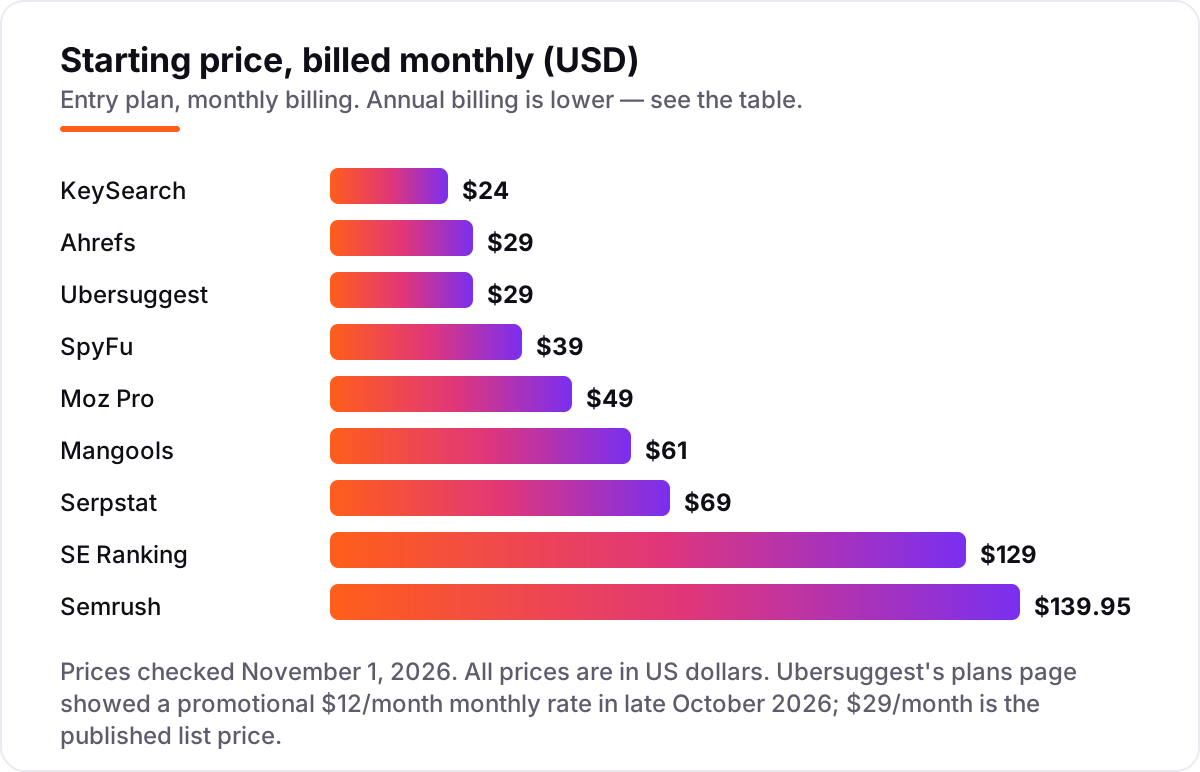
For a single small site, start with KeySearch at $24 a month or Ubersuggest at $29 a month. Both give you a real difficulty score and a live look at the results page for less than a takeaway lunch. For anything client-facing, skip the budget tier: the reporting and white-label features start on the paid plans of the bigger tools. If your keywords are local, start with our guide to keyword research for local businesses — local difficulty works differently from national keywords.
Dedicated difficulty tools vs all-in-one suites
The nine tools in this list split into two camps. The dedicated tools — Mangools' KWFinder and KeySearch — do keyword research first and everything else second. They are cheaper, faster to learn and built around one question: can I rank for this keyword? They are usually the right pick for bloggers and niche-site owners.
The suites — Ahrefs, Semrush, Moz Pro, SE Ranking, Serpstat, Ubersuggest and SpyFu — bundle difficulty scores with rank tracking, site audits, backlinks and content tools. You pay more, but you replace two or three subscriptions. The right camp depends on what you already pay for: if you own a suite, use its difficulty score; if you only need to pick keywords, a dedicated tool costs less.
Difficulty scores are not the same number
The biggest buyer confusion in this category is treating every 0 to 100 score as the same thing. It is not. A "30" from a backlink-based score means the top-10 pages have few referring domains; a "30" from an authority-blend score means the top-10 domains are moderately strong. The numbers look alike and mean different things, so a score from one tool cannot be compared with a score from another.
The practical fix is to pick one tool as your reference and learn its scale. Check the same ten keywords in your chosen tool, note which ones you already rank for and what their scores were, and you will have a calibrated sense of what "easy" means for your site. Switching tools mid-project resets that calibration. And always look at the actual results page: if the top 10 is full of forums, thin pages and outdated posts, the keyword is easier than any score suggests.
Quick comparison: tool type by need
| Buyer | Best pick | Why |
|---|---|---|
| New blogger on a tight budget | KeySearch | $24/month, live SERP analysis, honest difficulty scores |
| Best difficulty data overall | Ahrefs | Backlink-based KD 0–100 from $29/month |
| Deepest research suite | Semrush | 27-billion-keyword database plus KD% from $117.33/month billed annually |
| Easiest dedicated difficulty tool | Mangools | KWFinder's colour-coded 0–100 score from $37.70/month billed annually |
| Best value suite | SE Ranking | 2,000 keywords a day plus AI visibility from $103.20/month billed annually |
| Competitor-first research | SpyFu | Rival rankings and ad history from $29/month billed annually |
How to choose: a short decision path
- Start with your site's strength. New sites should target keywords under 30 on your chosen tool's scale; established sites can aim higher. If you do not know your strength, check your own rankings first.
- Pick one score and stick to it. Every vendor measures difficulty differently, so comparing scores across tools wastes time. Choose the tool, learn its scale, calibrate against keywords you already rank for.
- Decide dedicated tool or suite. If you only pick keywords, Mangools or KeySearch cost less. If you need audits, backlinks and tracking too, a suite is cheaper than the tools separately.
- Check the free tier first. Ahrefs Free, the Semrush free account and Mangools' free plan all show real difficulty scores. Run your real keyword list for a week before paying.
- Mind the billing. The annual price is usually 15–20% lower, a few tools have no annual option at all, and Serpstat and Ubersuggest load their pricing pages with the annual or promotional rate selected.
Before you write for the keywords you pick, run your draft through the free keyword density checker — it shows whether your target phrase actually appears often enough to rank.
Mistakes to avoid
- Comparing scores across tools. A 30 in Ahrefs is not a 30 in Moz. Pick one scale and calibrate it against your own rankings.
- Chasing volume and ignoring difficulty. A keyword with 10,000 searches a month and a difficulty of 90 brings less traffic than a keyword with 500 searches and a difficulty of 15.
- Trusting the score without looking at the SERP. If the top 10 is forums and thin pages, the keyword is easier than the number says; if it is brands and big publishers, it is harder.
- Paying for a suite when you only need difficulty scores. A $24–$49 difficulty tool beats a $129 suite you only open for one number.
- Forgetting the trial ends. Set a reminder for the day the trial converts, and check the numbers against how to track your Google ranking so you know what the tool should be showing.
How we chose
We checked each vendor's own pricing page on November 1, 2026 and recorded the starting price exactly as shown, including the annual-billing figure where the page lists one. Ratings come from G2, except KeySearch, which has no G2 or Capterra rating — so no rating is shown for it. We ranked the tools by fit for the most common buyer — a small team or site owner picking keywords they can realistically rank for — not by brand size. No vendor paid for a place in this list, and none of the links here are affiliate links. One note: Long Tail Pro, once a well-known difficulty tool, is no longer sold — its site went offline in 2026 — so it is not in this list.
What to do next
Start with the decision path above: judge your site's strength, pick one difficulty scale, and decide dedicated tool or suite. Then take the free plan or trial of your top pick and run your real keyword list through it for a week. If the easy keywords it surfaces match pages you could actually write, you have your tool. If you'd rather have this set up and read for you, request a free SEO + AI visibility audit and get a ranked fix list in 2 business days.
Rather not run the tools yourself?
Tools show you the data. SerpAstra turns it into higher rankings, more map-pack calls and citations in AI answers.
Get a free SEO + AI visibility audit→Sources we checked (18)
- Ahrefs pricing — ahrefs.com/pricing (checked November 1, 2026)
- Ahrefs on G2 — 4.5/5, 723 reviews (checked November 1, 2026)
- Ahrefs search-traffic study — 90.63% of pages get zero organic traffic from Google
- Semrush pricing — semrush.com/prices (checked November 1, 2026)
- Semrush on G2 — 4.4/5, 4,304 reviews (checked November 1, 2026)
- Mangools pricing — mangools.com/plans-and-pricing (checked November 1, 2026)
- Mangools on G2 — 4.7/5, 97 reviews (checked November 1, 2026)
- Moz Pro pricing — moz.com/products/pro/pricing (checked November 1, 2026)
- Moz Pro on G2 — 4.3/5, 608 reviews (checked November 1, 2026)
- SE Ranking pricing — seranking.com/subscription.html (checked November 1, 2026)
- SE Ranking on G2 — 4.7/5, 1,619 reviews (checked November 1, 2026)
- KeySearch pricing — keysearch.co (checked November 1, 2026)
- Ubersuggest pricing — app.neilpatel.com/en/pricing (checked November 1, 2026)
- Ubersuggest on G2 — 4.2/5, 160 reviews (checked November 1, 2026)
- SpyFu pricing — spyfu.com/pricing (checked November 1, 2026)
- SpyFu on G2 — 4.6/5, 519 reviews (checked November 1, 2026)
- Serpstat pricing — serpstat.com/pay (checked November 1, 2026)
- Serpstat on G2 — 4.6/5, 466 reviews (checked November 1, 2026)
Shamim
Founder of SerpAstra
A full-stack SEO and digital marketer who spends most days on Local SEO for dental practices, AI search visibility and lead generation.
Frequently asked questions
What is the best keyword difficulty software in 2026?
Ahrefs is the best overall pick: its 0–100 difficulty score is built from the referring domains of the top-10 pages, and Starter costs $29/month. If you want the easiest dedicated difficulty tool, Mangools' KWFinder costs $37.70/month billed annually. For the deepest research suite, Semrush starts at $139.95/month.
How much does keyword difficulty software cost?
Between $24 and $139.95 a month at the entry level. KeySearch starts at $24, Ahrefs and Ubersuggest at $29, SpyFu at $39 and Moz Pro at $49. The full suites cost more — SE Ranking is $103.20/month billed annually and Semrush is $117.33/month billed annually. Free plans exist, but real research starts around $24–$49/month.
Is there a free keyword difficulty tool?
Yes, with limits. Ahrefs Free shows difficulty scores for your own verified sites, Semrush's free account covers 10 tracked keywords, Mangools has a permanent free plan, and Ubersuggest's free account allows three searches a day. Free tiers work for checking a handful of keywords; a full content plan needs a paid plan.
What is a good keyword difficulty score to target?
It depends on your site's strength. New sites should target keywords under 30 on their chosen tool's scale, while established sites with strong backlink profiles can aim at 40–60. The score is relative to your own authority, so calibrate it: check keywords you already rank for and note what their scores were.
Do all tools measure keyword difficulty the same way?
No. Ahrefs builds its 0–100 score from the referring domains of the top-10 pages, Moz builds its score from the Page and Domain Authority of those pages, and Semrush blends domain authority with SERP features into a percentage. The same keyword gets different numbers in different tools, so pick one scale and learn it.
Can I trust a keyword difficulty score on its own?
No. A score is an estimate, and it misses what the results page shows. Always open the top 10: if it is full of forums, thin pages and outdated posts, the keyword is easier than the number says. If it is brands and big publishers, it is harder. Check search volume and intent too — a low score on a keyword nobody searches for brings no traffic.
Should I buy a dedicated tool or a full SEO suite?
If you only pick keywords, a dedicated tool costs less — Mangools is $37.70/month billed annually and KeySearch is $24/month. If you also need rank tracking, site audits and backlink research, a suite is cheaper than buying those tools separately. SE Ranking is the cheapest suite here at $103.20/month billed annually.
Free SEO and AI visibility audit
Find out what is holding your rankings back
Send us your site. Within 2 business days you get a written audit, an AI visibility check and a short fix list ranked by impact. Free, with no contract attached.
Request my free audit→Related guides
 On-PageKeyword research for local businesses, step by stepA practical, step-by-step keyword research process for local businesses: find what customers search, map terms to pages, and skip vanity keywords.Read guide →
 StrategyHow many backlinks do I need to rank?How many backlinks do you need to rank? No fixed number — count referring domains against the pages beating you. Ranges by difficulty, and a safe pace.Read guide →
 StrategyHow to track your Google ranking (and what the numbers actually mean)Track your Google ranking the right way: Search Console, free checkers and rank trackers explained, and what average position and CTR really mean today.Read guide →