
10 Best Mobile Advertising Platforms for 2026 (Pros, Cons and Pricing)
Compare the 10 best mobile advertising platforms in 2026 on minimum budgets, ad formats and AI bidding, with every price checked November 5, 2026.
 Shamim Mia, Founder, SerpAstraLast verified November 5, 202614 min read
We compare pricing pages, documentation and public reviews. We never accept payment for rankings.

Key takeaways
- Google Ads is the best fit for most advertisers at no minimum spend; Meta Ads follows at about $1 a day per ad set, and TikTok Ads at a $50-a-day campaign minimum.
- AppLovin Ads and Snapchat Ads are the cheapest ways to test in-app inventory — $10 and $5 a day to start — while Chartboost CPI campaigns need $100 a day.
- The single most important buying factor is the floor that gates your test: TikTok's $50-a-day campaign minimum and Chartboost's $100-a-day CPI floor decide your budget, not the headline price.
- AdMob and Appodeal are the odd ones out: they are for app owners who earn from ads, not advertisers who buy them — and Unity closed ironSource Ads in April 2026, moving advertisers to Unity Ads.
On this page
Quick comparison
| Tool | Best for | Starting price | Free plan |
|---|---|---|---|
| Google Ads | Advertisers who want the largest mobile reach — App campaigns, YouTube, Search and Display in one account | No minimum | Yes (free to start) |
| Meta Ads | Brands that sell to consumers on Facebook and Instagram and want the deepest interest targeting | About $1/day | Yes (free to start) |
| TikTok Ads | Brands with short video creative that sell to under-35 audiences | $50/day | No ($50/day min) |
| Unity Ads | Mobile game studios buying installs inside other games | No official min | Yes (free to start) |
| AppLovin Ads | App and game marketers who want AI-bid installs across more than 1 billion daily players | $10/day | Yes (free to start) |
| Snapchat Ads | Brands selling to 13–34-year-olds with vertical video and AR | $5/day | Yes (free to start) |
| Appodeal | App owners who want one mediation layer across 70+ ad networks | Free | Yes (free) |
| Chartboost | Game publishers buying installs inside other games on a CPI basis | $100/day (CPI) | No (fund account) |
| InMobi | Brands buying mobile in-app inventory at scale, especially in Asia Pacific | Custom quote | No (custom quote) |
| AdMob | App owners who want to earn money from ads inside their own app | Free | Yes (free) |
Make one of these tools?
We re-check this list every quarter. Send a correction, request a review, or ask about a clearly labeled sponsored spot.
Request a listingThe best mobile advertising platforms
Google Ads
Best for: Advertisers who want the largest mobile reach — App campaigns, YouTube, Search and Display in one account
Google Ads is the default first buy for a reason: App campaigns put your app in front of people searching Google Play, watching YouTube and browsing the Display Network from one account, and there is no minimum spend — you set the daily budget and pay per click or install. Performance Max and Smart Bidding handle targeting and bids, so a small team can run mobile ads without a media buyer.
The trade-off is control. App campaigns decide where your ads appear, and Google's recommendations push budgets up — a $1-a-day test is possible, but Google suggests a daily budget of at least 50 times your target cost per install before the algorithm has enough data to learn. Buy Google Ads when you want the widest mobile reach; add Unity or AppLovin when installs inside games matter most.
What we like
- The largest mobile reach in this list: App campaigns, YouTube, Search, Display and Gmail from one account
- No minimum spend — a $1-a-day test budget is technically possible, and you control the daily cap
- Performance Max and Smart Bidding automate targeting and bids from your conversion data
- Google's own guidance is public: a daily budget of at least 50 times your target cost per install for App campaigns
Watch out for
- App campaigns give you almost no control over where ads appear — Google picks the placements
- Competitive keywords and installs get expensive fast, and costs vary sharply by country
- Account suspensions and policy reviews can pause campaigns with little warning

Meta Ads
Best for: Brands that sell to consumers on Facebook and Instagram and want the deepest interest targeting
Meta Ads is where most consumer brands spend first after Google: one Ads Manager buys Facebook, Instagram, Messenger and Audience Network, and the interest targeting is still the deepest in this list. The floor is low — about $1 a day per ad set for impression-based campaigns — and Advantage+ handles targeting, placements and creative variations, so a small budget can still find buyers.
The risks are operational, not financial. Ad accounts get disabled with little explanation, conversion campaigns need about $5 a day per ad set rather than the $1 floor, and Apple's tracking prompt means iOS attribution is weaker than it used to be. Creative also tires fast in the feed. Buy Meta Ads when your customer is a consumer on Facebook or Instagram; buy TikTok when short video is the whole pitch.
What we like
- The deepest interest and behavior targeting in this list, across Facebook, Instagram, Messenger and Audience Network
- Advantage+ automates targeting, placements and creative variations from your ad account data
- About $1 a day is enough to start an impression-based campaign, and Shops checkout is built in
- Retargeting is the strongest here: site visitors, app users and customer lists in one audience builder
Watch out for
- Ad accounts get disabled with little explanation, and appeals can take days
- Conversion campaigns need about $5 a day per ad set, not the $1 impression floor
- Apple's app-tracking prompt cut iOS targeting precision, so attribution is weaker than it was

TikTok Ads
Best for: Brands with short video creative that sell to under-35 audiences
TikTok Ads is the cheapest reach in social right now: CPMs run well below Meta's, in-feed video blends into the For You feed, and Spark Ads turn an organic post — yours or a creator's — into an ad with one click. Smart+ automates targeting and bidding for purchase campaigns, and the discovery effect is real: users buy products they were never searching for.
The catch is the floor. A campaign needs $50 a day and an ad group $20, so one campaign costs $1,500 over a 30-day month before you learn anything, and creative tires in days — plan on several new videos a week. Buy TikTok Ads when you can make short video at volume; buy Meta when your audience is older or your creative budget is thin.
What we like
- The lowest CPMs of the social platforms here, with ads that blend into the feed instead of interrupting it
- Spark Ads let you boost your own or a creator's organic posts as ads
- Smart+ automates targeting, bidding and creative selection for campaigns that optimize to purchases
- The strongest discovery engine here for new brands — users find products they were not searching for
Watch out for
- The $50-a-day campaign minimum is the highest floor of the social platforms in this list
- Creative burns out in days, so you need a steady supply of new short videos
- Direct-response tracking is weaker than Meta's, and audiences over 35 are thin

Unity Ads is the in-game network: your game's ads run as rewarded video, interstitials and playables inside other Unity games, where players are already in a play mindset and often choose to watch an ad for an in-game reward. Vector, Unity's self-learning AI, bids toward installs, events and ROAS, and there is no official minimum spend — you set a daily cap and a CPI bid per country.
The audience is the limit. Unity Ads is built for games, so non-gaming apps and general brands will find little useful inventory, and Unity's own guide recommends $500 a day for meaningful learning — a $50 daily cap runs, but it learns slowly. Buy Unity Ads when you sell a game; buy Google App campaigns when your app is not a game.
What we like
- The largest in-game inventory here: ads run inside games built with the Unity engine
- Vector, Unity's self-learning AI, optimizes bids toward installs, events and ROAS
- Rewarded video gets willing attention — players choose to watch for an in-game reward
- Unity closed ironSource Ads direct demand on April 30, 2026, and moved those advertisers to Unity Ads
Watch out for
- Built for games — it is a weak buy for non-gaming apps and general brands
- Unity's own guide recommends $500 a day for meaningful learning, so small tests learn slowly
- Reviewers on G2 rate its support below the social platforms in this list
AppLovin Ads
Best for: App and game marketers who want AI-bid installs across more than 1 billion daily players
AppLovin Ads grew up on mobile games and opened its self-serve platform to every business on June 22, 2026. Axon, its AI engine, predicts the likelihood of each impression converting and bids on that prediction, and you can launch with as little as $10 a day — the lowest floor of any in-game network in this list. Ecommerce, subscription and lead-generation brands can now buy in, not just games.
The price is whatever the auction says: AppLovin publishes no rate card, so your cost per install is set by competition and Axon's read of your creative. Inventory is still heavily gaming, and web advertisers must install the Axon Pixel before campaigns can optimize to purchases. Buy AppLovin Ads when you want AI bidding on in-game inventory; buy Unity Ads when your creative is built for Unity games specifically.
What we like
- Axon, AppLovin's AI engine, predicts which impressions will convert and bids on that prediction
- Self-serve opened to all businesses on June 22, 2026 — no account team or referral needed
- Launch with as little as $10 a day, the lowest floor of any in-game network here
- Expanded beyond games in 2026: ecommerce, subscription and lead-generation brands can now buy in
Watch out for
- No published rate card — what you pay is whatever the auction and Axon decide
- Inventory is still heavily gaming, so non-game apps get less useful reach
- Web advertisers must install the Axon Pixel before campaigns can optimize to purchases

Snapchat Ads
Best for: Brands selling to 13–34-year-olds with vertical video and AR
Snapchat Ads is the cheapest social test in this list: the floor is $5 a day, there is no subscription or platform fee, and new advertisers get $75 in free ad credit when they spend $50. The formats are the draw — full-screen vertical video plus AR lenses and filters that no other platform here offers — and the audience is young, with most daily users under 35.
The $5 figure is a floor, not a plan. Snap itself recommends $20–$50 a day to complete the exploration phase, and conversion campaigns need about $50 a day to stabilize, so a real test costs $600–$1,500 a month. Buy Snapchat Ads when your buyer is young and your creative is vertical video or AR; buy Meta when the audience is older or the sale needs longer consideration.
What we like
- A $5-a-day floor — the lowest minimum of any social platform in this list
- AR lenses and filters are formats no other platform here can match
- New advertisers get $75 in free ad credit when they spend $50
- The audience is young and engaged: most daily users are under 35
Watch out for
- The $5 floor is not a working budget — Snap recommends $20–$50 a day to exit the learning phase
- Weak for B2B and for audiences over 35, who barely use the app
- Attribution and reporting are thinner than Meta's, and conversion campaigns need about $50 a day to stabilize

Appodeal
Best for: App owners who want one mediation layer across 70+ ad networks
Appodeal is the mediation layer for app owners who would rather earn from ads than buy them. One SDK connects your app to 70+ ad networks, and an auction picks the highest bid for every impression. It is free to join with no minimum traffic requirement, and reviewers rate it 4.7 out of 5 on G2, the highest score in this list.
The model is the thing to understand. Appodeal says it earns only when publishers earn more, taking a share of the uplift its optimization creates — about 10% of total revenue on average, by its own account — and payouts run NET 30 with a $100 minimum. Use Appodeal when you own an app and want the most from every impression; use AdMob when you want Google's demand pool behind the same job.
What we like
- Auction-based mediation across 70+ ad networks picks the highest bid for every impression
- Free to join with no minimum traffic requirement — even a new app can use it
- Rated 4.7 out of 5 on G2, the highest score in this list, with reviewers praising setup and support
- Appodeal earns only when publishers earn more, taking a share of the uplift — about 10% of total revenue on average, by its own account
Watch out for
- This is the wrong side of the market for advertisers — Appodeal earns money from ads, it does not buy them
- The revenue share is calculated on the uplift, which is hard to verify from the outside
- Payouts run NET 30 and need a $100 minimum balance before you get paid
Chartboost
Best for: Game publishers buying installs inside other games on a CPI basis
Chartboost is the games-only network that sells on a simple promise: you pay per install, not per impression. CPI campaigns need a $100-a-day minimum budget, and the inventory is entirely inside mobile games — interstitials, rewarded video and playables — with direct deals and programmatic buying in the same dashboard. The same platform also offers mediation, so a game publisher can earn from ads and buy installs in one place.
The floor is the story: $100 a day is $3,000 over a 30-day month for a single CPI campaign, and accounts are prepaid, so you fund the balance before anything runs. There is no published rate card. Buy Chartboost when you sell a game and want to pay per install; buy AppLovin when a $10-a-day test is more your speed.
What we like
- CPI pricing means you pay when a user installs, not when they merely see the ad
- A games-only network, so every impression lands in front of a player
- Direct deals and programmatic buying sit in the same dashboard
- The same platform offers mediation, so a publisher can earn and buy in one place
Watch out for
- The $100-a-day CPI floor is the steepest minimum in this list — $3,000 over a 30-day month
- Accounts are prepaid: you fund the balance before ads run, and funds are non-refundable
- No published rate card, and games are the only audience — no use for non-game brands

InMobi
Best for: Brands buying mobile in-app inventory at scale, especially in Asia Pacific
InMobi is the global DSP in this list: it buys mobile in-app inventory across its own exchange and partner exchanges, with CPI and ROAS targets and audience segments built from its own data. Its coverage is deepest in Asia Pacific, and its May 2026 purchase of MobileAction added ASO and Apple Ads tooling, so app marketers get discovery and paid growth in one vendor.
Transparency is the weakness. InMobi publishes no minimum and no prices, DSP setup is complex, and there is little independent review data to check it against — plan on a sales conversation before you can even budget. Buy InMobi when Asia Pacific is a core market and you have programmatic experience; buy Google or Meta when you want published prices and a self-serve start.
What we like
- The InMobi DSP buys in-app inventory across its own exchange and partner exchanges
- Strongest in Asia Pacific, where its exchange and data coverage are deepest
- CPI and ROAS targets keep buying tied to installs and revenue, not just impressions
- Bought MobileAction in May 2026, adding ASO and Apple Ads tooling to the platform
Watch out for
- No official minimum and no published pricing — every deal is negotiated
- DSP setup is complex, with a steeper learning curve than the social platforms
- Little public pricing or independent review data to check the platform against

AdMob
Best for: App owners who want to earn money from ads inside their own app
AdMob is the odd one out in this list, and deliberately so: it is for app owners who earn from ads, not advertisers who buy them. You add the Google Mobile Ads SDK to your app, create ad units, and Google fills them from the largest demand pool here — Google Ads plus third-party networks — paying you once earnings pass the $100 threshold. There is no traffic minimum and mediation is free.
The catch is that you are the inventory, not the buyer. Google takes a share of every ad dollar and publishes no fixed AdMob revenue split, support for small publishers is limited, and invalid-click enforcement can freeze payouts. Use AdMob when you own an app and want it to pay for itself; use Google Ads when you want to buy the attention of someone else's users.
What we like
- The largest advertiser demand pool here — Google Ads demand plus third-party networks
- Free to join with no minimum traffic requirement, and mediation across networks is included
- Pays monthly once earnings reach the $100 payout threshold
- Formats built for apps: banners, interstitials, rewarded video and native ads
Watch out for
- This is the wrong side of the market for advertisers — AdMob earns money from ads, it does not buy them
- Google takes a share of every ad dollar and publishes no fixed AdMob revenue split
- Small publishers get limited direct support, and invalid-click enforcement can freeze payouts
The best mobile advertising platforms split into two camps: the ones that sell you attention, and the ones that pay you for it. This list covers both, ranked by fit for the most common buyer — a business or app team spending its own money to reach people on their phones — and every price was checked on November 5, 2026.
How to choose the best mobile advertising platforms
- Start with the floor, not the features. A platform you cannot afford to test is not an option: TikTok needs $50 a day per campaign and Chartboost CPI needs $100 a day, while Google Ads has no minimum at all.
- Match the platform to the audience. Meta and TikTok own social attention, Unity and AppLovin own games, and Snapchat owns the under-35 crowd. The best targeting in the world is useless where your buyer never goes.
- Count the creative you can actually make. TikTok and Snapchat eat short video — several new clips a week — while Google App campaigns and Unity will run on a handful of assets. If you cannot feed the format, do not buy the platform.
- Decide which side of the market you are on. Advertisers buy attention on Google, Meta and TikTok; app owners earn from it on AdMob and Appodeal. Mixing the two up is the most common mistake in this category.
- Check the learning budget, not just the minimum. Unity recommends $500 a day for meaningful learning and Snap $20–$50 a day to exit its exploration phase. A floor that lets you start is not a budget that lets you learn.
Every ad you run needs clean tracking behind it, or you will optimize on guesswork. Tag every campaign link with the free UTM builder tool before you spend a dollar, so installs and sales tie back to the exact platform and creative. And if the ads are driving people to a site that does not rank, the traffic leaks — our guide to advertising platforms covers the wider paid-media mix, including the desktop and search platforms that pair with these mobile buys.
Whatever you shortlist, test one platform at a time with a real budget. A $5-a-day Snapchat test and a $50-a-day TikTok campaign are not comparable experiments, and running five platforms at $10 a day each teaches you nothing about any of them. Pick the platform where your audience lives, fund it past its learning phase, and judge it on cost per install or cost per purchase — not on clicks.
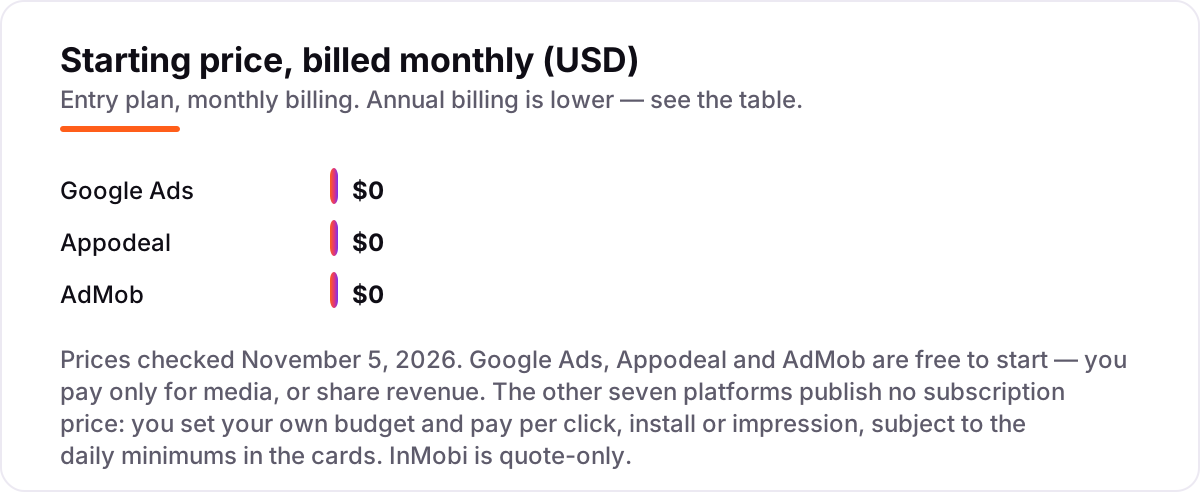
Mobile advertising platforms pricing: what you will actually pay
Take a $3,000-a-month test budget for a consumer app. The honest split is $500 on Google App campaigns, $500 on Meta Ads, $1,500 on one TikTok campaign at its $50-a-day floor, $300 on AppLovin Ads at $10 a day and $150 on Snapchat Ads at its $5-a-day floor — $2,950 in total, with $50 left for the UTM tags and creative tweaks. That buys one real test on each of the five biggest surfaces, with enough daily spend for the algorithms to learn.
Two numbers in that split need adjusting before they are real. First, TikTok's $1,500 is the floor for one campaign, not a working budget — a second campaign needs another $1,500, so most small teams run one TikTok campaign at a time. Second, Snapchat's $150 is the technical floor, not a learning budget: Snap recommends $20–$50 a day, which is $600–$1,500 a month, so a serious Snapchat test costs four to ten times the floor. Chartboost does not fit this $3,000 budget at all — one CPI campaign at $100 a day is the whole $3,000 on its own.
The platforms with no floor have their own hidden cost: creative. TikTok and Snapchat burn through short video in days, and a steady supply of new clips is a production budget, not a media budget. AppLovin and Unity need playable or video creative too, though fewer assets last longer. If you cannot make video at volume, the cheapest platforms to run are Google App campaigns and Meta Ads, which will optimize a handful of images and clips for weeks. For the wider picture — including desktop search and display, where the same dollars often go further — see our guide to digital advertising platforms.
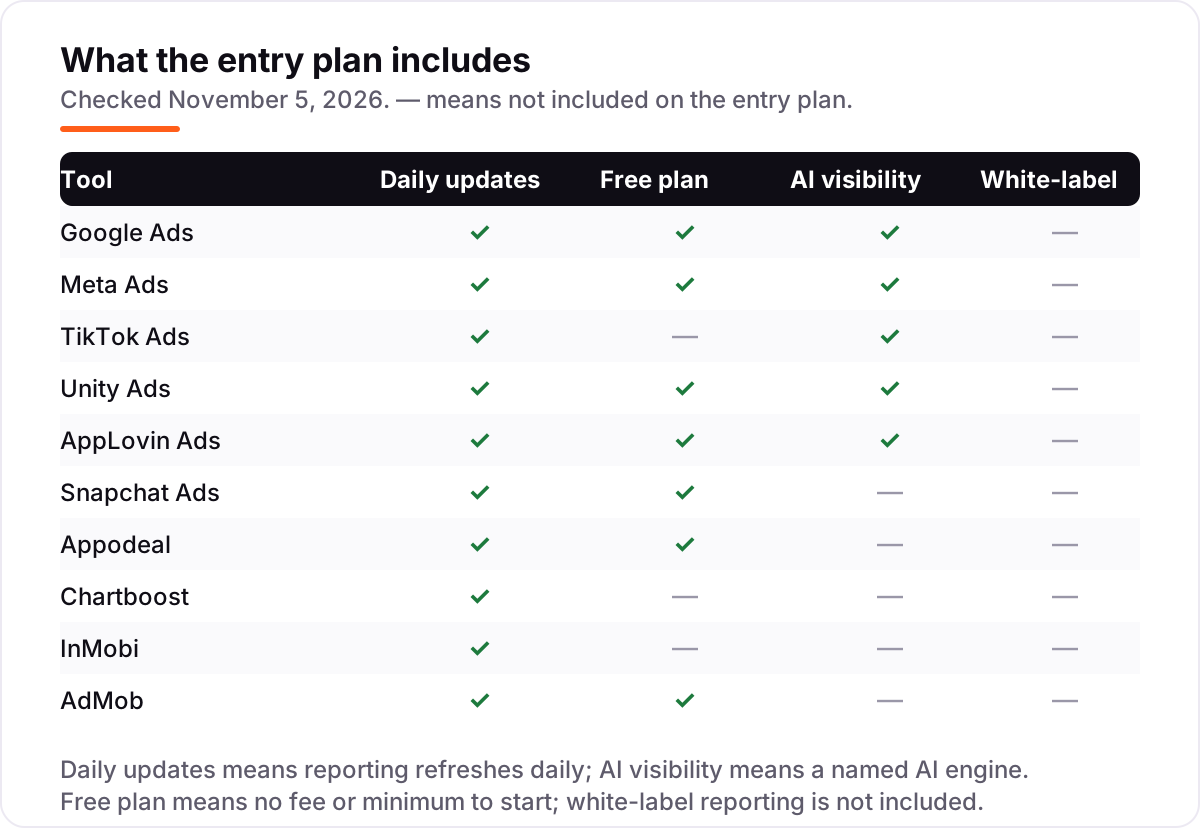
Know the difference: buying ads vs monetizing your app
The confusion in this category is between the two sides of one market. Buying ads means paying a platform to put your message in front of someone else's users: Google Ads, Meta Ads, TikTok Ads, Unity Ads, AppLovin Ads, Snapchat Ads, Chartboost and InMobi all sell attention, and you pay per click, install or impression. Monetizing an app means getting paid when ads show inside your own app: AdMob and Appodeal do this, and you earn a share of what advertisers pay. Same word — advertising — two opposite jobs.
There is a second, quieter confusion: a low minimum is not a low cost. Snapchat's $5-a-day floor and AppLovin's $10-a-day launch budget look cheap, but Snap recommends $20–$50 a day to learn anything and AppLovin's Axon needs enough conversions to bid well. TikTok's $50-a-day floor looks expensive, but its CPMs are the lowest in social, so the cost per thousand people reached can still be the cheapest in the list. Judge platforms on cost per install or cost per purchase, never on the minimum alone.
A third distinction worth knowing is the one that caught buyers out in 2026: platforms disappear. Unity closed the direct demand side of ironSource Ads on April 30, 2026, and moved those advertisers to Unity Ads, with the offerwall going to Tapjoy. If an old guide still tells you to buy installs on ironSource Ads, it is out of date. Check that every platform in a list still sells ads before you build a plan around it.
Quick comparison: tool type by need
| Buyer | Best pick | Why |
|---|---|---|
| Most advertisers, any app | Google Ads | Widest mobile reach, no minimum spend, App campaigns included |
| Consumer brand on social | Meta Ads | Deepest targeting on Facebook and Instagram, from about $1/day |
| Short-video brand, under-35 audience | TikTok Ads | Cheapest social CPMs, Spark Ads, $50/day campaign floor |
| Game studio buying installs | Unity Ads | Rewarded video inside Unity games, Vector AI, no official minimum |
| Cheapest in-game test | AppLovin Ads | Axon AI bidding, launch from $10/day |
| Young audience, AR creative | Snapchat Ads | AR lenses, $5/day floor, $75 credit when you spend $50 |
| App owner earning from ads | Appodeal | Mediation across 70+ networks, free to join, rated 4.7/5 on G2 |
Mistakes to avoid
- Budgeting on the floor instead of the learning budget. A $5-a-day Snapchat test and a $50-a-day TikTok campaign are not the same experiment. Unity wants $500 a day to learn and Snap wants $20–$50 — fund the learning phase, not the minimum.
- Buying on the wrong side of the market. AdMob and Appodeal pay you; they do not sell you attention. An advertiser who signs up for AdMob expecting installs will wait forever.
- Running five platforms at $10 a day each. Thin budgets teach you nothing anywhere. One platform, funded past its learning phase, beats five starved tests.
- Judging on clicks instead of installs or purchases. A cheap click that never installs is the most expensive traffic you can buy. Every platform here should be judged on cost per install or cost per purchase.
- Trusting a 2025 guide's platform list. ironSource Ads stopped selling installs in April 2026 and AppLovin opened self-serve to everyone in June 2026. Check that each platform still exists as a buying option before you plan around it.
How we chose
We checked each vendor's own pricing page, documentation or ad manager guidance on November 5, 2026 and recorded the starting price exactly as shown — and where a platform publishes no price, we say custom quote rather than estimating one. Two figures are floors enforced inside the ad managers rather than published rate cards: Meta's about-$1-a-day ad-set floor and AppLovin's $10-a-day launch budget, and the cards say so. Appodeal's revenue share is its own published model, about 10% of total revenue on average. Ratings come only from G2 pages we opened in a fresh crawl this week; four tools carry no rating because no G2 page could be verified for them, and we would rather show no rating than a stale one. We ranked by fit for the most common buyer — a business or app team buying mobile reach — not by brand size. No vendor paid for a place in this list, and none of the links here are affiliate links.
What to do next
Start with the platform where your audience already spends time — Google Ads for most, Meta Ads for consumer brands, Unity or AppLovin for games — and fund one campaign past its learning phase before you judge it. Tag every link with the UTM builder, watch cost per install for two weeks, and kill the creative that does not convert. If the ads are working but the site they land on is not bringing in search traffic, our monthly SEO service handles the visibility side — or compare providers in our guide to app marketing companies. Once your tools are in place, find out what's holding your rankings back.
Your stack only works if people find you
SerpAstra fixes what keeps your site off page one and makes it easy for AI assistants to recommend.
Get a free audit→Sources we checked (18)
- Google Ads — ads.google.com/home (checked November 5, 2026)
- Meta Ads — facebook.com/business/ads (checked November 5, 2026)
- TikTok Ads — ads.tiktok.com (checked November 5, 2026)
- Unity Ads user-acquisition guide — unity.com (checked November 5, 2026)
- Unity Ads campaign guide — unity.com (checked November 5, 2026)
- AppLovin Axon explained — sprites.ai (checked November 5, 2026)
- Snapchat Ads pricing — forbusiness.snapchat.com (checked November 5, 2026)
- Chartboost advertising docs — docs.chartboost.com (checked November 5, 2026)
- Best app advertising platforms 2026 — superapp.dev (checked November 5, 2026)
- AdMob guide — whizsky.com (checked November 5, 2026)
- Appodeal vs AdMob — blognife.com (checked November 5, 2026)
- 2026 minimum ad spend guide — granularmarketing.com (checked November 5, 2026)
- Google Ads reviews — g2.com (checked November 5, 2026)
- Facebook for Business reviews — g2.com (checked November 5, 2026)
- TikTok Ads reviews — g2.com (checked November 5, 2026)
- Unity Ads reviews — g2.com (checked November 5, 2026)
- Appodeal reviews — g2.com (checked November 5, 2026)
- Google AdMob reviews — g2.com (checked November 5, 2026)
Shamim
Founder of SerpAstra
A full-stack SEO and digital marketer who spends most days on Local SEO for dental practices, AI search visibility and lead generation.
Frequently asked questions
What is the best mobile advertising platform?
Google Ads is the best fit for most advertisers: the widest mobile reach and no minimum spend. Meta Ads is the better pick when your customer is a consumer on Facebook or Instagram and you want the deepest targeting. For games, Unity Ads and AppLovin Ads lead. There is no single winner — the right platform is the one where your audience already spends time.
How much does mobile advertising cost?
There is no subscription on most platforms — you pay for media. The floors are what matter: Google Ads has no minimum, Meta Ads starts at about $1 a day per ad set, Snapchat at $5, AppLovin at $10, TikTok at $50 a day per campaign and Chartboost CPI at $100 a day. A realistic first test across three platforms runs $1,500–$3,000 a month.
Is there a free mobile advertising platform?
Google Ads and AdMob are free to join, and Appodeal is free for publishers, but no platform gives you free media — you still pay for every click, install or impression. The free part is the account and the tools. The cheapest genuine test is Snapchat Ads at $5 a day, or AppLovin Ads at $10 a day for in-game inventory.
What is the difference between buying ads and monetizing an app?
Buying ads means paying a platform to show your ad to someone else's users — Google Ads, Meta Ads and TikTok Ads do this. Monetizing means getting paid when ads show inside your own app — AdMob and Appodeal do this. The two jobs use different tools, different pricing and different skills, so pick the side you are on before you compare platforms.
Can I advertise a mobile game without a big budget?
Yes, within limits. AppLovin Ads launches from $10 a day and Unity Ads has no official minimum, though Unity recommends a $50 daily cap and $500 a day for meaningful learning. Chartboost CPI needs $100 a day, so it is not a small-budget test. Start on AppLovin or Unity, prove one creative works, then scale the winners.
What happened to ironSource Ads?
Unity closed the direct demand side of ironSource Ads on April 30, 2026, and moved advertisers to Unity Ads. The offerwall business went to Tapjoy. If an old guide still lists ironSource Ads as a place to buy installs, it is out of date — the buying now happens on Unity Ads, and mediation still runs through LevelPlay.
Do I need a separate platform for iOS and Android?
No. Google Ads, Meta Ads, TikTok Ads and the in-game networks all buy both stores from one account, and you can split budgets by operating system inside a campaign. The one exception is the App Store itself: Apple Ads is a separate buy for search ads inside the App Store, and it is not in this list.
Free SEO and AI visibility audit
Find out what is holding your rankings back
Send us your site. Within 2 business days you get a written audit, an AI visibility check and a short fix list ranked by impact. Free, with no contract attached.
Request my free audit→Related guides
 Digital Marketing & AdsBest Advertising Platforms (2026): 12 Options Ranked for Every BudgetCompare the 12 best advertising platforms on minimum budgets, pricing and reach, with every minimum checked November 4, 2026, and sorted by use case.Read guide →
 Digital Marketing & Ads10 Best Digital Advertising Platforms in 2026, ComparedCompare the 10 best digital advertising platforms on price, minimum budgets, targeting and AI tools — every figure checked November 4, 2026.Read guide →
 Digital Marketing & Ads11 Best App Marketing Companies in 2026: Free and Paid Apps RankedCompare the 11 best app marketing companies on price, free plans, ASO tools and attribution, with every price checked on the vendor page, November 4, 2026.Read guide →