
8 Best Platforms to Sell Products Online in 2026, Compared
Compare the 8 best platforms to sell products online, from Amazon, eBay and Etsy to Shopify and WooCommerce, with real fees checked on each vendor's own page.
 Shamim Mia, Founder, SerpAstraLast verified November 12, 202610 min read
We compare pricing pages, documentation and public reviews. We never accept payment for rankings.
Key takeaways
- Marketplaces bring the buyers and take a cut: Amazon's most common referral fee is 15%, eBay's final value fee is 13.6% in most categories, and Etsy charges 6.5% plus processing.
- Your own store costs a flat fee instead: Shopify Basic is $39 a month, or $29 billed annually, and charges no extra platform fee when you use Shopify Payments.
- On Amazon, the Professional plan at $39.99 a month beats Individual's $0.99 per item once you sell about 40 items a month.
- Most sellers do best with both: a marketplace for discovery and an owned store for repeat buyers and an email list.
On this page
Quick comparison
| Tool | Best for | Starting price | Free plan |
|---|---|---|---|
 Shopify | Brands that want their own online store with the largest app and theme ecosystem | $39/mo | No (trial) |
 Amazon | Sellers of everyday products who want access to buyers already searching to purchase | $0.99/item or $39.99/mo | No monthly fee |
 eBay | Resellers and sellers of used, collectible or one-off items who list in volume | 13.6% + $0.40/order | 250 free listings/mo |
 Etsy | Makers of handmade, vintage and craft products who want buyers to find them | Free; $0.20/listing | Yes (no monthly fee) |
 WooCommerce | Sellers on WordPress who want to own the store outright with no platform fee | Free | Yes (free plugin) |
 BigCommerce | Growing stores with large catalogs that want features built in rather than added as apps | $39/mo | No (15-day trial) |
 Wix | Small businesses that want a website, a product store and bookings in one place | $36/mo | Yes (free plan) |
 Squarespace | Design-led brands with a small catalog that want a polished store with little setup | $25/mo | No (14-day trial) |
Make one of these tools?
We re-check this list every quarter. Send a correction, request a review, or ask about a clearly labeled sponsored spot.
Request a listingThe best platforms to sell products
Shopify
Best for: Brands that want their own online store with the largest app and theme ecosystem

Shopify is the default choice for a seller who wants a store of their own. Basic includes unlimited products, hosting, SSL and checkout, plus POS for in-person sales at markets and pop-ups, and the app and theme library is the largest in this list. Basic costs $39 a month, or $29 billed annually, and Shopify Payments charges 2.9% + 30c online with no extra platform fee.
The headline price is not the whole bill. A paid theme and a few apps can double the monthly cost, a 2% fee applies when you use a third-party payment gateway on Basic, and only the owner gets a staff account. Shopify brings no shoppers of its own, so budget time or money for traffic.
What we like
- The largest app and theme ecosystem here, with ready-made themes for almost any kind of store
- Unlimited products, hosting, SSL and checkout included, with AI-chat selling on the entry plan
- Shopify Payments charges 2.9% + 30c online with no extra platform fee
- POS for in-person sales at markets and pop-ups is included on Basic
Watch out for
- Apps and a paid theme push the real bill well above the $39 headline price
- A 2% fee applies on sales through a third-party payment gateway on Basic
- Only the store owner gets a staff account on Basic, so a small team must upgrade
Amazon
Best for: Sellers of everyday products who want access to buyers already searching to purchase
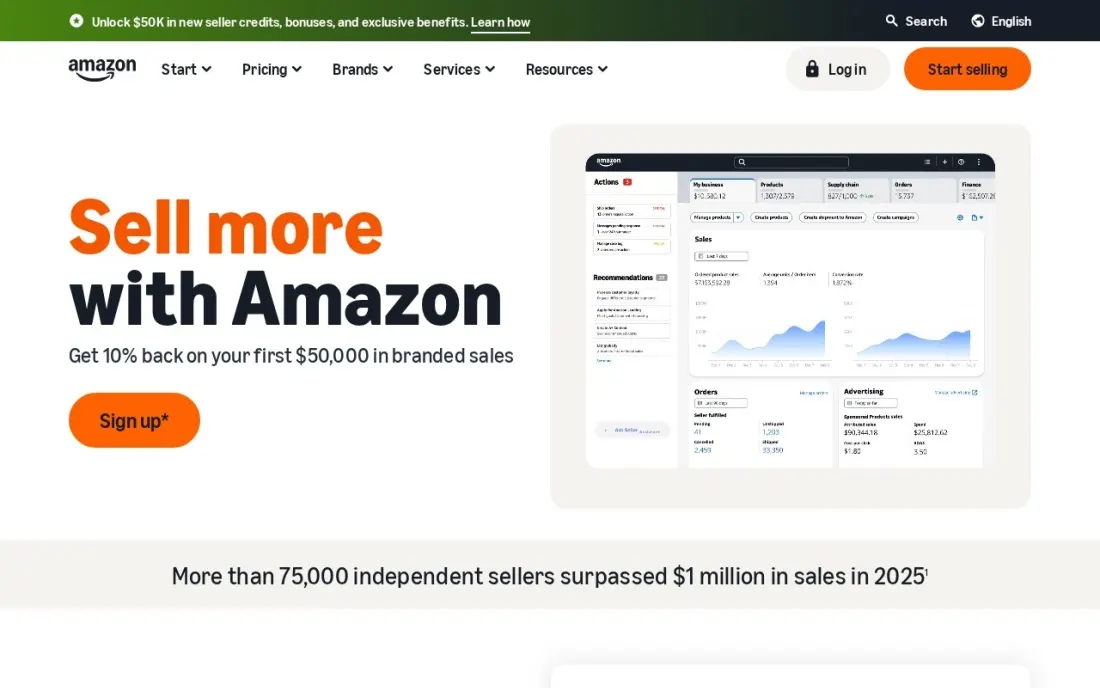
Amazon is the biggest shop window for physical products. You list into a catalog that buyers already search, and the optional Fulfillment by Amazon program can take over fulfillment at an added cost, with a revenue calculator to compare it against shipping yourself. The Individual plan has no monthly fee and charges $0.99 per item sold, but it lists one product at a time with static prices.
Professional costs $39.99 a month and adds bulk operations, so it pays off once you sell about 40 items a month. Every sale also carries a referral fee of 5% to 45% depending on category, most commonly 15%, with a $0.30 minimum in most categories. Amazon owns the customer relationship, so plan an owned store for repeat buyers.
What we like
- Sell where shoppers already search, with no storefront traffic to build
- Professional adds bulk operations to list, price and manage inventory faster
- Fulfillment by Amazon is an optional program, with a revenue calculator to compare its cost
Watch out for
- Referral fees run from 5% to 45% by category, with 15% the most common rate
- FBA and advertising are extra costs on top of the plan and referral fees
- Individual lists one product at a time with static prices only
eBay
Best for: Resellers and sellers of used, collectible or one-off items who list in volume

eBay suits sellers whose stock is varied, used or collectible rather than a branded product line. Every month you get up to 250 zero insertion fee listings, or more with an eBay Store, and each listing past that costs $0.35. There is no monthly fee to start, so a reseller clearing a garage or sourcing from thrift stores pays only when items sell.
When an item sells, the final value fee in most categories is 13.6% of the total sale up to $7,500, and 2.35% on the portion above that. A per-order fee of $0.30 applies to orders of $10 or less and $0.40 above $10. On a $40 sale that is $5.84, so price low-value items with the per-order fee in mind.
What we like
- Up to 250 zero insertion fee listings every month, more with an eBay Store
- No monthly subscription needed to start selling
- Strong demand for used, refurbished, vintage and collectible goods
Watch out for
- 13.6% final value fee in most categories, plus $0.30 or $0.40 per order
- Listings past the free allowance cost $0.35 each
- Store subscriptions change the fee schedule, so compare before you upgrade
Etsy
Best for: Makers of handmade, vintage and craft products who want buyers to find them
Etsy is the marketplace for handmade, vintage and craft goods, where shoppers search for gifts and one-of-a-kind items rather than the lowest price. A standard shop has no monthly fee: each listing costs $0.20 and stays live for four months, and Etsy Payments takes cards, PayPal, Apple Pay and Klarna in one checkout. Etsy Plus is optional at $10 a month.
Fees stack to about 10% of each sale: a 6.5% transaction fee plus 3% + $0.25 processing, before ads. Offsite Ads take 12% to 15% of the sales they drive, and shops cannot opt out once they pass $10,000 a year. There is no custom domain or email list, so add an owned store once repeat customers appear.
What we like
- Built-in buyers: Etsy search brings customers to the listing without ads or an audience of your own
- No monthly fee — a standard shop costs $0.20 per listing plus fees only when something sells
- Digital downloads deliver automatically, with no file hosting or checkout to build
- Etsy Payments handles cards, PayPal, Apple Pay and Klarna in one checkout
Watch out for
- Fees stack to about 10% of a sale: 6.5% transaction plus 3% + $0.25 processing, before ads
- Offsite Ads take 12–15% of sales they drive, and shops cannot opt out once they pass $10,000 a year
- The shop is Etsy's, not yours — no custom domain, no email list, and rules can change overnight
WooCommerce
Best for: Sellers on WordPress who want to own the store outright with no platform fee
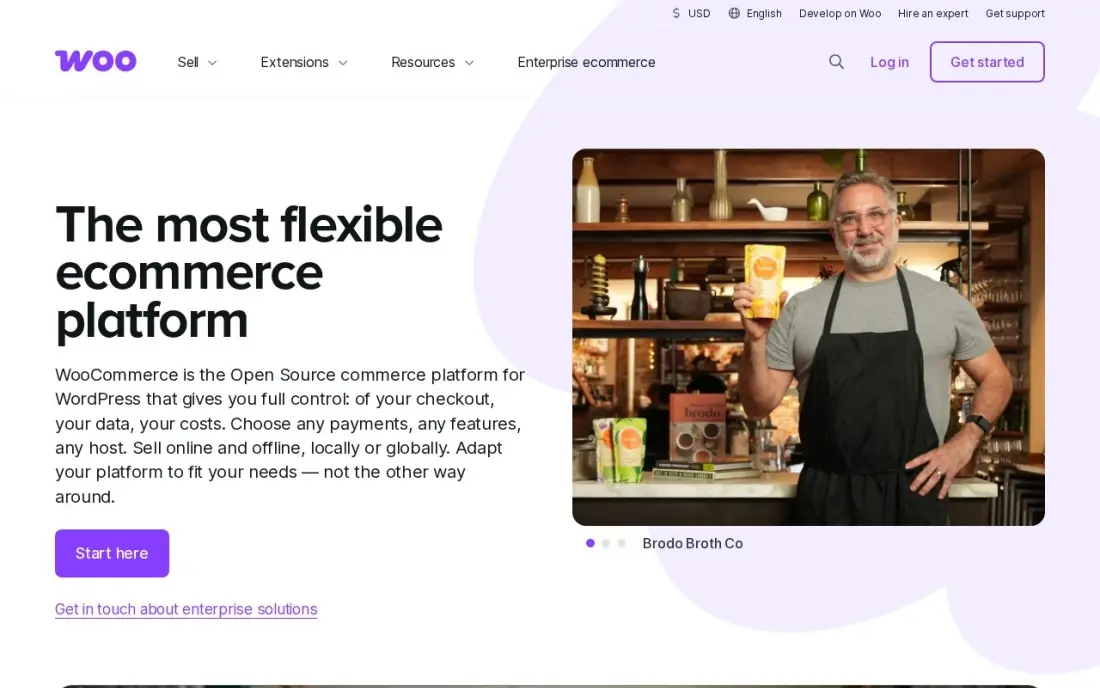
WooCommerce is the free route to a store you fully own. The plugin is free and open source, runs on more than 7 million WordPress sites, takes 0% of revenue and puts no platform branding on checkout. That suits a seller who already has a WordPress site with traffic and wants to add products without moving platforms.
The cost moves to hosting and upkeep. WooCommerce estimates hosting at $25 to $350 a month, extensions run $29 to $299 a year each, and the owner handles security, backups and updates with no hosted support line. For a seller with technical help, it is the cheapest way to run a large catalog; for a beginner, Shopify is simpler.
What we like
- The plugin itself is free and open source, with no licence fee and 0% revenue share
- More than 7 million active installations, so almost every ecommerce tool already integrates with it
- Full control over design, checkout and customer data, with no platform branding anywhere
- Subscriptions, bundles and memberships are available through extensions
Watch out for
- Hosting, security and updates are the owner's job, not the platform's
- The real cost is hosting at $25-$350 a month plus paid extensions at $29-$299 a year each
- No hosted support team to call when checkout breaks at midnight
BigCommerce
Best for: Growing stores with large catalogs that want features built in rather than added as apps
BigCommerce suits a seller with many products and variants. Core includes unlimited products, staff accounts and storage, with multi-currency selling, gift cards and real-time shipping quotes built in rather than sold as apps. There is no platform fee on orders through approved payment providers such as Stripe and PayPal. Core costs $39 a month, or $29 billed annually.
The catch is the sales threshold. Core covers up to $30,000 in trailing 12-month sales, and the store auto-upgrades to the next plan once it passes that line. Orders through gateways outside the approved list carry a 2% fee, and abandoned cart recovery is not on Core. Choose it when the catalog is large and the team is more than one person.
What we like
- Unlimited products, staff accounts and storage on every plan, with real-time shipping quotes
- Multi-currency selling and gift cards are included on Core, not held for a higher tier
- No platform fee on orders through approved embedded payment providers such as Stripe and PayPal
- Built-in SEO and product filtering that large catalogs with many variants need
Watch out for
- The plan auto-upgrades when trailing 12-month sales pass $30,000, so growth raises the bill
- A 2% fee applies on orders through payment gateways outside BigCommerce's approved list
- Abandoned cart recovery is not included on the entry Core plan
Wix
Best for: Small businesses that want a website, a product store and bookings in one place

Wix puts the website, the store, a blog and bookings in one dashboard, so a small business selling products alongside services does not need two systems. Hundreds of templates need no code, and Core takes payments through Wix Payments with no platform fee at 2.9% + 30c per card sale. Core costs $36 a month, or $29 billed annually.
Read the plan ladder before you build. Light at $17 a month billed annually cannot take payments, so selling starts at Core, which caps storage at 50 GB and collaborators at five. Wix often runs 50%-off first-year promotions, so budget for the renewal price rather than the discount. The free plan builds a site but cannot sell.
What we like
- Core takes payments with 0% platform fee through Wix Payments, at 2.9% + 30c a card sale
- Bookings, a blog and marketing tools sit in the same dashboard as the store
- Hundreds of templates and an app market, with no code needed to launch
- A free plan exists for the website, so the brand can build before it pays
Watch out for
- Light at $17 a month billed annually cannot take payments, so selling starts at Core
- Core's 50 GB of storage and 5 collaborators cap a growing catalog and team
- Wix runs 50%-off first-year promotions often, so the renewal price is the honest one to budget
Squarespace
Best for: Design-led brands with a small catalog that want a polished store with little setup

Squarespace gets a small product brand to a good-looking store fastest. Its templates are the most polished in this list, and every plan includes unlimited products, subscription products, abandoned cart recovery and invoices, plus hosting and SSL. Basic costs $25 a month, or $19 billed annually, and there is a 14-day free trial.
The fee is the trade-off. Basic adds a 2% Squarespace fee on every online store sale on top of card processing, so a store selling $2,000 a month pays $40 extra. Basic also allows only two contributors and no code injection for custom tracking. It is a strong start for a small catalog; a growing store should compare the next plan up.
What we like
- The most polished templates here, with strong photography and video presentation
- Unlimited products, subscription products and abandoned cart recovery on every plan
- Hosting, SSL and a free custom domain for the first year are included on annual billing
- Invoices, memberships and digital content are built in, not add-ons
Watch out for
- Basic adds a 2% Squarespace fee on every online store sale, on top of card processing
- Only two contributors on Basic, so a team quickly outgrows it
- No code injection on Basic, which limits custom tracking and widgets
The best platform to sell products is the one that matches where your buyers already are and how much of each sale you can afford to give away. We compared eight platforms across the two ways to sell online — marketplaces that bring buyers for a cut of each sale, and store builders that charge a flat fee while you bring the traffic — and every fee below comes from the platform's own pricing or help page as checked in November 2026.
How to choose the best platform to sell products
- Decide who brings the buyers. Amazon, eBay and Etsy put your listing in front of people already searching; Shopify, WooCommerce and the website builders give you a store that needs its own traffic.
- Work out the fee on one real sale. A percentage fee on a $40 item and a flat monthly fee on 50 orders lead to very different answers, so run your own numbers.
- Match the platform to the product. Everyday branded goods suit Amazon, used and collectible items suit eBay, handmade and vintage suit Etsy, and a brand with repeat buyers suits an owned store.
- Check who owns the customer. Marketplaces keep the buyer relationship; an owned store lets you build an email list and sell to the same person again.
- Price the extras. Fulfillment, ads, paid themes, apps and payment gateway fees often cost more than the plan itself.
- Plan for growth. Watch for sales thresholds, seat limits and per-sale platform fees that bite as volume rises.
An owned store only pays off when people can find it. If you run a Shopify, WooCommerce or Wix store that is not getting search traffic, our SEO audit finds what is holding it back, and the guide to the best ecommerce platform for SEO compares the technical side.
Selling platform pricing: what you will actually pay
Take a seller with a $40 product and 50 orders a month, or $2,000 in sales. On Amazon's Professional plan, $39.99 a month plus a 15% referral fee comes to $339.99 before fulfillment and ads; the Individual plan comes to $349.50, because 50 items at $0.99 cost more than the monthly fee. On eBay, the 13.6% final value fee plus $0.40 per order comes to $292, with all 50 listings inside the free 250. On Etsy, the 6.5% transaction fee plus 3% + $0.25 processing comes to $202.50, plus $0.20 per listing.
An owned store swaps percentages for a flat fee. Shopify Basic costs $39 billed monthly, or $29 billed annually, and Shopify Payments takes 2.9% + 30c a sale, so the same month costs about $112 billed monthly or $102 billed annually. Squarespace Basic costs $19 billed annually or $25 monthly, plus its 2% fee of $40 on $2,000, before card processing. WooCommerce has no platform fee but hosting starts around $25 a month.
The gap is the price of traffic. The marketplaces cost more per sale because they bring the buyer; the stores cost less but need ads, search or social to send people in.
Know the difference: marketplace vs your own online store
A marketplace is a shop window owned by someone else. Amazon, eBay and Etsy already have shoppers searching, so a new seller can make sales in the first week without spending on ads. In return, they take a percentage of every sale, set the rules, control how your listing looks and keep the buyer's details, which makes repeat marketing hard.
An online store is your own shop. Shopify, BigCommerce, WooCommerce, Wix and Squarespace charge a subscription or hosting fee instead of a large cut, and you keep the customer list, the branding and the checkout. The trade-off is that nobody arrives by default. Most growing sellers end up with both: a marketplace to find new customers and an owned store to sell to them again.
Quick comparison: tool type by need
| Buyer | Best pick | Why |
|---|---|---|
| Brands building their own store | Shopify | Largest app and theme ecosystem; Basic $39/month or $29 billed annually |
| Everyday products at volume | Amazon | Buyers already searching; Professional $39.99/month plus referral fees |
| Used and collectible items | eBay | 250 free listings a month; 13.6% final value fee in most categories |
| Handmade and vintage makers | Etsy | No monthly fee; $0.20 per listing and 6.5% per sale |
| WordPress site owners | WooCommerce | Free plugin, 0% revenue share; hosting paid separately |
| Large catalogs | BigCommerce | Unlimited products and staff on Core from $29/month billed annually |
| Products plus services | Wix | Store, bookings and blog in one dashboard; selling starts on Core |
| Small design-led brands | Squarespace | Polished templates; Basic $19/month billed annually plus a 2% fee |
Mistakes to avoid
- Comparing monthly fees instead of total cost. A marketplace with no subscription can cost three times more per month than a store once percentage fees are added.
- Staying on Amazon's Individual plan too long. Past about 40 items a month, $0.99 per item costs more than the $39.99 Professional plan.
- Building a store with no traffic plan. An owned store without search, social or ads gets no visitors; decide how buyers will arrive before you launch.
- Depending on one marketplace. Policy changes, fee rises or a suspended account can stop all sales overnight; keep a second channel.
- Ignoring payment and ad fees. Processing fees, third-party gateway fees and Etsy's Offsite Ads can quietly add several percent to every sale.
Related comparisons: Platforms to Sell Digital Products Online · Platforms for Selling Digital Products · Demo Software for SaaS Products · Digital Platforms for Skin Care Products
How we chose
We read each platform's own pricing or fee page in November 2026 and recorded the fees exactly as shown, including annual and monthly billing for the store builders. Amazon and eBay fees come from their seller pricing and help pages read on 16 November 2026. We ranked the platforms by fit for the most common buyer, a small business or individual selling physical products online for the first time, and grouped them into marketplaces and owned stores. Ratings come from G2 pages checked on the dates shown in the sources, and we omit ratings we did not read. No vendor paid for a place in this list, and none of the links here are affiliate links.
What to do next
Take your best-selling product, work out the fee on one sale on two marketplaces and one store builder, and launch on the cheapest marketplace that fits your product while you build an owned store in parallel. When the store is live and needs visitors, book a free SEO review.
Frequently asked questions
What is the best platform to sell products online?
For your own store, Shopify is the best all-round platform at $39 a month, or $29 billed annually. For reaching buyers who are already shopping, Amazon is the largest marketplace for everyday products, eBay suits used and collectible items, and Etsy suits handmade and vintage goods.
Where can I sell products online for free?
Amazon's Individual plan has no monthly fee and charges $0.99 per item sold plus referral fees, eBay gives up to 250 zero insertion fee listings a month, and Etsy has no monthly fee with $0.20 per listing. WooCommerce is a free plugin, but hosting costs $25 to $350 a month.
Is it better to sell on Amazon or my own website?
Amazon brings buyers but takes a referral fee, most commonly 15%, and keeps the customer relationship. Your own website on Shopify or WooCommerce costs a flat fee and keeps the customer data, but you must bring the traffic. Many sellers use a marketplace for discovery and their own store for repeat sales.
How much does Amazon charge to sell products?
Amazon's Individual plan costs $0.99 per item sold and Professional costs $39.99 a month. Both pay referral fees of 5% to 45% by category, with 15% the most common rate and a $0.30 minimum in most categories. Fulfillment by Amazon and ads cost extra.
What are eBay's selling fees?
eBay gives up to 250 zero insertion fee listings a month, then charges $0.35 per listing. In most categories the final value fee is 13.6% of the sale up to $7,500, plus $0.30 per order of $10 or less or $0.40 per order above $10.
Which platform is best for beginners selling products?
Etsy and eBay are the easiest places to start because there is no monthly fee and buyers already browse there. For a first owned store, Shopify and Squarespace are the simplest to set up without code.
What is the best platform to sell used stuff?
eBay is the best fit for used, refurbished, vintage and collectible items. You get up to 250 zero insertion fee listings a month, each listing after that costs $0.35, and there is no monthly fee to start. The final value fee is 13.6% in most categories plus a per-order fee. Etsy also suits vintage goods, at $0.20 a listing plus 6.5% per sale.
Sources we checked (12)
- Shopify — shopify.com/pricing (checked November 12, 2026)
- Shopify reviews on G2 (checked November 12, 2026)
- Amazon — sell.amazon.com/pricing (checked November 16, 2026)
- eBay — www.ebay.com/help/selling/fees-credits-invoices/selling-fees?id=4822 (checked November 16, 2026)
- Etsy — www.etsy.com/legal/fees (checked November 12, 2026)
- WooCommerce — woocommerce.com/pricing (checked November 12, 2026)
- WooCommerce reviews on G2 (checked November 12, 2026)
- BigCommerce — www.bigcommerce.com/pricing (checked November 12, 2026)
- Wix — www.wix.com/plans (checked November 12, 2026)
- Wix reviews on G2 (checked November 12, 2026)
- Squarespace — www.squarespace.com/pricing (checked November 12, 2026)
- Squarespace reviews on G2 (checked November 12, 2026)
Make one of these tools?
We re-check this list every quarter. Send a correction, request a review, or ask about a clearly labeled sponsored spot.
Request a listingShamim
Founder of SerpAstra
A full-stack digital marketer and SEO strategist covering technical and local SEO, AI search visibility, paid ads and lead generation for local businesses, e-commerce brands and SaaS teams.
Free SEO and AI visibility audit
Find out what is holding your rankings back
Send us your site. Within 2 business days you get a written audit, an AI visibility check and a short fix list ranked by impact. Free, with no contract attached.
Request my free audit→Related buying guides
 Ecommerce8 Best Ecommerce Platforms for Small Businesses in 2026, ComparedCompare the 8 best ecommerce platforms for small businesses on free plans, transaction fees, in-person selling and real yearly cost, with prices checked.Read guide →
 Ecommerce8 Best Platforms to Sell Digital Products Online in 2026, ComparedCompare the 8 best platforms to sell digital products online on per-sale fees, tax handling, storefronts and real monthly cost, with prices checked in 2026.Read guide →
 EcommerceBest Cross Posting Apps for Resellers (2026): 9 Apps Worth DownloadingCompare the 9 best cross posting app for resellers options on price, free plans, marketplaces and auto-delist, with every price checked November 4, 2026.Read guide →