Best rank tracking tools in 2026
Best rank tracking tools in 2026: Semrush, Ahrefs, AccuRanker, SE Ranking and Wincher compared on price, keyword limits, update speed and AI visibility.
Key takeaways
- Answer six questions first (keyword count, freshness, local needs) - they decide which tracker fits.
- Suites bundle tracking with research and audits; specialists do rankings only, usually faster or cheaper per keyword.
- Compare cost per keyword per month, not the headline price - a $4.99 plan and a $129 plan can cost about the same per keyword.
- Google Search Console is free and the only source of first-party ranking data - set it up before paying for anything.
- AI visibility tracking is the new feature that matters: check whether a tool tracks AI Overviews and AI answer mentions.
- Prices in this guide come from October 2026 comparisons and change often - confirm the price on the vendor's page before you buy.

By Shamim, founder of Serpastra
Updated , 9 min read

Rank tracking used to be simple: pick your keywords, check positions weekly, watch the line go up. In 2026 it is a bigger job — Google’s AI Overviews, ChatGPT search and Perplexity are reshaping discovery, so watching only your Google position misses a growing slice of visibility. The tools below were compared on accuracy, update frequency, AI and local tracking, ease of use, and real cost.
The short version: if you already pay for Ahrefs or Semrush, use their bundled trackers first. If tracking is the job itself, AccuRanker has the fastest data, SE Ranking the best value, and Wincher the cheapest way to track many sites. For a local business with a few dozen keywords, Google Search Console plus one cheap tracker is usually enough.
How to choose a rank tracker
Before you compare prices, answer six questions. They decide which tool fits, and they are the same questions that make a cheap tool expensive or an expensive tool worth it.
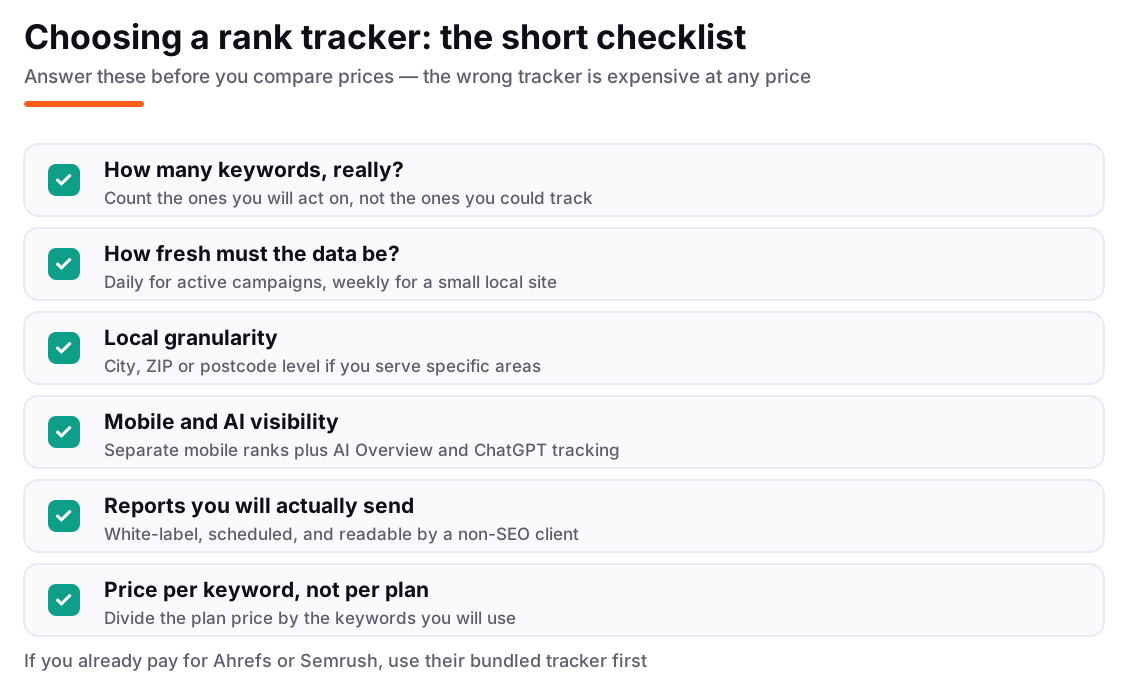
How many keywords, really? Count the ones you will act on, not the ones you could track. A dental practice in one city might need 50 to 100 keywords; a multi-location business or a SaaS company needs hundreds or thousands. The keyword limit decides your plan, so count honestly.
How fresh must the data be? Daily updates matter when you are actively working on rankings. Weekly is fine for a small local site that changes slowly. On-demand refresh — re-checking a keyword right now — matters most to agencies reporting to clients.
Local granularity. If you serve specific areas, you need tracking at city, ZIP or postcode level, not just national — a dentist in Austin and one in Dallas are in different markets.
Mobile and AI visibility. Mobile rankings differ from desktop, and AI Overview and ChatGPT visibility are now a real feature. If your customers find you through AI answers, you need a tool that tracks that.
Reports you will actually send. White-label, scheduled reports a non-SEO client can read are worth paying for if you report to anyone else. If it is just you, a simple dashboard is enough.
Price per keyword, not per plan. Divide the plan price by the keywords you will actually use. That number, not the headline price, is the real cost.
Suites vs specialists
Rank trackers fall into two camps. Suites — Ahrefs, Semrush, SE Ranking, Mangools — bundle tracking with research, backlinks and audits: one login, one invoice, tracking that is good but rarely the deepest. Specialists — AccuRanker, ProRankTracker, Wincher, Nightwatch — do rankings only, usually faster or cheaper per keyword, with better local data and reporting.
The suites win when you already pay for one: their trackers are included, and a second tool means paying twice for overlapping data. The specialists win when tracking is the job — agencies with thousands of keywords, or businesses that need on-demand refreshes and polished reports. The right camp depends on what else you already pay for.
Not sure where to start?
Get a free audit - written findings in 2 business days, yours to keep.
Get my free auditThe 8 tools, reviewed
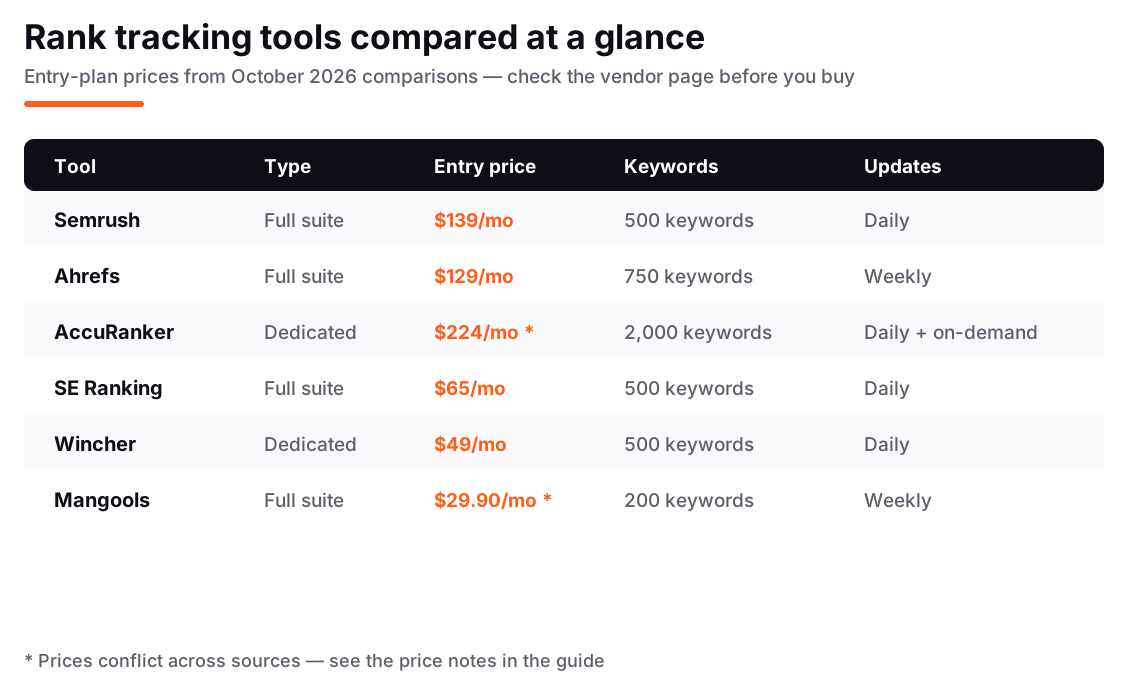
Semrush — best if you already use Semrush. Position Tracking is part of the SEO plan, from $139 a month ($117.33 billed annually) for 500 keywords updated daily, with the whole toolkit around it: keyword research, backlinks, site audit and share of voice. It tracks Google AI Overviews as a SERP feature. It is the most complete option and the most expensive per keyword — but if the suite is already in your stack, the tracker is effectively free. Seven-day free trial.
Ahrefs — best for backlink-focused teams. Rank Tracker comes with Lite at $129 a month for 750 keywords, updated weekly — the weekly cadence is its main weakness. Starter at $29 a month covers 50 keywords, which suits a very small site. Ahrefs’ backlink data and historical SERPs are the deepest in the industry, and Brand Radar tracks AI answer mentions. No free trial, but Ahrefs Webmaster Tools is free for sites you own.
AccuRanker — best for large keyword sets and speed. The fastest dedicated tracker on this list, with daily updates plus on-demand refreshes and tracking for 100,000+ keywords at the top end. Professional is listed at $224 a month billed annually ($249 monthly) for 2,000 keywords — though one comparison lists it from $109 and another lists a 1,000-keyword tier at $129, so check the pricing page for the tier matching your count. It tracks AI Overviews as a SERP feature. Fourteen-day free trial, no credit card required.
SE Ranking — best overall value. A full suite cheaper than Semrush or Ahrefs: Essential is $65 a month ($52 billed annually) for 500 keywords, Core is $129 a month ($103.20 annually) for 2,000, both daily, with ZIP-level local tracking and white-label reports. For freelancers and small agencies it is the best value on this list. Fourteen-day free trial, no card required.
Wincher — cheapest for many sites. Basic is $49 a month for 500 keywords across 10 websites, updated daily. If you track many small sites, Wincher’s per-site pricing is hard to beat. The trade-off is a shallower toolkit — a tracker, not a suite — so you will still need other tools for research and audits.
Mangools (SERPWatcher) — lowest cost. Basic is listed at $29.90 a month billed annually ($49 monthly) for 200 keywords, updated weekly — though one comparison lists $18.85, so confirm the current price. It is the friendliest set of tools at the lowest credible price, and the best starting point for a beginner. Ten-day free trial; limited free plan available.
Nightwatch — best for unlimited seats and AI search. Starter is €79 a month billed yearly (about $85) for 500 keywords updated daily, with unlimited seats and AI search tracking alongside classic rankings. Nightwatch prices in euros, so the dollar cost moves with the exchange rate. It suits teams that want everyone in the tool and care about AI visibility.
ProRankTracker — best for precise local data and client reports. Starter is $99 a month for 1,000 terms, with precise local tracking and polished white-label client reports. It is an agency tool first: if your clients need rankings in a report they can understand, it is built for exactly that.
What tracking actually costs
Entry prices hide the real cost. A $4.99 plan and a $129 plan can cost about the same per keyword, and a $139 plan can cost four times more. The honest comparison is cost per keyword per month, on the entry plan, billed monthly — and on that measure the ranking flips completely.
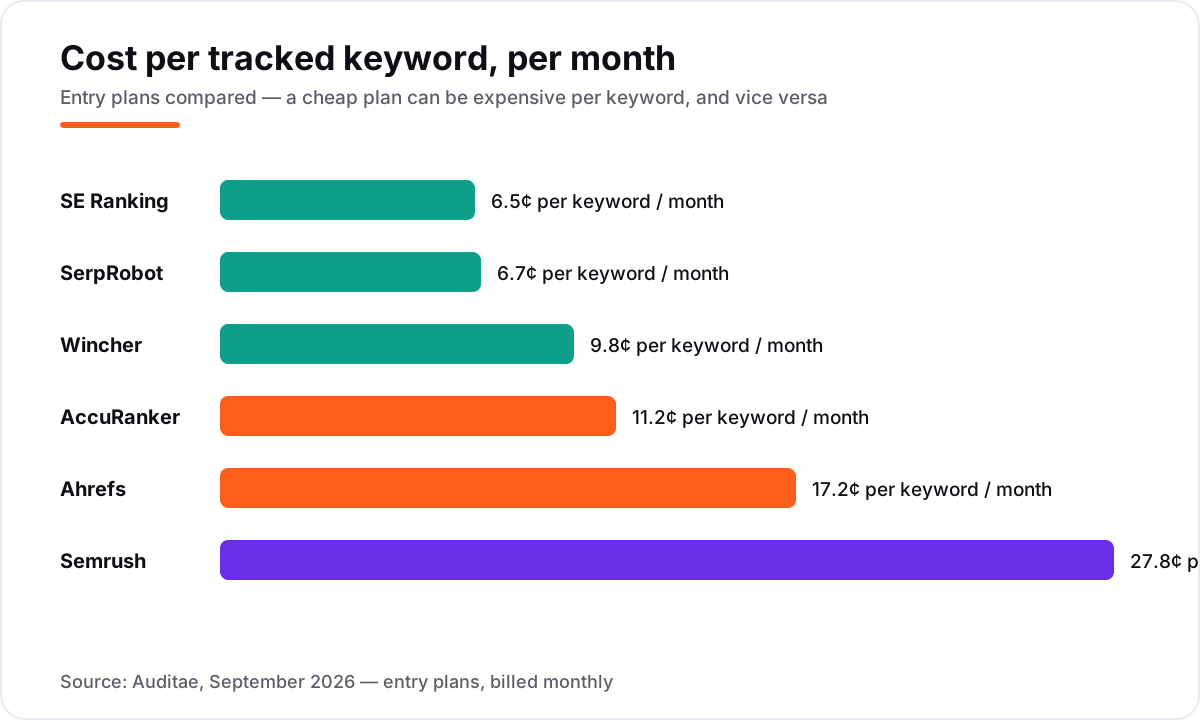
According to Auditae’s September 2026 comparison, SE Ranking Core costs 6.5 cents per keyword per month, and SerpRobot — $4.99 a month for 75 keywords — costs 6.7 cents. Wincher is 9.8, AccuRanker 11.2, Ahrefs 17.2 and Semrush 27.8 cents. The cheapest credible options are Mangools and SE Ranking on annual billing; Semrush is the most expensive, which is fine if you pay for the suite and wasteful if you only need the tracker.
Two things to watch. First, keyword limits are the trap: a 2,000-keyword plan looks generous until you realise you track 200 of them and pay for 1,800 you never use. Second, update frequency is a hidden cost: Ahrefs’ weekly Lite updates show changes a week later than a daily tracker. For a slow-changing site that does not matter; for an active campaign it does.
AI visibility tracking: the new feature that matters
In 2026, “rank tracking” means more than it did even two years ago. Google’s AI Overviews, ChatGPT search and Perplexity are reshaping discovery, so watching only your Google position misses a growing slice of visibility. The tools are catching up at different speeds.
Semrush and AccuRanker track Google AI Overviews as a SERP feature — whether an overview appears for your keyword, and whether you are cited. Ahrefs tracks AI answer mentions through Brand Radar; Nightwatch tracks AI search alongside classic rankings. SE Ranking’s AI tracking is more limited. If AI visibility is a priority, check this feature before you buy — it is the one most likely to be missing from the plan you are looking at.
Whatever tool you choose, pair it with the method in our guide on how to rank in Google AI Overviews: a fixed prompt set, a monthly citation check, and a refresh cycle. Our guide on best AI SEO tools in 2026 covers the AI tracking tools — Otterly, Brand Radar and Profound — that specialise in this.
The free option: Google Search Console
Before you pay for anything, set up Google Search Console. It is free, the only source of first-party ranking data — actual impressions and clicks from Google itself — and it now has dedicated generative AI performance reports. No paid tool can replace that.
What Search Console cannot do is track a fixed keyword list over time with local granularity, show competitor positions, or send a readable report. So the sensible setup for a small business is Search Console plus one cheap tracker — Wincher or Mangools for a single site, SE Ranking if you want the suite — and nothing else until the keyword list outgrows it.
Track the right keywords, too. Our keyword research guide for local businesses shows how to build a list of terms a paying customer actually types, and our how to track Google ranking guide covers the routine: what to check, how often, and what to do when a ranking moves.
Which tool for which business
A local business with one location and under 100 keywords: Google Search Console plus Wincher ($49 a month) or Mangools ($29.90 a month billed annually). Daily updates, local tracking, and nothing you will not use.
A freelancer or small agency with several clients: SE Ranking. The Core plan at $103.20 a month billed annually covers 2,000 keywords, daily updates, ZIP-level local data and white-label reports — the best value for the money on this list.
An agency tracking thousands of keywords: AccuRanker. On-demand refreshes, the fastest data, and the scale to handle 100,000+ keywords. Check the current tier pricing first, because the published prices conflict across sources.
A team already paying for Ahrefs or Semrush: use the bundled tracker. Buying a second tool means paying twice for overlapping data, and both suites’ trackers are good enough for most purposes.
A SaaS company that lives or dies by “best tool for” searches: Semrush or Ahrefs for the suite, plus a dedicated AI visibility tool. Our guide on how long SEO takes to rank sets the timeline expectations — tracking is the part that tells you whether the plan is working.
Put the choice in a plan, not a subscription. Our SEO strategy template includes a measurement section: which keywords, which tool, how often you check, and what counts as progress. A tracker you check once a quarter is a subscription, not a strategy.
A note on prices
Rank trackers change their tiers often, and the prices here come from reputable October 2026 comparisons — Auditae, SpotSaaS and TrySight — that checked vendor pricing pages in September and October 2026, not from vendor pages opened directly. Prices conflict across those sources in places, and we have flagged them rather than picking one and pretending it is certain.
The conflicts: AccuRanker Professional is listed at $224 a month billed annually ($249 monthly) for 2,000 keywords in two comparisons, but another lists it from $109 and a fourth lists a 1,000-keyword tier at $129 — almost certainly different tiers, but the sources do not label them clearly. Mangools Basic is listed at $29.90 a month billed annually in one comparison and $18.85 in another. Semrush is listed at $139 in some places and $139.95 in others. SE Ranking’s Essential and Core are different tiers ($65 and $129 a month), not conflicting prices.
Check the vendor pricing page before you buy, and check the keyword limit and update frequency on the exact plan — those two numbers decide the real bill. If you want help, Serpastra’s one-time audit is $349 and includes a keyword list, a tracking setup and a baseline report. Monthly SEO starts from $700 a month, Local SEO from $450 per location, both with tracking included. Book a call and we will tell you which tool fits your keyword list.
Related guides
 StrategyHow to track your Google ranking in 2026Track your Google ranking the right way: Search Console, free checkers and rank trackers explained, and what average position and CTR really mean today.
 StrategyHow long does it take to rank on Google in 2026?How long SEO takes to rank in 2026: realistic timelines by keyword, site age and market, what moves fastest, and how to tell if your SEO is actually working.
 AI SearchBest AI SEO tools in 2026: honest picks by jobBest AI SEO tools in 2026, picked by job: Semrush and Ahrefs for research, Surfer and Clearscope for content, Otterly for AI tracking, with 2026 prices.
Frequently asked questions
What is the best rank tracking tool in 2026?
It depends on your scale. SE Ranking is the best value for most teams, AccuRanker is the fastest dedicated tracker for agencies, and Wincher is the cheapest way to track many sites. If you already pay for Ahrefs or Semrush, use their bundled trackers before buying a dedicated tool.
How much does a rank tracker cost?
From $4.99 a month for a bare-bones tracker like SerpRobot, to $49 to $65 a month for Wincher or SE Ranking, to $129 to $139 a month for Ahrefs or Semrush, to $224 a month and up for AccuRanker. The real cost is price per keyword, not the plan price — see the cost-per-keyword section above.
Can I track Google rankings for free?
Yes, with Google Search Console. It is free and it is the only source of first-party ranking data — actual impressions and clicks from Google. It cannot track a fixed keyword list with local granularity or show competitor positions, so most businesses pair it with one cheap paid tracker.
Do rank trackers track AI Overviews and ChatGPT?
Some do. Semrush and AccuRanker track Google AI Overviews as a SERP feature, Ahrefs tracks AI answer mentions through Brand Radar, and Nightwatch tracks AI search alongside classic rankings. SE Ranking's AI tracking is more limited. Check this feature specifically before you buy.
How often should rank tracking update?
Daily for active campaigns, where you want to see the effect of a change quickly. Weekly is fine for a small local site that changes slowly. On-demand refresh — re-checking a keyword right now — matters most to agencies reporting to clients.
Is Semrush or Ahrefs better for rank tracking?
Semrush updates daily and tracks AI Overviews as a SERP feature; Ahrefs updates weekly on the Lite plan but has deeper backlink data and historical SERPs. If you already pay for one of them, use its bundled tracker. If you are choosing between them, pick by the rest of the suite, not the tracker alone.
Shamim
Founder of Serpastra. A full-stack SEO and digital marketer who spends most days on Local SEO for dental practices, AI search visibility and lead generation. More about Shamim.