
10 Best Restaurant Reservation Software in 2026, Compared
Compare the 10 best restaurant reservation software options on price, per-cover fees and free plans, with every price checked November 8, 2026.
 Shamim Mia, Founder, SerpAstraLast verified November 8, 202615 min read
We compare pricing pages, documentation and public reviews. We never accept payment for rankings.

Key takeaways
- OpenTable is the best fit for most US restaurants at $149 a month, but its $1.50 per-cover fee makes it the dearest at volume; Resy and Tock both charge a flat $289 a month with no per-cover fees.
- Eat App and resOS both offer genuinely free plans — Eat App up to 100 covers a month, resOS up to 25 bookings — and their first paid plans cost $99 and $47 a month.
- The single most important buying factor is where your bookings come from: a marketplace sends you new diners and charges per cover, while a direct-booking tool charges one flat fee and lets you keep the guest data.
- SevenRooms and Toast Tables publish no price, so get a written quote before comparing them, and check the contract term — OpenTable's standard contract runs a year and auto-renews.
On this page
Quick comparison
| Tool | Best for | Starting price | Free plan |
|---|---|---|---|
| OpenTable | Restaurants that want the largest US diner network and will pay per-cover fees for discovery | $149/mo | No |
| Resy | Upscale and fine-dining rooms that want a flat monthly fee and American Express cardholder demand | $289/mo | No |
| Tock | Tasting menus, prix fixe and ticketed experiences where guests prepay when they book | $289/mo | No |
| SevenRooms | Multi-venue groups that want guest CRM and marketing automation in one platform | Custom quote | No |
| Yelp Guest Manager | US restaurants where Yelp search already drives diners to the door | $159/mo | No |
| Eat App | Independent restaurants that want a free start and flat monthly pricing with no cover fees | Free; Lite $99/mo | Yes (free plan) |
| resOS | Very small venues that want a genuine free plan and the cheapest paid step up | Free; Basic $47/mo | Yes (free plan) |
| Toast Tables | Restaurants already running Toast POS that want reservations inside the POS | Custom quote | No (Toast add-on) |
| ResDiary | UK, Irish and APAC venues that want a white-label diary priced by booking volume | £109/mo + VAT | No |
| Zenchef | European restaurants that want Google Reserve and no per-cover fees | €129/mo | No |
Make one of these tools?
We re-check this list every quarter. Send a correction, request a review, or ask about a clearly labeled sponsored spot.
Request a listingThe best restaurant reservation software

OpenTable
Best for: Restaurants that want the largest US diner network and will pay per-cover fees for discovery
OpenTable has taken restaurant reservations since 1998 and is still the default discovery platform for diners. Its published plans run Basic at $149 a month, Core at $299 and Pro at $499, and the subscription is only half the bill: Basic adds $1.50 for every diner who finds you through the network, and $0.25 for every guest who books through your own website, unless you pay the $49 flat fee instead.
The network is the reason to pay it. A restaurant in a competitive city gets discovered by diners who would never find its own website, and the 30-day free trial on Basic is a real test. The catch is the contract: one year, auto-renewing, with 30 days' notice to cancel. Buy OpenTable when discovery is the bottleneck; buy a flat-fee tool when your regulars already find you.
What we like
- The largest US diner network, so new guests find you without ads
- Published prices: Basic $149, Core $299 and Pro $499 a month
- Phone and walk-in reservations carry no fees on any plan
- No charge for no-shows or cancellations, only for seated diners
Watch out for
- Per-cover fees scale with success: 750 network covers a month add $1,125 to the $149 Basic bill
- Standard contract runs one year and auto-renews unless you give 30 days' notice
- Guest CRM and marketing automation wait for Pro at $499 a month

Resy
Best for: Upscale and fine-dining rooms that want a flat monthly fee and American Express cardholder demand
Resy is the reservation platform for rooms that fill up on reputation: an American Express company since 2019, built for full-service restaurants, wineries and hotels. The price is a flat monthly fee with no per-cover charges — Platform at $289 a month, Platform 360 at $459 — and the Tock-powered Essential and Premium plans cost the same $289 and $459, with a 3% or 2% fee only on prepayments.
The flat fee is the whole appeal: seat twice as many guests and the bill does not move, unlike OpenTable's per-cover meter. The trade-off is reach and tooling: there is no built-in CRM, no free tier and no free trial, and advanced analytics wait for Platform 360. Choose Resy when your room is already in demand; choose OpenTable when you still need to be discovered.
What we like
- Flat monthly fee with no per-cover charges on any plan
- American Express owns Resy, so Amex cardholders find your tables first
- Platform 360 adds advanced analytics and automated guest insights
- Notify waitlist and POS integrations included from the entry plan
Watch out for
- No free tier and no free trial, so a small room pays $289 a month from day one
- No built-in CRM; guest communications and analytics need Platform 360 at $459
- Resy stopped serving UK restaurants in August 2024, so it is US-focused

Tock
Best for: Tasting menus, prix fixe and ticketed experiences where guests prepay when they book
Tock changed fine dining by treating dinner like a ticket: guests pay when they book, so an empty seat still pays. American Express bought Tock in 2024 and announced in February 2026 that it is folding Tock into Resy, so the two now sell one four-plan lineup. Essential costs $289 a month with a 3% fee on prepayments; Premium costs $459 with a 2% fee.
Prepayment is the point. For a prix fixe menu, a chef's table or a winery tasting, a no-show that keeps the money is the difference between profit and loss. The risk is the merger: the consumer app and website are being sunset, and features may shift as the two systems combine. Buy Tock when prepaid dining is your model; buy Resy Platform when standard bookings are enough.
What we like
- Guests prepay like theatre tickets, which cuts no-shows sharply
- Flat monthly fee with no per-cover charges on any plan
- Deposits, prepayments and ticketed experiences built in from Essential
- Wineries and tasting-menu rooms are its home turf, with 1,200 wineries on board
Watch out for
- Essential adds a 3% fee on every prepayment, which bites on expensive tasting menus
- Now part of Resy, so the roadmap may merge and features may shift
- No free tier and no free trial; the consumer app and site are being sunset

SevenRooms
Best for: Multi-venue groups that want guest CRM and marketing automation in one platform
SevenRooms is less a booking widget than a guest platform: reservations and table management on top of a CRM that remembers who your regulars are and what they order. DoorDash bought it for $1.2 billion in a deal that closed in June 2025. The price is the problem for buyers: SevenRooms publishes nothing, and every plan is quote-only behind a demo.
What you get for the quote is depth no flat-fee tool matches — guest profiles, marketing automation, review management and payments in one place, with no per-cover fee on any channel. Operator reports put a lean single venue near $499 a month, with setup fees from a few hundred dollars to $25,000. Buy SevenRooms when guest data is the strategy; buy a published-price tool when you need to know the cost before the sales call.
What we like
- The deepest guest CRM here: profiles, tags, marketing automation and reporting
- No per-cover fee or reservation commission on any channel
- Starter, Growth and Premium packages scale from one venue to groups
- Owned by DoorDash since June 2025, with delivery and ordering links in the same group
Watch out for
- No published price: every plan is quote-only behind a demo
- Reported setup fees run from a few hundred dollars to $5,000 or more
- Annual contracts with a 90-day cancellation notice, per operator reports

Yelp Guest Manager
Best for: US restaurants where Yelp search already drives diners to the door
Yelp Guest Manager turns Yelp searchers into seated guests. Bookings come from your Yelp page, Google and Apple Maps, and the system charges no per-cover fees. Basic costs $159 a month, or $129 billed annually, and caps at 500 covers a month; Plus costs $349, or $279 annually, with unlimited covers, table management and guest profiles. New customers get up to 60 days of free onboarding.
The value tracks your Yelp strength in your market: a restaurant with strong Yelp traffic gains far more than one with little Yelp presence, and guest data ownership is mixed, since marketplace guests remain Yelp users. The contract also deserves a read — annual terms with a $600 early-termination fee on Basic and $1,500 on Plus. Buy Yelp Guest Manager when Yelp already sends you diners.
What we like
- Bookings come from your Yelp page, Google and Apple Maps, where diners already look
- No per-cover fees on any plan, unlike OpenTable
- Waitlist and reservations in one subscription, with Notify Me for waiting guests
- Yelp Host, a separate AI phone product from $249 a month, can answer calls after hours
Watch out for
- Basic caps at 500 covers a month, so a busy room needs Plus at $349
- No POS integration or guest profiles on Basic; both wait for Plus
- Annual contracts carry an early-termination fee of $600 on Basic and $1,500 on Plus

Eat App
Best for: Independent restaurants that want a free start and flat monthly pricing with no cover fees
Eat App is the value pick for independents: a reservation, table management and guest CRM system with a real free plan and flat monthly pricing. The free tier covers up to 100 covers a month; Lite costs $99 a month, or $69 billed annually, with unlimited covers; Core is $199, Pro is $389. Bookings are commission-free, with no per-cover fees, and the restaurant owns its guest data.
The catch is the add-ons. POS integration costs $39 a month extra on Lite and Core, and the waitlist, deposits and email marketing are paid extras at $19 to $39 a month each, so a fully loaded Lite can reach $176 a month. Even so, the free plan is the best on-ramp here for a small room moving off a paper book. Start on Eat App when the budget is tight.
What we like
- A real free plan: reservations and table management at $0 for up to 100 covers a month
- Flat monthly pricing with no per-cover fees and no cover cap on paid plans
- The restaurant owns its guest data rather than sharing it with a marketplace
- Guest CRM with WhatsApp and SMS messaging built in from Lite
Watch out for
- POS and payments integration costs $39 a month extra on Lite and Core
- Waitlist, deposits and email marketing are paid add-ons, $19 to $39 a month each
- Free plan stops at 100 covers a month, so a busy weekend outgrows it fast

resOS
Best for: Very small venues that want a genuine free plan and the cheapest paid step up
resOS is a Danish booking system with a visual table planner and an online booking widget — the cheapest way into this list. The free plan covers 25 bookings a month forever, with no credit card. Paid plans run by booking volume: Basic is $47 a month for 350 bookings, Plus is $98 for 750, Unlimited is $149. Every plan includes all core features, with no per-cover fees, no commission and no contract.
The limits are the add-ons and the caps: the waitlist, online payments for deposits and Reserve with Google are paid extras, and the free plan's 25-booking cap suits only very small venues. There is also no G2 or Capterra listing yet, so there is no independent review score to check. Even so, a 90-day money-back guarantee and month-to-month billing make it the lowest-risk plan here.
What we like
- The cheapest paid plan here: Basic is $47 a month for 350 bookings
- Every plan includes all core features, including the drag-and-drop floor plan
- No per-cover fees, no commission, no setup fee and no contract
- 90-day money-back guarantee on paid plans, with pause or cancel anytime
Watch out for
- Free plan stops at 25 bookings a month, so most rooms pay from the first month
- Waitlist, payments and Reserve with Google are paid add-ons, not included
- No G2 or Capterra listing yet, so there is no independent review score to check

Toast Tables
Best for: Restaurants already running Toast POS that want reservations inside the POS
Toast Tables is a reservation and waitlist add-on for Toast POS, not a standalone platform. Bookings and table status sync with the POS in real time, so the host stand sees which tables have ordered and when dishes fired. The base tier includes an unlimited waitlist and 25 reservations a month; Plus adds unlimited reservations and Experiences. Toast publishes no price for either tier.
For a restaurant already on Toast, it is the easiest swap: no new system to learn and no per-cover fees. For anyone else it is a non-starter, since you must run Toast POS first, and the Plus tier is quote-only. Third-party write-ups put the base tier near $50 a month and Plus near $199, but Toast itself publishes neither figure. Buy Toast Tables only if Toast already runs your dining room.
What we like
- Table and order status sync with Toast POS in real time
- Unlimited waitlist on the base tier, with automated SMS and email updates
- Server rotation and cover counts built in, so seating stays fair
- Guests can book from your site, Google Search and Maps, or the Local by Toast app
Watch out for
- Only sold to existing Toast merchants; there is no standalone option
- No published price, so the add-on cost comes from a Toast quote
- Base tier caps at 25 reservations a month; unlimited bookings need Plus

ResDiary
Best for: UK, Irish and APAC venues that want a white-label diary priced by booking volume
ResDiary is the established UK diary, part of The Access Group since 2023, and strongest in the UK, Ireland and APAC. Its Evo packages charge a flat monthly fee with zero commission, and plans differ only by booking volume: Connect is £109 a month plus VAT for up to 150 bookings, Express is £145, Pro is £205 and the top tier is £295 for unlimited. A £99 set-up fee applies in the UK.
The diary itself is the selling point: a live covers dashboard, table-plan visuals and a long EPOS integration list, with a white-label widget. The extras add up, though: SMS, POS and CRM links cost £10 a month each, gift vouchers and events cost £35, and deposits carry a 1.2% surcharge. Buy ResDiary when you run a UK venue and want a commission-free diary.
What we like
- White-label booking widget, so guests never leave your brand
- No commission on bookings from any channel, only the flat subscription
- Same core features on every package; you pay for booking volume, not features
- Part of The Access Group since 2023, with a long EPOS integration list
Watch out for
- Plans are priced by booking volume, so going over your limit moves you up a tier
- SMS, POS, CRM and gift vouchers are paid add-ons at £10 to £35 a month each
- A £99 set-up fee applies in the UK, and deposits carry a 1.2% surcharge

Zenchef
Best for: European restaurants that want Google Reserve and no per-cover fees
Zenchef is the French market default, a Paris-based suite that now includes Formitable, Resengo and Guestonline on one platform. Its published euro plans run Reserve at €129 a month, Manage at €169 and Grow at €249, with no per-cover fee on any channel, including bookings from the Zenchef app. Google Reserve comes on every plan; Instagram and Facebook Reserve start from Manage.
The price to watch is not the subscription but the card fees: deposits and prepayments carry 6% on Reserve, 4% on Manage and 2% on Grow, and SMS reminders cost extra. There is also no annual discount, and the global pricing page lists no amounts, so confirm the euro figures in writing. Buy Zenchef when you fill your own tables in Europe and hate cover fees.
What we like
- No per-cover fee on any channel, including bookings from the Zenchef app
- Google Reserve on every plan, with Instagram and Facebook Reserve from Manage
- Flat published plans: Reserve €129, Manage €169 and Grow €249 a month
- Now one platform with Formitable, Resengo and Guestonline behind it
Watch out for
- No price on the global page; euro prices sit on the French pricing page
- Card payment fees run 6% on Reserve, 4% on Manage and 2% on Grow
- No free plan and no free trial published; SMS reminders cost extra
The best restaurant reservation software does more than take bookings: it fills tables, cuts no-shows and keeps your regulars' details in one place. We ranked the ten tools below by fit for the most common buyer — an independent US restaurant that takes most bookings online — and every price was checked on the vendor's own pricing page, or a dated read of it, on November 8, 2026.
How to choose the best restaurant reservation software
- Count where your bookings come from. If most guests find you through an app, a marketplace earns its fee; if they come from your own site or Google, a flat-fee tool keeps the money.
- Do the per-cover math before the subscription math. OpenTable Basic looks cheap at $149 a month until 750 network covers add $1,125; Resy and Tock charge $289 flat however busy you get.
- Check whether the cap counts bookings or covers. resOS and ResDiary price by bookings (one table), while Eat App and Yelp price by covers (one guest) — a table of four uses one booking but four covers.
- Decide how you stop no-shows. Tock prepayments, card holds on Yelp Plus, deposits on ResDiary and reminders everywhere: pick the tool whose no-show weapon matches your menu prices.
- Read the contract, not just the price. OpenTable runs a year and auto-renews, SevenRooms is annual with a 90-day notice, and resOS is month-to-month with no contract at all.
- Check who owns the guest list. Marketplaces keep their diners' details; direct-booking tools hand you the data, which is what lets you fill a slow Tuesday yourself.
A reservation system is one part of getting found. If the restaurant also needs to show up on Google Maps, our local SEO service covers the visibility side, and the free local business schema generator helps Google understand your restaurant's hours, menu and booking link.
Whatever you shortlist, try it with real bookings before you pay. The free plans and trials in this list are long enough to run one genuine week — your tables, your floor plan, your regulars — and that week tells you more than any review can. Check two things in the trial: that the host stand can seat a full service without fighting the floor plan, and that the reminder messages actually reach guests before no-show time.
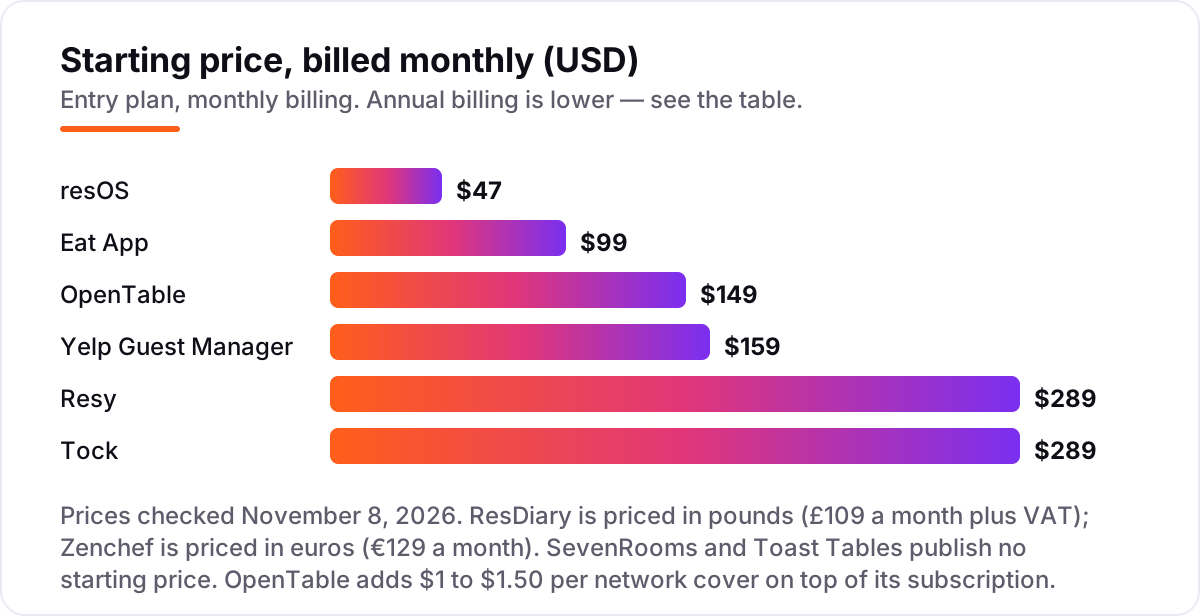
Restaurant reservation software pricing: what you will actually pay
Take a restaurant doing 500 bookings a month — about 1,500 covers at three guests a table — with half the covers coming through a marketplace and half through its own site. On list prices, the monthly subscription costs $47 on resOS Basic, $99 on Eat App Lite, $149 on OpenTable Basic, $159 on Yelp Guest Manager Basic, $289 on Resy Platform or Tock Essential, and $299 on OpenTable Core. Two of those numbers need adjusting before they are real: resOS Basic covers 350 bookings, so 500 bookings need Plus at $98, and Yelp Basic caps at 500 covers, so 1,500 covers need Plus at $349.
Then the cover fees land. OpenTable Basic adds 750 network covers at $1.50, which is $1,125, plus 750 website covers at $0.25, which is $187.50, taking the monthly bill to about $1,462. OpenTable Core adds 750 network covers at $1.00, which is $750, taking it to $1,049, with website bookings included. Resy and Tock stay flat at $289, Yelp Plus stays flat at $349, Eat App Lite stays flat at $99 and resOS Plus stays flat at $98.
Over a year, that is $1,176 on resOS Plus, $1,188 on Eat App Lite, $3,468 on Resy Platform or Tock Essential, $4,188 on Yelp Plus, $12,588 on OpenTable Core and about $17,544 on OpenTable Basic. The same 500 bookings cost $1,176 a year at the cheap end and $17,544 at the dear end — a $16,368 gap that comes entirely from per-cover fees, not from features. The two European tools sit outside this math: ResDiary Pro costs £205 a month plus VAT for 1,000 bookings, and Zenchef Manage costs €169 a month, both flat. SevenRooms and Toast Tables publish no price, so get both quotes in writing before you compare them with anything here.
Three costs sit outside every number above. First, prepayment fees: 2% on OpenTable prepaid experiences, 3% on Tock Essential and 2% on Premium, and 1.2% on ResDiary deposits. Second, card processing on the deposits and prepayments you take, which is charged per transaction rather than per month. Third, the add-ons: POS integration at $39 a month on Eat App Lite and Core, SMS credits on most tools, and Yelp Host from $249 a month if you want an AI phone service answering calls after hours.
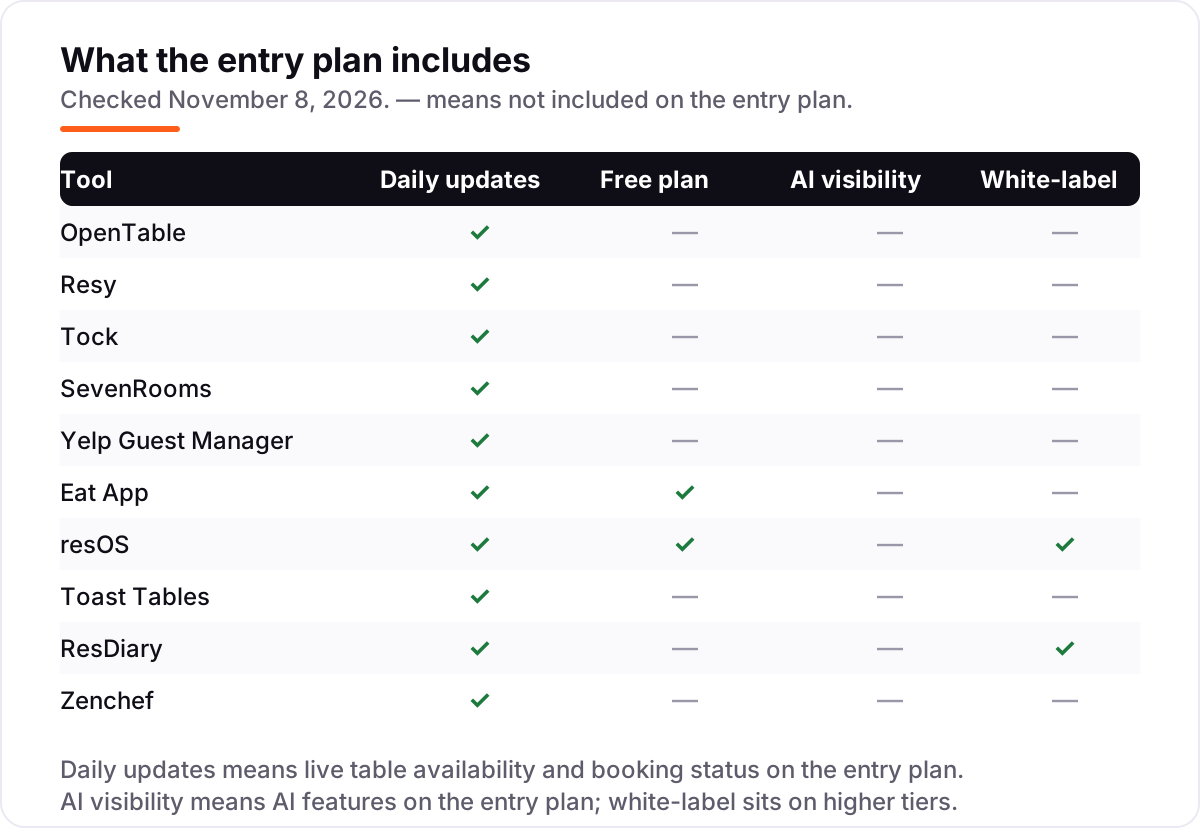
Know the difference: a reservation system vs a booking marketplace
The confusion in this category is between a tool and a marketplace. A reservation system is software you rent: you put its widget on your website, guests book directly, you pay one flat fee and you keep the guest data. Eat App, resOS, ResDiary and Zenchef all work this way. A booking marketplace is a place diners go to find a table: OpenTable, Resy and Yelp put your restaurant in front of guests who were not looking for you, and you pay for that reach — per cover on OpenTable, or through the subscription and the guest relationship on Resy and Yelp.
Neither model is wrong; they solve different problems. A new restaurant in a competitive city needs discovery more than software, so OpenTable's network or Yelp's search traffic is worth paying for. A neighbourhood restaurant with a loyal following needs the opposite: a cheap direct-booking tool that takes the booking, remembers the regular and costs the same in a quiet month as a busy one. The expensive mistake is buying one when you need the other — paying per cover for guests who would have booked direct anyway, or renting a flat-fee widget when nobody knows your restaurant exists.
A third distinction worth knowing is bookings versus covers, because the two words price different things. resOS and ResDiary sell bookings: one table, however many guests sit at it. Eat App and Yelp sell covers: one guest, however they are grouped. A restaurant that seats mostly couples pays roughly the same either way; a restaurant that seats mostly tables of six pays far more per cover than per booking. Check which unit your cap counts before you compare two prices.
One more fact that changes the shortlist: Quandoo is closing globally. New bookings ended on September 30, 2026, and its website, app and infrastructure go offline on December 31, 2026. If your restaurant still runs Quandoo, move now — Eat App and resOS both offer free plans for the move, and ResDiary is the closest like-for-like diary for UK venues.
Quick comparison: tool type by need
| Buyer | Best pick | Why |
|---|---|---|
| Most US restaurants | OpenTable | Biggest diner network, from $149/month plus $1 to $1.50 per network cover |
| Upscale and fine dining | Resy | Flat $289/month, no per-cover fees, Amex cardholder demand |
| Prepaid and ticketed dining | Tock | Guests pay at booking, from $289/month plus a 2 to 3% prepayment fee |
| Guest CRM and marketing | SevenRooms | Deepest guest profiles, priced by quote, no per-cover fees |
| Yelp-driven discovery | Yelp Guest Manager | Bookings from Yelp, Google and Apple Maps, from $159/month, 500-cover cap |
| Best value with a free plan | Eat App | Free up to 100 covers a month, Lite is $99/month with no cover fees |
| Cheapest paid plan | resOS | Free up to 25 bookings a month, Basic is $47/month for 350 bookings |
| Already on Toast POS | Toast Tables | Reservations inside the POS you run, priced by quote, no per-cover fees |
| UK and APAC white-label diary | ResDiary | White-label and commission-free, from £109/month plus VAT |
| European venues | Zenchef | Flat euro pricing from €129/month, no per-cover fees, Google Reserve included |
Mistakes to avoid
- Budgeting on the subscription and forgetting the cover fees. OpenTable Basic at $149 a month is not a $149 bill once network covers are added — at 750 network covers it is about $1,462 a month.
- Buying a marketplace when your regulars already find you. If most bookings come from your own site or Google, a flat-fee tool like Eat App or resOS does the same job for a tenth of the price.
- Ignoring the cap that bites first. Yelp Basic stops at 500 covers, resOS Free at 25 bookings and ResDiary Connect at 150 bookings — the cap you hit first is your real starting price.
- Signing a year contract without reading the renewal clause. OpenTable auto-renews after a year with 30 days' notice to cancel, and Yelp charges $600 to $1,500 to exit early — ask for the termination terms in writing.
- Staying on a platform that is closing. Quandoo stopped taking new bookings on September 30, 2026 and goes offline on December 31, 2026 — move your bookings and guest list before then, not after.
How we chose
We checked each vendor's own pricing page on November 8, 2026 and recorded the starting price exactly as shown, including the annual-billing figure where the page lists one, and we ranked the tools by fit for the most common buyer — an independent US restaurant that takes most bookings online — not by brand size. Two prices need a note: Zenchef's euro prices come from its French pricing page as read on October 21 and 27, 2026, since its global page lists no amounts, and Yelp's $159 a month comes from Yelp's own pricing page, which supersedes the older $99 figure still shown on G2. SevenRooms and Toast Tables publish no price, so we list them as custom quote rather than repeating a third-party estimate. Ratings come from G2 pages checked November 8, 2026; resOS has no G2 listing, Toast Tables has no separate G2 listing apart from Toast POS, and we found no G2 or Capterra rating for Zenchef, so those three cards show no rating rather than a borrowed one. No vendor paid for a place in this list, and none of the links here are affiliate links.
What to do next
Start with the free plan or trial of your top pick and run one real week of bookings through it. Check that the host stand can seat a full service without fighting the floor plan, that reminders reach guests before no-show time, and that you can export your guest list. If the bookings are sorted but new customers are not finding you, our monthly SEO service handles the visibility side — or compare providers in our guide to SEO companies for small business. Once your tools are in place, find out what's holding your rankings back.
Your stack only works if people find you
SerpAstra fixes what keeps your site off page one and makes it easy for AI assistants to recommend.
Get a free audit→Sources we checked (17)
- OpenTable pricing — opentable.com/restaurant-solutions/plans (checked November 8, 2026)
- Resy pricing — resy.com/join/plans-pricing (checked November 8, 2026)
- Tock pricing — resy.com/join/plans-pricing, Tock-powered plans (checked November 8, 2026)
- SevenRooms — sevenrooms.com (checked November 8, 2026)
- Yelp Guest Manager pricing — business.yelp.com/restaurants/yelp-restaurants-pricing (checked November 8, 2026)
- Eat App pricing — restaurant.eatapp.co/pricing (checked November 8, 2026)
- resOS pricing — resos.com/pricing (checked November 8, 2026)
- Toast Tables — pos.toasttab.com/products/toast-tables (checked November 8, 2026)
- ResDiary pricing — resdiary.com/pricing-gbp (checked November 8, 2026)
- Zenchef pricing — zenchef.com, French pricing page €129/€169/€249 (read October 2026)
- OpenTable for Restaurants reviews — g2.com/products/opentable-for-restaurants/reviews (checked November 8, 2026)
- ResyOS reviews — g2.com/products/resyos/reviews (checked November 8, 2026)
- Tock reviews — g2.com/products/tock/reviews (checked November 8, 2026)
- SevenRooms reviews — g2.com/products/sevenrooms/reviews (checked November 8, 2026)
- Yelp Guest Manager reviews — g2.com/products/yelp-guest-manager/reviews (checked November 8, 2026)
- Eat App reviews — g2.com/products/eat-app-eat-app/reviews (checked November 8, 2026)
- ResDiary reviews — g2.com/products/resdiary/reviews (checked November 8, 2026)
Shamim
Founder of SerpAstra
A full-stack SEO and digital marketer who spends most days on Local SEO for dental practices, AI search visibility and lead generation.
Frequently asked questions
What is the best restaurant reservation software?
OpenTable is the best fit for most US restaurants because of its diner network, from $149 a month plus per-cover fees. Resy is the better pick for upscale rooms that want a flat $289 a month with no cover fees. Eat App is the best value, with a free plan up to 100 covers a month and Lite at $99 a month.
How much does restaurant reservation software cost?
Entry prices run from $0 to $289 a month in the US. Eat App and resOS both have free plans, and the first paid plans cost $47 to $159 a month. OpenTable is the dearest at volume because of its $1 to $1.50 per-cover fee, while Resy and Tock charge a flat $289 a month with no cover fees.
Is there really free restaurant reservation software?
Yes, with caps. Eat App is free for up to 100 covers a month, and resOS is free for up to 25 bookings a month, both with no credit card. The caps are the catch: a busy room outgrows either free plan fast, so treat them as a trial with real bookings, not a permanent home for a full dining room.
OpenTable vs Resy: which is cheaper?
It depends on volume. At 750 network covers a month, OpenTable Basic costs about $1,462 a month once cover fees are added, while Resy Platform costs a flat $289. Below roughly 100 network covers a month, OpenTable Basic is cheaper. The break-even sits near 100 covers, so count your network covers before choosing.
Do I need a marketplace or a direct-booking tool?
Pick a marketplace when you need new diners: OpenTable, Resy and Yelp put your tables where guests already search, and you pay for that reach. Pick a direct-booking tool like Eat App, resOS, ResDiary or Zenchef when your regulars already find you, since you pay one flat fee and keep the guest data.
Can I switch restaurant reservation software later?
Yes, but plan the move for a quiet week. Export your guest list and upcoming bookings from the old tool, rebuild the floor plan and booking rules in the new one, and run both systems in parallel for a week so no reservation is lost. Check the old contract first: OpenTable needs 30 days' notice before renewal.
What happened to Quandoo?
Quandoo is closing globally. New bookings ended on September 30, 2026, and its website, app and infrastructure go offline on December 31, 2026. Restaurants still on Quandoo need a new system now: Eat App and resOS both offer free plans for the move, and ResDiary is the closest like-for-like diary for UK venues.
Free SEO and AI visibility audit
Find out what is holding your rankings back
Send us your site. Within 2 business days you get a written audit, an AI visibility check and a short fix list ranked by impact. Free, with no contract attached.
Request my free audit→Related guides
 Local Business & Vertical Software11 Best Booking Software for Salons in 2026, ComparedCompare the 11 best booking software for salons on price, free plans, marketplace fees and no-show tools, with every price checked November 7, 2026.Read guide →
 SEO & AI SearchBest Local SEO Tools for 2026: 11 Picks Ranked by What You Need11 best local SEO tools with real prices checked November 1, 2026 — from $14/month trackers to quote-only enterprise platforms, sorted by what you need.Read guide →
 SEO & AI Search8 Best SEO Companies for Small Business in 20268 best SEO companies for small business compared on price, contracts and AI visibility, with prices checked on each agency's own site on November 1, 2026.Read guide →