
10 Best SAAS Companies to Work (2026): Who to Hire and What It Costs
Compare the 10 best saas companies to work with on starting price, free plans and user reviews — every price checked November 4, 2026 before you buy.
 Shamim Mia, Founder, SerpAstraLast verified November 4, 202614 min read
We compare pricing pages, documentation and public reviews. We never accept payment for rankings.

Key takeaways
- Salesforce leads for most buyers at $25/user/month for Starter Suite; HubSpot follows at $20/seat/month with a free CRM, and Microsoft 365 covers the basics at $7/user/month.
- ServiceNow and Workday publish no price at all — both are custom quotes, so budget them through a sales conversation, not a pricing page.
- The single most important buying factor is the per-user math: a $25 seat and a $7 seat look close on a pricing page and are $216 apart per person per year.
- Every company here except ServiceNow and Workday has a free plan or a free trial, so test the real workflow before signing an annual contract.
On this page
Quick comparison
| Tool | Best for | Starting price | Free plan |
|---|---|---|---|
| Salesforce | Growing sales teams that want the most widely adopted CRM and can live with per-user pricing | $25/user/mo | No (30-day trial) |
| HubSpot | Small businesses that want a free CRM to start on and a gentle upgrade path as the team grows | $20/seat/mo | Yes (free CRM) |
| Microsoft 365 | Small businesses that need email, Office apps, Teams and 1 TB of storage for every user | $7/user/mo | No (1-month trial) |
| Adobe Creative Cloud | Design, video and marketing teams that need the full desktop creative suite under one subscription | $54.99/mo | No (7-day trial) |
| Shopify | Solo founders and small teams launching their first online store | $39/mo | No (3-day trial) |
| Slack | Teams that live in chat and want unlimited message history without paying enterprise prices | $7.25/user/mo | Yes (free plan) |
| Zoom Workplace | Small businesses that need reliable video meetings with AI summaries included | $14.16/user/mo | Yes (free plan) |
| Atlassian Jira | Software teams that need structured issue tracking, sprints and roadmaps in one place | $9.70/user/mo | Yes (free to 10) |
| ServiceNow | Large enterprises that need one platform for IT service, operations and employee workflows | Custom quote | No (demo only) |
| Workday | Large employers that want HR, payroll, talent and finance on one system of record | Custom quote | No (demo only) |
Make one of these tools?
We re-check this list every quarter. Send a correction, request a review, or ask about a clearly labeled sponsored spot.
Request a listingThe best saas companies to work with

Salesforce
Best for: Growing sales teams that want the most widely adopted CRM and can live with per-user pricing
Salesforce is the company most businesses mean when they say CRM. Sales Cloud starts at $25 per user per month for Starter Suite, bundling sales, service and marketing basics for 10 users, the only edition Salesforce sells month to month. Above it — Pro Suite at $100, Core at $195, Advanced at $395, Max at $550 — everything is billed annually, so the entry price is the only flexible one.
The catch is the step up: once a team outgrows Starter Suite, the per-user price quadruples, and premium AI (Agentforce for Sales) starts at $125 per user per month. Setup also takes real admin time, with a learning curve G2 reviewers mention. Pick Salesforce for the most widely adopted CRM and the deepest app ecosystem; pick HubSpot for a gentler price curve as the team grows.
What we like
- Starter Suite costs $25 per user per month on monthly or annual billing, the only edition Salesforce sells month to month
- The deepest CRM ecosystem in this list: thousands of apps on AppExchange and native sales, service and marketing in one account
- A 30-day free trial lets a small team start without a contract
- G2's largest review base here, 27,587 reviews at 4.4 out of 5, with the strongest marks for automation and reporting
Watch out for
- Starter Suite is capped at 10 users, and the next step up quadruples the per-user price to $100
- Premium AI (Agentforce for Sales) is a separate add-on from $125 per user per month
- Setup and customization take real admin time, and G2 reviewers repeatedly cite the learning curve

HubSpot
Best for: Small businesses that want a free CRM to start on and a gentle upgrade path as the team grows
HubSpot is the easiest company here to start with: the free tier is a real CRM, not a timed trial. The free plan covers 2 users and 1,000 contacts with email tracking and meeting scheduling, and Sales Hub Starter costs $20 per seat per month when you are ready to pay. Breeze AI is included on every plan, so the entry tier is not stripped of the selling point.
Watch the price curve: new customers currently see a $7 per seat annual promo, but the list price is $20, and Professional jumps to $90 per seat per month plus a $1,500 onboarding fee, with sequences and forecasting behind it. Pick HubSpot when you want to start free and grow inside one account; pick Salesforce when you need the deepest CRM ecosystem and can pay for it.
What we like
- The only free CRM in this list that stays useful past the trial: 2 users, 1,000 contacts, email tracking and meeting scheduling
- Sales Hub Starter costs $20 per seat per month on monthly billing, with Breeze AI features included on every plan
- One account covers sales, marketing, service and content, so the stack grows without a replatform
- Rated 4.4 out of 5 on G2 from 14,384 reviews, with ease of use the most-cited strength
Watch out for
- The $7 annual promo for new customers is time-limited; the list price is $20 per seat per month
- Professional jumps to $90 per seat per month plus a $1,500 one-time onboarding fee
- Advanced sequences, forecasting and custom reporting are locked behind Professional

Microsoft 365
Best for: Small businesses that need email, Office apps, Teams and 1 TB of storage for every user
Microsoft 365 is the quiet default in this list: the software most teams already know, at the lowest entry price here. Business Basic costs $7 per user per month on an annual commitment and covers business email, Teams, SharePoint and 1 TB of OneDrive storage, plus web and mobile Office apps. Copilot Chat is included in every plan.
Two limits matter: Basic has no desktop Office apps — the installed versions need Business Standard at $14 per user per month — and the plan caps at 300 users, so larger companies move to Enterprise pricing. Note the price: Basic rose from $6 to $7 on July 1, 2026, and older listings still show $6. Pick Microsoft 365 when email and Office are the core need; pick Slack or Zoom when the work is mostly chat and meetings.
What we like
- The cheapest entry seat in this list at $7 per user per month on an annual commitment
- One licence covers business email, Teams, SharePoint and 1 TB of OneDrive storage per user
- Copilot Chat enhancements are now included in every plan, not sold as a separate add-on
- The highest G2 score here, 4.6 out of 5 from 5,883 reviews, with seamless integration the top-cited strength
Watch out for
- Business Basic rose from $6 to $7 per user per month on July 1, 2026, and G2 still lists the old $6 figure
- No desktop Office apps on Basic — Word, Excel and PowerPoint are web and mobile only
- The plan caps at 300 users, so growing companies eventually move to an Enterprise plan

Adobe Creative Cloud
Best for: Design, video and marketing teams that need the full desktop creative suite under one subscription
Adobe Creative Cloud is the creative-industry default, and its pricing changed in June 2025, which older guides still get wrong. The old All Apps plan is now Creative Cloud Pro at $69.99 a month, and the entry plan is Creative Cloud Standard at $54.99 a month on an annual plan billed monthly. Standard includes the full desktop app set — Photoshop, Illustrator, Premiere Pro and more — plus 100 GB of storage, Adobe Fonts and Portfolio.
The difference is almost entirely generative AI: Standard allows 25 generative credits a month, Pro allows 4,000 plus premium video and audio generation. Cancelling an annual plan early triggers a fee of 50% of the remaining balance. Pick Standard when desktop apps are the need; pick Pro when generative AI is part of the daily workflow.
What we like
- Standard costs $54.99 a month on an annual plan billed monthly and includes the full desktop app set: Photoshop, Illustrator, Premiere Pro and more
- 100 GB of cloud storage, Adobe Fonts and Adobe Portfolio are included on every individual plan
- The highest review score in this list, 4.7 out of 5 on Capterra from 7,327 reviews
- Single-app plans from $22.99 a month mean a team that needs only Photoshop never pays for the suite
Watch out for
- The old $59.99 All Apps price is gone: the plan is now Creative Cloud Pro at $69.99, with Standard at $54.99 below it
- Cancelling an annual plan early triggers a fee equal to 50% of the remaining balance
- Standard caps generative AI at 25 credits a month, far below Pro's 4,000

Shopify
Best for: Solo founders and small teams launching their first online store
Shopify is the fastest route from idea to a working store here. The Basic plan costs $39 a month, or $29 a month billed annually, and includes a full store with unlimited products, hosting, SSL and gift cards. Shopify Payments charges 2.9% plus 30 cents per online sale with no extra platform fee, and the trial — 3 days free, then $1 a month for 3 months — is the longest cheap on-ramp.
The bill grows past the subscription. A 2% fee applies on sales through a third-party gateway, and G2 reviewers report paid apps and themes pushing the total from $39 to $200 or $300 a month. Checkout customization is also limited on Basic. Pick Shopify when you want to sell online quickly; pick a self-hosted platform when you need full control of checkout and fees.
What we like
- Basic costs $39 a month, or $29 a month billed annually, and includes a full store with unlimited products, hosting and SSL
- Shopify Payments charges 2.9% + 30 cents online with no extra platform fee, and Sidekick AI is included
- The 3-day free trial followed by $1 a month for 3 months is the longest cheap on-ramp in this list
- Rated 4.4 out of 5 on G2 from 5,129 reviews, with easy integration the most-cited strength
Watch out for
- A 2% fee applies on sales through a third-party payment gateway, on top of the gateway's own fees
- App and theme costs stack fast: G2 reviewers report $39 a month becoming $200 to $300 with paid apps
- Checkout customization is limited on Basic; deeper control needs Advanced at $399 a month

Slack
Best for: Teams that live in chat and want unlimited message history without paying enterprise prices
Slack is the team-chat default, and its pricing has one feature no rival here matches: Fair Billing. Pro costs $7.25 per user per month billed annually, or $8.75 month to month, and you only pay for members who were active in the last 28 days — inactive seats earn prorated credits. The plan includes unlimited message history, unlimited apps and integrations, group huddles and basic AI.
The catch is the AI ladder. Advanced AI features moved to Business+ at $15 per user per month, nearly double the Pro price, so teams that bought Slack for AI may find themselves upgrading. Pro also has a 3-user minimum, so a two-person team pays for three seats. Pick Slack when chat is where the work happens; pick Microsoft 365 when email and Office matter more than chat.
What we like
- Pro costs $7.25 per user per month billed annually, or $8.75 month to month, with unlimited message history and apps
- Fair Billing means you only pay for members active in the last 28 days, with credits for inactive seats
- Basic AI is included on Pro, and Slack connects to more than 2,600 apps
- Rated 4.5 out of 5 on G2 from 39,274 reviews, with ease of use the most-cited strength
Watch out for
- Advanced AI features moved to Business+ at $15 per user per month, nearly double the Pro price
- Pro requires a 3-user minimum, so a two-person team still pays for three seats
- G2 reviewers flag notification overload and rising cost as teams grow

Zoom Workplace
Best for: Small businesses that need reliable video meetings with AI summaries included
Zoom Workplace is the meeting standard, and its Pro plan is the most complete entry tier in this list. At $14.16 per user per month billed annually, or $16.99 month to month, it removes the free plan's 40-minute group limit, extends meetings to 30 hours for up to 100 participants, and includes AI Companion summaries and note-taking at no extra charge. One licence also covers Team Chat, Mail and Calendar.
The free plan is genuinely usable for one-to-one calls, but the 40-minute cap on group meetings is the push toward paid. Zoom's chat and docs are also less polished than Slack's, per G2 reviewers, so teams that live in chat usually pair the two. Pick Zoom when meetings are the core of the working day; pick Slack when the work happens in channels rather than calls.
What we like
- Pro costs $14.16 per user per month billed annually, or $16.99 month to month, with 30-hour meetings for up to 100 participants
- AI Companion meeting summaries and note-taking are included on Pro at no extra charge
- The largest review base in this list, 4.5 out of 5 on G2 from 56,560 reviews, led by audio quality
- One licence covers Meetings, Team Chat, Mail and Calendar, so it replaces several single-purpose tools
Watch out for
- The free plan caps group meetings at 40 minutes, which interrupts real work
- Chat, docs and whiteboards feel less polished than Slack's, per G2 reviewers
- Pro allows up to 99 licences; larger rollouts need Business at $18.33 per user per month

Atlassian Jira
Best for: Software teams that need structured issue tracking, sprints and roadmaps in one place
Jira is the project-tracking standard for software teams, with the most banded pricing in this list. Standard costs $9.70 per user per month for teams of 1 to 100 users on monthly billing, or $9,700 a year for 100 users — about $8.08 per user per month. The rate falls as the team grows: $8.20 for 101 to 250 users, $6.85 for 251 to 1,000. Free for up to 10 users.
The price moved recently: Atlassian raised Cloud prices on October 13, 2026, taking Standard from $9.05 to $9.70 for the smallest band; older guides still quote $7.53 or $7.91. AI agents are included on every paid plan, with 25 Rovo credits per user per month on Standard. Pick Jira when software delivery is the work; pick a simpler tracker for a shared to-do list.
What we like
- Standard costs $9.70 per user per month on monthly billing for 1-100 users, or $9,700 a year for 100 users on annual billing
- Free for up to 10 users, so a small team can run real sprints before paying anything
- AI agents (Rovo) are included on every paid plan, with 25 Rovo AI credits per user per month on Standard
- Rated 4.3 out of 5 on G2 from 7,941 reviews, with project management the most-cited strength
Watch out for
- Atlassian raised Cloud prices on October 13, 2026: Standard went from $9.05 to $9.70 per user per month for 1-100 users
- The per-user rate changes by user band, so the bill is hard to predict as the team grows
- G2 reviewers cite complexity and a steep learning curve for new users

ServiceNow
Best for: Large enterprises that need one platform for IT service, operations and employee workflows
ServiceNow is the enterprise end of this list, and it is the only company here besides Workday that publishes no price at all. Its IT Service Management platform is sold in three tiers — Foundation, Advanced and Prime — and every deal is a custom quote shaped by module mix, fulfiller count and support tier. Third-party analysts put ITSM fulfilment roughly at $70 to $200 per user per month, but that is an estimate, not a ServiceNow figure.
What the money buys is breadth: incidents, requests, changes, problems and knowledge on one platform, with AI assists bundled into every tier since April 2026, and requesters free — only the staff who fulfil tickets need licences. Implementation typically takes about 5 months. Pick ServiceNow when IT operations run the business; it is not a small-team purchase.
What we like
- IT Service Management is sold in three tiers — Foundation, Advanced and Prime — with AI assists bundled into every tier since April 2026
- One platform covers incidents, requests, changes, problems and knowledge, with workflow automation across all of them
- Rated 4.5 out of 5 on G2 from 2,021 reviews, with features and automation the most-cited strengths
- Requesters are free: only the staff who fulfil tickets need paid licences
Watch out for
- No published price: every deal is a custom quote, and third-party estimates put ITSM fulfilment at roughly $70-$200 per user per month
- G2 reviewers report a typical implementation of about 5 months
- Heavy customization needs specialist administrators, and licensing costs rise with every module

Workday
Best for: Large employers that want HR, payroll, talent and finance on one system of record
Workday is the HR and finance counterpart to ServiceNow: the system large employers run their people operations on, equally quote-only. Its HCM suite covers core HR, absence, compensation, benefits and workflows, with payroll, talent and financial management on the same platform, and Illuminate AI agents are rolling out across it. Pricing is per worker per year inside a negotiated contract; third-party ranges put HCM around $50 to $150 per worker per year.
The real cost is time: G2 reviewers report implementations commonly taking more than 12 months. Talent, Learning, Payroll and Time Tracking are separate paid modules on top of the base. There is no free tier and no HCM trial, only a demo. Pick Workday when the whole people operation needs one system of record — not a purchase for a team of ten.
What we like
- HCM covers core HR, absence, compensation, benefits and workflows on one system, with payroll and financials on the same platform
- Illuminate AI agents are rolling out across HCM for recruiting, reporting and workforce planning
- Rated 4.2 out of 5 on G2 from 2,494 reviews, with a user-friendly interface the most-cited strength
- One worker count (Full Service Equivalent) prices the whole subscription, which keeps the contract model simple
Watch out for
- No published price: HCM is sold per worker per year inside a negotiated contract, with third-party ranges around $50-$150 per worker per year
- G2 reviewers report implementations commonly taking more than 12 months
- Talent, Learning, Payroll and Time Tracking are separate paid modules on top of the base
The best saas companies to work with are the ones your team already depends on every day: the CRM that holds your pipeline, the chat where decisions happen, the store that takes your orders. This list ranks the ten SaaS companies most businesses end up hiring, ordered by fit for the most common buyer — a small or mid-sized team picking its core stack — with every starting price checked on November 4, 2026.
How to choose the best saas companies to work with
- Start from the job, not the brand. A CRM, a chat tool and an online store solve different problems; the biggest name in one category is useless in another. List the three workflows your team does daily, then match a company to each.
- Do the per-user math before the per-month math. A $25 seat and a $7 seat look close on a pricing page and are $216 apart per person per year. Multiply every price by your headcount before you compare.
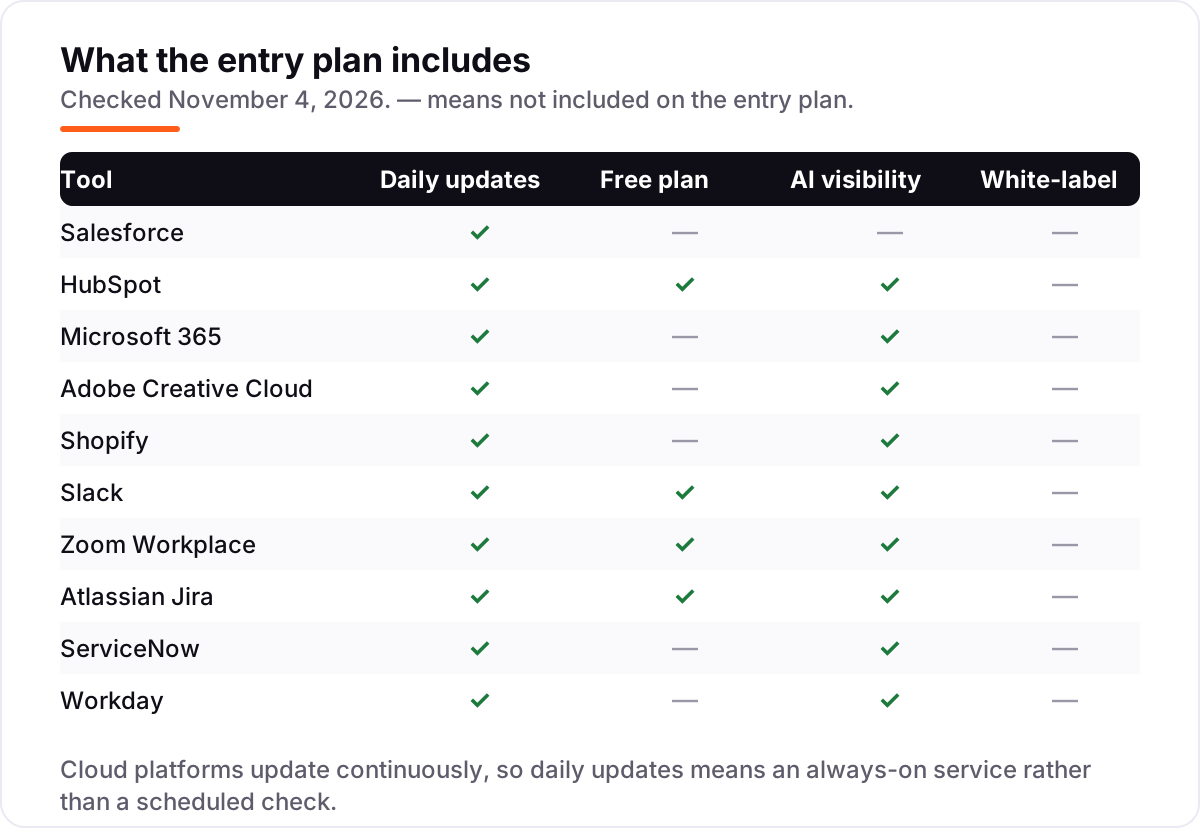
- Check what the entry plan actually includes. AI is the current dividing line: HubSpot, Microsoft 365, Zoom and Jira include AI on the entry plan, while Salesforce charges extra for Agentforce and Slack reserves advanced AI for Business+.
- Read the billing term, not just the price. Several prices here are annual-commitment rates: Microsoft 365 at $7, Slack at $7.25 and Zoom at $14.16 all cost more month to month. Salesforce Starter Suite is the only plan in this list with the same price on either term.
- Try the free tier first. HubSpot, Slack, Zoom and Jira all have free plans, and the other priced companies offer trials. A month on the free tier tells you more about fit than any review.
A company's website is only half the story: if customers cannot find it on Google, the best product in the world still loses deals. Our monthly SEO service handles that side, and the free SERP snippet preview tool shows exactly how your pages will look in search results before you publish them.
Whatever you shortlist, run one real workflow through the free plan or trial before you pay. Add a lead and close it, run a sprint, hold a week of meetings, sell one product — and check two things: that the team actually uses it without prompting, and that the price at your headcount still looks right. Every company here except ServiceNow and Workday lets you do that without a sales call.
SaaS companies pricing: what you will actually pay
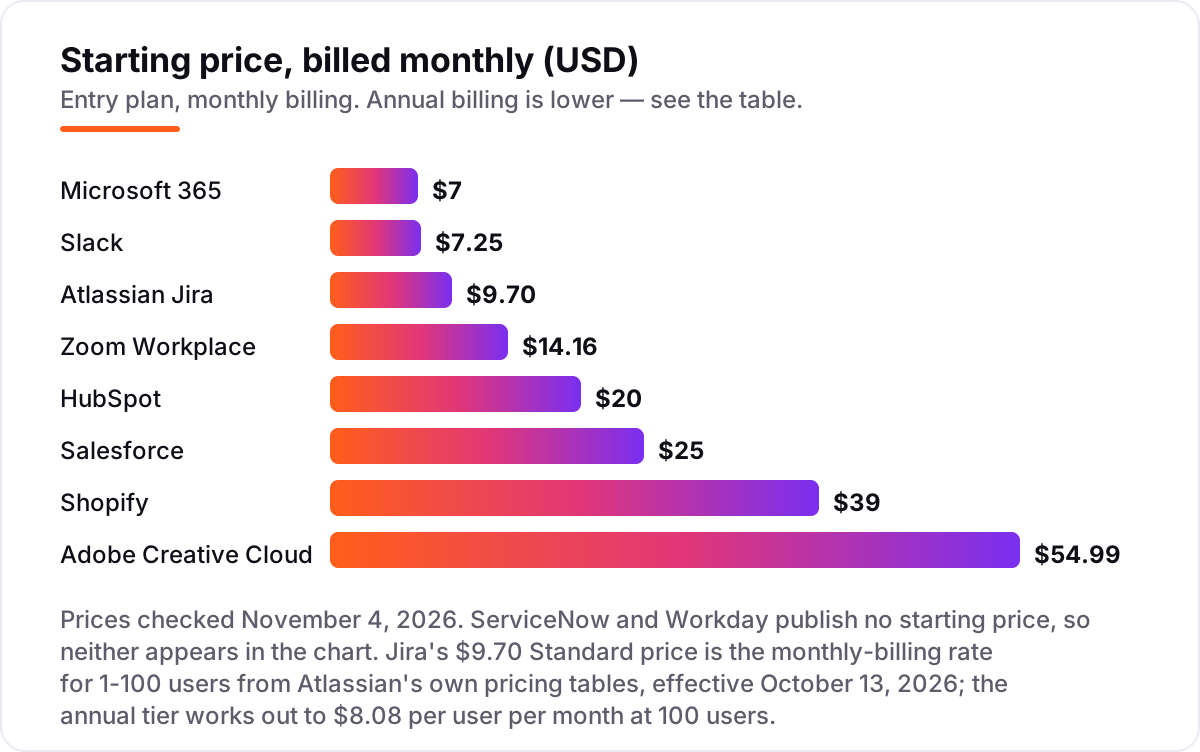
Take a 10-person team that buys the core stack on entry plans. The monthly bill is $250 for Salesforce Starter Suite at $25 a seat, $200 for HubSpot Sales Hub Starter at $20 a seat, $70 for Microsoft 365 Business Basic at $7 a seat, $54.99 for Adobe Creative Cloud Standard, $39 for Shopify Basic, $72.50 for Slack Pro at $7.25 a seat, $141.60 for Zoom Pro at $14.16 a seat, and $97 for Jira Standard at $9.70 a seat. That adds up to $925.09 a month, or $11,101.08 a year.
Three adjustments make that number real. First, the annual-commitment prices are the ones used above: paying month to month raises Slack to $8.75 a seat, Zoom to $16.99 and Microsoft 365 to $7.20, adding about $45 a month for the same 10 people. Second, Shopify's $39 is the monthly rate — annual billing drops it to $29, saving $120 a year. Third, the two companies missing from the total are the expensive ones: ServiceNow and Workday are custom quotes, and third-party estimates put their entry points in the thousands per month for a team this size, before implementation.
Two costs sit outside every number above. The first is the step up: Salesforce quadruples to $100 a seat above Starter Suite, HubSpot jumps to $90 a seat on Professional plus a $1,500 onboarding fee, and Adobe's Pro tier costs $69.99 against Standard's $54.99. The second is the add-on bill: Salesforce's Agentforce starts at $125 a user per month, Shopify's paid apps can add $200 a month, and ServiceNow and Workday charge separately for modules, training and support. Budget the stack on the second-year price, not the first-month promo.
Know the difference: buying a SaaS product vs hiring a SaaS company
The confusion in this category is between a product and a company. Each name here sells many products at many prices: Salesforce sells Sales Cloud, Service Cloud and Marketing Cloud; Microsoft sells 365, Azure and Dynamics; Adobe sells Creative Cloud, Acrobat and Experience Cloud. The starting price in each card is for the flagship product a buyer usually starts with — Sales Cloud for Salesforce, Business Basic for Microsoft 365, Creative Cloud Standard for Adobe — not for everything the company sells.
There is a second, quieter confusion: per-user pricing vs per-company pricing. Eight of the ten companies here charge per user per month, so the bill scales with headcount and a 10-person team pays ten times the headline price. Shopify and Adobe charge per account or per subscription instead, so the price is the price whatever the team size. ServiceNow and Workday are a third model entirely: an annual contract priced on fulfiller count or worker count, negotiated rather than listed.
A third distinction worth knowing is trial vs free plan. A free plan — HubSpot, Slack, Zoom, Jira — never expires and caps features; a trial — Salesforce, Microsoft 365, Adobe, Shopify — gives you everything for a set number of days and then stops. Free plans are for evaluation over weeks; trials are for a focused test over days. Use the free plan to learn whether the team adopts the tool, and the trial to test the paid features before the first invoice.
Quick comparison: tool type by need
| Buyer | Best pick | Why |
|---|---|---|
| Most teams, first CRM | Salesforce | Starter Suite $25/user/month, deepest app ecosystem |
| Small business starting free | HubSpot | Free CRM, Starter $20/seat/month, one account for everything |
| Cheapest seat for email and Office | Microsoft 365 | Business Basic $7/user/month, email, Teams and 1 TB storage |
| Design and video team | Adobe Creative Cloud | Standard $54.99/month, full desktop app set |
| First online store | Shopify | Basic $39/month, $29 billed annually, 3-month $1 trial |
| Team that lives in chat | Slack | Pro $7.25/user/month, pay only for active members |
| Reliable video meetings | Zoom Workplace | Pro $14.16/user/month, AI summaries included |
| Software team tracking work | Atlassian Jira | Standard $9.70/user/month, free up to 10 users |
| Enterprise IT operations | ServiceNow | Custom quote, ITSM in three tiers with AI bundled |
| Enterprise HR and finance | Workday | Custom quote, one system for people, money and planning |
Mistakes to avoid
- Budgeting on the promo price. HubSpot's $7 annual promo, Shopify's $1 trial months and Adobe's first-year discounts all end. The list price is what you pay in month two, so compare companies on that number.
- Forgetting the per-user multiplier. A $25 seat is $3,000 a year for ten people; a $7 seat is $840. Multiply every price by headcount before you decide anything is cheap.
- Ignoring the step up. Salesforce quadruples above Starter Suite, HubSpot jumps to $90 a seat on Professional, and Slack's advanced AI needs Business+ at $15. Check the price of the tier you will need in a year, not the one you start on.
- Signing an annual contract before the trial. ServiceNow and Workday implementations take months and the contracts run a year or more. Every other company here lets you test free first — use that before you commit.
- Trusting old price listings. Microsoft 365 rose from $6 to $7 in July 2026, Adobe's $59.99 All Apps became Pro at $69.99, and Jira rose in October 2026. Price pages change; check the vendor's own page on the day you buy.
How we chose
We checked each vendor's own pricing page on November 4, 2026 and recorded the starting price exactly as shown, then ranked the companies by fit for the most common buyer — a small or mid-sized team picking its core software stack — not by brand size. Three prices need a note. Microsoft 365 Business Basic rose from $6 to $7 per user per month on July 1, 2026, and G2 still lists the old $6 figure; $7 is the current vendor price. Adobe's old $59.99 All Apps plan no longer exists: it became Creative Cloud Pro at $69.99 in June 2025, and the entry plan is now Creative Cloud Standard at $54.99. Jira Standard rose from $9.05 to $9.70 per user per month on October 13, 2026, per Atlassian's own pricing tables, and older guides still quote $7.53 or $7.91. ServiceNow and Workday publish no prices, so both are listed as custom quotes and no third-party estimate is presented as their price. Ratings come only from G2 and Capterra pages we opened on November 4, 2026. No vendor paid for a place in this list, and none of the links here are affiliate links.
What to do next
Start with the free plan or trial of your top pick and run one real workflow through it for a week or two — a lead, a sprint, a week of meetings, a first sale. Check that the team uses it without prompting and that the price at your headcount still looks right before you sign anything annual. If the stack is sorted but new customers are not finding the company behind it, our monthly SEO service handles the visibility side — or compare providers in our guide to SEO companies for small business. Once your tools are in place, find out what's holding your rankings back.
Your stack only works if people find you
SerpAstra fixes what keeps your site off page one and makes it easy for AI assistants to recommend.
Get a free audit→Sources we checked (19)
- Salesforce Sales Cloud pricing — salesforce.com/sales/pricing (checked November 4, 2026)
- Salesforce Sales Cloud G2 reviews — g2.com (checked November 4, 2026)
- HubSpot Sales Hub pricing — hubspot.com/pricing/sales (checked November 4, 2026)
- HubSpot Sales Hub G2 reviews — g2.com (checked November 4, 2026)
- Microsoft 365 business plans — microsoft.com (checked November 4, 2026)
- Microsoft 365 G2 reviews — g2.com (checked November 4, 2026)
- Adobe Creative Cloud plans — adobe.com/creativecloud/plans (checked November 4, 2026)
- Adobe Creative Cloud Capterra reviews — capterra.com (checked November 4, 2026)
- Shopify pricing — shopify.com/pricing (checked November 4, 2026)
- Shopify G2 reviews — g2.com (checked November 4, 2026)
- Slack pricing — slack.com/pricing (checked November 4, 2026)
- Slack and Zoom Workplace G2 comparison — g2.com (checked November 4, 2026)
- Zoom pricing — zoom.us/pricing (checked November 4, 2026)
- Atlassian Jira Cloud pricing tables — atlassian.com (checked November 4, 2026)
- Jira G2 reviews — g2.com (checked November 4, 2026)
- ServiceNow pricing — servicenow.com (checked November 4, 2026)
- ServiceNow IT Service Management G2 reviews — g2.com (checked November 4, 2026)
- Workday pricing — workday.com (checked November 4, 2026)
- Workday HCM G2 reviews — g2.com (checked November 4, 2026)
Shamim
Founder of SerpAstra
A full-stack SEO and digital marketer who spends most days on Local SEO for dental practices, AI search visibility and lead generation.
Frequently asked questions
What is the best SaaS company to work with?
Salesforce is the best fit for most buyers: the most widely adopted CRM at $25 per user per month, with the deepest app ecosystem. HubSpot is the best starting point for small businesses, with a free CRM and a $20 Starter seat, and Microsoft 365 is the cheapest seat in the list at $7 per user per month.
How much does it cost to work with a SaaS company?
Entry prices in this list run from $7 to $54.99 per user per month: Microsoft 365 at $7, Slack at $7.25, Jira at $9.70, Zoom at $14.16, HubSpot at $20, Salesforce at $25, Shopify at $39 and Adobe at $54.99. ServiceNow and Workday publish no price and quote every deal individually.
Which SaaS companies in this list offer a free plan?
HubSpot, Slack, Zoom and Jira all have free plans: HubSpot's free CRM covers 2 users, Slack's free plan keeps 90 days of message history, Zoom's free Basic plan allows 40-minute group meetings, and Jira is free for up to 10 users. Salesforce, Microsoft 365, Adobe and Shopify offer free trials instead.
Salesforce or HubSpot: which is better for a small business?
HubSpot is the better starting point: its free CRM covers 2 users, and Starter costs $20 per seat per month. Salesforce's Starter Suite is $25 per user per month and caps at 10 users, with the next tier at $100. Choose Salesforce when you need the deepest CRM ecosystem and integrations; choose HubSpot when budget and ease of use matter more.
Why do ServiceNow and Workday not publish prices?
Both sell enterprise platforms where the price depends on modules, user counts and contract terms, so every deal is a custom quote. Third-party estimates put ServiceNow ITSM fulfilment roughly at $70 to $200 per user per month and Workday HCM around $50 to $150 per worker per year, but neither vendor publishes those figures.
Is Microsoft 365 or Slack the cheaper starting point?
Microsoft 365 is cheaper per seat at $7 per user per month against Slack Pro at $7.25, but they buy different things: Microsoft 365 covers email, Office apps, Teams and storage, while Slack is a dedicated chat platform. Most small teams end up with both, since Teams and Slack serve different working styles.
Do I need a contract to start with these companies?
No for most of them. HubSpot, Slack, Zoom and Jira have free plans with no contract, and Salesforce, Microsoft 365, Adobe and Shopify offer free trials. ServiceNow and Workday are the exceptions: both require a sales conversation and a signed annual contract, with implementations measured in months.
Free SEO and AI visibility audit
Find out what is holding your rankings back
Send us your site. Within 2 business days you get a written audit, an AI visibility check and a short fix list ranked by impact. Free, with no contract attached.
Request my free audit→Related guides
 SEO & AI Search8 Best AI Visibility Companies (2026): Who to Hire and What It Costs8 best AI visibility companies compared on price, services and fit, with real published fees. Find the right AI visibility partner for your budget and timeline.Read guide →
 SEO & AI Search8 Best SEO Companies for Small Business in 20268 best SEO companies for small business compared on price, contracts and AI visibility, with prices checked on each agency's own site on November 1, 2026.Read guide →
 SEO & AI Search8 Best SEO Agencies for SAAS Companies in 20268 best SEO agencies for SaaS companies compared on starting retainer, SaaS focus and AI visibility, with prices checked on the agency's site, November 1, 2026.Read guide →