
Best Software for PPC in 2026: 10 Options Compared by Use Case
Compare the best software for PPC on price, free plans and automation, with every price checked November 5, 2026 — from free ad platforms to enterprise tools.
 Shamim Mia, Founder, SerpAstraLast verified November 5, 202613 min read
We compare pricing pages, documentation and public reviews. We never accept payment for rankings.

Key takeaways
- Google Ads and Microsoft Advertising cost $0 to use — you pay only for ad spend — while the cheapest paid tools here are Unbounce at $29/month and SpyFu at $39/month.
- The single most important buying factor is what the price is tied to: ad spend, visitors or seats decide your real bill, not the headline monthly figure.
- SpyFu at $39/month is the cheapest way into competitor ad intelligence, and Optmyzr at $299/month is the automation pick for agencies managing many accounts.
- Skai is the only tool here with no published price — it quotes by ad spend and suits six-figure monthly budgets only.
On this page
Quick comparison
| Tool | Best for | Starting price | Free plan |
|---|---|---|---|
| Google Ads | Any advertiser who wants to run search ads where most buyers actually search, with no software fee | $0 + ad spend | Yes (free platform) |
| Microsoft Advertising | Advertisers who want cheaper clicks on Bing and Yahoo search, usually alongside Google Ads | $0 + ad spend | Yes (free platform) |
| Semrush | Teams that want PPC research, competitor ad history and keyword data in the same suite as their SEO | $139.95/mo | Yes (free account) |
| SpyFu | PPC teams who want to see exactly which keywords and ads competitors have run, going back years | $39/mo | Yes (limited free) |
| Optmyzr | Agencies and in-house teams managing many accounts who want rules-based automation and audits | $299/mo | No (14-day trial) |
| AdEspresso | Small advertisers on Facebook and Instagram who want fast split tests without learning Ads Manager | $49/mo | No (14-day trial) |
| Unbounce | Small teams that need a landing page for each ad group and want it live today | $29/mo | No (14-day trial) |
| Instapage | Larger paid-search teams that want ad-to-page personalization and server-side testing | $99/mo | No (14-day trial) |
| AdRoll | Ecommerce brands that want retargeting across display, social and email without a subscription fee | Free; Plus $36/mo | Yes (free plan) |
| Skai | Large advertisers and agencies spending six figures a month across search, social and retail media | Custom quote | No (demo) |
Make one of these tools?
We re-check this list every quarter. Send a correction, request a review, or ask about a clearly labeled sponsored spot.
Request a listingThe best software for PPC
Google Ads
Best for: Any advertiser who wants to run search ads where most buyers actually search, with no software fee
Google Ads is the platform itself, not a layer on top of it, and that is why it leads this list: it is free to use, it reaches the buyers who search on Google, and it includes the bidding, targeting and measurement that third-party tools charge to repeat. You set a budget, pick keywords, write ads, and pay only when someone clicks — there is no subscription, no seat fee and no minimum spend.
The catch is that the platform is also the bill. Competitive keywords cost several dollars a click, and Google's automated recommendations push budgets up, not down. Smart Bidding and Performance Max help once conversion data exists, but a new account needs limits: daily budgets, negative keywords and a maximum cost per click. Start here before buying any management tool; most small advertisers never need anything else.
What we like
- The largest search audience in the world, with Performance Max and Smart Bidding built in
- No subscription fee: the platform is free and you control the budget down to the dollar
- Deepest keyword, audience and conversion data of any ad platform
- Free tools inside the account — Keyword Planner, auction insights, ad previews — cover most research needs
Watch out for
- Click costs in competitive keywords can eat a small budget in days with no cap on waste unless you set one
- The interface pushes automated recommendations that often raise spend, not efficiency
- Learning curve is steep: match types, Quality Score and bidding take real study
Microsoft Advertising
Best for: Advertisers who want cheaper clicks on Bing and Yahoo search, usually alongside Google Ads
Microsoft Advertising runs the ads on Bing, Yahoo and partner sites, and it is the cheapest second channel in PPC: the platform is free, clicks on the same keyword usually cost less than on Google, and the audience skews older and higher-income. The one-click import copies a Google Ads account — campaigns, keywords, ads and budgets — in minutes, so a working Google account becomes a working Bing account with almost no extra effort.
The limit is volume. Bing's search share is a small fraction of Google's, so Microsoft Advertising is an add-on, not a replacement: expect it to add 10 to 20 percent more search traffic at a lower cost per click, not to double the account. It earns its place for any advertiser already spending on Google who wants cheaper incremental clicks without learning a new platform.
What we like
- Clicks typically cost less than the same keyword on Google Ads, with an older, higher-income audience
- One-click import copies Google Ads campaigns, keywords and ads in minutes
- No subscription fee: the platform is free and you set the budget
- Microsoft Audience Network adds native and display reach beyond search
Watch out for
- Search volume is a fraction of Google's, so it rarely works as a standalone channel
- Importing from Google Ads is easy, but Bing-specific quirks still need manual fixes
- Reporting and audience tools are thinner than Google's, especially for Display

Semrush
Best for: Teams that want PPC research, competitor ad history and keyword data in the same suite as their SEO
Semrush earns its place in a PPC list because of what it reveals before you spend: Advertising Research shows the live ads your competitors run, the keywords they bid on and their estimated budgets, while the Keyword Magic Tool and PPC Keyword Tool build clean keyword lists from that data. The entry SEO plan costs $139.95 a month, or $117.33 billed annually, and tracks 500 keywords a day across 5 projects.
It is a research suite, not a campaign manager — you cannot run ads from Semrush, and the ads you do run live in Google Ads. The price makes sense when the SEO side gets used too: keyword research, site audits and position tracking share the subscription. Buy it when one tool must cover both organic and paid search; buy SpyFu when competitor ad history is the whole job.
What we like
- Advertising Research shows competitors' live ads, keywords and estimated budgets in one view
- Keyword Magic Tool and PPC Keyword Tool build and clean keyword lists fast
- Position Tracking covers 500 keywords daily on the entry plan
- One subscription covers SEO, PPC research and AI visibility reporting
Watch out for
- The SEO plan covers AI Overviews citations only, not prompt tracking in AI search
- Advertising research is strong on Google but thinner on Meta and other channels
- $139.95 a month is a lot if you only need the PPC tools and never touch the SEO side

SpyFu
Best for: PPC teams who want to see exactly which keywords and ads competitors have run, going back years
SpyFu answers one question better than any tool at this price: what have my competitors been doing in Google Ads, and for how long? Basic costs $39 a month, or $29 billed annually, and opens more than ten years of history — every keyword a rival bid on, every ad variant they ran, and an estimate of what they spent. It turns that history into pre-built Google Ads campaigns you can import.
The limits are refresh speed and depth. Rank data updates weekly, so SpyFu is a research tool, not a dashboard, and Basic caps results and exports at 10,000 rows for one user. It does no campaign management: the ads run in Google Ads. Pick SpyFu when competitor research drives your strategy and the budget is tight; it is the cheapest specialist in this list by a wide margin.
What we like
- More than 10 years of competitor Google Ads history: keywords, ad copy and estimated budgets
- Pre-built Google Ads campaigns generated from competitor data on every plan
- Cheapest specialist PPC intelligence here at $39 a month
- Site audit with 50,000 crawl pages a month is included on Basic
Watch out for
- Rank data refreshes weekly, so it is not a live campaign monitor
- Basic caps search results and exports at 10,000 rows and covers one user
- AI Brand Monitoring is not included on Basic — it starts on the Pro + AI plan

Optmyzr
Best for: Agencies and in-house teams managing many accounts who want rules-based automation and audits
Optmyzr is the management layer for advertisers who have outgrown the ad platforms' own interfaces: its Rule Engine runs if-then automations — raise bids when stock is high, pause ads when a landing page breaks, shift budget to the best campaigns — across Google, Microsoft, Meta and LinkedIn. Essentials starts at $299 a month billed monthly ($209 billed annually), priced by the monthly ad spend under management.
The price is the thing to plan around, because it rises with spend: the more you manage, the more Optmyzr costs, and white-labeled reports and shopping tools wait for Premium. The Rule Engine also needs real setup time before it pays off. Buy Optmyzr when one person manages many accounts and manual checks are the bottleneck; a single-account advertiser gets little from it.
What we like
- Rule Engine automates bids, budgets and alerts across Google, Microsoft, Meta and LinkedIn
- Real-time data refresh and budget pacing on every plan
- One-click account audits surface wasted spend and broken settings fast
- No per-seat charges: every plan covers the whole team
Watch out for
- Pricing scales with monthly ad spend, so the bill grows as your accounts grow
- White-labeled reports and shopping tools wait for the Premium plan
- The Rule Engine is powerful but takes real setup time before it pays off

AdEspresso
Best for: Small advertisers on Facebook and Instagram who want fast split tests without learning Ads Manager
AdEspresso is the fastest way to run a proper split test on Facebook and Instagram: give it a few headlines, images and audiences and it builds the full test matrix, runs it, and shifts budget toward the winners with simple rules. Starter costs $49 a month, covers unlimited ad accounts, and includes a 14-day free trial on every plan.
The spend cap is the catch that matters. Starter stops at $1,000 of monthly ad spend, and crossing it moves you to Plus at $99 a month — the upgrade is automatic, not a choice. AdEspresso is also Meta-only in practice, with only basic Google Ads support. Pick it when Meta ads are the whole job and spend stays under $1,000 a month; beyond that, the price doubles.
What we like
- Turns a few headlines, images and audiences into a full split-test matrix in minutes
- Unlimited ad accounts on the entry plan, so one subscription covers every client
- Simple rules pause losers and shift budget to winners automatically
- Clean PDF reports clients can read without logging into Ads Manager
Watch out for
- Starter caps monthly ad spend at $1,000 — pass it and you are forced onto Plus at $99
- Meta-only at heart: Google Ads support is basic and other channels are absent
- Support and billing complaints recur in reviews, so keep records of every charge

Unbounce
Best for: Small teams that need a landing page for each ad group and want it live today
Unbounce exists for the half of PPC that happens after the click: the landing page. Starter costs $29 a month, or $22 billed annually, and gives a drag-and-drop builder with more than 100 templates, lead forms and publishing to your own domain — enough to put a dedicated page behind every ad group instead of sending paid traffic to a generic homepage.
Starter is small on purpose: 5 pages and 500 visitors a month, with no A/B testing — testing starts at $149 a month on the Experiment plan, and traffic over the cap costs $80 per extra 10,000 visits. The Build plan at $99 is the realistic starting point for a live campaign. Buy Unbounce when the ad is ready and the page is the bottleneck.
What we like
- Drag-and-drop builder with 100+ templates, no code needed for a first page
- Unlimited pages, popups and sticky bars from the $99 Build plan
- AI copywriting is included from the Build plan upward
- Landing pages publish to your own domain with SSL included
Watch out for
- Starter caps at 500 visitors a month, so a real campaign outgrows it fast
- A/B testing starts at $149 a month — the $29 plan is a builder without testing
- Traffic overage costs $80 per extra 10,000 visits, so a viral ad can spike the bill

Instapage
Best for: Larger paid-search teams that want ad-to-page personalization and server-side testing
Instapage is the landing page platform for teams whose ad spend justifies personalization: AdMap links each ad group to its own page, dynamic text replacement swaps the headline to match the keyword that was searched, and server-side testing on the Optimize plan runs experiments without page flicker. Create costs $99 a month, or $79 billed annually, with 15,000 unique visitors included.
The visitor cap is the real price. A campaign sending more than 15,000 visitors a month needs Optimize at $159 or more, and heatmaps and ad-to-page personalization sit on the custom Convert tier. The trial also asks for a card and charges automatically. Choose Instapage when one landing page per ad group is the strategy and the traffic is there to justify it.
What we like
- AdMap ties each ad group to its own landing page, and dynamic text swaps headlines to match the search keyword
- Server-side A/B testing on the Optimize plan avoids page flicker
- Real-time collaboration and commenting suit teams, not solo users
- Unlimited pages, conversions and contacts on every plan
Watch out for
- Create caps at 15,000 visitors a month; real volume forces Optimize at $159 or more
- A/B testing and heatmaps sit on higher tiers, not on the $99 entry plan
- The 14-day trial requires a card and charges automatically if you do not cancel

AdRoll
Best for: Ecommerce brands that want retargeting across display, social and email without a subscription fee
AdRoll covers the PPC job most search tools ignore: bringing back the visitors who clicked and left. The Ads plan is free — no subscription, no minimum — and launches display, native, video and connected-TV retargeting with audience segmentation and reporting included. You pay only for the media, and Marketing & Ads Plus adds email and automation recipes from $36 a month.
Free does not mean cheap. AdRoll takes a margin on the media it buys, so the effective cost per click is higher than buying the same inventory directly, and the free plan covers retargeting only — prospecting and email need the paid tier. Pick AdRoll when a store already gets traffic and needs to recover abandoned carts; it is not a first channel.
What we like
- Free Ads plan launches display, native, video and connected-TV retargeting with no subscription
- Audience segmentation and reporting are included on the free plan
- Marketing & Ads Plus adds email and automation recipes from $36 a month
- Shopify integration returns 10% of ad spend in credits on qualifying plans
Watch out for
- The free Ads plan is display retargeting only; email and automation need Plus from $36 a month
- AdRoll takes a margin on the media it buys, so the true cost is more than the plan price
- Support quality is the most common complaint in reviews

Skai
Best for: Large advertisers and agencies spending six figures a month across search, social and retail media
Skai, formerly Kenshoo, is the enterprise end of this list: one platform for paid search, paid social and retail media, with portfolio bidding, forecasting and cross-channel budgets for advertisers spending six figures a month. Its pricing page quotes by monthly ad spend and publishes no starting price, so every deal is a custom quote — and the top tier is explicitly for advertisers spending more than $35 million a year.
That scale is the point and the problem. Skai's automation, forecasting and reporting are built for teams managing hundreds of campaigns across channels, and onboarding takes weeks. A single-account advertiser gets nothing from it that Google Ads and Optmyzr do not cover for far less. Shortlist Skai only when the media budget and the team are both large enough to need it.
What we like
- One platform for paid search, paid social and retail media, with cross-channel budgeting
- Portfolio bid strategies and forecasting built for very large accounts
- Celeste AI and automation across the whole media plan
- Enterprise controls, custom reporting and dedicated support
Watch out for
- No published starting price — every deal is quoted on ad spend, so small buyers cannot even budget
- Enterprise onboarding and setup take weeks, not an afternoon
- Far more platform than a single-account advertiser will ever use
The best software for PPC is not one tool: it is the ad platform where your buyers search, plus the software that manages, researches or lands the clicks. This list ranks ten options by fit for the most common buyer — a small or mid-size advertiser spending real money on search — from the free platforms themselves to the enterprise suite, and every price was checked on the vendor's own pricing page on November 5, 2026.
How to choose the best software for ppc
- Start with the platform, not the tool. Google Ads and Microsoft Advertising are free and run the ads; management, research and landing page tools sit on top of them, so buy those only when a specific job hurts.
- Check what the price is tied to. Optmyzr charges by ad spend, Unbounce and Instapage by visitors, AdEspresso by spend on the entry plan — the meter that grows first is your real bill.
- Count the accounts and the people. One account and one user needs little more than Google Ads; ten accounts and a team need Optmyzr's automation and reporting.
- Decide what happens after the click. If paid traffic lands on a generic homepage, a landing page tool like Unbounce or Instapage will lift conversions more than any bid tool.
- Try the free tier first. The platforms are free, SpyFu and Semrush have limited free accounts, and every paid tool here offers a 14-day trial — run one real campaign through it before paying.
PPC is one half of search visibility; the other half is showing up without paying per click. Our AI search optimization service covers the organic and AI-answer side, and before you launch a campaign, build the tracking links with the free UTM builder tool so every click is attributed to the right ad and campaign.
Whatever you shortlist, test it with real spend before you commit. A 14-day trial is long enough to run one genuine campaign — your keywords, your budget, your landing page — and that campaign tells you more than any review can. Check two things in the trial: that the tool saves more time than it costs in setup, and that its reports answer the question your boss or client actually asks.
Software for PPC pricing: what you will actually pay
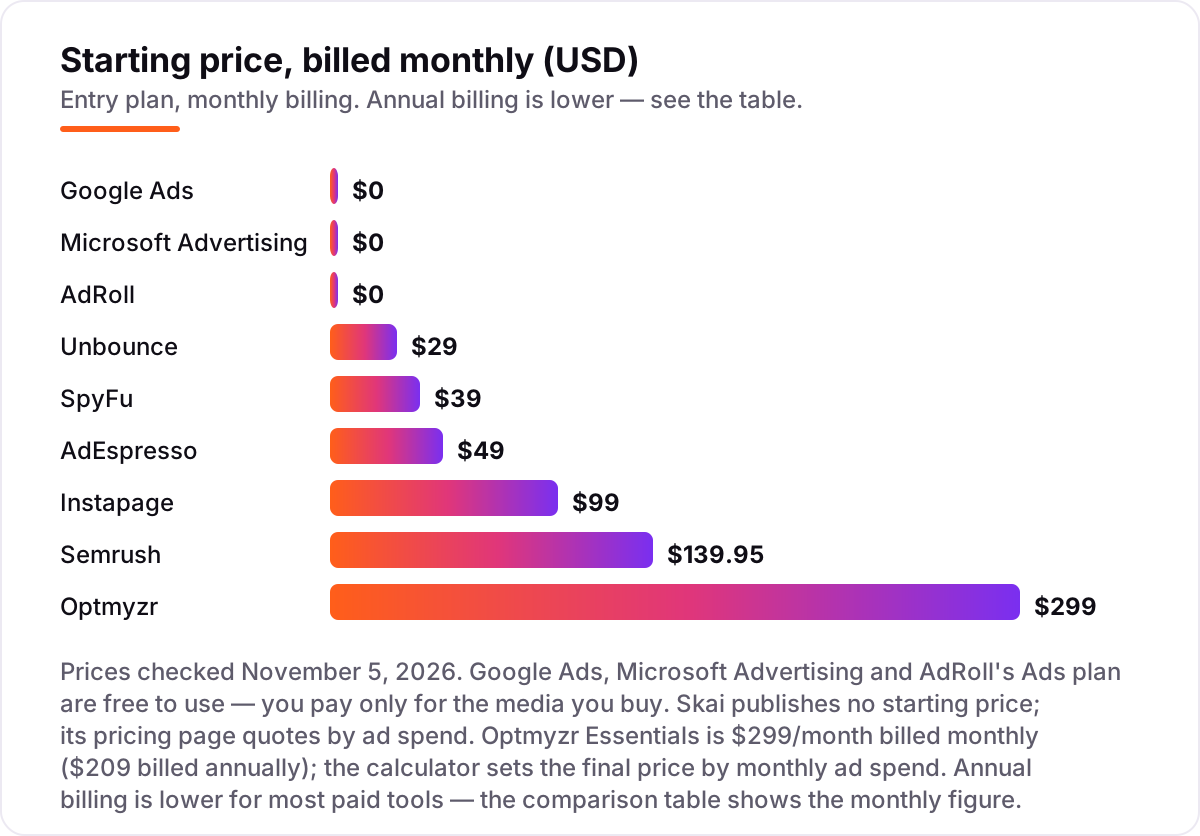
Take a small advertiser spending $5,000 a month on clicks, with one person running the account. The software bill is $0 on Google Ads and Microsoft Advertising, $39 on SpyFu Basic and $29 on Unbounce Starter — $68 a month for the whole stack, or $816 a year. Swap Unbounce Starter for Instapage Create at $99 and the stack costs $138 a month, or $1,656 a year. Add Optmyzr Essentials at $299 for automation and the stack costs $367 a month, or $4,404 a year.
Annual billing cuts those numbers: SpyFu Basic drops to $29 a month, or $348 a year; Unbounce Starter to $22 a month, or $264 a year; Semrush's SEO plan to $117.33 a month, or about $1,408 a year; Optmyzr saves 30% on annual billing. Two costs sit outside every number above. First, the ad spend itself — $5,000 a month here — which dwarfs the software bill and is the number that actually decides the budget. Second, the meters: AdEspresso's Starter plan caps spend at $1,000 a month, so this advertiser would need Plus at $99, and Unbounce Starter caps at 500 visitors, so a real campaign needs Build at $99.
The honest way to read the chart is software cost per dollar of ad spend. At $5,000 of monthly spend, the $68 SpyFu-plus-Unbounce stack is about 1.4% of spend; the $367 stack with Optmyzr is about 7.3%. If the tool does not return at least its own cost in saved waste or extra conversions, drop it — the ad platform is free, so the software has to earn its place every month.
Know the difference: PPC software vs the ad platforms themselves
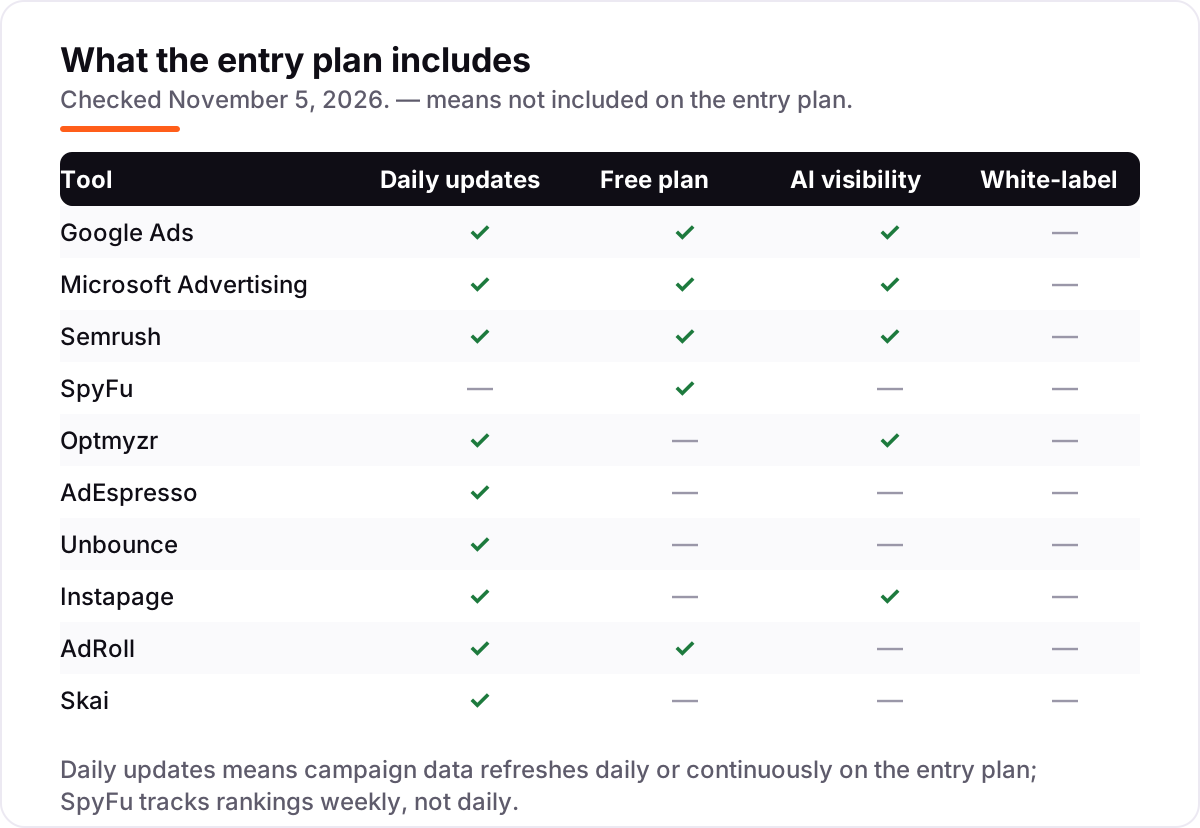
The confusion in this category is between the place ads run and the tools around it. Google Ads and Microsoft Advertising are the platforms: they sell the clicks, run the auctions and report the results. Everything else in this list is software that sits beside them — research tools that study competitors, management tools that automate accounts, and landing page tools that catch the clicks.
That distinction decides what you are actually buying. A research tool like SpyFu or Semrush cannot run an ad; it can only tell you which keywords and ads to run. A management tool like Optmyzr cannot buy a click; it changes bids and budgets inside Google Ads. A landing page tool like Unbounce or Instapage never touches the ad account at all — it builds the page the ad points to. And a retargeting tool like AdRoll buys media on other networks, but the search campaigns still live in Google Ads.
There is a second distinction worth knowing: subscription cost versus media cost. The platforms charge no subscription, only the clicks. The tools charge a subscription on top of the clicks. So the real question is never "what does the tool cost?" but "does this tool save or earn more than its subscription?" If it does not, the free platform alone is the better buy.
Quick comparison: tool type by need
| Buyer | Best pick | Why |
|---|---|---|
| Just starting, small budget | Google Ads | Free platform, pay only for clicks, largest search audience |
| Cheaper clicks alongside Google | Microsoft Advertising | Free platform, one-click import from Google Ads |
| Competitor research on a budget | SpyFu | 10+ years of rival ad history, Basic is $39/month |
| Many accounts, want automation | Optmyzr | Rule Engine across four platforms, from $299/month |
| Meta split tests | AdEspresso | Fast A/B testing on Facebook and Instagram, $49/month |
| Landing pages that match the ad | Instapage | Ad-to-page personalization, Create is $99/month |
Mistakes to avoid
- Buying a management tool before you have campaigns to manage. Optmyzr and Skai solve multi-account problems; a single account with $500 of spend does not have those problems yet.
- Budgeting on the subscription and forgetting the clicks. The software here costs $0–$209 a month; the ad spend is usually ten to fifty times that, and it is the number that decides whether PPC pays.
- Ignoring the meter that bites first. AdEspresso Starter caps spend at $1,000 a month, Unbounce Starter at 500 visitors, Instapage Create at 15,000 visitors — the cap you hit first is your real starting price.
- Sending paid traffic to a generic homepage. A click that lands on the wrong page converts at a fraction of one that lands on a page built for the ad — fix the page before raising the budget.
- Trusting automated recommendations blindly. Google's own suggestions usually raise spend; check every recommendation against your cost per conversion before accepting it.
How we chose
We checked each vendor's own pricing page on November 5, 2026 and recorded the starting price exactly as shown, including the annual-billing figure where the page lists one, and we ranked the tools by fit for the most common buyer — a small or mid-size advertiser spending on search — not by brand size. Two prices need a note: Optmyzr's pricing page is a calculator that sets the final price by monthly ad spend, so its entry figure is Essentials at $299 a month billed monthly ($209 billed annually), and Skai's pricing page quotes by ad spend with no published starting price, so it is listed as a custom quote. Ratings appear only where a fresh G2 page showed the score and review count on November 5, 2026; Semrush's rating is omitted because two fresh G2 pages disagreed on it (4.4 and 4.5), and the other tools' G2 pages had no fresh crawl, so we show no rating rather than a stale one. No vendor paid for a place in this list, and none of the links here are affiliate links.
What to do next
Start with the free platforms and run one real campaign before buying any software: set up Google Ads, import it into Microsoft Advertising, and spend $500 watching which keywords convert. If competitor research would change your keyword list, add SpyFu's limited free account; if the landing page is the weak point, trial Unbounce or Instapage for 14 days. If the ads work but new customers are not finding you without paying, our monthly SEO service handles the organic side — or compare the two channels in our guide to PPC vs SEO. Once your tools are in place, find out what's holding your rankings back.
Your stack only works if people find you
SerpAstra fixes what keeps your site off page one and makes it easy for AI assistants to recommend.
Get a free audit→Sources we checked (13)
- Google Ads — ads.google.com/home (checked November 5, 2026)
- Google Ads reviews on G2 — g2.com/products/google-ads/reviews (checked November 5, 2026)
- Microsoft Advertising — ads.microsoft.com (checked November 5, 2026)
- Semrush pricing — semrush.com/pricing (checked November 5, 2026)
- SpyFu pricing — spyfu.com/pricing (checked November 5, 2026)
- SpyFu reviews on G2 — g2.com/products/spyfu/reviews (checked November 5, 2026)
- Optmyzr pricing — optmyzr.com/info/pricing (checked November 5, 2026)
- Optmyzr reviews on G2 — g2.com/products/optmyzr/reviews (checked November 5, 2026)
- AdEspresso pricing — adespresso.com/pricing (checked November 5, 2026)
- Unbounce pricing — unbounce.com/pricing (checked November 5, 2026)
- Instapage pricing — instapage.com/pricing (checked November 5, 2026)
- AdRoll pricing — adroll.com/pricing (checked November 5, 2026)
- Skai pricing — skai.io/pricing (checked November 5, 2026)
Shamim
Founder of SerpAstra
A full-stack SEO and digital marketer who spends most days on Local SEO for dental practices, AI search visibility and lead generation.
Frequently asked questions
What is the best software for PPC?
Google Ads is the best starting point for most advertisers: it is free to use, reaches the largest search audience, and you pay only for clicks. Add SpyFu at $39/month for competitor research, or Optmyzr from $299/month when you manage many accounts and need automation.
How much does PPC software cost?
The ad platforms themselves are free — Google Ads, Microsoft Advertising and AdRoll's Ads plan charge no subscription. Paid tools in this list run from $29 a month for Unbounce Starter to $299 a month for Optmyzr Essentials, and Skai is quoted by ad spend. Ad spend itself is separate and usually far larger than the software bill.
Is there free PPC software?
Yes. Google Ads and Microsoft Advertising are free platforms: you pay only for the clicks you buy. AdRoll's Ads plan is also free, covering display retargeting with no subscription. Semrush and SpyFu both offer limited free accounts for research, and most paid tools here include a 14-day free trial.
Do I need PPC software, or is Google Ads enough?
Google Ads alone is enough for most small advertisers: it runs the campaigns, tracks conversions and suggests keywords. Buy extra software when a specific job hurts — competitor research (SpyFu), many accounts (Optmyzr), split tests on Meta (AdEspresso) or landing pages that match each ad (Unbounce or Instapage).
What is the difference between PPC software and Google Ads?
Google Ads is the platform where the ads actually run and the clicks are bought. PPC software sits around it: research tools like Semrush and SpyFu study competitors, management tools like Optmyzr automate the accounts, and landing page tools like Unbounce and Instapage catch the clicks. None of them replaces Google Ads.
Can I switch PPC tools later?
Yes, and switching is easier than in most software categories because the campaigns live in Google Ads, not in the tool. Export your keyword lists, negative keywords and reports first, cancel the old subscription, and connect the new tool to the same ad accounts — your campaign history and Quality Scores stay with the ad platform.
Which PPC tool is best for a small budget?
Start with Google Ads and Microsoft Advertising, both free to use, and add SpyFu Basic at $39 a month for competitor research. That stack costs $39 a month in software plus whatever you spend on clicks. Avoid Optmyzr and Skai until the account count or the spend justifies them.
Free SEO and AI visibility audit
Find out what is holding your rankings back
Send us your site. Within 2 business days you get a written audit, an AI visibility check and a short fix list ranked by impact. Free, with no contract attached.
Request my free audit→Related guides
 MarketingPPC vs SEO: which should a local business choose first?PPC vs SEO for a local business: how they differ on speed, cost and staying power, when each one wins, and a 90-day plan to test both without wasting money.Read guide →
 Digital Marketing & Ads10 Best Amazon PPC Automation Software in 2026, Compared10 best amazon ppc automation software options compared on price, automation style and spend fit, with the real monthly cost worked out for you.Read guide →
 Digital Marketing & Ads7 Best Advertising Platforms for Small Businesses in 2026, Compared7 best advertising platforms for small businesses compared on minimum budgets, cost per click and who each one fits — minimums checked on each vendor's page.Read guide →