
8 Best Sports Analytics Tools for Player Data in 2026, Compared
The 8 best sports analytics tools for player data, compared with real prices — from $25/month AI cameras to pro GPS wearables and custom-quote platforms.
 Shamim Mia, Founder, SerpAstraLast verified November 2, 202613 min read
We compare pricing pages, documentation and public reviews. We never accept payment for rankings.

Key takeaways
- Short-list: Trace from $25/month, Veo from $149/month and Hudl by custom quote — Trace is the best value for most clubs, with the camera leased free on the annual plan.
- Catapult One (£159.99/year) and STATSports ($320 one-time) cover wearable GPS without a team contract, while Playermaker ($199 kit) is the only pick that measures technique at the boot.
- The single most important buying factor is what you want measured: video and event data, physical load from GPS, or technical data from boot sensors — no one tool does all three well.
- Every price below was checked on November 2, 2026. Veo's price is third-party sourced and flagged as such, and Hudl, StatsBomb and Kitman Labs publish no starting price at all.
On this page
Quick comparison
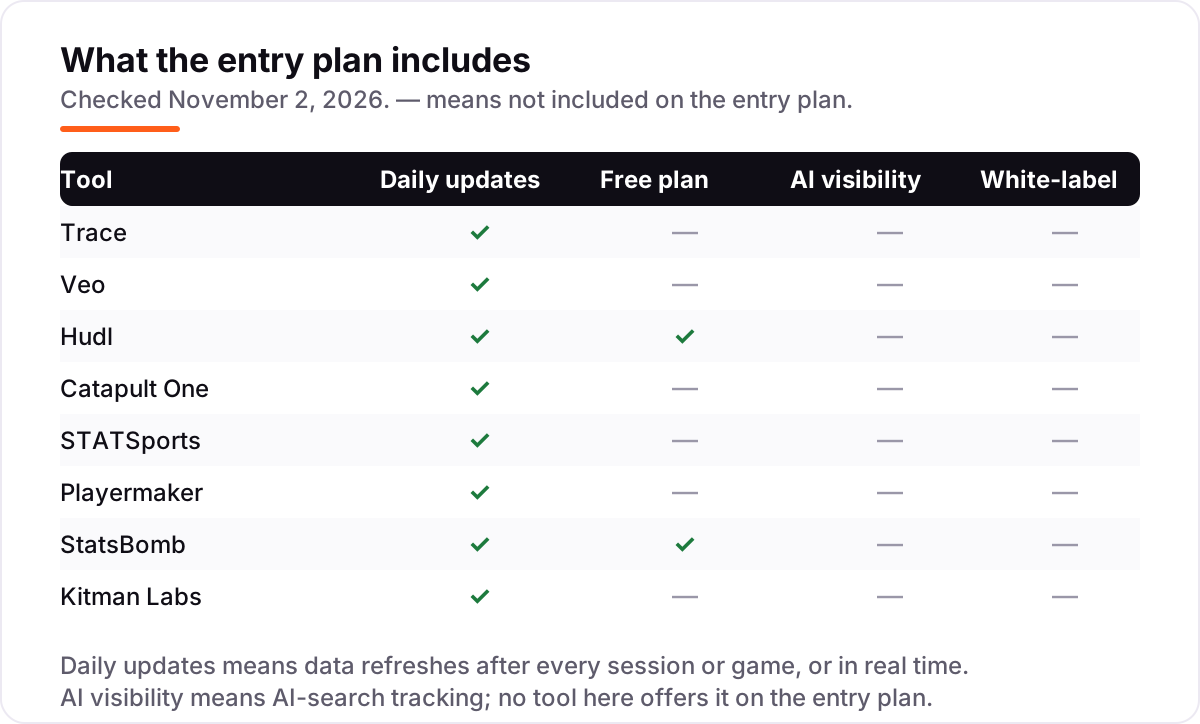
| Tool | Best for | Starting price | Free plan |
|---|---|---|---|
| Trace | Youth and club soccer coaches who want every player's highlights and stats without buying a camera | $25/mo | No |
| Veo | Clubs that want an AI camera of their own plus optional player analytics, and can pay for the hardware up front | $149/mo | No |
| Hudl | Schools and clubs with a video analyst who want film, stats and scouting in one platform | Custom quote | Yes (athlete app) |
| Catapult One | Individual players who want pro-level GPS load data from a vest, with a coach dashboard for teams | £13.33/mo (annual) | No |
| STATSports | Individual players and parents who want pro GPS data with a single payment and no subscription | $320 one-time | No |
| Playermaker | Young soccer players and their parents who want to measure touches, weak-foot use and kicking, not just running | $199 one-time | No |
| StatsBomb | Analysts and scouts who need the deepest event data on individual players, including expected goals | Custom quote | Yes (open data) |
| Kitman Labs | Pro and college performance and medical teams that need one system for load, wellness and injury risk | Custom quote | No |
Make one of these tools?
We re-check this list every quarter. Send a correction, request a review, or ask about a clearly labeled sponsored spot.
Request a listingThe best sports analytics tools for player data

Trace
Best for: Youth and club soccer coaches who want every player's highlights and stats without buying a camera
Trace is the cheapest complete player-data system in this list because the hardware problem is solved for you: the camera, tripod and cases are leased free with an annual plan, and the $15-a-month annual Basic price covers filming plus per-player highlights. Sock-worn GPS tracers follow every player across the full pitch, so after each game every family gets their own child's reel instead of one wide team video.
The trade-off is scope. Trace is built for youth soccer and basketball in the US and Canada, not for pro analysis, and the Basic plan stores only the last five games with no analytics. But for a youth coach or a parent who wants to see one player clearly, no other tool here gives you filmed, tracked and clipped player data for $180 a year.
What we like
- Camera, tripod and cases are leased free with an annual plan, so the $180 yearly Basic price is the whole setup cost
- PlayerFocus AI cuts an individual highlight reel for every player after each game, with GPS tracers worn in the socks
- Livestreaming is included at no extra cost, and families subscribe per player rather than the club paying for all of them
Watch out for
- Sold mainly for US and Canadian youth soccer and basketball, with no UK availability
- Player analytics and downloads need the Pro plan at $35/month, and monthly billing adds a $99 one-time camera lease fee

Veo
Best for: Clubs that want an AI camera of their own plus optional player analytics, and can pay for the hardware up front
Veo is the set-and-forget option. The Cam 3 sits on a tall tripod, records the full pitch in panoramic 4K, follows the ball without an operator and uploads the match when you get home. The Starter plan covers one team with 10 recording hours a month and 15 invited users, and the AI editor cuts a follow-cam view and highlights from the wide shot.
The catch is the total cost. The camera is $1,299 before the subscription, the tripod starts at $299, and the player-level stats that make Veo a player-data tool arrive through the paid Analytics 2 add-on. Buy Veo when the club wants its own camera and a polished video library; buy Trace when the budget only stretches to a subscription.
What we like
- Cam 3 records the whole pitch in panoramic 4K and follows the ball on its own, so no one has to film
- Starter includes 10 recording hours a month, 15 users and 6 months of storage for one team
- Veo Analytics 2 adds per-player stats and Veo Live adds livestreaming, both as optional add-ons
Watch out for
- The Cam 3 costs $1,299 on top of the subscription, plus a tripod from $299, before you record anything
- Player analytics and livestreaming cost extra, and recording hours are capped on the Starter and Team plans

Hudl
Best for: Schools and clubs with a video analyst who want film, stats and scouting in one platform
Hudl is the industry standard for team video, and it has grown into the broadest player-data platform in this list. Game film, tagging, Sportscode coding and scouting sit alongside Wyscout's player database and StatsBomb event data, so a coach can move from a clip to the numbers behind it without changing tools. Hudl Focus cameras remove the filming job entirely at venues that have them.
The honest limitation is price and people. Hudl publishes no starting price, so a program must get a quote before it can budget, and the scouting and coding tools pay off only when someone on staff uses them every week. For a school or club with an analyst, nothing else here covers as much ground; for a single youth team, Trace or Veo is the cheaper route in.
What we like
- The broadest platform here: game film, tagging, Sportscode coding, Wyscout scouting data and StatsBomb event data under one login
- Hudl Focus cameras record and upload automatically, and the library is shared with players, assistants and parents
- Free athlete accounts let players watch their own clips and build recruiting reels without a paid seat
Watch out for
- No published starting price — every program is quoted, so budgeting needs a sales conversation
- The depth needs staff time: coding, tagging and scouting tools reward an analyst, not a coach working alone

Catapult One
Best for: Individual players who want pro-level GPS load data from a vest, with a coach dashboard for teams
Catapult One puts the company's pro GPS technology on one player. A 10 Hz pod in a vest tracks distance, top speed, sprint distance and intensity ten times a second, and the app turns each session into trends a player can actually read: what improved, what faded, and when the load was too high. Membership costs £159.99 a year in the UK store, with a monthly plan also available.
Two limits matter. The pod measures how a player ran, not what they did with the ball, so technical development needs a different tool such as Playermaker. And Catapult One is an individual membership: clubs wanting a squad dashboard should ask about Catapult One Team, priced at $180 per player per year with a two-year commitment.
What we like
- 10 Hz GPS pod measures distance, top speed, sprint distance and intensity, the same metrics pro clubs track
- The app shows trends over time plus training content from elite coaches, not just raw session numbers
- Membership can be paused for one month every six months, and the annual plan saves 20% in the first year over monthly billing
Watch out for
- It measures running load only — no ball touches, no video and no event data
- The pro Vector system for whole squads is a separate quote-only product, so team pricing is not the price shown here

STATSports
Best for: Individual players and parents who want pro GPS data with a single payment and no subscription
STATSports Academy is the simplest deal in this list: one $320 payment buys the FIFA-approved GPS pod, the vest and the app, and there is no subscription to keep paying. The tracker records 24 metrics at 10 Hz — distance, sprint distance, top speed, work rate and heart-rate zones — using the same hardware trusted by professional clubs. More than 250,000 players use it, according to STATSports.
The trade-off is that you get physical data and nothing else. There is no video, no touch count and no coach dashboard, so a club tracking a whole squad will still need a camera or a team platform. But for one competitive player, or a parent buying a tracker for their child, the one-time price is the easiest yes in this list.
What we like
- One payment of $320 covers the GPS pod, vest and app — no monthly fee, ever
- Tracks 24 metrics at 10 Hz, including distance, sprints, top speed, work rate and heart-rate zones
- The app adds more than 200 drills and coaching masterclasses from professional players
Watch out for
- It measures physical output only — no ball skills, no video and no team dashboard
- Data lives in the phone app, and the battery lasts about six hours per charge

Playermaker
Best for: Young soccer players and their parents who want to measure touches, weak-foot use and kicking, not just running
Playermaker answers a different question from the GPS vests: not how far a player ran, but what their feet did. A sensor strapped to each boot records touches, weak-foot share, kick velocity and release time, plus speed and distance, across more than 25 metrics. The $199 kit includes the sensors, straps, charging case and 12 months of tracking, and it is designed for players aged 8 and up.
The membership is the catch to price in. After the first year, new sessions cannot be recorded or synced without the $149-a-year renewal, so the three-year cost is $497, not $199. Reviewers also report occasional sync and battery problems. Even so, no other tool here measures technique at the boot, and for a developing player that data is the point.
What we like
- Sensors on each boot measure touches, left- and right-foot use, kick velocity and release time alongside speed and distance
- Tracks more than 25 technical and physical metrics, the widest technical set of any wearable here
- Ages 8 and up, with a 30-day money-back guarantee and free shipping on the kit
Watch out for
- After the included 12 months, recording stops without a $149-a-year renewal
- Soccer only, and some reviewers report sync and battery issues that need support to resolve

StatsBomb
Best for: Analysts and scouts who need the deepest event data on individual players, including expected goals
StatsBomb is the data source behind much of modern football analysis. Its event data records every shot, pass and defensive action with freeze frames showing player positions, and its expected-goals model is widely treated as the reference. Analysts get more than 160 insight metrics for scouting, opposition analysis and recruitment, and the platform now links each event to video inside Hudl.
The price is the barrier. StatsBomb publishes no starting price, and paid access is an enterprise contract that most clubs must negotiate. The way in for everyone else is the free open data, which covers thousands of matches, and free IQ access for women's teams in more than ten leagues. If you employ an analyst, StatsBomb is the deepest player data available; if you do not, start with the free data.
What we like
- Event data covers every shot, pass and defensive action with freeze frames, plus the StatsBomb xG model and 160-plus insight metrics
- Free open data on GitHub has trained a generation of analysts, and women's teams in more than 10 leagues get IQ free
- Now part of Hudl, so event data links directly to video clips in the Hudl platform
Watch out for
- Enterprise pricing with no published figure — annual contracts for clubs run to five figures and more
- The full platform needs analyst skill; casual users will get more from the free data than from a paid seat

Kitman Labs
Best for: Pro and college performance and medical teams that need one system for load, wellness and injury risk
Kitman Labs is the only tool here built for the performance department rather than the coach. Its Intelligence Platform pulls GPS, wellness, medical and training data from more than 150 sources into a single profile for every athlete, so doctors, scientists and coaches work from the same numbers. The Risk Advisor add-on uses machine learning to flag elevated injury risk and show what is driving it.
It is also the most expensive and the most demanding pick. Pricing is a custom enterprise quote, the setup is configured per organization, and G2 reviewers warn that some workflows feel illogical and new features arrive slowly. Youth clubs should stop at the wearables and cameras above; Kitman Labs is for organizations with full-time performance and medical staff.
What we like
- Unifies GPS, wellness, medical and training data from more than 150 sources into one athlete profile
- Risk Advisor uses machine learning to flag elevated injury risk and the factors behind it
- Trusted by teams in the NFL, NBA, NHL, EPL, Bundesliga, AFL and NRL, per Kitman Labs' G2 profile
Watch out for
- Quote-only enterprise pricing — out of reach for youth clubs and individual buyers
- G2 reviewers call some workflows illogical and note that features can take a long time to arrive
Coaches no longer have to guess which player ran the most or who touched the ball least. The best sports analytics tools for player data turn every match and training session into per-player numbers: distance and sprints from a GPS vest, touches and kick speed from boot sensors, or shots, passes and expected goals from event data. This guide compares eight tools, sorted by what each one actually measures, with real prices checked on November 2, 2026.
What a sports analytics tool for player data actually does
A sports analytics tool for player data answers questions about one athlete at a time, not about the team as a whole. It records what a player did — how far they ran, how fast they sprinted, how many times they touched the ball, or how their shots compare to the expected-goals average — and it keeps that record across a season so a coach can see change instead of guessing from one game.
The tools in this list do one of three jobs. GPS wearables measure physical load: distance, speed and sprinting. AI cameras and video platforms capture the game and cut it into clips and stats for each player. Event-data platforms record every on-ball action and turn it into models such as expected goals. Most buyers need only one of the three, which is why this guide is sorted by measurement, not by brand.
The scale of adoption is already large: STATSports says more than 250,000 players use its Academy tracker, which shows how far pro-level GPS data has moved from elite clubs into youth football. That shift is the reason prices now range from $25 a month to custom enterprise contracts — the same technology is being sold to parents, clubs and pro departments at very different prices.
AI cameras that film and tag every player
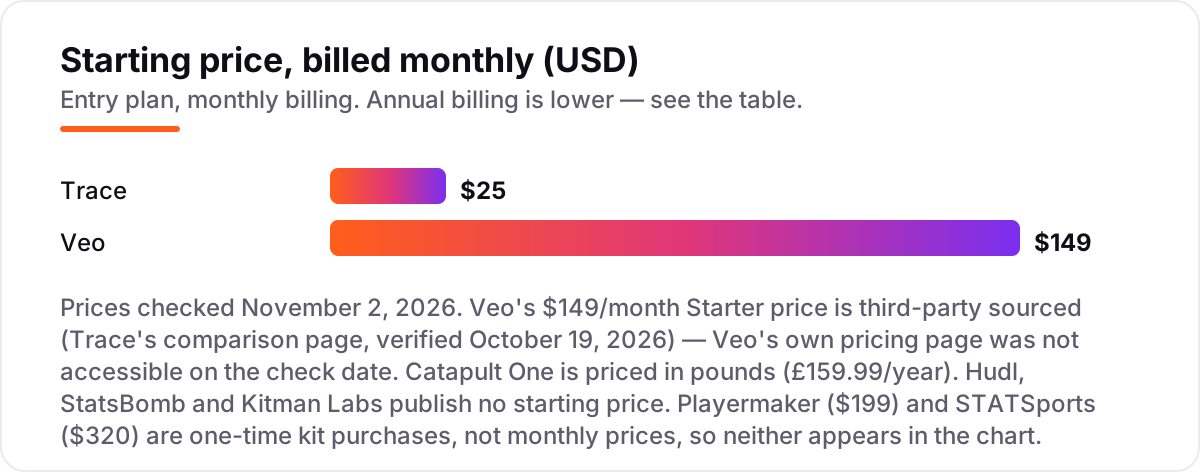
The cheapest way into player data is an AI camera. Trace and Veo both film the whole pitch without an operator and turn the footage into something a coach can use for one player: Trace cuts an individual reel for every player after each game, while Veo follows the ball and, with its Analytics 2 add-on, produces per-player stats. For a youth coach who films every weekend, the camera replaces the parent on the sideline with a phone.
The ownership models are opposites, and they decide the real cost. Trace leases the camera free with an annual plan, so $180 a year is the whole setup. Veo sells the Cam 3 for $1,299 plus a tripod from $299, then charges $149 a month for Starter — about $3,100 in year one before the analytics add-on. Veo owns the better hardware and the more polished library; Trace owns the lower bill.
Wearables that measure the player, not the ball
GPS vests and boot sensors skip video entirely and measure the athlete. Catapult One and STATSports both put a 10 Hz GPS pod in a vest and report distance, sprint distance, top speed and work rate; the difference is the payment model, with Catapult charging £159.99 a year and STATSports charging $320 once. Playermaker takes the other route and straps a sensor to each boot, measuring touches, weak-foot use and kick velocity — the only technical data in this list.
Wearables suit a different buyer from cameras. They work in training as well as matches, they need no filming setup, and they travel with the player rather than the club. Their limit is equally clear: a vest cannot tell you whether a pass was good, and a boot sensor cannot show you the game. Buy a wearable when the question is physical — fitness, load, speed, technique — and buy a camera when the question is what actually happened on the pitch.
Platforms for analysts and performance staff
The last three tools are not bought by individual players at all. Hudl is the platform a school or club runs its whole video operation on: film, tagging, Sportscode coding and scouting, now with StatsBomb event data inside it. StatsBomb itself is the analyst's tool, with the deepest event data and the expected-goals model that other platforms quote. Kitman Labs sits one level up again, joining GPS, wellness and medical records into a single athlete profile for performance and medical staff.
These platforms share two traits: they are priced by quote, and they need staff. Hudl's coding and scouting tools pay off only when an analyst uses them weekly, StatsBomb's 160-plus metrics need someone who can read them, and Kitman Labs is configured per organization. A youth club with no analyst will get more from Trace and a GPS vest than from any of these three — and will spend a fraction of the money.
Quick comparison: tool type by need
| Buyer | Best pick | Why |
|---|---|---|
| Youth or club coach on a budget | Trace | $25/month, camera leased free on the annual plan |
| Club that wants its own camera | Veo | AI filming plus optional player analytics from $149/month |
| School or club with an analyst | Hudl | Film, tagging and scouting in one platform, priced per program |
| Individual player, GPS load | Catapult One or STATSports | £159.99/year membership, or $320 once with no subscription |
| Young player working on technique | Playermaker | Boot sensors measure touches and kick speed from $199 |
| Scout or analyst, deepest data | StatsBomb | Event data and xG, with free open data to start |
| Pro medical and performance staff | Kitman Labs | One profile for load, wellness and injury risk, by quote |
How to choose the best sports analytics tools for player data
- Decide what to measure first. Video and event data if you need to see the game, GPS if you need to manage load and fitness, boot sensors if you need technique. No tool in this list does all three well.
- Count the players, not the teams. A $25-a-month camera covers a squad; a $320 vest covers one player. Multiply the wearable price by the squad size before comparing it with a camera.
- Add up the whole first year. Hardware, tripods, renewals and add-ons are where the bill grows: Veo costs about $3,100 in year one, Playermaker costs $497 over three years, and Trace costs $180 a year with nothing else to buy.
- Check who does the work. Cameras and wearables run themselves after setup; Hudl, StatsBomb and Kitman Labs need an analyst or a performance team to be worth the money.
- Use the free route first. StatsBomb's open data, Hudl's free athlete app and Playermaker's 30-day money-back guarantee all let you check the data quality before you pay.
Before you publish a recruiting profile or a club page for a player, run the page title through the free SERP snippet preview tool — it shows exactly how the title and description will look in Google.
Mistakes to avoid
- Comparing the subscription without the hardware. Veo's $149 a month looks close to Trace's $25 until you add the $1,299 camera and a tripod.
- Buying a GPS vest when you need technique data. A vest measures running, not touches. If the goal is a better first touch, Playermaker is the tool, not Catapult or STATSports.
- Paying for enterprise data without an analyst. StatsBomb and Kitman Labs are built for staff who use them daily; without that person, the free open data teaches you more than a paid seat.
- Forgetting the renewal. Catapult One and Playermaker both stop recording when the yearly membership lapses, so the second-year cost is part of the buying decision, not an afterthought.
- Trusting a directory price. Veo's prices vary by region and promotion, and Catapult One is priced in pounds on its UK store — always check the vendor's own page for the figure that applies to you.
How we chose
We checked each vendor's own pricing page on November 2, 2026 and recorded the starting price exactly as shown. Two exceptions are flagged honestly. Veo's $149-a-month Starter price comes from Trace's comparison page, which states its prices come from each company's site and was last verified on October 19, 2026 — we could not open Veo's own pricing page on the check date, so we do not present that figure as vendor-verified. Catapult One's price is the one shown on Catapult's UK store, £159.99 a year, because that is the current published membership figure. Ratings come from G2 for Kitman Labs and from Trustpilot for Veo and STATSports; tools without a matching review page show no rating. We ranked the tools by fit for the most common buyer — a youth or club coach, or an individual player — not by brand size. No vendor paid for a place in this list, and none of the links here are affiliate links.
What to do next
Start with the decision path above: pick the measurement, count the players, and add up the full first year including hardware. Then use the free route — StatsBomb's open data, Hudl's free athlete app, or Playermaker's 30-day guarantee — before you commit to a subscription or a quote. If the data shows your club website is not turning visits into trial sign-ups, an SEO audit will show what to fix first. If you'd rather have this set up and read for you, request a free SEO + AI visibility audit and get a ranked fix list in 2 business days.
Rather not run the tools yourself?
Tools show you the data. SerpAstra turns it into higher rankings, more map-pack calls and citations in AI answers.
Get a free SEO + AI visibility audit→Sources we checked (14)
- Trace pricing — traceup.com/pricing (checked November 2, 2026)
- Trace vs Veo comparison, including Veo prices — traceup.com/compare/trace-vs-veo (checked November 2, 2026)
- Veo on Trustpilot — 4.1/5, 1,304 reviews (checked November 2, 2026)
- Catapult One membership — gb-store.catapultsports.com/pages/subscribe (checked November 2, 2026)
- Catapult One Team pricing — zone14.ai (checked November 2, 2026)
- Playermaker 2.0 — playermaker.com (checked November 2, 2026)
- STATSports Academy — statsports.com (checked November 2, 2026)
- STATSports on Trustpilot — 4.1/5, 3,276 reviews (checked November 2, 2026)
- Kitman Labs on G2 — 4.5/5, 6 reviews (checked November 2, 2026)
- Hudl — hudl.com (checked November 2, 2026; no published pricing)
- StatsBomb platform — hudl.com (checked November 2, 2026)
- Kitman Labs — kitmanlabs.com (checked November 2, 2026; no published pricing)
- StatsBomb — statsbomb.com (checked November 2, 2026)
- Kitman Labs performance overview — intuitionlabs.ai (checked November 2, 2026)
Shamim
Founder of SerpAstra
A full-stack SEO and digital marketer who spends most days on Local SEO for dental practices, AI search visibility and lead generation.
Frequently asked questions
What is the best sports analytics tool for player data?
Trace is the best pick for most clubs and families: an AI camera plus per-player highlights from $25 a month, with the camera leased free on the annual plan. Clubs that want their own hardware should look at Veo, and individual players at Catapult One or STATSports. Analysts who need the deepest event data should start with StatsBomb's free open data.
How much do sports analytics tools for player data cost?
From $25 a month for Trace to custom enterprise quotes for Hudl, StatsBomb and Kitman Labs. Veo starts at $149 a month plus a $1,299 camera, Catapult One costs £159.99 a year, Playermaker is a $199 kit with a $149 yearly renewal, and STATSports is a $320 one-time purchase. Always add hardware, renewals and add-ons to the headline price.
Is there a free sports analytics tool for player data?
Yes, with limits. StatsBomb publishes free open event data covering thousands of matches, and Hudl's athlete app is free for players to watch film and build highlight reels. The wearables and cameras have no free plan, though Playermaker offers a 30-day money-back guarantee. Free options work for learning the data; a paid plan is needed to track your own players.
Should I buy a GPS vest or an AI camera first?
Buy the camera first if your problem is seeing the game — Trace or Veo films every match and gives each player their own clips. Buy a GPS vest first if you already have film and need to manage training load, prevent injuries or compare fitness across the squad. Most clubs end up with both, because video shows what happened and GPS shows how hard it was.
Can I buy a player tracker once, or do I need a subscription?
Both models exist. STATSports Academy is a $320 one-time purchase with no subscription at all. Catapult One and Playermaker charge a yearly membership after the first year — $159.99 and $149 respectively — and recording stops without it. Trace and Veo are subscriptions by design, and Hudl, StatsBomb and Kitman Labs are quoted per program or contract.
What is the difference between event data and tracking data?
Event data records what happened with the ball — shots, passes, tackles and expected goals — and StatsBomb is the leading source for it. Tracking data records where players were and how they moved, from GPS vests or camera systems like Veo and Trace. Analysts combine the two: event data explains the game, tracking data explains the physical cost of playing it.
Do these tools track individual players, or just the team?
Every tool in this list tracks individuals. Trace and Veo cut a separate reel for each player, GPS vests and boot sensors record one athlete at a time, and StatsBomb breaks every event down by player. The difference is the view: cameras and sensors show your player, while Hudl and Kitman Labs roll individuals up into team and squad reports.
Free SEO and AI visibility audit
Find out what is holding your rankings back
Send us your site. Within 2 business days you get a written audit, an AI visibility check and a short fix list ranked by impact. Free, with no contract attached.
Request my free audit→Related guides
 SEO & AI Search11 Best Rank Tracking Tools in 2026 (Free and Paid, Compared)11 best rank tracking tools compared on price, keyword limits, update speed and AI visibility. Prices checked on the vendor pricing page, October 31, 2026.Read guide →
 SEO & AI SearchBest SEO Audit Software for 2026: 10 Options Compared by Use Case10 best SEO audit software tools compared on price, crawl depth and AI visibility. Prices checked on vendor pricing pages, November 1, 2026.Read guide →
 SEO & AI SearchBest Local SEO Tools for 2026: 11 Picks Ranked by What You Need11 best local SEO tools with real prices checked November 1, 2026 — from $14/month trackers to quote-only enterprise platforms, sorted by what you need.Read guide →