
10 Best Tools for Keyword Gap Analysis in 2026, Compared
Compare the best tool for keyword gap analysis for your budget: 10 tools ranked on price, gap depth and data size, with prices checked November 2, 2026.
 Shamim Mia, Founder, SerpAstraLast verified November 2, 202615 min read
We compare pricing pages, documentation and public reviews. We never accept payment for rankings.

Key takeaways
- Semrush is the best tool for keyword gap analysis for most teams: five-domain comparisons, keyword and backlink gaps, from $139.95/month billed monthly.
- Ahrefs Content Gap is the cheapest way into deep data at $29/month, and SpyFu Kombat is the cheapest dedicated gap tool at $39/month.
- Free options exist — Serpstat, Ubersuggest and SpyFu all have free plans — but the gap views that matter start on paid plans.
- The single most important buying factor is how many competitors you can compare at once: one rival shows a gap, three or more show a market.
- Every price below was checked on the vendor's own pricing page on November 2, 2026. Ratings are G2, except KeySearch, which has no G2 or Capterra profile.
On this page
Quick comparison
| Tool | Best for | Starting price | Free plan |
|---|---|---|---|
| Semrush | Small agencies and in-house teams that run gap analysis weekly across several competitors and want the deepest data | $117.33/mo (annual) | Yes (10 keywords) |
| Ahrefs | In-house SEOs and agencies that want the cheapest entry into deep backlink and keyword data with a true content-gap report | $29/mo | Yes (limited) |
| SE Ranking | Small agencies and in-house teams that want gap analysis plus rank tracking, audits and AI visibility in one value-priced suite | $103.20/mo (annual) | No (14-day trial) |
| SpyFu | Freelancers and small agencies that want a dedicated three-way keyword comparison without paying suite prices | $29/mo (annual) | Yes (limited) |
| Serpstat | Freelancers and small businesses that want a budget all-in-one with a named missing-keywords report | $50/mo (annual) | Yes (limited) |
| Moz Pro | Small in-house teams that want Domain Authority metrics and a visual gap view in a beginner-friendly suite | $49/mo | No (7-day trial) |
| Similarweb | Marketers and strategists who want gaps ranked by the traffic they actually bring, not just by ranking position | $125/mo (annual) | Yes (limited) |
| Ubersuggest | Solo site owners who want one budget tool that also tracks competitors and flags keyword gaps | $16/mo (annual) | Yes (3 searches/day) |
| KeySearch | Bloggers and niche-site owners who want competitor gap data at the lowest monthly price in this list | $20/mo (annual) | No (7-day trial) |
| CognitiveSEO | Agencies and in-house teams that want content gaps tied to backlink depth and penalty-risk data | $89/mo (annual) | No (7-day trial) |
Make one of these tools?
We re-check this list every quarter. Send a correction, request a review, or ask about a clearly labeled sponsored spot.
Request a listingThe best keyword gap analysis tools

Semrush
Best for: Small agencies and in-house teams that run gap analysis weekly across several competitors and want the deepest data
Semrush Keyword Gap is the most complete gap report in this list. Compare your domain against up to four competitors at once, split the results into shared, missing, weak and untapped keywords, and filter by volume, difficulty, intent and SERP features. It sits on a keyword database Semrush puts at more than 27 billion keywords, so the gaps it finds are rarely data artifacts.
The catch is price and packaging. The SEO plan costs $139.95 a month billed monthly, the highest entry price among the suites here, and the AI visibility toolkit that tracks prompts across ChatGPT and Perplexity is a separate Starter bundle at $199 a month. Buy Semrush when gap analysis is a weekly workflow across several competitors; for a one-off check, the cheaper tools below do the job.
What we like
- Keyword Gap compares your domain against up to 4 competitors at once, split into shared, missing, weak and untapped keywords
- Sits on a keyword database Semrush puts at more than 27 billion keywords, plus Backlink Gap and Position Tracking for 500 keywords a day
- Filters by volume, difficulty, intent and SERP features, so gaps can be sorted by winnability
Watch out for
- Highest entry price among the suites here, and the AI visibility toolkit that tracks prompts is a separate Starter bundle at $199/month
- Extra users start at $45/month, and the interface takes time to learn

Ahrefs
Best for: In-house SEOs and agencies that want the cheapest entry into deep backlink and keyword data with a true content-gap report
Ahrefs Content Gap is the simplest gap report to act on: enter your domain and up to ten competitors, and it lists the keywords they rank for that you do not, with traffic potential and keyword difficulty beside each term. The data sits on one of the largest backlink indexes and a 110-billion-keyword database, so every gap comes with link context.
The limits are the credits and the refresh speed. Starter gives you 200 report credits a month, and a full content-gap analysis across a large site can eat a noticeable share of that allowance. Rank Tracker also updates weekly by default, so daily movement needs the paid Project Boost add-on. For teams already paying for Ahrefs, the gap report is an easy yes; as a first gap tool, the price is hard to beat.
What we like
- Content Gap shows keywords competitors rank for that you do not, with traffic potential and keyword difficulty per term
- Sits on one of the largest backlink indexes and a 110-billion-keyword database, so gaps come with link context
- Starter at $29/month is the cheapest entry to professional-grade gap data in this list
Watch out for
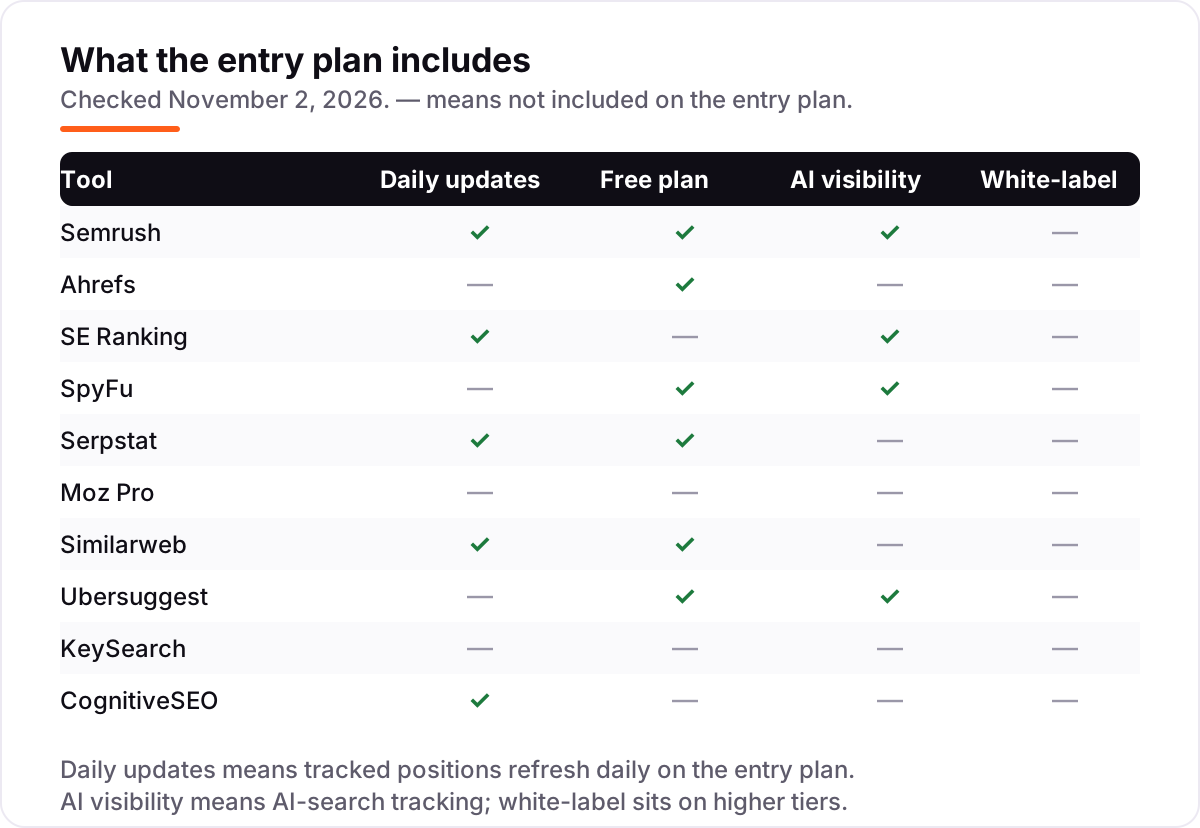
- Rank Tracker updates weekly by default on every plan — daily updates need the paid Project Boost add-on
- No free trial, and metered report credits on Starter cap how much gap research you can run each month

SE Ranking
Best for: Small agencies and in-house teams that want gap analysis plus rank tracking, audits and AI visibility in one value-priced suite
SE Ranking's gap analysis lives inside Competitive Research: enter a rival domain and it shows the keywords they rank for that you miss, with traffic and difficulty per term, plus the pages earning that traffic. Core tracks 2,000 keywords daily and bundles AI visibility across five engines, so a gap can be checked against AI answers as well as organic results. It is the best-value suite in this list.
The trade-off is polish. Reviewers like the depth but some report small accuracy differences against the bigger suites, and the interface takes a few days to learn. The per-keyword cost is the lowest of any suite here, so if you want daily tracking at scale plus gap analysis in one subscription, start here; if you need the largest backlink index, look at Semrush or Ahrefs instead.
What we like
- Competitive Research shows the keywords rivals rank for that you miss, with traffic and difficulty per term
- Core tracks 2,000 keywords daily and bundles AI visibility across five engines, so gaps can be checked against AI answers too
- Lowest cost per daily-tracked keyword among the suites here
Watch out for
- Some G2 reviewers report occasional minor discrepancies in rank-tracking accuracy and search-volume estimates versus larger competitors
- Reviewers note the interface can feel less intuitive, and complex reports take getting used to

SpyFu
Best for: Freelancers and small agencies that want a dedicated three-way keyword comparison without paying suite prices
SpyFu Kombat is the only tool in this list built around one job: comparing keyword portfolios. Enter your domain and two competitors and it draws a Venn diagram, splitting keywords into weaknesses (they rank, you do not), exclusive wins, core niche and the full keyword universe. Every plan includes 10+ years of historical keyword and ad data, so a gap can be checked against what rivals were doing years ago.
The catch is freshness. SpyFu's keyword data refreshes monthly, so a gap that opened last week may not show up yet, and rank tracking is weekly rather than daily. White-label reports and API access also sit on Professional at $79 a month. For a freelancer or small agency that lives in competitor data, Kombat at $39 a month is the cheapest dedicated gap view here.
What we like
- Kombat compares your domain against two competitors in a Venn diagram, splitting keywords into weaknesses, exclusive wins and core niche
- 10+ years of historical keyword and ad data on every plan, so gaps can be checked against what rivals did years ago
- Unlimited searches and data exports on every plan, including Basic
Watch out for
- Keyword data refreshes monthly, so fresh gaps appear slower than in tools with daily updates
- White-label PDF reports and API access sit on Professional ($79/month), not Basic

Serpstat
Best for: Freelancers and small businesses that want a budget all-in-one with a named missing-keywords report
Serpstat's Missing Keywords report does exactly what the name promises: it lists the terms your competitors rank for that your domain does not, with a difficulty score beside each one so you can sort by winnability. It covers 230 Google databases, so gaps can be checked market by market, and Individual bundles rank tracking, a site audit and PPC research into the same $69 a month.
The weak spot is the traffic column. Independent reviews find Serpstat's traffic estimates rougher than Semrush's, so treat the numbers as a guide rather than a forecast. JavaScript rendering and the API also sit on Team at $129 a month. For a freelancer or small business that wants a named gap report without suite prices, Serpstat is the cheapest all-in-one here.
What we like
- Missing Keywords report lists the terms competitors rank for that your domain does not, with difficulty scores
- Covers 230 Google databases, so gaps can be checked market by market
- Individual includes rank tracking, site audit and PPC research in the same $69/month
Watch out for
- Traffic estimates are rougher than Semrush's, per independent reviews, so treat the traffic column as a guide
- JavaScript rendering and the API sit on Team ($129/month), not Individual

Moz Pro
Best for: Small in-house teams that want Domain Authority metrics and a visual gap view in a beginner-friendly suite
Moz Pro's Keyword Gap 2.0 compares your domain against up to three competitors and shows the overlap as a Venn diagram, with four views: keywords to improve, new opportunities, winning keywords and all ranking keywords. Each missing keyword carries a Traffic Lift metric, so the list can be sorted by the visits a win would bring. True Competitor detection finds the sites actually competing for your keywords, not the ones you assume.
The limitation is the entry plan. Starter at $49 a month has no rank tracking, so gaps found in Keyword Gap cannot be monitored over time without Standard at $99 a month. Moz's keyword database is also smaller than Ahrefs' or Semrush's, so long-tail gaps show up less often. Buy Moz for the friendliest gap view and the DA metrics clients already know.
What we like
- Keyword Gap 2.0 compares your domain against up to 3 competitors in a Venn diagram, with a Traffic Lift metric per keyword
- True Competitor detection finds the sites actually competing for your keywords, instead of the ones you assume
- Domain Authority, Page Authority and Spam Score — the metrics clients already recognize — built into every plan
Watch out for
- The $49/month Starter plan has no rank tracking, so gaps cannot be monitored over time without Standard ($99/month)
- Smaller keyword database than Ahrefs and Semrush, so long-tail gaps show up less often

Similarweb
Best for: Marketers and strategists who want gaps ranked by the traffic they actually bring, not just by ranking position
Similarweb's Keyword Gap ranks missing keywords by the traffic they actually bring, which changes the answer. A keyword your rival ranks for with 10,000 visits a month outranks one with 100, even if both are gaps. The report pairs the gap with traffic sources, engagement and audience overlap for the same competitors, and it covers 100 million websites, so even large or unusual rivals usually have data.
The catch is that the numbers are modeled, not measured. Similarweb builds traffic from a panel and public signals, and its own knowledge center calls it an estimations tool, so accuracy drops for low-traffic sites. Self-serve plans are also single-seat, and paying monthly instead of annually costs $199 rather than $125. Pick Similarweb when the question is how much a gap is worth, not just that it exists.
What we like
- Keyword Gap weighs each missing keyword by the traffic it actually brings, so the list is sorted by value, not volume
- Pairs the gap with traffic sources, engagement and audience overlap for the same competitors
- Covers 100 million websites, so even large or unusual competitors usually have data
Watch out for
- Estimates are modeled from a panel, not measured, and accuracy drops for low-traffic sites
- Single seat on every self-serve plan, and the monthly premium over annual billing is steep at 59% on Starter

Ubersuggest
Best for: Solo site owners who want one budget tool that also tracks competitors and flags keyword gaps
Ubersuggest puts the gap view inside its project dashboard: add up to five competitors on Individual and it splits their keywords into common keywords you both rank for and keyword gaps they hold that you do not. The same plan covers 125 tracked keywords, 150 reports a day and AI search visibility for 10 ChatGPT prompts per brand. A $290 lifetime option exists for buyers who would rather pay once than subscribe.
The gap view is lighter than the dedicated tools here: it is a comparison of common keywords against gaps, not a full multi-domain report with filters for intent and SERP features. Search-volume and difficulty figures are also less accurate than the big suites, per multiple G2 reviewers. For a solo owner wanting one budget tool for tracking and gaps, $29 a month is hard to argue with.
What we like
- Project competitor tracking splits keywords into common keywords and keyword gaps, so the missing terms are one click away
- Individual covers 125 tracked keywords, 150 reports a day and AI search visibility for 10 ChatGPT prompts per brand
- A $290 lifetime option exists for buyers who would rather pay once than subscribe
Watch out for
- Search-volume and difficulty figures are less accurate than the big suites, per multiple G2 reviewers
- The gap view is a lighter comparison of common keywords versus gaps, not a dedicated multi-domain report

KeySearch
Best for: Bloggers and niche-site owners who want competitor gap data at the lowest monthly price in this list
KeySearch's competitor research shows the keywords your rivals rank for and the gaps to target, with a difficulty score beside each term so a blogger can sort by winnability before spending a credit. Starter at $24 a month is the cheapest paid plan in this list, and it still bundles rank tracking for 80 keywords, a site auditor and YouTube keyword research.
The budget shows in the limits. Daily search credits are shared across every feature, so heavy gap research can eat the allowance before the day ends, and the keyword database is smaller than the suites'. There is also no API access on any plan. For a niche site or blog that needs gap data at the lowest price, KeySearch is the pick; for agency work, the caps arrive fast.
What we like
- Competitor research shows the keywords rivals rank for and the gaps to target, with difficulty scores per term
- Starter at $24/month is the cheapest paid plan in this list, with rank tracking and a site auditor included
- YouTube keyword research is bundled in, which none of the other budget tools here offer
Watch out for
- Daily search credits are shared across features, so heavy gap research can eat the allowance fast
- Smaller keyword database than the suites, and no API access on any plan

CognitiveSEO
Best for: Agencies and in-house teams that want content gaps tied to backlink depth and penalty-risk data
CognitiveSEO's gap analysis works at page level: its content optimization tool compares your page against the top-ranking pages and lists the keywords you are missing, then hands you a Content Performance Score and a concrete recipe for closing the gap. The same plan pairs that with deep backlink analysis and unnatural-link detection, so content gaps and link gaps get fixed together.
The price is the problem. Starter costs $129.99 a month, the joint-highest entry price here, and there is no free plan — only a 7-day trial that needs a credit card or PayPal up front. The interface also feels dated next to newer tools. Buy CognitiveSEO when the gap that matters is on the page itself and the link profile behind it, not when you just need a domain comparison.
What we like
- Content gap identification compares your pages against top-ranking pages and lists the keywords you are missing
- Pairs the gap with deep backlink analysis and unnatural-link detection, so content and link gaps are fixed together
- Content Performance Score grades each page against the competition with a concrete optimization recipe
Watch out for
- Entry price of $129.99/month is the joint-highest here, and the interface feels dated next to newer tools
- No free plan, and the 7-day trial needs a credit card or PayPal up front
The best tool for keyword gap analysis answers one question: which keywords do your competitors rank for that you do not? Every tool in this list compares your domain against rivals and returns the missing terms, but they differ in how many competitors you can compare, how the gaps are sorted, and what the data behind them is worth. We compared ten tools on price, gap depth and data size, with every price checked on the vendor's own pricing page on November 2, 2026.
The short answer: Semrush is the best pick for most teams, Ahrefs is the cheapest way into deep data, and SpyFu is the best dedicated gap tool. The rest of this guide is organised by what you actually need — a full suite, a dedicated gap tool, a budget pick, or a traffic-weighted view — so you can skip to the group that fits.
What the best tool for keyword gap analysis actually does
A keyword gap tool takes your domain and one or more competitor domains, pulls each site's ranking keywords, and returns the difference: the terms rivals rank for that you do not, the terms you both rank for, and the terms only you hold. The good ones then sort that difference by value — search volume, difficulty, intent, or the traffic a term actually brings — so the list reads as a content plan, not a data dump.
The scale of the data matters more than the interface. Semrush puts its keyword database at more than 27 billion keywords, and Ahrefs at 110 billion, which is why their gap reports rarely come back empty for niche terms. Smaller databases still work for common keywords, but they miss the long tail — the exact terms a gap analysis is supposed to surface. That is why the cheapest tool is not always the cheapest gap analysis: a $24 plan that misses half your gaps costs more in missed traffic than a $39 plan that finds them.
People search for this category three ways — keyword gap analysis, content gap analysis and competitor keyword analysis — and they overlap but are not the same thing. Domain-level gap tools compare whole sites; page-level gap tools compare one page against the top-ranking pages for a topic. This list covers both, and the FAQ at the end explains which one you need first.
Full suites: the deepest gap data
If gap analysis is a weekly workflow rather than a one-off check, buy a suite. Semrush, Ahrefs and SE Ranking all run gap reports on the largest keyword databases in this list, and the same subscription adds rank tracking, site audits and backlink research, so the gaps you find can be tracked and fixed without a second purchase. The trade-off is price: the suites start at $29 a month for Ahrefs Starter and run to $139.95 for Semrush's SEO plan. Pick the suite whose other tools you will actually use; the gap report alone rarely justifies the subscription.
A suite is the wrong buy when you only run gap analysis once a quarter. In that case a dedicated tool or a budget pick covers the same comparison for a third of the price, and you can cancel between runs. Suites earn their price from daily use across several tools, not from one report.
Dedicated gap specialists
SpyFu and CognitiveSEO do one job first and everything else second. SpyFu Kombat is the purest gap tool in this list — a three-way Venn diagram of keyword portfolios, built for people who live in competitor data. CognitiveSEO works at page level instead, comparing your page against the top-ranking pages and handing back the missing keywords plus a fix recipe. Neither is cheap for what it does beyond the gap — SpyFu's data refreshes monthly, CognitiveSEO starts at $129.99 — but neither wastes money on features you will never open.
Budget picks under $50 a month
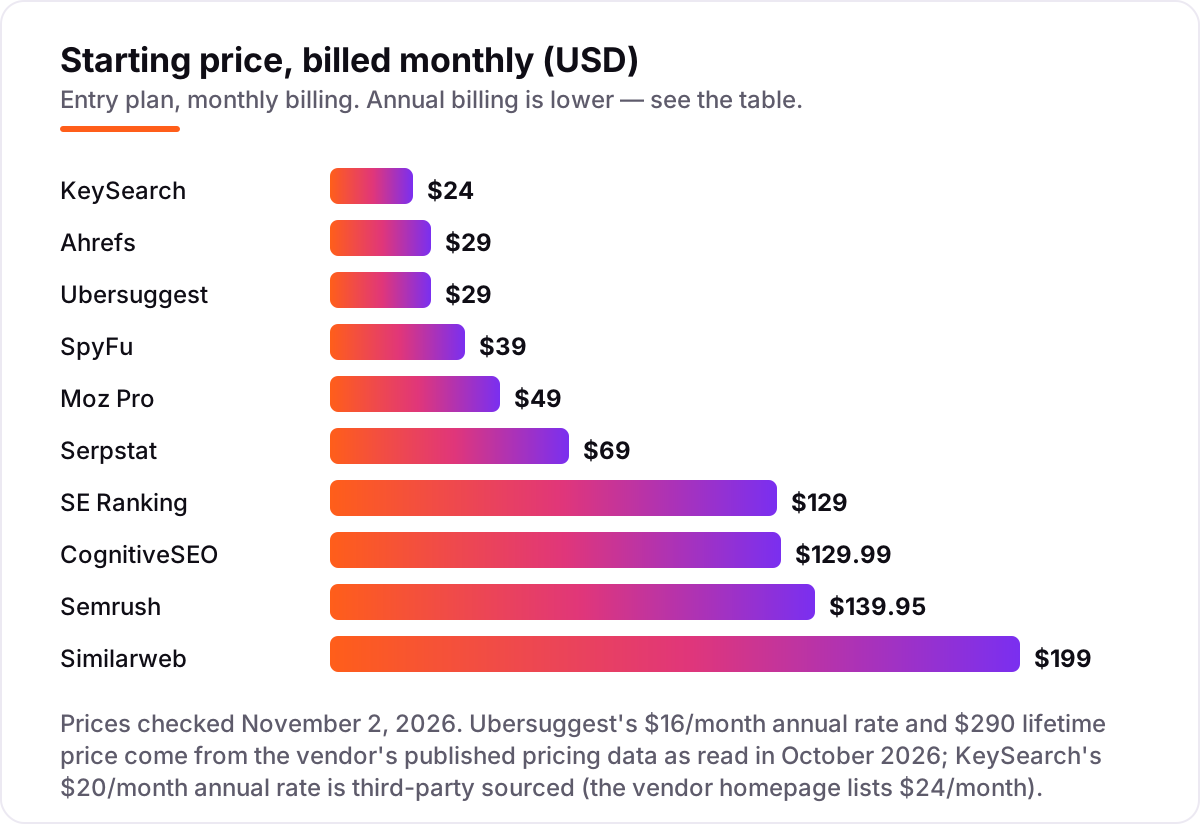
Five tools in this list start under $50 a month, and the gap data is real in all of them. Ahrefs Starter at $29 is the cheapest way into deep data; KeySearch at $24 is the cheapest paid plan of all; Ubersuggest at $29 adds a lifetime option for buyers who would rather pay once. Serpstat at $69 sits just above the line but earns its place with a named Missing Keywords report, and Moz Pro Starter at $49 brings the friendliest gap view in the category. The budget trade is always the same: smaller databases, slower refreshes, and caps on searches or tracked keywords.
The annual math matters most at this end of the list. SpyFu drops from $39 to $29 a month on annual billing, Ubersuggest from $29 to $16, and KeySearch from $24 to $20 — so a yearly commitment can move a tool down a whole price tier. The exception is Ahrefs Starter and Moz Pro Starter, which have no annual option at all, so the monthly price is the price. If you are choosing between two budget tools, compare the annual figures, not the monthly ones.
Traffic-weighted gaps
Similarweb is the odd one out, and that is the point. Every other tool in this list sorts gaps by ranking position; Similarweb sorts them by the traffic they actually bring, because its gap report is built on traffic estimates rather than rank data. A keyword your rival ranks for with 10,000 visits a month outranks one with 100, even if both are gaps.
The numbers are modeled from a panel, not measured, so accuracy drops for low-traffic sites — but for sizing a market or pricing an opportunity, traffic is the honest unit. Use Similarweb to decide which gaps are worth chasing, then use a rank-based tool to decide what to write. The two views answer different questions, and a team that runs both rarely regrets it.
Quick comparison: tool type by need
| Buyer | Best pick | Why |
|---|---|---|
| Small agency, gap analysis every week | Semrush | Five-domain comparisons on the biggest database, from $139.95/month |
| Solo SEO who wants deep data cheap | Ahrefs | Content Gap on a 110-billion-keyword database from $29/month |
| Best value suite | SE Ranking | Gap analysis plus 2,000 daily-tracked keywords from $103.20/month billed annually |
| Dedicated gap work on a budget | SpyFu | Kombat's three-way Venn view from $39/month |
| Budget all-in-one | Serpstat | Named Missing Keywords report from $69/month |
| Beginner team that needs DA metrics | Moz Pro | Keyword Gap 2.0 with Traffic Lift from $49/month |
| Sizing gaps by traffic value | Similarweb | Traffic-weighted gaps from $125/month billed annually |
| Solo owner, one budget tool | Ubersuggest or KeySearch | Competitor gaps from $29 and $24/month respectively |
How to choose: a short decision path
- Count your competitors first. One rival shows a gap; three or more show a market. Semrush compares up to four competitors at once, Moz Pro three, SpyFu two.
- Decide domain gap or page gap. If you need new topics, compare whole domains. If you need to fix one page, compare that page against the top-ranking pages — CognitiveSEO is the pick for that job.
- Check the data behind the gap. A 27-billion or 110-billion keyword database finds long-tail gaps a small database misses. For niche sites, database size matters more than the interface.
- Weigh traffic against position. If you need to know what a gap is worth, Similarweb's traffic-weighted view beats a position-only list. If you need to know what to write, a position list is enough.
- Try before you pay. Every tool in this list has a free plan or a free trial. Run your domain against your two closest competitors and check whether the gaps match what Search Console already tells you.
Before you write the pages your gap list calls for, run your titles through the free keyword density checker — it shows whether the target term actually appears where Google expects it.
Mistakes to avoid
- Comparing monthly prices without checking billing. The annual price is usually 15–30% lower — Similarweb drops from $199 to $125 a month on annual billing — and Ahrefs Starter and Moz Pro Starter have no annual option at all.
- Trusting a directory price. G2 still lists SpyFu Basic at $59 a month; the live pricing page says $39. Always check the vendor's own page.
- Picking one competitor. A gap against a single rival is that rival's strategy, not your market's. Compare at least two or three direct competitors.
- Chasing every gap. A keyword your rival ranks for is only an opportunity if you can realistically outrank them for it — check difficulty and your own authority first. Our guide to keyword research explains how to sort winnable terms from vanity ones.
- Forgetting the trial ends. Set a reminder for the day the trial converts, and export your gap lists first — several tools lock exports behind paid plans.
How we chose
We checked each vendor's own pricing page on November 2, 2026 and recorded the starting price exactly as shown, including the annual-billing figure where the page lists one. Two figures needed a note: Ubersuggest's $16-a-month annual rate and $290 lifetime price come from the vendor's published pricing data as read in October 2026, because the live pricing page renders its plan table dynamically and shows the $29-to-$99 range; and KeySearch's $20-a-month annual rate is third-party sourced, since the vendor homepage lists only the $24 monthly price. Ratings come from G2, opened the same day; KeySearch has no G2 or Capterra profile, so it carries no rating. The 27-billion-keyword figure for Semrush comes from Semrush's own product description on G2. We ranked the tools by fit for the most common buyer — a small agency or in-house team running gap analysis across a few competitors — not by brand size. No vendor paid for a place in this list, and none of the links here are affiliate links.
What to do next
Start with the decision path above: count your competitors, pick domain or page gaps, and check the database behind the tool. Then take the free plan or trial of your top pick and run your domain against your two closest competitors — if the gaps match what you already know from Search Console, you have your tool. If the numbers point to a bigger problem than missing keywords, our SEO audit service will tell you what is actually holding the site back. If you'd rather have this set up and read for you, request a free SEO + AI visibility audit and get a ranked fix list in 2 business days.
Rather not run the tools yourself?
Tools show you the data. SerpAstra turns it into higher rankings, more map-pack calls and citations in AI answers.
Get a free SEO + AI visibility audit→Sources we checked (19)
- Semrush pricing — semrush.com/prices (checked November 2, 2026)
- Semrush on G2 — 4.4/5, 4,304 reviews (checked November 2, 2026)
- Ahrefs pricing — ahrefs.com/pricing (checked November 2, 2026)
- Ahrefs on G2 — 4.5/5, 723 reviews (checked November 2, 2026)
- SE Ranking pricing — seranking.com/subscription.html (checked November 2, 2026)
- SE Ranking on G2 — 4.7/5, 1,619 reviews (checked November 2, 2026)
- SpyFu pricing — spyfu.com/pricing (checked November 2, 2026)
- SpyFu on G2 — 4.6/5, 519 reviews (checked November 2, 2026)
- Serpstat pricing — serpstat.com/page/pricing-plans (checked November 2, 2026)
- Serpstat on G2 — 4.6/5, 466 reviews (checked November 2, 2026)
- Moz Pro pricing — moz.com/products/pro/pricing (checked November 2, 2026)
- Moz Pro on G2 — 4.3/5, 608 reviews (checked November 2, 2026)
- Similarweb pricing — similarweb.com/pricing (checked November 2, 2026)
- Similarweb on G2 — 4.4/5, 1,248 reviews (checked November 2, 2026)
- Ubersuggest pricing — app.neilpatel.com/en/pricing (checked November 2, 2026)
- Ubersuggest on G2 — 4.2/5, 160 reviews (checked November 2, 2026)
- KeySearch pricing — keysearch.co homepage (checked November 2, 2026)
- CognitiveSEO pricing — cognitiveseo.com/pricing.php (checked November 2, 2026)
- CognitiveSEO on G2 — 4.4/5, 74 reviews (checked November 2, 2026)
Shamim
Founder of SerpAstra
A full-stack SEO and digital marketer who spends most days on Local SEO for dental practices, AI search visibility and lead generation.
Frequently asked questions
What is the best tool for keyword gap analysis in 2026?
Semrush, for most teams: its Keyword Gap tool compares your domain against up to four competitors, splits results into missing, weak and untapped keywords, and sits on a 27-billion-keyword database. Ahrefs Content Gap is the better buy if you want deep data from $29 a month, and SpyFu Kombat is the best dedicated gap tool at $39 a month.
How much does a keyword gap analysis tool cost?
Between $24 and $199 a month at the entry level. KeySearch starts at $24, Ahrefs and Ubersuggest at $29, SpyFu at $39 and Moz Pro at $49. The full suites cost more: SE Ranking from $129, Semrush from $139.95 and CognitiveSEO from $129.99 a month, all billed monthly. Annual billing cuts most of these by 15 to 30 percent.
Is there a free keyword gap analysis tool?
Yes, with limits. Serpstat, Ubersuggest and SpyFu all have free plans or free tiers, and Similarweb has a free version, but the gap views on free plans are limited to a handful of searches or results. For a real gap analysis across several competitors, expect to pay from $24 a month — KeySearch is the cheapest paid plan here.
What is the difference between keyword gap analysis and content gap analysis?
Keyword gap analysis compares whole domains: which keywords competitors rank for that you do not. Content gap analysis compares pages: which keywords the top-ranking pages for one topic cover that your page misses. Semrush, Ahrefs and SpyFu do domain gaps; CognitiveSEO does page gaps. Most buyers need the domain view first.
How many competitors should I compare in a gap analysis?
Three is the practical minimum: your domain plus two or three direct competitors. One rival shows a gap; three show whether it is a market pattern or one site's quirk. Semrush compares up to four competitors at once, Moz Pro up to three, and SpyFu Kombat two. Pick direct competitors, not market leaders you cannot realistically outrank.
Can a keyword gap tool replace rank tracking?
No. A gap tool finds keywords you do not rank for yet; a rank tracker watches the keywords you already target. Use the gap report to build the list, then track it: SE Ranking, Semrush and Serpstat all bundle daily rank tracking with their gap tools, so the same subscription covers both jobs without a second purchase.
Free SEO and AI visibility audit
Find out what is holding your rankings back
Send us your site. Within 2 business days you get a written audit, an AI visibility check and a short fix list ranked by impact. Free, with no contract attached.
Request my free audit→Related guides
 SEO & AI Search10 Best Keyword Research Software in 2026, Compared10 best keyword research software tools compared on price, database size and ease of use, with prices checked on each vendor page on November 1, 2026.Read guide →
 SEO & AI Search11 Best Keyword Rank Tracker Software in 2026, ComparedThe 11 best keyword rank tracker software options compared on price, keyword limits, update speed and AI visibility, with prices checked November 1, 2026.Read guide →
 AI SearchBest AI SEO tools in 2026: honest picks by jobBest AI SEO tools in 2026, picked by job: Semrush and Ahrefs for research, Surfer and Clearscope for content, Otterly for AI tracking, with 2026 prices.Read guide →