
10 Best Tools for Entity Optimization in 2026, Compared
10 best tools for entity optimization compared on price, knowledge graphs, schema and AI visibility. Prices cross-checked on November 2, 2026.
 Shamim Mia, Founder, SerpAstraLast verified November 2, 202616 min read
We compare pricing pages, documentation and public reviews. We never accept payment for rankings.

Key takeaways
- InLinks is the best starting point for most buyers: a dedicated entity platform with a site knowledge graph, internal linking and schema from $49/month, with a free plan.
- WordLift builds the deepest knowledge graph but now starts at €160/month billed annually, and Schema App's schema-only platform starts at $50/month — confirm the price at checkout.
- If you write in WordPress, Rank Math PRO (€95.88/year first year) and Yoast Premium ($118.80/year) add schema inside the plugin you already run.
- The single most important buying factor is where your entities live: pages need a content optimizer, the site needs a knowledge graph, and the brand itself needs Kalicube Pro.
- Prices below were cross-checked against vendor pricing pages and vendor documentation in fresh crawls dated October 30 to November 2, 2026. No review ratings are shown — G2 and Capterra pages could not be opened on November 2, 2026.
On this page
Quick comparison
| Tool | Best for | Starting price | Free plan |
|---|---|---|---|
| InLinks | Solo SEOs and small agencies that want entity-based content optimization, internal linking and schema from one platform | $49/mo | Yes |
| WordLift | Publishers and in-house teams that want automated schema and a site-wide knowledge graph without hand-writing markup | €160/mo (annual) | No |
| Schema App | Agencies and in-house teams that need correct, validated schema markup across any CMS without writing JSON-LD by hand | $50/mo | No |
| Surfer | Content teams and solo creators who want live SERP-based scoring on every draft | $49/mo (annual) | No |
| Frase | Small content teams that want SERP research, briefs and AI drafting in one cheap subscription | $39/mo (annual) | No (7-day trial) |
| Clearscope | Editorial teams that need one clear, defensible content grade for every draft | $129/mo | No (14-day trial) |
| MarketMuse | Larger content teams planning topical authority across hundreds of pages | Custom quote | Yes (10 queries) |
| Rank Math | WordPress site owners who want schema, redirects and rank tracking in the SEO plugin they already run | €7.99/mo (first year) | Yes |
| Yoast SEO | WordPress teams already trained on Yoast who want schema, redirects and internal-link suggestions in one familiar plugin | $9.90/mo (annual equiv.) | Yes |
| Kalicube Pro | Agencies and brands that need search engines and AI assistants to understand the brand itself — not just its pages | Custom quote | No |
Make one of these tools?
We re-check this list every quarter. Send a correction, request a review, or ask about a clearly labeled sponsored spot.
Request a listingThe best entity optimization tools

InLinks
Best for: Solo SEOs and small agencies that want entity-based content optimization, internal linking and schema from one platform
InLinks is the only tool in this list built entirely around entities. It reads your content, identifies the entities you cover, and builds a knowledge graph of your whole site — then uses that graph to suggest internal links between pages that share entities, including synonyms and related terms. It also writes About and FAQ schema from the entities it detects, so the markup matches the page.
The Freelancer plan covers 100 pages for $49 a month, which fits a small site or a single client, and the free plan lets you test the workflow on a handful of pages first. The limit to respect is scale: every 100-page block costs more, and the schema output is simpler than WordLift's for unusual types. Buy InLinks when internal linking and entity coverage are the job.
What we like
- Builds a site knowledge graph from the entities detected in your own content
- Suggests internal links from entity relationships, including synonyms and related terms
- Auto-generates About and FAQ schema from detected entities, with no hand-written JSON-LD
Watch out for
- Freelancer caps at 100 pages, so larger sites pay more per 100-page block
- Free plan covers only 2 content optimizations a month and internal linking for 25 pages
- No AI visibility tracking — it optimizes entities, it does not report AI mentions

WordLift
Best for: Publishers and in-house teams that want automated schema and a site-wide knowledge graph without hand-writing markup
WordLift is the category-defining knowledge-graph platform: it annotates the entities in your content, links them into a graph of your whole site, and turns that graph into schema markup automatically. Where InLinks works page by page, WordLift works site-wide — the graph is queryable, so you can see how entities connect across hundreds of pages and where the coverage is thin.
The catch is the 2026 price. The Agent plan now starts at €160 a month billed annually, and Business+ is €799 a month billed annually, with no self-serve trial to test the platform first. That puts WordLift out of reach for solo sites. Buy it when the knowledge graph itself is the product — for a publisher whose content is the business.
What we like
- Builds a queryable knowledge graph of the whole site, not just page-level schema
- Automates entity annotation and schema markup, including product and FAQ types
- WordPress plugin and API integrations keep the graph in sync as content changes
Watch out for
- Entry price is now €160 a month billed annually — the priciest dedicated tool here
- Sales-led pricing above Agent, with no self-serve trial to test the platform
- WordPress-first; other sites work through the API, which needs developer time

Schema App
Best for: Agencies and in-house teams that need correct, validated schema markup across any CMS without writing JSON-LD by hand
Schema App does one job and does it properly: it produces validated JSON-LD for any content management system and deploys it through a single script, so the markup is correct before it ever reaches Google. The editor covers the full Schema.org vocabulary, and custom markup can be built for pages that templates cannot handle — product variants, events, local business details.
The honest caveat is pricing transparency. The live pricing page lists no public prices, and the $50 a month figure comes from Schema App's own support pricing page, so confirm it at checkout. There is no free plan and no trial listed. Buy Schema App when the site is custom-built or multi-CMS and the schema has to be right.
What we like
- Supports the full Schema.org vocabulary with validation before anything goes live
- Works on any CMS, not just WordPress, with deployment through one script
- Schema App Editor builds custom markup for pages that templates cannot cover
Watch out for
- The live pricing page lists no public prices — the $50 figure comes from the vendor's own support pricing page
- No free plan, and per-domain pricing adds up fast across client sites
- Schema only — no content optimization, internal linking or rank tracking

Surfer
Best for: Content teams and solo creators who want live SERP-based scoring on every draft
Surfer grades every draft against the pages already ranking and shows the terms and entities to cover, live, as you write. The Content Score is the feature that matters: it turns entity coverage from a vague goal into a number you can chase, and Content Audit flags the older pages that are decaying so you can refresh them before they slide.
Discovery costs $49 a month billed annually and covers 120 documents a year, which fits a solo creator publishing a couple of optimized posts a month. The limit is AI tracking: Discovery follows 10 pages but tracks no AI prompts, so prompt tracking starts on Standard. Buy Surfer when the writing itself is the bottleneck.
What we like
- Content Score compares each draft live against the pages already ranking, with NLP term and entity guidance
- Content Audit flags decaying pages and quick-win refreshes
- Surfy AI assistant, AI detector and humanizer sit inside the same workspace
Watch out for
- AI visibility tracking starts on Standard ($99/month) — Discovery tracks no AI prompts
- 120 documents a year is roughly two optimized posts a month
- No free plan and no trial — only a 7-day money-back guarantee

Frase
Best for: Small content teams that want SERP research, briefs and AI drafting in one cheap subscription
Frase runs the whole research-to-publish loop in one subscription: it researches the SERP, builds a brief from the entities and topics the ranking pages cover, drafts against that brief, and scores the result. It is the cheapest tool in this list that also tracks AI visibility — Starter follows mentions on ChatGPT and Google AI from day one.
Starter costs $39 a month billed annually and covers 10 articles and 50 audit pages a month, which fits a small team publishing weekly. The ceiling is volume: more articles or all five AI engines need Professional or Scale. Buy Frase when you want briefs and AI tracking on the smallest budget.
What we like
- Research, briefs, drafting and optimization in one loop, with SERP-derived entity and topic coverage
- AI visibility tracking on ChatGPT and Google AI from the entry plan
- Cheapest route to briefs plus AI tracking in this list
Watch out for
- Starter caps at 10 articles and 50 audit pages a month — volume costs more
- Full five-engine AI coverage needs Scale ($239/month billed annually)
- No free plan; the 7-day trial is capped at 5 articles and 25 AI prompts

Clearscope
Best for: Editorial teams that need one clear, defensible content grade for every draft
Clearscope gives every draft a letter grade from F to A++ and lists the exact terms and topics to cover to reach it, which makes it the easiest tool in this list to hand to a freelancer. Essentials covers 50 pages and 50 tracked prompts, and every plan includes unlimited users and projects, so a growing editorial team never pays per seat.
At $129 a month it is the most expensive dedicated optimizer here, and 20 drafts a month is a real cap — extra drafts cost $50 per 10. There is no keyword research, AI writing or site audit, so you arrive with a target keyword in hand. Buy Clearscope when grading quality matters more than volume.
What we like
- Letter grade from F to A++ that any freelancer can follow, with the exact terms and topics to cover
- Unlimited users and projects on every plan, with no contract and a 14-day free trial
- 50 tracked prompts on Essentials follow your pages in ChatGPT, Gemini and Claude answers
Watch out for
- Highest entry price among the dedicated optimizers here at $129 a month
- 20 drafts a month on Essentials — extra drafts cost $50 per 10 once the allowance runs out
- No keyword research, AI writing or site audit — you arrive with a target keyword

MarketMuse
Best for: Larger content teams planning topical authority across hundreds of pages
MarketMuse works one level above the other content tools: instead of optimizing one page, it scores topical authority across your whole inventory and tells you what to create, what to update and what to consolidate. Briefs are built from your own inventory data rather than just the top ten results for one keyword, so the plan reflects your site, not the SERP alone.
The free plan covers 10 queries a month, which is enough to test the research before any sales call. The paid tiers start with a demo and a quote, so you cannot budget before talking to sales, and the platform takes time to learn. Buy MarketMuse when the inventory is the problem, not a single page.
What we like
- Inventory-wide topical authority scoring shows what to create, update or consolidate across a whole site
- Content briefs built from your own inventory data, not just the top ten results for one keyword
- Free plan with 10 queries a month lets an individual test the research before a sales call
Watch out for
- No published paid prices — every paid tier starts with a demo, so you cannot budget before a call
- Reviewers warn the platform takes time to learn and the dashboards run deep
- Overkill for a single site or a handful of pages — the value shows at inventory scale

Rank Math
Best for: WordPress site owners who want schema, redirects and rank tracking in the SEO plugin they already run
Rank Math PRO puts schema, redirects and rank tracking inside the WordPress plugin you already run, which is why it is the value pick for WordPress sites. The advanced schema generator covers more than 20 types, the rank tracker follows 500 keywords, and one PRO licence covers unlimited personal sites — Yoast charges $118.80 per site for the same job.
PRO costs €95.88 for the first year and renews at €107.88 a year, so budget the renewal, not the intro price. Client sites need the Business plan, and the 190-plus settings overwhelm new users. Buy Rank Math PRO when you run WordPress and want schema handled inside the plugin.
What we like
- Advanced schema generator covers 20+ types, including Local Business and Product, inside WordPress
- One PRO licence covers unlimited personal sites — Yoast charges per site
- Rank tracking, redirects and a 404 monitor included, so less plugin juggling
Watch out for
- First-year price rises to €107.88 a year on renewal
- Client sites need Business ($299.88/year) or Agency — PRO covers personal sites only
- 190+ settings overwhelm new users, and AI content credits are capped

Yoast SEO
Best for: WordPress teams already trained on Yoast who want schema, redirects and internal-link suggestions in one familiar plugin
Yoast SEO Premium is the familiar pick: the plugin most WordPress teams already know, now with Local, Video and News SEO bundled into Premium instead of sold separately. Premium adds multiple focus keyphrases, a redirect manager and internal linking suggestions to the free plugin's schema output, and the interface needs no training for anyone who has used Yoast before.
Premium costs $118.80 a year for one site, and the licence is per site — ten sites cost $1,188 a year before bulk discounts, where Rank Math PRO covers unlimited personal sites for one fee. Schema control is also lighter than Rank Math or Schema App for custom types. Buy Yoast Premium when your team already lives in it.
What we like
- Schema output is solid for standard types, and Local, Video and News SEO now come bundled
- The most widely used WordPress SEO plugin — over 10 million installs, so help is easy to find
- Internal linking suggestions and redirect manager included in Premium
Watch out for
- Licence is per site — ten sites cost $1,188 a year before bulk discounts
- Schema control is lighter than Rank Math PRO or Schema App for custom types
- No rank tracking or AI visibility tracking in the plugin

Kalicube Pro
Best for: Agencies and brands that need search engines and AI assistants to understand the brand itself — not just its pages
Kalicube Pro is the only tool in this list that optimizes the brand rather than the pages. It audits how Google, Knowledge Graphs and large language models understand a company or person, finds the inconsistent names, descriptions and facts that confuse them, and produces a roadmap for fixing the brand's digital footprint — including the knowledge panel.
There is no published price and no free trial: every engagement starts with a quote, and Kalicube has discontinued agency platform subscriptions in favour of Done With You services. Results also build over months, not days. Buy Kalicube Pro when the brand itself is misunderstood.
What we like
- Tracks how Google, Knowledge Graphs and large language models understand a brand over time
- Finds inconsistent names, descriptions and facts across the web and prioritizes the fixes
- White-label option lets agencies deliver the work under their own brand
Watch out for
- No published prices — every engagement starts with a quote, so budgeting needs a call
- Agency platform subscriptions were discontinued in favour of Done With You services
- Entity results build over months, not days — this is not a quick-fix tool
Entity optimization is the work of making sure Google and AI assistants understand what your business, products and topics actually are — not just which keywords appear on the page. The 10 best tools for entity optimization below are sorted by the job they do: dedicated entity platforms, schema-first tools, and content optimizers that cover entities as part of the draft. Prices run from $9.90 a month to €160 a month, plus two quote-only platforms, and every price was cross-checked against vendor pricing pages and vendor documentation in fresh crawls dated October 30 to November 2, 2026.
If you only remember one thing, remember this: entities live in three places — your pages, your site's structure, and your brand's reputation across the web. No single tool covers all three well, so the right buy depends on which of the three is weakest for you right now.
What the best tools for entity optimization actually do
An entity is a distinct thing — a person, a company, a product, a place, a concept — that Google stores with a set of facts and relationships. Google said in 2020 that its Knowledge Graph held over 500 billion facts about five billion entities, drawn from the web and from open and licensed databases. Entity optimization is the work of making sure the facts about your entities are correct, consistent and machine-readable, so search engines and AI assistants describe you accurately instead of guessing.
These tools attack that job from different angles. InLinks and WordLift build a knowledge graph of your site and annotate the entities in your content. Schema App, Rank Math and Yoast turn those facts into schema markup that machines can read. Surfer, Frase, Clearscope and MarketMuse make sure each page covers the entities and topics that ranking pages cover. Kalicube Pro works on the brand itself — the entity that is your company — and whether Google and AI engines understand it at all.
Dedicated entity platforms first
InLinks, WordLift and Kalicube Pro are the only tools here built for entities first rather than for keywords or drafts. InLinks is the practical pick: $49 a month, a free plan, and one workflow that covers content audits, internal links and schema. WordLift is the deeper platform — a real knowledge graph with an API — but its entry price moved to €160 a month billed annually in 2026, which puts it out of reach for solo sites. Kalicube Pro is a different animal entirely: it does not optimize pages, it optimizes the brand, and it is priced by quote.
Start here if your problem is understanding, not writing. If Google confuses your brand with a same-named company, if your internal links ignore topic relationships, or if your pages cover entities without ever naming them clearly, a dedicated platform pays for itself. If your pages are thin or your drafts miss the topics competitors cover, skip to the content optimizers below — a knowledge graph will not fix weak writing.
Schema-first tools
Schema markup is how entities get delivered to machines, and Schema App, Rank Math PRO and Yoast Premium are the three ways to produce it. Schema App is the specialist: it validates markup against the full Schema.org vocabulary and deploys it on any CMS through one script, which matters when the site is not WordPress. Rank Math PRO and Yoast Premium live inside WordPress instead, so the schema is generated where the content is written — Rank Math covers 20-plus types for €95.88 in the first year, Yoast covers the standard types plus Local, Video and News SEO for $118.80 a year per site.
If you need a quick check on a single page's FAQ markup, the free FAQ schema generator builds valid JSON-LD without a subscription. For production use, pick Schema App when the site is custom-built or multi-CMS, Rank Math PRO when you run several WordPress sites yourself, and Yoast Premium when your team already knows Yoast and runs one site per licence.
Content optimizers with entity coverage
Surfer, Frase, Clearscope and MarketMuse are content tools first, but each one treats entities as part of the draft. Surfer's Content Score grades every draft against the pages already ranking and lists the terms and entities to cover; Frase builds briefs from SERP research and adds AI visibility tracking on ChatGPT and Google AI from its $49 Starter plan; Clearscope gives every draft a letter grade and tracks 50 prompts across ChatGPT, Gemini and Claude. MarketMuse works at a higher level — it scores topical authority across your whole inventory and tells you what to create, update or consolidate.
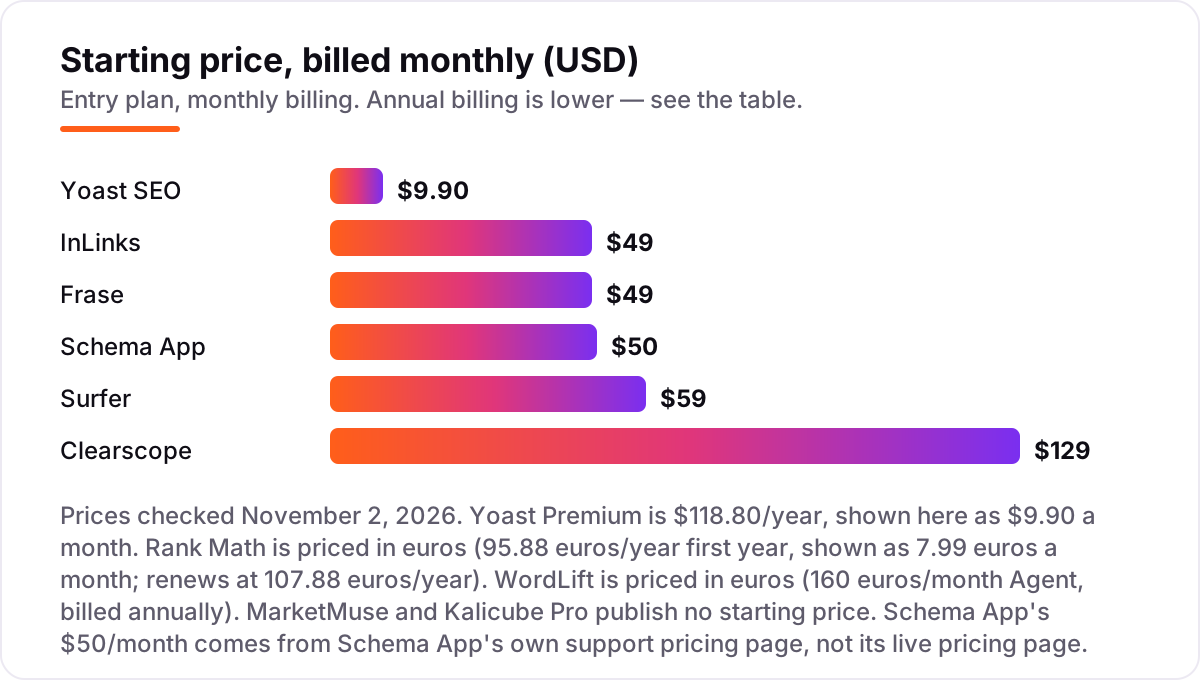
These are the right tools when the writing is the bottleneck. A page that never mentions the entities readers expect will not rank for them, no matter how good the schema is. Note the price spread: Frase and Surfer start under $60 a month, Clearscope starts at $129, and MarketMuse does not publish a price at all — it starts with a demo and a quote.
AI visibility: where the brand itself is the entity
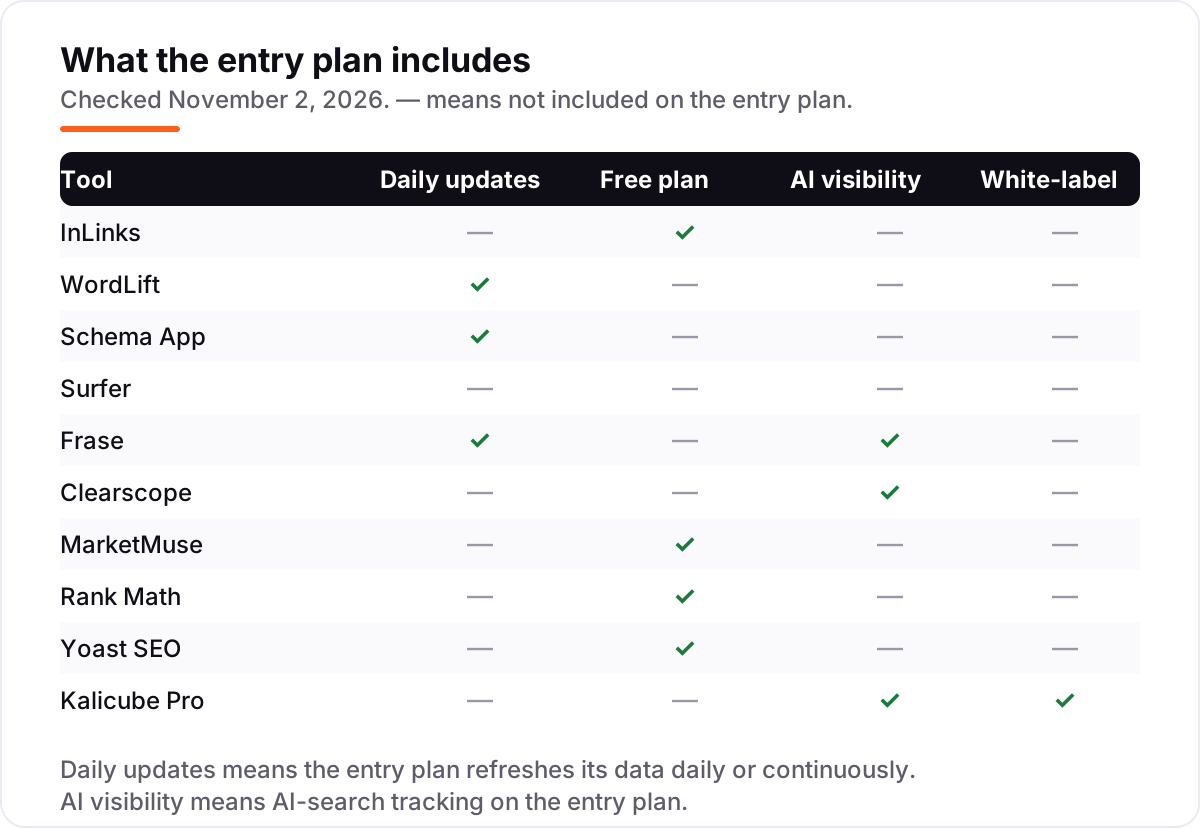
AI answers quote entities, not keywords, so entity work and AI visibility are now the same job. Clearscope and Frase track AI mentions from their entry plans; Surfer adds prompt tracking from Standard ($99 a month billed annually), and its standalone AI Search Analytics plan costs $82 a month billed annually. WordLift and InLinks work the other side of the same problem: they structure entities so AI engines can quote you accurately. Kalicube Pro watches the brand itself — how Google, Knowledge Graphs and large language models understand it — which is the only view that covers knowledge panels.
If AI citations matter to your clients, check this before you buy: several tools in this list charge extra for AI tracking or reserve it for higher tiers. Our guide to getting cited in ChatGPT explains what the AI engines actually quote, and our AI search optimization service is built around exactly this data.
Quick comparison: tool type by need
| Buyer | Best pick | Why |
|---|---|---|
| Solo site, tight budget | InLinks | $49/month, free plan, entity content plus links plus schema in one place |
| Publisher with a large site | WordLift | Automated schema and a real knowledge graph, from €160/month billed annually |
| Any CMS, schema only | Schema App | Validated JSON-LD deployment for $50/month, 1 domain |
| Content team writing daily | Surfer or Frase | Live scoring and briefs from $49/month billed annually |
| Editorial team, one clear grade | Clearscope | Letter grades plus AI prompt tracking for $129/month |
| Whole-inventory strategy | MarketMuse | Topical authority across hundreds of pages, custom quote |
| WordPress, several sites | Rank Math PRO | Schema plus rank tracking for €95.88 in the first year |
| WordPress, one site, familiar tool | Yoast Premium | Schema and redirects for $118.80/year per site |
| Brand and knowledge panel | Kalicube Pro | Brand-entity audits and tracking, custom quote |
How to choose: a short decision path
- Find the weak layer first. Pages, site structure, or brand reputation — pick the tool that fixes the weakest one, not the one with the longest feature list.
- Count your pages and sites. InLinks charges per 100 pages, Schema App per domain, Yoast per site. A tool that looks cheap for one site can triple in price across five.
- Check the AI question. If clients ask about ChatGPT and AI Overviews, make sure the plan you pick includes AI visibility — Surfer reserves it for Standard and up, and MarketMuse does not track it at all.
- Test the workflow, not the demo. Every tool here except Kalicube Pro has a free plan, a trial or a money-back window. Run your real pages through it for a week before committing.
- Budget the renewal, not the first year. Rank Math PRO rises from €95.88 to €107.88 a year on renewal, and WordLift's Agent plan is billed annually upfront.
Mistakes to avoid
- Adding schema to thin pages. Markup cannot fix content that never covers the entity properly — write the page first, then mark it up.
- Treating entity optimization as a one-off. Knowledge panels and AI citations change as the web changes; the facts need checking every quarter, not once.
- Comparing monthly prices without checking billing. Annual billing is usually 15–20% cheaper, and two tools here (MarketMuse, Kalicube Pro) publish no price at all.
- Trusting a directory price. WordLift's old $99 plans still appear in reviews, and InLinks still shows $39 on G2 — the live figures are €160 a month billed annually and $49 a month. Always check the vendor's own page.
- Buying a suite when you need one job. If all you need is valid schema on a custom CMS, Schema App at $50 a month beats a $129 content optimizer you will only use for markup.
How we chose
We cross-checked each price against the vendor's published pricing as captured in fresh search-index crawls dated October 30 to November 2, 2026, and against figures verified the previous day in our own research files; where sources disagreed we used the vendor's own page or support documentation. Two prices need a note: Schema App's $50 a month comes from Schema App's own support pricing page because its live pricing page lists no public prices, and MarketMuse and Kalicube Pro publish no starting price at all, so both are listed as custom quote. No review ratings appear in this guide because the G2 and Capterra pages could not be opened on November 2, 2026, and we do not publish ratings we cannot verify the same day. We ranked the tools by fit for the most common buyer — a small agency or in-house team that needs entities understood, not just keywords tracked — not by brand size. No vendor paid for a place in this list, and none of the links here are affiliate links.
What to do next
Start with the decision path above: find your weak layer, count your pages and sites, and check the AI question. Then take the free plan or trial of your top pick and run your real pages through it for a week. If the schema validates, the internal links make sense and the entity coverage improves, you have your tool. If you'd rather have this set up and read for you, request a free SEO + AI visibility audit and get a ranked fix list in 2 business days.
Rather not run the tools yourself?
Tools show you the data. SerpAstra turns it into higher rankings, more map-pack calls and citations in AI answers.
Get a free SEO + AI visibility audit→Sources we checked (12)
- InLinks pricing — inlinks.com/pricing (checked November 2, 2026)
- WordLift pricing — wordlift.io/pricing (checked November 2, 2026)
- Schema App pricing — schemaapp.com/pricing (checked November 2, 2026)
- Surfer pricing — surferseo.com/pricing (checked November 2, 2026)
- Frase pricing — frase.io/pricing (checked November 2, 2026)
- Clearscope pricing — clearscope.io/pricing (checked November 2, 2026)
- MarketMuse pricing — marketmuse.com/pricing (checked November 2, 2026)
- Rank Math pricing — rankmath.com/pricing (checked November 2, 2026)
- Yoast SEO Premium pricing — yoast.com/wordpress/plugins/seo/premium (checked November 2, 2026)
- Kalicube Pro pricing — kalicube.pro/pricing (checked November 2, 2026)
- Google Knowledge Graph facts — Wikipedia, citing Google's May 2020 disclosure (500 billion facts, 5 billion entities)
- Kalicube white-label option — kalicube.com help center (updated March 13, 2025)
Shamim
Founder of SerpAstra
A full-stack SEO and digital marketer who spends most days on Local SEO for dental practices, AI search visibility and lead generation.
Frequently asked questions
What is entity optimization?
Entity optimization is the work of helping search engines and AI assistants understand the real things behind your pages — your brand, your products, your authors and your topics — instead of matching keywords. It combines consistent facts across the web, schema markup, internal links between related entities and content that covers each entity fully. The goal is a correct knowledge panel and accurate AI answers, not a ranking.
How much do entity optimization tools cost?
Between $9.90 and $160 a month at the entry level, depending on the job. InLinks starts at $49, Frase at $49 and Surfer at $59 billed monthly, while WordLift starts at €160 a month billed annually. WordPress plugins are cheaper per year: Rank Math PRO is €95.88 for the first year and Yoast Premium is $118.80. MarketMuse and Kalicube Pro publish no prices — both start with a quote.
Is there a free entity optimization tool?
Yes, with limits. InLinks has a free plan with 2 content optimizations a month and internal linking for 25 pages, and MarketMuse has a free plan with 10 queries a month. Rank Math and Yoast both ship free WordPress plugins with basic schema included. Free plans work for learning the workflow on one small site; real entity work across a whole site needs a paid plan.
InLinks or WordLift: which is better for entity optimization?
InLinks is better for most buyers: it is cheaper at $49 a month, it has a free plan, and it covers content optimization, internal linking and schema. WordLift is better when the knowledge graph is the product — for publishers who need automated entity annotation and schema across a site and can pay €160 a month. If you only need schema, Schema App at $50 a month sits between them.
Do I need schema markup for entity optimization?
Schema is the delivery mechanism, not the whole job. It tells Google and AI engines, in machine-readable form, what your entities are and how they relate — but it cannot fix inconsistent facts, thin content or missing pages. Think of it as the label on the box: the contents still have to be right. Every tool in this list except the pure brand platform handles schema in some form.
Can entity optimization tools help with AI search and ChatGPT?
Yes — that is where most of the value now sits. Clearscope and Frase track whether your pages appear in ChatGPT, Gemini and Google AI answers from their entry plans, and Surfer adds the same tracking from Standard. WordLift and InLinks work the other side: they structure your entities so AI engines can quote you accurately. Kalicube Pro tracks how AI engines understand your brand itself.
How long does entity optimization take to show results?
Months, not days. Schema and internal-link fixes can show in search results within weeks, but knowledge panels and AI citations depend on Google and the AI engines rebuilding their picture of your brand — and that picture changes slowly. Plan for three to six months of consistent facts, schema and content before judging the work. Tools that promise overnight entity results are selling something else.
Free SEO and AI visibility audit
Find out what is holding your rankings back
Send us your site. Within 2 business days you get a written audit, an AI visibility check and a short fix list ranked by impact. Free, with no contract attached.
Request my free audit→Related guides
 SEO & AI Search7 Best SEO Content Optimization Tools in 2026, Compared7 best seo content optimization tools compared on price, content scoring and AI visibility, with prices checked on the vendor pricing pages on November 1, 2026.Read guide →
 SEO & AI Search10 Best On-Page SEO Analysis Tools in 2026 (Free and Paid, Compared)10 best on-page seo analysis tools compared on price, content scoring and technical audits, with every price checked on the vendor's own pricing page.Read guide →
 SEO & AI SearchBest SEO Audit Software for 2026: 10 Options Compared by Use Case10 best SEO audit software tools compared on price, crawl depth and AI visibility. Prices checked on vendor pricing pages, November 1, 2026.Read guide →