
Best Tools for SEO for Retail in 2026: 8 Picks Ranked by What You Need
8 best tools for SEO for retail compared on price, local listings, rank tracking and AI visibility. Real prices checked on vendor pages, November 2, 2026.
 Shamim Mia, Founder, SerpAstraLast verified November 2, 202614 min read
We compare pricing pages, documentation and public reviews. We never accept payment for rankings.
Key takeaways
- Semrush is the best all-in-one for most retailers at $139.95/month; BrightLocal is the best local specialist at $41/month per location; SE Ranking is the best value suite at $103.20/month billed annually.
- Retail SEO is two jobs at once: ranking product and category pages, and winning the map pack for every store. Tools that do both cost more than tools that do one.
- The single most important buying factor is per-location pricing: most local tools charge per store, so a 10-store chain pays 10 times the headline price.
- Every price below was checked on the vendor's own pricing page on November 2, 2026. G2 ratings are omitted because the review pages could not be opened for verification today.
On this page
Quick comparison
| Tool | Best for | Starting price | Free plan |
|---|---|---|---|
| Semrush | Retailers with physical stores and an online shop who want rank tracking, local listings and AI visibility in one subscription | $117.33/mo (annual) | Yes (10 keywords) |
| BrightLocal | Retailers with 1–10 stores who need map-pack rankings, GBP audits and citation checks per location | $31/mo (annual) | No (14-day trial) |
| SE Ranking | Small retail chains and in-house teams tracking up to 2,000 keywords a day who want a full suite for about $103/month | $103.20/mo (annual) | No (14-day trial) |
| Moz Local | Retail chains with 1–50 US, UK or Canadian locations who need listings kept consistent across 90+ directories | $20/mo per location | No |
| Ahrefs | Retailers with large product catalogs who need backlink and keyword research behind product-page SEO | $29/mo | Yes (free plan) |
| Surfer | Retailers optimizing product and category pages who want data-backed content briefs for each page | $49/mo (annual) | No |
| Yext | Larger retail chains with many locations who need listings and location pages synced across 200+ publishers | $199/yr per location | No (demo only) |
| Whitespark | Single-store retailers and small agencies who want to buy only the local SEO tools they need, from $1 a month | $1/mo per location | No (free tools) |
Make one of these tools?
We re-check this list every quarter. Send a correction, request a review, or ask about a clearly labeled sponsored spot.
Request a listingThe best tools for SEO for retail

Semrush
Best for: Retailers with physical stores and an online shop who want rank tracking, local listings and AI visibility in one subscription
Semrush is the all-in-one pick because retail SEO splits in two: the online shop needs rank tracking, keyword research and audits, while every store needs local visibility. The SEO plan covers both — 500 keywords tracked daily, a site audit and a 27-billion-plus keyword database — and the Local add-on handles listings per store. One login covers the website and the shops.
The price is the honest catch. At $139.95 a month it is the most expensive entry here, extra users start at $45 a month, and the Local add-on costs more on top. AI prompt tracking across ChatGPT and Perplexity needs the Starter plan at $199 a month; the SEO plan covers AI Overviews citations only. Buy Semrush for one subscription covering shop and stores; buy a local specialist when the map pack is the whole job.
What we like
- 500 keywords tracked daily on the SEO plan, with Position Tracking down to ZIP-code level
- Bundles rank tracking with a 27-billion-plus keyword database, site audits and backlink analysis
- AI Overviews citations tracked on the SEO plan, with full AI prompt tracking from the Starter plan
Watch out for
- Highest entry price among the suites here, and extra users start at $45/month
- AI prompt tracking across ChatGPT and Perplexity needs the Starter plan ($199/month), not the SEO plan
- The Semrush Local add-on costs extra on top of the suite price

BrightLocal
Best for: Retailers with 1–10 stores who need map-pack rankings, GBP audits and citation checks per location
BrightLocal is the local specialist in this list, and it shows in the feature set: a Local Search Grid that maps your map-pack position across a 7×7 grid, a Google Business Profile audit, citation checks and competitor insights, all in the Track plan. It is built for the job retailers actually struggle with — knowing whether each store shows up when someone nearby searches for what it sells.
The billing model is the thing to price before you buy. Track costs $41 a month per location, so a second store doubles the bill and a ten-store chain pays $410 a month. Review management needs the Grow plan at $65 a month, and citation building is priced separately. For one to ten stores, it is the most focused local tool here; for fifty stores, the per-location math deserves a spreadsheet first.
What we like
- Local Search Grid shows map-pack rankings across a 7×7 grid with up to 5 keywords on every plan
- Bundles rank tracking, citation audits, a Google Business Profile audit and competitor insights in one per-location price
- Local AI Visibility Tracker included, so you can see how AI answers mention each store
Watch out for
- Priced per location, so the bill doubles with a second store — 10 locations cost 10 times the headline price
- Review management sits on the Grow plan ($65/month), not Track
- Citation building costs extra at $2–$3.20 per citation

SE Ranking
Best for: Small retail chains and in-house teams tracking up to 2,000 keywords a day who want a full suite for about $103/month
SE Ranking is the value pick in this list because the entry Core plan does not feel like an entry plan: 2,000 keywords tracked daily, 10 projects, a 250,000-page site audit allowance and AI visibility tracking across five engines. For a small retail chain or an in-house team, that is the whole SEO workflow in one subscription, and the per-keyword cost is the lowest of any suite here.
The trade-off is local depth. Core covers only 3 local business locations, so a chain with more stores pays for extra locations, and the interface takes a few days to learn. If you want the cheapest route to daily tracking at scale with AI visibility included, start here; if listings across dozens of stores are the priority, look at Moz Local or BrightLocal instead.
What we like
- 2,000 keywords tracked daily on Core, the most daily keywords per dollar among the suites here
- AI visibility across five engines included on Core (100 prompts a day)
- White-label reporting and guest links for client work, with an Agency Pack add-on from $69/month
Watch out for
- Core covers only 3 local business locations — chains pay more for extra locations
- Reviewers note the interface can feel less intuitive, and complex reports take getting used to

Moz Local
Best for: Retail chains with 1–50 US, UK or Canadian locations who need listings kept consistent across 90+ directories
Moz Local does one job — listings — and does it thoroughly. Lite distributes your name, address, phone number and hours across 90+ directories, monitors them for changes, and suppresses duplicates so a wrong phone number cannot spread. For a retail chain, that consistency is the foundation: the map pack cannot rank a store whose details disagree across the web.
What it does not do is track ranks daily or manage reviews on the entry plan. Review replies start on Preferred at $30 a month per location, and there is no free trial — the $20 a month Lite plan is the cheapest way to test it. Pick Moz Local when listings accuracy is the gap; pair it with a rank tracker when you also need to watch positions.
What we like
- Distributes and monitors listings across 90+ directories in the US, UK and Canada from one dashboard
- Duplicate suppression keeps a wrong phone number or address from spreading to new directories
- No setup fee, and monthly billing means a single store can cancel any month
Watch out for
- Lite covers listings only — review replies start on Preferred ($30/month) and rank tracking is basic
- No free trial, and the per-location rate does not fall with volume until Enterprise (50+ locations)
- Covers the US, UK and Canada only, so it does not fit retailers selling in other markets

Ahrefs
Best for: Retailers with large product catalogs who need backlink and keyword research behind product-page SEO
Ahrefs is the research engine in this list, and retail catalogs are where that research pays off. With hundreds of product pages competing for similar terms, the keyword database and backlink index tell you which pages can realistically rank and which competitors are winning the terms you want. Site Audit checks 170+ technical issues across the catalog, so broken filters, duplicate product descriptions and thin category pages surface fast.
The Starter plan is cheap but tight: 200 report credits a month, 50 tracked keywords, and weekly rank updates by default. A catalog with hundreds of products will burn through the credits in a few sessions, and daily tracking costs extra. Buy Ahrefs for the research depth behind product SEO; buy a local tool alongside it for the stores.
What we like
- One of the largest backlink indexes plus a 110-billion-keyword database behind every product-page decision
- Tracks positions across 190+ locations on desktop and mobile, with competitor tracking
- Site Audit checks 170+ technical issues, so category and product pages get a real health check
Watch out for
- Rank Tracker updates weekly by default — daily updates need the paid Project Boost add-on
- Starter's 200 monthly report credits run out fast on a catalog with hundreds of products
- No free trial, and AI visibility (Brand Radar) is a separate add-on

Surfer
Best for: Retailers optimizing product and category pages who want data-backed content briefs for each page
Surfer answers a question every retail site faces: what should this product page say to rank? The Content Editor scores a draft against the pages already ranking, then lists the terms, headings and structure to add — a brief a writer or store owner can follow without guessing. For category pages competing on broad terms like 'running shoes' or 'garden furniture', that guidance is worth more than another keyword list.
Discovery is a writing tool, not an SEO suite: no rank tracking, no site audit, and no AI prompt tracking — that starts on Standard at $99 a month billed annually. The 120-document yearly allowance covers about two pages a month, so a large catalog needs Standard or Pro. Pair Surfer with a tracker and it earns its keep; alone it cannot tell you whether the pages moved.
What we like
- Content Editor scores product and category pages against the top-ranking pages and tells you exactly what to fix
- 120 documents a year on Discovery — enough for about two optimized pages a month
- Keyword research, content audits and SERP analysis included from the entry plan
Watch out for
- No AI prompt tracking on Discovery — AI visibility starts on Standard ($99/month billed annually)
- No rank tracking or site audit, so it pairs with another tool rather than replacing one
- 120 documents a year sounds generous until a retailer with hundreds of product pages does the math
Yext
Best for: Larger retail chains with many locations who need listings and location pages synced across 200+ publishers
Yext is the chain-scale option: one Knowledge Graph holds the data for every store, and a single edit to hours or services pushes out to 200+ publishers across 216 countries. Its Pages product builds a location page for each store from one template, so a hundred stores get consistent pages without a hundred manual builds. For a retailer whose listings live in dozens of places, that central control is the point.
The entry price needs reading carefully. Emerging at $199 a year per location covers minor directories only — Google, Apple Maps, Bing, Facebook and Yelp need Essential at $449 a year. Billing is annual only, with a year-long commitment and no self-serve trial. Yext fits chains that need global reach and central control; a single store will find cheaper tools above.
What we like
- Publishes listing updates to 200+ publishers in 216 countries, with changes going live fast
- Pages builds a location page for every store from one template, so hours and services stay consistent
- Knowledge Graph keeps the data behind every listing in one place, so one edit lands everywhere at once
Watch out for
- Emerging covers minor directories only — Google, Apple Maps, Bing, Facebook and Yelp need Essential ($449/year)
- Annual-only billing with a year-long commitment, and no self-serve trial
- Priced per location with no volume break until Enterprise, so a 50-store chain pays 50 times the headline price

Whitespark
Best for: Single-store retailers and small agencies who want to buy only the local SEO tools they need, from $1 a month
Whitespark sells its tools one at a time, which makes it the cheapest way into local SEO and the easiest to overspend on. The Local Platform manages Google Business Profiles in bulk for $1 a month per location and blocks unwanted profile updates — a real risk when anyone can suggest an edit to your listing. Add the Local Rank Tracker from $14 a month and the Citation Finder from $33 a month only if you need them.
The modular model is both the strength and the catch. A single store that only needs profile management and rank tracking pays about $15 a month; a store that also wants citations and reviews pays far more across four separate bills. Buy Whitespark when you know exactly which local jobs you need done, and skip the tools you do not.
What we like
- Local Platform manages Google Business Profiles in bulk for $1 a month per location — the cheapest entry here
- Local Citation Finder uncovers citation gaps, and one-time citation building starts at $20
- Local Rank Tracker covers local and organic positions from $14 a month, with grids up to 225 points from $10 a month
Watch out for
- Every tool is a separate subscription — the full set costs far more than the $1 headline
- No bundled suite: rank tracking, citations, reviews and GBP management are four separate bills
- Reputation Builder, the review tool, costs $79 a month per location — more than the rank tracker and platform combined
Retail SEO is two jobs wearing one name, and the best tools for SEO for retail are the ones that cover both: ranking the product and category pages on your website, and winning the map pack for every physical store. A tool that only does one half leaves the other half to guesswork — and for most retailers, the store half is where the money is. This guide sorts the 8 tools by the job they do best, with real prices checked on November 2, 2026.
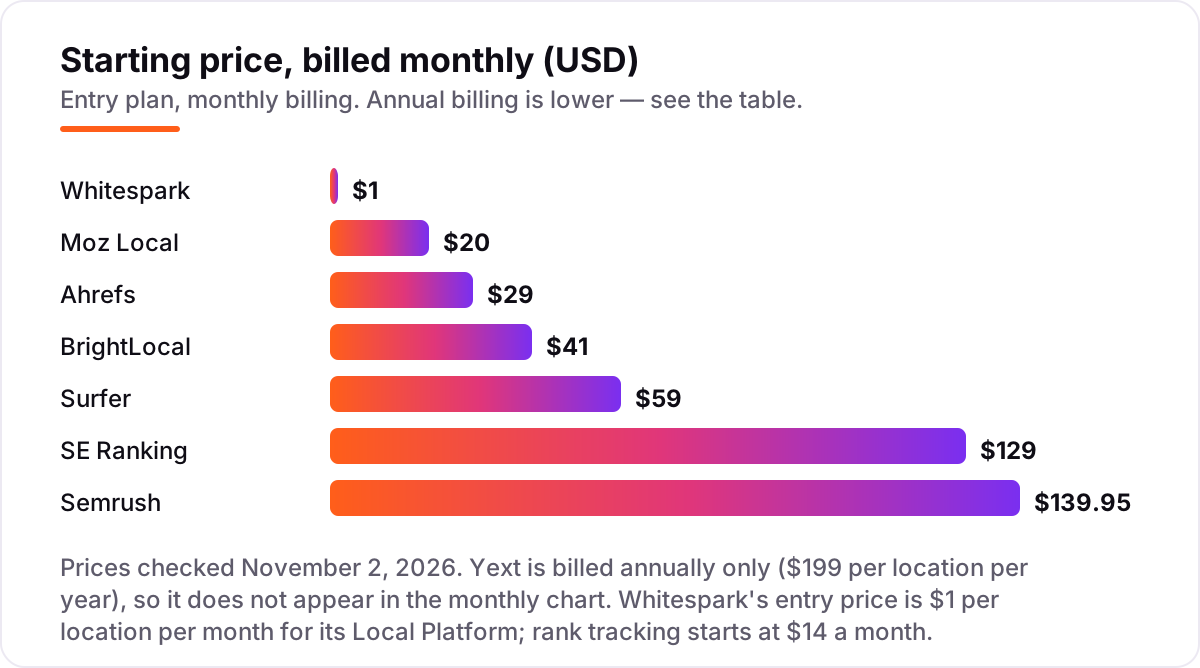
The list is sorted by the job each tool does best, not by brand size. The suites come first because most retailers need one subscription that covers the website; the local specialists follow because the map pack decides foot traffic; the content tools close the list because product pages are where retail SEO differs from every other kind. Prices are the starting price of the entry plan, checked on the vendor's own pricing page on November 2, 2026 — and where a tool charges per location, the price shown is per location, not per account.
What the best tools for SEO for retail actually do
A retail SEO tool does three things. First, it tracks where your pages rank for the searches that sell — product names, category terms and "near me" queries — and alerts you when a page drops. Second, it keeps every store's name, address, phone number and hours identical across Google, Apple Maps, Bing and the directories that feed them, because a listing with the wrong hours loses the visit. Third, the newer ones track whether AI answers mention your brand when a shopper asks ChatGPT or Google's AI Overviews where to buy something.
The urgency is real: Google's mobile search research found that 76% of people who search on their phones for something nearby visit a business within a day. That visit starts with a search result — a map pack listing or a product page — and the retailer whose listing is accurate and whose page ranks is the one that gets it. The tools below are ranked by fit for the most common retail buyer: a retailer with one to ten stores plus an online shop.
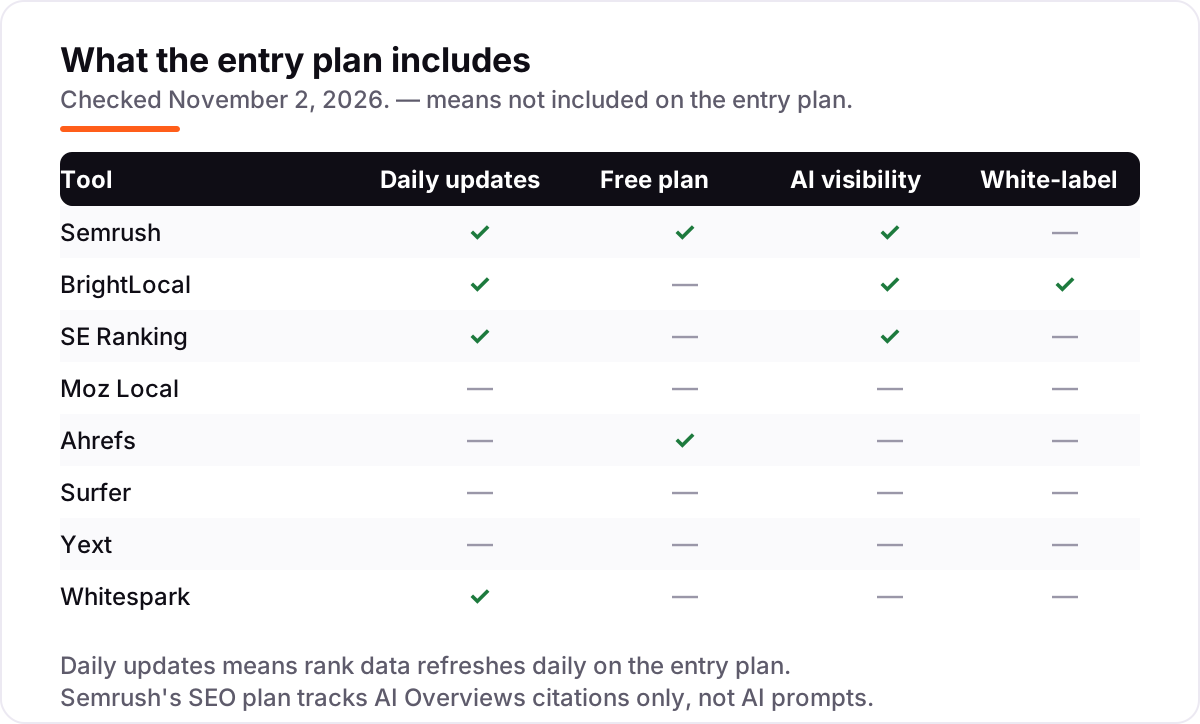
AI visibility is the newest of the three jobs, and the least settled. SE Ranking and BrightLocal include AI tracking on their entry plans; Semrush tracks AI Overviews citations on the SEO plan but charges $199 a month for full prompt tracking; Surfer starts AI tracking on Standard. If shoppers in your niche already ask AI assistants where to buy, treat AI visibility as a requirement, not a bonus — and check whether the plan you buy actually includes it.
All-in-one suites first
If you want one subscription for the website and the stores, start with the suites. Semrush is the deepest: rank tracking, keyword research, site audits, backlinks and AI visibility in one login, with a Local add-on for listings per store. SE Ranking is the value alternative — 2,000 keywords tracked daily on Core for about $103 a month billed annually, with AI visibility included. Ahrefs is the research-first choice, best when the catalog is large and the product pages need the deepest backlink and keyword data behind them.
Suites cost more because they replace two or three subscriptions. A retailer that already pays for a suite should use its tracker and its local module before buying a second tool; a retailer that only needs map-pack tracking will find the suites overpriced for that one job.
The suites also share a weakness for retailers: none of them manages listings as its main job. Semrush sells Local as an add-on, SE Ranking's local module covers three locations on Core, and Ahrefs has no listings tool at all. That is why even a suite buyer usually ends up with a local tool alongside it — the question is whether the suite or the local tool is the first purchase, and the answer depends on where your revenue comes from: the website or the shop floor.
Local listings and map-pack tools
The local specialists do the job the suites treat as an add-on. BrightLocal bundles map-pack grid tracking, GBP audits, citation checks and AI visibility per location, which is why it leads this group for retailers with a handful of stores. Moz Local is the listings workhorse: it distributes and monitors your details across 90+ directories and suppresses duplicates. Yext goes further — 200+ publishers in 216 countries plus a location page for every store — but its entry plan covers minor directories only, so the real price for Google visibility is Essential at $449 a year. Whitespark sells each local tool separately, so a single store can buy just profile management for $1 a month per location.
Per-location pricing is the theme of this whole group: the headline price is per store, not per account. Count your stores, multiply, and then compare — a tool that looks cheap for one store can be the most expensive for ten. Our local SEO service is built around exactly this data: accurate listings, map-pack tracking and reviews for every location.
The per-location math is worth doing once, with real numbers. Ten stores on BrightLocal Track cost $310 a month billed annually ($31 × 10); the same ten stores on Moz Local Lite cost $1,990 a year ($199 × 10). On Yext Emerging the same ten stores cost $1,990 a year too — but without Google coverage, which needs Essential at $4,490 a year. A single store pays the headline price on all four; a chain pays the headline price times its store count.
Content tools for product and category pages
Product pages are where retail SEO differs from local SEO. A store page needs accurate hours; a product page needs the right terms, headings and structure to outrank the competitors selling the same item. Surfer's Content Editor scores a draft against the pages already ranking and lists exactly what to add, which is why it earns a place here even though it tracks no ranks and runs no audits. Ahrefs plays the same role from the research side: its keyword and backlink data shows which product pages can realistically rank and which terms the competition already owns.
Before you publish a new product page, run its title and description through the free local business schema generator and the snippet preview so the listing looks right in search — structured data is what turns a plain blue link into a result with price, availability and reviews.
Start with the pages that earn: the category pages for your best-selling ranges, then the product pages with the highest margins. A retailer with 500 products cannot optimize every page in a quarter, and Surfer's 120-document yearly allowance forces the choice anyway. Optimize the ten pages that drive the most revenue first, measure the movement in your tracker, and only then move down the list.
Quick comparison: tool type by need
| Buyer | Best pick | Why |
|---|---|---|
| Single store, tight budget | Whitespark | $1/month per location for GBP management; add rank tracking from $14/month |
| Retailer with 1–10 stores | BrightLocal | Map-pack grids, GBP audits and citations from $31/month billed annually |
| Store plus online shop, one subscription | Semrush | Rank tracking, local listings and AI visibility from $139.95/month |
| Best value suite | SE Ranking | 2,000 keywords a day plus AI visibility from $103.20/month |
| Large product catalog | Ahrefs or Surfer | Backlink research from $29/month; content briefs from $49/month billed annually |
| Chain with many locations | Moz Local or Yext | Listings across 90+ directories from $20/month per location; Yext from $199/year |
How to choose: a short decision path
- Count your stores first. One store can use almost anything; ten stores make per-location pricing the deciding factor. Multiply the headline price by your store count before comparing.
- Split the two jobs. If the map pack brings most of your customers, buy a local tool first. If the online shop brings most of the revenue, buy a suite first and add local listings after.
- Check what counts as a location. Some tools charge per store, others per account. BrightLocal, Moz Local, Yext and Whitespark all charge per location; the suites charge per account with location limits inside the plan.
- Ask about AI answers. If shoppers in your niche ask ChatGPT where to buy, make sure the plan includes AI visibility — SE Ranking and BrightLocal include it on their entry plans, while Semrush and Surfer charge more for it.
- Try before you pay. Every suite and BrightLocal offer a free plan or trial. Run your real store list and your top 20 product keywords for a week and compare the numbers against Search Console before committing.
Mistakes to avoid
- Comparing headline prices without multiplying by stores. A $20-a-month tool costs $200 a month for ten stores; a $139.95-a-month suite costs the same for one store or fifty.
- Buying the cheapest Yext plan and expecting Google coverage. Emerging at $199 a year covers minor directories only — Google, Apple Maps and Yelp need Essential at $449 a year.
- Paying for a suite when only the map pack matters. A dedicated local tool at $31–$41 a month beats a $129 suite you only use for listings.
- Trusting a directory price. Several directories still show old figures for these tools; the live pricing pages are the only numbers used in this guide.
- Forgetting the trial ends. Set a reminder for the day the trial converts, and check the numbers against your own Search Console data so you know what the tool should be showing.
How we chose
We checked each vendor's own pricing page on November 2, 2026 and recorded the starting price exactly as shown, including the annual-billing figure where the page lists one. Ratings are omitted from this list because the G2 review pages could not be opened for verification on November 2, 2026, so no rating is shown rather than an unverified one. We ranked the tools by fit for the most common buyer — a retailer with one to ten stores plus an online shop — not by brand size. No vendor paid for a place in this list, and none of the links here are affiliate links.
What to do next
Start with the decision path above: count your stores, split the two jobs, and decide whether the map pack or the product pages matter more this quarter. Then take the free plan or trial of your top pick and run your real store list and your top 20 product keywords for a week. If the numbers match Search Console and the listings stay accurate, you have your tool. If you'd rather have this set up and read for you, request a free SEO + AI visibility audit and get a ranked fix list in 2 business days.
Rather not run the tools yourself?
Tools show you the data. SerpAstra turns it into higher rankings, more map-pack calls and citations in AI answers.
Get a free SEO + AI visibility audit→Sources we checked (9)
- Semrush pricing — semrush.com/prices (checked November 2, 2026)
- BrightLocal pricing — brightlocal.com/pricing (checked November 2, 2026)
- SE Ranking pricing — seranking.com/subscription.html (checked November 2, 2026)
- Moz Local pricing — moz.com/products/local/pricing (checked November 2, 2026)
- Ahrefs pricing — ahrefs.com/pricing (checked November 2, 2026)
- Surfer pricing — surferseo.com/pricing (checked November 2, 2026)
- Yext pricing — yext.com/pricing (checked November 2, 2026)
- Whitespark pricing — whitespark.ca/pricing (checked November 2, 2026)
- Google mobile search research — 76% of nearby searches lead to a store visit within a day (via Shopify local SEO statistics, checked November 2, 2026)
Shamim
Founder of SerpAstra
A full-stack SEO and digital marketer who spends most days on Local SEO for dental practices, AI search visibility and lead generation.
Frequently asked questions
What is the best SEO tool for a retail store?
Semrush is the best all-in-one for most retailers: rank tracking, research and local listings in one subscription from $139.95/month. If the map pack is the whole job, BrightLocal is the better buy at $41/month per location. A single store on a tight budget should start with Whitespark, from $1/month per location.
How much do SEO tools for retail cost?
From $1 a month per location (Whitespark Local Platform) to $139.95 a month (Semrush SEO plan), with most local tools priced per store. A 10-store chain pays 10 times the headline price on Moz Local, BrightLocal and Yext, so multiply the per-location price by your store count before comparing plans.
Do retail stores need local SEO tools or a regular SEO suite?
Both, because retail SEO is two jobs: ranking product and category pages, and winning the map pack for each store. A suite like Semrush or SE Ranking handles the pages; a local tool like BrightLocal or Moz Local handles listings and map rankings. Retailers with one store can often get by with one suite plus a free Google Business Profile.
Is there a free SEO tool for retail?
Yes, with limits. Ahrefs Free covers verified site owners, Semrush has a free account tracking 10 keywords, and Whitespark offers free local tools. No free plan covers the full local job — listings distribution, map-pack tracking and review management all sit on paid plans, so expect to pay once you manage more than one store.
What is the difference between Moz Local and Yext?
Moz Local is cheaper and simpler: $20 a month per location for listings across 90+ directories in the US, UK and Canada, with monthly billing. Yext reaches 200+ publishers in 216 countries and adds location pages, but its $199-a-year Emerging plan covers minor directories only — Google and Apple Maps need Essential at $449 a year.
Can these tools track AI visibility for a retail brand?
Three of them can on their entry plans. SE Ranking tracks 100 AI prompts a day across five engines on Core, BrightLocal includes a Local AI Visibility Tracker, and Semrush tracks AI Overviews citations on its SEO plan. Full AI prompt tracking across ChatGPT and Perplexity costs extra — Semrush Starter at $199/month or Surfer Standard at $99/month billed annually.
How do I choose between BrightLocal and Whitespark?
Pick BrightLocal when you want one bill: rank tracking, GBP audits, citation checks and AI visibility bundled per location from $31/month billed annually. Pick Whitespark when you want to buy tools one at a time — GBP management for $1 a month per location, rank tracking from $14. Add up Whitespark's separate tools first; the bundle is often cheaper.
Free SEO and AI visibility audit
Find out what is holding your rankings back
Send us your site. Within 2 business days you get a written audit, an AI visibility check and a short fix list ranked by impact. Free, with no contract attached.
Request my free audit→Related guides
 SEO & AI Search7 Best Ecommerce Platforms for SEO in 2026 (Pros, Cons and Pricing)The 7 best ecommerce platform for SEO picks compared on price, SEO controls and ease of use, with real 2026 prices checked on each vendor's pricing page.Read guide →
 SEO & AI SearchBest Local SEO Tools for 2026: 11 Picks Ranked by What You Need11 best local SEO tools with real prices checked November 1, 2026 — from $14/month trackers to quote-only enterprise platforms, sorted by what you need.Read guide →
 StrategySEO for ecommerce: product and category pages that rankSEO for ecommerce: product and category pages that rank, with the structure, schema and internal links that turn search traffic into paying customers.Read guide →