
Best Voice Analytics Software for 2026: 7 Options Compared by Use Case
Compare the 7 best voice analytics software tools for sales and support teams, with real prices, G2 ratings and the right pick by use case, checked Nov 2, 2026.
 Shamim Mia, Founder, SerpAstraLast verified November 2, 202612 min read
We compare pricing pages, documentation and public reviews. We never accept payment for rankings.
Key takeaways
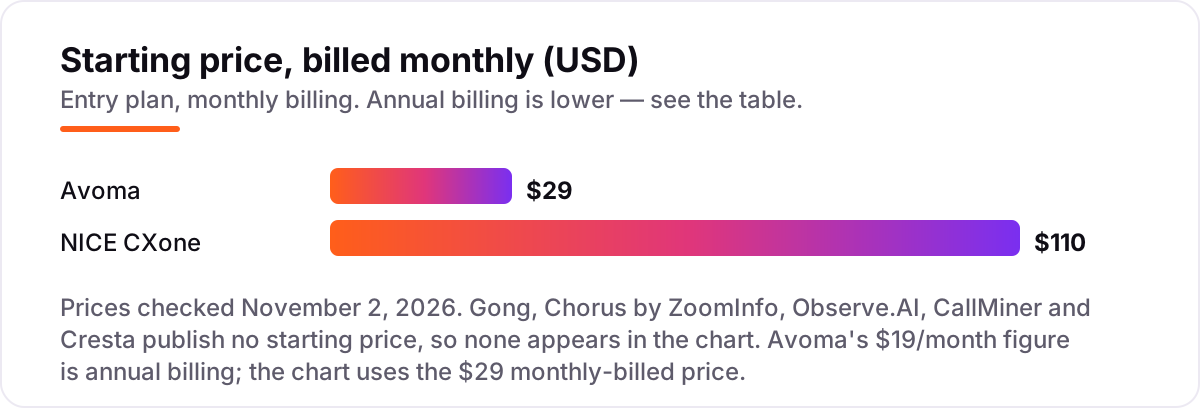
- Gong is the deepest sales pick, Avoma the affordable one from $19/month billed annually, and NICE CXone the only full contact-center platform with a published price, from $110/agent/month.
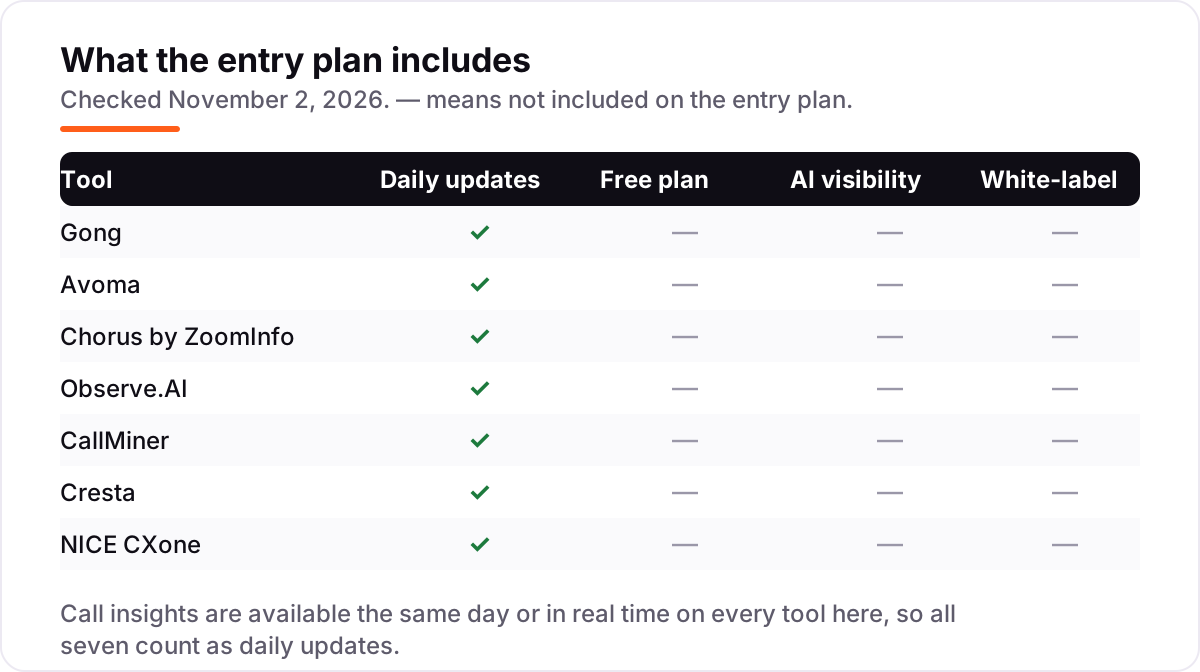
- Five of the seven tools publish no price at all: Gong, Chorus, Observe.AI, CallMiner and Cresta are all custom quote, so budget for a sales call, not a checkout.
- The single most important buying factor is whether you need sales coaching or support QA: the two jobs need different tools, and no tool here does both equally well.
- Every price below was checked November 2, 2026. Ratings are G2, with review counts shown; Chorus, CallMiner and Cresta carry no rating because their G2 pages could not be opened today.
On this page
Quick comparison
| Tool | Best for | Starting price | Free plan |
|---|---|---|---|
| Gong | Revenue teams of 10+ reps who want call insights tied to deals, coaching and forecasting in one platform | Custom quote | No |
| Avoma | Small sales teams of up to 25 reps who want meeting notes, call scoring and CRM sync without enterprise pricing | $29/mo | No (14-day trial) |
| Chorus by ZoomInfo | Sales teams already paying for ZoomInfo who want conversation intelligence folded into their existing contract | Custom quote | No (trial) |
| Observe.AI | Enterprise contact centers with 100+ agents that need automated QA scoring on 100% of calls | Custom quote | No |
| CallMiner | Large regulated contact centers that need speech analytics, sentiment and compliance redaction in one platform | Custom quote | No |
| Cresta | Large contact centers that want real-time agent guidance plus post-call analytics on the same platform | Custom quote | No |
| NICE CXone | Mid-market and enterprise contact centers that want voice analytics inside a full cloud contact-center platform | $110/mo | No |
Make one of these tools?
We re-check this list every quarter. Send a correction, request a review, or ask about a clearly labeled sponsored spot.
Request a listingThe best voice analytics software

Gong
Best for: Revenue teams of 10+ reps who want call insights tied to deals, coaching and forecasting in one platform
Gong is the benchmark sales teams measure everything else against. It records and transcribes every call, then turns the conversation into deal intelligence: which deals are stalling, which talk tracks work, and which reps need coaching on a specific moment. The AI summaries and searchable call library mean a new hire can learn from the best calls on day one instead of shadowing for a month.
The cost is the honest catch. Gong publishes no prices, and buyer reports describe per-user licences plus a platform fee and a metered AI credit system introduced in 2026. If your team lives in its CRM and needs forecasting as well as coaching, that price buys the deepest tool here. If you only need call review, Avoma does most of the job for far less.
What we like
- Call insights feed deal boards, forecasting and coaching in one platform, not just a call library
- Searchable library of every call with AI summaries, trackers and alerts for moments that matter
- Deep Salesforce and HubSpot sync plus more than 40 integrations, including an MCP server for AI tools
Watch out for
- Quote-only pricing: per-user licences plus a mandatory platform fee on top, according to buyer reports
- Metered AI credits introduced in 2026 make heavy use of AI trackers and workflows harder to budget
- Implementation typically takes about a month, and the feature set can feel sprawling at first

Avoma
Best for: Small sales teams of up to 25 reps who want meeting notes, call scoring and CRM sync without enterprise pricing
Avoma is the most accessible way into voice analytics for a small sales team. The Startup plan records and transcribes unlimited meetings, writes AI notes, and syncs them to the CRM from $19/month billed annually, with no platform fee and no minimum seat count. Only the people who record meetings need a paid seat, so managers and collaborators can review calls free.
The pricing catch is the add-ons. Call scoring, coaching scorecards and deal-risk alerts each cost $29/seat/month on top of the base plan, so a fully loaded seat runs $48/month or more. Even so, that is a fraction of Gong, and for a team of up to 25 reps that mainly needs notes, transcripts and basic coaching, Avoma is the sensible buy.
What we like
- Published per-seat pricing from $19/month billed annually, with no platform fee and no seat minimum below Enterprise
- Only recorder seats are paid; unlimited free viewer seats for managers and collaborators
- Conversation Intelligence add-on gives AI call scoring and scorecards for MEDDIC, SPICED and custom frameworks
Watch out for
- Call scoring and revenue intelligence are $29/seat/month add-ons each, so the full tool costs far more than $19
- G2 reviewers report the recorder sometimes joins late or drops mid-call
- No free plan, only a 14-day trial, and viewers are free but cannot record

Chorus by ZoomInfo
Best for: Sales teams already paying for ZoomInfo who want conversation intelligence folded into their existing contract
Chorus is the conversation intelligence layer inside ZoomInfo, which acquired it in 2021. It captures meetings, transcribes them, and turns them into coaching moments and deal signals, all in the same workspace where reps already prospect. For a team that pays for ZoomInfo anyway, that bundling is the whole argument: one vendor, one contract, no new integration to maintain.
Bought on its own, the case is weaker. ZoomInfo publishes no Chorus price and sells it inside a broader contract, often on a two-year term, with bundle pressure reported by buyers. It also does less on forecasting than Gong. Choose Chorus when ZoomInfo is already in the building; otherwise compare it against Avoma first.
What we like
- Call recording, transcription and AI summaries bundled with ZoomInfo prospecting data
- Coaching insights and deal visibility in the same workspace as the ZoomInfo data teams already use
- No separate platform to integrate if your team already runs ZoomInfo
Watch out for
- No published pricing; Chorus is sold as a custom ZoomInfo bundle, not a standalone product
- Standalone buying is discouraged and bundles are pushed, according to buyer reports
- Less depth on forecasting and deal management than Gong, per head-to-head comparisons

Observe.AI
Best for: Enterprise contact centers with 100+ agents that need automated QA scoring on 100% of calls
Observe.AI is built for the support side of voice analytics: quality assurance at scale. Its Auto QA scores every interaction against rubrics your team defines, so managers stop sampling 2% of calls by hand and start seeing compliance risks, coaching gaps and repeat complaints across the whole queue. Real-time guidance helps agents while the customer is still on the line.
The floor is high. There is a 100-seat minimum, an annual contract, no free trial, and buyer reports put full deployments at $60,000 to $180,000 a year. G2 reviewers also warn that rubric calibration takes real work up front. For a large center, that investment replaces a manual QA team; for anyone smaller, it is simply out of reach.
What we like
- Auto QA scores 100% of interactions against custom rubrics instead of a small manual sample
- Real-time agent guidance during live calls, plus post-call summaries and coaching plans
- Purpose-built for contact centers, with pre-built QA rubrics, coaching workflows and 250+ integrations
Watch out for
- A 100-seat minimum and annual contracts shut out smaller teams entirely
- Quote-only pricing, with full deployments reported at $60,000 to $180,000 a year
- G2 reviewers note rubric calibration takes real upfront effort, and transcription struggles with heavy accents

CallMiner
Best for: Large regulated contact centers that need speech analytics, sentiment and compliance redaction in one platform
CallMiner is the enterprise standard for analyzing every customer interaction across channels. The Eureka platform scores calls automatically, tracks sentiment and topics, and flags compliance risks, while built-in redaction protects card and personal data. For a regulated contact center in finance, insurance or healthcare, that combination of depth and compliance is the reason it leads the category.
Everything about the buying process is enterprise-scale too: quote-based pricing, bundled packages priced by users or interaction volume, and G2-reported implementation around five months. Pilot programs exist in certain cases, but there is no trial or self-serve route. Buy CallMiner when compliance and omnichannel depth justify the effort; smaller teams should start with Observe.AI or Avoma.
What we like
- Analyzes 100% of calls, chats, emails and surveys, not just voice, in one Eureka platform
- Compliance redaction for PCI and PII data built in, which regulated teams need
- Automated scoring plus sentiment and topic discovery across every interaction
Watch out for
- Quote-based enterprise pricing with no published starting price and no self-serve option
- G2 reports average implementation around 5 months, the longest in this list
- Overkill for teams under roughly 100 agents, where lighter tools do the same job for less

Cresta
Best for: Large contact centers that want real-time agent guidance plus post-call analytics on the same platform
Cresta is the real-time pick in this list. While other tools mostly analyze calls after they end, Cresta's Agent Assist listens live and prompts the agent with the right knowledge, the next step, and the compliance line to say — during the call, when it still changes the outcome. Conversation Intelligence then scores the same interactions afterward, and an AI Agent can resolve routine contacts on its own.
The price matches the ambition. Cresta publishes no pricing, and its AWS Marketplace listing prices Agent Assist at $150,000 a year for up to 100,000 calls. There is no trial and no self-serve tier. For a large center where live guidance cuts handle time and errors, that can pay back; for a small team, it is not a realistic buy.
What we like
- Real-time Agent Assist guides agents live with knowledge, next steps and compliance prompts
- Conversation Intelligence scores and analyzes every interaction after the call
- AI Agent resolves routine contacts without a human, on the same platform as the assist tools
Watch out for
- Quote-only enterprise pricing; its AWS Marketplace listing prices Agent Assist at $150,000 a year
- No self-serve tier or trial, so evaluation runs through the sales team
- Built for 100+ agent centers; smaller teams will not get value from the platform

NICE CXone
Best for: Mid-market and enterprise contact centers that want voice analytics inside a full cloud contact-center platform
NICE CXone is different from the rest of this list: it is a full cloud contact-center platform, and voice analytics is one capability inside it. Interaction Analytics reads every voice, digital and self-service interaction, while the same platform handles routing, recording, workforce management and AI Copilot. For a center that is replacing its phone platform anyway, buying the analytics with the platform is simpler than bolting a separate tool on top.
Read the price carefully, though. The $110/agent/month Omnichannel Suite covers routing and recording; Interaction Analytics and AI Copilot are add-ons on the lower suites, and the full analytics stack sits on the higher tiers. It is still the only support-side tool here with a published price, and with 1,730 G2 reviews it is also the most reviewed.
What we like
- Published suite pricing from $110/agent/month, billed monthly in arrears with no prepay
- Interaction Analytics covers voice, digital and self-service interactions in one place
- The largest review base in the support half of this list, at 1,730 G2 reviews
Watch out for
- Interaction Analytics and AI Copilot are add-ons on lower suites, so the $110 entry price does not buy analytics
- G2 reviewers report occasional call drops and slow, hard-to-read reporting
- Enterprise-scale platform: small teams pay for routing and workforce tools they may not need
The best voice analytics software turns every sales and support call into something a manager can act on: a coachable moment, a churn warning, or a deal about to stall. This guide compares 7 tools, sorted by the job they do best — sales coaching, support QA, or real-time guidance — with starting prices checked on November 2, 2026. Five of the seven publish no price at all, so we say so plainly instead of guessing. Pick the group that matches your team first, then compare the tools inside it.
What a voice analytics tool actually does
A voice analytics tool records calls, transcribes them, and then reads the transcript the way a manager would: what was said, how the customer felt, whether the rep followed the script, and what happened next. The output is not the recording itself but the insight on top of it — a coaching note, a QA score, a deal-risk flag, or a trend across a thousand calls that no human could spot by listening one by one.
The category is large and growing. Research and Markets sizes the conversation-intelligence software market at $32.25 billion in 2026, which explains why every vendor in this list now sells AI summaries, scoring and real-time guidance as standard. The tools still split cleanly by buyer, though: three of them serve sales teams, three serve support centers, and one sits in the middle. That split is how this guide is organized.
For sales teams: coaching and deal insight
Gong, Avoma and Chorus do the same core job: record the call, write it up, and show the manager what good looks like. Gong goes furthest, tying call moments to deal boards and forecasts, which is why it leads this list for revenue teams. Avoma covers the same ground at a published price, with the coaching features sold as add-ons, which suits smaller teams that want notes and transcripts first and scoring second. Chorus makes sense mainly inside a ZoomInfo contract, where it adds call intelligence to data the team already pays for.
For a sales team, the question is not which tool transcribes best — all three do that well — but what happens to the transcript afterward. Gong pushes it into the forecast, Avoma pushes it into the CRM, and Chorus keeps it next to the prospect record. Choose the destination that matches how your team already works.
For support teams: QA and compliance
Observe.AI and CallMiner serve the other side of the building: the contact center. Both score 100% of interactions instead of the 2% a manual QA team can sample, and both flag compliance risks, coaching gaps and repeat complaints. Observe.AI is the more focused QA tool, with automated scorecards and real-time guidance; CallMiner adds omnichannel coverage — chats, emails and surveys as well as calls — plus compliance redaction that regulated industries need.
The trade-off is scale. Observe.AI requires 100 seats and CallMiner is built for large, regulated operations, so neither fits a 20-agent team. Both are quote-only, both take months to implement, and both need real calibration work before the scores mean anything. For a small support team, Avoma's call scoring add-on is the honest starting point until the volume justifies an enterprise platform.
For real-time guidance during the call
Cresta is the only tool in this list whose main job happens while the customer is still talking. Its Agent Assist listens live and prompts the agent with the right knowledge article, the next step, and the compliance line to say. That is a different product from post-call analytics: it prevents mistakes instead of reporting them, which matters most for new hires and for regulated scripts where one wrong sentence costs money.
The catch is the price and the audience. Cresta publishes no pricing, its AWS Marketplace listing prices Agent Assist at $150,000 a year, and there is no trial. It is built for centers with 100 or more agents. If your team is smaller, or if your problem is coaching after the call rather than guidance during it, the post-call tools above do the job for far less.
Analytics inside a contact-center platform
NICE CXone is the all-in-one option: a full cloud contact-center platform with voice analytics built in. Interaction Analytics reads voice, digital and self-service contacts in one place, and the same platform handles routing, recording and workforce management. For a center that is replacing its phone system anyway, that single-vendor route is simpler than buying a phone platform and a separate analytics tool and integrating them.
Read the $110/agent/month entry price carefully, though. The Omnichannel Suite covers routing and recording; Interaction Analytics and AI Copilot are add-ons on the lower suites, so the analytics stack costs more than the headline. NICE is still the only support-side tool here with a published price, and its 1,730 G2 reviews are the largest base in the support half of this list.
Quick comparison: tool type by need
| Buyer | Best pick | Why |
|---|---|---|
| Sales team that lives in its CRM | Gong | Deepest deal, coaching and forecasting data in this list |
| Small sales team on a budget | Avoma | Published pricing from $19/month billed annually |
| Team already paying for ZoomInfo | Chorus by ZoomInfo | Conversation intelligence inside the ZoomInfo contract |
| Support team that must QA every call | Observe.AI | Automated scoring on 100% of interactions |
| Regulated contact center | CallMiner | Omnichannel analytics with PCI and PII redaction |
| Team that needs live help on calls | Cresta | Real-time guidance while the customer is still on the line |
| Center replacing its phone platform too | NICE CXone | Analytics inside a full contact-center platform from $110/agent/month |
How to choose the best voice analytics software
- Decide sales or support first. Sales coaching and support QA are different jobs with different tools. Gong, Avoma and Chorus serve revenue teams; Observe.AI, CallMiner and NICE serve contact centers; Cresta serves both, live.
- Count your seats honestly. Observe.AI needs 100 seats and Cresta is built for 100-plus agents. Below that, Avoma or NICE CXone are the realistic options.
- Ask what the starting price actually buys. Avoma's $19/month is the base plan without call scoring, and NICE's $110/agent/month is the suite without analytics. Get the analytics price in writing before you compare.
- Demo with your own calls. Record a week of real calls, run them through the trial or pilot, and check whether the summaries, scores and flags match what your managers heard.
- Check the implementation timeline. Avoma runs the same day; Gong takes about a month; Observe.AI and NICE take around three months; CallMiner around five. If you need results this quarter, that alone may decide it.
If the calls show prospects arriving with the wrong expectations, that is often a search problem: an SEO audit finds the pages sending them. And if the fix is a landing page, check its title with the free SERP snippet preview tool before you publish.
Mistakes to avoid
- Comparing quote-only tools on a guessed price. Five of the seven publish no price. Treat third-party price figures as negotiation ranges, not list prices, and get a written quote before budgeting.
- Buying the platform before checking what the analytics costs. Avoma's scoring and NICE's Interaction Analytics are both add-ons. The entry price is not the analytics price.
- Ignoring the seat minimum. Observe.AI requires 100 seats and Cresta is built for large centers. Signing up and then discovering the minimum is an expensive mistake.
- Scoring calls nobody reviews. Automated QA only helps if a manager reads the flags and coaches on them. Without a review routine, the scores pile up unread.
- Forgetting recording consent and redaction. Turn on consent prompts and sensitive-data redaction from day one, and check the recording rules where your callers live.
How we chose
We checked each vendor's own pricing page on November 2, 2026 and recorded the starting price exactly as shown, including the annual-billing figure where the page lists one. Five vendors publish no price at all, so those five are listed as custom quote and no price is invented for them. Ratings come from G2 pages we opened on November 2, 2026; Chorus, CallMiner and Cresta carry no rating because their G2 pages could not be opened today, and we left the rating out rather than estimating one. We ranked the tools by fit for the most common buyer — a sales or support team that needs call insight without an enterprise project — not by brand size. No vendor paid for a place in this list, and none of the links here are affiliate links.
What to do next
Start with the decision path above: pick sales or support, count your seats, and ask what the starting price actually buys. Then trial Avoma if you are a small sales team, or book demos with Gong and Observe.AI if you are buying for a larger team. Run your real calls through the trial and check the output against what your managers heard. If you'd rather have this set up and read for you, request a free SEO + AI visibility audit and get a ranked fix list in 2 business days.
Rather not run the tools yourself?
Tools show you the data. SerpAstra turns it into higher rankings, more map-pack calls and citations in AI answers.
Get a free SEO + AI visibility audit→Sources we checked (14)
- Gong pricing — gong.io/pricing (checked November 2, 2026)
- Gong on G2 — 4.7/5, 6,784 reviews (checked November 2, 2026)
- Gong pricing structure, platform fee and credits — avoma.com/blog/gong-pricing (checked November 2, 2026)
- Avoma pricing — avoma.com/pricing (checked November 2, 2026)
- Avoma on G2 — 4.6/5, 1,366 reviews (checked November 2, 2026)
- Chorus by ZoomInfo — zoominfo.com/products/chorus (checked November 2, 2026)
- Observe.AI on G2 — 4.5/5, 306 reviews (checked November 2, 2026)
- Observe.AI pricing estimates — cloudtalk.io/blog/observe-ai-pricing/ (checked November 2, 2026)
- CallMiner — callminer.com (checked November 2, 2026)
- Cresta — cresta.com (checked November 2, 2026)
- Cresta AWS Marketplace pricing — quiq.com/blog/cresta-pricing/ (checked November 2, 2026)
- NICE CXone pricing — nice.com/pricing (checked November 2, 2026)
- NICE CXone on G2 — 4.3/5, 1,730 reviews (checked November 2, 2026)
- Conversation-intelligence market size, $32.25B in 2026 (Research and Markets, via TechieHub)
Shamim
Founder of SerpAstra
A full-stack SEO and digital marketer who spends most days on Local SEO for dental practices, AI search visibility and lead generation.
Frequently asked questions
What is the best voice analytics software in 2026?
Gong is the best pick for most revenue teams: the deepest call, coaching and forecasting data in this list. Avoma is the best value for small sales teams, from $19/month billed annually. For support QA at scale, Observe.AI leads. The right answer depends on whether you need sales coaching or support QA, not on brand size.
How much does voice analytics software cost?
Avoma starts at $29/month billed monthly, and NICE CXone from $110/agent/month. Gong, Chorus, Observe.AI, CallMiner and Cresta publish no prices and sell on custom quotes. Enterprise deployments are reported at $60,000 to $180,000 a year, so always budget for a platform fee and implementation on top of the per-seat price.
Is there a free voice analytics tool?
No tool in this list has a free plan. Avoma offers a 14-day free trial and Chorus offers a free trial, but Gong, Observe.AI, Cresta and NICE CXone are demo-only, and CallMiner offers pilot programs only in certain cases. If you need a free start, trial Avoma first, then demo the enterprise tools.
What is the difference between voice analytics and speech analytics?
The terms overlap heavily. Speech analytics usually means transcribing calls and measuring sentiment and keywords, while voice analytics usually means turning those transcripts into coaching, QA scores and deal insight. This list covers both jobs: Gong, Avoma and Chorus lean toward sales coaching, while Observe.AI, CallMiner and NICE lean toward support QA.
Do I need real-time guidance or post-call analytics?
Real-time guidance, like Cresta's Agent Assist, helps agents while the customer is still on the line, which matters for compliance scripts and new hires. Post-call analytics suits QA trends, coaching and deal review. Most teams should start with post-call analytics and add real-time guidance only when live mistakes are costing them money.
Can voice analytics software record calls legally?
It depends on where the caller is. Some US states require all parties to consent, and rules differ by country, so check local law before recording. Every tool here offers consent prompts, access controls and redaction for sensitive data. Turn those on from day one, and tell callers they are being recorded.
How long does voice analytics software take to set up?
Avoma can be running the same day, since it is self-serve with published pricing. Gong typically takes about a month, and NICE CXone and Observe.AI around three months, according to G2. CallMiner averages around five months. Budget the longest for the enterprise tools, and run a pilot with real calls before rolling out to the whole team.
Free SEO and AI visibility audit
Find out what is holding your rankings back
Send us your site. Within 2 business days you get a written audit, an AI visibility check and a short fix list ranked by impact. Free, with no contract attached.
Request my free audit→Related guides
 SEO & AI SearchBest SEO Audit Software for 2026: 10 Options Compared by Use Case10 best SEO audit software tools compared on price, crawl depth and AI visibility. Prices checked on vendor pricing pages, November 1, 2026.Read guide →
 AI SearchBest AI SEO tools in 2026: honest picks by jobBest AI SEO tools in 2026, picked by job: Semrush and Ahrefs for research, Surfer and Clearscope for content, Otterly for AI tracking, with 2026 prices.Read guide →
 StrategyHow to track your Google ranking (and what the numbers actually mean)Track your Google ranking the right way: Search Console, free checkers and rank trackers explained, and what average position and CTR really mean today.Read guide →