
9 Best Website Auditing Tools in 2026 (Free and Paid, Compared)
9 best website auditing tools compared on crawl depth, price and reporting, sorted by use case, with real vendor prices checked on November 2, 2026.
 Shamim Mia, Founder, SerpAstraLast verified November 2, 202615 min read
We compare pricing pages, documentation and public reviews. We never accept payment for rankings.

Key takeaways
- Screaming Frog is the best pick for most auditors: 300+ checks for £199 a year, with a free version that crawls 500 URLs. Sitebulb is the friendlier guided alternative from $18/month.
- SE Ranking is the best value suite at $129/month, and Ahrefs is the cheapest way into a professional audit at $29/month.
- The single most important buying factor is crawl depth versus readability: raw crawl data finds more issues, but prioritized reports get fixes done.
- Every price below was checked on the vendor's own pricing page on November 2, 2026. Ratings are G2, except Screaming Frog (Capterra), with review counts shown.
On this page
Quick comparison
| Tool | Best for | Starting price | Free plan |
|---|---|---|---|
| Screaming Frog | Technical SEOs and agencies that need the deepest crawl for the lowest annual cost | £199/yr | Yes (500 URLs) |
| Sitebulb | Freelancers and small agencies that want prioritized, client-readable audit reports | $18/mo | No (14-day trial) |
| SE Ranking | Small agencies and in-house teams that want a full-suite audit plus rank tracking and AI visibility for about $103/month | $103.20/mo (annual) | No (14-day trial) |
| Semrush | Small teams and agencies that want audits plus keyword research, backlinks and AI visibility in one subscription | $117.33/mo (annual) | Yes (100 pages/mo) |
| Ahrefs | In-house SEOs and agencies already paying for Ahrefs who want audits tied to backlink data | $29/mo | Yes (Site Audit) |
| SEOptimer | Freelancers and small agencies that sell SEO audits and need branded, client-ready PDF reports | $21.75/mo (annual) | Yes (1/day) |
| Moz Pro | Small in-house teams that want Domain Authority metrics and plain-language audits in one beginner-friendly suite | $49/mo | No (7-day trial) |
| JetOctopus | In-house teams running large sites who need crawl data joined to server logs and Search Console | $349/mo (annual) | No (7-day trial) |
| Lumar | Enterprise teams with million-page sites that need scheduled crawls, APIs and CI/CD checks | Custom quote | No (demo only) |
Make one of these tools?
We re-check this list every quarter. Send a correction, request a review, or ask about a clearly labeled sponsored spot.
Request a listingThe best website auditing tools
Screaming Frog
Best for: Technical SEOs and agencies that need the deepest crawl for the lowest annual cost
Screaming Frog SEO Spider is the crawler most technical SEOs reach for first, and the reason is simple: it crawls a site the way a search engine does and reports more than 300 issues, from broken links and redirect chains to duplicate titles, hreflang errors and structured-data problems. The free version crawls 500 URLs, which covers a small business site outright, and the paid licence removes the limit entirely.
The trade-off is presentation. You get tables of raw data, not a prioritized fix list, so someone on the team has to know which issues matter and in what order. Crawl size is also bounded by your own machine. If you can read a crawl and want the deepest audit per dollar, start here; if you need reports a client can read, look at Sitebulb instead.
What we like
- Audits a site for over 300 SEO issues: broken links, redirects, duplicates, hreflang, structured data and more
- JavaScript rendering, custom extraction via XPath or regex, crawl comparison and scheduled crawls on the paid licence
- GA, Search Console and PageSpeed Insights integrations pull traffic and performance data into the crawl
Watch out for
- Desktop software: crawl size is limited by your machine's memory and storage, with no cloud scheduling or team sharing
- Raw data tables with no plain-English fix guidance, so juniors need a senior to interpret the output
- Interface looks dated next to newer tools, per multiple Capterra reviewers
Sitebulb
Best for: Freelancers and small agencies that want prioritized, client-readable audit reports
Sitebulb is the audit tool you hand to a client or a junior and they actually understand it. Every finding is a prioritized Hint with a plain-English explanation of the problem and the fix, backed by visual crawl maps that show how the site hangs together. Lite starts at $18 a month and covers 10,000 URLs per audit, which is enough for most small and mid-size sites.
The limits are the ones you would expect at this price. There is no free plan, only a 14-day trial, and scheduling, audit comparisons and customized PDFs sit on the $42-a-month Pro plan. It is still desktop software on Lite, so very large sites need the cloud version. Buy Sitebulb when the report matters as much as the crawl.
What we like
- Every finding arrives as a prioritized Hint with a plain-English explanation of what is wrong and how to fix it
- JavaScript crawling, crawl maps and Search Console, Analytics and Sheets integrations on every plan
- Pro covers 500,000 URLs per audit, raisable to 2 million, with 300+ Hints
Watch out for
- No free plan, only a 14-day trial, and Lite audits cap at 10,000 URLs per audit
- Scheduling, audit comparisons and customized PDF reports need Pro ($42/month)
- Desktop software, so crawl size is limited by your machine and there is no cloud version on Lite

SE Ranking
Best for: Small agencies and in-house teams that want a full-suite audit plus rank tracking and AI visibility for about $103/month
SE Ranking is the value pick in this list because the entry Core plan does not feel like an entry plan: a 250,000-page site audit allowance, 2,000 keywords tracked daily, 10 projects and AI visibility tracking across five engines, all from $103.20 a month billed annually. For a small agency or an in-house team, that is the whole SEO workflow in one subscription.
The trade-off is polish. Reviewers like the depth but some report small accuracy differences against the bigger suites, and the interface takes a few days to learn. If you want the cheapest route to a full audit plus tracking at scale, start here; if you need the largest backlink index, look at Semrush or Ahrefs instead.
What we like
- Core includes a 250,000-page site audit allowance, 2,000 keywords tracked daily and 10 projects
- AI visibility tracking across five engines is included on the entry Core plan
- White-label reporting and guest links for client work, with an Agency Pack add-on from $69/month
Watch out for
- Some G2 reviewers report occasional minor discrepancies in rank-tracking accuracy and search-volume estimates versus larger competitors
- Reviewers note the interface can feel less intuitive, and complex reports take getting used to

Semrush
Best for: Small teams and agencies that want audits plus keyword research, backlinks and AI visibility in one subscription
Semrush is the deepest bench in this list. The entry SEO plan runs Site Audit over 100,000 pages a month with more than 130 checks and Core Web Vitals data, and pairs it with a keyword database Semrush puts at more than 27 billion keywords, plus backlink analysis and position tracking. If your team already lives in Semrush for research, the audit is a natural extension rather than another subscription.
It is also the priciest way in among the suites, and the extras add up: additional users start at $45 a month and white-label reports are paid add-ons. A single audit is capped at 20,000 pages below the Advanced plan, so very large sites get partial crawls. Buy Semrush when you need the research depth, not just the audit.
What we like
- Site Audit crawls 100,000 pages a month on the SEO plan, with 130+ checks and Core Web Vitals data
- Bundles the audit with a 27-billion-plus keyword database, backlink analysis and Position Tracking
- AI search performance tracking is included on the entry SEO plan, with AI visibility reports for any domain
Watch out for
- Highest entry price among the full suites here, and extra users start at $45/month with white-label reports as paid add-ons
- Site Audit caps a single audit at 20,000 pages below the Advanced plan, so very large sites get partial crawls

Ahrefs
Best for: In-house SEOs and agencies already paying for Ahrefs who want audits tied to backlink data
Ahrefs Site Audit is a module inside the full Ahrefs suite, not a standalone product. The $29 Starter plan is the cheapest way into this list, and it checks a site for more than 170 technical issues with a Health Score per crawl, scheduled crawls and issue history. What you are really buying is the research behind the audit: the backlink index and the 110-billion-keyword database.
The credit meter is the honest limitation. Starter allows 200 report credits a month, so heavy audit work quickly needs Lite at $129 a month, and there is no free trial. For teams already paying for Ahrefs, the audit is an easy yes; as a first audit tool on its own, the cheaper dedicated crawlers give you more crawl for less.
What we like
- Site Audit checks a site for 170+ pre-defined technical SEO issues, with a Health Score per crawl
- Scheduled crawls with issue history, so you can see whether a fix actually worked
- Sits on one of the largest backlink indexes and a 110-billion-keyword database, so audits come with research depth
Watch out for
- Starter is capped at 200 report credits a month, so heavy audit work needs Lite ($129/month) or above
- No free trial, and AI visibility (Brand Radar) is a separate add-on rather than bundled in

SEOptimer
Best for: Freelancers and small agencies that sell SEO audits and need branded, client-ready PDF reports
SEOptimer is built for selling audits, not just running them. It grades a page against more than 100 on-page checks and returns an overall score with prioritized fixes in about 20 seconds, and the White Label plan turns that into a branded PDF on your own domain. DIY SEO starts at $29 a month, and the free single-page audit lets a prospect see the product before they buy.
The catch is depth and volume. Four crawls a month on DIY SEO means re-checking a fix costs a quarter of the month's allowance, and there is no serious backlink index or PPC data behind the report. Buy SEOptimer when the audit is a sales tool; buy a crawler when the audit is a technical job.
What we like
- Runs 100+ on-page checks and returns an overall score with prioritized fixes in about 20 seconds
- White-label PDFs and a custom domain from the $39 White Label plan; an embeddable audit widget from $59
- DIY SEO includes keyword tracking for 20 keywords and a task checklist with guides per website type
Watch out for
- Only 4 crawls a month on DIY SEO, so re-checking fixes eats the allowance fast
- Lighter research data than the suites: no serious backlink index or PPC data
- White-label PDFs need the $39/month White Label plan, and the embeddable lead-gen widget needs $59/month

Moz Pro
Best for: Small in-house teams that want Domain Authority metrics and plain-language audits in one beginner-friendly suite
Moz Pro is the friendliest suite in this list, and it owns Domain Authority: the 0-to-100 site-strength score that appears in countless client reports. Starter costs $49 a month and bundles Site Crawl, which runs automated weekly audits in plain language, with Keyword Explorer, Link Explorer and rank tracking, plus MozBar Premium from Standard.
The audit itself is the weakest part of the package next to the dedicated crawlers. Starter covers one site and 20,000 pages a month, and AI visibility starts on the $179-a-month Medium plan. Buy Moz for the metrics and the learning curve; buy a crawler if the audit is the job.
What we like
- Site Crawl runs automated weekly audits flagging broken links, duplicates, crawl errors and meta issues in plain language
- Domain Authority, Page Authority and Spam Score: the metrics clients already recognize, built into every plan
- Rated the easiest full SEO suite to learn, with Moz Academy training and extensive documentation
Watch out for
- Starter covers 1 site and 20,000 pages crawled a month, so larger sites need Standard ($99/month) or above
- Backlink index is smaller than Ahrefs and Semrush, and rank tracking updates weekly on Standard
- AI Visibility (Beta) starts on the Medium plan ($179/month), not on Starter

JetOctopus
Best for: In-house teams running large sites who need crawl data joined to server logs and Search Console
JetOctopus answers a question no other tool in this list can: what does Googlebot actually crawl, and what does it ignore? The entry Growth plan pairs cloud crawling with log-file analysis, so crawl data, server logs, Search Console and GA4 sit in one place. At $349 a month billed annually it covers 500,000 crawled URLs and 2 million log lines a month, with unlimited seats, projects and domains.
The price is the barrier, and the learning curve is the second one. Log analysis rewards a team that already thinks in crawl budget and indexation; without that, much of the product goes unused. Pick JetOctopus when your site is large enough that crawl waste is a real cost.
What we like
- Cloud crawling with log-file analysis on the entry plan: see what Googlebot actually crawls, not just what the site contains
- Growth covers 500,000 crawled URLs and 2 million log lines a month, with JavaScript rendering and crawl comparison
- Unlimited seats, projects and domains, with GSC and GA4 integrations and an AI Bots Analyzer for ChatGPT and Claude crawls
Watch out for
- Entry price is $349/month: the most expensive self-serve tool in this list
- Log analysis has a real learning curve; teams without technical SEO maturity will underuse it
- White-label reports need the Ultra plan ($1,559/month billed annually)

Lumar
Best for: Enterprise teams with million-page sites that need scheduled crawls, APIs and CI/CD checks
Lumar, formerly DeepCrawl, is infrastructure for technical SEO at scale: cloud crawling at millions of URLs, scheduled crawls, log-file analysis and a GraphQL API that plugs crawl data into engineering pipelines. Its Monitor and Protect modules watch for regressions and test pre-production code before it ships, which is why large publishers and marketplaces use it.
Everything about the commercial model says enterprise: custom annual contracts, guided onboarding and no self-serve trial. Third-party benchmarks put entry contracts around $12,000 to $32,000 a year. A 500-page site gains nothing here that Screaming Frog does not deliver for £199. Buy Lumar when crawl scale and monitoring are the job.
What we like
- Cloud crawling at multi-million-page scale with JavaScript rendering and raw-vs-rendered comparison
- Scheduled crawls, log-file analysis and a GraphQL API, with multi-domain dashboards
- Monitor and Protect modules watch for regressions and test pre-production code before it ships
Watch out for
- Quote-only pricing with annual contracts: third-party data puts entry around $12,000-$32,000 a year
- No self-serve trial; evaluation runs through the sales team with a demo
- Overkill below roughly 500,000 pages, where cheaper crawlers do the same job
What the best website auditing tools actually do
A website audit is a full health check of a site: a crawler walks every page the way Googlebot does, then reports what is broken, missing or slowing the site down. The best website auditing tools turn that walk into a fix list, covering broken links, redirect chains, duplicate titles, missing meta data, slow pages, thin content and pages Google cannot reach. This guide is organised by what you actually need: a deep crawler, a guided report, a full suite, or enterprise-scale monitoring.
That split matters because the tools differ more in how they report than in what they find. A desktop crawler finds the most issues per dollar but hands you raw tables. A suite finds fewer crawl issues and more context: rankings, backlinks and keyword data around the same pages. One number shows the scale behind the suites: Semrush says its keyword database holds more than 27 billion keywords, and that research index is a large part of what its audit price pays for.
A good audit also answers three questions in order. First, can search engines reach the pages that matter, and are they wasting time on pages that do not? Second, are the pages they reach healthy — correct status codes, clean redirects, unique titles and meta descriptions, no duplicate content? Third, are the pages worth ranking — fast, rendered correctly and linked well from inside the site? Every tool in this list covers the first two questions. The third is where they split: crawlers show you the structure, suites show you the rankings and links behind it, and the enterprise tools show you the server logs that prove what Googlebot actually did.
Deep crawls for technical teams
If the audit is the job itself, start with a dedicated crawler. Screaming Frog and Sitebulb both crawl a site page by page and check hundreds of issues, but they report them very differently. Screaming Frog gives you the raw data: every URL, every status code, every duplicate, in tables you can filter and export. Sitebulb turns the same crawl into prioritized Hints with plain-English fixes and visual crawl maps.
The choice is about who reads the output. A technical SEO who lives in crawl data will be faster with Screaming Frog and will pay £199 a year for it. A freelancer who has to explain the findings to a client will get more value from Sitebulb at $18 a month, because the report does half the explaining. Both are desktop tools on their entry plans, so very large sites need the cloud versions or a cloud crawler like JetOctopus.
Both crawlers also handle the parts of an audit that a quick scan misses. Screaming Frog renders JavaScript, extracts custom data with XPath or regex, and compares two crawls so you can prove a fix worked. Sitebulb adds crawl maps that show internal linking at a glance and integrations with Search Console, Analytics and Sheets, so traffic data sits next to the technical findings. Neither one is a good fit for a team that needs the same audit to run on a schedule in the cloud and be shared with ten people — that is a suite or enterprise job, and it costs more for a reason.
Suites that audit and research
The suites in this list — SE Ranking, Semrush, Ahrefs and Moz Pro — bundle the audit with keyword research, backlink data and rank tracking. You pay more than a crawler costs, but you replace two or three subscriptions, and the audit gains context: a broken page that also ranks, a redirect chain on a page with backlinks, a thin page that targets a valuable keyword. That context is what turns an audit from a list of errors into a priority order.
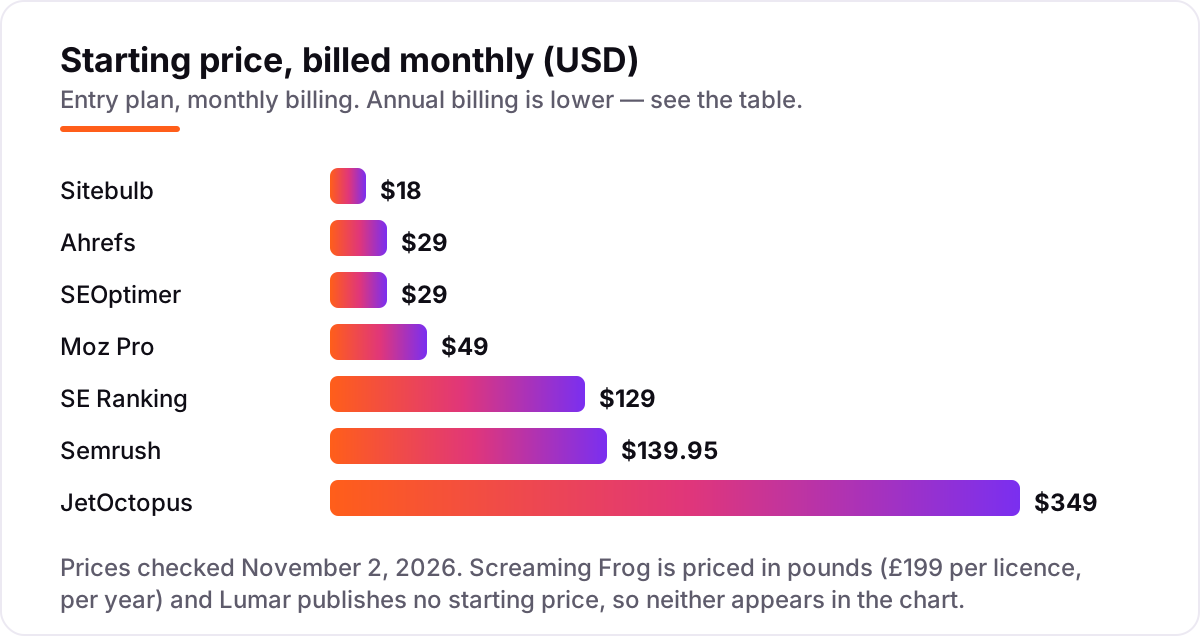
The cheapest way in is Ahrefs Starter at $29 a month, though its 200 monthly report credits limit heavy audit work. SE Ranking Core at $129 a month is the best value for a team that audits and tracks at scale, with a 250,000-page audit allowance. Semrush is the deepest bench and the priciest entry at $139.95 a month, while Moz Pro at $49 a month is the friendliest starting point for a team still learning SEO. If you already pay for one of these suites, use its audit before buying a crawler.
Suites also change how often an audit happens. A dedicated crawler runs when someone remembers to run it; a suite can crawl on a schedule and keep the history, so you can see whether last month's fixes actually moved the Health Score. That history is the difference between an audit and a monitoring habit. The suites also catch the issues a crawler alone cannot judge: a page that is technically perfect but targets a keyword nobody searches for, or a redirect chain on a page that still earns links. The audit tells you what is broken; the research data tells you what is worth fixing first.
Fast, client-ready audit reports
Some audits are sold, not just run. SEOptimer is built for that job: it grades a page against more than 100 on-page checks and returns a score with prioritized fixes in about 20 seconds, and the White Label plan turns the result into a branded PDF on your own domain. The free single-page audit is the sales pitch itself — a prospect sees the report before they pay anything.
The trade-off is depth. SEOptimer grades pages; it does not crawl a whole site the way Screaming Frog or Sitebulb do, and its four crawls a month on DIY SEO run out fast when you re-check fixes. Use it when the audit is a lead magnet or a client deliverable. For the technical work behind the report, pair it with a crawler, and check the heading structure of the pages you fix with our free heading structure checker before you re-crawl.
A client-ready report has to do three things a raw crawl cannot: give the site a score the client understands, rank the fixes so the client knows what to do first, and look like it came from your agency. SEOptimer does all three, which is why agencies use it at the start of a sales conversation. The honest limit is that a good score on one page says nothing about the other 499 pages. Treat the SEOptimer report as the opening conversation, then run a full crawl to find the problems the single-page grade could not see.
Enterprise-scale crawling
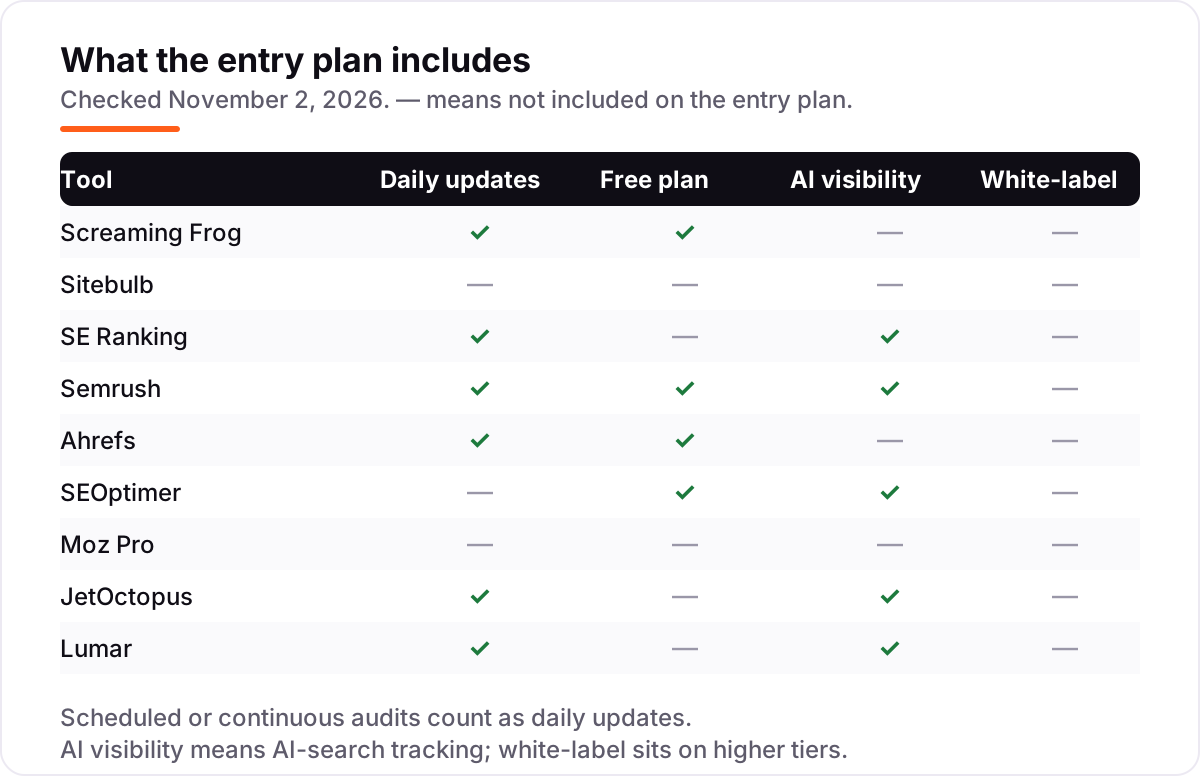
Once a site passes roughly half a million pages, the tools above stop being practical. JetOctopus and Lumar are built for that scale: cloud crawling, log-file analysis, scheduled crawls and APIs that feed crawl data into engineering pipelines. JetOctopus starts at $349 a month billed annually and shows what Googlebot actually crawls, which is the data that decides crawl budget. Lumar is quote-only and adds accessibility, site-speed and pre-production testing through its Monitor and Protect modules.
Do not buy either for a small site. A 500-page site gains nothing from Lumar that Screaming Frog does not deliver for £199 a year, and JetOctopus only earns its price when crawl waste is a real cost. If your site is that large, our SEO audit service can run the crawl and read the logs for you.
The enterprise difference is not just scale, it is workflow. Lumar's Protect module tests code before it ships, so a bad deploy never reaches production. JetOctopus joins log lines to crawl data, so you can see which pages Googlebot visits every day and which it has abandoned. Both plug into engineering pipelines through APIs, which matters when the fixes belong to developers rather than marketers. Below that scale, those features are overhead: a scheduled crawl and a spreadsheet of fixes will do the same job for a fraction of the price.
Quick comparison: tool type by need
| Buyer | Best pick | Why |
|---|---|---|
| Technical SEO, deepest crawl | Screaming Frog | 300+ checks for £199 a year, free to 500 URLs |
| Freelancer, client-readable reports | Sitebulb | Prioritized Hints and visual maps from $18/month |
| Small agency, best value suite | SE Ranking | 250,000-page audit allowance from $103.20/month |
| Deepest research data | Semrush or Ahrefs | Largest keyword and backlink indexes in this list |
| Selling audits to clients | SEOptimer | Branded PDF in 20 seconds from $29/month |
| Large site with server logs | JetOctopus | Crawls plus log analysis from $349/month |
| Enterprise, million-page sites | Lumar | Cloud crawling at scale, custom quote |
How to choose: a short decision path
- Count your pages first. Under 500, the free versions cover you. Under 10,000, Sitebulb Lite or a suite plan is enough. Over 500,000, you need JetOctopus or Lumar.
- Decide who reads the report. If it is a client, pick Sitebulb or SEOptimer for readable output. If it is a technical SEO, Screaming Frog's raw tables are faster.
- Decide suite or crawler. If you already pay for research tools, buy a dedicated crawler. If you need keyword research and tracking too, a suite is cheaper than the tools separately.
- Check the re-crawl allowance. Some plans cap crawls per month, so fixing and re-checking can eat the allowance. SEOptimer allows 4 crawls a month on DIY SEO.
- Try before you pay. Every tool in this list has a free version, a free audit or a free trial. Run a crawl of your real site and compare the findings against Search Console before committing.
Mistakes to avoid
- Comparing monthly prices without checking billing. The annual price is usually 15–20% lower, and a few tools have no annual option at all.
- Ignoring the crawl allowance. A plan that covers 10,000 URLs per audit will not crawl a 50,000-page site, and a 4-crawl monthly limit runs out when you re-check fixes.
- Fixing issues in the order the tool lists them. Sort by impact: indexation and crawl errors first, then duplicates and redirects, then meta and content issues.
- Trusting a directory price. Several directories still show old figures for these tools; the live pricing page is the only number that counts. Always check the vendor's own page.
- Auditing once and never again. A site changes every week: new pages, new redirects, new template bugs. Schedule the next crawl before you close the first report.
How we chose
We checked each vendor's own pricing page on November 2, 2026 and recorded the starting price exactly as shown, including the annual-billing figure where the page lists one. Ratings come from G2, except Screaming Frog, where we used its Capterra rating because the G2 profile covers the agency services rather than the SEO Spider product. We ranked the tools by fit for the most common buyer — a small agency or in-house team auditing one or a few sites — not by brand size. No vendor paid for a place in this list, and none of the links here are affiliate links.
What to do next
Start with the decision path above: count your pages, decide who reads the report, and pick crawler or suite. Then take the free version or trial of your top pick and crawl your real site. If the findings match what Search Console shows and the fixes are clear, you have your tool. If you'd rather have this set up and read for you, request a free SEO + AI visibility audit and get a ranked fix list in 2 business days.
Rather not run the tools yourself?
Tools show you the data. SerpAstra turns it into higher rankings, more map-pack calls and citations in AI answers.
Get a free SEO + AI visibility audit→Sources we checked (18)
- Screaming Frog pricing — screamingfrog.co.uk/seo-spider (checked November 2, 2026)
- Screaming Frog on Capterra — 4.9/5, 134 reviews (checked November 2, 2026)
- Sitebulb pricing — sitebulb.com/subscriptions/pricing (checked November 2, 2026)
- Sitebulb on G2 — 4.5/5, 13 reviews (checked November 2, 2026)
- SE Ranking pricing — seranking.com/subscription.html (checked November 2, 2026)
- SE Ranking on G2 — 4.7/5, 1,619 reviews (checked November 2, 2026)
- Semrush pricing — semrush.com/prices (checked November 2, 2026)
- Semrush on G2 — 4.4/5, 4,304 reviews (checked November 2, 2026)
- Ahrefs pricing — ahrefs.com/pricing (checked November 2, 2026)
- Ahrefs on G2 — 4.5/5, 723 reviews (checked November 2, 2026)
- SEOptimer pricing — seoptimer.com/pricing (checked November 2, 2026)
- SEOptimer on G2 — 4.6/5, 354 reviews (checked November 2, 2026)
- Moz Pro pricing — moz.com/products/pro/pricing (checked November 2, 2026)
- Moz Pro on G2 — 4.3/5, 608 reviews (checked November 2, 2026)
- JetOctopus pricing — jetoctopus.com/pricing (checked November 2, 2026)
- JetOctopus on G2 — 4.5/5, 21 reviews (checked November 2, 2026)
- Lumar pricing — lumar.io/pricing (checked November 2, 2026)
- Lumar on G2 — 4.6/5, 101 reviews (checked November 2, 2026)
Shamim
Founder of SerpAstra
A full-stack SEO and digital marketer who spends most days on Local SEO for dental practices, AI search visibility and lead generation.
Frequently asked questions
What is the best website auditing tool in 2026?
Screaming Frog is the best pick for most auditors: 300+ checks for £199 a year, with a free version that crawls 500 URLs. Sitebulb is the friendlier guided alternative from $18 a month, and SE Ranking is the best value suite at $129 a month. Large sites should look at JetOctopus or Lumar instead.
How much does a website auditing tool cost?
Between $18 and $349 a month at the entry level, plus Screaming Frog at £199 a year and Lumar on a custom quote. Sitebulb starts at $18, Ahrefs and SEOptimer at $29, and Moz Pro at $49. The cheapest plan is not always the cheapest audit: check the crawl allowance before comparing prices.
Is there a free website auditing tool?
Yes, with limits. Screaming Frog crawls 500 URLs free, Ahrefs Free includes Site Audit for sites you own, Semrush's free account audits 100 pages a month, and SEOptimer runs one free single-page audit a day. Free tiers work for one small site; client work needs a paid plan for reporting and scheduling.
What is the difference between a website audit and an SEO audit?
A website audit is the wider check: technical SEO, content, speed, accessibility and user experience. An SEO audit is the search-focused slice of it, covering crawlability, indexation, links and rankings. Most tools in this list do the SEO slice well; Lumar and Sitebulb also reach into accessibility and site quality.
How often should I audit my website?
Run a full audit monthly, and re-crawl after any site change that touches templates, navigation or redirects. Sites that publish daily or deploy code weekly should monitor continuously, which is what JetOctopus and Lumar are built for. A one-off audit before a redesign or migration is the minimum any site should do.
Do I need a desktop crawler or a cloud suite?
Pick a desktop crawler like Screaming Frog or Sitebulb when one person runs deep technical audits and wants the lowest cost. Pick a cloud suite like SE Ranking or Semrush when the team also needs rank tracking, keyword research and client reporting. Large sites with logs to analyze need a cloud crawler like JetOctopus.
Can these tools audit JavaScript-heavy sites?
Most of them can. Screaming Frog, Sitebulb, JetOctopus and Lumar all render JavaScript, so they see what Googlebot sees after rendering. Semrush, SE Ranking and Ahrefs also crawl rendered pages. If your site is a single-page app, confirm rendering is included on the plan you pick, not just on the top tier.
Free SEO and AI visibility audit
Find out what is holding your rankings back
Send us your site. Within 2 business days you get a written audit, an AI visibility check and a short fix list ranked by impact. Free, with no contract attached.
Request my free audit→Related guides
 SEO & AI SearchBest SEO Audit Software for 2026: 10 Options Compared by Use Case10 best SEO audit software tools compared on price, crawl depth and AI visibility. Prices checked on vendor pricing pages, November 1, 2026.Read guide →
 SEO & AI Search11 Best Rank Tracking Tools in 2026 (Free and Paid, Compared)11 best rank tracking tools compared on price, keyword limits, update speed and AI visibility. Prices checked on the vendor pricing page, October 31, 2026.Read guide →
 SEO & AI Search10 Best On-Page SEO Analysis Tools in 2026 (Free and Paid, Compared)10 best on-page seo analysis tools compared on price, content scoring and technical audits, with every price checked on the vendor's own pricing page.Read guide →