
Digital marketing for local businesses: the end-to-end playbook
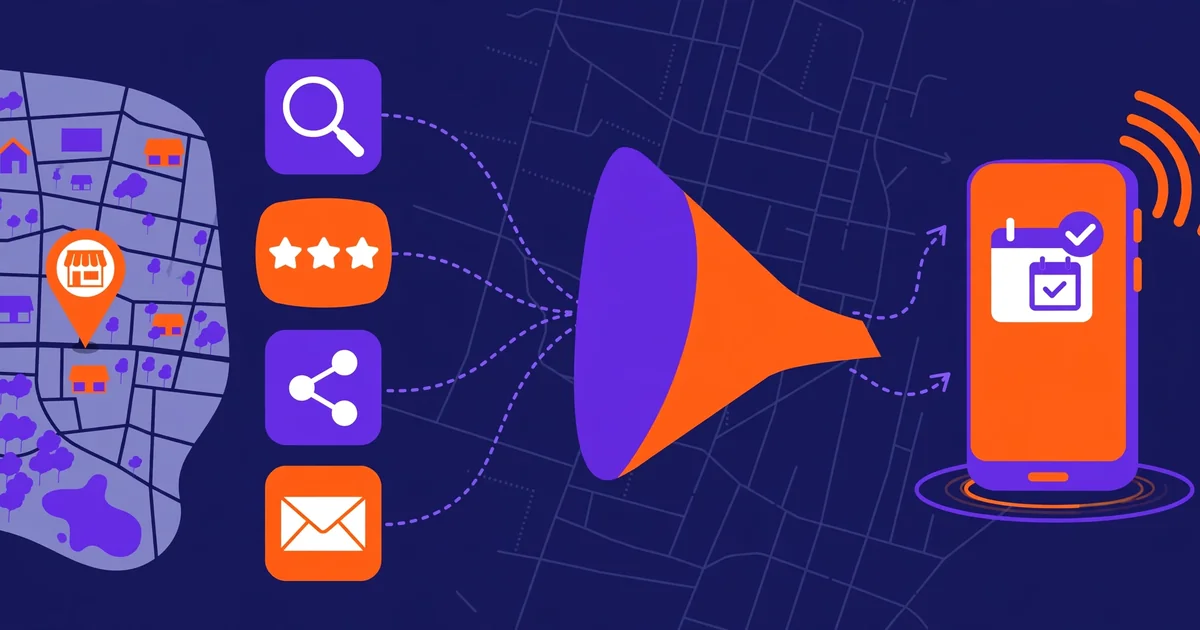
Digital marketing for a local business is not ten channels. It is one system: be found, be trusted, be chosen, be remembered. This playbook builds it in that order.
 Shamim, founder of SerpAstraUpdated October 31, 20269 min read
Key takeaways
- Start with the system, not the channel: be found, be trusted, be chosen, be remembered — in that order.
- Your website and Google Business Profile do most of the work. Everything else points at them.
- Reviews are the cheapest marketing a local business owns: 97% of consumers read them, and only 4% never do.
- Paid ads fill the gaps while SEO compounds. Neither replaces the other.
- Measure leads and booked jobs. Impressions, followers and clicks are not results.
On this page
Ask ten marketers what digital marketing means for a local business and you will get ten different answers, usually the one that matches what they sell. The SEO agency says SEO. The ads agency says ads. The social media manager says TikTok. All of them are partly right and all of them are selling you a channel, not a system.
A local business does not need ten channels. It needs one system that does four jobs: be found when someone searches, be trusted when they compare, be chosen when they decide, and be remembered so they come back and tell a friend. Every channel in this playbook serves one of those four jobs. If a channel does not serve any of them, it does not belong in your plan — however fashionable it is. This guide builds the system end to end, in the order that matters, with honest notes on what each part costs and how long it takes.
The one-page plan: four jobs, not ten channels
Before you spend anything, write one page. At the top, who your customer is and what they search for when they need you. Then four lines: how will they find you, why will they trust you, why will they choose you over the business next door, and how will you stay in touch afterwards. If you cannot answer those four lines, no channel will fix it — you will just be louder about a business people cannot distinguish from the next one.
The four jobs map to channels simply. Being found is local SEO, your Google Business Profile and search ads. Being trusted is reviews, photos of real work, and mentions from real local sources. Being chosen is your website: clear service pages, honest pricing signals, an easy way to call or book. Being remembered is email and social media, used lightly and consistently. Notice what is not on the list: nothing here requires going viral, and nothing here requires a big budget. It requires doing ordinary things steadily.

Your website is the hub
Everything in digital marketing points at your website, so it has to do three things well: load fast on a phone, say clearly what you do and where, and make the next step obvious. Most local business websites fail at least one of these. They load slowly because of oversized photos, they describe the business in vague language instead of naming services and areas, and they hide the phone number behind a menu.
The pages that matter most are the service pages — one per service, with real detail — and the area pages for each place you serve. Each page should answer the questions a customer asks before calling: what it costs, how long it takes, what happens first, whether you cover their area. Add the business name, address and phone number consistently, and add LocalBusiness schema so Google and AI systems can read those facts directly. Our schema markup guide shows which types matter for a small business.
You do not need a redesign to fix most of this. A fast host, compressed images, a clear headline on every page and a visible call button will do more than a new design. And keep the site honest: real photos of your work, real team members, real service areas. Stock photos of smiling strangers do not build trust with someone choosing a dentist or a roofer.
Local SEO and the map pack
For a local business, local SEO is the highest-return marketing there is, because it puts you in front of people who are already looking for what you do, in your area, right now. The centrepiece is your Google Business Profile: complete categories, services, hours, photos, posts and reviews. It is free, it is the first thing most customers see, and it is the single most neglected asset in local marketing.
The map pack — the three businesses with a map at the top of local results — runs on relevance, distance and prominence. You cannot move your shop, but you can control relevance and prominence: complete profile, service pages for each area, consistent business details everywhere, and a steady flow of reviews. Our guide to ranking in the Google map pack walks through the steps, and our Google Business Profile checklist is the field-by-field version.
Local SEO is slow to start and then it compounds. Expect three to six months before real movement — our guide to how long SEO takes to rank explains why — and then expect the leads to keep coming without a per-click cost. That compounding is what makes it the foundation of the whole playbook rather than one channel among many.
Reviews: the channel you already own
Reviews are the cheapest marketing a local business owns, because you already earned them — you just have to ask for them. BrightLocal's 2025 survey found that 97% of consumers read reviews for local businesses, and only 4% said they never read them. Reviews feed your map pack ranking, your AI recommendations and your conversion rate at the same time. No other channel does all three.
The system is simple: ask every happy customer, at the moment they are happiest — right after the job is done, the treatment is finished, the problem is solved. Send a short message with a direct link to your Google review page, and make it easy. One ask per customer, no incentives, no filtering out the unhappy ones — Google's policies prohibit selectively asking only happy customers, and a few honest critical reviews make the good ones believable.
Reply to every review, good or bad, within a day or two. Replies are read by future customers, not just by the reviewer, and a thoughtful reply to a complaint is worth more than ten five-star reviews with no replies. Our guide to Google reviews and SEO covers the asking process and the reply templates that work.
Nobody remembers the business with the prettiest ads. They remember the business their neighbour recommended — and today that recommendation is a review.
— Shamim, founder of SerpAstra
Paid ads for the gaps
Paid ads are the part of the playbook that buys speed. Local SEO takes months; ads take days. Use them for the gaps: a new business with no rankings yet, a slow season, a new service nobody knows about, or your most profitable keywords where competitors bid on your name. They are a tap, not a well — leads stop the day you stop paying — which is why they sit alongside SEO rather than instead of it.
For most local businesses, Google Search Ads and Local Services Ads are the two formats that book jobs. Search ads win the urgent, specific searches; Local Services Ads win the trust-first searches with their Google Guaranteed badge. WordStream's 2026 benchmarks put the average Google Ads cost per lead at $66.69 across industries — but legal leads averaged over $130 and auto repair around $30, so work from your own keywords. Our paid ads strategy guide covers the maths, the structure and the tracking in full.
| Channel | Speed | Cost pattern | Best job in the playbook |
|---|---|---|---|
| Google Business Profile | Weeks | Free | Be found and be trusted |
| Local SEO | 3–6 months | Monthly work, then compounds | Be found, long term |
| Google Search Ads | Days | About $67 per lead on average | Be found, right now |
| Reviews system | Weeks | Your time only | Be trusted |
| Email and social | Weeks | Low cost, steady effort | Be remembered |
Social ads have a narrower role for most local businesses: retargeting people who visited your site but did not call, and promoting a specific offer to a local audience. They rarely beat search for direct bookings, because the buyer on social media was not looking for you. Spend there only after search and local SEO are working.

Social and email: keeping in touch
Social media and email do the fourth job: being remembered. Their purpose is not to win new customers directly — it is to stay in front of the people who already know you, so that when they need you again, or when a friend asks for a recommendation, your name is the one that comes to mind.
Keep it simple and real. One post a week showing actual work — a finished job, a team member, a tip that helps even people who never buy from you — beats daily generic content. Use the platform your customers actually use, which for most local businesses is Facebook or Instagram, not every platform at once. And answer comments and messages; an unanswered message on your own page is worse than no page at all.
Email is the quieter, stronger half of this job. A short monthly email to past customers — a seasonal reminder, a useful tip, a genuine offer — costs almost nothing and brings repeat work. Collect addresses at every job with permission, keep the list clean, and write like a person, not a flyer. The open rate of a list of real customers will beat any bought list by a wide margin.
What to measure — and what to ignore
Digital marketing produces more numbers than any small business needs, and most of them are distractions. Impressions, followers, likes, clicks and even traffic can all rise while bookings stay flat. The numbers that matter fit on one page: how many people called, filled in a form or booked, where each one came from, what it cost, and how many became paying customers.
Set up the tracking once and keep it simple. Call tracking on the website and the profile, a form that records its source, and a weekly note of where each booked job came from. Google Analytics and Search Console are free and will tell you the rest. Review the numbers monthly, not daily — daily numbers are noise, and reacting to noise is how good campaigns get paused for bad reasons.
Judge each channel on its own job. Local SEO is judged on map pack position and organic leads. Ads are judged on cost per booked job. Reviews are judged on count, recency and rating. Email is judged on repeat bookings. A channel that does its job is working even if its vanity numbers look small — and a channel with big vanity numbers that produces no jobs is not working at all.

The 90-day rollout
Here is the whole playbook as a ninety-day plan. Days 1 to 30: fix the hub. Fast website, clear service pages, complete Google Business Profile, consistent business details everywhere, call tracking switched on. Days 31 to 60: be found and be trusted. Start the review system, publish the first service-area pages, launch search ads on your most profitable service if you need leads now. Days 61 to 90: be chosen and be remembered. Improve the pages that get traffic but few calls, start the monthly email, post real work weekly.
After ninety days, the system runs on a weekly rhythm of about two to three hours: check the numbers, reply to reviews, post once, send the email, and do one improvement to the website or the profile. That rhythm is the whole secret. Local businesses do not fail at digital marketing because they chose the wrong channel. They fail because they did everything once and then stopped.
If you want help building the system rather than buying a channel, that is what we do. Our Local SEO plan is $450 a month and covers the profile, local rankings and reviews; Monthly SEO at $700 a month adds the content and technical work; and a one-time audit at $349 will show you exactly where your system stands today. Or book a free call and we will talk through your four jobs together.
Not sure where to start?
Get a free audit - written findings in 2 business days, yours to keep.
Get my free audit→Sources we checked
Every figure in this guide comes from one of the sources below, or from SerpAstra's own client work. We did not invent statistics for this post.
- BrightLocal, Local Consumer Review Survey 2025 — https://www.brightlocal.com/research/local-consumer-review-survey-2025/
- WordStream by LocaliQ, Google Ads Benchmarks 2026 — https://www.wordstream.com/blog/2026-google-ads-benchmarks
- Google Search Central, SEO Starter Guide — https://developers.google.com/search/docs/fundamentals/seo-starter-guide
Shamim
Founder of SerpAstra
A full-stack SEO and digital marketer who spends most days on Local SEO for dental practices, AI search visibility and lead generation.
Frequently asked questions
What is digital marketing for a local business?
It is the system that gets local customers to find you, trust you, choose you and remember you: a fast website, local SEO and a complete Google Business Profile, reviews, paid ads where needed, and email and social media to stay in touch. It is one system, not ten separate channels.
How much does digital marketing cost for a small local business?
It depends on how much you do yourself. The profile and reviews cost only time. Local SEO with an agency runs from around $450 a month at SerpAstra's rates; Google Ads add media spend, averaging about $67 per lead in 2026 benchmarks. Start with the free foundations before spending on ads.
Which digital marketing channel works best for local businesses?
Local search — your Google Business Profile and the map pack — because it reaches people already looking for what you do, nearby, right now. Reviews are the second most valuable channel because they feed rankings and choice at once. Ads are best for speed; email is best for repeat work.
Do local businesses need social media marketing?
They need it for the fourth job: being remembered. One genuine post a week showing real work, on the platform your customers actually use, is enough for most businesses. Social media rarely beats search for direct bookings, so do not let it consume the budget that local SEO needs.
How long before digital marketing works for a local business?
Ads can produce leads in days. Local SEO usually takes three to six months to show real movement. Reviews and email build steadily over weeks. The honest answer is that the system compounds: month six is usually far better than month one, because every part strengthens the others.
Should I hire an agency or do digital marketing myself?
Do the free foundations yourself — the profile, the reviews, the website basics — because no one knows your customers better than you. Hire help for the parts that need breadth and consistency: technical SEO, content, ads and reporting. Our guide to how SEO agencies work explains what to expect from one.
Free SEO and AI visibility audit
Find out what is holding your rankings back
Send us your site. Within 2 business days you get a written audit, an AI visibility check and a short fix list ranked by impact. Free, with no contract attached.
Request my free audit→Related guides
 Local SEOWhat is local SEO? A beginner's guide for small businessesWhat is local SEO? A clear beginner’s guide: how the map pack works, the five pillars, what it costs, and the first steps any small business can take.Read guide →
 Pricing & HiringHow much does SEO cost in 2026? A plain pricing guideWhat SEO costs in 2026, how hourly, project, retainer and performance pricing work, what drives the price up or down, and how to set a budget that holds up.Read guide →
 Local SEOSEO for home services: plumbers, electricians and roofersSEO for home services: how plumbers, electricians and roofers win the map pack, emergency searches and service-area pages — and turn calls into booked jobs.Read guide →