
Best A/B Testing Software for 2026: 12 Options Compared by Use Case
Compare the 12 best a/b testing software options on price, free plans and stats engines, with every price checked November 4, 2026, and sorted by use case.
 Shamim Mia, Founder, SerpAstraLast verified November 4, 202614 min read
We compare pricing pages, documentation and public reviews. We never accept payment for rankings.

Key takeaways
- Convert is the best fit for most teams at $399/month, with Kameleoon next at $495/month and GrowthBook's free Starter the cheapest way to start serious testing.
- Four tools in this list publish no prices at all — Optimizely, VWO, AB Tasty and Adobe Target are all custom quote, so budget for a sales conversation.
- The single most important buying factor is the meter: tested visitors, monthly tracked users, seats or launched experiments decide what you actually pay, not the headline price.
- Free plans are real but capped: GrowthBook Starter covers 3 users, Statsig Developer covers 2M events a month, and Amplitude Free allows 1 active experiment.
On this page
Quick comparison
| Tool | Best for | Starting price | Free plan |
|---|---|---|---|
| Convert | Mid-size marketing and CRO teams that want published pricing, privacy-first testing and full-stack experiments without a sales call | $399/mo | No (15-day trial) |
| VWO | Marketing teams that want testing, heatmaps and session recordings in one platform | Custom quote | No (30-day trial) |
| Kameleoon | Mid-market teams that want AI to draft test variations from plain-language prompts | $495/mo | No (30-day trial) |
| GrowthBook | Product and data teams with a warehouse who want open-source experimentation without per-visitor fees | Free; Pro $40/seat | Yes (free Starter) |
| Statsig | Engineering-led product teams that want feature flags, experiments and analytics on one event platform | Free; Pro $150/mo | Yes (free Developer) |
| PostHog | Startups that want experiments inside the same tool as analytics, replay and feature flags | Free (pay as you go) | Yes (free tier) |
| Amplitude Experiment | Product teams already measuring behavior in Amplitude who want tests next to their funnels | Free | Yes (free plan) |
| Unbounce | Paid-traffic teams that test landing pages rather than whole websites | $149/mo | No (14-day trial) |
| Optimizely | Large enterprises running a high-volume experimentation program with dedicated stats support | Custom quote | No (Rollouts only) |
| AB Tasty | European mid-market and enterprise teams that want testing plus AI personalization in one platform | Custom quote | No |
| Adobe Target | Enterprises already standardized on Adobe Analytics and Experience Manager | Custom quote | No |
| Datadog Experiments | Data teams with a warehouse who want rigorous stats inside their observability stack | $530/mo per experiment | No (14-day trial) |
Make one of these tools?
We re-check this list every quarter. Send a correction, request a review, or ask about a clearly labeled sponsored spot.
Request a listingThe best a/b testing software

Convert
Best for: Mid-size marketing and CRO teams that want published pricing, privacy-first testing and full-stack experiments without a sales call
Convert is the rare enterprise-grade testing tool that still prints its prices. Growth costs $399 a month billed monthly, or $299 billed annually, for 100,000 tested users, and covers A/B and split URL testing, a visual editor, sequential testing and sample-ratio-mismatch checks. Pro costs $599 a month, or $420 billed annually, and adds multivariate, multipage and full-stack testing with multi-armed bandit allocation. Heatmaps and session recordings come with every plan at no extra cost.
The catch is the tested-user meter: passing 100,000 tested users means buying more at $399 per 100,000 on Growth. The platform is privacy-first — GDPR, CCPA and HIPAA-ready, with no data reselling — which suits regulated teams. Pick Convert when you want a published price and a complete CRO suite without a sales process.
What we like
- Publishes its prices: Growth $399 a month billed monthly or $299 billed annually, with no feature sold as a separate module
- Frequentist and Bayesian stats engines with sequential testing and sample-ratio-mismatch checks on every plan
- Flicker-free delivery and a visual editor, so marketers build variations without engineering help
- Privacy-first handling (GDPR, CCPA and HIPAA-ready, no data reselling) plus 90+ integrations
Watch out for
- No free plan — the 15-day trial is the only way to try it before paying
- Multivariate, multipage and full-stack testing need Pro at $420 a month billed annually
- Growth caps at 5 active projects and 5 active experiences per project

VWO
Best for: Marketing teams that want testing, heatmaps and session recordings in one platform
VWO Testing is the broadest all-in-one option here: A/B, split URL, multivariate and server-side testing with a visual editor, plus heatmaps, session recordings, funnels and surveys in the same platform. The same tool that finds the conversion problem runs the test that fixes it. Since VWO merged with AB Tasty under Wingify in January 2026, the two brands share one pricing page — Growth, Pro and Enterprise tiers with no currency figures and a demo behind every tier.
That missing price is the real cost of choosing VWO: you cannot budget it from the website, and the bill is metered on monthly tracked users, so it climbs with traffic. Multivariate testing and behavioral targeting wait for Pro. Pick VWO when one platform for research and testing matters more than a published price.
What we like
- The most complete all-in-one CRO suite here: testing plus heatmaps, session recordings, funnels and surveys
- Visual editor with A/B, split URL, multivariate and server-side testing in one platform
- Bayesian stats engine with SmartStats, plus AI CoPilot assistance on paid plans
- 30-day free trial of paid features
Watch out for
- No prices published since the Wingify merger — every paid tier routes through a demo and custom quote
- Pricing is metered on monthly tracked users, so the bill climbs with traffic
- Multivariate testing and behavioral targeting sit on the Pro tier, not Growth

Kameleoon
Best for: Mid-market teams that want AI to draft test variations from plain-language prompts
Kameleoon's pitch is Prompt-Based Experimentation: describe a page change in plain language and the AI drafts the variation for review, which is the fastest route from idea to running test in this list. PBX Starter costs $495 a month for up to 10 experiments and 50,000 tested visitors, with a 30-day free trial covering 3 experiments and no credit card. Underneath, the stats engine offers Bayesian, frequentist and sequential methods with predictive targeting.
The entry price is the catch: $495 a month prices small teams out, there is no free plan, and feature management, mobile testing and server-side testing all need the custom Enterprise package. Starter is also web-only and covers a single project. Pick Kameleoon when AI-assisted variation building is worth $495 a month to your team.
What we like
- Prompt-Based Experimentation drafts variations from a plain-language description for review
- Publishes its entry price — rare transparency at this level of the market
- Bayesian, frequentist and sequential stats with predictive targeting and personalization
- 30-day free trial with up to 3 experiments and no credit card required
Watch out for
- No free plan, and $495 a month prices small teams out entirely
- Feature management, mobile app testing and server-side testing need the custom Enterprise package
- Starter covers one project and web testing only, with a 50,000-visitor monthly cap

GrowthBook
Best for: Product and data teams with a warehouse who want open-source experimentation without per-visitor fees
GrowthBook is the open-source option: self-host it free with no traffic cap, or use Cloud Starter free for up to 3 users with unlimited flags, experiments and traffic. Pro costs $40 per seat per month and adds the AI Visual Editor, multi-armed bandits, safe rollouts and split URL tests. Because it is warehouse-native, analysis runs against your own data with visible SQL, Bayesian and frequentist stats, CUPED and sequential testing.
The trade-off is that you need a data warehouse — or the managed warehouse add-on — and an engineer to wire it up. Cloud Starter caps at 3 users and 1 project, and advanced governance waits for Enterprise. Pick GrowthBook when your data already lives in a warehouse and per-visitor pricing would punish your traffic.
What we like
- Open-source and self-hostable with no traffic cap; Cloud Starter is free for up to 3 users
- Warehouse-native analysis with visible SQL, Bayesian and frequentist stats, CUPED and sequential testing
- Per-seat Pro pricing ($40/seat/month) means the bill does not rise with visitor volume
- Feature flags, multi-armed bandits and 24+ SDKs in one codebase
Watch out for
- Needs a data warehouse (or the managed warehouse add-on) to run experiments — no hosted analytics of its own
- AI Visual Editor and split URL tests wait for Pro; advanced governance waits for Enterprise
- Cloud Starter caps at 3 users, 1 project and 1M CDN requests a month

Statsig
Best for: Engineering-led product teams that want feature flags, experiments and analytics on one event platform
Statsig combines feature flags, experimentation, product analytics and session replay on one event platform, with 30+ SDKs and warehouse-native deployment. The Developer tier is free: gates, configs, experimentation and analytics with 2 million metered events a month. Pro starts at a published $150 a month baseline for 5 million events, with overages at $0.05 per extra 1,000 events. Metric lifts compute in real time, so results arrive while the test runs.
Two things to watch. Each Pro subscription covers one project only, so multi-product teams pay per project. And ownership changed hands in 2025–2026 — OpenAI acquired Statsig, then Amplitude took over the brand and customer base in May 2026 — so confirm the roadmap before a long commitment. Pick Statsig when engineering runs the experiments and flags matter as much as tests.
What we like
- Generous free Developer tier: gates, configs, experimentation and analytics with 2M metered events a month
- Pro is a published $150 a month baseline for 5M events, with $0.05 per extra 1,000 events
- 30+ SDKs with warehouse-native deployment and real-time metric lifts
- Session replay and product analytics included, so the why sits next to the what
Watch out for
- Each Pro subscription covers one project only — more projects need separate upgrades
- Usage-based billing on metered events makes the bill harder to forecast than a flat plan
- Enterprise extras (volume discounts, custom billing) need a sales conversation

PostHog
Best for: Startups that want experiments inside the same tool as analytics, replay and feature flags
PostHog bundles experiments with product analytics, session replay, surveys and error tracking behind one SDK and one bill. There is no base fee and no seat fee: the free tier resets monthly with 1 million analytics events, 5,000 recordings and 1 million flag requests, and experiments are billed with feature flags. Past the allowance, flag requests cost $0.0001 each at the first tier, falling with volume. Billing limits let you cap the spend.
The catch is predictability. With 13 metered products, the total bill depends on how much of the suite you switch on, and the platform packages — Boost at $250 a month, Scale at $750 — gate SSO, white labeling and RBAC. Self-hosting is officially unsupported now. Pick PostHog when you want the whole product toolkit free until it earns its keep.
What we like
- No base fee and no seat fees: every product has a monthly free allowance, including 1M flag requests
- Experiments, analytics, session replay, surveys and error tracking share one SDK and one bill
- Pay-as-you-go starts at $0 with billing limits you control
- Flag requests past the free allowance cost $0.0001 each at the first tier, falling with volume
Watch out for
- Usage-based pricing across 13 products makes the total bill hard to predict without the calculator
- Platform packages (Boost $250/month, Scale $750/month) gate SSO, white labeling and RBAC
- Self-hosting is officially unsupported — the cloud is the way to run it now

Amplitude Experiment
Best for: Product teams already measuring behavior in Amplitude who want tests next to their funnels
Amplitude Experiment puts testing next to the funnels: every plan includes the full platform — analytics, session replay, feature flags and experimentation — with unlimited seats. The Free plan covers 2 million events a month, web experimentation and 1 active experiment, with no credit card and no time limit. Plus starts at $0 and scales with event volume, up to 700,000 monthly tracked users. Growth and Enterprise are custom-priced and add unlimited experiments, multi-armed bandits and holdouts.
One warning: Amplitude repriced in 2026, and the $49 a month Plus figure older guides quote no longer appears on the pricing page — Plus now starts at $0 and scales with usage. That makes small-scale testing free but the bill harder to forecast. Pick Amplitude when the team already lives in its analytics and wants experiments in the same place.
What we like
- Every plan includes the full platform: analytics, session replay, flags and experimentation, with unlimited seats
- Free plan includes 2M events a month, web experimentation and 1 active experiment — no credit card
- Feature and web experiments with mutual exclusion groups, holdouts and multi-armed bandits (Growth+)
- Startup program gives qualifying startups a free year on Growth
Watch out for
- Unlimited experiments and advanced stats need Growth or Enterprise, both custom-priced
- Plus starts at $0 and scales with event volume, so costs rise with usage rather than a flat fee
- Experimentation is one module of a big analytics platform — setup is heavier than a dedicated tester

Unbounce
Best for: Paid-traffic teams that test landing pages rather than whole websites
Unbounce is a landing page builder first and a testing tool second, which is exactly right for paid-traffic teams. Build pages with the drag-and-drop editor, then test them: the Experiment plan costs $149 a month, includes unlimited A/B testing, dynamic text replacement and conversion reporting, and covers 30,000 unique visitors with 3 user seats. Optimize at $249 a month adds Smart Traffic, the AI routing that sends each visitor to the variant most likely to convert.
The catch is the plan ladder. The $29 Starter and $99 Build plans cannot run a single A/B test, so testing costs $149 a month at minimum, and every plan caps visitors — overages run $80 per extra 10,000 visits. Pick Unbounce when landing pages are the whole funnel; pick Convert or VWO when the wider website needs testing too.
What we like
- Unlimited landing pages, popups and sticky bars with a drag-and-drop builder on every plan
- A/B testing with dynamic text replacement and conversion reporting from the Experiment plan
- Smart Traffic AI routing sends visitors to the variant most likely to convert (Optimize, $249/month)
- Annual billing saves 25% across the self-serve plans
Watch out for
- A/B testing is not on the $29 Starter or $99 Build plans — testing starts at $149 a month
- Every plan caps monthly unique visitors (30,000 on Experiment), with $80 per extra 10,000 visits
- Testing covers landing pages only, not the wider website or product

Optimizely
Best for: Large enterprises running a high-volume experimentation program with dedicated stats support
Optimizely is the most established name in experimentation, and it still sets the standard for large programs: a mature frequentist Stats Engine, a visual editor for marketers, and Web Experimentation for client-side tests alongside Feature Experimentation for server-side tests and flags. A free Rollouts plan covers feature flags and one concurrent A/B test. The platform also bundles personalization and content management for teams already on Optimizely One.
The price is the problem for everyone else. Optimizely publishes no prices — its plans page says every plan is individually packaged — and contracts are annual, with enterprise-scale minimums. Web and Feature Experimentation are licensed separately. Pick Optimizely when the program is big enough to justify a sales conversation and a dedicated stats team.
What we like
- The most established name in experimentation, with a mature frequentist Stats Engine and visual editor
- Web and Feature Experimentation cover client-side tests, server-side tests and feature flags
- Free Rollouts plan includes feature flags and one concurrent A/B test
- Deep personalization and CMS bundling for teams already on the Optimizely platform
Watch out for
- No published prices — every plan is individually packaged and quoted by sales
- Web Experimentation and Feature Experimentation are licensed as separate products
- Annual contracts only, with enterprise-scale minimums that rule out small teams

AB Tasty
Best for: European mid-market and enterprise teams that want testing plus AI personalization in one platform
AB Tasty pairs solid experimentation with the strongest personalization story in this list. Beyond A/B, multivariate and split URL testing on a Bayesian engine, it adds EmotionsAI emotional segmentation, AI-based targeting, product recommendations and RevenueIQ reporting that ties tests to money. In January 2026 it merged with VWO under Wingify, and the two brands now share one pricing page and one roadmap.
The buying process is the weak point. The pricing page states there are no fixed plans, only a custom proposal, and pricing is based on monthly active users and traffic volume, so quotes are hard to compare. The full platform — feature management, recommendations, EmotionsAI — is priced as add-ons or higher tiers. Pick AB Tasty when personalization matters as much as testing and the budget is enterprise-scale.
What we like
- Bayesian stats engine with EmotionsAI segmentation and product recommendations alongside testing
- Strong personalization story: AI targeting, RevenueIQ reporting and feature management (Flagship)
- Merged with VWO under Wingify in 2026, so the roadmap now spans both platforms
- Dedicated customer success manager and 24/7 support on Enterprise
Watch out for
- No published prices — the pricing page states 'no fixed plans, just a custom proposal'
- Pricing is based on monthly active users and traffic volume, so quotes are hard to compare
- Full platform (feature management, recommendations, EmotionsAI) is priced as add-ons or higher tiers

Adobe Target
Best for: Enterprises already standardized on Adobe Analytics and Experience Manager
Adobe Target is the testing and personalization engine for teams already standardized on Adobe. Standard covers A/B and multivariate testing, auto-allocate, rules-based targeting and server-side testing through APIs, all licensed on annual page-view traffic. Premium adds Auto-Target and Automated Personalization, which use AI to pick the best experience for each visitor, plus Recommendations. Integration with Adobe Analytics and Experience Manager is the point: test results flow into the stack you already report from.
Everything else is a hurdle. Adobe publishes no prices and offers no free trial, so every contract starts with a sales conversation, and the bill scales with page views. The full value also needs Adobe Analytics and Experience Platform wired in alongside Target. Pick Adobe Target when the Adobe stack is already the system of record.
What we like
- Auto-Target and Automated Personalization use AI to pick the best experience per visitor (Premium)
- Deep integration with Adobe Analytics and Experience Manager for teams already in the stack
- Standard covers A/B, multivariate, auto-allocate and server-side testing via APIs
- Enterprise-grade governance, targeting and omnichannel delivery
Watch out for
- No published prices and no free trial — every contract is a sales conversation
- Licensed on annual page-view traffic, so costs scale with site volume
- Full value needs Adobe Analytics and Experience Platform wired in alongside it

Datadog Experiments
Best for: Data teams with a warehouse who want rigorous stats inside their observability stack
Datadog Experiments is the successor to Eppo: Datadog acquired Eppo in May 2025 and launched Experiments in April 2026, carrying over its warehouse-native stats engine. Pricing is published and unusual — $450 per successfully launched experiment per month billed annually, $530 month-to-month, or $575 on demand. An experiment becomes billable after 500 subjects and 3 days. Results connect directly to business metrics in your warehouse instead of a separate analytics silo.
The per-experiment meter is the thing to model: one test running all year costs $5,400 billed annually, and five concurrent tests cost five times that. There is no free tier, only a 14-day Datadog trial, and feature-flag usage past 1 million requests a month bills separately. Pick Datadog Experiments when the data team already trusts the warehouse and the observability stack is Datadog.
What we like
- Published per-experiment pricing: $450 a month billed annually, $530 month-to-month, $575 on demand
- Warehouse-native analysis from Eppo's stats engine, with CUPED and sequential testing heritage
- Experiments connect directly to business metrics in the warehouse, not a separate analytics silo
- Runs inside Datadog alongside monitoring, logs and RUM for teams already there
Watch out for
- Eppo was folded into Datadog in 2026 — new buyers purchase Datadog Experiments, not a standalone Eppo
- Priced per launched experiment, so a busy program with many concurrent tests gets expensive fast
- No free tier; feature-flag usage beyond 1M requests a month is billed separately
The best a/b testing software turns opinions about a page into evidence: it shows half your visitors one version, half another, and tells you which one converts better. We compared 12 tools — from free open-source options to enterprise platforms that only quote by phone — and ranked them by fit for the most common buyer, a marketing or product team running its first serious testing program. Every price below was checked on the vendor's own pricing page on November 4, 2026, except the four vendors that publish no prices at all.
If you are testing headlines or page layouts, try your variants in the free SERP snippet preview tool first — it shows how each title will look in Google before you spend traffic on the test.
How to choose the best a/b testing software
- Start with the meter. Convert and Kameleoon charge by tested visitors, VWO by monthly tracked users, GrowthBook by seats, Statsig by metered events and Datadog by launched experiments. The meter decides the bill, not the headline price.
- Match the tool to the surface. Landing pages belong to Unbounce, websites to Convert, VWO and Kameleoon, product features and apps to GrowthBook, Statsig, PostHog and Amplitude, and the whole stack to Optimizely or Adobe Target.
- Check the stats engine. Frequentist, Bayesian and sequential methods are standard here; CUPED variance reduction and sample-ratio-mismatch checks matter once tests run every week.
- Count the people who will run tests. Visual editors let marketers ship variations without engineering; warehouse-native tools need a data team to set up and maintain.
- Price the second year, not the first. Trials end, free tiers cap out, and custom quotes renew — ask what the renewal costs before signing.
Testing is one part of getting found and converting. If the site also needs more qualified traffic, our AI search optimization service covers the visibility side, and our guide to marketing platforms for small business SEO covers the wider stack.
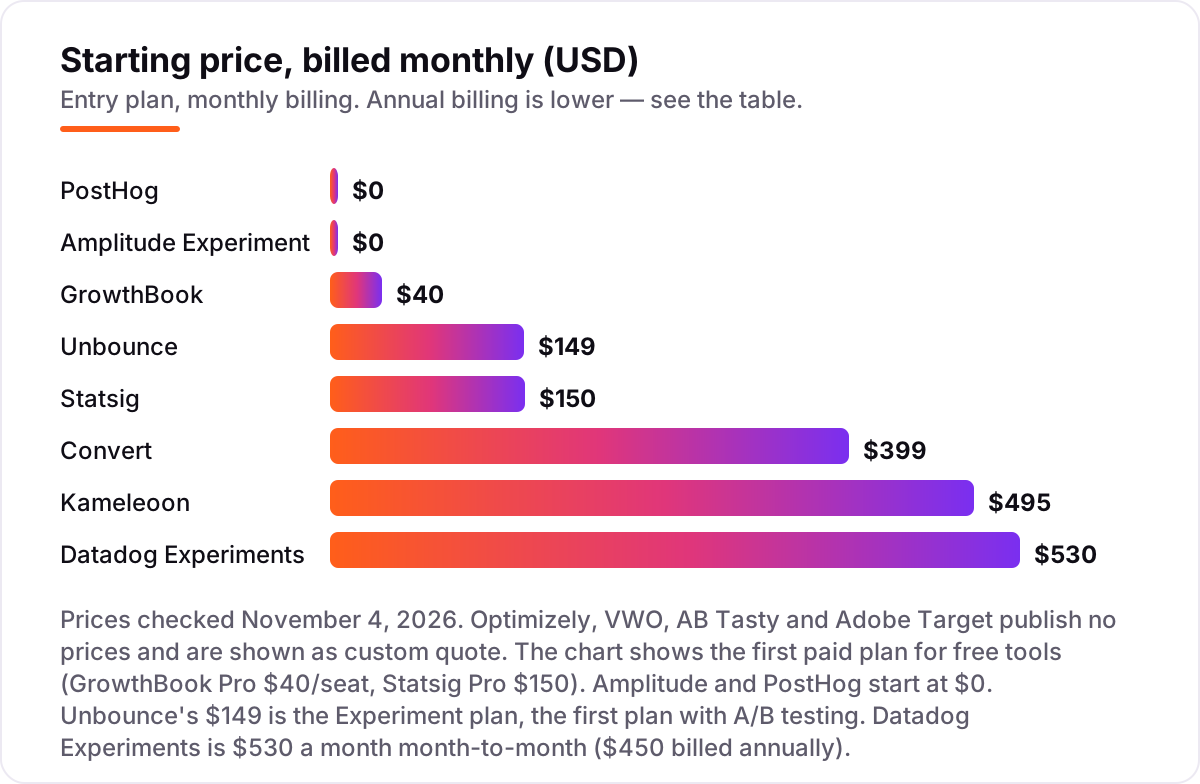
A/B testing software pricing: what you will actually pay
Take a five-person product team running experiments all year. On GrowthBook Pro, five seats at $40 cost $200 a month, or $2,400 a year — and the bill does not move with traffic. On Statsig Pro, the $150 monthly baseline costs $1,800 a year before overages past 5 million events. Convert Growth billed annually costs $299 a month, or $3,588 a year, for 100,000 tested users. Kameleoon Starter costs $495 a month, or $5,940 a year, for 50,000 tested visitors. One Datadog experiment running all year costs $450 a month billed annually, or $5,400 — and a second concurrent experiment doubles it.
Three costs sit outside those numbers. First, traffic overages: Unbounce charges $80 per extra 10,000 visits, Convert charges $399 per extra 100,000 tested users on Growth, and VWO's bill rises with monthly tracked users. Second, the add-ons: PostHog's Boost package at $250 a month gates white labeling and SSO, and Amplitude's advanced experimentation sits on custom-priced Growth. Third, the quote-only tools — Optimizely, VWO, AB Tasty and Adobe Target — publish no prices, so budget for a sales conversation and get the traffic allowance in writing before signing.
Annual billing cuts the bill where it exists: Convert Growth drops from $399 to $299 a month, and Unbounce saves 25% across its self-serve plans. The free tiers are real but capped: GrowthBook Starter covers 3 users, Statsig Developer covers 2 million events a month, PostHog's free tier covers 1 million flag requests a month, and Amplitude Free allows 1 active experiment. A team that outgrows a free tier should price the first paid plan before building its process around the free one.
Know the difference: A/B testing vs feature flags
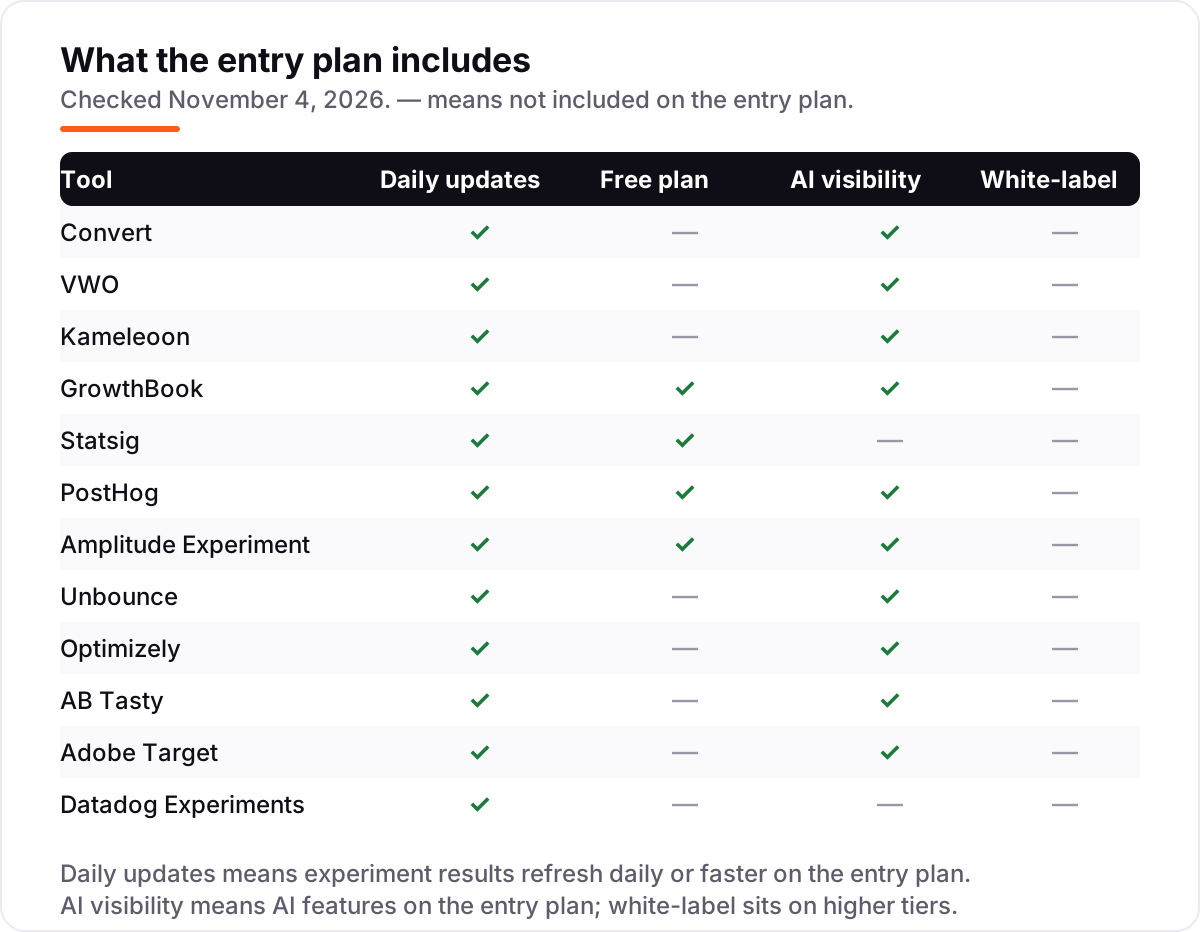
The confusion in this category is between measuring and releasing. A/B testing measures which version performs better — it needs a hypothesis, a traffic split, and a stats engine that calls the winner. Feature flags control who sees a feature — they release code gradually, kill a bad release instantly, and target by user or segment. A flag without a measurement plan is a rollout, not a test.
Several tools in this list do both, which is where buyers get confused. GrowthBook, Statsig, PostHog and Amplitude bundle flags with experiments; Optimizely sells them as separate products (Web Experimentation and Feature Experimentation); Convert, VWO, Kameleoon, Unbounce and Adobe Target are testing-first, with flags as an add-on or not at all. If your team ships features weekly, buy the tool that does both well. If marketing runs page tests and engineering ships separately, a testing-only tool is the cheaper buy.
There is a second confusion: personalization is not testing. AB Tasty's EmotionsAI and Adobe Target's Automated Personalization pick the best experience per visitor automatically — that is a different job from running a controlled experiment, and it is priced as a higher tier on both platforms.
Quick comparison: tool type by need
| Buyer | Best pick | Why |
|---|---|---|
| Small team, first tests, $0 budget | GrowthBook | Free Starter, unlimited experiments, Pro is $40/seat when you outgrow it |
| Marketing team that wants one platform | Convert | Published pricing from $399/month, testing plus heatmaps and recordings |
| Team that wants AI to draft variations | Kameleoon | Prompt-based experimentation, $495/month |
| Engineering-led product team | Statsig | Free Developer tier, Pro from $150/month, flags plus experiments |
| Startup consolidating product tools | PostHog | Free tier, experiments with analytics and replay on one bill |
| Landing-page and paid-traffic team | Unbounce | A/B testing from $149/month on Experiment |
| Enterprise with a stats team | Optimizely | The deepest platform, custom quote |
| Adobe-stack enterprise | Adobe Target | Native Adobe integration, custom quote |
Mistakes to avoid
- Buying on the headline price. The $29 Unbounce Starter and $99 Build plans cannot run a single A/B test — testing starts at $149. Check which plan the testing feature actually sits on.
- Ignoring the meter. Tested visitors, tracked users, seats, events and launched experiments all scale differently. Model your traffic first, then price the tool.
- Running tests your traffic cannot power. A low-traffic page needs weeks to reach significance; a test called early on a small sample is a guess, not a result.
- Paying for personalization when you need testing. AI targeting and recommendations are higher tiers on AB Tasty and Adobe Target — do not pay for them to run simple A/B tests.
- Skipping the renewal question. Custom quotes renew, free tiers cap out, and usage-based bills grow with traffic. Ask what year two costs before signing year one.
How we chose
We checked each vendor's own pricing page on November 4, 2026 and recorded the starting price exactly as shown, including the annual-billing figure where the page lists one. Four vendors — Optimizely, VWO, AB Tasty and Adobe Target — publish no prices, so they are listed as custom quote. PostHog's pricing page would not load for a direct read on November 4, 2026, so its figure rests on three independent reads of the same page in October 2026. This list carries no review ratings because the G2 review pages could not be opened on November 4, 2026, and we would rather show no rating than a stale or estimated one. We ranked the tools by fit for the most common buyer — a marketing or product team running its first serious testing program — not by brand size. No vendor paid for a place in this list, and none of the links here are affiliate links.
What to do next
Start with the free tier or trial of your top pick and run one real test end to end: build the variation, split the traffic, and read the result to a decision. Check that the stats engine calls a winner your team trusts, and that the meter — visitors, seats, events or experiments — fits your traffic before the trial ends. If the tests are running but new visitors are not finding you, our monthly SEO service handles the visibility side — or compare options in our guide to AI SEO tools for 2026. Once your tools are in place, find out what's holding your rankings back.
Your stack only works if people find you
SerpAstra fixes what keeps your site off page one and makes it easy for AI assistants to recommend.
Get a free audit→Sources we checked (12)
- Convert Experiences pricing — convert.com/pricing (checked November 4, 2026)
- Wingify pricing (VWO and AB Tasty) — wingify.com/pricing (checked November 4, 2026)
- Kameleoon plans — kameleoon.com/plans (checked November 4, 2026)
- GrowthBook pricing — growthbook.io/pricing (checked November 4, 2026)
- Statsig pricing — statsig.com/pricing (checked November 4, 2026)
- PostHog pricing — posthog.com/pricing (checked November 4, 2026)
- Amplitude pricing — amplitude.com/pricing (checked November 4, 2026)
- Unbounce pricing — unbounce.com/pricing (checked November 4, 2026)
- Optimizely plans and pricing — optimizely.com/plans (checked November 4, 2026)
- Adobe Target — adobe.com/marketing/target.html (checked November 4, 2026)
- Datadog pricing list — datadoghq.com/pricing/list (checked November 4, 2026)
- Google Optimize sunset — support.google.com/analytics/answer/12979939 (checked November 4, 2026)
Shamim
Founder of SerpAstra
A full-stack SEO and digital marketer who spends most days on Local SEO for dental practices, AI search visibility and lead generation.
Frequently asked questions
What is the best a/b testing software?
Convert is the best fit for most teams: published pricing from $399 a month, a full CRO suite and no sales process. GrowthBook is the best free start for product teams with a warehouse. Optimizely is the best enterprise pick, but only by custom quote. VWO is the best all-in-one if you want heatmaps and recordings in the same tool.
How much does a/b testing software cost?
Published prices run from $0 to $495 a month: GrowthBook Pro is $40 a seat, Statsig Pro starts at $150, Unbounce testing starts at $149 and Convert Growth is $399 a month. Kameleoon starts at $495. Optimizely, VWO, AB Tasty and Adobe Target publish no prices and quote by sales conversation.
Is there free a/b testing software?
Yes, with limits. GrowthBook's self-hosted edition is free with no traffic cap, Statsig's Developer tier is free up to 2 million events a month, PostHog's free tier covers 1 million flag requests a month, and Amplitude Free allows 1 active experiment. Google Optimize, the old free option, shut down on September 30, 2023.
What is the difference between a/b testing software and feature flags?
A/B testing measures which version performs better using a stats engine; feature flags control who sees a feature and allow gradual rollouts and instant kill switches. GrowthBook, Statsig, PostHog and Amplitude bundle both. Optimizely sells them as separate products, and testing-first tools like Convert and VWO treat flags as an add-on or not at all.
Do I need a developer to run a/b tests?
Not on the marketing tools: Convert, VWO, Kameleoon and Unbounce all have visual editors that let marketers build variations without code. Warehouse-native tools like GrowthBook, Statsig and Datadog Experiments need engineering and data help to set up. Pick the visual-editor tools if no developer is available.
How many visitors do I need to run an a/b test?
It depends on your baseline conversion rate and the size of the change you are testing: a small lift on a low-traffic page can take weeks to reach significance. Use a sample-size calculator before launching, and do not call a test early — a result from too little traffic is a guess, not evidence.
Can I switch a/b testing tools later?
Yes, but plan the move between test cycles, not mid-test. Export your experiment history and results, recreate the running tests in the new tool, and re-check the tracking code on every page. Switching also means re-learning the stats engine, so run one parallel test in both tools before you commit.
Free SEO and AI visibility audit
Find out what is holding your rankings back
Send us your site. Within 2 business days you get a written audit, an AI visibility check and a short fix list ranked by impact. Free, with no contract attached.
Request my free audit→Related guides
 SEO & AI Search12 Best Marketing Platforms for Small Business SEO in 2026, ComparedThe 12 best marketing platforms for small business SEO, compared on real prices, SEO tools and AI visibility. Every price checked November 1, 2026.Read guide →
 SEO & AI Search8 Best SEO Tools for Affiliate Marketing in 2026, Compared8 best seo tools for affiliate marketing compared on price, keyword research, content scoring and outreach, with real starting prices checked on vendor pages.Read guide →
 AI SearchBest AI SEO tools in 2026: honest picks by jobBest AI SEO tools in 2026, picked by job: Semrush and Ahrefs for research, Surfer and Clearscope for content, Otterly for AI tracking, with 2026 prices.Read guide →