
12 Best Marketing Platforms for Small Business SEO in 2026, Compared
The 12 best marketing platforms for small business SEO, compared on real prices, SEO tools and AI visibility. Every price checked November 1, 2026.
 Shamim Mia, Founder, SerpAstraLast verified November 1, 202617 min read
We compare pricing pages, documentation and public reviews. We never accept payment for rankings.

Key takeaways
- HubSpot Content Hub is the best all-rounder for most small businesses: website, blog, email and CRM with built-in SEO guidance from $20/month per seat.
- Semrush is the deepest SEO platform here at $139.95/month; SE Ranking is the best-value suite at $103.20/month billed annually.
- Wix, Squarespace and Duda bundle the website and the SEO basics for $25–$29/month — the cheapest way to own a site that can rank.
- The single most important buying factor is whether the platform covers your whole workflow — website, content and follow-up — or only one part of it.
- Every price below was checked on the vendor's own pricing page on November 1, 2026, except Buffer's $6 monthly rate, which comes from Buffer's vendor-provided G2 listing.
On this page
Quick comparison
| Tool | Best for | Starting price | Free plan |
|---|---|---|---|
| HubSpot Content Hub | Small businesses that want their website, blog, email and CRM in one place with built-in SEO guidance | $20/mo per seat | No |
| Semrush | Small teams that need deep keyword research, rank tracking, audits and AI visibility in one subscription | $117.33/mo (annual) | Yes (10 keywords) |
| Wix | Solo owners and tiny teams that need a website with built-in SEO and marketing tools, no developer required | $29/mo (annual) | Yes (free plan) |
| SE Ranking | Small agencies and in-house teams that want a full SEO suite with AI visibility for about $103/month | $103.20/mo (annual) | No (14-day trial) |
| Ahrefs | In-house SEOs who want rank tracking bundled with the deepest backlink and keyword research data | $29/mo | Yes (no Rank Tracker) |
| Squarespace | Design-led small businesses that want a polished website with built-in SEO and email marketing | $19/mo (annual) | No (14-day trial) |
| Duda | Small businesses and freelancers who build client sites and need fast, SEO-ready pages with AI tools | $19/mo (annual) | No (14-day trial) |
| Moz Pro | Beginner in-house teams that want Domain Authority metrics, keyword research and rank tracking in one suite | $49/mo | No (7-day trial) |
| Mailchimp | Small businesses with up to 500 contacts that want email, landing pages and a website from one login | $13/mo (annual) | Yes (free plan) |
| Brevo | Small businesses on a tight budget that need email, SMS and a free CRM without per-contact pricing | $9/mo | Yes (free plan) |
| Constant Contact | Local shops and nonprofits that want simple email and social posting with live phone support | $10/mo (annual) | No |
| Buffer | Solo owners who publish on a few social channels and want dead-simple scheduling that feeds SEO content | $5/mo (annual) | Yes (3 channels) |
Make one of these tools?
We re-check this list every quarter. Send a correction, request a review, or ask about a clearly labeled sponsored spot.
Request a listingThe best marketing platforms for small business SEO

HubSpot Content Hub
Best for: Small businesses that want their website, blog, email and CRM in one place with built-in SEO guidance
HubSpot Content Hub is the only platform in this list that is the website, the blog, the email tool and the CRM at once. A small business can publish a service page, write the blog post that supports it, send the email that promotes it and see which contact read it, without exporting a list or logging into a second tool. Starter adds basic SEO recommendations to every page, and the AI content tools draft first versions in the business's own brand voice.
The catch is the seat. Starter costs $20 a month per seat, so a team of three pays $60 before any add-ons, and the deeper SEO tools start on Professional at $500 a month. If one person runs the marketing, HubSpot is the simplest stack here; if three people need seats, price the team before you commit.
What we like
- Website, blog, landing pages, email and CRM share one database, so content and contacts stay in sync
- Basic SEO recommendations on Starter, with AI content tools and brand voice built in
- Free CRM tools underneath, so a small business can start without a second subscription
Watch out for
- Price is per seat, so a team of three pays three times the Starter price
- Deeper SEO tools, like full-site auditing and advanced recommendations, start on Professional ($500/month)

Semrush
Best for: Small teams that need deep keyword research, rank tracking, audits and AI visibility in one subscription
Semrush is the deepest bench in this list. The entry SEO plan tracks 500 keywords daily and pairs Position Tracking with a keyword database of more than 27 billion keywords, plus site audits, backlink analysis and PPC research. If your team already lives in Semrush for research, the tracker is a natural extension rather than another subscription to manage, and the entry plan now includes AI visibility reports for any domain.
It is also the priciest way in among the suites, and the extras add up: additional users start at $45 a month and white-label reports are paid add-ons. The free account is genuinely useful for a single small site, but ten tracked keywords will not cover a real client. Buy Semrush when you need the research depth, not just the positions.
What we like
- 500 keywords tracked daily on the entry SEO plan, with tracking down to ZIP-code level
- A 27-billion-plus keyword database plus site audit, backlink analysis and PPC research in one login
- AI visibility reports and AI search performance tracking included on the entry SEO plan
Watch out for
- Highest entry price in this list, and extra users start at $45/month
- Dedicated daily AI prompt tracking starts at Starter ($199/month), not on the entry SEO plan
Wix
Best for: Solo owners and tiny teams that need a website with built-in SEO and marketing tools, no developer required
Wix is the fastest route in this list from no website to a live, indexed site. The Core plan puts the builder, the blog, the forms and the SEO settings in one place, and a solo owner can publish a service page, set the title and meta description, and connect a custom domain without touching code or hiring a developer. The free plan is a real way to test the editor before paying anything.
The limits are honest ones. Wix publishes no monthly-billing price, so Core means $29 a month on an annual bill, and G2 reviewers rate the built-in SEO below WordPress and below the dedicated suites here. Costs also creep up as premium features are charged separately. Pick Wix when speed and simplicity matter more than SEO depth.
What we like
- Drag-and-drop builder with hundreds of templates, so a site goes live in a day without code
- Built-in SEO settings, blog, forms, bookings and email marketing in the same account
- Free plan lets a business test the builder before paying for a custom domain
Watch out for
- No monthly-billing price is published — Core is $29/month billed annually only
- G2 reviewers say the built-in SEO is not as strong as WordPress or a dedicated suite

SE Ranking
Best for: Small agencies and in-house teams that want a full SEO suite with AI visibility for about $103/month
SE Ranking is the value pick in this list because the entry Core plan does not feel like an entry plan: 2,000 keywords tracked daily, 10 projects, a 250,000-page site audit allowance and AI visibility tracking across five engines. For a small agency or an in-house team, that is the whole SEO workflow in one subscription, and the per-keyword cost is the lowest of any tool here.
The trade-off is polish. Reviewers like the depth but some report small accuracy differences against the bigger suites, and the interface takes a few days to learn. White-label reporting needs the $69-a-month Agency Pack add-on. If you want the cheapest route to daily tracking at scale, start here; if you need the largest backlink index, look at Semrush or Ahrefs instead.
What we like
- 2,000 keywords tracked daily from $103.20/month billed annually — the lowest cost per keyword here
- Full suite in one plan: rank tracking, site audit, keyword and backlink research, plus AI visibility on 5 engines
- 25 AI prompts a day included on Core, across ChatGPT, Perplexity, Gemini, Copilot and Google AI Overviews
Watch out for
- Some G2 reviewers report occasional minor differences in rank-tracking accuracy versus larger competitors
- Reviewers note the interface can feel less intuitive, and complex reports take getting used to

Ahrefs
Best for: In-house SEOs who want rank tracking bundled with the deepest backlink and keyword research data
Ahrefs Rank Tracker is a module inside the full Ahrefs suite, not a standalone product. The $29 Starter plan is the cheapest way into this list, but it only tracks 50 keywords and updates weekly — serious tracking starts at Lite ($129 a month, 750 keywords). What you are really buying is the research behind the positions: the backlink index and the 110-billion-keyword database.
The weekly default is the honest limitation. If you need to see a ranking move the day after a change, you will pay extra for the Project Boost add-on, and AI prompt tracking starts at Lite rather than Starter. For teams already paying for Ahrefs, the tracker is an easy yes; as a first rank tracker on its own, the cheaper dedicated tools give you daily updates for less.
What we like
- Rank Tracker sits on one of the largest backlink indexes and a 110-billion-keyword database
- Tracks positions across 190+ locations on desktop and mobile, with competitor tracking and SERP-feature visibility
- Lite ($129/month) jumps to 750 tracked keywords with 6 months of history, plus API and MCP access
Watch out for
- Rank Tracker updates weekly by default on every plan — daily updates need the paid Project Boost add-on
- No free trial, and metered report credits on Starter cap how much research you can do each month

Squarespace
Best for: Design-led small businesses that want a polished website with built-in SEO and email marketing
Squarespace is the best-looking website builder in this list, and that matters for a small business whose site is its shop window. The Basic plan covers the website, the blog, built-in SEO settings, analytics and email campaigns, with a free custom domain for a year on annual billing. A design-led business — a salon, a photographer, a cafe — can launch a site that looks expensive without hiring a designer.
The trade-offs are flexibility and SEO depth. Switching templates means rebuilding content, and G2 reviewers describe the SEO tools as solid but basic, with indexing that can feel slow next to WordPress. There is also no free plan, only a 14-day trial. Choose Squarespace when the look of the site is the priority; choose a suite when the rankings are.
What we like
- Beautiful templates and a drag-and-drop editor that keep a small business looking polished
- Built-in SEO settings, blogging, analytics and email campaigns in the same subscription
- Free custom domain for a year on annual plans, plus built-in AI content tools
Watch out for
- Templates are hard to switch without rebuilding content, per G2 reviewers
- G2 reviewers say the SEO tools are solid but basic, and indexing can feel slow

Duda
Best for: Small businesses and freelancers who build client sites and need fast, SEO-ready pages with AI tools
Duda is the highest-rated website builder in this list on G2, at 4.6 out of 5, and the reviews keep coming back to the same two things: speed and client work. The Basic plan includes hosting, built-in SEO tools with AI help for alt text and meta descriptions, and client management with roles and permissions, so a freelancer or a small agency can run several small-business sites from one login.
The audience is the catch. Duda is built for people who build sites for others, so a solo owner pays for agency features they may never touch, and white-labeling sits on the $199-a-month White Label plan. If you build sites for clients, Duda is the fastest tool here; if you only need one site for yourself, Wix or Squarespace is simpler.
What we like
- Built-in SEO tools with AI help for alt text and meta descriptions, plus strong Core Web Vitals scores
- Client management, roles and permissions built in, so one login serves many small-business sites
- Fast editor and hosting included, with e-commerce and booking widgets available
Watch out for
- Built for people who build sites for others, so solo owners pay for agency features they may not use
- No free plan, and white-labeling sits on the $199/month White Label plan, not Basic

Moz Pro
Best for: Beginner in-house teams that want Domain Authority metrics, keyword research and rank tracking in one suite
Moz Pro is the friendliest suite in this list, and it owns Domain Authority — the 0–100 site-strength score that appears in countless client reports. Standard costs $79 a month billed annually and bundles Keyword Explorer, Link Explorer, site audit and rank tracking with MozBar Premium, which is a lot of tool for a team that is still learning SEO.
Read the entry plan carefully, though. The $49 Starter plan has no Rank Checker at all, so rank tracking really starts at Standard, and even there it updates weekly — daily tracking needs the $179-a-month Medium plan. Buy Moz for the metrics and the learning curve; buy a dedicated tracker if daily positions are the job.
What we like
- Domain Authority, Page Authority and Spam Score — the metrics clients already recognize — built into every plan
- Full suite in one subscription: Keyword Explorer, Link Explorer, site audit and rank tracking from Standard
- Rated the easiest full SEO suite to learn, with extensive training resources for newer SEOs
Watch out for
- The $49/month Starter plan has no Rank Checker, so rank tracking starts at Standard ($99/month)
- Rank tracking updates weekly on Standard; daily updates need Medium ($179/month)

Mailchimp
Best for: Small businesses with up to 500 contacts that want email, landing pages and a website from one login
Mailchimp is the default email platform for small business, and the review count shows it: nearly 13,000 G2 reviews, more than every other tool in this list combined. The Essentials plan covers email templates, segmentation and reporting for 500 contacts, and the free plan plus a website builder and landing pages means a business can start with no budget at all.
The pricing model is the thing to watch. The bill rises with the contact list, so a list that grows from 500 to 5,000 contacts costs several times more, and the Customer Journey Builder that automates welcome and abandoned-cart emails sits on Standard at $20 a month, not Essentials. Start on Essentials; move to Standard when automation starts paying for itself.
What we like
- The most-reviewed email platform here — 12,997 G2 reviews — with templates, segmentation and analytics
- Customer Journey Builder on Standard automates welcome, abandoned-cart and post-purchase emails
- Free plan plus a website builder and landing pages, so a business can start with no budget
Watch out for
- Price rises with the contact list, so a growing audience gets expensive fast
- Customer journey automation and the better templates sit on Standard, not Essentials

Brevo
Best for: Small businesses on a tight budget that need email, SMS and a free CRM without per-contact pricing
Brevo is the cheapest paid plan in this list, and its pricing model is the reason: you pay for email volume, not for contacts. The $9 Starter plan covers 5,000 emails a month with no Brevo branding, and the free plan sends 300 emails a day, which is enough for a small list to run without paying anything. Email, SMS, WhatsApp and a free CRM sit in the same account.
The trade-off is that the volume cap bites fast. A business that emails a 2,000-person list twice a week blows past 5,000 sends in a month, and automation and A/B testing sit on Standard at $18 a month. Brevo is the right pick when the list is small and the budget is tight; Mailchimp fits better once automation matters.
What we like
- Cheapest paid plan in this list at $9/month, with no per-contact price rises
- Email, SMS, WhatsApp and a free CRM in one account, with transactional email included
- Free plan sends 300 emails a day, which covers a small list without paying anything
Watch out for
- Pricing is by email volume, not contacts, so heavy senders outgrow Starter quickly
- Automation and A/B testing sit on Standard ($18/month), not the $9 Starter plan

Constant Contact
Best for: Local shops and nonprofits that want simple email and social posting with live phone support
Constant Contact is the easiest email platform in this list for a non-technical owner. The Lite plan puts hundreds of drag-and-drop templates, an AI content generator, social posting and reporting in one dashboard, and live phone and chat support come with every plan — the only tool here where a real human answers on the cheapest tier. A 30-day money-back guarantee covers the first month.
It is also the lowest-rated tool here, at 4.1 on G2, and the complaints are consistent: the editor feels clunky next to Mailchimp, and the price is based on contact count, so the bill grows with the list. There are no SEO or rank tracking tools at all. Pick it when simple email and real support matter more than features.
What we like
- Hundreds of drag-and-drop templates with an AI content generator for emails and social posts
- Live phone and chat support on every plan, plus a 30-day money-back guarantee
- Social posting, SMS and event tools sit next to email in the same dashboard
Watch out for
- Lowest G2 score in this list at 4.1, with reviewers calling the editor clunky
- Price is based on contact count, so the bill grows with the list

Buffer
Best for: Solo owners who publish on a few social channels and want dead-simple scheduling that feeds SEO content
Buffer does one job and stays out of the way: it schedules your posts. Connect a channel, fill the queue, and the posts go out on time while you get on with running the business. Per-channel pricing means a business with two channels pays for two, not for a bundle, and the free plan covers three channels with ten scheduled posts each — enough to test whether scheduling is worth paying for.
It is not an SEO tool, and it never claims to be. There is no rank tracking, no keyword research and no site audit; Buffer only distributes the content your other tools help you rank, and the analytics on the lower tiers are thin. Treat it as a cheap add-on to a website builder or a suite, never as the SEO platform itself.
What we like
- Simplest scheduler in this list — connect a channel and the queue runs itself
- Per-channel pricing, so a business with two channels pays for two, not for a bundle
- Free plan covers 3 channels, and the AI assistant drafts posts in the dashboard
Watch out for
- No SEO tools at all — it only distributes the content your other tools help you rank
- Analytics on lower tiers is thin, per G2 reviewers
What the best marketing platforms for small business seo actually does
The best marketing platforms for small business SEO do three jobs that used to need three subscriptions: they hold the website, they help the pages rank, and they follow up with the people who visit. A website builder gives you the pages, an SEO suite tells you which keywords to target and whether the pages are moving, and an email or social tool turns a one-time visitor into a repeat customer. The 12 platforms in this list are sorted by what they cover, not by brand size — the hubs first, then the SEO suites, then the website builders, then the tool that only distributes what the others create.
One number explains why this category matters: BrightEdge's channel research found organic search drove 53% of trackable website traffic, against 15% for paid search and 5% for organic social. That is why the cheapest platform here is not always the cheapest marketing: a $25 website builder that ranks can bring in more customers than a $140 suite nobody has time to use, and a $9 email tool can be worth more than both if it turns the traffic you already get into repeat sales.
All-in-one marketing hubs in the best marketing platforms for small business seo
The hubs — HubSpot Content Hub, Mailchimp, Brevo and Constant Contact — are for the owner who wants one login for the whole job. They hold the contact list, send the emails, publish the pages and report on what happened, so nothing falls between tools. HubSpot is the most complete version of this idea: the website, the blog, the email and the CRM share one database, and the SEO recommendations sit on the page you are editing. Mailchimp, Brevo and Constant Contact are narrower — email first, with landing pages and a website builder attached — but they cost a fraction of HubSpot once seats are counted.
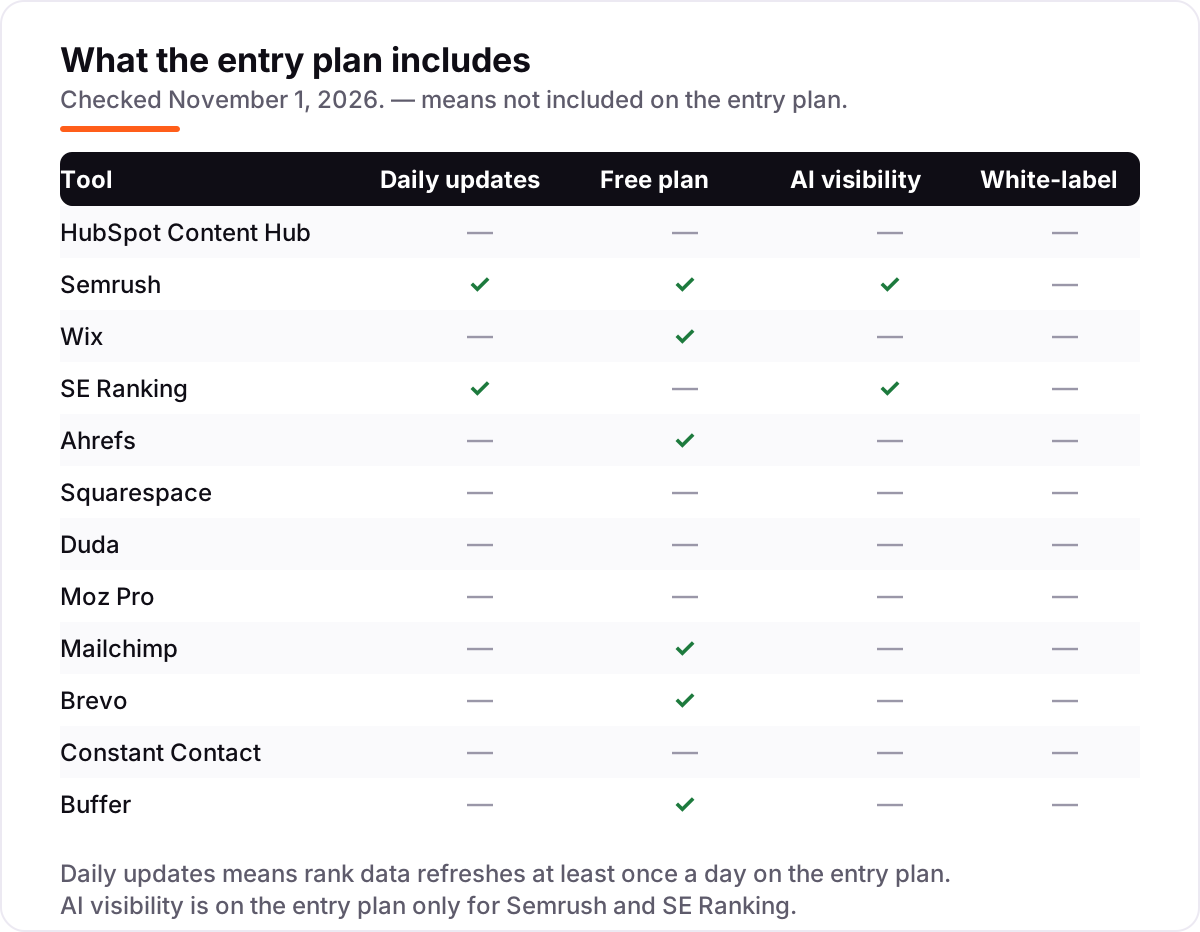
The hub trade-off is depth. None of these four tracks keyword rankings daily, and only HubSpot's higher tiers track AI visibility at all. If your site already ranks and you need to convert the traffic, a hub is the right buy. If the site does not rank yet, pair a hub with one of the SEO suites below, or pick a suite that covers the basics itself.
Dedicated SEO suites in the best marketing platforms for small business seo
The suites — Semrush, SE Ranking, Ahrefs and Moz Pro — are the research engines of this list. They track where your pages rank, find the keywords worth targeting, audit the site for technical problems and show who links to you. Semrush is the deepest, with a keyword database of more than 27 billion keywords and AI visibility reports on the entry plan. SE Ranking is the best value: 2,000 keywords tracked daily plus AI visibility across five engines for $103.20 a month billed annually. Ahrefs has the strongest backlink data but updates weekly by default, and Moz Pro is the friendliest suite to learn, with the Domain Authority scores clients already ask for by name.
The suite trade-off is price and time. These tools cost $29 to $140 a month, and they only pay off if somebody actually opens them weekly. A suite you never log into is the most expensive subscription you own. If you hire an agency, check what they already use first — paying for a suite your agency also pays for is paying twice for the same data.
Website builders in the best marketing platforms for small business seo
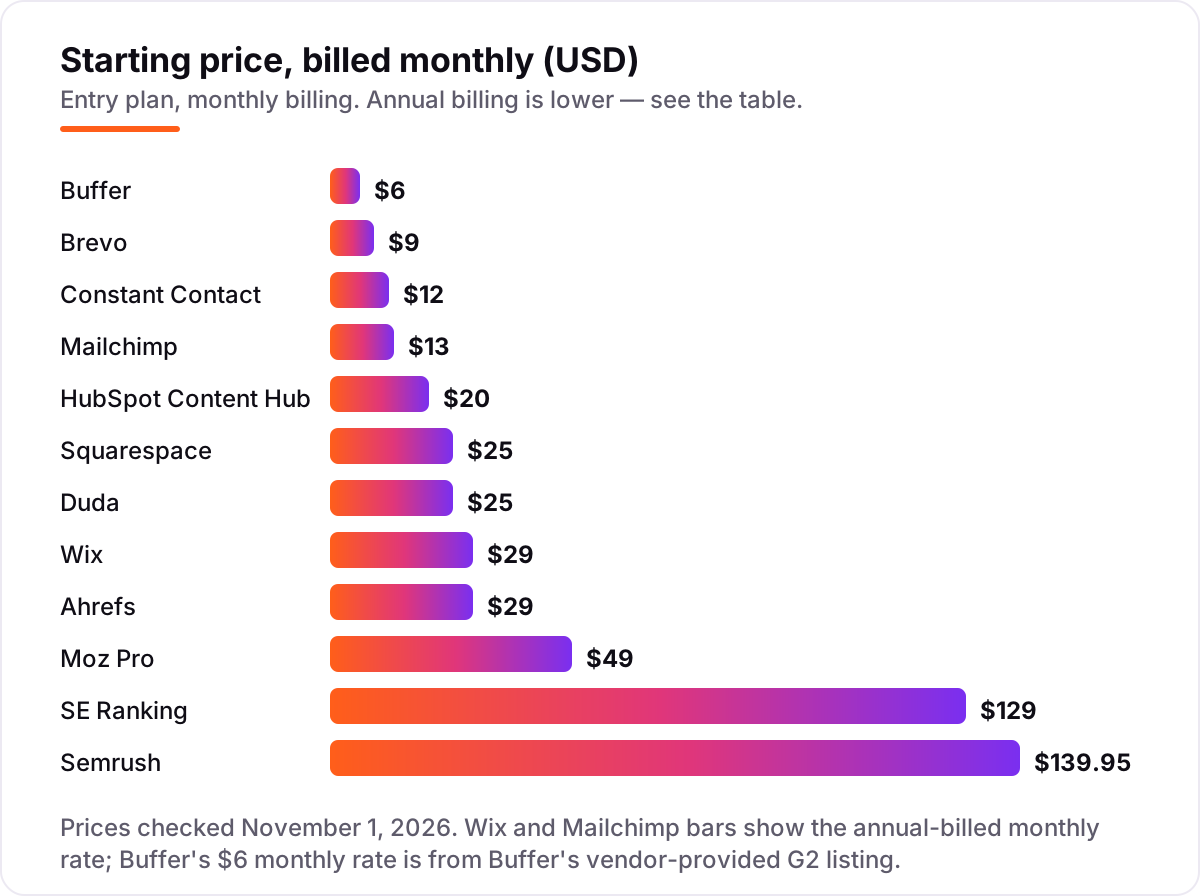
The builders — Wix, Squarespace and Duda — are for the business with no site yet, or a site that needs replacing. They bundle hosting, templates, SEO settings and analytics for $25 to $29 a month, which is less than hosting alone used to cost. Wix is the easiest to start with and has the most built-in marketing tools; Squarespace produces the best-looking sites; Duda is the fastest and the highest-rated on G2, at 4.6 out of 5, and is built for people who make sites for clients.
The builder trade-off is SEO ceiling. The SEO tools are solid but basic: titles, descriptions, sitemaps and simple analytics, not rank tracking or keyword research. A builder gets you indexed and looking professional, and that is enough for many local businesses. When the site starts competing for valuable keywords, add one of the suites above rather than expecting the builder to do research it was never built for. Our guide to the best blogging platform for SEO compares the builders in more depth.
Social scheduling in the best marketing platforms for small business seo
Buffer is the only pure distribution tool in this list, and it earns its place because publishing is where most small-business SEO plans quietly fail. A blog post that is never shared gets no links, no traffic and no signal that it exists. Buffer schedules the post to every channel from one queue, at $6 a channel a month, with a free plan covering three channels. It is the cheapest add-on here, and the only one that does nothing but distribute.
Do not mistake it for an SEO platform. Buffer has no rank tracking, no keyword data and no site audit, and its analytics on the lower tiers are thin. It belongs after the website and the suite are in place, as the tool that makes sure the content you worked hard to rank actually gets seen. If you only buy one tool from this list, it should not be Buffer.
Website builder vs SEO suite in the best marketing platforms for small business seo
The biggest confusion in this category is mistaking a website builder for an SEO platform. A builder gives you pages that can rank; a suite tells you which pages to build and whether they are moving. Wix can set your title tags, but it cannot tell you that your competitor ranks for "emergency plumber Denver" with a page you do not have. Semrush can tell you that, but it cannot build the page. HubSpot sits in between: it builds the page and gives basic SEO recommendations, but it does not track rankings daily.
The practical split is simple. If you have no website, start with a builder. If you have a website and it is not bringing in customers, start with a suite. If you have both and still lose customers after they visit, add a hub for the follow-up. Most small businesses end up with two of the three — a builder plus a suite, or a hub plus a suite — and that is cheaper than buying the wrong one twice.
Quick comparison: tool type by need
| Buyer | Best pick | Why |
|---|---|---|
| One login for website, content and CRM | HubSpot Content Hub | Everything shares one database from $20/month per seat |
| Deepest SEO research and AI visibility | Semrush | 27-billion-keyword database and daily tracking from $139.95/month |
| Best-value SEO suite | SE Ranking | 2,000 keywords a day plus AI visibility from $103.20/month |
| First website, no developer | Wix | Builder, blog and SEO basics from $29/month billed annually |
| Design-led website | Squarespace or Duda | Polished templates from $25/month; Duda is the highest-rated builder here |
| Cheapest email follow-up | Brevo | $9/month with no per-contact price rises |
| Simple social scheduling | Buffer | $6/month per channel with a usable free plan |
How to choose the best marketing platforms for small business seo: a short decision path
- Start from what you already have. No website: pick a builder first. Have a website but no traffic: pick a suite. Have traffic but no repeat customers: pick a hub.
- Count the real price, not the headline. HubSpot charges per seat, Mailchimp and Constant Contact charge per contact, Buffer charges per channel. Multiply the headline price by your seats, contacts or channels before comparing.
- Check what is actually included on the entry plan. Rank tracking starts at Moz Pro Standard, not Starter; AI visibility starts at Semrush Starter for prompts, not the SEO plan; automation starts at Mailchimp Standard, not Essentials.
- Try before you pay. Every tool in this list has a free plan or a free trial. Run your real website and your real contact list for a week and check the numbers against Search Console before committing.
- Buy the workflow, not the feature list. The best platform is the one somebody on your team will open every week. A $9 tool used daily beats a $140 tool that nobody logs into.
Before you publish new pages for the keywords you target, run your titles through the free SERP snippet preview tool — it shows exactly how the title and description will look in Google.
Mistakes to avoid with the best marketing platforms for small business seo
- Comparing monthly prices without checking billing. The annual price is usually 10–20% lower, and a few tools publish no monthly price at all — Wix and Mailchimp only show the annual-billed monthly rate.
- Ignoring what the price is per. A $20 HubSpot seat, a $13 Mailchimp contact tier and a $6 Buffer channel are three different units. The same business can pay $20 or $120 depending on which unit it counts.
- Paying for a suite when you only need a website. A $25 builder covers a brochure site; a $140 suite you never open is the most expensive subscription you own.
- Trusting a directory price. G2 still shows old plan names and prices for several tools here, including Squarespace's retired Personal plan. Always check the vendor's own pricing page.
- Forgetting the trial ends. Set a reminder for the day the trial converts, and check the numbers against our monthly SEO service benchmarks so you know what the tool should be showing.
How we chose the best marketing platforms for small business seo
We checked each vendor's own pricing page on November 1, 2026 and recorded the starting price exactly as shown, including the annual-billing figure where the page lists one, and every rating comes from the G2 page we opened the same day. Three prices need a note: Wix's pricing page failed to load its plan table on the day, so the Core $29 a month figure is the published annual-billed rate and Wix publishes no monthly-billing price; Mailchimp's $13 is likewise the annual-billed monthly rate for Essentials; and Buffer's $6 monthly rate comes from Buffer's vendor-provided G2 listing, while Buffer's own page leads with the $5 annual-billed rate. The Moz Pro pricing page was blocked by our page fetcher, so the $49 Starter price rests on the October 31 live check and cross-checks against G2's vendor-provided listing, which also shows $49. We ranked the tools by fit for the most common buyer — a small-business owner doing their own marketing — not by brand size. No vendor paid for a place in this list, and none of the links here are affiliate links.
What to do next with the best marketing platforms for small business seo
Start with the decision path above: check what you already have, count the real price per seat, contact or channel, and try the free plan or trial of your top pick for a week. Run your real website and contact list through it, and compare the numbers against Search Console. If you'd rather have this set up and read for you, request a free SEO + AI visibility audit and get a ranked fix list in 2 business days.
Rather not run the tools yourself?
Tools show you the data. SerpAstra turns it into higher rankings, more map-pack calls and citations in AI answers.
Get a free SEO + AI visibility audit→Sources we checked (25)
- HubSpot Content Hub pricing — hubspot.com/pricing/marketing/content-hub (checked November 1, 2026)
- HubSpot Content Hub on G2 — 4.5/5, 2,205 reviews (checked November 1, 2026)
- Semrush pricing — semrush.com/prices (checked November 1, 2026)
- Semrush on G2 — 4.4/5, 4,304 reviews (checked November 1, 2026)
- Wix pricing — wix.com/pricing (checked November 1, 2026)
- Wix on G2 — 4.2/5, 1,910 reviews (checked November 1, 2026)
- SE Ranking pricing — seranking.com/subscription.html (checked November 1, 2026)
- SE Ranking on G2 — 4.7/5, 1,619 reviews (checked November 1, 2026)
- Ahrefs pricing — ahrefs.com/pricing (checked November 1, 2026)
- Ahrefs on G2 — 4.5/5, 723 reviews (checked November 1, 2026)
- Squarespace pricing — squarespace.com/pricing (checked November 1, 2026)
- Squarespace on G2 — 4.4/5, 1,137 reviews (checked November 1, 2026)
- Duda pricing — duda.co/pricing (checked November 1, 2026)
- Duda on G2 — 4.6/5, 794 reviews (checked November 1, 2026)
- Moz Pro pricing — moz.com/products/pro/pricing (checked November 1, 2026)
- Moz Pro on G2 — 4.3/5, 608 reviews (checked November 1, 2026)
- Mailchimp pricing — mailchimp.com/pricing (checked November 1, 2026)
- Mailchimp on G2 — 4.3/5, 12,997 reviews (checked November 1, 2026)
- Brevo pricing — brevo.com/pricing (checked November 1, 2026)
- Brevo on G2 — 4.5/5, 2,776 reviews (checked November 1, 2026)
- Constant Contact pricing — constantcontact.com/pricing (checked November 1, 2026)
- Constant Contact on G2 — 4.1/5, 7,625 reviews (checked November 1, 2026)
- Buffer pricing — buffer.com/pricing (checked November 1, 2026)
- Buffer on G2 — 4.3/5, 1,042 reviews (checked November 1, 2026)
- BrightEdge channel research — 53% of trackable website traffic from organic search (via SearchLab SEO Statistics 2026)
Shamim
Founder of SerpAstra
A full-stack SEO and digital marketer who spends most days on Local SEO for dental practices, AI search visibility and lead generation.
Frequently asked questions
What is the best marketing platform for small business SEO in 2026?
HubSpot Content Hub is the best all-rounder for most small businesses: website, blog, email and CRM with SEO guidance from $20/month per seat. If you need the deepest SEO data, Semrush at $139.95/month is the stronger pick, and SE Ranking at $103.20/month billed annually is the best value.
How much does a marketing platform for small business SEO cost?
Between $6 and $140 a month at the entry level. Buffer starts at $6 per channel, Brevo at $9, and the website builders at $25–$29. The SEO suites cost more: Ahrefs Starter is $29, Moz Pro is $49, SE Ranking is $103.20 billed annually, and Semrush is $139.95.
Is there a free marketing platform for small business SEO?
Yes, with limits. Wix, Mailchimp, Brevo and Buffer all have free plans, and Semrush and Ahrefs have free accounts for site owners. Free plans work for a single small site; once you need a custom domain, daily rank tracking or automation, a paid plan is cheaper than the time you lose.
Do I need a website builder or an SEO suite?
A website builder if you have no site yet: Wix, Squarespace or Duda give you the site plus the SEO basics for $25–$29 a month. An SEO suite if you already have a site and need to grow it: Semrush, SE Ranking, Ahrefs or Moz Pro track rankings and find the keywords worth targeting.
Can these platforms track AI visibility, like ChatGPT?
Only two entry plans here can. SE Ranking includes 25 AI prompts a day across five engines on Core, and Semrush includes AI visibility reports on its SEO plan. HubSpot adds AI visibility tracking on its Professional tiers. The website builders and email tools in this list do not track AI visibility at all.
What should I check before paying for a marketing platform?
Four things: whether the price is monthly or annual billing, whether it is per seat, per contact or per channel, whether rank tracking and AI visibility are included or paid extras, and whether there is a free plan or trial. All four vary widely — the comparison table at the top shows the starting price and free plan for each tool.
Free SEO and AI visibility audit
Find out what is holding your rankings back
Send us your site. Within 2 business days you get a written audit, an AI visibility check and a short fix list ranked by impact. Free, with no contract attached.
Request my free audit→Related guides
 SEO & AI Search12 Best Blogging Platforms for SEO in 2026 (Pros, Cons and Pricing)Compare the best blogging platform for SEO for your budget: 12 platforms ranked on price, SEO controls and ownership, from free WordPress to Ghost and Webflow.Read guide →
 SEO & AI SearchBest CMS for SEO in 2026: 8 Options Ranked and Reviewed8 best CMS for SEO compared with real 2026 prices, free plans and SEO controls. WordPress, Webflow, Shopify and more, ranked by fit for a small business site.Read guide →
 MarketingMarketing automation for small businesses: what to automate (and what not to)Marketing automation for small businesses, explained: what to automate first, what to keep human, and the tools that save hours without losing customers.Read guide →