
8 Best Accounting Software for 1099 Contractors in 2026, Compared
Compare the 8 best accounting software for 1099 contractors on price, mileage, tax estimates and 1099 filing, with every price checked November 7, 2026.
 Shamim Mia, Founder, SerpAstraLast verified November 7, 202614 min read
We compare pricing pages, documentation and public reviews. We never accept payment for rankings.

Key takeaways
- QuickBooks Solopreneur is the best fit for most 1099 contractors at $20/month, with mileage and quarterly tax estimates built in; Wave is free and FreshBooks follows at $23/month for invoice-heavy work.
- The cheapest working setup is Wave Starter at $0 plus Hurdlr Premium at $9.99/month — about $100 a year for a ledger and automatic mileage.
- The single most important buying factor is whether the tool handles the tax side — mileage capture, quarterly estimates and 1099 filing — not just invoicing, because that is where contractors lose money.
- Hurdlr and Keeper are tax sidekicks, not full ledgers: pair Hurdlr with a free ledger, or use Keeper Standard at $199 a year when you want deductions found and the return filed in one place.
On this page
Quick comparison
| Tool | Best for | Starting price | Free plan |
|---|---|---|---|
| QuickBooks Solopreneur | One-person businesses that want mileage and quarterly tax estimates handled automatically | $20/mo | Yes (Free plan) |
| FreshBooks | Contractors who invoice clients constantly and want billing to be painless | $23/mo | No (30-day trial) |
| Wave | Contractors who want real double-entry accounting free, with no invoice or revenue caps | Free; Pro $19/mo | Yes (free) |
| Xero | Contractors whose books are getting complicated, with several clients and a part-time bookkeeper | $27/mo | No (30-day trial) |
| Zoho Books | Contractors on tight budgets who want a genuinely free ledger while revenue stays under $50,000 | $15/mo (annual) | Yes (free plan) |
| Hurdlr | Contractors who drive for work and want mileage and deductions captured automatically | $9.99/mo | Yes (free basic) |
| Keeper | 1099 workers who want deductions found all year and the return filed in the same place | $16.58/mo (annual) | No (14-day trial) |
| Bonsai | Freelancers who want proposals, contracts, time tracking and accounting in one subscription | $15/user/mo | No (7-day trial) |
Make one of these tools?
We re-check this list every quarter. Send a correction, request a review, or ask about a clearly labeled sponsored spot.
Request a listingThe best accounting software for 1099 contractors

QuickBooks Solopreneur
Best for: One-person businesses that want mileage and quarterly tax estimates handled automatically
QuickBooks Solopreneur is the safe default for a 1099 contractor because Intuit built it for the one-person business: connect bank accounts, tag business versus personal spending, track mileage automatically from your phone, and get quarterly estimated tax figures without a spreadsheet. The $20 a month price is straightforward, with a 30-day trial to test the bank connections, and the plan covers up to three contractors if you pay help.
The limitation is the ceiling: there is one plan, so a contractor who hires help or adds partners eventually needs to move to QuickBooks Online, and there is no accountant access on this plan. The free tier is very limited at two invoices a month. For a true solo 1099 worker who wants the least thinking about taxes, it is the easiest yes on this list.
What we like
- Automatic mileage tracking from your phone, with no manual trip log to keep
- Quarterly estimated tax figures are calculated for you, so April holds no surprise
- Separates business and personal spending cleanly for a Schedule C return
- Exports flow into TurboTax, which many contractors already use at tax time
Watch out for
- Single plan with no room to grow into multi-user books — growing means migrating to QuickBooks Online
- No accountant access on the Solopreneur plan, so your accountant cannot work in the same books
- Pricier than the free alternatives for a contractor who only needs a basic ledger

FreshBooks
Best for: Contractors who invoice clients constantly and want billing to be painless
FreshBooks wins contractors who live on invoices. Creating, sending and chasing invoices takes minutes, with automatic payment reminders and client-friendly online payment options. Expenses attach to projects, receipts scan from the phone, and the reports read clearly without accounting training. Lite at $23 a month covers a solo contractor with a modest client list, and time tracking is included on every plan.
The client cap is the catch: Lite covers only five billable clients, so a sixth client moves you to Plus at $43 a month, and every extra team member costs $11 a month on top. There is no mileage tracking and no quarterly tax estimates, so drivers and the tax-anxious pair it with Hurdlr or Keeper. Pick FreshBooks when invoicing is the job; pick QuickBooks Solopreneur when taxes and mileage matter more.
What we like
- The easiest invoicing in this list: clean invoices, estimates, recurring billing and payment reminders
- Time tracking and expense tracking built in, so billable hours flow straight onto invoices
- Plus adds double-entry reports, bank reconciliation and free accountant access for $43/month
- Rated the easiest tool here to set up, with support reviewers praise most
Watch out for
- Lite covers only 5 billable clients — a sixth client forces Plus at $43/month
- Every extra team member costs $11/month on top of the plan price
- No mileage tracking and no quarterly tax estimates built in

Wave
Best for: Contractors who want real double-entry accounting free, with no invoice or revenue caps
Wave is the only real accounting tool here that starts at $0. The free Starter plan covers accounting, invoicing and receipt scanning, which handles the core 1099 workflow: record income per client, log deductible expenses, and generate the reports your tax preparer wants. For a contractor watching every dollar, that is hard to beat, and there is no revenue cap or invoice cap to outgrow.
Pro at $19 a month, or $190 a year, adds automatic bank imports, unlimited users and live support — the automation that makes the books sustainable past fifty transactions a month. The gaps are mileage tracking and built-in quarterly tax estimates, so drivers and the tax-anxious need a companion app. As a free ledger, though, nothing else here competes.
What we like
- The only genuinely free full ledger here: unlimited invoices, bills and bookkeeping records at $0 with no revenue cap
- Pro is a single $19/month upgrade that adds automatic bank imports, receipt scanning and unlimited users
- Payments and payroll are pay-as-you-go add-ons, so a contractor who only invoices pays nothing at all
- Simple enough for an owner with no accounting background to run the books alone
Watch out for
- Automatic bank imports, receipt scanning and extra users all need Pro at $19/month — Starter means manual entry
- No mileage tracking and no quarterly tax estimates at any price
- US and Canada only, and support on the free plan is limited to help articles and community answers
Xero
Best for: Contractors whose books are getting complicated, with several clients and a part-time bookkeeper
Xero is the pick for contractors whose books are getting complicated. When one client pays in euros, another needs project tracking, and the expense list runs long, Xero's reconciliation and integration depth earns its price. The dashboard shows cash flow clearly, and the app ecosystem covers payroll, payments and reporting add-ons. Early at $27 a month includes W-9 and 1099 management, so paying subcontractors stays in the same books.
Early caps monthly invoices at twenty and bills at five, so high-volume contractors need the $59 Growing plan, and there is no built-in mileage tracker or contractor-specific tax workflow — which is why QuickBooks Solopreneur beats it for simple solo cases. For the contractor outgrowing simple tools, Xero is the natural next step.
What we like
- Unlimited users on every plan, including Early at $27/month — no per-seat fees at any tier
- Bank reconciliation and Hubdoc receipt capture included from the entry plan
- More than 1,000 app integrations, the widest marketplace in this list
- Early includes W-9 and 1099 management, so paying subcontractors stays in the same books
Watch out for
- Early caps at 20 invoices and 5 bills a month — most active contractors need Growing at $59/month
- No mileage tracking and no contractor-specific tax workflow built in
- No native US payroll; payroll comes through Gusto at $36/month plus $6 per person paid

Zoho Books
Best for: Contractors on tight budgets who want a genuinely free ledger while revenue stays under $50,000
Zoho Books is the value play for contractors already in the Zoho world. Businesses under $50,000 in annual revenue use the core accounting free, which covers invoicing, expenses, bank reconciliation and tax reports. Paid Standard starts at $20 a month, or $15 on annual billing, and lifts the limits to three users and 5,000 invoices a year. The fit is best for contractors who also use Zoho CRM or Zoho Invoice, since the data flows between them.
The free plan stops at 1,000 invoices a year, and a contractor earning over $50,000 must move to a paid plan, so most full-time contractors pay Standard at $20 a month. US-specific tax workflows are thinner than QuickBooks, and mileage tracking is basic. For a solo contractor under the revenue threshold who wants a ledger for nothing, it deserves a look alongside Wave.
What we like
- A real free plan: full double-entry accounting, invoicing and bank reconciliation at $0 while revenue stays under $50,000 a year
- Cheapest paid step up here — Standard is $20/month for 3 users and 5,000 invoices a year
- Deep Zoho ecosystem: CRM, Inventory, Expense and Payroll connect without third-party tools
- Client portal and payment reminders included, so clients can pay from the invoice itself
Watch out for
- Free plan stops at 1,000 invoices a year and only while annual revenue stays under $50,000
- Multi-currency and inventory wait for Professional at $50/month, and there is no payroll module on any plan
- No mileage tracking and US tax workflows are thinner than QuickBooks Solopreneur

Hurdlr
Best for: Contractors who drive for work and want mileage and deductions captured automatically
Hurdlr is not full accounting software, and that is the appeal. It does three things for 1099 contractors: automatic mileage tracking, expense capture, and live estimates of what you owe each quarter. For rideshare drivers, delivery contractors and traveling freelancers, the mileage log alone can pay for the subscription in deductions. Premium at $9.99 a month adds the deduction finder and tax features, with a free basic plan for trying the core.
Think of Hurdlr as the tax sidekick to a ledger like Wave or QuickBooks: it finds the write-offs and estimates the quarterly payments, while the accounting tool keeps the books. Paired with a free ledger, the combo costs under $10 a month. The catch is the price itself — Hurdlr publishes no prices on its own pricing page, so the $9.99 figure comes from the App Store listing.
What we like
- Automatic mileage tracking that runs in the background while you drive
- Real-time tax estimates for quarterly payments, with reminders of when to pay
- Expense capture tuned for freelancers, with automatic deduction finding
- A free basic plan covers manual tracking, so you can try the core before paying
Watch out for
- Not full accounting software, so most users pair it with a ledger like Wave or QuickBooks
- Full automation needs Premium — the free plan means manual mileage and expense entry
- The $9.99 price is not published on Hurdlr's own pricing page; it comes from the App Store listing

Keeper
Best for: 1099 workers who want deductions found all year and the return filed in the same place
Keeper is built for the 1099 worker who hates tax season. Connect your bank accounts and cards, and its AI flags likely business deductions transaction by transaction, in a chat-style interface where you accept or reject each suggestion. Standard at $199 a year adds federal and state e-filing, reviewed and signed by a tax professional, plus quarterly tax estimates that run all year. Gig workers will like the connections to Uber, DoorDash, Stripe and PayPal.
The trade-off is the shape of the bill: filing plans are annual only, so Standard means $199 paid upfront, and the $20-a-month Bookkeeping Only plan files nothing. There is no mileage tracking, so drivers still need Hurdlr or a mileage app beside it. And the AI still needs you — every flagged deduction wants your review before it goes on a return.
What we like
- AI scans bank and card transactions and flags likely business deductions as you spend
- Standard includes year-round bookkeeping plus federal and state e-filing in one price
- Quarterly tax estimates run all year, so the April bill never arrives as a surprise
- Connects to gig platforms and payment apps, from Uber and DoorDash to Stripe and PayPal
Watch out for
- Filing plans are annual only — Standard is $199 a year paid upfront, with no monthly billing
- Bookkeeping Only at $20 a month does not include filing at all
- No mileage tracking, so drivers still need a separate mileage app

Bonsai
Best for: Freelancers who want proposals, contracts, time tracking and accounting in one subscription
Bonsai is the all-in-one for freelancers who sell their time. Proposals, contracts, time tracking, invoicing and payments live in one subscription, with unlimited clients and projects on every plan and a client portal for approvals and signatures. Basic costs $15 per user a month, or $9 billed annually, and the 7-day trial is long enough to send a real proposal through it. For a contractor whose money work starts with winning the job, that combination is the point.
The catch is the tier split: invoicing, proposals and payments start on Essentials at $25 per user a month, not on Basic, so the plan a contractor needs costs $10 more. Per-user pricing means a second seat doubles the bill, and there is no mileage tracking or tax filing — the tax side still needs QuickBooks Solopreneur, Keeper or Hurdlr beside it.
What we like
- Proposals, contracts, invoicing and time tracking in one place, built for freelancers
- Unlimited clients and projects on every plan, including Basic at $15/user/month
- Client portal, scheduling and expense tracking arrive on Essentials at $25/user/month
- Income and expense tracking keeps the books next to the client work, not in a second app
Watch out for
- Invoicing, proposals and payments start on Essentials at $25/user/month, not on Basic at $15
- Per-user pricing — a second seat doubles the bill for a two-person practice
- No mileage tracking and no tax filing, so the tax side still needs another tool
A 1099 contractor gets no withholding, no employer tax filings and no benefits admin — the software has to cover that gap. The best accounting software for 1099 contractors tracks income across clients, captures mileage and expenses for Schedule C deductions, estimates quarterly taxes, and ideally helps with 1099-NEC filing. We ranked the eight tools below by fit for the most common buyer — a solo US contractor doing their own books — and every price was checked on November 7, 2026.
How to choose the best accounting software for 1099 contractors
- Count your clients first. FreshBooks Lite stops at 5 billable clients and Xero Early at 20 invoices a month, so a contractor with 14 clients needs FreshBooks Plus or a tool without a client cap.
- Check the mileage question. Only QuickBooks Solopreneur and Hurdlr track mileage automatically. If you drive for work, that one feature decides the shortlist.
- Decide how much tax help you want. QuickBooks Solopreneur and Keeper estimate quarterly taxes; Hurdlr does too. Wave, Xero and Zoho Books keep the books and leave the tax math to you.
- Check the free plan's ceiling. Wave Starter has no revenue cap, Zoho Books Free stops when revenue passes $50,000, and QuickBooks Free stops at 2 invoices a month.
- Think about who else touches the books. Xero, Wave Pro and Zoho Books include extra users or an accountant seat; QuickBooks Solopreneur has no accountant access at all.
Accounting is one system in your stack, not the whole stack. If the business also needs to be found online, our guide to invoicing software for small business covers the billing side, and the tax preparation software guide covers filing season. And before you publish new pages for the services you sell, run your titles through the free SERP snippet preview tool — it shows exactly how the title and description will look in Google.
Whatever you shortlist, try it with real data before you pay. The free plans and trials in this list are long enough to run one genuine month — your invoices, your bank feed, your clients — and that month tells you more than any review can. Check two things in the trial: that the bank feed reconciles without daily fixing, and that the mileage log captures every trip without you remembering to start it. Every tool here except QuickBooks Solopreneur gives your accountant access at no extra charge, so there is no reason to buy before they have looked at it.
Accounting software for 1099 contractors pricing: what you will actually pay
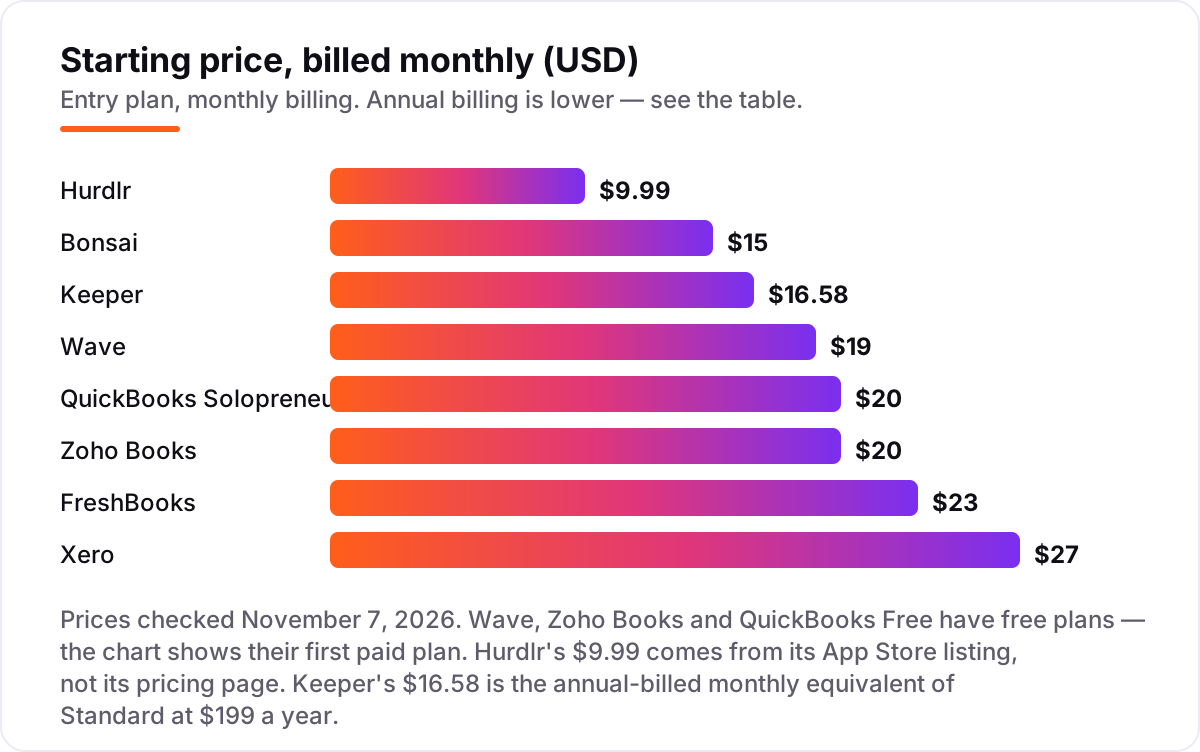
Take a contractor earning $80,000 across 14 clients who drives 12,000 business miles a year. On list prices, the subscription costs $0 a year on Wave Starter, $99.99 on Hurdlr Premium billed annually, $180 on Zoho Books Standard billed annually, $199 on Keeper Standard, $228 on Bonsai Essentials billed annually, $240 on QuickBooks Solopreneur, $324 on Xero Early and $516 on FreshBooks Plus. Two of those numbers need adjusting before they are real: FreshBooks Lite at $23 a month covers only 5 billable clients, so 14 clients means Plus at $43 a month, and Zoho Books Free stops at $50,000 of revenue, so an $80,000 contractor pays Standard.
Over a year, the cheapest working setup is Wave Starter at $0 plus Hurdlr Premium at $99.99 a year — about $100 for a ledger and automatic mileage. The same contractor and the same 14 clients cost $199 a year on Keeper Standard, $240 on QuickBooks Solopreneur, $324 on Xero Early and $516 on FreshBooks Plus. The $416 gap between the cheapest setup and FreshBooks Plus comes entirely from the client cap and the missing mileage, not from features.
Three costs sit outside every number above. First, the introductory discounts — 50% off for three months on QuickBooks Solopreneur, 80% off for three months on Xero and 80% off for four months on FreshBooks — end, so budget on the list price. Second, card processing on the invoices you send, which is charged per transaction rather than per month. Third, tax filing itself: Keeper Standard includes federal and state e-filing in its $199, while every other tool here leaves filing to you or your accountant. If you run a general small business rather than a solo contracting practice, the comparison shifts — see our guide to the best accounting software for small businesses.
Annual billing cuts the bill on most tools here: Zoho Books Standard drops from $240 to $180 a year, Wave Pro from $228 to $190, Bonsai Essentials from $300 to $228, and FreshBooks takes 10% off. Xero publishes no annual price, so the monthly figure is the whole story. One more cost to check before you commit: a second business is a second subscription on every tool in this list, and Bonsai charges per user, so a second seat doubles its bill.
Know the difference: a ledger vs a tax sidekick
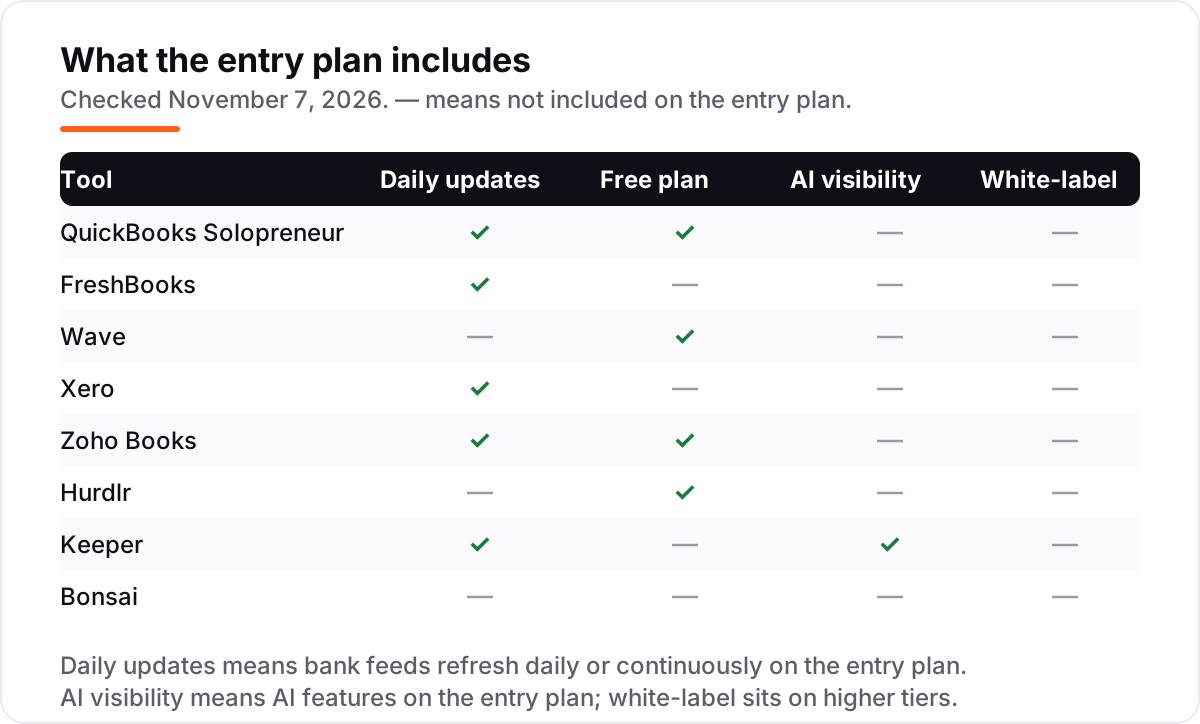
The confusion in this category is between a tool that keeps the books and a tool that handles the tax side. A full ledger — Wave, Xero, Zoho Books, FreshBooks and QuickBooks Solopreneur — records income and expenses, reconciles the bank and produces the reports a tax return needs. A tax sidekick — Hurdlr and Keeper — finds deductions, estimates quarterly taxes and helps with filing, but it is not a full ledger: Hurdlr has no double-entry books, and Keeper has no invoicing.
That split decides the buy. A sidekick alone is not a set of books, and a ledger alone may not estimate your quarterly taxes. The two working combinations are a free ledger plus Hurdlr — Wave Starter at $0 with Hurdlr Premium at $9.99 a month — or one tool that covers both sides, like QuickBooks Solopreneur at $20 a month or Keeper Standard at $199 a year. Hurdlr says its users find over $5,600 in deductions on average, which is the sidekick's whole pitch: it pays for itself in write-offs the ledger alone would never surface.
There is a second, quieter confusion: invoicing tools are not accounting software. An invoicing tool sends bills and tracks payments; it does not keep a double-entry ledger, produce a balance sheet, or give your accountant a tax-ready set of books. All five ledgers in this list are full double-entry books, including the free ones, which is what the phrase "accounting software" means here. If a tool only invoices, it belongs in a different list.
A third distinction worth knowing is the 1099 you receive versus the 1099s you send. As a contractor you receive a 1099-NEC from each client that paid you $600 or more; the software's job is to track that income per client so the numbers match. If you also pay subcontractors, you owe them 1099-NECs too — Xero Early includes W-9 and 1099 management, QuickBooks Solopreneur covers up to three contractors, and every other tool here leaves that job to a filing service or your accountant.
Quick comparison: tool type by need
| Buyer | Best pick | Why |
|---|---|---|
| Solo contractor who drives a lot | QuickBooks Solopreneur | Mileage and quarterly tax estimates in one plan, $20/month |
| Contractor on a $0 budget | Wave | Free Starter ledger; add Hurdlr Premium at $9.99/month for mileage |
| Contractor who lives on invoices | FreshBooks | Invoicing-first design, Lite is $23/month for 5 clients |
| Contractor with complicated books | Xero | Unlimited users and W-9/1099 management, Early is $27/month |
| Contractor under $50,000 revenue | Zoho Books | Free plan, Standard is $20/month above the threshold |
| Contractor who wants filing done | Keeper | Deductions found and the return filed, Standard is $199/year |
Mistakes to avoid
- Budgeting on the promo price. The 50% and 80% introductory discounts in this list last three to four months. The list price is what you pay in month five, so compare tools on that number.
- Buying on the free plan, then finding the bank feed costs extra. Wave Starter is free, but automatic bank imports need Pro at $19 a month. If you process more than fifty transactions a month, count Pro in the price from day one.
- Ignoring the cap that bites first. A tool can be cheap and still be the wrong buy: FreshBooks Lite at $23 is no bargain once you pass 5 clients, Xero Early at $27 is no bargain once you pass 20 invoices a month, and Zoho Books Free ends at $50,000 of revenue.
- Treating a tax app as a full ledger. Hurdlr and Keeper find deductions and estimate taxes, but neither keeps double-entry books or sends invoices. Pair them with a ledger, or the books will not balance at year-end.
- Forgetting quarterly estimated taxes. Nothing is withheld from 1099 income, so the tax bill arrives in four instalments through the year, plus penalties if you underpay. A tool that estimates them — Solopreneur, Keeper or Hurdlr — pays for itself the first April.
How we chose
We checked each vendor's own pricing page on November 7, 2026 and recorded the starting price exactly as shown, including the annual-billing figure where the page lists one, and we ranked the tools by fit for the most common buyer — a solo 1099 contractor doing their own books — not by brand size. Two exceptions are disclosed plainly: Hurdlr publishes no prices on its own pricing page, so its $9.99 Premium price comes from its App Store listing rather than a vendor page, and QuickBooks Solopreneur carries no review rating because we could not verify a current G2 or Capterra page for it today, so we show no rating rather than a stale or estimated one. Ratings for the other seven tools come from fresh copies of their G2 pages, except Keeper, whose rating comes from Trustpilot. No vendor paid for a place in this list, and none of the links here are affiliate links.
What to do next
Start with the free plan or trial of your top pick and run one real month of invoices through it. Check that the bank feed reconciles, the mileage log captures every trip, and the quarterly estimate looks sane before you commit to a year. If the books are sorted but new customers are not finding you, our monthly SEO service handles the visibility side — or compare providers in our guide to SEO companies for small business. Once your tools are in place, find out what's holding your rankings back.
Your stack only works if people find you
SerpAstra fixes what keeps your site off page one and makes it easy for AI assistants to recommend.
Get a free audit→Sources we checked (16)
- QuickBooks Solopreneur pricing — quickbooks.intuit.com/pricing (checked November 7, 2026)
- FreshBooks pricing — freshbooks.com/pricing (checked November 7, 2026)
- Wave pricing — waveapps.com/pricing (checked November 7, 2026)
- Xero pricing — xero.com/us/pricing-plans (checked November 7, 2026)
- Zoho Books pricing — zoho.com/us/books/pricing (checked November 7, 2026)
- Hurdlr pricing — hurdlr.com/pricing (checked November 7, 2026; page lists no prices)
- Hurdlr Premium price — App Store listing via appstor.io (checked November 7, 2026)
- Keeper pricing — keepertax.com/pricing (checked November 7, 2026)
- Bonsai pricing — hellobonsai.com/pricing (checked November 7, 2026)
- FreshBooks reviews — g2.com (checked November 7, 2026)
- Wave reviews — g2.com (checked November 7, 2026)
- Xero reviews — g2.com (checked November 7, 2026)
- Zoho Books reviews — g2.com (checked November 7, 2026)
- Hurdlr reviews — g2.com (checked November 7, 2026)
- Keeper reviews — trustpilot.com/review/keepertax.com (checked November 7, 2026)
- Bonsai reviews — g2.com (checked November 7, 2026)
Shamim
Founder of SerpAstra
A full-stack SEO and digital marketer who spends most days on Local SEO for dental practices, AI search visibility and lead generation.
Frequently asked questions
What is the best accounting software for 1099 contractors?
QuickBooks Solopreneur is the best fit for most 1099 contractors: mileage tracking and quarterly tax estimates built in, from $20/month. Wave is the best free option, with a real double-entry ledger at $0. FreshBooks is the better pick when invoicing dominates the work, and Keeper is the pick when you want the return filed in the same place.
How much does accounting software for 1099 contractors cost?
Entry prices run from $0 to $27 a month. Wave Starter and Zoho Books Free cost nothing, Hurdlr Premium is $9.99 a month, and the first paid ledgers cost $15 to $27 a month. A solo contractor typically pays $100 to $516 a year for the subscription alone, before payroll and card processing fees.
Is there really free accounting software for 1099 contractors?
Yes, with limits. Wave Starter is free with unlimited invoices and no revenue cap, but bank feeds need the $19/month Pro plan. Zoho Books is free while annual revenue stays under $50,000, capped at 1,000 invoices a year. Hurdlr's free basic plan covers manual mileage and expense tracking.
What is the difference between accounting software and a tax app?
Accounting software keeps the double-entry ledger — invoices, bills, bank feeds and reports. A tax app like Hurdlr or Keeper finds deductions, estimates quarterly taxes and helps with filing, but it is not a full ledger. Most contractors need one of each, or one tool like QuickBooks Solopreneur that covers both sides.
Do I need to file 1099 forms for people I pay?
Yes, if you pay an unincorporated contractor $600 or more in a year, you generally must send them a 1099-NEC and file it with the IRS. Xero Early includes W-9 and 1099 management, and QuickBooks Solopreneur covers up to three contractors. Otherwise, use a filing service or your accountant at year-end.
Can I switch accounting software later?
Yes, but plan the move for your year-end. Export your chart of accounts, customer and vendor lists, open invoices and transaction history from the old tool, then import them into the new one and reconcile the bank before going live. Switching mid-year means running two systems through tax season.
Does accounting software track mileage?
Only some of it does. QuickBooks Solopreneur tracks mileage automatically from your phone, and Hurdlr is built around automatic mileage tracking. Wave, Xero, Zoho Books, Keeper and Bonsai do not track mileage, and FreshBooks does not either — drivers using those tools need a separate mileage app.
Free SEO and AI visibility audit
Find out what is holding your rankings back
Send us your site. Within 2 business days you get a written audit, an AI visibility check and a short fix list ranked by impact. Free, with no contract attached.
Request my free audit→Related guides
 Accounting, Tax & Finance7 Best Accounting Software for Small Businesses in 2026, ComparedCompare the 7 best accounting software for small businesses on price, free plans, bank feeds and AI features, with every price checked November 2, 2026.Read guide →
 Accounting, Tax & Finance11 Best Invoicing Software for Small Business in 2026, Compared11 best invoicing software for small business compared on price, free plans and payment fees. Prices checked on vendor pricing pages, November 2, 2026.Read guide →
 Accounting, Tax & Finance8 Best Tax Preparation Software for Small Business in 2026, ComparedCompare the 8 best tax preparation software for small business on price, entity coverage and expert help, with every price checked November 4, 2026.Read guide →