
12 Best Accounting Software for SAAS in 2026, Compared
12 best accounting software for saas tools compared with real 2026 prices, from $0 billing layers to full ledgers and ERP, sorted by what your SaaS needs.
 Shamim Mia, Founder, SerpAstraLast verified November 2, 202616 min read
We compare pricing pages, documentation and public reviews. We never accept payment for rankings.

Key takeaways
- QuickBooks Online ($38/month), Xero ($27/month) and Stripe Billing ($0 plus 0.7% of volume) are the short list for most SaaS companies: a ledger you already know, a cheaper ledger with unlimited users, or the billing layer you may already run.
- Billing is the dividing line in this category: ledgers keep the books, billing tools charge customers every month, and only Sage Intacct, NetSuite and Maxio do revenue recognition properly in one place.
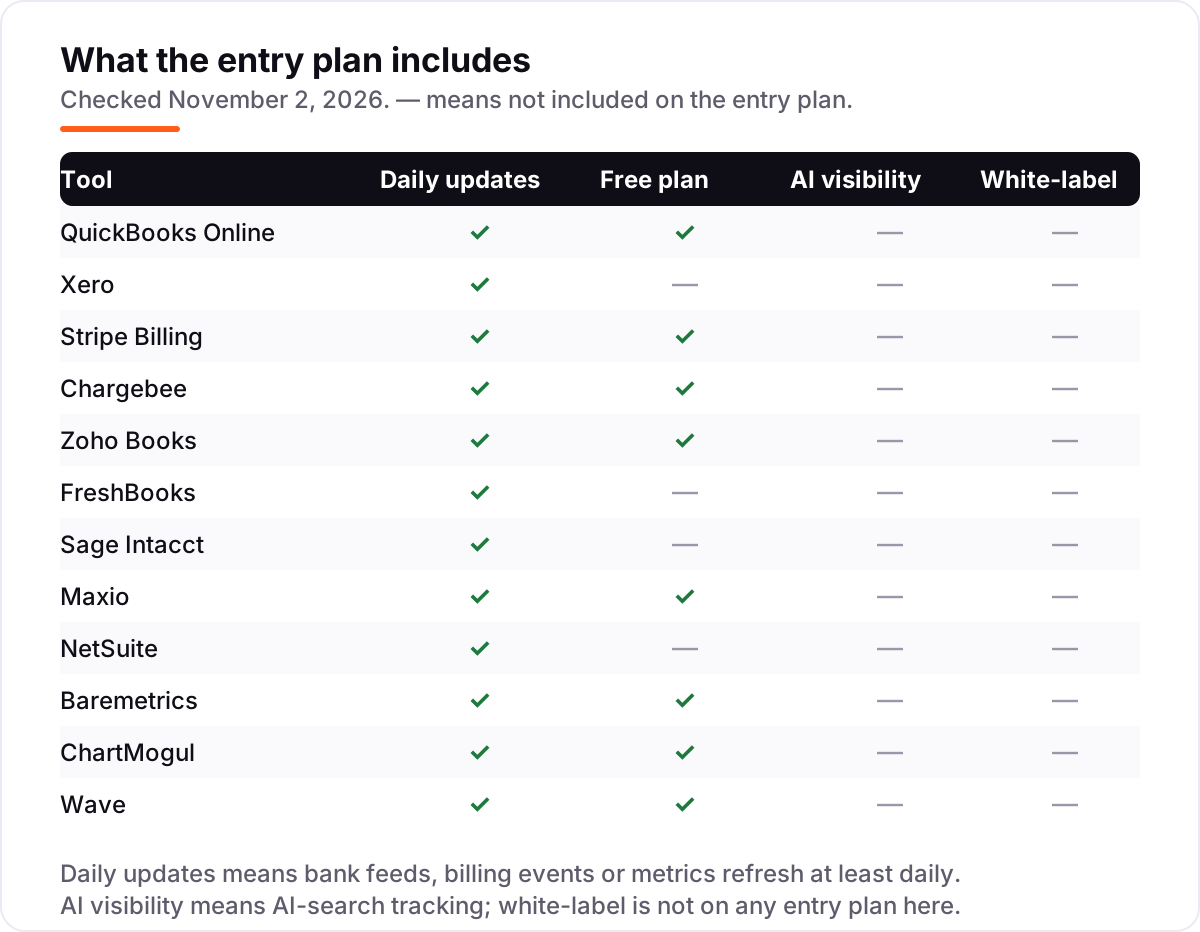
- Free plans are real here — Wave Starter costs $0, ChartMogul is free to $10K MRR and Zoho Books is free under $50K revenue — but automatic bank feeds usually need a paid plan.
- The single most important buying factor is whether subscription billing and revenue recognition live inside the tool or need a second product: that choice decides your real monthly cost, not the headline price.
- Every price below was checked against the vendor's pricing page in November 2026. Ratings are G2 only where we opened the G2 page on November 2, 2026; Sage Intacct and NetSuite publish no starting price.
On this page
Quick comparison
| Tool | Best for | Starting price | Free plan |
|---|---|---|---|
| QuickBooks Online | SaaS founders who want the ledger their accountant already knows, with the widest integration list | $38/mo | Yes (2 invoices/mo) |
| Xero | SaaS teams that want unlimited seats and clean bank reconciliation without per-user fees | $27/mo | No (30-day trial) |
| Stripe Billing | SaaS companies already processing payments on Stripe that need subscription billing without a new platform | $0 + 0.7% | Yes ($0 base fee) |
| Chargebee | Growing SaaS teams that want subscription billing across many gateways without a flat platform fee | $0 + 0.80% | Yes ($0 base fee) |
| Zoho Books | Budget-conscious SaaS teams inside the Zoho ecosystem that need a full ledger from $20 a month | $20/mo | Yes (under $50K rev) |
| FreshBooks | Service-led SaaS teams and agencies that bill clients and want simple invoicing first | $23/mo | No (30-day trial) |
| Sage Intacct | Mid-market SaaS companies outgrowing QuickBooks that need multi-entity books and audit-ready rev rec | Custom quote | No (demo only) |
| Maxio | Sales-led B2B SaaS companies that need billing and GAAP revenue recognition in one platform | $599/mo | Yes (Build sandbox) |
| NetSuite | SaaS companies past $10M ARR running several entities, currencies and product lines on one ERP | Custom quote | No (demo only) |
| Baremetrics | Stripe-native SaaS teams that want MRR, churn and LTV without building a spreadsheet model | $75/mo | Yes (to $180K ARR) |
| ChartMogul | SaaS teams past $10K MRR that want benchmarks and a built-in CRM beside their metrics | $69/mo | Yes (to $10K MRR) |
| Wave | Solo SaaS founders in the US or Canada who want a free ledger and bill a handful of customers | $19/mo (Pro) | Yes (Starter free) |
Make one of these tools?
We re-check this list every quarter. Send a correction, request a review, or ask about a clearly labeled sponsored spot.
Request a listingThe best accounting software for SaaS

QuickBooks Online
Best for: SaaS founders who want the ledger their accountant already knows, with the widest integration list
QuickBooks Online is the default ledger for most SaaS companies because it covers the whole back office in one subscription: invoicing, bills, bank feeds, expenses and the monthly close, with payroll as a paid add-on. Simple Start costs $38 a month for one user, and the plan caps decide when you upgrade, not per-seat pricing. Its G2 profile lists 118 integrations, connecting it to Stripe, Shopify and most billing tools a SaaS stack already runs.
The honest trade-off is price movement. Intuit raised Essentials, Plus and Advanced in August 2026, and G2 reviewers rate it 4.0 out of 5, the lowest score in this list, with support and price rises the common complaints. If you want the ledger your accountant already knows and the widest integration list, start here; if every seat needs access, Xero's unlimited users cost less.
What we like
- Simple Start at $38/month covers invoicing, bank feeds and expenses for a single-user SaaS
- 118 integrations on its G2 profile, including Stripe, Shopify, PayPal and Gusto
- Plus ($140/month) adds inventory, project profitability and budgeting in one plan
Watch out for
- User caps force upgrades: 1 user on Simple Start, 3 on Essentials, 5 on Plus
- G2 reviewers report frequent price rises and mixed support; rated 4.0/5, the lowest here
- Payroll is a paid add-on, and the 50%-off intro lasts only three months
Xero
Best for: SaaS teams that want unlimited seats and clean bank reconciliation without per-user fees
Xero is the cleanest alternative to QuickBooks for a SaaS team: a proper double-entry ledger with bank reconciliation that mostly runs itself, and unlimited users on every plan. Early costs $27 a month, $11 less than QuickBooks Simple Start, and the whole team can log in without anyone counting seats. Its G2 profile lists 129 integrations, so the billing and payment tools you already use connect without custom work.
The limits sit in the plan tiers, not the seat count. Early caps at 20 invoices and 5 bills a month, so a SaaS company billing real volume needs Growing at $59, and multi-currency, projects and expense claims wait for Established at $97. There is no native US payroll either. Pick Xero when seats matter more than the brand name on the invoice.
What we like
- Unlimited users on every plan, so the whole team and your accountant log in free
- Early at $27/month undercuts QuickBooks Simple Start by $11 a month
- Bank reconciliation with automatic matching, plus Hubdoc receipt capture on every plan
Watch out for
- Early caps at 20 invoices and 5 bills a month, so most SaaS companies need Growing at $59
- Multi-currency, projects and expense claims need Established at $97/month
- No native US payroll; it runs through Gusto at $36/month plus $6 per person

Stripe Billing
Best for: SaaS companies already processing payments on Stripe that need subscription billing without a new platform
Stripe Billing is not accounting software, and that is exactly why it belongs in this list: most SaaS companies already take payments through Stripe, and the billing layer sits on top of the payments they already run. There is no monthly fee on pay-as-you-go, just 0.7% of billing volume, with Smart Retries, dunning, proration and usage metering included. At $20,000 of monthly volume that is about $140 for the billing layer.
The catch is that the percentage never stops growing, and card processing sits on top: 2.9% plus 30 cents per charge, so the all-in rate lands near 3.6% before tax. Annual tiers from $620 a month cap the billing fee once volume passes $100K a month. Use Stripe Billing when subscriptions already run on Stripe; buy a ledger beside it, not instead of it.
What we like
- 0.7% of billing volume with no monthly fee, so a pre-revenue SaaS pays almost nothing
- Smart Retries and dunning, proration, coupons and usage metering built into the billing layer
- Annual tiers from $620/month cap the percentage once volume passes $100K a month
Watch out for
- It is a billing layer, not a ledger: you still need accounting software for the books
- Card processing (2.9% + 30¢) sits on top, so the all-in rate is about 3.6% before tax
- Revenue recognition (ASC 606) is a separate Stripe product, priced separately

Chargebee
Best for: Growing SaaS teams that want subscription billing across many gateways without a flat platform fee
Chargebee rebuilt its pricing in 2026 around one self-serve plan, Flow, with two variants: pay-as-you-go at $0 plus 0.80% of monthly billing value, or commit-monthly at 0.65% plus a $99 platform fee. Both include 100 million usage events a month, more than 40 gateways and smart dunning. The two variants cross over at about $66,000 a month in billing, so small teams pay the percentage and larger ones pay the fee.
Like Stripe, Chargebee is a billing layer rather than a ledger, so the books still need QuickBooks, Xero or an ERP beside it. Revenue recognition, CPQ and the Growth retention product are all priced separately. Choose Chargebee when you bill through several gateways or need dunning that Stripe's basic retries do not cover.
What we like
- Flow pay-as-you-go is $0 plus 0.80% of billing, so costs track revenue instead of seats
- 40+ payment gateways and both basic and smart dunning included on the self-serve plan
- Startup program lets qualifying startups bill free until $1M in cumulative billing
Watch out for
- Percentage pricing means the bill grows with revenue; at $100K a month it costs about $749
- Revenue recognition (RevRec), CPQ and Growth are separate products, priced separately
- No free-forever tier for established companies; the old flat $599 Performance plan is gone

Zoho Books
Best for: Budget-conscious SaaS teams inside the Zoho ecosystem that need a full ledger from $20 a month
Zoho Books is the cheapest full ledger in this list, and the pricing model is the reason: it charges per organization, not per user, so Standard at $20 a month includes 3 users and Professional at $50 includes 5. The free plan stays free while revenue is under $50,000 a year, with 1,000 invoices a year included. If your SaaS already runs on Zoho CRM, won deals flow straight into Books as customer records.
The gaps are specific rather than general. Multi-currency and inventory wait for Professional, there is no payroll module on any plan anywhere, and G2 reviewers rate it 4.4 out of 5 while reporting slow support and rigid report customization. For a small SaaS team that wants a real ledger at the lowest price, it is hard to beat.
What we like
- Standard at $20/month is the cheapest full ledger here, with a free plan under $50K revenue
- Per-organization pricing, not per-user: Standard includes 3 users, Professional 5
- Native link to Zoho CRM pushes won deals straight into Books as customer records
Watch out for
- Multi-currency and inventory wait until Professional at $50/month
- No payroll module on any plan, in any country
- G2 reviewers report slow support and rigid reporting customization

FreshBooks
Best for: Service-led SaaS teams and agencies that bill clients and want simple invoicing first
FreshBooks starts from invoicing rather than from the ledger, which suits service-led SaaS teams and agencies that bill clients for work. Lite costs $23 a month for 5 billable clients, and Plus at $43 is where it becomes a genuine accounting product, with a chart of accounts, general ledger, trial balance, balance sheet and bank reconciliation. New customers get 90% off the first three months, so the real price only starts after the trial period ends.
The pricing model to watch is the client cap: Lite stops at 5 billable clients and Plus at 50, and every extra team member costs $11 a month on any plan. There is no inventory tracking at all. Buy FreshBooks when invoicing is the daily job; buy QuickBooks or Xero when the general ledger is.
What we like
- Plus at $43/month adds double-entry reports, bank reconciliation and free accountant access
- Simple invoicing-first workflow that service-based SaaS teams learn in a day
- 90% off the first three months for new customers, and 10% off on annual billing
Watch out for
- Lite at $23/month caps at 5 billable clients and leaves out accounting reports
- Extra team members cost $11 a month each on every plan
- No inventory tracking, so SaaS companies selling hardware or merch need another tool

Sage Intacct
Best for: Mid-market SaaS companies outgrowing QuickBooks that need multi-entity books and audit-ready rev rec
Sage Intacct is the usual step up when QuickBooks stops fitting: a cloud finance platform built for mid-market SaaS, with multi-entity consolidation, dimensional reporting and revenue recognition for ASC 606 and IFRS 15 in the core product. G2 reviewers rate it 4.3 out of 5 from 4,529 reviews, and the reporting depth is the strength they praise most. It is also the only financial management solution endorsed by the AICPA.
There is no published price, and that is the honest barrier. Third-party estimates start around $12,000 a year for a basic single-user setup, most mid-market companies pay $25,000 to $35,000 a year, and implementation typically takes three to six months. Buy it when you run several entities or need audit-ready books, not before.
What we like
- Multi-entity consolidation and dimensional reporting built for SaaS companies with several entities
- Built-in revenue recognition for ASC 606 and IFRS 15, plus project accounting and billing
- Rated 4.3/5 on G2 from 4,529 reviews, with reporting depth the most praised strength
Watch out for
- Quote-only pricing, with third-party estimates starting around $12,000 a year
- Implementation typically takes three to six months, per G2 reviewers
- No free plan or self-serve trial; evaluation runs through Sage or a partner

Maxio
Best for: Sales-led B2B SaaS companies that need billing and GAAP revenue recognition in one platform
Maxio, formed from the merger of Chargify and SaaSOptics, is a financial operations platform rather than a pure billing tool: it runs subscription billing, GAAP revenue recognition and SaaS reporting in one place. Grow costs $599 a month for up to $100,000 in monthly billings, with usage-based and hybrid pricing, CPQ and dunning that runs up to 30 steps over 365 days. A free Build tier works as a developer sandbox.
The ceiling matters. Grow stops at $100K in monthly billings, and advanced revenue management, expense amortization and multi-entity support all sit on the quote-only Scale tier. Annual payment is standard on Grow, with monthly billing as a paid add-on. Choose Maxio when finance needs audit-grade rev rec beside billing, not just invoices.
What we like
- Grow at $599/month bundles billing, revenue recognition and SaaS metrics to $100K monthly billings
- Usage-based and hybrid billing plus CPQ, built for sales-led B2B SaaS contracts
- Dunning runs up to 30 steps over 365 days, with editable templates and SMS
Watch out for
- Grow caps at $100K in monthly billings; above that, Scale is quote-only
- Advanced revenue management, expense amortization and multi-entity support are Scale-only
- Annual payment is standard on Grow; monthly billing is a paid add-on

NetSuite
Best for: SaaS companies past $10M ARR running several entities, currencies and product lines on one ERP
NetSuite is Oracle's cloud ERP, and it is the biggest system in this list: general ledger, billing, CRM, inventory, procurement, planning and multi-subsidiary consolidation through OneWorld, all on one platform. Revenue recognition follows ASC 606 and IFRS 15, fixed asset management and SuiteAnalytics reporting are built in, and the system scales from a single entity to global multi-subsidiary operations without replatforming.
Oracle publishes no price list, so every quote is negotiated. Third-party estimates commonly put the base platform around $999 a month plus $129 to $199 per user per month, with implementation as a separate one-time cost. It is the right pick for a SaaS company past $10M ARR with several entities; below that, a ledger plus a billing tool costs far less.
What we like
- One system for ledger, billing, CRM, inventory and multi-subsidiary consolidation (OneWorld)
- ASC 606 and IFRS 15 revenue recognition, fixed assets and SuiteAnalytics reporting built in
- Scales from a single entity to multi-subsidiary global operations without replatforming
Watch out for
- Quote-only pricing; third-party estimates put the base around $999/month plus $129–$199 per user
- Implementation is a separate one-time cost, commonly $25,000 or more
- Overkill below roughly $1M in revenue, where a ledger plus billing tool costs far less

Baremetrics
Best for: Stripe-native SaaS teams that want MRR, churn and LTV without building a spreadsheet model
Baremetrics is subscription analytics, not accounting: it reads your Stripe data and turns it into MRR, churn, LTV, cohort retention and forecasts without anyone building a spreadsheet model. Launch starts at $75 a month billed monthly, or $49 a month billed annually, for businesses up to $360K ARR, and the plan is free up to $180K ARR. Growth and Scale step up with the ARR you track.
The add-ons are where the bill grows. Payment Recovery and Cancellation Insights cost $129 a month each, so a team at $240K ARR wanting the full stack pays about $333 a month. Metrics refresh about every two hours rather than in real time. Buy Baremetrics when the board asks about churn and LTV every month, not just at the year end.
What we like
- Launch from $75/month tracks MRR, churn, LTV and cohorts straight from Stripe
- Free up to $180K ARR, so early SaaS teams start without paying
- Forecasting, dunning recovery and cancellation insights available as add-ons
Watch out for
- Pricing scales with ARR, so the bill rises as you grow even if usage stays flat
- Payment Recovery and Cancellation Insights cost $129 a month each on top of the base plan
- Metrics refresh about every two hours, not in real time

ChartMogul
Best for: SaaS teams past $10K MRR that want benchmarks and a built-in CRM beside their metrics
ChartMogul turns billing data into subscription metrics — MRR, ARR, churn, retention and LTV — and it is free up to $10K MRR, with core analytics, segmentation, forecasting, benchmarks and a CRM seat included. Starter starts at $69 a month billed monthly, or $57 billed annually, for up to $10M ARR. It connects more than 30 billing sources, including PayPal and GoCardless, so teams that bill outside Stripe are covered.
The two things that set it apart are the benchmarks, which compare your metrics with peers at the same stage and ARR, and the built-in CRM on every plan. The limits are just as clear: Starter connects one billing system and three team members, and the price rises with the ARR you track. Pick ChartMogul when benchmarks and a CRM matter beside the metrics.
What we like
- Free up to $10K MRR, with core analytics, segmentation, forecasting and a CRM seat included
- Stage- and ARR-specific industry benchmarks show how your metrics compare with peers
- Connects 30+ billing sources, including PayPal and GoCardless, not just Stripe
Watch out for
- Starter at $69/month connects only one billing system and caps at 3 team members
- Price rises with the ARR you track, so fast growth means a fast-rising bill
- Forecasting stays in the metrics layer; there is no P&L, burn or runway view

Wave
Best for: Solo SaaS founders in the US or Canada who want a free ledger and bill a handful of customers
Wave is the only genuinely free ledger in this list. Starter costs $0 and includes unlimited estimates, invoices, bills and double-entry bookkeeping records, with no cap on users or transactions. Wave earns its money from card processing at 2.9% plus 60 cents a transaction, so the free plan is funded by the payments that run through it. Pro at $19 a month adds automatic bank imports, receipt scanning and multi-user roles.
The limits are hard edges rather than soft ones. Wave is US and Canada only, it has no multi-currency support and no inventory tracking, and automatic bank feeds sit behind Pro — Starter means manual entry or uploading statement files. For a solo founder billing a handful of customers, it is enough; for a SaaS company with global customers, it is not.
What we like
- Starter is genuinely free: unlimited invoices, bills and bookkeeping records, no user cap
- Pro at $19/month adds automatic bank imports, receipt scanning and multi-user roles
- Simple double-entry ledger a solo founder can run without an accountant
Watch out for
- US and Canada only; Wave stopped accepting accounts elsewhere in 2020
- No multi-currency support and no inventory tracking on any plan
- Automatic bank imports need Pro; Starter means manual entry or file uploads
Choosing the best accounting software for saas means picking two things at once: a ledger that keeps the books clean, and a billing layer that charges customers every month without leaking revenue. Most SaaS companies get the first part right and bolt on the second part late, which is where failed payments, messy revenue recognition and investor questions start. This guide sorts 12 tools by what your SaaS actually needs — a ledger, a billing layer, scale-up finance or metrics — with starting prices checked in November 2026 and no tool ranked by brand size.
What accounting software for SaaS actually does
Accounting software for SaaS does three jobs that look like one. The ledger records every transaction, reconciles the bank and produces the profit and loss statement and balance sheet your accountant and your investors read. The billing layer charges customers on a schedule, retries failed cards, handles upgrades, downgrades and proration, and tracks what each customer owes. The metrics layer turns those payments into MRR, churn, LTV and forecasts, so the board sees the business rather than the bank balance.
One number shows how connected the ledger is expected to be: Xero lists 129 integrations on its G2 profile, and QuickBooks Online lists 118, spanning payments, payroll, CRM and e-commerce. A SaaS ledger is a hub, not a silo, and the tools in this list differ mostly in which of the three jobs they do well and which they leave to another product.
Ledgers first: the general ledger
Every SaaS company needs a ledger, and the five ledgers in this list cover the whole range from free to $38 a month. QuickBooks Online is the default because accountants know it and it connects to everything; Xero is the cheaper alternative with unlimited users; Zoho Books is the cheapest full ledger of all; FreshBooks is the invoicing-first option for service-led teams; Wave is the free option for a solo founder.
Pick the ledger by who touches the books. One person billing a handful of customers can run on Wave Starter for $0. A team that all needs access should look at Xero, where seats are free. A company whose accountant already works in QuickBooks should stay there, because the switching cost is higher than the $11 a month Xero saves. And remember the plan caps: QuickBooks charges by user count, Zoho by organization, and FreshBooks by billable client — the meter that forces your upgrade is different on each one.
Billing layers: charge for subscriptions
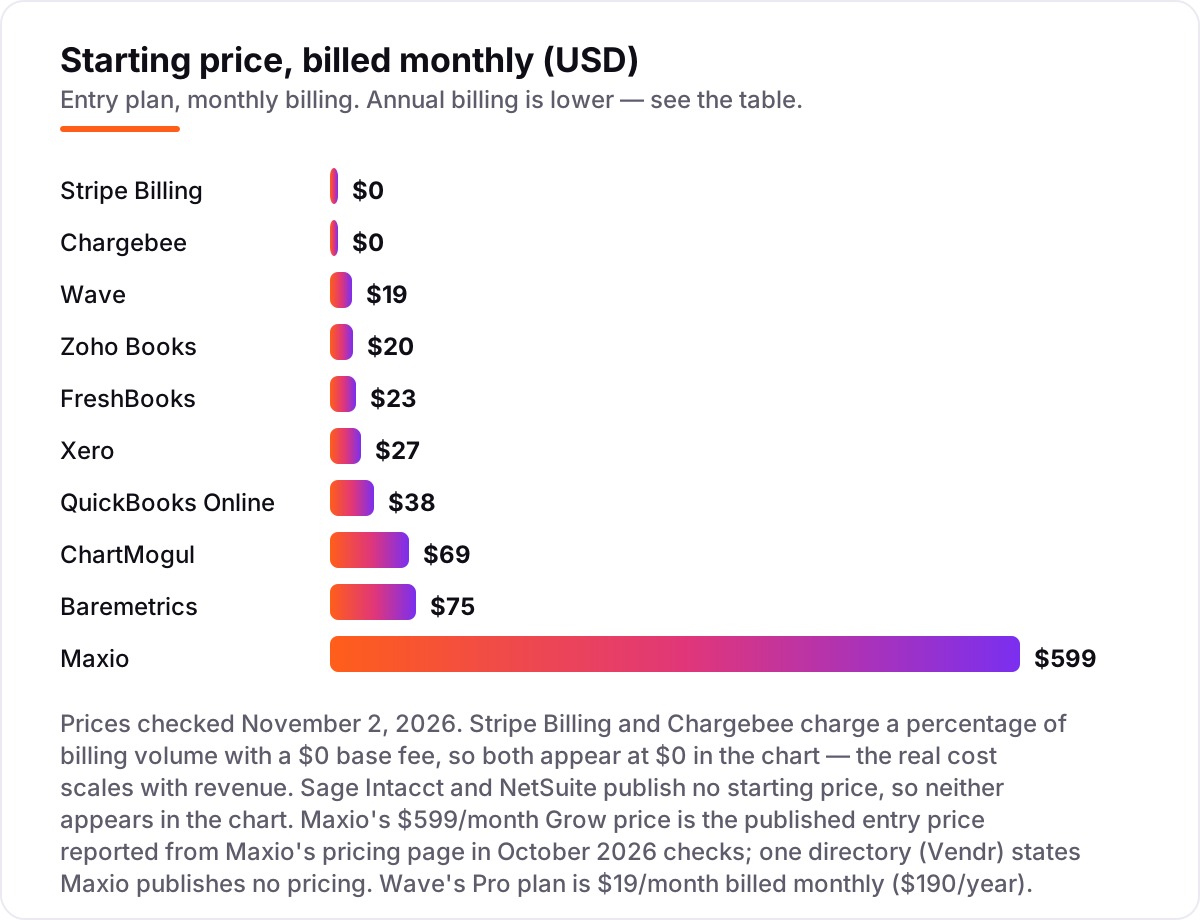
A ledger invoices; a billing layer runs subscriptions. Stripe Billing, Chargebee and Maxio exist because recurring revenue has failure modes a ledger never sees: cards expire, customers upgrade mid-cycle, usage varies month to month, and a failed payment quietly becomes churn. Stripe Billing charges 0.7% of billing volume with no monthly fee, Chargebee Flow charges 0.80% with a $0 base fee, and Maxio Grow charges a flat $599 a month to $100K in monthly billings.
The right billing layer depends on where your payments already live. If subscriptions already run on Stripe, Stripe Billing is the cheapest next step and needs no new platform. If you bill through several gateways or need dunning that Stripe's basic retries do not cover, Chargebee earns its percentage. If finance needs GAAP revenue recognition beside the billing, Maxio is the only one of the three that does it in the same subscription.
Scale up: multi-entity and ERP
There is a revenue line where a ledger plus a billing tool stops being enough, and it usually arrives with a second entity, a second currency or an audit. Sage Intacct and NetSuite are built for that line: multi-entity consolidation, dimensional reporting and revenue recognition under ASC 606 and IFRS 15, with project accounting, fixed assets and planning beside the ledger. Sage Intacct is the narrower step up from QuickBooks; NetSuite is the full ERP that also replaces the CRM and the inventory system.
Both are quote-only, and both need a real implementation: Sage Intacct typically takes three to six months to go live, per G2 reviewers, and NetSuite implementation is a separate one-time cost on top of the subscription. Do not buy either early. A SaaS company under roughly $1M in revenue gets the same books from QuickBooks plus Stripe Billing for a fraction of the cost, and the ERP only pays once consolidation and audit readiness are monthly work rather than annual events.
Metrics: know your MRR
Baremetrics and ChartMogul do not keep books and do not charge customers. They read the billing data and answer the questions the board asks every month: what is MRR doing, where is churn coming from, what is a customer worth, and what happens if growth slows. Baremetrics starts at $75 a month billed monthly and is free up to $180K ARR; ChartMogul is free to $10K MRR and starts at $69 a month billed monthly, with stage-specific industry benchmarks and a built-in CRM.
The choice between them is about where you bill and what else you want. Baremetrics is the tighter fit for a Stripe-only stack with forecasting and recovery add-ons. ChartMogul fits teams billing through several sources, including PayPal and GoCardless, and teams that want peer benchmarks beside their own numbers. Metrics only help if people find you: once the books are clean, our SEO audit service checks whether your pricing and feature pages rank for the terms buyers actually search.
Quick comparison: tool type by need
| Buyer | Best pick | Why |
|---|---|---|
| Solo founder, free to start | Wave | Starter costs $0 with unlimited invoices; Pro adds bank feeds for $19/month |
| Small SaaS team, best value ledger | Xero | $27/month with unlimited users and clean bank reconciliation |
| Already billing on Stripe | Stripe Billing | 0.7% of volume, no monthly fee, no new platform to learn |
| Several gateways, needs dunning | Chargebee | $0 plus 0.80% of volume, 40+ gateways, smart dunning included |
| Outgrowing QuickBooks | Sage Intacct | Multi-entity consolidation and ASC 606 rev rec, priced by quote |
| Board asks about MRR and churn | Baremetrics or ChartMogul | MRR, churn and LTV from $75 and $69 a month, both free to start |
How to choose the best accounting software for saas
- Count what you bill, not what you earn. Subscriptions, one-off invoices, usage charges and annual contracts each need different tooling. Under 20 invoices a month, Xero Early or Wave Starter covers you; above that, price the next tier before you commit.
- Decide ledger first, billing second. Pick the ledger your accountant can work in, then add the billing layer that fits your payment stack. Buying billing before the ledger leaves you with invoices and no books.
- Check the revenue recognition question. If you sell annual contracts or usage-based pricing, ask whether the tool handles ASC 606 natively. Only Sage Intacct, NetSuite and Maxio do it in this list; the rest need a second product or a spreadsheet.
- Price the second year, not the first. Intro discounts end, percentage billing grows with revenue, and ARR-based pricing rises as you grow. A $0 start that becomes $749 at $100K a month is not a cheap tool.
- Try the real workflow before you pay. Every tool in this list has a free plan, a free trial or a demo. Run one real billing cycle through it — invoice, payment, failed card, refund — and check the books match your bank before you migrate the company.
Before you publish new pages for the plans you sell, run your titles through the free SERP snippet preview tool — it shows exactly how the title and description will look in Google.
Mistakes to avoid
- Buying an ERP before you need one. NetSuite and Sage Intacct are powerful, but a SaaS company under $1M in revenue pays thousands a year for consolidation it does not yet do.
- Comparing flat prices with percentage prices. A $38 ledger and a 0.7% billing layer are different kinds of cost: one is fixed, the other grows with every dollar you bill.
- Ignoring the plan meter. QuickBooks meters users, FreshBooks meters billable clients, Maxio meters monthly billings and Baremetrics meters ARR. The meter that forces your upgrade is the price that matters.
- Assuming the ledger does revenue recognition. QuickBooks, Xero, Zoho Books and FreshBooks do not handle ASC 606 natively. If investors ask about deferred revenue, you need Sage Intacct, NetSuite, Maxio or a separate rev rec product.
- Trusting a directory price. Maxio's $599 Grow price is reported from its pricing page in October 2026 checks, while one directory states Maxio publishes no pricing. Always check the vendor's own page before budgeting.
How we chose
We ranked the 12 tools by fit for the most common buyer — a growing SaaS company that needs a ledger and a billing layer — not by brand size. Prices come from the vendors' own pricing pages, cross-checked against multiple independent reads dated October and November 2026, because direct loads of several vendor pricing pages failed today with browser service errors; where a price could not be verified on the vendor page, we say so here. Sage Intacct and NetSuite publish no starting price, so both are listed as custom quote. Stripe Billing and Chargebee charge a percentage of billing volume with a $0 base fee, so their chart bars sit at $0 and the real cost scales with revenue. Ratings appear only for the four tools whose G2 pages we opened on November 2, 2026; the other eight carry no rating rather than an estimated one. No vendor paid for a place in this list, and none of the links here are affiliate links.
What to do next
Start with the decision path above: count what you bill, pick the ledger first, then add the billing layer that fits your payment stack. Take the free plan or trial of your top pick and run one real billing cycle through it before you migrate. If the numbers match your bank and the reports make sense to an investor, you have your stack. If you'd rather have this set up and read for you, request a free SEO + AI visibility audit and get a ranked fix list in 2 business days.
Rather not run the tools yourself?
Tools show you the data. SerpAstra turns it into higher rankings, more map-pack calls and citations in AI answers.
Get a free SEO + AI visibility audit→Sources we checked (19)
- QuickBooks Online pricing — quickbooks.intuit.com/pricing (checked November 2, 2026)
- QuickBooks Online on G2 — 4.0/5, 3,901 reviews (checked November 2, 2026)
- Xero pricing — xero.com/us/pricing (checked November 2, 2026)
- Xero on G2 — 4.4/5, 1,849 reviews (checked November 2, 2026)
- Stripe Billing pricing — stripe.com/billing/pricing (checked November 2, 2026)
- Chargebee pricing — chargebee.com/pricing (checked November 2, 2026)
- Zoho Books pricing — zoho.com/us/books/pricing (checked November 2, 2026)
- Zoho Books on G2 — 4.4/5, 330 reviews (checked November 2, 2026)
- FreshBooks pricing — freshbooks.com/pricing (checked November 2, 2026)
- Sage Intacct pricing — sage.com/en-gb/sage-business-cloud/intacct/pricing (checked November 2, 2026)
- Sage Intacct on G2 — 4.3/5, 4,529 reviews (checked November 2, 2026)
- Maxio pricing — maxio.com/pricing (checked November 2, 2026)
- NetSuite pricing — netsuite.com/portal/products/pricing.shtml (checked November 2, 2026)
- Baremetrics pricing — baremetrics.com/pricing (checked November 2, 2026)
- ChartMogul pricing — chartmogul.com/pricing (checked November 2, 2026)
- Wave pricing — waveapps.com/pricing (checked November 2, 2026)
- Maxio Grow $599/month, verified against Maxio pricing page — baremetrics.com/blog/stripe-vs-maxio (September 1, 2026)
- Chargebee Flow 0.80% pricing — baremetrics.com/blog/what-is-chargebee (checked November 2, 2026)
- Wave Pro $19/month, Starter free — cpaadvisor.us/articles/waveapps-review (September 2026)
Shamim
Founder of SerpAstra
A full-stack SEO and digital marketer who spends most days on Local SEO for dental practices, AI search visibility and lead generation.
Frequently asked questions
What is the best accounting software for a SaaS startup?
Start with a ledger plus a billing layer: QuickBooks Online at $38 a month or Xero at $27, with Stripe Billing at 0.7% of volume handling subscriptions. That pair covers the books and the billing for under $50 a month before processing fees. Move to Sage Intacct or Maxio only when multi-entity books or audit-grade revenue recognition become real needs.
How much does accounting software for SaaS cost?
From $0 to $599 a month at the entry level. Wave Starter and the billing layers cost nothing to start, Zoho Books is $20 a month, Xero is $27 and QuickBooks Online is $38. Maxio Grow is $599 a month, while Sage Intacct and NetSuite are quote-only and typically start around $12,000 a year. Processing fees sit on top of every price here.
Do I need separate billing software, or is a ledger enough?
A ledger alone is enough until subscriptions get complicated. QuickBooks and Xero invoice well, but they do not run dunning, proration, usage metering or failed-payment recovery. Once churn from failed payments or complex pricing shows up, add Stripe Billing, Chargebee or Maxio beside the ledger instead of replacing it.
What is revenue recognition (ASC 606) and when does it matter?
Revenue recognition is the rule for when subscription money counts as earned revenue rather than deferred revenue. It matters once you sell annual contracts, multi-year deals or usage-based pricing, and investors and auditors will ask about it. Sage Intacct, NetSuite and Maxio handle ASC 606 in the product; the ledgers here do not.
Is there free accounting software for SaaS?
Yes, with limits. Wave Starter is free with unlimited invoices and bookkeeping, Zoho Books is free under $50,000 revenue, and ChartMogul is free to $10K MRR. Stripe Billing and Chargebee Flow have a $0 base fee and charge a percentage of volume. Free plans work for solo founders; a growing team outgrows them within a year.
QuickBooks vs Xero for SaaS — which is better?
QuickBooks Online wins on integrations and accountant familiarity, with 118 integrations on its G2 profile; Xero wins on seats, with unlimited users on every plan and a lower entry price of $27 a month against $38. If your accountant already uses QuickBooks, stay there. If the whole team needs access, Xero costs less.
Free SEO and AI visibility audit
Find out what is holding your rankings back
Send us your site. Within 2 business days you get a written audit, an AI visibility check and a short fix list ranked by impact. Free, with no contract attached.
Request my free audit→Related guides
 SEO & AI SearchBest SEO Audit Software for 2026: 10 Options Compared by Use Case10 best SEO audit software tools compared on price, crawl depth and AI visibility. Prices checked on vendor pricing pages, November 1, 2026.Read guide →
 SEO & AI SearchBest Local SEO Tools for 2026: 11 Picks Ranked by What You Need11 best local SEO tools with real prices checked November 1, 2026 — from $14/month trackers to quote-only enterprise platforms, sorted by what you need.Read guide →
 MarketingMarketing automation for small businesses: what to automate (and what not to)Marketing automation for small businesses, explained: what to automate first, what to keep human, and the tools that save hours without losing customers.Read guide →