
Best AI Code Review Tools for 2026: 12 Picks Ranked by What You Need
Compare the 12 best ai code review tools on price, free plans, Git platforms and AI review depth, with every price checked November 6, 2026.
 Shamim Mia, Founder, SerpAstraLast verified November 6, 202615 min read
We compare pricing pages, documentation and public reviews. We never accept payment for rankings.

Key takeaways
- CodeRabbit leads for most teams at $24/user a month, GitHub Copilot is the cheapest way in at $10, and Codacy is the best value all-rounder at $18 a developer a month.
- The single most important buying factor is the billing model: seat-based tools charge per developer, while Qodo, Greptile, Bito and DeepSource meter reviews, credits or lines, so your pull-request volume decides the real bill.
- Five tools have genuinely free tiers — CodeRabbit, Copilot, Greptile, Sourcery and SonarQube Cloud — but free plans cap reviews, lines of code or platforms.
- No AI reviewer replaces a human: the tools reliably catch style issues, common bugs and security anti-patterns, but they miss context-dependent logic and produce false positives.
On this page
Quick comparison
| Tool | Best for | Starting price | Free plan |
|---|---|---|---|
| CodeRabbit | Teams that want the deepest automated review on every pull request, across GitHub, GitLab, Bitbucket and Azure DevOps | $24/user/mo | Yes (free tier) |
| GitHub Copilot | GitHub teams already paying for Copilot that want review inside the editor and the pull request | $10/user/mo | Yes (Free plan) |
| Qodo | Teams that want review plus test generation and compliance checks from one platform | $30/mo | No (14-day trial) |
| Codacy | Small teams that want quality, security and AI review on one bill, with no usage metering | $18/dev/mo | Yes (open source) |
| SonarQube Cloud | Teams that want rule-based quality gates plus AI fixes, priced by codebase size instead of seats | $34/mo | Yes (free to 50k LOC) |
| DeepSource | Teams that want deterministic static analysis first, with an AI reviewer on top of it | $24/user/mo | Yes (open source) |
| CodeAnt AI | Teams that want review plus SAST, secrets and infrastructure checks in a single pass | $24/user/mo | Yes (open source) |
| Greptile | Teams with large repos or monorepos that want full-codebase context and pay only for reviews used | $1/credit | Yes (Starter) |
| Graphite | GitHub teams that ship with stacked pull requests and want review inside that workflow | $20/user/mo | Yes (Hobby) |
| Sourcery | Python-heavy teams that want refactoring suggestions, not just bug catches | $12/dev/mo | Yes (open source) |
| Bito | Teams that want the cheapest paid seats and a self-hosted review option | $12/seat/mo | Yes (free plan) |
| CodeScene | Engineering leaders who want review plus code-health and team-knowledge insight | €18/author/mo | Yes (open source) |
Make one of these tools?
We re-check this list every quarter. Send a correction, request a review, or ask about a clearly labeled sponsored spot.
Request a listingThe best ai code review tools

CodeRabbit
Best for: Teams that want the deepest automated review on every pull request, across GitHub, GitLab, Bitbucket and Azure DevOps
CodeRabbit is the most thorough reviewer in this list: it reads every pull request line by line, writes a summary and a diagram of the change, and posts specific comments with one-click fixes. It works on GitHub, GitLab, Bitbucket and Azure DevOps, so a team that spans platforms gets the same review everywhere. Essentials costs $24 per user a month on annual billing, and only developers who open pull requests are billed.
The catch is noise. Independent tests put CodeRabbit's noise near 28%, so more than a quarter of its comments add little value, and a noisy reviewer on top of sloppy pull requests makes human review worse. Keep pull requests small, tune the review instructions, and treat its comments as suggestions to verify. Buy CodeRabbit when review depth matters most; buy Copilot when the team already lives on GitHub.
What we like
- The most detailed line-by-line analysis here, with PR summaries, diagrams and one-click fixes
- Works across GitHub, GitLab, Bitbucket and Azure DevOps — the widest platform coverage in this list
- Charges only developers who create pull requests, so reviewers and managers cost nothing
- Free tier covers public and private repos, and open-source projects get the full product free
Watch out for
- Independent tests put noise near 28% — more than a quarter of comments add little value
- Essentials caps reviews at 5 per developer per hour, with a $0.25-per-file overage above the cap
- No stacked-PR workflow, so teams that chain pull requests need a second tool

GitHub Copilot
Best for: GitHub teams already paying for Copilot that want review inside the editor and the pull request
GitHub Copilot is the easiest reviewer to start with if the team already lives on GitHub: code review is included on every plan, including the $0 Free plan, and it runs on pull requests at github.com and on file diffs inside VS Code and JetBrains. Pro costs $10 a user a month, and it also writes PR descriptions, explains code in the editor and helps resolve merge conflicts.
The limits are platform and metering. Copilot reviews GitHub code only, so a team with GitLab or Bitbucket repos needs a second tool, and review work consumes GitHub AI Credits — heavy use costs more than the $10 seat price. Context is diff-only on some plans, so cross-file issues can slip past. Pick Copilot when the team is GitHub-only and already pays for it; pick CodeRabbit when review depth is the priority.
What we like
- Code review is included on every plan, including the $0 Free plan, with no separate reviewer to install
- Reviews live where the code lives — pull requests on github.com and file diffs in VS Code and JetBrains
- Also writes PR descriptions, explains code in the IDE and fixes merge conflicts
- Pro is $10 a user a month, the lowest paid entry price in this list
Watch out for
- GitHub only — no GitLab, Bitbucket or Azure DevOps support at any price
- Review and agent work consume GitHub AI Credits, so heavy use costs more than the $10 seat price
- Context is diff-only on some plans, so it can miss issues that span the wider codebase

Qodo
Best for: Teams that want review plus test generation and compliance checks from one platform
Qodo, formerly CodiumAI, is the test-first pick: it reviews pull requests against the full codebase, the team's own history and linked tickets, and it generates tests for the changed code in the same pass. Pricing is pooled credits, not seats — Pro Team costs $30 a month for 2,500 credits, about 18 reviews, shared across the whole team.
That model is a bargain for a small team and a forecasting headache for a busy one. A team shipping 40 pull requests a month needs a bigger pack, and credits expire each month, so unused reviews do not roll over. There is no permanent free tier, only a 14-day trial. Choose Qodo when tests and review should come from one tool; choose CodeRabbit when a flat per-seat price matters more.
What we like
- Pairs review with test generation, so one tool covers both halves of pre-merge quality
- One $30 credit pack covers the whole team — small teams pay far less than per-seat rivals
- Reviews against the full codebase, team history and linked tickets, not just the diff
- Runs on GitHub, GitLab, Bitbucket and Azure DevOps, with on-prem and air-gapped options on Enterprise
Watch out for
- No permanent free tier on the current pricing page — only a 14-day trial
- Credit billing is hard to forecast: about 18 reviews per $30 pack, then overage at the same rate
- Cross-repo features and merge blocking wait for Enterprise, priced for teams of 30 or more

Codacy
Best for: Small teams that want quality, security and AI review on one bill, with no usage metering
Codacy is the value all-rounder: one Team plan at $18 a developer a month on annual billing covers code quality, coverage gates, SAST, SCA, secrets detection and the AI Reviewer, with unlimited lines of code and no metered reviews. It bills only developers who actively commit, so managers who only read dashboards cost nothing.
The AI Reviewer reads the pull request, its description and the linked Jira ticket, checking the code against what the ticket asked for — but it works on GitHub only. Team also caps at 30 developers and 100 private repos. Pick Codacy when one predictable bill matters most; pick CodeAnt when the team needs review plus security on all four Git platforms.
What we like
- One flat per-developer price with unlimited lines of code — no metered AI reviews or line allowances
- AI Reviewer reads the pull request, its description and the linked Jira ticket, not just the code
- Bills only developers who actively commit, so read-only managers and reviewers cost nothing
- Free forever for open-source projects, with a free Developer IDE plugin for solo use
Watch out for
- AI Reviewer works on GitHub only — GitLab and Bitbucket get static analysis without the AI layer
- Team caps at 30 developers and 100 private repositories; bigger teams need a custom Business quote
- No on-premise deployment on the cloud plans, and Azure Repos is still on a waitlist

SonarQube Cloud
Best for: Teams that want rule-based quality gates plus AI fixes, priced by codebase size instead of seats
SonarQube Cloud is the flat-price pick: the Team plan costs $34 a month for up to 100,000 lines of code, however many developers touch the repo, and private projects up to 50,000 lines are free. It analyses pull requests against a deep rule engine, enforces quality gates that can block a merge, and its AI CodeFix proposes working fixes for flagged issues.
The trade-off is the pricing axis. A growing codebase pushes the team into the next lines-of-code tier even if headcount stays flat, and the AI layer is thinner than the dedicated reviewers — rules first, AI second. Choose SonarQube Cloud when the team is large and the codebase is small; choose CodeRabbit when review depth matters more than seat count.
What we like
- Flat monthly price per codebase, not per seat — a 50-developer team pays the same $34 as a team of five
- Quality gates can block merges, so standards are enforced instead of merely suggested
- AI CodeFix proposes working fixes for flagged issues, and SonarLint brings the same rules into the IDE
- Free tier covers private projects up to 50,000 lines of code with no expiry
Watch out for
- Priced by lines of code, so the bill grows with the codebase even if the team does not
- The AI layer is thinner than the dedicated reviewers — rules first, AI second
- Enterprise features such as portfolio reporting and advanced security need a custom quote

DeepSource
Best for: Teams that want deterministic static analysis first, with an AI reviewer on top of it
DeepSource is the hybrid pick: a deterministic engine with more than 5,000 rules checks the code first, then an AI reviewer adds a structured Report Card across five quality dimensions on every pull request, with Autofix patches for what it finds. Team costs $24 a user a month on annual billing, with unlimited repos and scans and no caps on team size.
Watch the AI Review metering. The seat price covers the platform, but AI Review is billed at $8 per 10,000 lines once the $100 annual credit per user runs out, so a large codebase costs more than $24 a seat. DeepSource was also acquired by Harness in September 2026. Pick it when deterministic rules matter most; pick CodeRabbit for pure AI review depth.
What we like
- Runs 5,000-plus deterministic rules before the AI agent touches the code, with a sub-5% false-positive rate
- AI review gives a structured Report Card across five quality dimensions on every pull request
- Unlimited repositories, developers and static-analysis scans on the Team plan — no artificial caps
- Free Open Source plan covers public repos with 1,000 PR reviews a month
Watch out for
- AI Review is billed separately from the seat: $8 per 10,000 lines once the $100 annual credit per user runs out
- Acquired by Harness in September 2026, so the roadmap now folds into the Harness platform
- The free tier covers public repositories only — the old individual free plan for private repos is gone

CodeAnt AI
Best for: Teams that want review plus SAST, secrets and infrastructure checks in a single pass
CodeAnt AI is the security bundle: one Premium plan at $24 a user a month covers AI code review, SAST, secrets detection and infrastructure-as-code scanning, with unlimited reviews, one-click fixes and DORA metrics. It works across GitHub, GitLab, Bitbucket and Azure DevOps, and Enterprise adds on-prem or VPC deployment.
The catch is packaging. There is no permanent free plan — only a 14-day trial with 100 PR reviews — and the wider Code Quality and Code Security products are sold separately with a 10-seat minimum. Its own guides also rank CodeAnt first, so weigh those claims carefully. Choose CodeAnt when one pass should catch quality and security together.
What we like
- Bundles review, SAST, secrets detection and infrastructure-as-code scanning in a single plan
- Unlimited reviews at a flat per-user price — no credit packs or per-review metering
- One-click fixes and quality gates that can block merges with critical issues
- Works across all four major Git platforms, with on-prem or VPC deployment on Enterprise
Watch out for
- No permanent free plan — only a 14-day trial and free access for open-source projects
- Code Quality and Code Security are sold as separate products with a 10-seat minimum
- Vendor guides self-rank CodeAnt first, so treat its own comparison claims with caution

Greptile
Best for: Teams with large repos or monorepos that want full-codebase context and pay only for reviews used
Greptile is the pay-per-review pick: it indexes the whole codebase, so its reviews understand how a change affects code far from the diff — the reason it suits large repos and monorepos. There is no seat fee on paid usage: a Base review costs 1 credit, deeper reviews up to 10, and each credit costs $1. Starter is free for one developer with 50 credits a month.
The model changed in late 2026, when Greptile dropped its $30-a-seat plan, so older roundups quoting that price are out of date. A heavy month costs more than a flat seat plan, and the tool supports GitHub and GitLab only. Pick Greptile when review volume is low or spiky; pick CodeRabbit when the team reviews every day.
What we like
- Indexes the whole codebase, so reviews understand cross-file effects that diff-only tools miss
- No seat fee on paid usage — the bill is a direct function of review volume and depth
- Free Starter tier gives one developer 50 credits a month, and qualified open-source projects are free
- Multi-repo support suits monorepos and teams that review across many services
Watch out for
- Greptile dropped its $30-a-seat plan in late 2026, so older roundups quoting $30 a seat are out of date
- A heavy month costs more than a flat seat plan: deep Apex reviews cost 10 credits each
- No Bitbucket Cloud or Azure DevOps support — GitHub and GitLab only

Graphite
Best for: GitHub teams that ship with stacked pull requests and want review inside that workflow
Graphite is the odd one out: it is a stacked pull-request workflow first and a reviewer second. Its AI reviewer reads chains of dependent pull requests with stack-aware context, posts suggested fixes on the PR page, and feeds a stack-aware merge queue. Starter costs $20 a user a month on annual billing, and the Hobby tier is free for personal repos.
The catch is the packaging. Unlimited AI reviews start on Team at $40 a user a month — Starter reviews are limited — and the tool is GitHub only. A team that does not stack pull requests pays for a workflow it will not use. Choose Graphite when the team already stacks; choose CodeRabbit when it only needs a reviewer.
What we like
- Stack-aware context understands chains of dependent pull requests instead of reviewing each diff alone
- Review sits inside the PR page, with suggested fixes, PR metrics and a stack-aware merge queue
- Hobby tier is free for personal repos, and Starter covers all organization repos
- Tracks PR comment metrics, so teams can see which review comments actually get acted on
Watch out for
- Unlimited AI reviews start on Team at $40 a user a month — Starter reviews are limited
- GitHub only, with GitHub Enterprise Server reserved for the Enterprise plan
- Review is part of a broader workflow product, so teams that only want a reviewer pay for stacking too

Sourcery
Best for: Python-heavy teams that want refactoring suggestions, not just bug catches
Sourcery is the refactoring pick: it started as a Python engine and still goes deepest there, suggesting cleaner implementations — a list comprehension here, a dataclass there — instead of only flagging bugs. It now covers JavaScript, TypeScript and Go too, with real-time feedback in the IDE and reviews on every pull request. Pro costs $12 a developer a month on annual billing.
The free Open Source plan covers public repos with full features, which makes it the cheapest way to try AI review at all. The limits are language depth and packaging: security scanning and analytics wait for Team at $24 a developer a month. Pick Sourcery when the codebase is Python-first; pick a generalist when it is not.
What we like
- Deepest Python analysis here — suggests cleaner implementations, not just flags bugs
- Free Open Source plan covers public repos with full features, no usage cap stated
- Real-time IDE feedback in VS Code and PyCharm, plus reviews on every pull request
- Pro is $12 a developer a month on annual billing, the joint-cheapest paid seat in this list
Watch out for
- Python is where the analysis is deepest — other languages get a thinner review
- Security scanning and analytics wait for Team at $24 a developer a month
- Older roundups quote Pro at $10 a user a month; the current pricing page lists $12 annual

Bito
Best for: Teams that want the cheapest paid seats and a self-hosted review option
Bito is the budget enterprise pick: its AI Code Review agent covers GitHub, GitLab and Bitbucket, runs in Git, the IDE and the CLI, and Team seats cost $12 a month on annual billing — joint-cheapest here. Professional adds custom review guidelines, Jira and Confluence integrations, and a self-hosted add-on at $5 a seat a month.
The catch is the line meter. Team includes 5,000 reviewed lines per seat a month, then charges $5 per extra 1,000 lines, so a month of large pull requests costs more than $12 a seat. The community is also smaller than CodeRabbit's. Choose Bito when budget and self-hosting matter most; choose CodeAnt for unlimited reviews.
What we like
- Joint-cheapest paid seats here at $12 a seat a month on annual billing
- Self-hosted deployment is a $5-a-seat add-on on Professional, keeping code inside your infrastructure
- Reviews run in Git, the IDE and the CLI, so feedback arrives before the pull request exists
- Integrates with Snyk for security findings and Jira for workflow context on Professional
Watch out for
- Reviews are metered by lines: 5,000 per seat a month, then $5 per extra 1,000 lines
- Some plans meter reviews by lines of code, so a month of large pull requests costs more
- Smaller community and fewer independent reviews than CodeRabbit or Copilot

CodeScene
Best for: Engineering leaders who want review plus code-health and team-knowledge insight
CodeScene is the insight pick: it scores code health from version-control history, ranks hotspots where risky code changes often, and tracks which developers actually know each part of the codebase — so it spots knowledge loss before a departure becomes a crisis. Standard costs €18 per active author a month on annual billing, and the Community plan is free for open source.
It is more of a code-health platform than a dedicated reviewer, so its pull-request review is shallower than CodeRabbit's, and Standard drops team and delivery insights — the full picture waits for Pro at €27. Pick CodeScene when leaders need to see where the risky code and the knowledge gaps are.
What we like
- The only tool here that scores code health from version-control history, not just the current code
- Spots knowledge loss and bus-factor risk by tracking who actually knows each part of the codebase
- Bills per active author — anyone who committed in the past three months, counted once
- Cloud and self-managed on-premise are offered on every plan, and open source is free
Watch out for
- Priced in euros, so US teams pay a converted rate that moves with the exchange rate
- Standard drops team insights and delivery insights — the full picture waits for Pro at €27
- More of a code-health platform than a dedicated reviewer, so review depth is shallower than CodeRabbit
The best ai code review tools do one job well: they read every pull request before a human does, catch the bugs, style slips and security mistakes that slip past tired eyes, and leave the reviewer free to judge design and logic. We ranked the 12 tools below by fit for the most common buyer — a team shipping pull requests every day — starting with the deepest reviewer and ending with the code-health specialist, and every price was checked on the vendor's own pricing page on November 6, 2026.
How to choose the best ai code review tools
- Start with your Git host. GitHub Copilot and Graphite are GitHub-only. If the team has GitLab or Bitbucket repos, the shortlist is CodeRabbit, Qodo, CodeAnt AI, Bito, Codacy or DeepSource.
- Pick the billing model before the tool. Seat-based tools charge per developer; Qodo, Greptile, Bito and DeepSource meter credits, reviews or lines. Count last month's pull requests first — the cheaper model depends on that number.
- Check the free tier's real limit. Free plans cap reviews per hour, lines of code or platforms. A free tier that covers 50 reviews a month is no bargain for a team shipping 200.
- Decide whether security is part of the job. CodeAnt AI, Codacy and DeepSource bundle SAST, secrets and SCA into the review; CodeRabbit, Copilot and Graphite focus on code quality alone.
- Trial on real pull requests for two weeks. A noisy reviewer on top of sloppy pull requests makes review worse, so measure how many comments engineers act on before you pay.
- Check who pays for the review. Some tools bill every developer, some bill only pull-request authors, and SonarQube Cloud bills by lines of code — the same team can cost $34 or $2,880 a month depending on the model.
Code review is one system in the stack, not the whole stack. If the product also needs to be found online, our guide to the best AI search optimization tools covers the visibility side. And before you publish new pages for the product you ship, run your titles through the free SERP snippet preview tool — it shows exactly how the title and description will look in Google.
Whatever you shortlist, try it with real pull requests before you pay. The free tiers and trials in this list are long enough to run two genuine weeks — your repos, your pull requests, your reviewers — and those two weeks tell you more than any review can. Check two things in the trial: how many comments engineers actually act on, and whether the bill matches the quote once real volume flows through it.
AI code review tools pricing: what you will actually pay
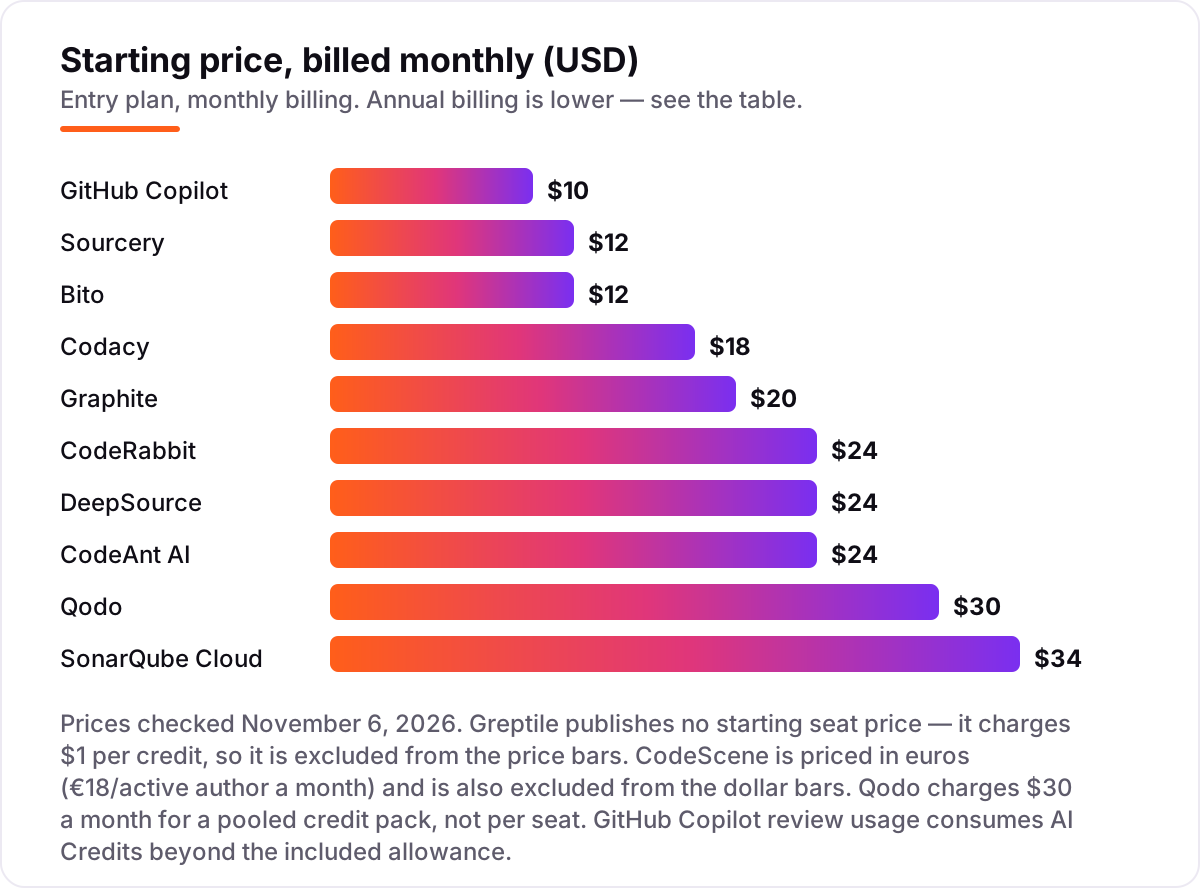
Take a 10-developer team shipping about 40 pull requests a month. On list prices, the subscription costs $34 a month on SonarQube Cloud Team, $40 on Greptile at 40 Base reviews, $100 on GitHub Copilot Pro, $120 on Sourcery Pro or Bito Team, $180 on Codacy Team, $200 on Graphite Starter, $240 on CodeRabbit Essentials, DeepSource Team or CodeAnt Premium, and $30 on Qodo's smallest credit pack — but that pack covers only about 18 reviews, so the team needs the $60 pack for 40 reviews.
Over a year, that is $408 on SonarQube Cloud, $480 on Greptile, $720 on Qodo's $60 pack, $1,200 on Copilot Pro, $1,440 on Sourcery Pro or Bito Team, $2,160 on Codacy Team, $2,400 on Graphite Starter, and $2,880 on CodeRabbit Essentials, DeepSource Team or CodeAnt Premium. The same 10 developers and the same 40 pull requests cost $408 a year at the cheap end and $2,880 at the dear end — a $2,472 gap that comes entirely from the billing model, not from features.
Three costs sit outside every number above. First, the metered extras: Copilot reviews consume AI Credits beyond the included allowance, Bito charges $5 per extra 1,000 lines beyond 5,000 per seat, and DeepSource bills AI Review at $8 per 10,000 lines once the $100 annual credit per user runs out. Second, the upgrade triggers: Graphite's unlimited AI reviews start on Team at $40 a user a month, and Codacy's Team plan caps at 30 developers. Third, the exchange rate on CodeScene, which bills €18 per active author a month — about $21 at current rates, but the dollar figure moves with the euro.
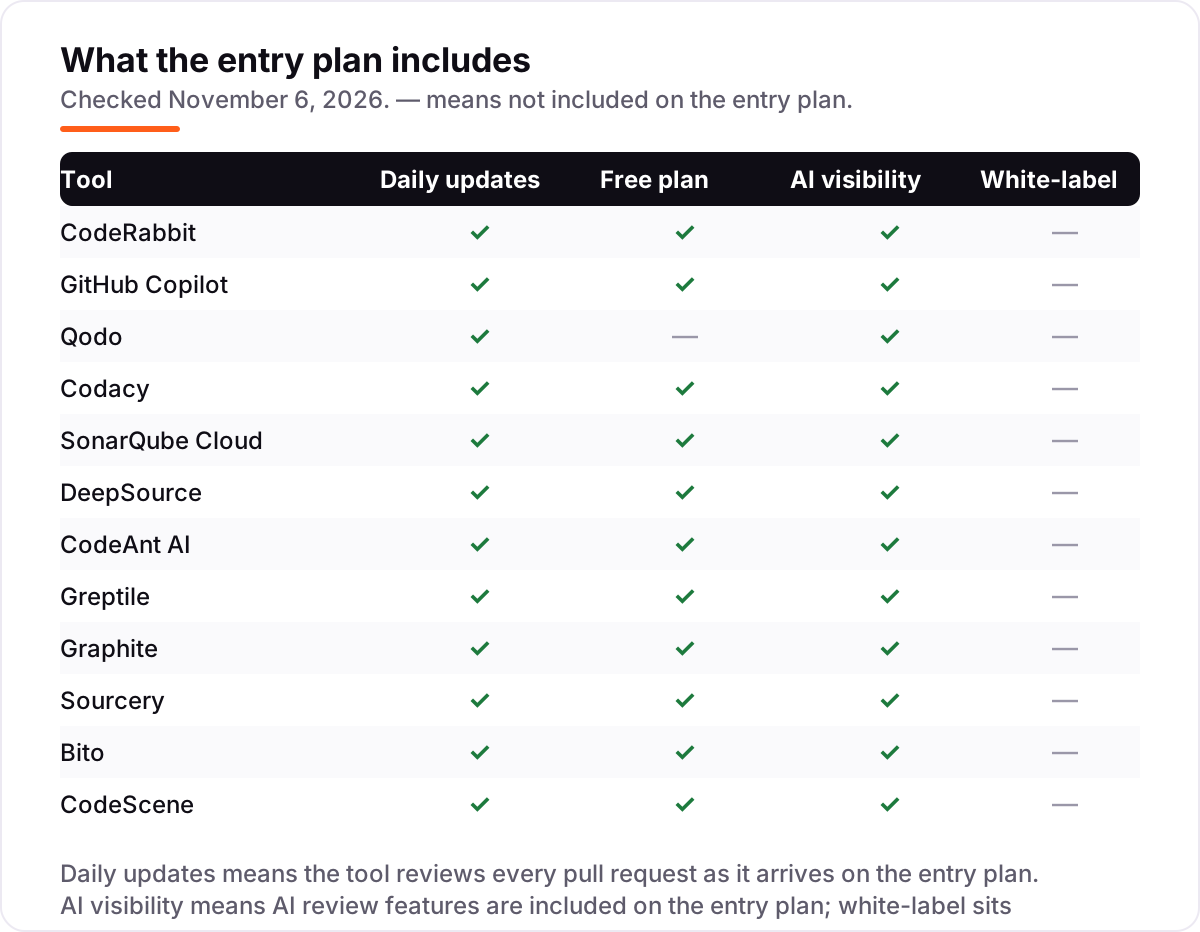
Annual billing cuts the bill on most tools here: CodeRabbit Essentials drops from $30 to $24 a user a month, Codacy Team from $21 to $18, Graphite Starter from $25 to $20, and Sourcery Pro from $15 to $12. SonarQube Cloud and Greptile publish no annual discount, so the monthly figure is the whole story. One more cost to check before you commit: a second repository host is a second decision on most tools here. GitHub-only tools need a second reviewer for GitLab or Bitbucket repos, and that second bill is the real cost of a mixed-platform team. If you run an agency rather than one product team, the visibility tools differ too — see our guide to the best SEO audit software.
Know the difference: AI review vs static analysis
The confusion in this category is between two kinds of tool that look identical on a pricing page. A static analysis tool runs deterministic rules over the code — it knows that a null pointer dereference is always a bug, and it enforces the same rules on every line, every time. An AI reviewer reads the change the way a colleague would: it understands intent, spots a logic error the rules never thought of, and suggests a cleaner implementation. The first is predictable and boring; the second is clever and sometimes wrong.
Most tools in this list blend the two. DeepSource and SonarQube Cloud run the rules first and let the AI comment on top; CodeRabbit, Qodo and CodeAnt AI lead with the AI and bolt rules on underneath. The blend matters because it decides what the tool misses: rule engines miss logic errors, and AI reviewers miss nothing so much as they invent findings that are not there. Independent tests put CodeRabbit's noise near 28%, and every AI reviewer in this list produces false positives at some rate.
There is a second, quieter confusion: a code review tool is not a code generation tool. Copilot writes code as well as reviewing it, and Qodo generates tests, but the review job is separate — reading a change, judging it, and blocking or approving it. If a tool only writes code, it belongs in a different list. Buy the reviewer for the review job, and judge the generator separately.
A third distinction worth knowing is advisory review versus enforced gates. Most AI reviewers comment and suggest; only some can block a merge. SonarQube Cloud quality gates, CodeAnt AI gates and Codacy gates can stop a pull request, while CodeRabbit and Qodo comments are advisory unless you wire up your own checks. If the team needs enforcement rather than advice, that single feature decides the shortlist.
Quick comparison: tool type by need
| Buyer | Best pick | Why |
|---|---|---|
| Most teams, deepest review | CodeRabbit | Deepest line-by-line review on all four Git platforms, from $24/user a month |
| GitHub-only team on a budget | GitHub Copilot | Review bundled into Copilot Pro at $10/user a month, Free plan at $0 |
| Review plus test generation | Qodo | One $30-a-month credit pack covers the whole team, tests included |
| Best value, one flat bill | Codacy | Quality, SAST, SCA and AI review for $18 a developer a month, no metering |
| Large team, small codebase | SonarQube Cloud | Flat $34 a month for the whole team, priced by lines of code |
| Python-first codebase | Sourcery | Deepest Python refactoring suggestions, Pro at $12 a developer a month |
Mistakes to avoid
- Budgeting on the seat price alone. Copilot reviews consume AI Credits, Bito charges per extra 1,000 lines, and DeepSource bills AI Review per 10,000 lines — the seat price is the floor, not the bill.
- Buying a GitHub-only reviewer for a mixed-platform team. Copilot and Graphite review GitHub code only. If the team has GitLab or Bitbucket repos, the second reviewer is a second bill.
- Trusting the free tier past its limit. CodeRabbit's free tier rate-limits reviews, SonarQube Cloud's free tier stops at 50,000 lines, and Qodo has no free tier at all — only a 14-day trial.
- Letting the AI be the only approval. AI reviewers miss context-dependent logic and produce false positives. Keep a human approval on every change, especially on risky ones.
- Skipping the two-week trial on real pull requests. A noisy reviewer on top of sloppy pull requests makes review worse. Measure how many comments engineers act on before you commit to a year.
How we chose
We checked each vendor's own pricing page on November 6, 2026 and recorded the starting price exactly as shown, including the annual-billing figure where the page lists one, and we ranked the tools by fit for the most common buyer — a team shipping pull requests every day — not by brand size. Ratings are shown only where a fresh copy of the exact G2 review page, crawled within the last few days, showed the score and count; the other seven tools carry no rating here because their G2 pages were not verified, and we would rather show no rating than a stale or estimated one. Three prices need a note: Greptile dropped its $30-a-seat plan in late 2026 and now charges $1 per review credit, Qodo's free tier appears retired on its current pricing page, and Sourcery Pro is $12 a developer a month on annual billing, not the $10 quoted in older roundups. No vendor paid for a place in this list, and none of the links here are affiliate links.
What to do next
Start with the free tier or trial of your top pick and run two real weeks of pull requests through it. Check how many comments engineers act on, and whether the bill matches the quote once real volume flows through it. If the code is sorted but new customers are not finding you, our AI search optimization service handles the visibility side — or compare providers in our guide to A/B testing software for app developers. Once your tools are in place, find out what's holding your rankings back.
Your stack only works if people find you
SerpAstra fixes what keeps your site off page one and makes it easy for AI assistants to recommend.
Get a free audit→Sources we checked (17)
- CodeRabbit pricing — coderabbit.ai/pricing (checked November 6, 2026)
- GitHub Copilot plans — github.com/features/copilot/plans (checked November 6, 2026)
- Qodo pricing — qodo.ai/pricing (checked November 6, 2026)
- Codacy pricing — codacy.com/pricing (checked November 6, 2026)
- SonarQube Cloud plans and pricing — sonarsource.com/plans-and-pricing (checked November 6, 2026)
- DeepSource pricing — deepsource.com/pricing (checked November 6, 2026)
- CodeAnt AI pricing — codeant.ai/pricing (checked November 6, 2026)
- Greptile pricing — greptile.com/pricing (checked November 6, 2026)
- Graphite pricing — graphite.dev/pricing (checked November 6, 2026)
- Sourcery pricing — sourcery.ai/pricing (checked November 6, 2026)
- Bito pricing — bito.ai/pricing (checked November 6, 2026)
- CodeScene pricing — codescene.com/pricing (checked November 6, 2026)
- CodeRabbit reviews — g2.com/products/coderabbit/reviews (checked November 6, 2026)
- GitHub Copilot reviews — g2.com/products/github-copilot/reviews (checked November 6, 2026)
- Codacy reviews — g2.com/products/codacy/reviews (checked November 6, 2026)
- SonarQube reviews — g2.com/products/sonarqube/reviews (checked November 6, 2026)
- DeepSource reviews — g2.com/products/deepsource/reviews (checked November 6, 2026)
Shamim
Founder of SerpAstra
A full-stack SEO and digital marketer who spends most days on Local SEO for dental practices, AI search visibility and lead generation.
Frequently asked questions
What is the best AI code review tool?
CodeRabbit is the best fit for most teams: the deepest line-by-line review, all four Git platforms, and a free tier, from $24/user a month on annual billing. GitHub-only teams should start with Copilot at $10, and small teams on a budget should look at Codacy at $18 a developer a month.
How much does AI code review cost?
Seat-based tools run $10–$34 a user a month: Copilot Pro is $10, Sourcery and Bito are $12, Codacy is $18, and CodeRabbit, DeepSource and CodeAnt are $24. Usage-based tools differ: Qodo charges $30 a month for a credit pack, Greptile charges $1 per review credit, and SonarQube Cloud is a flat $34 a month.
Is there a free AI code review tool?
Yes, with limits. CodeRabbit and GitHub Copilot both have free tiers, Greptile Starter is free for one developer with 50 credits a month, and Sourcery, SonarQube Cloud, DeepSource and Codacy are free for open-source or small codebases. Free plans cap reviews, lines of code or platforms, so check the limit before you rely on one.
Can AI code review replace human reviewers?
No, not yet. AI reviewers reliably catch style issues, common bug patterns, security anti-patterns and obvious performance wins, but they miss context-dependent logic and produce false positives. Keep a human approval on every change, and never let an AI reviewer be the only approval on risky changes.
Which AI code review tools work with GitLab or Bitbucket?
CodeRabbit, Qodo, CodeAnt AI and Bito work across GitHub, GitLab and Bitbucket, and Codacy and DeepSource cover GitLab and Bitbucket too. GitHub Copilot and Graphite are GitHub-only, and Greptile supports GitHub and GitLab but not Bitbucket Cloud. Check your host before you trial anything.
What do AI code review tools actually catch?
They catch style and formatting issues, common bugs such as null-pointer risks and off-by-one errors, security anti-patterns such as hardcoded secrets and SQL injection, and obvious performance wins such as N+1 queries. They miss business rules, design trade-offs and context-dependent logic, so verify every suggestion before merging.
Should I pay per seat or per review?
Pay per seat when the team reviews every day — a flat $24 a user a month beats metered billing at high volume. Pay per review when volume is low or spiky: Greptile at $1 a credit or Qodo at $30 a month for a credit pack can cost far less than ten seats. Count last month's pull requests before you choose.
Free SEO and AI visibility audit
Find out what is holding your rankings back
Send us your site. Within 2 business days you get a written audit, an AI visibility check and a short fix list ranked by impact. Free, with no contract attached.
Request my free audit→Related guides
 SEO & AI Search10 Best AI Search Optimization Tools in 2026 (Free and Paid, Compared)10 best AI search optimization tools compared on price, AI visibility coverage and content scoring, with real prices checked October 31, 2026.Read guide →
 SEO & AI SearchBest SEO Audit Software for 2026: 10 Options Compared by Use Case10 best SEO audit software tools compared on price, crawl depth and AI visibility. Prices checked on vendor pricing pages, November 1, 2026.Read guide →
 Digital Marketing & Ads9 Best A/B Testing Software for App Developers in 2026, ComparedCompare the 9 best A/B testing software for app developers on price, free tiers, SDKs and stats, with every price checked today, November 4, 2026.Read guide →