
10 Best AI Marketing Automation Tools in 2026, Compared
10 best AI marketing automation tools compared on price, AI features and free plans — real starting prices checked November 4, 2026, sorted by use case.
 Shamim Mia, Founder, SerpAstraLast verified November 4, 202615 min read
We compare pricing pages, documentation and public reviews. We never accept payment for rankings.

Key takeaways
- HubSpot is the best all-in-one for most teams: free CRM and email, with Starter at $20 per seat a month. ActiveCampaign has the deepest automation for the money, from $15 a month billed annually.
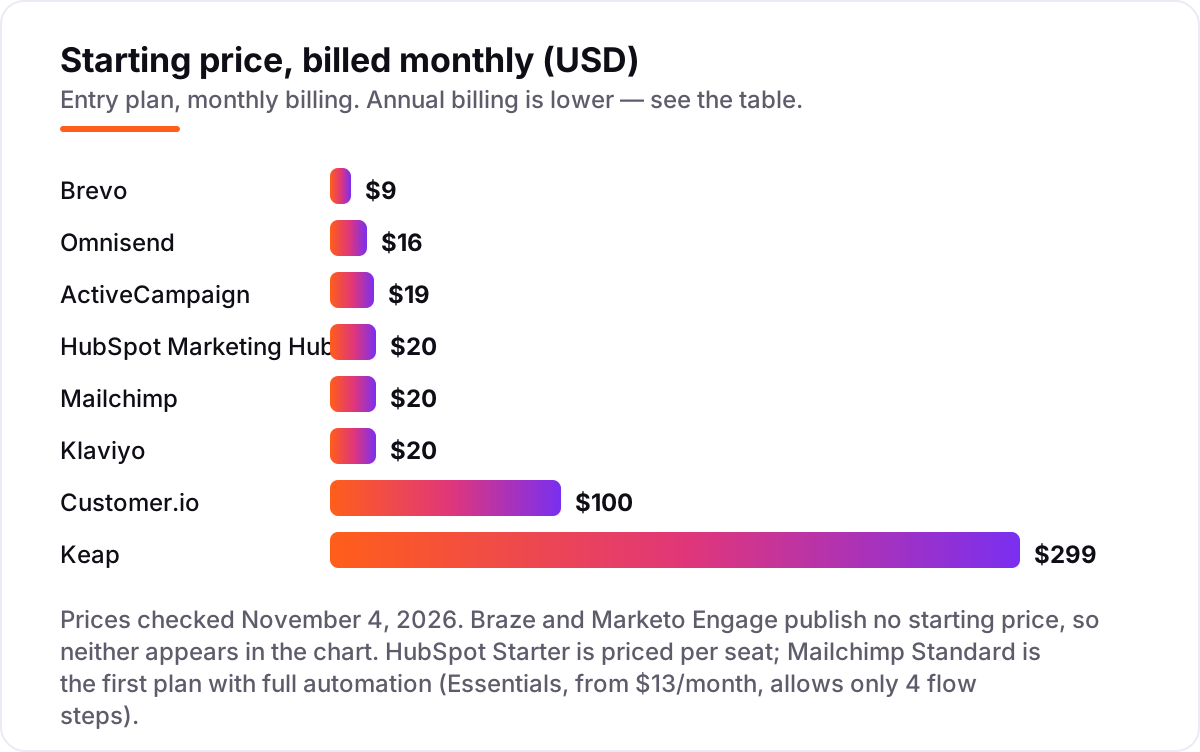
- Brevo is the cheapest paid start at $9 a month, and Omnisend is the best ecommerce value at $16 a month, with every feature on the free plan.
- The single most important buying factor is what the price is based on — contacts, profiles, emails sent or seats — because the same list can cost $9 or $100 a month depending on the billing model.
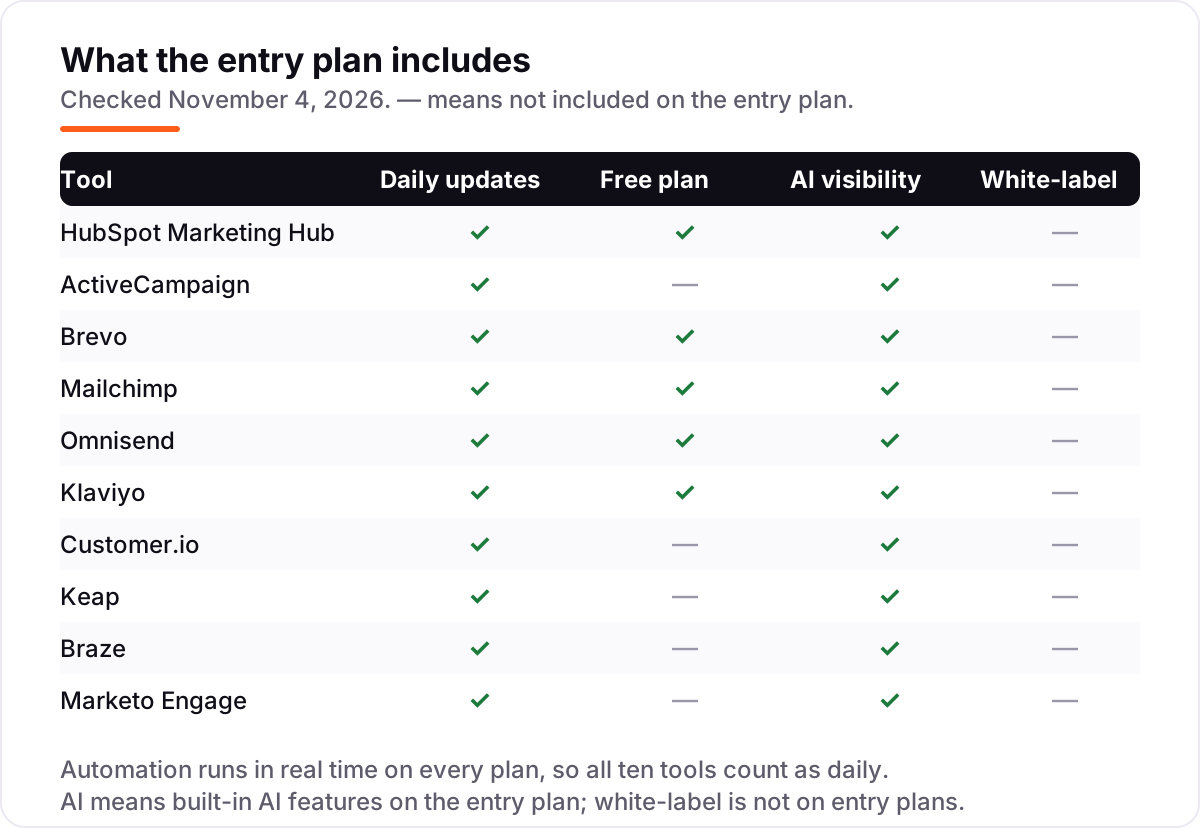
- Free plans exist — HubSpot, Brevo, Mailchimp, Klaviyo and Omnisend all have one — but full automation usually needs a paid plan.
- Every price below was checked on the vendor's own pricing page on November 4, 2026, except Braze and Marketo Engage, which publish no prices. Ratings are G2, except Keap (Capterra), with review counts shown.
On this page
Quick comparison
| Tool | Best for | Starting price | Free plan |
|---|---|---|---|
| HubSpot Marketing Hub | Small and mid-sized teams that want email, CRM, landing pages and automation in one system | $20/mo per seat | Yes (free plan) |
| ActiveCampaign | Small teams that need deep, visual automation and a built-in CRM without enterprise pricing | $19/mo | No (14-day trial) |
| Brevo | Small businesses with big lists that send infrequently and want the lowest monthly bill | $9/mo | Yes (300/day) |
| Mailchimp | Small businesses that want the most familiar all-in-one suite with the widest integration library | $20/mo | Yes (250 contacts) |
| Omnisend | Small and mid-sized online stores that want Klaviyo-style automation at a lower price | $16/mo | Yes (250 contacts) |
| Klaviyo | Growth-stage ecommerce brands that live on email and SMS revenue from Shopify or WooCommerce | $20/mo | Yes (250 profiles) |
| Customer.io | B2B SaaS and app teams that trigger messages from what users do inside the product | $100/mo | No (14-day trial) |
| Keap | Service businesses and coaches that want CRM, sales pipelines and automation in one account | $299/mo | No (14-day trial) |
| Braze | Consumer apps and large B2C brands running cross-channel journeys at scale | Custom quote | No (demo only) |
| Marketo Engage | Enterprise B2B marketing teams running complex nurture, scoring and account-based programs | Custom quote | No (demo only) |
Make one of these tools?
We re-check this list every quarter. Send a correction, request a review, or ask about a clearly labeled sponsored spot.
Request a listingThe best AI marketing automation tools

HubSpot Marketing Hub
Best for: Small and mid-sized teams that want email, CRM, landing pages and automation in one system
HubSpot Marketing Hub is the default all-in-one pick because the free plan is genuinely usable: email marketing, forms, landing pages and the CRM are included, and Starter ($20 per seat per month) removes HubSpot branding and adds 1,000 marketing contacts. Everything shares one contact record, so a workflow can score a lead, enrol it in a nurture sequence and alert sales without a third-party connector.
The catch is the pricing curve. Starter bills per seat and per 1,000-contact block ($50 a month per extra block), and the automation that makes HubSpot famous — lead scoring, smart content and A/B testing at scale — sits on Professional at $890 a month plus a $3,000 onboarding fee. Buy HubSpot when you want one system for marketing and sales; buy a cheaper email tool if you only need campaigns.
What we like
- Free plan covers email marketing, forms and the CRM, so a small team can start without paying
- Breeze AI writes and personalizes emails, and Smart Content adapts pages and emails by contact
- Workflows connect email, ads, social and the CRM, so one automation can span the whole funnel
- More than 1,500 integrations, including Salesforce, Slack and Shopify, with native reporting
Watch out for
- Starter is priced per seat and per 1,000 marketing contacts, so the bill grows with both team and list
- Real automation depth starts at Professional ($890/month), a steep jump from Starter, plus a $3,000 onboarding fee

ActiveCampaign
Best for: Small teams that need deep, visual automation and a built-in CRM without enterprise pricing
ActiveCampaign is the automation specialist in this list. The visual builder handles multi-step, behaviour-triggered workflows — abandoned cart, post-purchase, win-back — without code, and the 950-plus recipe library means most teams never build from scratch. Starter costs $15 a month billed annually ($19 month to month) for 1,000 contacts and includes email, automation and a standard CRM.
The limits are on the entry plan: each automation holds only 5 actions, segmentation is limited and there is a single user, so most serious programs need Plus at $49 a month. Pricing also scales hard with list size — Starter reaches $149 a month at 10,000 contacts. Choose ActiveCampaign when automation depth is the priority and the list is still small.
What we like
- Visual automation builder with 950+ recipes and conditional logic, the strongest at this price
- Predictive sending and win probability on Plus, with site tracking and ecommerce triggers
- Built-in CRM with deal pipelines, so sales follow-up lives in the same account as email
Watch out for
- Starter caps each automation at 5 actions and allows only 1 user, so real programs need Plus ($49/month)
- No free plan, and the price rises steeply with contact count — $149/month at 10,000 contacts on Starter
Brevo
Best for: Small businesses with big lists that send infrequently and want the lowest monthly bill
Brevo is the cheapest way into marketing automation because it bills by emails sent rather than contacts stored. Starter costs $9 a month for 5,000 emails, and the free plan stores up to 100,000 contacts while sending 300 emails a day. That pricing model suits a business with a big list it emails once or twice a month, and the same account covers SMS, WhatsApp and transactional email.
The trade-off is depth. Automation templates exist but the builder is simpler than ActiveCampaign's, and Starter ties contact storage to send volume — 500 contacts at the 5,000-email tier — while removing the Brevo logo costs another $12 a month. Pick Brevo when the list is large, the sending is light and the budget is tight.
What we like
- Cheapest entry here at $9 a month, and the free plan stores 100,000 contacts with 300 emails a day
- Bills by emails sent, not contacts stored, so a large list you rarely email costs almost nothing
- Email, SMS, WhatsApp and transactional messages plus a basic CRM in one account
Watch out for
- Starter caps contacts by send volume — 500 contacts at 5,000 emails — and keeps the Brevo logo unless you pay $12 a month extra
- Automation is lighter than ActiveCampaign or Klaviyo, and phone support starts on Professional ($499/month)

Mailchimp
Best for: Small businesses that want the most familiar all-in-one suite with the widest integration library
Mailchimp is the name most small businesses already know, and that familiarity is the point: 300-plus integrations, landing pages, surveys and social posting sit next to email in one account. Automation lives on the Standard plan at $20 a month for 500 contacts, with up to 200 flows, predictive segmentation, dynamic content and generative AI features.
The pricing needs a close read. Essentials starts at $13 a month but caps flows at four steps, so Standard is the real entry price for automation. The bill also scales with every contact band — Standard reaches $100 a month at 5,000 contacts — and unsubscribed contacts count toward the tier until archived. Choose Mailchimp for breadth and integrations, not for the lowest bill.
What we like
- Largest integration library in this list — 300+ apps — plus landing pages, surveys and social posting
- Standard adds up to 200 automation flows, predictive segmentation and generative AI writing
- Free plan covers 250 contacts and 500 sends a month, with a 14-day trial of any paid plan
Watch out for
- Essentials ($13/month) allows only 4 flow steps, so real automation needs Standard at $20 a month
- Price climbs fast with list size — Standard is $100 a month at 5,000 contacts — and unsubscribed contacts still count

Omnisend
Best for: Small and mid-sized online stores that want Klaviyo-style automation at a lower price
Omnisend is the value pick for online stores. Standard costs $16 a month for 500 contacts with 6,000 emails, and the free plan covers 250 contacts with every feature unlocked — including the AI segment builder, subject-line assistant and product recommendations. Pre-built flows for welcome series, abandoned cart and post-purchase get a store running in an afternoon, and migration from Klaviyo is free.
The gaps are at the edges. SMS changed in 2026: new Standard accounts buy it as an add-on rather than getting credits included, and Pro is the plan that bundles it. Segmentation and reporting are also shallower than Klaviyo's, so a large store doing serious revenue analysis will outgrow it. For a growing store that wants the core ecommerce playbook cheap, Omnisend is hard to beat.
What we like
- Every feature, including AI tools, is available on the free plan — no feature gating by tier
- Pre-built ecommerce flows for welcome, abandoned cart and post-purchase, with free migration from Klaviyo
- Email, SMS and web push in one platform, with Forms AI and Reports AI on Standard
Watch out for
- SMS is a paid add-on for new sign-ups from May 2026, not included in Standard as it once was
- Reporting and segmentation are shallower than Klaviyo's, and the template editor is less flexible

Klaviyo
Best for: Growth-stage ecommerce brands that live on email and SMS revenue from Shopify or WooCommerce
Klaviyo is the deepest ecommerce automation tool in this list. The Email plan starts at $20 a month for 500 active profiles with 5,000 sends, and it pairs flows for the full purchase journey with predictive analytics — expected date of next order, churn risk, lifetime value — and product recommendations driven by the store's own catalog.
The pricing model is the thing to understand: since February 2025 Klaviyo bills on every active profile, whether or not you emailed them, so a stale list costs real money. There is no annual discount on self-serve plans, and the Email+SMS bundle is priced on request. Buy Klaviyo when email and SMS drive a large share of store revenue; buy Omnisend when the budget matters more than the depth.
What we like
- Deepest ecommerce automation here: predictive analytics, product recommendations and 350+ integrations
- Bills on active profiles with a 10x send multiplier, and flows cover the full purchase journey
- Generative AI writes subject lines and content, with benchmarking against similar stores
Watch out for
- No annual discount on self-serve plans, and the bill rises fast — $150 a month at 10,000 profiles
- Email+SMS bundle pricing is on request, and list hygiene directly controls the cost

Customer.io
Best for: B2B SaaS and app teams that trigger messages from what users do inside the product
Customer.io is built for product-led teams. Essentials costs $100 a month for 5,000 profiles and triggers email, SMS, push and in-app messages from events inside your product — a trial expiring, a feature used, a plan upgraded — rather than from a static list. Unlimited seats and a million emails a month are included, and company objects make it work for B2B accounts.
The entry price is the honest limitation: there is no plan under 5,000 profiles, so a 500-person list pays the same $100 as a 5,000-person one. Setup also needs real event data piped in, which takes engineering time, and there is no free plan — only a 14-day trial and a 12-month Startup Program for eligible companies. Pick Customer.io when product behaviour, not list size, should drive the message.
What we like
- Event-based workflows trigger email, SMS, push and in-app messages from real product behaviour
- Unlimited seats and 1 million emails a month on Essentials, with company objects for B2B accounts
- AI agents draft and run campaigns, and the data model handles nested event data without workarounds
Watch out for
- No plan under 5,000 profiles, so a small list pays $100 a month for room it does not use
- No free plan, and the learning curve is steep — setup needs real event data, not just a contact list

Keap
Best for: Service businesses and coaches that want CRM, sales pipelines and automation in one account
Keap, formerly Infusionsoft and now part of Thryv, is the all-in-one for service businesses. A single plan — $299 a month, or $249 billed annually — covers the CRM, email campaigns, sales pipelines, appointment scheduling, quotes, invoicing and payments for 1,500 contacts and two users. The visual automation builder now adds AI Plays that draft follow-ups and predict the best send time.
The cost is the whole story. There are no cheaper tiers, a $500 implementation fee is mandatory, and cancelling an annual contract early costs $299 — with cancellation by phone. Reviewers also note the learning curve and a dated interface. Keap fits a service business that will use the CRM, the pipeline and the payments every day; for email alone it is far too expensive.
What we like
- One plan covers CRM, email, pipelines, invoicing, payments and appointment scheduling
- Visual automation builder with AI Plays and predictive send-time intelligence
- Quotes, invoicing and payment collection are built in, so follow-up ends in a paid invoice
Watch out for
- Single plan at $299 a month ($249 billed annually) plus a mandatory $500 implementation fee
- No free plan, phone-only cancellation, and a $299 early-termination fee on annual contracts

Braze
Best for: Consumer apps and large B2C brands running cross-channel journeys at scale
Braze is the enterprise cross-channel platform in this list. Its Canvas builder maps multi-step journeys across email, push, SMS, in-app messages and web push, and BrazeAI personalizes content, predicts churn and picks the best send time per user. Pricing is by monthly active users, and there are no per-seat fees, so the whole team can work in the account.
There is no public price — every deal is a custom quote, and third-party reports put typical contracts in the tens of thousands of dollars a year and up. Implementation runs for months and the platform needs a dedicated team to operate. Braze is the right pick for a consumer app or large B2C brand with millions of users; it is not a tool a small business should shortlist.
What we like
- Canvas builds multi-step, cross-channel journeys across email, push, SMS, in-app and web push
- BrazeAI personalizes content and predicts churn and lifetime value in real time
- Real-time data streaming and Liquid personalization, with no per-seat fees for team members
Watch out for
- Quote-only pricing with no public rate card — budgeting needs a sales conversation first
- Enterprise-only in practice: long implementation and a dedicated team to run it

Marketo Engage
Best for: Enterprise B2B marketing teams running complex nurture, scoring and account-based programs
Marketo Engage is Adobe's enterprise B2B automation platform and the category's old hand. Four packages — Growth, Select, Prime and the top tier — are quoted annually by database size and cover lead scoring, multi-step nurture, account-based marketing and revenue attribution, with deep Salesforce and Dynamics sync. Adobe Sensei AI adds predictive content and Dynamic Chat for conversational lead qualification.
Adobe publishes no price, and every package is a custom quote shaped by database size and add-ons. Implementation typically takes around three months, and G2 reviewers consistently cite the steep learning curve and dated interface. Marketo fits an enterprise B2B team with a dedicated marketing-operations specialist; smaller teams will find HubSpot or ActiveCampaign far easier to live with.
What we like
- Deepest B2B automation here: lead scoring, nurture programs, account-based marketing and revenue attribution
- Four packages scale from Growth to the top tier, with 20,000–50,000 API calls a day and strong CRM sync
- Adobe Sensei AI powers predictive content and Dynamic Chat for conversational qualification
Watch out for
- Quote-only pricing — Adobe publishes no price list — and typical contracts run into five figures a year
- Steep learning curve and a dated interface; G2 reviewers report about three months to implement
These are the 10 best AI marketing automation tools in 2026, ranked by fit for the most common buyer: a small or mid-sized team that wants campaigns, journeys and follow-up to run themselves. The list is sorted by who each tool fits — all-in-one suites first, then email-first tools, ecommerce specialists, event-driven platforms and enterprise systems — not by brand size. Every price below was checked on the vendor's own pricing page on November 4, 2026, except Braze and Marketo Engage, which publish no prices.
What an AI marketing automation tool actually does
A marketing automation tool watches what contacts do and reacts without a human in the loop. Someone abandons a cart, and a reminder goes out an hour later; a trial user goes quiet, and a win-back sequence starts; a lead hits a score threshold, and sales gets an alert. The AI layer adds prediction on top: the best time to send, the product a customer is most likely to buy next, or the subject line most likely to be opened.
The payoff is real — Omnisend's 2026 personalization guide reports that automated emails were only 2% of sends but generated 30% of revenue for the stores it covers — but only if the triggers are built on real behaviour, not on guesswork. A tool that only schedules bulk newsletters is email marketing, not automation, however much AI it claims.
Free and cheap options first
If your list is small or your budget is tight, start free. HubSpot, Brevo, Mailchimp, Klaviyo and Omnisend all have free plans, and Omnisend is the only one that puts its AI tools on the free tier with no feature gating. Brevo's free plan is the most generous on paper — 100,000 contacts and 300 emails a day — because it bills by sends, not by contacts.
The free tiers are honest products, but they cap out fast: Mailchimp allows 250 contacts and 500 sends a month, and Klaviyo 250 profiles. Once you need multi-step journeys or more than a few hundred contacts, the paid plans below start at $9 a month, and the cheapest paid plan is usually cheaper than the time you lose to manual follow-up.
Email-first automation for small teams
HubSpot, ActiveCampaign, Brevo and Mailchimp are the generalists: email first, with automation, landing pages and a CRM layered on. They fit a team that sends newsletters, runs nurture sequences and wants sales follow-up in the same account. HubSpot is the all-in-one, ActiveCampaign the automation specialist, Brevo the budget pick and Mailchimp the familiar suite with the widest integrations.
If you only send email, any of the four works; the choice comes down to price per contact, how deep the automation goes on the plan you can afford, and whether you need a real CRM. Our AI search optimization service can help once the emails are flowing — automation brings people back, but search is what finds them first.
Ecommerce automation that pays for itself
For online stores, automation is not a nice extra — it is the revenue engine. Klaviyo and Omnisend are built for it: welcome series, abandoned cart, post-purchase and win-back flows that trigger from the store's own order data, with product recommendations and predictive analytics on top. Klaviyo goes deeper on segmentation and reporting; Omnisend is cheaper at every list size and includes every feature on the free plan.
Brevo also works for stores that send infrequently, and Mailchimp covers general stores that want landing pages and social posting alongside email. Whichever you pick, connect the store first — flows built on purchase data outperform flows built on list segments.
Event-driven lifecycle for SaaS and apps
Customer.io is the odd one out in this list, and deliberately so. It does not think in campaigns; it thinks in events. A user signs up, invites a teammate, hits a usage limit or goes quiet for a week, and the right message goes out on the right channel — email, SMS, push or in-app. That event model is what B2B SaaS and app teams need, and it is why Customer.io charges by profiles with unlimited seats rather than by campaigns.
The trade-off is setup: you need real event data piped in before the first workflow is worth anything, and there is no plan under 5,000 profiles.
Enterprise cross-channel and B2B
Braze and Marketo Engage are the enterprise end of the list, and they are bought differently: through sales, on annual contracts, with implementation measured in months. Braze runs cross-channel journeys for consumer apps — email, push, SMS and in-app from one canvas, priced by monthly active users. Marketo Engage runs B2B nurture, lead scoring and account-based marketing for large sales teams, quoted by database size.
Neither publishes a price, and neither should be on a small team's shortlist. They are here because they define the top of the category — and because knowing what they cost in time and money makes the $9–$100 tools look like the bargains they are.
Quick comparison: tool type by need
| Buyer | Best pick | Why |
|---|---|---|
| Small team, one system for marketing and sales | HubSpot Marketing Hub | Free CRM and email, Starter $20 per seat |
| Deepest automation for the money | ActiveCampaign | Visual builder and 950+ recipes from $15 a month billed annually |
| Tightest budget, big list | Brevo | $9 a month, billed by sends not contacts |
| Familiar suite, widest integrations | Mailchimp | 300+ integrations, Standard $20 a month |
| Online store, best value | Omnisend | Every feature on the free plan, Standard $16 a month |
| Online store, deepest ecommerce | Klaviyo | Predictive analytics and product recommendations from $20 a month |
| SaaS or app, event-driven messaging | Customer.io | Workflows triggered by product behaviour, $100 a month |
| Service business, CRM plus automation | Keap | CRM, pipeline and payments in one plan, $249 a month billed annually |
| Consumer app, cross-channel at scale | Braze | Canvas journeys across every channel, custom quote |
| Enterprise B2B, complex nurture | Marketo Engage | Lead scoring and ABM, custom quote |
Pricing: what you will actually pay
Price your own list, not the headline. Take a 5,000-person list sending weekly: Brevo Starter costs about $32 a month because it bills by sends, not contacts. ActiveCampaign Starter costs $79 a month billed annually. Mailchimp Standard, Klaviyo Email and Customer.io Essentials each cost about $100 a month for the same list. Over a year that is roughly $384 on Brevo, $948 on ActiveCampaign and about $1,200 on Mailchimp, Klaviyo or Customer.io — the same contacts, the same sends, three very different bills. Then check the automation limits on the plan you can afford: ActiveCampaign Starter caps each automation at 5 actions and Mailchimp Essentials at 4 flow steps, so a cheap plan that cannot run your journey is not cheap. Keap at $249 a month billed annually only makes sense once you need its CRM, pipeline and payments in the same plan.
Know the difference: AI marketing automation vs email marketing vs CRM
Email marketing sends messages — newsletters, campaigns, one-off blasts — and reports opens and clicks. AI marketing automation runs multi-step journeys across channels: it scores leads, branches on behaviour, sends the right message at the right time and lets AI decide the next step. A CRM stores the customer record and the sales pipeline; it is the memory, not the messenger. Most tools in this list combine two or all three — HubSpot and Keap bundle CRM with automation, Klaviyo and Omnisend pair ecommerce data with journeys — but the buying question stays the same: do you need sends, journeys, or the record behind them? Buy the capability you will actually use, because a CRM-priced plan bought for email sends is money spent on memory you never read.
How to choose the best ai marketing automation tools: a short decision path
- Work out what the price is based on. Contacts, active profiles, emails sent or seats — the same 5,000-person list costs about $100 a month on Mailchimp Standard, Klaviyo Email and Customer.io Essentials, $79 on ActiveCampaign Starter billed annually, and about $32 on Brevo Starter if you send weekly. Price your own list, not the headline.
- Check the automation limits on the plan you can afford. ActiveCampaign Starter caps each automation at 5 actions, Mailchimp Essentials at 4 flow steps, and several tools gate predictive sending or AI features to higher tiers.
- Decide email-first or event-first. If campaigns and newsletters are the job, pick an email-first tool. If product behaviour should trigger the message, you need Customer.io or an enterprise platform.
- Count the seats and the add-ons. HubSpot Starter bills per seat, Keap charges $39 a month per extra user, and logo removal, SMS credits and onboarding fees all sit outside the headline price.
- Try it with real data. Every tool here has a free plan or a trial. Build one real journey — a welcome series or an abandoned cart — and check the reports before you pay. Before you publish the landing pages those journeys point to, run your titles through the free SERP snippet preview tool to see how they will look in Google.
Mistakes to avoid
- Comparing headline prices without checking the billing unit. A $9 tool billed by sends and a $20 tool billed by contacts are not comparable until you price your own list and send volume.
- Paying for a suite when you only need email. A $299-a-month all-in-one is wasted if you send two newsletters a month — Brevo or Omnisend will do the same job for under $20.
- Ignoring what counts as a contact. Klaviyo bills every active profile, Mailchimp counts unsubscribed contacts, and Brevo caps contacts by send volume. A stale list costs real money on all three.
- Trusting a directory price. Several directories still show old figures for these tools; the live pricing page is the only number that matters, and it changes without notice.
- Forgetting the implementation fee. Keap charges $500 to get started, HubSpot Professional adds a $3,000 onboarding fee, and Marketo typically takes three months to implement. Budget the setup, not just the subscription.
How we chose
We checked each vendor's own pricing page on November 4, 2026 and recorded the starting price exactly as shown, including the annual-billing figure where the page lists one. Braze and Marketo Engage publish no prices, so both are listed as custom quote. Ratings come from G2, except Keap, where G2's rebranded profile holds only about 30 reviews — so we used its Capterra rating instead. We ranked the tools by fit for the most common buyer — a small or mid-sized team automating email and follow-up — not by brand size. No vendor paid for a place in this list, and none of the links here are affiliate links.
What to do next
Start with the decision path above: price your own list, check the automation limits on the plan you can afford, and decide email-first or event-first. Then take the free plan or trial of your top pick and build one real journey — a welcome series or an abandoned cart flow — with your actual contacts. If the reports make sense and the messages send on time, you have your tool. Once your tools are in place, find out what's holding your rankings back.
Your stack only works if people find you
SerpAstra fixes what keeps your site off page one and makes it easy for AI assistants to recommend.
Get a free audit→Sources we checked (21)
- HubSpot Marketing Hub pricing — hubspot.com/pricing/marketing (checked November 4, 2026)
- HubSpot Marketing Hub on G2 — 4.4/5, 16,046 reviews (checked November 4, 2026)
- ActiveCampaign pricing — activecampaign.com/pricing (checked November 4, 2026)
- ActiveCampaign on G2 — 4.4/5, 14,825 reviews (checked November 4, 2026)
- Brevo pricing — brevo.com/pricing (checked November 4, 2026)
- Brevo on G2 — 4.5/5, 2,570 reviews (checked November 4, 2026)
- Mailchimp pricing — mailchimp.com/pricing/marketing (checked November 4, 2026)
- Mailchimp on G2 — 4.4/5, 5,442 reviews (checked November 4, 2026)
- Omnisend pricing — omnisend.com/pricing (checked November 4, 2026)
- Omnisend on G2 — 4.6/5, 1,267 reviews (checked November 4, 2026)
- Klaviyo pricing — klaviyo.com/pricing (checked November 4, 2026)
- Klaviyo on G2 — 4.6/5, 1,360 reviews (checked November 4, 2026)
- Customer.io pricing — customer.io/pricing (checked November 4, 2026)
- Customer.io on G2 — 4.4/5, 1,002 reviews (checked November 4, 2026)
- Keap pricing — keap.com/pricing (checked November 4, 2026)
- Keap on Capterra — 4.1/5, 1,299 reviews (checked November 4, 2026)
- Braze — braze.com (no published pricing; quote only, checked November 4, 2026)
- Braze on G2 — 4.5/5, 1,683 reviews (checked November 4, 2026)
- Marketo Engage — business.adobe.com (no published pricing; quote only, checked November 4, 2026)
- Marketo Engage on G2 — 4.1/5, 3,344 reviews (checked November 4, 2026)
- Omnisend on automated email revenue — automated emails were 2% of sends and 30% of revenue (2026)
Shamim
Founder of SerpAstra
A full-stack SEO and digital marketer who spends most days on Local SEO for dental practices, AI search visibility and lead generation.
Frequently asked questions
What is the best AI marketing automation tool in 2026?
HubSpot Marketing Hub is the best all-in-one for most teams: free CRM and email, with Starter at $20 per seat a month. ActiveCampaign has the deepest automation for the money, from $15 a month billed annually. Klaviyo leads for ecommerce, and Braze and Marketo Engage are the enterprise picks. The right tool depends on whether you need a CRM, store revenue or B2B nurture.
How much does AI marketing automation software cost?
Between $9 and $299 a month at the entry level. Brevo starts at $9, Omnisend at $16, ActiveCampaign at $15 billed annually and HubSpot at $20 per seat. Customer.io starts at $100 and Keap at $299. Braze and Marketo Engage are quote-only, with typical enterprise contracts running into five figures a year. The billing unit — contacts, profiles, sends or seats — matters as much as the headline price.
Is there a free AI marketing automation tool?
Yes, with limits. HubSpot, Brevo, Mailchimp, Klaviyo and Omnisend all have free plans, and Omnisend includes its AI tools on the free plan. Free tiers cap contacts and sends — Mailchimp allows 250 contacts and 500 sends a month — and full automation usually needs a paid plan. ActiveCampaign, Customer.io and Keap offer 14-day trials instead of a free plan.
What is the difference between marketing automation and email marketing?
Email marketing sends campaigns to a list. Marketing automation runs multi-step journeys triggered by behaviour — a cart abandoned, a trial expiring, a page visited — and scores and segments contacts automatically. The AI part adds prediction and personalization: the best send time, the next product to recommend, or the leads most likely to buy. Every tool in this list does both email and automation.
Which AI marketing automation tool is best for ecommerce?
Klaviyo is the deepest for ecommerce, with predictive analytics and product recommendations from $20 a month. Omnisend is the best value at $16 a month, with the same core flows and every feature on the free plan. Brevo is the cheapest at $9 a month for stores that send infrequently. Mailchimp works for general stores that also want landing pages and social posting in one account.
Should I choose HubSpot or ActiveCampaign?
Choose HubSpot if marketing and sales should share one system — the CRM, email and workflows use one contact record, and the free plan is genuinely usable. Choose ActiveCampaign if automation depth per dollar matters most: its visual builder and 950-plus recipes beat HubSpot Starter, and it costs less until your list grows. The step up to HubSpot Professional at $890 a month is the number to watch.
What should I check before paying for a marketing automation tool?
Four things: what the price is based on — contacts, profiles, emails sent or seats — and what a 5,000-person list costs; whether the entry plan caps automation steps or actions; whether the AI features are included or paid add-ons; and whether there are implementation or onboarding fees, like Keap's $500. The comparison table above shows the starting price and free plan for each tool.
Free SEO and AI visibility audit
Find out what is holding your rankings back
Send us your site. Within 2 business days you get a written audit, an AI visibility check and a short fix list ranked by impact. Free, with no contract attached.
Request my free audit→Related guides
 AI SearchBest AI SEO tools in 2026: honest picks by jobBest AI SEO tools in 2026, picked by job: Semrush and Ahrefs for research, Surfer and Clearscope for content, Otterly for AI tracking, with 2026 prices.Read guide →
 MarketingMarketing automation for small businesses: what to automate (and what not to)Marketing automation for small businesses, explained: what to automate first, what to keep human, and the tools that save hours without losing customers.Read guide →
 MarketingEmail marketing for local businesses (that customers actually open)Email marketing for local businesses: build a list the right way, send emails customers open, and turn past customers into repeat bookings without spam.Read guide →