
7 Best Apparel Software in 2026, Compared
Compare the 7 best apparel software tools for fashion brands, from ApparelMagic and AIMS360 ERP to Techpacker and CLO 3D design, with prices from vendor pages.
 Shamim Mia, Founder, SerpAstraLast verified November 10, 20267 min read
We compare pricing pages, documentation and public reviews. We never accept payment for rankings.
Key takeaways
- ApparelMagic is the apparel ERP with a published price: $337 a month paid annually for 3 users, with PLM, manufacturing and B2B ecommerce included.
- AIMS360 is quote-only, but new customers who sign by December 31, 2026 get Bronze free for the first year on a 24-month agreement.
- Techpacker builds tech packs from $35 per user a month on annual billing, and CLO 3D design costs $50 a month for individuals.
- Small makers can start on Katana's free plan, and apparel shops can run stores on Lightspeed Retail from $89 a month or Shopify from $29 a month on annual billing.
On this page
Quick comparison
| Tool | Best for | Starting price | Free plan |
|---|---|---|---|
| ApparelMagic | Growing fashion brands that want an apparel ERP with PLM, production and B2B ordering at a published price | $337/mo | No (demo) |
| AIMS360 | Wholesale-heavy apparel brands that need native retailer EDI, WMS and expert-led implementation | Custom quote | No (demo) |
| Techpacker | Designers and small brands that need clean tech packs and light PLM without an ERP | $35/user/mo | No (7-day trial) |
| CLO | Fashion designers who want to design, fit and sample garments in 3D before cutting fabric | $50/mo | No (free trial) |
| Katana | Small apparel makers who manufacture in-house and sell through Shopify or Amazon | $299/mo | Yes (30 SKUs) |
| Lightspeed Retail | Apparel boutiques that need a POS handling sizes, colours and stock across locations | $89/mo (annual) | No (trial) |
| Shopify | Direct-to-consumer apparel brands that want the largest ecommerce app and theme ecosystem | $39/mo | No (trial) |
Make one of these tools?
We re-check this list every quarter. Send a correction, request a review, or ask about a clearly labeled sponsored spot.
Request a listingThe best apparel software

ApparelMagic
Best for: Growing fashion brands that want an apparel ERP with PLM, production and B2B ordering at a published price
ApparelMagic is an ERP built for fashion brands, covering the work between design and the customer: advanced PLM, manufacturing management, forecasting, inventory across warehouses, B2B ecommerce and multi-currency accounting. It suits brands that sell wholesale and online and have outgrown spreadsheets and a generic accounting tool.
Professional costs $337 a month paid annually, or $356 a month paid monthly with an annual commitment, for 3 users, 3 integrations and 3 warehouses. Enterprise costs $655 a month paid annually, or $691 monthly, for 5 users and adds custom fields, audit logs and replenishment. Ultimate is custom priced for 10 or more users.
What we like
- Published prices, unusual for apparel ERP
- Professional includes advanced PLM, manufacturing, forecasting and B2B ecommerce
- Multi-currency accounting on the entry plan
Watch out for
- Every plan needs an annual commitment
- Professional covers only 3 users, 3 integrations and 3 warehouses

AIMS360
Best for: Wholesale-heavy apparel brands that need native retailer EDI, WMS and expert-led implementation
AIMS360 is a consumer products ERP with deep apparel roots. Every plan runs the full platform: production and costing, style, colour and size matrices, order management, warehouse management with barcode scanning, CRM, accounting and reporting. Its standout is native EDI to more than 350 retailers, including Nordstrom, Macy's, Target and Walmart, with unlimited transactions.
Prices are quote-only. Plans differ only by users, with Bronze from 3, Silver from 5 and Gold from 10, billed quarterly, and implementation is billed hourly in the same quote. New customers who sign by December 31, 2026 get Bronze free for the first year on their first 3 users, on a 24-month agreement.
What we like
- Native in-house EDI to 350+ retailers with no per-document or VAN fees
- WMS, production, PIM, CRM and accounting included on every plan
- Free unlimited support with 24/7 emergency coverage
Watch out for
- No published prices; implementation is billed hourly on top
- Bronze needs at least 3 users, Silver 5 and Gold 10

Techpacker
Best for: Designers and small brands that need clean tech packs and light PLM without an ERP
Techpacker focuses on the document every factory needs: the tech pack. You build it from modular cards, edit images in place, share it with your team and factory in one collaboration hub, and track every edit and version. PLM Professional adds design templates, automated grading rules, bill of materials libraries and line sheets.
On yearly billing, Techpack Builder costs $35 per user a month, billed at $420 a year, PLM Professional $95 and PLM Premium $125 per user a month; the page shows these as 50% off, and monthly billing costs more. A 7-day free trial needs no credit card, and there is a 60-day money-back guarantee.
What we like
- Builds tech packs from modular cards with image editing
- Team and factory collaboration hub with version tracking
- PLM Professional adds grading rules, BOM libraries and line sheets
Watch out for
- Yearly prices shown at 50% off; monthly billing costs more
- Per-user pricing adds up for larger teams

CLO
Best for: Fashion designers who want to design, fit and sample garments in 3D before cutting fabric
CLO is 3D garment design software. Designers build and fit garments digitally and review them in 3D, which cuts the number of physical samples before production. It runs on Windows and macOS, and CLO-SET adds a shared workspace for reviewing styles with a team.
Individual costs $50 a month, and yearly billing saves 25%. Students get 50% off, at $25 a month or $225 a year. The Individual licence is only for freelancers and one-person businesses; any company with two or more employees must use Enterprise, which is custom priced and adds onboarding, training and a dedicated 3D specialist.
What we like
- 3D garment design and virtual sampling on Windows and macOS
- Student discount of 50% for up to 4 years
- Enterprise plans include onboarding and a dedicated 3D specialist
Watch out for
- Individual licence is only for one-person businesses
- Any company with 2+ employees must buy custom-priced Enterprise

Katana
Best for: Small apparel makers who manufacture in-house and sell through Shopify or Amazon
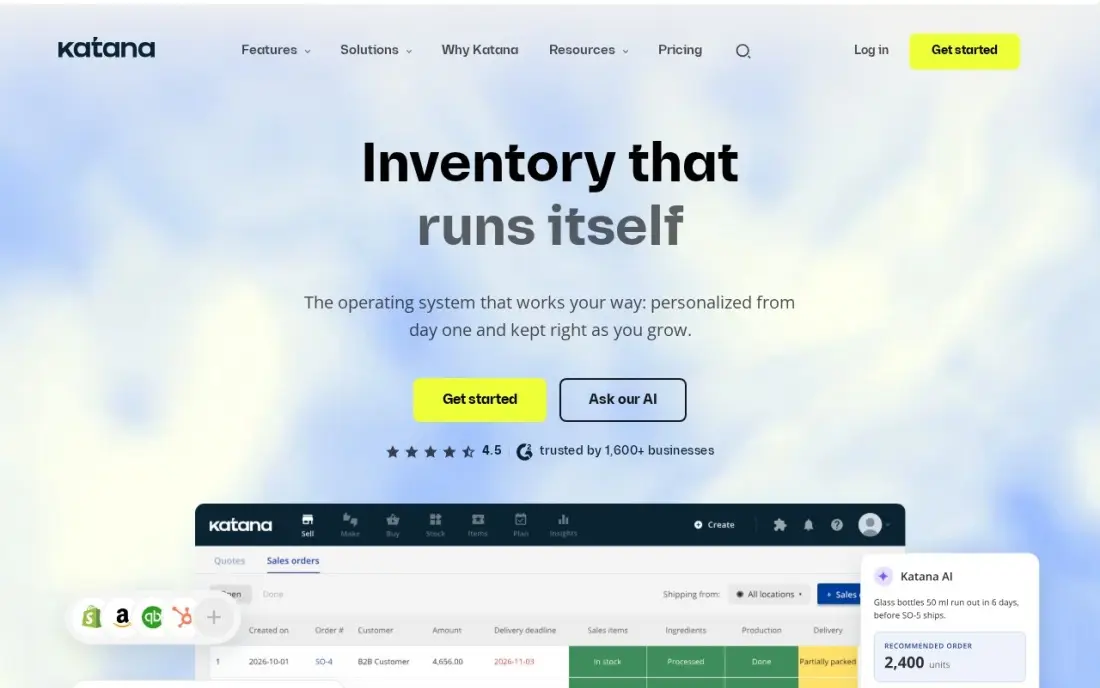
Katana is a manufacturing ERP that fits small apparel makers producing their own garments. Core includes multi-level bills of materials, so a shirt can draw down fabric, thread, buttons and labels, plus manufacturing orders, forecasting and real-time stock across sales channels, with QuickBooks and Xero integrations and unlimited users.
Core costs $299 a month billed monthly, with usage charges for sales-order volume and extra locations. Lot tracking costs $249 a month extra and production routings $199. A free plan covers 30 SKUs and 3 locations for Shopify sellers, enough to test the workflow. It has no apparel-specific EDI or size grids, so wholesale brands should look at ApparelMagic or AIMS360.
What we like
- Multi-level bills of materials and manufacturing orders included in Core
- Real-time stock across sales channels with QuickBooks and Xero integrations
- Unlimited users and integrations on the paid Core plan
Watch out for
- Lot tracking and production routings are paid add-ons ($249 and $199/month), not in Core
- Sales-order volume and extra locations add usage charges on top of the $299 base

Lightspeed Retail
Best for: Apparel boutiques that need a POS handling sizes, colours and stock across locations
Lightspeed Retail suits clothing stores where the stockroom matters as much as the till. It handles multi-variant products in sizes and colours, bundles, stock transfers between locations and purchase orders, and Basic includes POS, payments, core inventory and a basic online store for one register.
Basic costs $89 a month billed annually, or $109 monthly. Extra registers cost $59 a month each, and card processing runs through Lightspeed Payments at 2.6% plus 10 cents. Forecasting, custom reporting and API access wait for Plus at $289 a month. It holds 4.0 out of 5 on G2 from 294 reviews.
What we like
- Basic covers POS, payments, core inventory, purchase orders and a basic online store from $89/month billed annually
- Core ($149/month) adds loyalty, advanced reporting, accounting integrations and a mobile scanner app
- Handles multi-variant products, bundles, stock transfers and up to 10,000-item CSV imports
Watch out for
- Basic at $89/month billed annually covers 1 register and 1 location; extra registers are $59/month each
- Card processing runs through Lightspeed Payments at 2.6% + 10c on every plan, with no cheaper processor option on the page
- The features serious stockrooms need — forecasting, custom reporting, API access — sit on Plus ($289/month)

Shopify
Best for: Direct-to-consumer apparel brands that want the largest ecommerce app and theme ecosystem
Shopify is where most direct-to-consumer clothing brands sell online. Basic includes unlimited products, hosting, checkout and POS for pop-ups, and the largest app and theme library of any tool here. AIMS360 lists a two-way Shopify sync, so Shopify can sit at the front of a bigger apparel stack.
Basic costs $39 a month, or $29 on annual billing, after a 3-day free trial. Apps and a paid theme push the real bill higher, a 2% fee applies when you use a third-party payment gateway on Basic, and Basic includes only one staff account. It holds 4.4 out of 5 on G2 from more than 5,100 reviews.
What we like
- The largest app and theme ecosystem here, with skin care and beauty themes ready to install
- Unlimited products, hosting, SSL and checkout included, with AI-chat selling on the entry plan
- Shopify Payments charges 2.9% + 30c online with no extra platform fee
- POS for in-person sales at markets and pop-ups is included on Basic
Watch out for
- Apps and a paid theme push the real bill well above the $39 headline price
- A 2% fee applies on sales through a third-party payment gateway on Basic
- Only the store owner gets a staff account on Basic, so a small team must upgrade
The best apparel software keeps a clothing brand's styles, sizes, materials, production, stock and orders in sync, from the first sketch to the department-store shipment. We compared seven tools across the stages of an apparel business in 2026, apparel ERPs, tech pack and PLM tools, 3D design, manufacturing and retail and ecommerce platforms, and every price below was checked on vendor pages in November 2026.
How to choose the best apparel software
- Map your stage first. A design-led startup needs tech packs and 3D samples; a wholesale brand needs ERP and EDI.
- Insist on size and colour matrices. Apparel lives in style, colour and size grids; generic inventory tools that treat each size as a separate product create errors.
- Check retailer EDI. If you sell to department stores, native EDI and per-retailer connections decide your chargeback risk.
- Connect production to inventory. Bills of materials should draw down fabric and trims when you cut a style.
- Plan your sales channels. Make sure wholesale, Shopify and marketplaces share one stock count.
- Budget for implementation. ERP setup, data migration and training often cost as much as the first year's subscription.
Software runs the brand; shoppers still have to find it. Our local SEO service helps boutiques and showrooms rank in local search, and our guide to ecommerce platforms for fashion covers the storefront side.
Apparel software pricing: what you will actually pay
Take a small brand with three office users that designs, manufactures and sells online. On published prices, ApparelMagic Professional costs $337 a month paid annually, or $4,044 a year, for 3 users. Techpacker Techpack Builder for one designer costs $420 a year, and a CLO Individual licence costs $50 a month for a one-person business; a brand with two or more employees needs CLO Enterprise, priced by quote. Shopify Basic adds $29 a month on annual billing. A brand on Katana Core instead pays $299 a month billed monthly before usage charges, and AIMS360 needs a quote.
Know the difference: apparel ERP vs PLM and design tools
An apparel ERP such as ApparelMagic or AIMS360 runs the business after a style is approved. It holds the style, colour and size matrix, raises purchase and production orders, tracks fabric and finished goods by warehouse, takes wholesale and online orders, sends EDI to retailers and posts invoices to accounting. It is the system of record for stock and money.
PLM and design tools such as Techpacker and CLO work earlier, before production. Techpacker turns a design into a tech pack with measurements, materials and grading that a factory can follow, while CLO lets designers build and fit garments in 3D to cut physical samples. Many brands start with PLM and design tools and add an ERP once wholesale orders and multiple warehouses arrive.
Quick comparison: tool type by need
| Buyer | Best pick | Why |
|---|---|---|
| Apparel ERP, published price | ApparelMagic | PLM, production and B2B from $337/month annual |
| Wholesale and retailer EDI | AIMS360 | Native EDI to 350+ retailers, quote-only |
| Tech packs | Techpacker | Modular tech packs from $35/user/month yearly |
| 3D design and sampling | CLO | 3D garments, $50/month for individuals |
| Small in-house makers | Katana | BOMs and manufacturing orders, free plan to start |
| Clothing boutiques | Lightspeed Retail | Size and colour variants, $89/month annual |
| Direct-to-consumer stores | Shopify | Largest app ecosystem, $29/month annual |
Mistakes to avoid
- Treating sizes as separate products. Without a size and colour matrix, reporting by style becomes guesswork.
- Ignoring EDI until a retailer asks. Department-store chargebacks for non-compliant shipments can wipe out a season's margin.
- Skipping implementation budget. ERP quotes often exclude data migration and training; ask for them itemised.
- Buying an individual licence for a team. CLO's Individual plan is only for one-person businesses, so check licence terms.
- Running stock in two systems. If Shopify and your ERP disagree on stock, you will oversell; connect them before launch.
How we chose
We read each vendor's own pricing page in November 2026, or used our verified tool database checked the same month, and recorded prices exactly as shown, including billing period and commitment terms. We picked tools that cover the main stages of an apparel business, from design to retail, and ranked them by fit for a small to mid-sized clothing brand. Ratings come from G2 where we list them. No vendor paid for a place in this list, and none of the links here are affiliate links.
What to do next
Write down where your styles, stock and orders live today and which hand-off breaks most often, then trial the tool that fixes that one gap first. If you want more shoppers and stockists to find your brand online, book a free SEO review.
Frequently asked questions
What is the best apparel software?
For an apparel ERP with published pricing, ApparelMagic is the best fit, from $337 a month paid annually. AIMS360 is best for wholesale brands that need retailer EDI. Techpacker is best for tech packs, CLO for 3D design, and Shopify for selling direct to consumers.
What is apparel ERP software?
Apparel ERP software runs a clothing business from one system: styles with size and colour matrices, bills of materials, production orders, inventory across warehouses, wholesale and online orders, retailer EDI and accounting. ApparelMagic and AIMS360 are apparel ERPs.
How much does apparel software cost?
On published prices, Techpacker starts at $35 per user a month on yearly billing, CLO at $50 a month for individuals, ApparelMagic at $337 a month paid annually, Katana Core at $299 a month, Lightspeed Retail at $89 a month on annual billing and Shopify at $29 a month on annual billing. AIMS360 is quote-only.
What is a tech pack, and what software makes one?
A tech pack is the document a factory uses to make a garment: flat sketches, measurements, materials, construction details and grading. Techpacker is built for tech packs, and ApparelMagic and AIMS360 include tech pack features inside their PLM and production modules.
Is there free apparel software?
Katana has a free plan for up to 30 SKUs on Shopify. Techpacker and CLO offer free trials, and CLO gives students 50% off. Apparel ERPs such as ApparelMagic and AIMS360 have no free plan, though AIMS360 currently offers new customers a free first year of Bronze on a 24-month agreement.
Do I need apparel-specific software or will a general ERP work?
General ERPs can work, but they usually need customisation for size and colour matrices, pre-packs and retailer EDI. Apparel-specific tools such as ApparelMagic and AIMS360 handle those out of the box, which matters most for brands that sell wholesale to department stores.
Sources we checked (10)
- ApparelMagic — apparelmagic.com/pricing (checked November 21, 2026)
- AIMS360 — www.aims360.com/pricing-apparel-management-software-erp (checked November 21, 2026)
- Techpacker — techpacker.com/pricing (checked November 21, 2026)
- CLO — www.clo3d.com/en/pricing (checked November 21, 2026)
- Katana — katanamrp.com/pricing (checked November 10, 2026)
- Katana reviews on G2 (checked November 10, 2026)
- Lightspeed Retail — www.lightspeedhq.com/pricing (checked November 10, 2026)
- Lightspeed Retail reviews on G2 (checked November 10, 2026)
- Shopify — shopify.com/pricing (checked November 12, 2026)
- Shopify reviews on G2 (checked November 12, 2026)
Make one of these tools?
We re-check this list every quarter. Send a correction, request a review, or ask about a clearly labeled sponsored spot.
Request a listingShamim
Founder of SerpAstra
A full-stack digital marketer and SEO strategist covering technical and local SEO, AI search visibility, paid ads and lead generation for local businesses, e-commerce brands and SaaS teams.
Free SEO and AI visibility audit
Find out what is holding your rankings back
Send us your site. Within 2 business days you get a written audit, an AI visibility check and a short fix list ranked by impact. Free, with no contract attached.
Request my free audit→Related buying guides
 Ecommerce8 Best Ecommerce Platforms for Fashion in 2026, ComparedCompare the 8 best ecommerce platforms for fashion brands on size and colour variants, lookbook design, fees and real monthly cost, with prices checked in 2026.Read guide →
 Graphic Design & Creative6 Best AI Fashion Design Tools in 2026, ComparedCompare the 6 best AI fashion design tools for sketch-to-image renders, 3D garments and design variations, on free plans, credits and cost, checked in 2026.Read guide →
 Logistics, Supply Chain & Procurement10 Best Inventory Management Software Small Business in 2026, Compared10 best inventory management software small business picks compared with real 2026 prices, free plans and order limits, so you can choose by volume.Read guide →