
8 Best Automation Tools for Marketing in Healthcare in 2026, Compared
The 8 best automation tools for marketing in healthcare, compared on price, HIPAA readiness and patient-journey automation. Prices checked November 4, 2026.
 Shamim Mia, Founder, SerpAstraLast verified November 4, 202612 min read
We compare pricing pages, documentation and public reviews. We never accept payment for rankings.

Key takeaways
- HubSpot Marketing Hub is the best all-round pick for growing practices at $20 per seat a month; ActiveCampaign is the deepest automation for $19 a month; Tebra (PatientPop) is the healthcare-native choice from $49 per provider a month.
- The single most important buying factor is the Business Associate Agreement: only HubSpot (Enterprise), ActiveCampaign (Enterprise), Salesforce and the four healthcare-native tools will sign one, and Mailchimp never will.
- Two of the eight tools publish no usable starting price — Solutionreach and NexHealth are quote-only — and Weave publishes only a $199 starting figure.
- Every price below was checked on November 4, 2026; where the vendor's page would not load, the figure rests on at least two independent reads of the vendor's own pricing page. No review ratings are shown because the G2 pages could not be opened that day.
On this page
Quick comparison
| Tool | Best for | Starting price | Free plan |
|---|---|---|---|
| HubSpot Marketing Hub | Growing clinics and multi-location practices that want CRM, email and ads in one system | $20/seat/mo | Yes (free tools) |
| ActiveCampaign | Practices that live on email and want the deepest automation builder at a low entry price | $19/mo | No (14-day trial) |
| Tebra (PatientPop) | Independent practices that want a website, SEO, reviews and scheduling in one healthcare-native package | $49/provider/mo | No (demo) |
| Solutionreach | Dental, vision and medical practices that want reminders, recalls and two-way texting synced to their practice system | Custom quote | No (free trial) |
| Mailchimp | Small practices sending a general wellness newsletter with no patient data in it | $13/mo | Yes (250 contacts) |
| Weave | Dental and small medical practices that want phones, texting, reminders and payments on one front-desk system | $199/mo | No (demo) |
| NexHealth | Practices that want real-time online scheduling synced to their EHR, with reminders and forms on top | Custom quote | No (free trial) |
| Salesforce Marketing Cloud | Hospital systems and large health networks already running Salesforce that need enterprise journeys | $25/mo per user | No (demo) |
Make one of these tools?
We re-check this list every quarter. Send a correction, request a review, or ask about a clearly labeled sponsored spot.
Request a listingThe best automation tools for marketing in healthcare

HubSpot Marketing Hub
Best for: Growing clinics and multi-location practices that want CRM, email and ads in one system
HubSpot Marketing Hub is the most complete system in this list: CRM, email, landing pages, ads and reporting share one contact record, so a campaign that starts with a website visit can end with a booked appointment without exporting a list. Starter covers the basics — email automation, forms, live chat and ad management — for $20 per seat a month, and the free tools cover forms and email for a practice that is just starting.
The healthcare catch is the price of compliance. HubSpot only signs a Business Associate Agreement on Enterprise, at $3,600 a month, and its AI tools sit outside the BAA even there. A practice that keeps patient data out of HubSpot can run Starter happily; one that wants health data inside the CRM should budget for Enterprise or pair HubSpot with a healthcare-native tool.
What we like
- CRM, email, landing pages, ads and reporting share one contact record, so a visit can become a booked appointment without exporting a list
- Starter includes email automation, forms, live chat and ad management, with HubSpot branding removed
- The free tools cover forms, email and CRM, so a practice can start before paying anything
Watch out for
- A Business Associate Agreement is only available on Enterprise ($3,600/month), so Starter and Professional cannot hold patient health data
- The bill grows on two axes at once — seats and marketing contacts, with extra contacts at $50 per 1,000 a month
- Professional jumps to $890/month plus a $3,000 one-time onboarding fee, with no tier in between

ActiveCampaign
Best for: Practices that live on email and want the deepest automation builder at a low entry price
ActiveCampaign is the automation specialist of this list. The visual builder on the $19 Starter plan handles multi-step journeys, site tracking and 250 templates, and the built-in CRM means email, SMS and deals run off one record instead of three subscriptions. For a practice that sends appointment follow-ups, recall sequences and newsletters, that depth is hard to match at this price.
The limits are the contact meter and the BAA. The price is set by list size, so the bill climbs as the patient list grows — $149 a month at 10,000 contacts — and a Business Associate Agreement only comes with Enterprise. Keep patient health data out of the $19 plan and use it for general marketing; if your emails carry PHI, budget for Enterprise or a healthcare-native tool.
What we like
- The visual automation builder is the strongest at this price — multi-step journeys, site tracking and 250+ templates on Starter
- A built-in CRM sits in the same account, so email, SMS and deals run off one patient and prospect record
- Starter includes A/B testing and email and chat support, with predictive sending from Plus
Watch out for
- A Business Associate Agreement is only available on Enterprise, so the $19 Starter plan cannot carry patient health data
- The price is set by contact count, so the bill climbs steeply as the patient list grows — $149 a month at 10,000 contacts
- No free plan, and the AI add-on, SMS credits and extra users stack on top of the plan price

Tebra (PatientPop)
Best for: Independent practices that want a website, SEO, reviews and scheduling in one healthcare-native package
Tebra, formerly PatientPop, is the only tool here built for practices from the start. The Patient Experience + Marketing bundle gives a practice a custom website with SEO, online scheduling, reputation management and 80-plus directory listings for $49 a month per non-physician provider, with AI-powered review replies included. Because the EHR is native, bookings and reminders update the same record.
The trade-off is lock-in and the per-provider meter. The marketing bundle runs on a 12 to 24 month contract, the website and scheduling live inside Tebra rather than your existing stack, and every physician adds $99 a month. For an independent practice that wants one vendor for growth and patient experience, that is a fair trade; a practice happy with its current EHR should look at Solutionreach or Weave instead.
What we like
- Built for healthcare from the ground up: custom practice website with SEO, online scheduling, reputation management and 80+ directory listings
- HIPAA compliant with a Business Associate Agreement available, and the EHR is native rather than integrated
- AI-powered review replies and automated reminders run without staff touching them
Watch out for
- Pricing is per provider, so a practice with several physicians pays the per-provider rate for each one
- The marketing bundle is a 12 to 24 month contract, not month-to-month
- It is a closed system — the website, scheduling and reputation tools live inside Tebra, not your existing stack

Solutionreach
Best for: Dental, vision and medical practices that want reminders, recalls and two-way texting synced to their practice system
Solutionreach is the recall specialist. It connects to more than 400 practice management and EHR systems, then runs the messages that keep schedules full: appointment reminders, recall campaigns for lapsed patients, two-way texting, online scheduling and digital intake. It acts as your HIPAA business associate, so patient data inside it is covered by a signed agreement.
The honest problem is price transparency. Solutionreach publishes no starting price, and third-party directories disagree widely — figures from $199 to $400 a month — so budgeting starts with a sales call. Add-ons stack up too: extra SMS runs $50 to $250 a month and the AI receptionist is a paid add-on. Get the full first-year number in writing before signing.
What we like
- Connects with 400+ practice management and EHR systems, so reminders, recalls and intake sync without retyping
- Acts as your HIPAA business associate, with a Business Associate Agreement in its terms
- Automated recall and reactivation campaigns target lapsed patients, plus two-way texting, online scheduling and digital intake
Watch out for
- No published starting price, so budgeting starts with a sales conversation rather than a number on the page
- Third-party directories disagree on the entry price, listing figures from $199 to $400 a month
- Add-ons stack up: extra SMS runs $50–$250 a month and the AI receptionist is a paid add-on

Mailchimp
Best for: Small practices sending a general wellness newsletter with no patient data in it
Mailchimp is the cheapest way into this list and the simplest to run. Essentials starts at $13 a month for 500 contacts, the free plan covers 250 contacts, and the template library is the largest here, with A/B testing, scheduling and 24/7 support on the paid plans. For a small practice sending a general wellness newsletter, it does the job with the least setup.
The limit is compliance, and it is absolute. Mailchimp signs no Business Associate Agreement and its acceptable-use policy bars regulated sensitive personal information, so it must never carry patient health data. Automation is also thin on Essentials — flows cap at four steps. Use Mailchimp only for newsletters with no patient data, and keep patient messaging on a tool that signs a BAA.
What we like
- The cheapest way in here: Essentials starts at $13 a month and the free plan covers 250 contacts
- The largest template library of any tool here, with A/B testing, scheduling and 24/7 email and chat support on Essentials
- 3 user seats and 3 audiences on Essentials, with 10x contact sends a month
Watch out for
- Mailchimp signs no Business Associate Agreement, so it must never carry patient health data
- Automation on Essentials is capped at 4 steps per flow, which covers a welcome series and little else
- The price climbs with every contact band — $75 a month at 5,000 contacts — and counts unsubscribed contacts too

Weave
Best for: Dental and small medical practices that want phones, texting, reminders and payments on one front-desk system
Weave is the front desk in a box. Phone, two-way texting, payments and reviews run on one system that syncs with more than 100 practice systems, so a missed call gets an automatic text, a booked visit triggers a reminder, and a happy patient gets a review request — with no retyping by staff. It is HIPAA compliant under a Business Associate Agreement and built for dental, optometry and small medical practices.
The price is the catch. Weave publishes only a $199 starting figure; plan prices, hardware and contract terms come from sales, and the marketing bundle — reviews, email, bulk texting — adds $149 a month on top of the base plan. Third-party reports put setup near $750 and all-in costs at $400 to $700 a location. Ask for the full quote before comparing it with the others.
What we like
- Phone, two-way texting, payments and reviews in one front-desk system, with two-way sync to 100+ practice systems
- HIPAA compliant under a Business Associate Agreement, built for dental, optometry and small medical practices
- Automated reminders, recall and reactivation, plus online scheduling and digital forms in the Coordinate bundle
Watch out for
- Only a starting price is published — plan prices, hardware and contract terms come from sales
- The marketing bundle (reviews, email, bulk texting) costs $149 a month on top of the $199 base plan
- Third-party reports put a one-time setup fee near $750 and all-in costs at $400–$700 a location

NexHealth
Best for: Practices that want real-time online scheduling synced to their EHR, with reminders and forms on top
NexHealth is the scheduling-first pick. Its real-time online booking syncs with the EHR, so a patient who books at midnight updates the same record a receptionist sees in the morning — no reconciliation, no double-booking. Around that core sit automated reminders, two-way messaging, digital forms, online payments and insurance verification, all under a Business Associate Agreement with SOC 2.
Two honest caveats. NexHealth publishes no prices — its pricing page carries a quote calculator and no dollar figure — so budgeting starts with a sales conversation, and third-party directories put the entry point near $350 a month. And there is no phone system, so calls still run through a separate provider. Buy it when scheduling accuracy is the bottleneck; buy Weave when the phones are.
What we like
- Real-time online scheduling that syncs with the EHR, so a booked appointment updates the same record without staff intervention
- HIPAA compliant with a Business Associate Agreement, SOC 2 and single sign-on
- Automated reminders, two-way messaging, digital forms, online payments and insurance verification in one platform
Watch out for
- No published prices — the pricing page carries a quote calculator and no dollar figure for any package
- No phone system integration, so calls still run through a separate provider
- Usage add-ons stack up: campaign SMS past 5,000 a month and insurance verifications past 800 a month are billed extra

Salesforce Marketing Cloud
Best for: Hospital systems and large health networks already running Salesforce that need enterprise journeys
Salesforce Marketing Cloud is the enterprise pick, and it prices like one. The entry point is the $25-a-month-per-user Starter suite — but the automation this list is about starts at Growth, $1,500 a month per organization, billed annually, which buys multi-channel journeys, forms and landing pages on Data Cloud, with Agentforce AI campaign creation included. Hospital systems already on Salesforce keep patient journeys on the same data.
Everything else is a cost or a project. Salesforce signs a Business Associate Agreement for its listed HIPAA Covered Services, but implementations typically run 8 to 20 weeks, and SMS, WhatsApp and extra sends are metered at $10 per 1,000 credits on top of the edition fee. A single practice will never need this; a health network already on Salesforce will find it hard to beat.
What we like
- Multi-channel journeys, forms and landing pages built on Data Cloud, with Agentforce AI campaign creation on Growth
- Salesforce signs a Business Associate Agreement for the services it lists as HIPAA Covered Services
- Deepest enterprise feature set here: path experimentation, two-way SMS and WhatsApp on Advanced, and loyalty and intelligence add-ons
Watch out for
- Growth starts at $1,500 a month per organization, billed annually — $18,000 a year before add-ons
- The steepest learning curve here, with implementations that typically run 8–20 weeks
- SMS, WhatsApp and extra email sends are metered on top of the edition fee, at $10 per 1,000 credits
The best automation tools for marketing in healthcare split into two camps, and buying the wrong camp is the expensive mistake. General tools like HubSpot, ActiveCampaign and Mailchimp win new patients with campaigns and ads; healthcare-native tools like Tebra, Solutionreach, Weave and NexHealth keep existing patients coming back with reminders, recalls and scheduling. We compared eight tools — four general, four healthcare-native — and ranked them by fit for the most common buyer, a small to mid-size practice that needs both jobs done without hiring a marketing team. Every price below was checked on November 4, 2026.
If your practice already ranks well locally and just needs the follow-up handled, our local SEO service covers the visibility side. Before you write new campaign pages, run your titles through the free SERP snippet preview tool — it shows exactly how each title will look in Google.
How to choose the best automation tools for marketing in healthcare
- Start with the BAA. If any patient health data touches the tool, the vendor must sign a Business Associate Agreement for the plan you buy. Only Enterprise HubSpot and ActiveCampaign, Salesforce's covered services, and the four healthcare-native tools qualify — Mailchimp never does.
- Match the tool to the job. New-patient marketing belongs to HubSpot, ActiveCampaign and Mailchimp; reminders, recalls and scheduling belong to Tebra, Solutionreach, Weave and NexHealth. One tool rarely does both well.
- Find the meter. HubSpot bills per seat and per marketing contact, ActiveCampaign and Mailchimp per contact, Tebra per provider, Weave per location, Salesforce per organization. The meter decides the bill, not the headline price.
- Check the EHR sync. Tebra is native, Solutionreach connects to 400+ systems, Weave to 100+, NexHealth syncs in real time. If bookings and reminders do not update the same record, staff retype everything.
- Price the first year, not the first month. Setup fees, onboarding, add-ons and annual contracts add up — Weave reports put setup near $750, and HubSpot Professional carries a $3,000 onboarding fee.
Healthcare marketing automation pricing: what you will actually pay
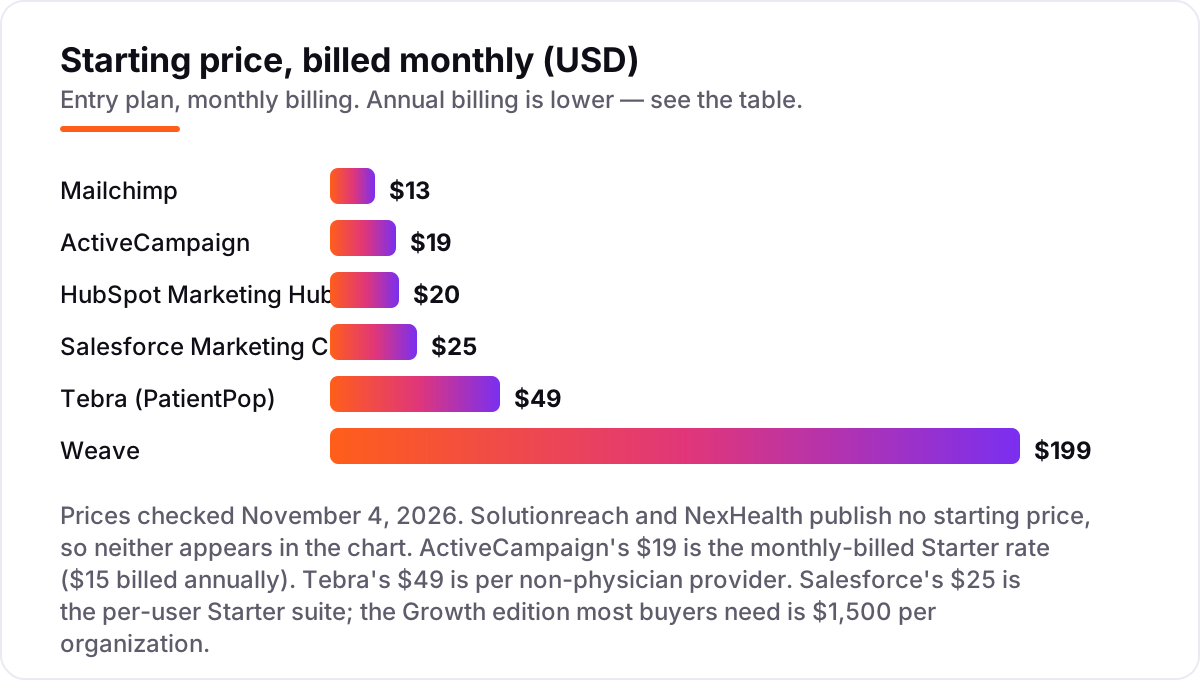
Take a three-provider practice with 1,000 contacts on its list. On HubSpot Starter, three seats cost $60 a month, or $720 a year, at 1,000 contacts — each extra 1,000 contacts adds $50 a month. On ActiveCampaign Starter the same list costs $19 a month, or $228 a year, billed monthly ($15 a month, $180 a year, billed annually). On Tebra, three non-physician providers cost $147 a month, or $1,764 a year; three physicians cost $297 a month. On Weave the base plan costs $199 a month, or $2,388 a year, before the $149 marketing bundle. On Salesforce Growth the bill is $1,500 a month, or $18,000 a year, before usage.
Three costs sit outside those numbers. First, the meter: Mailchimp Essentials is $13 a month at 500 contacts but $75 at 5,000, and ActiveCampaign Starter is $149 a month at 10,000 contacts. Second, the add-ons: HubSpot Professional adds a $3,000 onboarding fee, Solutionreach charges $50–$250 a month for extra SMS, and Salesforce meters SMS and WhatsApp at $10 per 1,000 credits. Third, the quote-only tools — Solutionreach and NexHealth publish no prices, so budget for a sales conversation and get the first-year total in writing before signing.
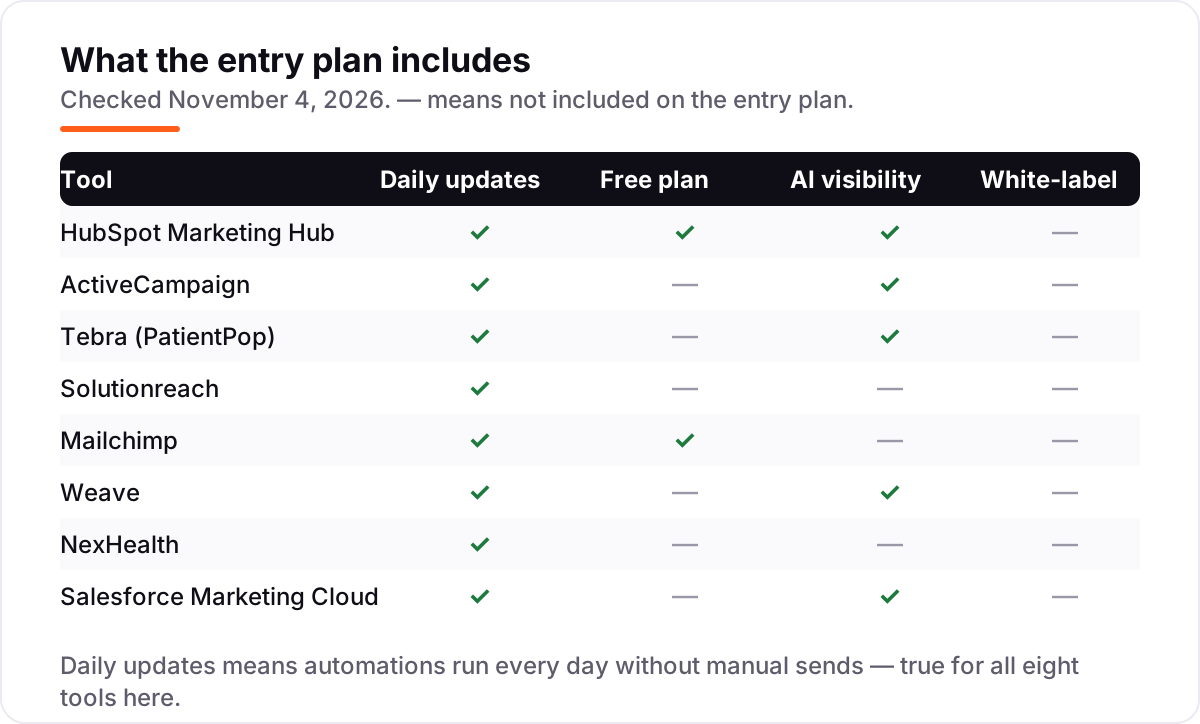
The free tiers are real but narrow: HubSpot's free tools cover forms, email and CRM, and Mailchimp's free plan covers 250 contacts. Neither can hold patient health data — that needs a paid plan with a signed BAA, which is why the cheapest compliant route for a small practice is usually Tebra or Solutionreach, not the cheapest tool on the page.
Know the difference: marketing automation vs patient engagement
The confusion in this category is between winning patients and keeping them. Marketing automation — HubSpot, ActiveCampaign, Mailchimp, Salesforce — finds new patients: campaigns, landing pages, ads and lead nurturing, measured in new bookings. Patient engagement software — Tebra, Solutionreach, Weave, NexHealth — keeps existing patients: reminders, recalls, scheduling, two-way texting and reviews, measured in kept appointments and fewer no-shows.
Several tools blur the line, which is where buyers get confused. HubSpot's CRM can run reminders through workflows, Tebra runs SEO and ads as well as scheduling, and Weave's review requests are marketing in everything but name. The test is simple: if the tool's core job is reaching people who are not yet patients, it is marketing automation; if its core job is managing people who already are, it is patient engagement.
There is a second confusion: HIPAA compliance is not a feature of the tool, it is a contract. A tool is only safe for patient health data when the vendor signs a Business Associate Agreement covering the plan you bought — and Mailchimp never signs one, while HubSpot and ActiveCampaign only sign on Enterprise. A "HIPAA-ready" claim on a Starter plan means nothing until the BAA is signed.
Quick comparison: tool type by need
| Buyer | Best pick | Why |
|---|---|---|
| Small practice, first automation, tight budget | ActiveCampaign | $19/month, deepest builder, 14-day trial |
| Growing practice that wants one system | HubSpot Marketing Hub | CRM, email and ads on one record from $20/seat |
| Independent practice, healthcare-native | Tebra (PatientPop) | Website, SEO, reviews and scheduling from $49/provider |
| Practice losing patients to no-shows | Solutionreach | Reminders and recalls synced to 400+ systems |
| General newsletter, no patient data | Mailchimp | Free plan, $13/month, largest template library |
| Front desk drowning in calls | Weave | Phones, texting and reminders from $199/month |
| Scheduling accuracy is the bottleneck | NexHealth | Real-time EHR-synced booking |
| Hospital system on Salesforce | Salesforce Marketing Cloud | Enterprise journeys from $1,500/org/month |
Mistakes to avoid
- Putting patient data in a tool with no BAA. Mailchimp signs none, and HubSpot and ActiveCampaign only sign on Enterprise. A marketing email with PHI on the wrong plan is a compliance problem, not a pricing problem.
- Comparing headline prices without the meter. Per-seat, per-contact, per-provider and per-location pricing scale differently — a $19 plan at 1,000 contacts is $149 at 10,000.
- Buying marketing automation when the problem is no-shows. Campaigns do not fix missed appointments; reminders and recalls do. Match the tool to the bottleneck.
- Skipping the first-year total. Setup fees, onboarding, add-ons and annual contracts add up — get the full year-one number in writing, especially from the quote-only vendors.
- Trusting a directory price. Solutionreach shows $199 to $400 a month across directories and publishes no price of its own. Always check the vendor's own page — or ask sales — before budgeting.
How we chose
We checked each vendor's pricing page on November 4, 2026 and recorded the starting price exactly as shown, including the annual-billing figure where the page lists one. Direct page loads failed in our browser that day, so each figure below rests on at least two independent published reads of the vendor's own pricing page from October 2026. Two vendors — Solutionreach and NexHealth — publish no starting price at all, so they are listed as custom quote; third-party directories disagree on Solutionreach ($199 to $400 a month) and list NexHealth at $350 a month, and we do not repeat either figure as a starting price. Tebra's $49 and Weave's $199 are the starting prices those vendors publish on their own pricing pages, as reported by multiple independent reads. This list carries no review ratings because the G2 review pages could not be opened on November 4, 2026, and we would rather show no rating than a stale or estimated one. We ranked the tools by fit for the most common buyer — a small to mid-size practice that needs new-patient marketing and patient retention without hiring a marketing team — not by brand size. No vendor paid for a place in this list, and none of the links here are affiliate links.
What to do next
Start with the BAA question: if patient health data will touch the tool, shortlist only the vendors that will sign one for the plan you can afford. Then take the free plan or trial of your top pick and run one real campaign end to end — build the journey, send it to a small segment, and check the bookings it produces before the trial ends. If the tools are running but new patients are not finding you, our monthly SEO service handles the visibility side — or compare options in our guide to medical SEO companies. Once your tools are in place, find out what's holding your rankings back.
Your stack only works if people find you
SerpAstra fixes what keeps your site off page one and makes it easy for AI assistants to recommend.
Get a free audit→Sources we checked (13)
- HubSpot Marketing Hub pricing — hubspot.com/pricing/marketing (checked November 4, 2026)
- HubSpot HIPAA and BAA — Enterprise only, Sensitive Data required (checked November 4, 2026)
- ActiveCampaign pricing — activecampaign.com/pricing (checked November 4, 2026)
- ActiveCampaign and Mailchimp BAA status for healthcare (checked November 4, 2026)
- Tebra pricing — Patient Experience + Marketing from $49 per provider (checked November 4, 2026)
- Solutionreach pricing — custom priced plans (checked November 4, 2026)
- Mailchimp pricing — mailchimp.com/pricing/marketing (checked November 4, 2026)
- Weave pricing — plans page from $199 a month (checked November 4, 2026)
- NexHealth pricing — vendor publishes no prices (checked November 4, 2026)
- Salesforce Marketing Cloud pricing — Starter $25 per user, Growth $1,500 per org a month (checked November 4, 2026)
- Salesforce Marketing Cloud pricing — Growth $1,500 per org a month (checked November 4, 2026)
- BAA directory — HubSpot, Salesforce, ActiveCampaign, Mailchimp (checked November 4, 2026)
- Patient scheduling tools — BAA and pricing models (checked November 4, 2026)
Shamim
Founder of SerpAstra
A full-stack SEO and digital marketer who spends most days on Local SEO for dental practices, AI search visibility and lead generation.
Frequently asked questions
What is the best automation tool for marketing in healthcare?
HubSpot Marketing Hub is the best all-round pick for growing practices: CRM, email and ads on one record from $20 per seat a month. Tebra (PatientPop) is the best healthcare-native option from $49 per provider a month, and ActiveCampaign is the deepest automation for $19 a month. The right pick depends on whether you need a BAA.
How much does healthcare marketing automation cost?
Between $13 and $1,500 a month at the entry level. Mailchimp Essentials starts at $13, ActiveCampaign at $19, HubSpot at $20 per seat and Tebra at $49 per provider. Weave starts at $199, Salesforce from $25 per user (Growth $1,500 per organization), and Solutionreach and NexHealth are quote-only. The meter decides the real bill.
Which marketing automation tools are HIPAA compliant?
HubSpot and ActiveCampaign sign a Business Associate Agreement only on Enterprise plans, and Salesforce signs one for its listed HIPAA Covered Services. Tebra, Solutionreach, Weave and NexHealth are built for healthcare and sign BAAs as a matter of course. Mailchimp signs no BAA at any price and must never carry patient health data.
Can I use Mailchimp to email my patients?
Only for general newsletters that contain no patient health data. Mailchimp signs no Business Associate Agreement and its acceptable-use policy bars regulated sensitive personal information. Any email that references a patient's condition, treatment or appointment should run through a tool with a signed BAA, such as Tebra or Solutionreach.
What is the difference between marketing automation and patient engagement software?
Marketing automation wins new patients: campaigns, ads, landing pages and lead nurturing, which is what HubSpot, ActiveCampaign and Mailchimp do best. Patient engagement software keeps existing patients coming back: reminders, recalls, scheduling and two-way texting, which is Tebra, Solutionreach, Weave and NexHealth. Most practices eventually need one of each.
Do any of these tools offer a free plan?
Yes, two of them. HubSpot's free tools cover forms, email and CRM with no time limit, and Mailchimp's free plan covers 250 contacts and 500 sends a month. ActiveCampaign, Tebra, Solutionreach, Weave, NexHealth and Salesforce offer demos or free trials instead. Free plans work for general marketing; patient data needs a paid plan with a BAA.
What should I check before paying for a healthcare marketing tool?
Four things: whether the vendor will sign a Business Associate Agreement for the plan you are buying, what the price meter is — seats, contacts, providers or locations — whether the tool syncs with your EHR or practice system, and what the first-year total is including setup and add-ons. All four vary widely across this list.
Free SEO and AI visibility audit
Find out what is holding your rankings back
Send us your site. Within 2 business days you get a written audit, an AI visibility check and a short fix list ranked by impact. Free, with no contract attached.
Request my free audit→Related guides
 SEO & AI Search9 Best Medical SEO Companies (2026): Who to Hire and What It Costs9 best medical SEO companies compared on price, specialty and AI visibility, with real starting prices where published and custom-quote warnings where not.Read guide →
 MarketingMarketing automation for small businesses: what to automate (and what not to)Marketing automation for small businesses, explained: what to automate first, what to keep human, and the tools that save hours without losing customers.Read guide →
 MarketingEmail marketing for local businesses (that customers actually open)Email marketing for local businesses: build a list the right way, send emails customers open, and turn past customers into repeat bookings without spam.Read guide →