
7 Best Cloud Security Platform Reviews in 2026: Pricing, Features and Pros & Cons
7 best cloud security platform reviews compared on price, coverage and deployment — Microsoft's published rates plus six custom quotes, checked Nov 10, 2026.
 Shamim Mia, Founder, SerpAstraLast verified November 10, 202612 min read
We compare pricing pages, documentation and public reviews. We never accept payment for rankings.
Key takeaways
- Wiz leads for most multi-cloud teams (custom quote; AWS Marketplace lists Essential at $24,000 a year per 100 workloads), Microsoft Defender for Cloud is the only one with published prices from $5.11 a resource a month, and Palo Alto Cortex Cloud is the broadest platform (custom quote).
- The single most important buying factor is the pricing unit: per workload, per billable resource, per server or per vCPU — the same estate costs very different amounts depending on the unit.
- Only Microsoft publishes prices and offers a free tier; the other six sell by custom quote, so get all quotes for the same workload count in the same week.
- This list prints no ratings: G2 pages could not be opened on November 10, 2026, so no score or review count is shown rather than a stale one.
On this page
Quick comparison
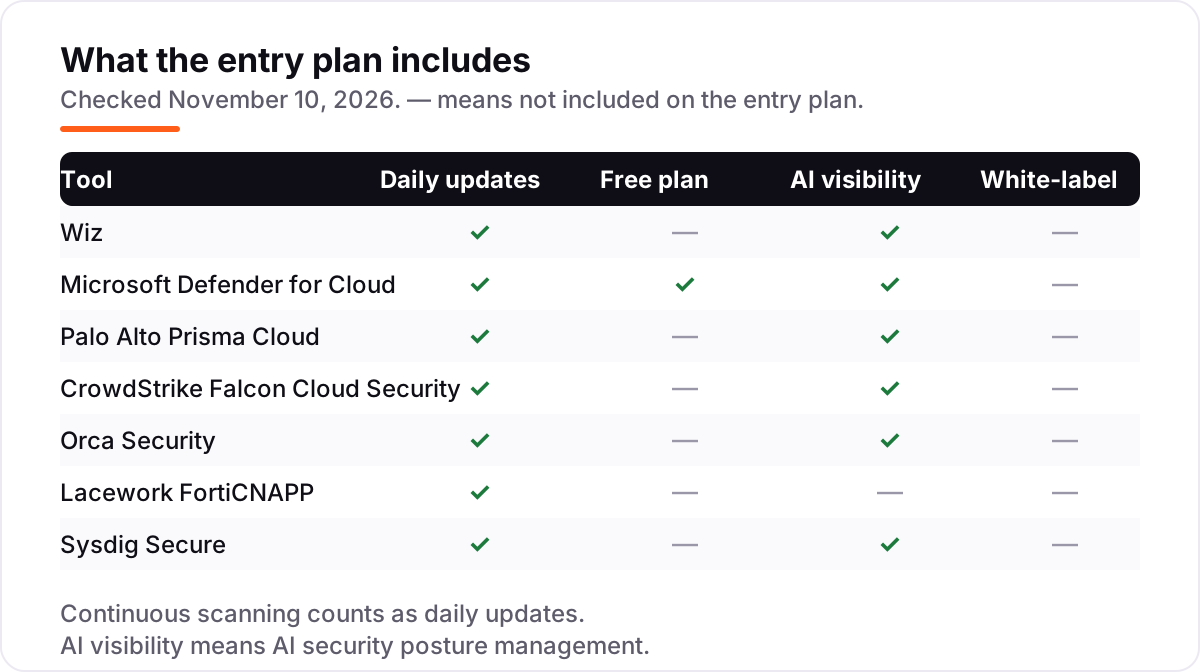
| Tool | Best for | Starting price | Free plan |
|---|---|---|---|
| Wiz | Multi-cloud teams that want agentless visibility and attack-path prioritization across AWS, Azure and GCP | Custom quote | No (demo only) |
| Microsoft Defender for Cloud | Teams running mainly on Azure that want published pay-as-you-go prices and a free posture tier | Free; from $5.11/mo | Yes (free tier) |
| Palo Alto Prisma Cloud | Large enterprises already running Palo Alto firewalls or Cortex that want code-to-cloud coverage plus SOC workflows | Custom quote | No (free trial) |
| CrowdStrike Falcon Cloud Security | Teams already running Falcon endpoint protection that want cloud and endpoint telemetry in one console | Custom quote | No (15-day trial) |
| Orca Security | Security teams that want agentless coverage live in minutes with no agent rollout | Custom quote | No (free trial) |
| Lacework FortiCNAPP | Fortinet customers that want behavioral anomaly detection across AWS, Azure and GCP | Custom quote | No (demo only) |
| Sysdig Secure | Kubernetes-heavy teams that want runtime threat detection built on open-source Falco | Custom quote | No (trial on request) |
Make one of these tools?
We re-check this list every quarter. Send a correction, request a review, or ask about a clearly labeled sponsored spot.
Request a listingThe best cloud security platforms

Wiz
Best for: Multi-cloud teams that want agentless visibility and attack-path prioritization across AWS, Azure and GCP
Wiz is the reference point every other platform in this list is measured against. It connects through cloud APIs and, within minutes, maps every workload, identity and exposed path — no agents to install, no maintenance windows. The attack path view is what makes it useful day to day: instead of a thousand misconfigurations, you see the handful an attacker could actually chain together to reach something valuable.
The catch is the buying process. There is no published price and no self-serve trial — Wiz One, Wiz Go and à la carte modules are all quoted, and the AWS Marketplace list prices start at $24,000 a year for 100 workloads on Essential. Google completed its $32 billion acquisition in March 2026; the platform stays multicloud. Buy Wiz for agentless coverage and prioritization; buy Defender for a published price.
What we like
- Agentless scanning connects through cloud APIs, so coverage starts in minutes with no agents to install or maintain
- Attack path analysis chains misconfigurations, vulnerabilities and exposed data into one exploitable path, cutting alert noise
- More than 2,800 built-in configuration rules and 250-plus compliance frameworks
- Works across AWS, Azure, GCP, Oracle Cloud and Alibaba Cloud, and stays multicloud after Google's acquisition
Watch out for
- No published price — every deal is a custom quote, and the AWS Marketplace list prices start at $24,000 a year per 100 workloads
- Add-ons stack up: Sensor, Code and Defend are priced separately from the base platform
- No free plan and no published free trial on its pricing page

Microsoft Defender for Cloud
Best for: Teams running mainly on Azure that want published pay-as-you-go prices and a free posture tier
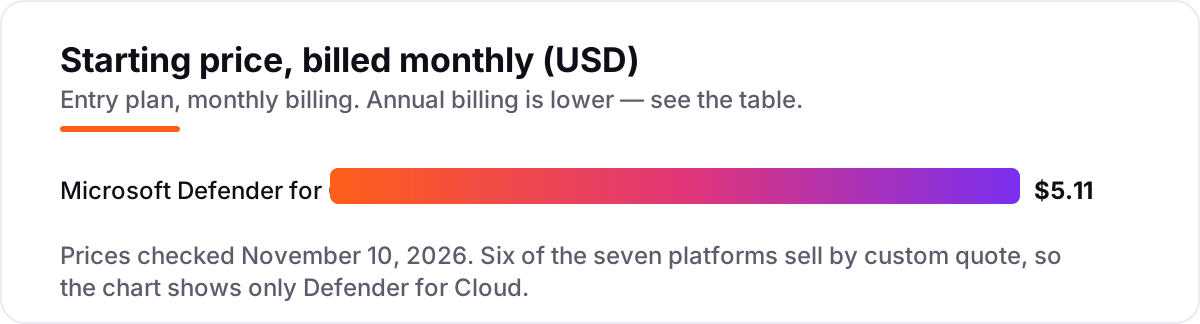
Defender for Cloud is the only platform here you can price without a sales call. Foundational CSPM is free on every supported cloud, and the paid tiers carry published rates: Defender CSPM at $5.11 a billable resource a month, Defender for Servers Plan 1 at $4.906 a server a month and Plan 2 at $14.60. The first 30 days are free, so a team can measure the real bill before committing.
The metered model is both the strength and the trap. You pay only for what you protect, but every resource type is its own meter, and a growing estate pushes the bill up. Coverage is multicloud, yet the console and workflow are Azure-first. Pick Defender when your estate is mostly Azure and you want transparent pricing; pick Wiz when the clouds are evenly split.
What we like
- The only free tier here: Foundational CSPM costs $0 across AWS, Azure and GCP
- Published pay-as-you-go prices — Defender CSPM at $5.11 a billable resource a month, Servers Plan 2 at $14.60 a server a month
- Attack path analysis, agentless vulnerability scanning and CIEM in the paid CSPM tier
- Lives inside the Azure portal, so Azure teams manage security where they already manage infrastructure
Watch out for
- Pay-as-you-go billing is hard to forecast: every resource type is a separate meter, and costs grow with the estate
- Deepest on Azure; AWS and GCP coverage exists but the console and workflow stay Azure-first
- Full workload protection needs several plans switched on — Servers, Containers, Databases and CSPM are priced separately

Palo Alto Prisma Cloud
Best for: Large enterprises already running Palo Alto firewalls or Cortex that want code-to-cloud coverage plus SOC workflows
Palo Alto's cloud platform is the broadest here: posture, runtime, code security, infrastructure-as-code scanning and cloud detection and response in one system. Palo Alto introduced Cortex Cloud in February 2025 as the next version of Prisma Cloud; the 2.0 release adds autonomous AI agents and a Cloud Command Center that push fixes instead of only listing findings. For teams already on Palo Alto products, the integration is the selling point.
Buying is the weakest part. There is no published price, licensing runs on credits that map differently to each module, and both product names still appear in quotes and documentation — so get the platform name and the module list in writing before you compare. This is an enterprise buy: a small team pays for scale it will never use, while a large one gets the deepest platform.
What we like
- Broadest coverage in this list: posture, runtime, code security, IaC scanning and cloud detection and response in one platform
- Credit-based licensing lets one pool of credits cover different modules and workload types
- Cortex Cloud 2.0 adds autonomous AI agents and a Cloud Command Center that turn findings into fixes
Watch out for
- No published price — every quote is custom, and the credit model makes quotes hard to compare with per-workload rivals
- Two product names in circulation (Prisma Cloud and Cortex Cloud), so confirm in writing which platform a quote covers
- Heaviest platform here to deploy and tune; small teams pay for enterprise scale they will not use

CrowdStrike Falcon Cloud Security
Best for: Teams already running Falcon endpoint protection that want cloud and endpoint telemetry in one console
Falcon Cloud Security is the cloud arm of the Falcon platform, and it shows: the same lightweight sensor that watches endpoints also watches cloud workloads and containers, and the real-time cloud detection and response covers AWS, Azure, GCP and Kubernetes. Agentless discovery maps the estate while the sensor handles runtime, so a team can mix models instead of choosing one. If your endpoints already run Falcon, cloud security is one console, not a second vendor.
The price is the problem to solve before you buy. CrowdStrike publishes per-device prices for Falcon endpoint bundles — Go $59.99 a device a year, Pro $99.99, Enterprise $184.99 — but those are endpoint prices, not cloud security prices, and Falcon Cloud Security itself is quoted. Get the cloud modules priced separately in writing, or the quote cannot be compared.
What we like
- Real-time multicloud cloud detection and response across AWS, Azure, GCP and Kubernetes
- One lightweight sensor covers endpoint, cloud workload and container runtime, so telemetry stays in one console
- Agentless discovery plus agent-based runtime protection, so teams pick the model per workload
- AI security posture management and Kubernetes admission control included in the platform
Watch out for
- No published price for Falcon Cloud Security — the per-device prices CrowdStrike publishes are for Falcon endpoint bundles, not this product
- Full value needs the Falcon ecosystem; as a standalone cloud tool it is priced like an enterprise suite
- The 15-day free trial covers Falcon Go endpoint products; cloud security modules are trialed separately through the Falcon store

Orca Security
Best for: Security teams that want agentless coverage live in minutes with no agent rollout
Orca is the simplest deployment in this list. Its patented SideScanning reads workload data straight from cloud storage and APIs, so a team connects its cloud accounts with read-only permissions and gets full visibility in minutes — no agents on any workload, no performance impact, no maintenance. The Unified Data Model then scores each risk by its attack path, so a vulnerability only matters when exposure and sensitive data make it exploitable.
The trade-off is runtime. The core platform scans; real-time blocking needs the optional Orca Sensor, a lightweight eBPF agent for critical workloads. Pricing is one edition by compute asset, quoted on request, and third-party buyer data puts entry near $50,000 a year. Pick Orca when fast, agentless coverage matters more than real-time blocking; pick Sysdig when runtime is the priority.
What we like
- Agentless SideScanning reads cloud storage directly, so deployment takes minutes and running workloads see zero performance impact
- Single edition with one price model — no tier maze, priced per compute asset
- Attack path analysis combines vulnerabilities, exposure and sensitive data into one risk score per alert
- Covers code to cloud in one platform: CSPM, CWPP, CIEM, DSPM, container, API and AI security
Watch out for
- No published price — quotes only, and third-party buyer data puts entry near $50,000 a year
- Runtime protection needs the optional Orca Sensor; the core platform is scan-based, not real-time blocking
- No free plan, and the trial length is not published

Lacework FortiCNAPP
Best for: Fortinet customers that want behavioral anomaly detection across AWS, Azure and GCP
Lacework FortiCNAPP takes a different approach from the rest of this list: instead of matching known bad patterns, its Polygraph engine learns what normal looks like in your cloud and flags what deviates. That behavioral view is why it reports far fewer false positives, and why it won Best Cloud Workload Protection at the 2025 SC Awards. Fortinet acquired Lacework in 2024 and sells it as FortiCNAPP, in Standard, Pro and Enterprise tiers licensed per vCPU.
The buying process is the least open here: no published price, no free trial, and demos run through Fortinet sales. The behavioral model needs a learning period before its baselines settle, so the first weeks are quieter than the steady state. Pick FortiCNAPP if you already run Fortinet and want anomaly detection; pick Wiz or Orca for a faster, self-serve evaluation.
What we like
- Polygraph behavioral analytics baselines normal activity and flags anomalies, cutting false positives instead of matching signatures
- Lightweight auto-updating agent with low CPU overhead, plus agentless coverage for posture
- Compliance mapping to PCI DSS, HIPAA, SOC 2 and ISO 27001 is built in, with continuous posture checks
- Named Best Cloud Workload Protection Solution at the 2025 SC Awards
Watch out for
- No published price and no free trial — every deal runs through Fortinet sales
- Fortinet acquired Lacework in 2024 and the roadmap inside the Fortinet portfolio is still settling
- Anomaly detection needs time to learn normal behavior before alerts are fully reliable

Sysdig Secure
Best for: Kubernetes-heavy teams that want runtime threat detection built on open-source Falco
Sysdig Secure is the runtime-first platform in this list. It is built on Falco, the open-source runtime security engine Sysdig created and donated to the CNCF, and it watches kernel-level behavior inside containers as attacks happen — not just the misconfigurations that might allow them. That runtime context also quiets vulnerability noise: an issue ranks high only when it touches a running workload. Kubernetes coverage is the deepest here, across EKS, AKS and GKE.
The cost is deployment effort and opacity. Runtime agents run on every Kubernetes node, so rollout takes more work than an agentless scan, and there is no published price — buyer data puts typical contracts at $50,000 a year and up. Pick Sysdig when containers and Kubernetes are the estate and runtime is the risk; pick Orca for coverage without installing anything.
What we like
- Runtime-first detection built on Falco, the open-source engine Sysdig created, watches kernel-level behavior as attacks run
- Deepest Kubernetes coverage here: EKS, AKS and GKE plus container image and CI/CD scanning
- Runtime context cuts vulnerability noise by focusing on issues that affect running workloads
- AI workload security covers generative AI risk alongside cloud and containers
Watch out for
- No published price — quotes only, with buyer data putting typical contracts at $50,000 a year and up
- Agent-based by design: runtime agents run on Kubernetes nodes, so deployment is heavier than agentless rivals
- No free plan, and trial access runs through sales rather than self-serve
Cloud security platforms promise one console for everything attackers can reach in your cloud — misconfigurations, vulnerable images, overprivileged identities and live runtime threats. This list of the best cloud security platform reviews ranks seven platforms by fit for the most common buyer: a team running workloads across AWS, Azure or Google Cloud that needs posture and runtime protection in one place. Every price was checked on November 10, 2026, and six of the seven vendors publish no price at all — so this guide says so plainly instead of inventing one.
How to choose from the best cloud security platform reviews
- Count your workloads first, then ask what the price counts. Wiz and Orca price by workload or compute asset, Microsoft by billable resource or server, Lacework by vCPU, Palo Alto by credits. The unit decides the bill more than the headline price does.
- Decide agentless or agent-based. Agentless tools (Wiz, Orca) deploy in minutes and touch nothing running; agent-based tools (Sysdig, CrowdStrike, Lacework) see attacks as they execute but need an install on every node.
- Check whether runtime protection is included. Posture scanning finds misconfigurations; runtime protection stops live attacks. Some platforms bundle both, others sell runtime as a module or an add-on.
- Match the clouds you actually run. All seven cover AWS, Azure and GCP, but Defender is deepest on Azure and Wiz is the most even across clouds. A single-cloud team pays less by buying the native option.
- Check the compliance frameworks you must prove. Every platform here maps findings to frameworks, but the built-in sets differ — confirm your standard (PCI DSS, HIPAA, SOC 2, ISO 27001) is covered before the trial.
- Run the trial on your own accounts. A demo on the vendor's data proves nothing. Connect one real account, watch the first findings land, and check whether the alerts are actionable or noise.
Cloud security stops breaches, but it does not bring in customers on its own. If the business is not showing up when people nearby search, our local SEO service covers that side. And before you publish the pages that explain your security posture to buyers, run them through the free SERP snippet preview tool to see how they will look in Google.
Whatever you shortlist, try it before you pay. The trials in this list run from a 15-day Falcon trial to a 30-day free Defender period, which is long enough to connect a real account, see real findings and check whether the platform's alerts match what your team can actually fix. Check two things in the trial: that findings map to your compliance frameworks, and that the pricing unit in the quote matches the estate you counted — not a smaller demo footprint.
Cloud security platform pricing: what you will actually pay
Take a team with 100 servers and 200 billable cloud resources. On Microsoft's published rates, Defender for Servers Plan 2 costs $14.60 times 100, or $1,460 a month, and Defender CSPM costs $5.11 times 200, or $1,022 a month — $2,482 a month for both, before storage and log costs. The same 100 workloads on Wiz's AWS Marketplace list prices cost $24,000 a year ($2,000 a month) on Essential or $38,000 a year (about $3,167 a month) on Advanced, before the Sensor, Code and Defend add-ons.
The other five platforms publish no price, so the only way to compare them is to get all five quotes for the same workload count in the same week — and to check what each quote counts. A quote priced per vCPU, one priced per workload and one priced in credits cannot be compared line by line; ask each vendor to price 100 workloads, or 100 servers, and write the unit on the quote. Also budget beyond the subscription: Defender bills log and storage separately, and every platform here charges more as the estate grows, so price the estate you will have in a year, not the one you have today.
Know the difference: CSPM vs CWPP — and why every platform now sells both
The confusion in this category is the two halves of the job. CSPM, cloud security posture management, scans configurations — open storage buckets, overprivileged identities, missing encryption — and reports what is wrong. CWPP, cloud workload protection, guards what is actually running: containers, servers and Kubernetes clusters, watching behavior in real time and blocking attacks as they execute. Posture finds the unlocked door; workload protection catches the person walking through it.
Every platform in this list now sells both under the CNAPP label, but the balance differs. Wiz and Orca are posture-first and agentless: they find every misconfiguration fast, but live blocking needs an add-on or a sensor. Sysdig and CrowdStrike are runtime-first: they see the attack as it runs, but they need agents installed to do it. The costly mistake is buying one half when you need both — a posture-only buy leaves live attacks unseen, and a runtime-only buy leaves misconfigurations piling up. Shortlist on the half you need most, then confirm the other half is included in the quote, not sold separately.
Quick comparison: tool type by need
| Buyer | Best pick | Why |
|---|---|---|
| Multi-cloud team, fastest deployment | Wiz | Agentless coverage in minutes; custom quote, marketplace lists $24,000/year per 100 workloads |
| Azure-heavy team on a budget | Microsoft Defender for Cloud | Free posture tier; paid plans from $5.11 a resource a month |
| Large enterprise, broadest platform | Palo Alto Prisma Cloud | Posture, runtime, code security and SOC workflows; custom quote |
| Team already on Falcon endpoint | CrowdStrike Falcon Cloud Security | One sensor for endpoint and cloud; custom quote |
| Team that wants no agents at all | Orca Security | Agentless SideScanning; custom quote, single edition |
| Kubernetes-heavy team | Sysdig Secure | Falco runtime detection; custom quote |
Mistakes to avoid
- Comparing quotes priced on different units. A per-vCPU quote, a per-workload quote and a credit quote cannot be compared line by line. Ask every vendor to price the same 100 workloads in the same week.
- Treating CrowdStrike's published endpoint prices as cloud security prices. Falcon Go at $59.99 a device a year is endpoint protection; Falcon Cloud Security is quoted separately, and the two numbers describe different products.
- Buying posture-only when you need runtime. A CSPM scan finds misconfigurations; it does not stop a live attack. Confirm runtime protection is in the quote, not an add-on you discover later.
- Budgeting the subscription and forgetting the meters. Defender bills log and storage separately, and usage-based pricing grows with the estate. Price the cloud you will run next year, not the one you run today.
- Signing before trialing on your own accounts. A vendor demo proves the interface, not the findings. Connect one real account, check the alerts against your frameworks, and confirm the pricing unit matches your estate before you sign.
How we chose
We checked each vendor's own pricing page on November 10, 2026 and recorded the starting price exactly as shown — which, for six of the seven platforms, is no price at all, only a custom quote. Direct page reads were unavailable on November 10, 2026, so prices were verified from fresh search-index crawls of the vendors' own pricing pages dated November 3–9, 2026. Two figures in this post are third-party sourced, not vendor-verified: Wiz's $24,000–$38,000 a year per 100 workloads comes from its AWS Marketplace listing as re-checked November 2, 2026, and the Orca and Sysdig entry figures near $50,000 a year come from buyer-reported data. A reseller's private-offer listing shows Prisma Cloud Business at $9,000 and Enterprise at $18,000 a year per 100 units, but that is a reseller listing, not Palo Alto's price, so we do not print it as the starting price. No ratings are printed: G2 pages could not be opened on November 10, 2026, so no score or review count is shown rather than a stale one. We ranked the tools by fit for the most common buyer — a team securing workloads across AWS, Azure or GCP that needs posture and runtime in one place — not by brand size. No vendor paid for a place in this list, and none of the links here are affiliate links.
What to do next
Start with the pricing unit: count your workloads, servers and billable resources, then ask every shortlisted vendor to quote that same estate in the same week. Run the free tier or trial of your top pick on one real cloud account and check that the findings map to your compliance frameworks. If the alerts are actionable and the quote's unit matches your estate, you have your platform. Once your tools are in place, find out what's holding your rankings back.
Your stack only works if people find you
SerpAstra fixes what keeps your site off page one and makes it easy for AI assistants to recommend.
Get a free audit→Sources we checked (14)
- Wiz pricing — wiz.io/pricing (checked November 10, 2026)
- Microsoft Defender for Cloud pricing — azure.microsoft.com/en-gb/pricing/details/defender-for-cloud (checked November 10, 2026)
- Palo Alto Networks — Cortex Cloud product page, no published pricing (checked November 10, 2026)
- CrowdStrike pricing — crowdstrike.com/en-au/pricing (checked November 10, 2026)
- CrowdStrike Falcon Cloud Security — crowdstrike.com/en-us/platform/cloud-security/cnapp (checked November 10, 2026)
- Orca Security — orca.security, no published pricing (checked November 10, 2026)
- Orca Security pricing on G2 — single edition, free trial, priced per compute asset (checked November 10, 2026)
- Fortinet FortiCNAPP data sheet — tiers and per-vCPU licensing (checked November 10, 2026)
- Lacework FortiCNAPP — lacework.com, no published pricing (checked November 10, 2026)
- Sysdig — sysdig.com, no published pricing (checked November 10, 2026)
- Sysdig Secure pricing on G2 — custom enterprise quotes (checked November 10, 2026)
- Wiz pricing — Software Lifecycle, AWS Marketplace list prices re-checked November 2, 2026 (third-party source)
- Orca Security pricing — Sacra, entry near $50,000 a year (third-party data)
- Sysdig pricing — Vendr, typical contracts from $50,000 a year (third-party data)
Shamim
Founder of SerpAstra
A full-stack SEO and digital marketer who spends most days on Local SEO for dental practices, AI search visibility and lead generation.
Frequently asked questions
What is the best cloud security platform?
Wiz is the best fit for most multi-cloud teams: agentless coverage, attack path analysis and the broadest cloud support, though it is custom quote only. Azure-heavy teams should start with Microsoft Defender for Cloud, the only platform here with published prices and a free tier. Teams already on Falcon should look at CrowdStrike first.
How much does a cloud security platform cost?
Six of the seven platforms here publish no price and sell by custom quote. The only published rates are Microsoft's: Defender CSPM at $5.11 a billable resource a month and Servers Plan 2 at $14.60 a server a month. Third-party data puts Wiz at $24,000 a year per 100 workloads on AWS Marketplace and Orca entry near $50,000 a year.
Is there a free cloud security platform?
Microsoft Defender for Cloud is the only one with a genuinely free tier: Foundational CSPM costs $0, and the first 30 days of paid plans are free. The rest offer trials or demos, not free plans — Orca and Palo Alto offer free trials, CrowdStrike offers a 15-day Falcon trial, and Wiz, Lacework and Sysdig start with a demo or a trial on request.
What is the difference between CSPM and CWPP?
CSPM scans cloud configurations for misconfigurations and compliance gaps — the posture side. CWPP protects running workloads: containers, servers and Kubernetes clusters, watching behavior in real time. Every platform in this list now bundles both under the CNAPP label, but the balance differs: Wiz and Orca lean agentless posture-first, while Sysdig and CrowdStrike lean runtime-first.
Do I need agents on every workload?
Not always. Wiz and Orca are agentless-first: they scan through cloud APIs and storage, so nothing runs on your workloads. CrowdStrike, Sysdig and Lacework use lightweight agents for runtime protection, which sees attacks as they run but needs an install on every node. Agentless is faster to deploy; agents see more at runtime.
Can I switch cloud security platforms later?
Yes, but plan for overlap. Connect the new platform while the old one still runs, compare findings on the same accounts for two weeks, then move alerting and ticketing across. Agentless tools switch fastest because there is nothing to uninstall; agent-based tools need a rollout and removal window for every node.
What should I check before paying for a cloud security platform?
Check what the price counts — workload, resource, server or vCPU — and price your real estate, not a demo account. Check whether runtime protection is included or an add-on, whether the trial covers your clouds, and what log and storage costs sit outside the subscription. Then run the trial on your own accounts before signing.
Free SEO and AI visibility audit
Find out what is holding your rankings back
Send us your site. Within 2 business days you get a written audit, an AI visibility check and a short fix list ranked by impact. Free, with no contract attached.
Request my free audit→Related guides
 IT, Security & DevOps11 Best Cloud Infrastructure Services Reviews in 2026The 11 best cloud infrastructure services reviews compared on price, free tiers, egress and AI features, with every price checked November 6, 2026.Read guide →
 Local Business & Vertical Software9 Best Cloud Based Dental Software in 2026, ComparedCompare the 9 best cloud based dental software options for 2026 — real prices, G2 and Capterra ratings, and which cloud PMS fits solo practices and DSOs.Read guide →
 Local Business & Vertical Software9 Best Cloud Based Chiropractic Software in 2026, ComparedCompare the 9 best cloud based chiropractic software options on price, AI notes, billing and free trials, with every price checked November 7, 2026.Read guide →