
9 Best Commercial Real Estate Companies in 2026
Compare the 9 best commercial real estate companies on tenant-rep volume, coverage and conflicts, with fees quoted per deal and facts checked November 7, 2026.
 Shamim Mia, Founder, SerpAstraLast verified November 7, 202612 min read
We compare pricing pages, documentation and public reviews. We never accept payment for rankings.

Key takeaways
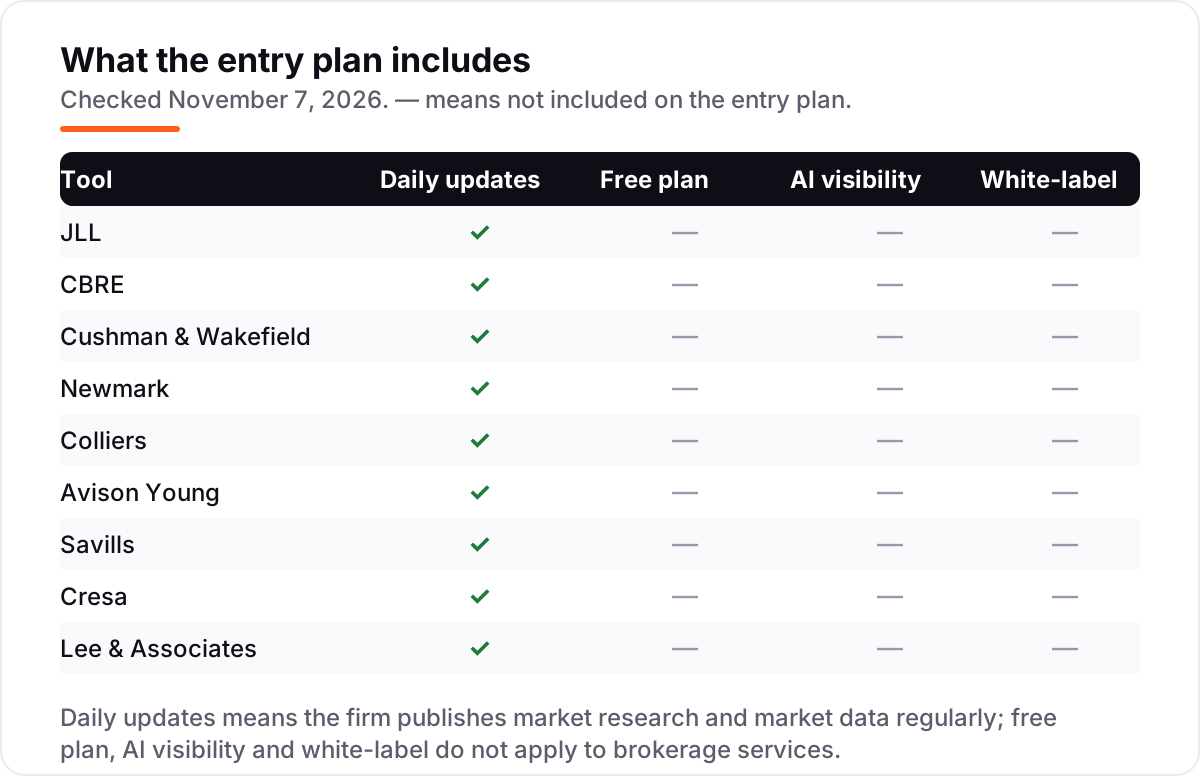
- JLL leads 2025 tenant-rep volume at $21.8 billion, CBRE follows at $19.4 billion and Cushman & Wakefield at $14.2 billion — and all nine firms quote fees per deal, with no published starting price.
- The single most important buying factor is deal size and market count: national platforms win above 25,000 square feet or across markets, while tenant-only firms give smaller deals more senior attention.
- CBRE manages about 19,000 properties, the most in the 2026 Biscred rankings, and 8.4 billion square feet in 2025 — scale that buys landlord access and market data.
- Cresa and Avison Young remove landlord conflicts by design in tenant-only work; full-service firms may represent both sides, so ask how conflicts are handled before you sign.
On this page
Quick comparison
| Tool | Best for | Starting price | Free plan |
|---|---|---|---|
| JLL | Large tenants and life-science occupiers that need the deepest tenant-rep volume and multi-market coverage | Custom quote | Not applicable |
| CBRE | Tenants, owners and investors who want the largest national footprint and the most properties under management | Custom quote | Not applicable |
| Cushman & Wakefield | Occupiers across office, retail and industrial who want strong research behind the deal | Custom quote | Not applicable |
| Newmark | East Coast office and life-science tenants and owners who also need capital-markets and financing depth | Custom quote | Not applicable |
| Colliers | Tenants in West Coast and Sun Belt secondary markets who want workplace strategy beside leasing | Custom quote | Not applicable |
| Avison Young | Tenants who want senior attention and a tenant-only advocate in markets where the firm runs that model | Custom quote | Not applicable |
| Savills | Tech and professional-services tenants who want senior negotiators and global coordination | Custom quote | Not applicable |
| Cresa | Tenants who want a conflict-free advocate that never represents landlords | Custom quote | Not applicable |
| Lee & Associates | Tenants and owners in US and Canadian local markets who want a broker-owned local office | Custom quote | Not applicable |
Make one of these tools?
We re-check this list every quarter. Send a correction, request a review, or ask about a clearly labeled sponsored spot.
Request a listingThe best commercial real estate companies

JLL
Best for: Large tenants and life-science occupiers that need the deepest tenant-rep volume and multi-market coverage
JLL, or Jones Lang LaSalle, leads this list on the number that matters most to tenants: 2025 tenant-rep volume of $21.8 billion in the Real Capital Analytics 2026 league tables, the highest of any firm here. Its corporate real estate, property management and capital markets teams cover the full deal cycle, and its office and life-science strength suits large tenants and research-driven occupiers. In 2025 it completed 23,500 tenant-rep deals covering 569 million square feet.
The trade-off is the large-firm process. A big platform can move slowly on a small deal, and the senior partner who pitches may not run the day-to-day work. Fees are quoted per deal and vary by market, so the written quote is the only firm number. Hire JLL when the deal is large, multi-market or life science, and data depth matters more than the fee.
What we like
- Leads 2025 tenant-rep volume at $21.8 billion in the Real Capital Analytics 2026 league tables
- Completed about 23,500 tenant-rep deals covering 569 million square feet in 2025
- Office and life-science strength with a strong East Coast presence
- Corporate real estate, property management and capital markets cover the full deal cycle
Watch out for
- Large-firm process can slow smaller deals, and junior staff may handle the day-to-day work
- Senior attention varies by deal size, with smaller deals getting less partner time
- Fees vary by market and deal, so the quote is the only number that counts

CBRE
Best for: Tenants, owners and investors who want the largest national footprint and the most properties under management
CBRE is the scale pick. It leads on property count under management at 19,000 properties in the 2026 Biscred rankings, and it managed 8.4 billion square feet of commercial property in 2025 — more than the other 29 firms in the CPE ranking combined. Its 2025 tenant-rep volume of $19.4 billion ranks second in the league tables, and at $40.6 billion in 2025 revenue it is the world's largest commercial real estate services firm.
That scale buys landlord access and market data no smaller firm can match, which is exactly what a multi-market tenant needs. The cost is attention: a small deal can sit behind bigger clients in the staffing queue, and the senior attention varies by deal size. Hire CBRE when the portfolio is national, the deal is large, or the owner needs property management beside leasing.
What we like
- Leads on property count under management at 19,000 properties in the 2026 Biscred rankings
- Managed 8.4 billion square feet of commercial property in 2025, more than the next 29 ranked firms combined
- Second in 2025 tenant-rep volume at $19.4 billion in the league tables
- The world's largest commercial real estate services firm by 2025 revenue, at $40.6 billion
Watch out for
- Large-firm process and tenant attention that varies by deal size are the trade-offs
- A smaller deal can sit behind bigger clients in the staffing queue
- Fees vary by market and deal, so get the terms in writing before engaging

Cushman & Wakefield
Best for: Occupiers across office, retail and industrial who want strong research behind the deal
Cushman & Wakefield ranks third in 2025 tenant-rep volume at $14.2 billion, with office, retail and industrial breadth that suits tenants beyond pure office. Its MarketBeat research reports are a genuine differentiator: many tenants use them to make market decisions before they ever talk to a broker. The firm employs about 53,000 people in more than 350 offices across nearly 60 countries, and reported $10.3 billion in 2025 revenue.
Capital markets, tenant representation, valuation and advisory cover the full deal cycle, and the industrial and retail depth suits tenants whose needs are not only office. The limits are the usual large-firm ones: process can slow a small deal, and coverage varies by market. Hire Cushman & Wakefield when research quality matters and the requirement spans more than one property type.
What we like
- Third in 2025 tenant-rep volume at $14.2 billion in the Real Capital Analytics 2026 league tables
- MarketBeat research reports that many tenants use for market decisions
- About 53,000 employees in more than 350 offices across nearly 60 countries
- Office, retail and industrial breadth, with $10.3 billion in 2025 revenue
Watch out for
- Large-firm process can slow smaller deals, and coverage varies by market
- Local team strength varies, so the submarket team matters more than the brand
- Fees vary by deal, so the written quote is the only firm number

Newmark
Best for: East Coast office and life-science tenants and owners who also need capital-markets and financing depth
Newmark ranks fourth in 2025 tenant-rep volume at $11.9 billion, with East Coast office and life-science strength plus Chicago and Boston depth. Its capital markets, debt and equity, and investment sales services suit owners and tenants that need financing beside leasing, and its office focus gives it depth in the major East Coast markets. The firm suits tenants in Boston, New York and Chicago that want a strong regional platform with national reach.
The trade-off is geography. East Coast concentration means thinner coverage in some Sun Belt and West Coast markets compared with CBRE or Colliers, and the national footprint is smaller than the top three. Hire Newmark for East Coast office and life-science work, especially when the deal also needs debt, equity or an investment sale.
What we like
- Fourth in 2025 tenant-rep volume at $11.9 billion in the Real Capital Analytics 2026 league tables
- East Coast office and life-science strength, with Chicago and Boston depth
- Debt and equity strength suits owners and tenants that need financing beside leasing
- Capital markets, investment sales and advisory cover the full deal cycle
Watch out for
- East Coast concentration means thinner coverage in some Sun Belt and West Coast markets
- Smaller national footprint than the top three firms
- Fees vary by deal, so get the terms in writing before engaging

Colliers
Best for: Tenants in West Coast and Sun Belt secondary markets who want workplace strategy beside leasing
Colliers ranks fifth in 2025 tenant-rep volume at $8.7 billion, with West Coast and Sun Belt secondary-market strength and workplace strategy and analytics services that help tenants plan space around labor and work patterns. Its leasing, advisory, property management and valuation services cover the full cycle, and its secondary-market depth suits tenants outside the largest gateway cities.
Volume trails the top four, and coverage varies by market, so the local team is worth checking before you commit. Hire Colliers when the requirement sits in a secondary market, or when the space decision needs workplace strategy beside the lease — how much space, where, and for which teams.
What we like
- Fifth in 2025 tenant-rep volume at $8.7 billion in the Real Capital Analytics 2026 league tables
- West Coast and Sun Belt secondary-market strength, beyond the gateway cities
- Workplace strategy and analytics help tenants plan space around labor and work patterns
- Leasing, advisory, property management and valuation cover the full cycle
Watch out for
- Volume trails the top four firms, at $8.7 billion in 2025 tenant-rep volume
- Coverage varies by market, so confirm the local team's depth
- Fees vary by deal, so the written quote is the only firm number

Avison Young
Best for: Tenants who want senior attention and a tenant-only advocate in markets where the firm runs that model
Avison Young ranks sixth in 2025 tenant-rep volume at $4.1 billion, with a tenant-only practice in some markets that removes landlord conflicts for occupiers. Its market intelligence and advisory services suit tenants that want data-driven decisions, and its trophy asset sales experience gives it depth in high-end markets. The firm's principal-led model gives tenants senior attention on deals where large firms may staff junior teams.
Volume trails the leaders, and the tenant-only scope varies by market, so confirm the local practice model before you engage — the model that applies in one city may not apply in the next. Hire Avison Young when senior attention matters more than national scale, and when a conflict-free advocate is the priority.
What we like
- Sixth in 2025 tenant-rep volume at $4.1 billion in the Real Capital Analytics 2026 league tables
- Tenant-only practice in some markets removes landlord conflicts for occupiers
- Principal-led model gives tenants senior attention on deals where large firms staff junior teams
- Market intelligence and advisory suit tenants that want data-driven decisions
Watch out for
- Volume trails the leaders, at $4.1 billion in 2025 tenant-rep volume
- Tenant-only scope varies by market, so confirm the local practice model before engaging
- Fees vary by deal, so get the terms in writing before engaging

Savills
Best for: Tech and professional-services tenants who want senior negotiators and global coordination
Savills ranks seventh in 2025 tenant-rep volume at $3.8 billion, with a tech and professional-services focus and a reputation for senior attention on tenant representation. Its lease negotiation and consultancy services suit tenants that want experienced negotiators rather than large teams, and its global platform helps multinational tenants coordinate across countries.
The firm's principal-led approach gives smaller deals senior time that large firms may not, which is the real reason to hire it. The limits are scale and coverage: US volume trails the leaders, and coverage is thinner outside major markets. Hire Savills for tech and professional-services tenants that want senior negotiators and global coordination.
What we like
- Seventh in 2025 tenant-rep volume at $3.8 billion in the Real Capital Analytics 2026 league tables
- Tech and professional-services focus, with experienced negotiators rather than large teams
- Global platform helps multinational tenants coordinate across countries
- Principal-led approach gives smaller deals senior time that large firms may not
Watch out for
- US volume trails the leaders, at $3.8 billion in 2025 tenant-rep volume
- Coverage is thinner outside major markets
- Fees vary by deal, so the written quote is the only firm number

Cresa
Best for: Tenants who want a conflict-free advocate that never represents landlords
Cresa is tenant-only by design, with 2025 tenant-rep volume of $3.2 billion and no landlord representation business to create conflicts. Its model suits occupiers who want an advocate that never represents the other side of the table, and its senior attention on smaller deals is a recurring strength in published guides. For deals of 1,000 to 25,000 square feet, tenant-only firms typically deliver more senior attention than national platforms.
Tenant-only scope means owners and investors need a different firm, and volume trails the leaders. That is the whole point of the model: the firm gives up landlord work to remove the conflict. Hire Cresa when you are the tenant, the deal is small or mid-size, and you want a broker whose only client in the room is you.
What we like
- Tenant-only by design, with 2025 tenant-rep volume of $3.2 billion and no landlord representation business
- No landlord conflicts, so the firm never sits on the other side of the table
- Senior attention on smaller deals is a recurring strength, especially at 1,000 to 25,000 square feet
- Occupier-only model suits tenants who want an advocate, not a broker for both sides
Watch out for
- Tenant-only scope means owners and investors need a different firm
- Volume trails the leaders, at $3.2 billion in 2025 tenant-rep volume
- Coverage varies by market, so confirm the local office before engaging

Lee & Associates
Best for: Tenants and owners in US and Canadian local markets who want a broker-owned local office
Lee & Associates ranks ninth in 2025 tenant-rep volume at $2.4 billion, and it is built differently from every other firm here. Founded in 1979, it is a broker-owned network: each office is owned and run by its own brokers, who keep a share of the local office's results. It now has more than 60 offices across the United States and Canada and over 1,300 people — the largest broker-owned commercial real estate firm in North America.
The model is the selling point and the risk at once. Local owners know their market and have a direct stake in the outcome, but quality depends on the local office, so one city's team is no guarantee of another's. Hire Lee & Associates when the requirement is local, submarket knowledge matters most, and you prefer dealing with owners rather than national hierarchy.
What we like
- Ninth in 2025 tenant-rep volume at $2.4 billion in the Real Capital Analytics 2026 league tables
- Broker-owned model: each office is owned by its own brokers, so the local team has a stake in the outcome
- Founded in 1979, with more than 60 offices across the United States and Canada
- The largest broker-owned commercial real estate firm in North America, with over 1,300 people
Watch out for
- Volume trails the national platforms, at $2.4 billion in 2025 tenant-rep volume
- Coverage depends on the local office, so quality varies market to market
- Fees vary by deal, so get the terms in writing before engaging
The best commercial real estate companies are not software you buy, they are firms you hire, and the fee is quoted per deal rather than listed on a pricing page. This list ranks nine firms by 2025 tenant-rep volume from the Real Capital Analytics 2026 league tables, then by coverage, service breadth and whether the firm ever represents landlords. JLL leads at $21.8 billion, CBRE follows at $19.4 billion, and the tenant-only firms at the end of the list win on a different measure entirely: no conflicts at all.
How to choose the best commercial real estate companies
- Start with deal size and market count. For deals of 25,000 square feet or more, or multi-market portfolios, national platforms like JLL, CBRE, Cushman & Wakefield or Newmark win on data depth and landlord access. For deals of 1,000 to 25,000 square feet, boutiques and tenant-only firms like Cresa, Savills or Avison Young typically deliver more senior attention.
- Check conflicts before you check fees. Tenant-only firms remove landlord conflicts by design, while full-service firms may represent both sides in different deals, so ask how the firm handles that.
- Match the firm's proven submarket work to your location. A strong Chicago team does not guarantee a strong Phoenix team, so ask for comparable deals in your submarket and size range, and call the references.
- Ask who staffs your deal by name and seniority. The partner who pitches is not always the person who runs the search, and on a small deal the difference matters more than the brand.
- Get fee terms, exclusivity and termination rights in writing. No firm here publishes a rate card, so the engagement letter is the only price you will ever see.
A broker finds the space, but search brings the customers to it. If your firm also needs to be found locally, our local SEO service covers Google Maps and AI answers for location-based businesses. Before you publish new location pages, check your markup with the free local business schema generator — it builds the structured data Google uses for local results.
Commercial real estate companies pricing: what you will actually pay
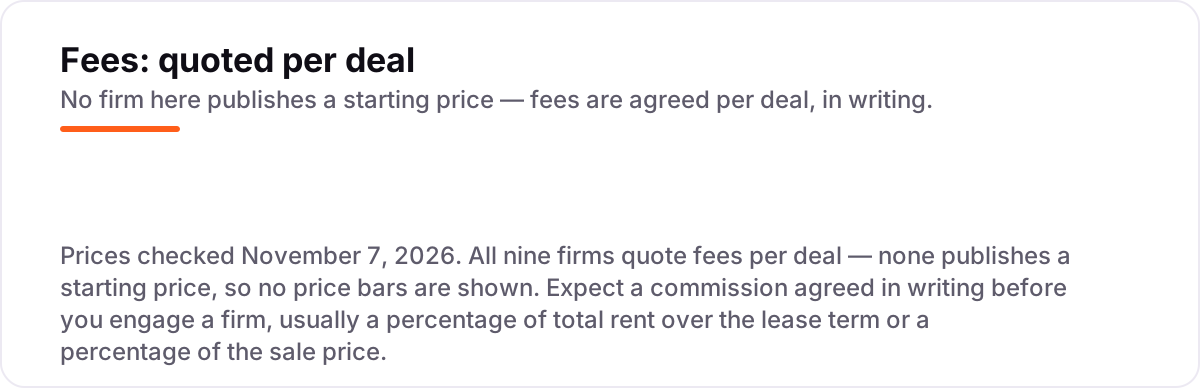
Take a tenant signing for 10,000 square feet at $30 per square foot per year on a five-year lease. The total rent over the term is $1.5 million — 10,000 square feet times $30 times 5 years — and the broker's fee is usually a percentage of that total, agreed in writing before the search starts. In most markets the landlord pays that commission, so the tenant's out-of-pocket fee is often $0, but "often" is not a contract term: confirm who pays, the percentage and the exclusivity period in the engagement letter.
That is why the nine cards above show no prices. The firms do not publish rate cards, and the fee on a $1.5 million lease is not the fee on a $15 million one. What varies instead is attention: JLL's $21.8 billion in 2025 tenant-rep volume buys data depth and landlord access, while Cresa's tenant-only model buys a broker whose only client in the room is you. The cheapest engagement is usually the one where the landlord pays, and the most expensive mistake is signing an exclusive agreement with the wrong firm — the fee is the same either way, but the result is not.
If the space is for a business that also markets itself online, the visibility side matters as much as the lease. Our guide to social media platforms for real estate agents covers how firms reach buyers and tenants after the deal is signed.
Know the difference: tenant representation vs landlord leasing
The confusion in this category is between two jobs that share one word: leasing. A leasing broker can represent either side of a deal — the landlord filling a building, or the tenant taking space in it. A tenant representative acts only for the occupier, negotiating rent, terms, concessions and flexibility on the tenant's behalf. The job titles sound alike, the incentives are not.
There is a second, quieter confusion: volume is not attention. A firm can lead the league tables on $21.8 billion of tenant-rep volume and still staff your 5,000-square-foot deal with a junior team, because volume is measured in dollars, not in hours per client. The firms at the bottom of this list exist for exactly that reason: Cresa and Avison Young trade volume for a model where the senior broker is the one doing the work.
A third distinction worth knowing is the conflict itself. A full-service firm may represent the landlord of the building you are considering while also representing you, in a different deal or even the same one, and the disclosure rules for that vary by state. A tenant-only firm removes the question by design: it has no landlord business, so there is nothing to disclose. If you hire a full-service firm, ask in writing how dual representation is handled; if you hire a tenant-only firm, that question answers itself.
Quick comparison: tool type by need
| Buyer | Best pick | Why |
|---|---|---|
| Large tenant, multi-market deal | JLL | Leads tenant-rep volume at $21.8 billion, with office and life-science depth |
| Owner or investor, national scale | CBRE | 19,000 properties under management, the largest national footprint |
| Research-driven occupier | Cushman & Wakefield | MarketBeat research and $14.2 billion in tenant-rep volume |
| East Coast office or life science | Newmark | $11.9 billion in volume, with debt and equity strength beside leasing |
| West Coast or Sun Belt secondary market | Colliers | $8.7 billion in volume, with workplace strategy beside the lease |
| Conflict-free tenant advocate | Cresa | Tenant-only by design, no landlord business at all |
| Local market, broker-owned office | Lee & Associates | Local owners with a stake in the outcome, founded 1979 |
Mistakes to avoid
- Hiring on brand alone. A strong Chicago team does not guarantee a strong Phoenix team. Ask for comparable deals in your submarket and size range, and call the references.
- Signing exclusivity before you know who staffs the deal. Get the names and seniority of the people who will run your search, and the termination rights, in the engagement letter.
- Treating volume as attention. League-table volume is measured in dollars, not hours per client. On a deal under 25,000 square feet, a tenant-only firm often gives you more senior time.
- Skipping the conflict question. Ask a full-service firm in writing how it handles representing both sides, and get the answer before you sign — not after the first proposal arrives.
- Starting the search too late. Small deals take 4 to 8 weeks and large ones 3 to 6 months or more. Start before the current lease expiry forces a rushed decision.
How we chose
We checked each firm's own site on November 7, 2026 and confirmed that none of the nine publishes a starting price or rate card, so every fee here is a custom quote agreed per deal. We ranked the firms by 2025 tenant-rep volume from the Real Capital Analytics 2026 league tables, with property-management scale from the 2026 Biscred rankings and management area from Commercial Property Executive's 2026 ranking. This list carries no review ratings because G2 and Capterra rate software products, not brokerage firms — G2's JLL listing, for example, rates the firm's software, not its brokerage service — and we would rather show no rating than a misleading one. No firm paid for a place in this list, and none of the links here are affiliate links.
What to do next
Shortlist two firms, not nine: one national platform and one tenant-only or local firm, then ask both for comparable deals in your submarket and a written fee proposal. Compare who staffs the deal, how conflicts are handled and how long the search will take — not the brand on the door. If the space is sorted but new customers are not finding you, our monthly SEO service handles the visibility side — or compare providers in our guide to SEO companies for small business. Once your tools are in place, find out what's holding your rankings back.
Your stack only works if people find you
SerpAstra fixes what keeps your site off page one and makes it easy for AI assistants to recommend.
Get a free audit→Sources we checked (12)
- JLL — jll.com (checked November 7, 2026)
- CBRE — cbre.com (checked November 7, 2026)
- Cushman & Wakefield — cushmanwakefield.com (checked November 7, 2026)
- Newmark — nmrk.com (checked November 7, 2026)
- Colliers — colliers.com (checked November 7, 2026)
- Avison Young — avisonyoung.com (checked November 7, 2026)
- Savills — savills.com (checked November 7, 2026)
- Cresa — cresa.com (checked November 7, 2026)
- Lee & Associates — lee-associates.com (checked November 7, 2026)
- Tenant-rep league tables — commercialleasecost.com (Real Capital Analytics 2026 league tables, checked November 7, 2026)
- Biscred 2026 property management rankings — bisnow.com (checked November 7, 2026)
- CPE 2026 Top Commercial Property Management Firms — commercialsearch.com (checked November 7, 2026)
Shamim
Founder of SerpAstra
A full-stack SEO and digital marketer who spends most days on Local SEO for dental practices, AI search visibility and lead generation.
Frequently asked questions
What is the best commercial real estate company?
JLL is the best fit for most large tenants: it leads 2025 tenant-rep volume at $21.8 billion, with office and life-science strength and multi-market coverage. CBRE is the better pick for owners and investors who need the largest footprint, with 19,000 properties under management. Cresa is the best pick for tenants who want a conflict-free advocate.
How are commercial real estate companies paid?
Most brokers earn a commission paid by the landlord or seller, usually a percentage of total rent over the lease term or a percentage of the sale price. Terms vary by market and deal, and none of the nine firms here publishes a rate card. Get the fee, who pays it, exclusivity and termination rights in writing before engaging a firm.
How much does it cost to hire a tenant rep broker?
There is no published starting price: every firm quotes per deal, and in most markets the landlord pays the commission, so the tenant's out-of-pocket fee is often $0. That is not a contract term, so confirm who pays, the percentage and the exclusivity period in the engagement letter before the search starts.
Should I use a national firm or a local broker?
Use a national firm for deals above 25,000 square feet or across several markets, where data depth and landlord access matter most. Use a local or tenant-only firm for smaller deals, where senior attention and submarket knowledge matter more. Match the firm to deal size and market count, not to brand size alone.
What is the difference between tenant representation and leasing?
Leasing can mean representing either side of a deal, while tenant representation means acting only for the occupier. A tenant-only firm like Cresa never represents landlords, which removes conflicts by design. Confirm which side your broker represents before engaging, and ask how the firm handles conflicts.
How long does a commercial lease negotiation take?
Small deals often close in 4 to 8 weeks, while large or complex deals take 3 to 6 months or more, including site tours, proposals and legal review. Build buffer time into relocation plans, and start the search before the current lease expiry forces a rushed decision.
Free SEO and AI visibility audit
Find out what is holding your rankings back
Send us your site. Within 2 business days you get a written audit, an AI visibility check and a short fix list ranked by impact. Free, with no contract attached.
Request my free audit→Related guides
 Email, SMS & Social Media10 Best Social Media Platforms for Real Estate Agents in 2026, ComparedCompare the 10 best social media platforms for real estate agents on audience, formats and cost — every platform free to join, checked Nov 6, 2026.Read guide →
 SEO & AI Search8 Best SEO Companies for Small Business in 20268 best SEO companies for small business compared on price, contracts and AI visibility, with prices checked on each agency's own site on November 1, 2026.Read guide →
 SEO & AI Search12 Best Marketing Platforms for Small Business SEO in 2026, ComparedThe 12 best marketing platforms for small business SEO, compared on real prices, SEO tools and AI visibility. Every price checked November 1, 2026.Read guide →