
7 Best Contractor Bidding Software in 2026, Compared
Compare the 7 best contractor bidding software options on price, takeoff, bid invitations and free plans, with every price checked November 7, 2026.
 Shamim Mia, Founder, SerpAstraLast verified November 7, 202612 min read
We compare pricing pages, documentation and public reviews. We never accept payment for rankings.

Key takeaways
- Buildertrend is the best fit for most residential builders, though its price is quoted per company; Contractor Foreman follows at $49/month for small GCs, and Clear Estimates is the cheapest estimating pick at $79/month ($59 billed annually).
- STACK is the strongest pure takeoff tool at $299 per user per month, while SmartBid at $450 a month is the pick for commercial GCs whose main job is bid invitations.
- The single most important buying factor is the pricing model: per-user tools triple in cost as the team grows, while flat-rate tools stay put — count seats before you compare headline prices.
- Procore publishes no price at all — expect a quote built per company, and budget for one to three months of implementation.
On this page
Quick comparison
| Tool | Best for | Starting price | Free plan |
|---|---|---|---|
| Buildertrend | Residential builders and remodelers who want estimating, bids and project management in one subscription | Custom quote | No |
| Contractor Foreman | Small general contractors that outgrew spreadsheets and want the most modules per dollar | $49/mo | No (30-day trial) |
| Buildxact | Residential builders and remodelers who price from live supplier lists | $199/mo | Yes (Go plan) |
| STACK | Preconstruction teams whose bottleneck is measuring plans, not sending invitations | $299/user/mo | Yes (free version) |
| Clear Estimates | Remodelers who need consistent, professional bid documents from a cost database | $79/mo | No (30-day trial) |
| SmartBid | Commercial general contractors whose main job is sending bid invitations and managing subcontractors | $450/mo | No |
| Procore | Mid-size and large general contractors that want bidding inside a full project platform | Custom quote | No |
Make one of these tools?
We re-check this list every quarter. Send a correction, request a review, or ask about a clearly labeled sponsored spot.
Request a listingThe best contractor bidding software

Buildertrend
Best for: Residential builders and remodelers who want estimating, bids and project management in one subscription
Buildertrend is the all-in-one pick for residential builders and remodelers who want estimating, bids and project management in one subscription. Essential covers scheduling, budgeting, change orders, daily logs and a client portal where homeowners track progress and approve selections. Bids feed straight into budgets and schedules, so nothing is re-entered once a job is won.
The catch is scope and commitment. There is no free trial, so the only way to evaluate it is a demo, and smaller shops pay for features they may never touch — higher tiers widen the toolkit and raise the price. Commercial GCs running competitive bid cycles with dozens of subs will find the bidding tools thinner than SmartBid or Procore. Buy Buildertrend when you build homes or remodel and want one system from first estimate to final walkthrough.
What we like
- Estimating, bids, scheduling, budgets and client communication in one subscription
- Client portal lets homeowners approve selections and track progress without phone calls
- Flat company rate to start, with no per-user charges on the entry plan
- QuickBooks integration keeps estimates and accounting in sync
Watch out for
- No free trial — evaluation is by demo only
- Higher tiers make the full feature set pricey, and prices are quoted per company
- Bidding depth lags SmartBid and Procore for commercial GCs running large bid cycles

Contractor Foreman
Best for: Small general contractors that outgrew spreadsheets and want the most modules per dollar
Contractor Foreman is the budget pick for small general contractors that outgrew spreadsheets but cannot justify Procore. Basic costs $49 a month billed annually for one user and covers estimates, scheduling, documents, a client portal and QuickBooks integration. Plans are priced by user caps rather than feature gates, so the whole company pays one flat rate, and every plan includes unlimited projects with no per-project fees.
The limits are the user caps. Basic covers one user, so a three-person office needs Standard at $105 a month billed annually, and a 15-person team needs Pro at $221. The interface is utilitarian next to Buildertrend, and reviewers describe it as busy and sometimes slow. Buy Contractor Foreman when you want the most modules per dollar and your team is small enough to fit the caps.
What we like
- Flat per-company pricing from $49 a month — no per-user charges on any tier
- Estimates, scheduling, daily logs, change orders and job costing in one system
- Free private training sessions on paid tiers
- QuickBooks integration included from the Basic plan
Watch out for
- Basic covers one user — a small team needs Standard at $105 a month or higher
- Interface looks dated and reviewers say pages can load slowly
- Local material pricing from 1build is not included on Basic or Standard

Buildxact
Best for: Residential builders and remodelers who price from live supplier lists
Buildxact is the estimating-first pick for residential builders and remodelers who price from supplier lists. Foundation costs $199 a month, or $169 billed annually, with unlimited users on every plan. Digital takeoffs flow into estimates, estimates into branded quote letters with digital sign-off, and the winning estimate becomes the cost baseline for purchase orders and job tracking.
The catch is where the job management lives. Scheduling and the Onsite mobile app start on Pro at $399 a month, so Foundation is an estimating tool first and a project platform second. Monthly plans reportedly carry a 12-month initial contract, and the Blu AI tools are add-ons on lower plans. Buy Buildxact when accurate residential estimates are the job and dealer pricing matters.
What we like
- Live dealer pricing, including Home Depot Pro, feeds estimates with current material rates
- Unlimited users on every plan — no per-seat charges as the team grows
- Free Go plan and 14-day trial let you test the workflow before paying
- Quote letters with digital sign-off and purchase orders included from Foundation
Watch out for
- Scheduling and job management wait for Pro at $399 a month
- Blu AI tools are paid add-ons on Foundation and Pro
- Monthly plans reportedly require a 12-month initial contract

STACK
Best for: Preconstruction teams whose bottleneck is measuring plans, not sending invitations
STACK is the takeoff-first pick for preconstruction teams whose bottleneck is measuring plans, not sending invitations. Takeoff & Estimate starts at $299 per user per month, as listed on the vendor's own pricing page, and estimators measure quantities directly from digital plans in the browser, collaborate on the same project in real time, and build estimates from the takeoff data.
The per-user model is the catch: three estimators cost $897 a month before any add-ons, and the AI features that lead the marketing are largely separate add-ons. A free version covers Takeoff & Estimate for small shops, and Build & Operate adds field tools from $49 per user per month. Buy STACK when takeoff speed and accuracy decide your win rate.
What we like
- Cloud takeoff with real-time collaboration — no desktop software to install
- Estimates build directly from takeoff quantities, so nothing is re-measured
- Free version for small shops, plus a two-week trial on Build & Operate
- GPT-powered AI chat helps estimators read plan documents faster
Watch out for
- Per-user pricing adds up fast — a ten-person estimating team pays $2,990 a month
- Vendor page lists $299 as the floor while older listings show Premium at $249 — confirm the quote
- AI features beyond chat are mostly paid add-ons, not in the base price

Clear Estimates
Best for: Remodelers who need consistent, professional bid documents from a cost database
Clear Estimates is the most focused tool here: it helps remodelers produce consistent, professional bid documents from a structured cost database. Standard costs $79 a month billed monthly, or $59 billed annually, and includes unlimited estimates, a database of 15,000 parts with local labor and material rates for 400 US areas, and more than 400 preloaded project templates.
That narrowness is the point — and the limit. Clear Estimates stops at the proposal: there is no scheduling, project management or client portal, and estimates do not sync automatically with QuickBooks or Xero. Extra users on Pro cost $9 a month each. Buy it when you remodel kitchens, baths and additions and need accurate, good-looking bids fast.
What we like
- 15,000-part cost database with local pricing for 400 US areas, updated regularly
- 400-plus project templates keep bids consistent across estimators
- Cheapest paid entry here at $59 a month billed annually
- Built-in e-signature and contract language on the Standard plan
Watch out for
- Stops at the proposal — no scheduling, job costing or client portal
- No automatic sync with QuickBooks or Xero
- Only one G2 review, so user feedback is thin

SmartBid
Best for: Commercial general contractors whose main job is sending bid invitations and managing subcontractors
SmartBid does one job for general contractors: run the invitation-to-bid process. At $450 a month, GCs build subcontractor mailing lists, send bid invitations from templates, share plans through the planroom, track who viewed and downloaded documents, and compare bids side by side. It taps the ConstructConnect and SmartInsight subcontractor databases to widen coverage.
The price is the filter: $450 a month is easy to justify for a GC running dozens of bid packages a year and impossible for a subcontractor or small builder. There is no free trial, and SmartBid does not do takeoffs or estimates — subs still price the work elsewhere. Buy SmartBid when bid invitations are a full-time function, not an occasional task.
What we like
- Purpose-built for bid invitations, ITB cycles and bid leveling
- ConstructConnect and SmartInsight databases widen the subcontractor pool fast
- Planroom tracks document views and downloads per invitee
- Integrates with Procore, Autodesk BIM 360, STACK and Dropbox
Watch out for
- Highest published starting price here at $450 a month
- No free trial and no free plan
- No takeoff or estimating tools — it manages bids, not the bid math

Procore
Best for: Mid-size and large general contractors that want bidding inside a full project platform
Procore is the default platform for mid-size and large general contractors that want bidding inside a full project system. GCs build bid packages from templates, share drawings and specifications through the planroom, invite subcontractors, compare responses, and convert the winning bid into a subcontract or purchase order with line-item breakdowns — nothing gets re-entered.
The reason not to buy it for bidding alone is scope and price. Pricing is quote-only and reflects the full platform, not just the bidding module, which prices out smaller firms; implementation typically takes one to three months. Buy Procore when the company is already running, or planning to run, its projects on the platform.
What we like
- Bid packages convert directly into subcontracts and purchase orders
- Planroom stores drawings with bid documents, with search by trade, cost code and location
- Highest-rated tool here at 4.6 out of 5 on G2, from more than 4,600 reviews
- Deepest integration list, including accounting, scheduling and field tools
Watch out for
- Quote-only pricing — no published starting price
- Too much platform, and too much implementation, for firms that only need bidding
- Bidding is one module of a large system, so small teams pay for breadth they will not use
Bidding is where a contractor's year is won or lost: the estimate has to be accurate enough to make money and fast enough to reach the client before a competitor does. The 7 best contractor bidding software options below cover both sides of that job — measuring and pricing the work, and managing the invitations, documents and deadlines around it — ranked for the most common buyer, a small or mid-size contractor bidding residential and light commercial work, with every price checked November 7, 2026.
A quick warning before the list: "bidding software" covers three different jobs, and buying the wrong type is the most expensive mistake in this category. Takeoff and estimating tools price the work; bid management tools run invitations and compare subcontractor bids; marketplaces find the work in the first place. We sort each tool by the job it actually does, so compare the tools in your job's group first.
How to choose the best contractor bidding software
- Name the job first. If the bottleneck is measuring plans, buy a takeoff tool like STACK or Buildxact. If it is chasing subcontractors, buy a bid management tool like SmartBid or Procore. If it is finding work, that is a marketplace, not software in this list.
- Count the seats, not the users. STACK charges $299 per user per month, so three estimators cost $897 a month; Buildertrend, Buildxact and Contractor Foreman charge a flat company rate. Multiply before you compare headline prices.
- Check the price book. A takeoff tool is only as good as its rates: Clear Estimates ships a 15,000-part database with local pricing, Buildxact pulls live dealer pricing, and STACK leans on assemblies you build yourself. Confirm your trades and region are covered.
- Ask what the entry plan leaves out. Scheduling waits for Buildxact Pro, the Blu AI tools are add-ons, and Procore's bidding is one module of a large platform. The feature that decides your purchase may sit a tier above the starting price.
- Test with a real bid. Run one live job through the trial using your own plan set — a takeoff, an estimate and a sent invitation. That single bid tells you more than any demo about speed, accuracy and fit.
If the bids are sorted but new customers are not finding you, our local SEO service covers the visibility side — and before you publish new service pages, run them through the free local business schema generator so Google reads your service area and reviews correctly.
Contractor bidding software pricing: what you will actually pay
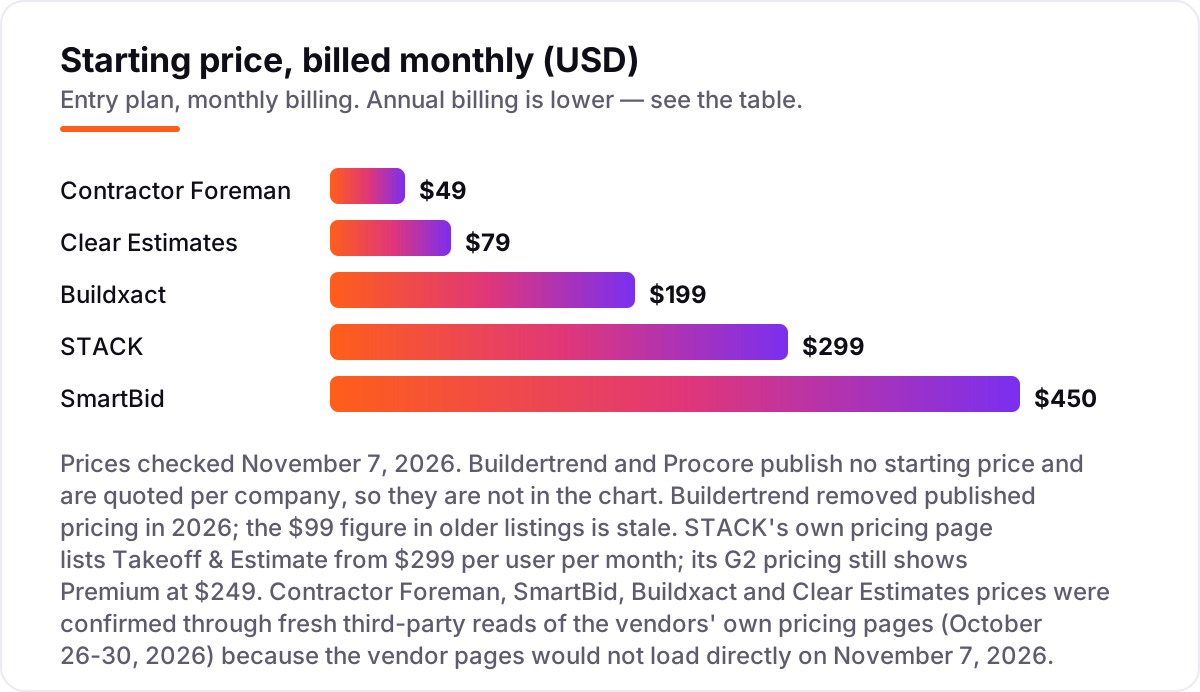
Take a three-person residential remodeling firm that sends about eight bids a month. On list prices, the subscription costs $79 a month on Clear Estimates Standard, $105 on Contractor Foreman Standard, $199 on Buildxact Foundation, $450 on SmartBid and $897 on STACK for three seats. Two of those numbers need adjusting before they are real: Contractor Foreman Basic at $49 covers one user only, so a three-person office needs Standard, and STACK is per user, so the $299 figure triples with the team.
Over a year, that is $708 on Clear Estimates billed annually, $1,260 on Contractor Foreman Standard billed annually, $2,028 on Buildxact Foundation billed annually, $5,400 on SmartBid and $10,764 on STACK for three seats. The same three people and the same eight bids cost $708 a year at the cheap end and $10,764 at the dear end — a $10,056 gap that comes entirely from the pricing model, not from features. Procore sits outside this math entirely: it quotes per company, so get the number in writing before you compare it with anything else.
Two costs sit outside every number above. First, the annual discount: Clear Estimates drops from $948 to $708 a year, Buildxact from $2,388 to $2,028, and Contractor Foreman Standard from $1,668 to $1,260 when you pay yearly — but only if you can commit to the year. Second, the add-ons: STACK's AI features beyond chat, Buildxact's Blu AI tools and Clear Estimates' extra users at $9 a month each all stack on top of the headline price. If you run a different kind of contracting business, the visibility tools differ too — see our guide to marketing software for contractors.
Know the difference: bidding software vs estimating software vs bid marketplaces
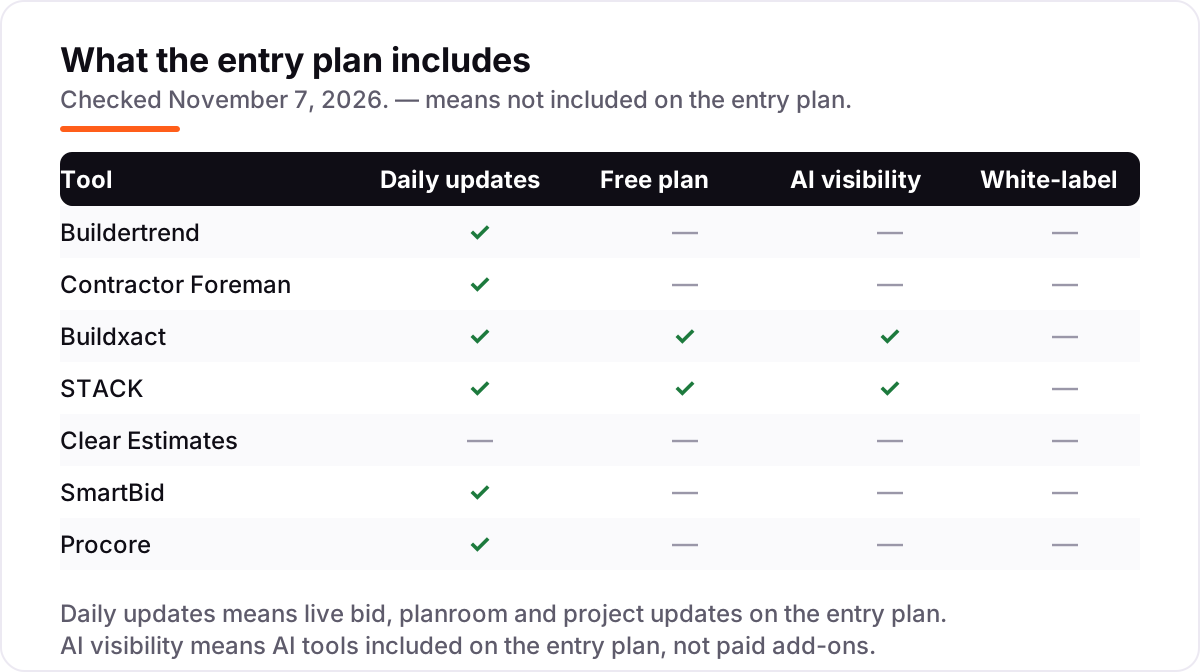
The confusion in this category is that three different jobs share one name. Estimating software prices the work: it measures quantities from plans, applies labor and material rates, and produces the number you put on the bid. STACK, Buildxact and Clear Estimates live here. Bidding software manages the process around that number: it sends invitations to bid, stores plans in a shared planroom, tracks which subcontractors opened the documents, and compares their responses side by side. SmartBid and Procore's bidding module live here.
The third job is finding the work at all. Bid marketplaces such as PlanHub post projects and let subcontractors discover them and submit bids — they are a source of opportunities, not a way to price or manage them. A subcontractor still needs an estimating tool to price the work it finds there, and a general contractor still needs a bid management tool to run the invitations.
There is a second, quieter confusion: the all-in-one platforms versus the specialists. Buildertrend and Contractor Foreman bundle estimating with scheduling, job costing and client communication, which suits a residential builder who wants one system. The specialists do one job deeply and expect you to pair them with something else. Neither approach is wrong; the mistake is buying a bundle for one job and then paying for the rest, or buying a specialist and discovering the job you actually needed was the one it does not do.
Quick comparison: tool type by need
| Buyer | Best pick | Why |
|---|---|---|
| Small GC on a tight budget | Contractor Foreman | Flat $49/month for the company, 30-day trial, most modules per dollar |
| Residential builder who wants it all | Buildertrend | Estimating through client portal in one subscription, quoted per company |
| Remodeler who needs a cost database | Clear Estimates | $79/month, 15,000-part price book with local rates |
| Preconstruction team whose bottleneck is takeoff | STACK | Cloud takeoff with real-time collaboration, $299/user/month |
| Residential builder who prices from dealer lists | Buildxact | $199/month, live dealer pricing and digital takeoffs |
| Commercial GC running bid invitations | SmartBid | $450/month, sub database, planroom and bid leveling |
| Large GC standardizing on one platform | Procore | Quote-only, bids convert straight into subcontracts |
Mistakes to avoid
- Buying the wrong type of tool. A takeoff tool will not chase subcontractors, and a bid management tool will not measure plans. Name the job — pricing the work, running invitations, or finding work — and buy for that job first.
- Budgeting on the annual price when you will pay monthly. Clear Estimates is $59 a month billed annually but $79 monthly, and Buildxact is $169 annually but $199 monthly. Compare tools on the billing you will actually use.
- Ignoring the per-user multiplier. STACK at $299 a user looks close to Buildxact at $199 flat until you count three estimators: $897 against $199. Flat-rate tools win as the team grows; per-user tools win when one person does the estimating.
- Skipping the trial with a real plan set. A demo uses the vendor's drawings. Run one of your own jobs through the trial — takeoff, estimate, invitation — and check the price book covers your trades before you pay.
- Buying the full platform for one module. Procore's bidding is strong, but you buy the whole platform and a one-to-three-month implementation with it. If bidding is the only job, SmartBid or Contractor Foreman costs less and starts faster.
How we chose
We checked each vendor's own pricing page on November 7, 2026 and recorded the starting price exactly as shown, including the annual-billing figure where the page lists one. STACK's price comes from its own pricing page, opened on November 7, 2026. Contractor Foreman, SmartBid, Buildxact and Clear Estimates publish their prices on their own pages, but those pages would not load directly on November 7, 2026, so their figures were confirmed through fresh third-party reads of the vendors' own pricing pages from October 26 to 30, 2026, and are disclosed as such rather than presented as direct vendor-page checks. Buildertrend removed published pricing in 2026, so it is listed as custom quote; the $99 figure in older listings is stale. Every rating comes from the tool's G2 review page, opened on November 7, 2026. We ranked the tools by fit for the most common buyer — a small or mid-size contractor bidding residential and light commercial work — not by brand size. No vendor paid for a place in this list, and none of the links here are affiliate links.
What to do next
Start with the free plan or trial of your top pick and run one real bid through it — takeoff, estimate and invitation — before you commit to a year. Check that the price book covers your trades, that the entry plan includes the features you actually need, and that the full annual cost with every seat fits the budget. If the bidding side is sorted but new customers are not finding you, our monthly SEO service handles the visibility side — or compare providers in our guide to marketing software for contractors. Once your tools are in place, find out what's holding your rankings back.
Your stack only works if people find you
SerpAstra fixes what keeps your site off page one and makes it easy for AI assistants to recommend.
Get a free audit→Sources we checked (14)
- Buildertrend pricing — buildertrend.com/pricing (no published price in 2026; quoted per company, checked November 7, 2026)
- Contractor Foreman pricing — contractorforeman.com/pricing (confirmed via fresh third-party reads of the vendor page, October 18–28, 2026; page would not load November 7, 2026)
- Buildxact pricing — buildxact.com/pricing (confirmed via fresh third-party reads of the vendor page, October 2026; page would not load November 7, 2026)
- STACK pricing — stackct.com/pricing (checked November 7, 2026)
- Clear Estimates pricing — clearestimates.com/pricing (confirmed via fresh third-party reads of the vendor page, October 30, 2026; page would not load November 7, 2026)
- SmartBid pricing — smartbid.com (no published pricing page; $450/month per SelectHub, October 26, 2026)
- Procore pricing — procore.com/pricing (quote-only; no published starting price)
- Procore reviews — g2.com/products/procore/reviews (checked November 7, 2026)
- Buildertrend reviews — g2.com/products/buildertrend/reviews (checked November 7, 2026)
- Contractor Foreman reviews — g2.com/products/contractor-foreman/reviews (checked November 7, 2026)
- STACK reviews — g2.com/products/stack-takeoff-estimate/reviews (checked November 7, 2026)
- Buildxact reviews — g2.com/products/buildxact/reviews (checked November 7, 2026)
- Clear Estimates reviews — g2.com/products/clear-estimates/reviews (checked November 7, 2026)
- SmartBid reviews — g2.com/products/smartbid/reviews (checked November 7, 2026)
Shamim
Founder of SerpAstra
A full-stack SEO and digital marketer who spends most days on Local SEO for dental practices, AI search visibility and lead generation.
Frequently asked questions
What is the best contractor bidding software?
Buildertrend is the best fit for most residential builders at a quoted price, with estimating, bids and project management in one subscription. Contractor Foreman at $49 a month is the better pick for small GCs on a tight budget, and STACK at $299 per user per month is the pick when takeoff speed is the bottleneck.
How much does contractor bidding software cost?
Published starting prices run from $49 to $450 a month. Clear Estimates is $79 a month, Buildxact $199, STACK $299 per user and SmartBid $450. Buildertrend and Procore publish no price and quote per company. Per-user tools cost far more once you count seats, so price the whole team, not one license.
Is there free contractor bidding software?
Yes, with limits. STACK has a free version of Takeoff & Estimate, and Buildxact has a free Go plan, both useful for evaluating real takeoff work. Contractor Foreman, Buildxact and Clear Estimates also offer free trials of 14 to 30 days. Buildertrend, SmartBid and Procore have no free plan or trial.
What is the difference between bidding software and estimating software?
Estimating software prices the work: takeoffs, cost databases and assemblies turn plans into a number. Bidding software manages the process around that number: bid invitations, planrooms, subcontractor responses and bid comparison. Many tools do one well and the other poorly, so name the job first and buy for it.
Do general contractors and subcontractors need different bidding software?
Usually, yes. A general contractor sends invitations and compares sub bids, so SmartBid or Procore fits. A subcontractor chases invitations and prices work, so STACK, Buildxact or Clear Estimates fits better. Some tools serve both sides, but check which side the features were built for before you buy.
What should I check before buying contractor bidding software?
Run one real bid through the trial using your own plan set, and check three things: that the price book covers your trades and region, that the entry plan includes the features you need rather than holding them for a higher tier, and that the full annual cost — seats included — fits the budget. Get any quote in writing.
Free SEO and AI visibility audit
Find out what is holding your rankings back
Send us your site. Within 2 business days you get a written audit, an AI visibility check and a short fix list ranked by impact. Free, with no contract attached.
Request my free audit→Related guides
 Digital Marketing & Ads7 Best Marketing Software for Contractors in 2026, ComparedCompare the 7 best marketing software for contractors on price, reviews and trade-specific features, with every price checked November 5, 2026.Read guide →
 Digital Marketing & AdsBest Marketing CRM Software for 2026: 11 Options Compared by Use CaseCompare the 11 best marketing crm software options for 2026 on price, free plans, automation and AI features, with every price checked November 5, 2026.Read guide →
 Digital Marketing & Ads12 Best Project Management Software for Marketing Teams in 2026, ComparedCompare the 12 best project management software for marketing teams on price, proofing, timelines and client seats, with prices checked November 5, 2026.Read guide →