
10 Best Crowdfunding Platforms for 2026 (Pros, Cons and Pricing)
Compare the 10 best crowdfunding platforms on fees, funding model and payout terms, with real prices checked November 2, 2026 — rewards, donation and equity.
 Shamim Mia, Founder, SerpAstraLast verified November 2, 202612 min read
We compare pricing pages, documentation and public reviews. We never accept payment for rankings.

Key takeaways
- Kickstarter is the best pick for most product launches at 5% plus payment processing; GoFundMe costs the least for personal causes at 0% platform fee, and Indiegogo matches Kickstarter at 5% plus 3% + $0.20 per transaction.
- The single most important buying factor is fees plus payout terms: a platform that takes 8% of a $10,000 raise leaves you $9,180 or less before fulfillment, and all-or-nothing platforms pay nothing if you miss the goal.
- Rewards, donation and equity crowdfunding are different products: backers get a product, a thank-you, or shares in your company, and the rules, fees and legal work change with the model.
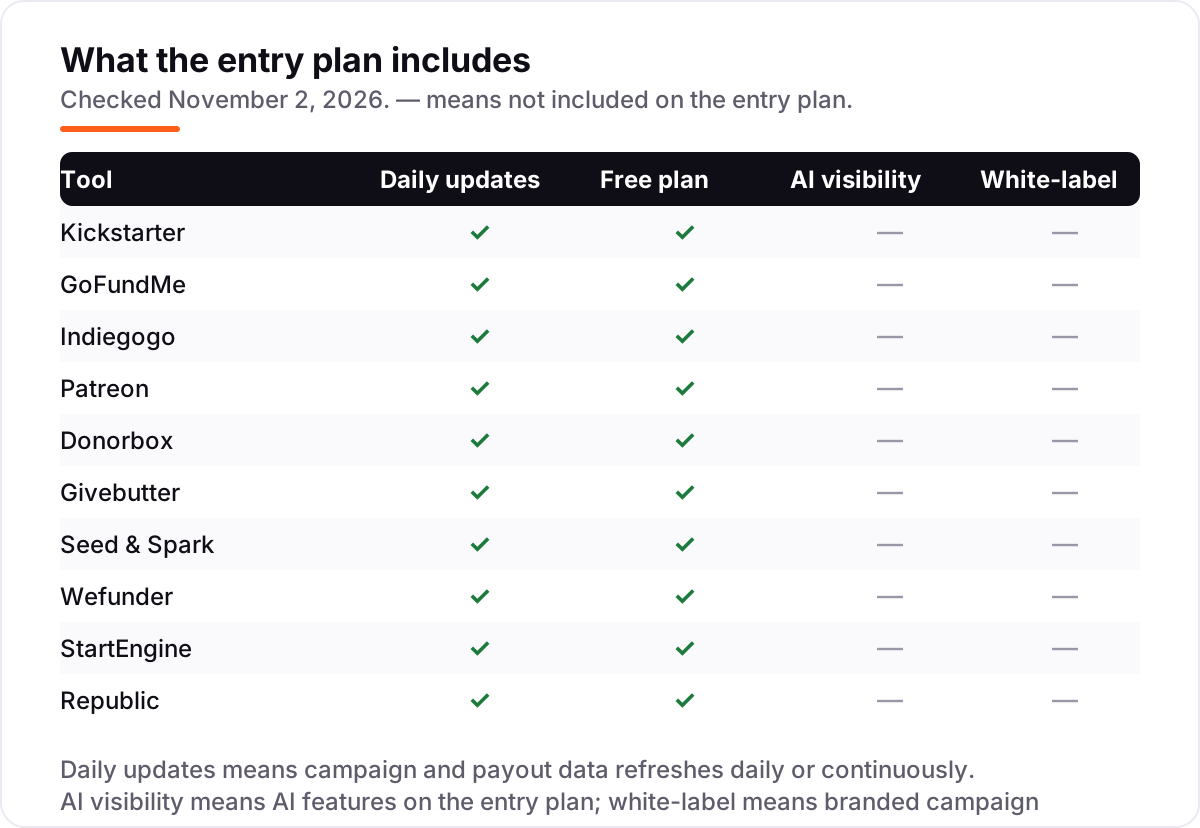
- Every fee below was checked on the vendor's own pricing or fees page on November 2, 2026, except where the text says otherwise. No platform here charges a monthly subscription to launch; you pay a percentage of what you raise.
On this page
Quick comparison
| Tool | Best for | Starting price | Free plan |
|---|---|---|---|
| Kickstarter | Creators launching a physical product, game or film who want the largest backer audience for rewards crowdfunding | 5% fee | Yes (5% if funded) |
| GoFundMe | Individuals, families and small nonprofits raising money for a personal cause, medical bills or a community need | 0% platform fee | Yes (free to start) |
| Indiegogo | Product teams and tech founders who want flexible campaign tools and a global backer base beyond Kickstarter | 5% fee | Yes (5% if funded) |
| Patreon | Podcasters, artists, writers and video makers who want recurring monthly income from fans | 10% fee | Yes (10% if paid) |
| Donorbox | Nonprofits that want embeddable donation forms, recurring giving and donor management on their own site | 2.95% fee | Yes (2.95% per gift) |
| Givebutter | Small nonprofits running donation pages, events, auctions and peer-to-peer campaigns on a zero budget | 0% fee (tips on) | Yes (free, tips on) |
| Seed & Spark | Independent filmmakers raising for a short, documentary or first feature who want specialist feedback | 0% platform fee | Yes (free to launch) |
| Wefunder | US startups raising up to $5 million from everyday investors under Regulation Crowdfunding | 7.9% fee | Yes (7.9% on close) |
| StartEngine | Startups that want a broker-dealer platform with a secondary market for their investors | 7% + 2% equity | Yes (fee on raise) |
| Republic | Startups that want a curated, vetted listing in front of Republic's investor community | 6% + 2% securities | Yes (fee on success) |
Make one of these tools?
We re-check this list every quarter. Send a correction, request a review, or ask about a clearly labeled sponsored spot.
Request a listingThe best crowdfunding platforms

Kickstarter
Best for: Creators launching a physical product, game or film who want the largest backer audience for rewards crowdfunding
Kickstarter is the largest rewards crowdfunding platform, and it is the default choice for a product launch because backers arrive looking for new products rather than for a cause to support. Campaigns run for up to 60 days, funding is all-or-nothing, and creators keep nothing unless the goal is met, which pushes teams to set honest goals and line up backers before launch day.
The cost is simple to budget: a 5% platform fee on successfully funded projects plus Stripe processing of roughly 3% to 5%. In the US, pledges of $10 or more cost 3% plus $0.30 each, so a typical campaign loses about 8% to 10% of its total before fulfillment, shipping and taxes. That reach is worth the cut when the product fits the platform, but a niche project with no built-in audience may do better elsewhere.
What we like
- The largest rewards-crowdfunding audience, with backers who arrive looking for new products
- Free to launch, with no fee at all if the campaign does not reach its goal
- All-or-nothing funding builds urgency and protects backers from half-funded projects
- Built-in Pledge Manager for surveys, add-ons and post-campaign shipping at the same fee rates
Watch out for
- All-or-nothing funding: if the campaign misses its goal, creators receive nothing and pay no fees
- No equity or donation model — backers get rewards, not shares, and campaigns are limited to creative projects
- Payment processing of roughly 3% to 5% sits on top of the 5% platform fee, so the total cost is around 8% to 10%

GoFundMe
Best for: Individuals, families and small nonprofits raising money for a personal cause, medical bills or a community need
GoFundMe is the simplest option in this list because it charges no platform fee on personal fundraisers in the US. Donors give to a person or a cause, not to a product, and there is no funding goal to hit — you keep whatever is raised, minus the 2.9% plus $0.30 transaction fee on each donation.
Certified nonprofit fundraisers in the US pay a lower 2.2% plus $0.30 per donation, and the checkout accepts cards, PayPal, Venmo, Apple Pay and Google Pay. The trade-off is scope: there are no reward tiers, no pre-orders and no investor tools, so it fits personal and community causes far better than product launches. Recurring donations carry an extra 5% fee, paid by the supporter.
What we like
- No platform fee on personal fundraisers in the US — only the 2.9% + $0.30 transaction fee per donation
- Keep what you raise: no funding goal to hit before the money is yours
- Certified nonprofit fundraisers in the US pay a lower 2.2% + $0.30 transaction fee
- The most recognized donation brand, so donors trust the checkout and share the page readily
Watch out for
- Built for donations, not product launches — no rewards tiers or pre-orders for backers
- Recurring donations carry an extra 5% fee, paid by the supporter
- Optional donor tips are presented at checkout and can confuse donors about where their money goes

Indiegogo
Best for: Product teams and tech founders who want flexible campaign tools and a global backer base beyond Kickstarter
Indiegogo is the closest rival to Kickstarter, with the same 5% platform fee and a global audience that suits tech products, gadgets and design-led hardware. New campaigns use fixed funding, so backers are charged only after a successful campaign, and the same 5% fee applies to post-campaign Late Pledge sales through its Pledge Manager.
Its fee page publishes a worked example, which is rare and useful: a $10,000 raise from 100 transactions pays $500 in platform fees and $320 in processing, leaving $9,180. The catch is payout timing — Indiegogo holds back 5% of funds for 180 days in most cases — and its live audience is smaller than Kickstarter's, so a launch needs more of its own traffic.
What we like
- Same headline fee as Kickstarter — 5% platform fee plus 3% + $0.20 per transaction
- Indiegogo publishes a worked example: a $10,000 raise from 100 transactions nets $9,180
- Late Pledge and Pledge Manager keep selling after the campaign at the same fee rates
- Fixed funding only for new campaigns, so backers are charged only after a successful campaign
Watch out for
- Smaller live-campaign audience than Kickstarter, so launches need more of their own traffic
- Indiegogo holds back 5% of funds for 180 days in most cases, which delays full payout
- Post-campaign Late Pledge sales carry the same 5% fee, so the cost does not drop after launch

Patreon
Best for: Podcasters, artists, writers and video makers who want recurring monthly income from fans
Patreon is the only platform in this list built for recurring income rather than a single campaign. Creators publish membership tiers, fans pay monthly or annually, and the platform takes its cut only on money that actually arrives. New creators who publish after August 4, 2025 pay a standard 10% platform fee, while earlier creators keep legacy rates of 5%, 8% or 11%.
Payment processing adds 2.9% plus $0.30 per payment over $3 in the US, and a 2.5% currency conversion fee applies when a fan pays in a different currency. The 10% fee is the highest ongoing cut in this list, and subscriptions bought inside the Patreon iPhone app now go through Apple in-app purchase. Even so, for a creator with a loyal audience, predictable monthly income beats a one-off campaign.
What we like
- No upfront cost: the standard 10% platform fee applies only to successfully processed payments
- Monthly and annual memberships, one-time digital sales, video hosting and community tools in one plan
- Payment processing is a standard 2.9% + $0.30 per payment over $3 in the US
- Creators who published before August 4, 2025 keep legacy platform rates of 5%, 8% or 11%
Watch out for
- The 10% platform fee for new creators is the highest ongoing cut among the membership options here
- Subscriptions bought inside the Patreon iPhone app go through Apple in-app purchase, with Apple's 30% cut from November 1, 2026
- Legacy creators keep 5%, 8% or 11% rates only while their page stays published — unpublishing moves them to 10%

Donorbox
Best for: Nonprofits that want embeddable donation forms, recurring giving and donor management on their own site
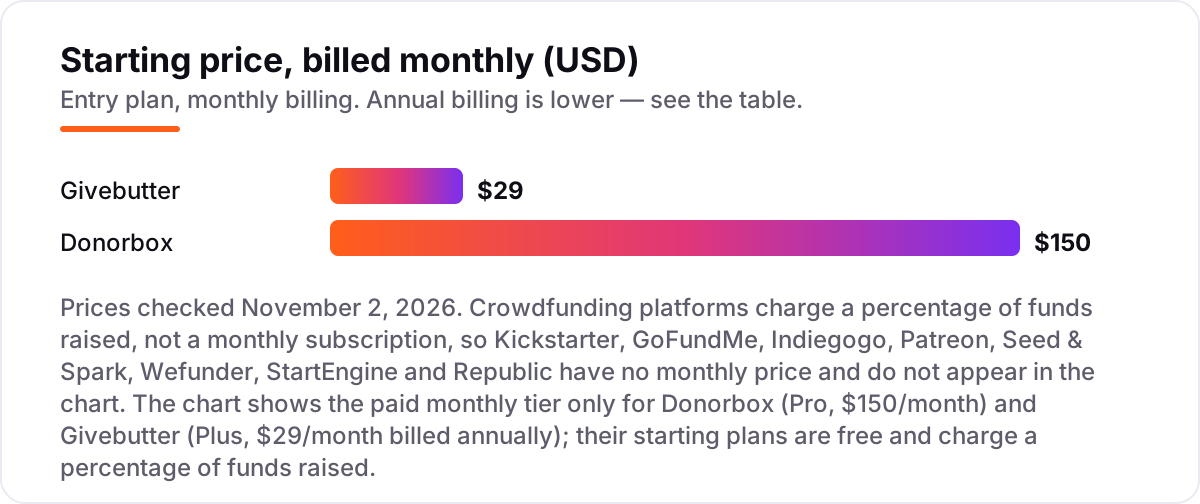
Donorbox is built for nonprofits that raise on their own website rather than on a public marketplace. Its embeddable donation forms, recurring giving tools and donor CRM sit behind a free Standard plan, which charges a 2.95% platform fee on donation forms and 3.95% on events, memberships and peer-to-peer pages, plus Stripe or PayPal processing.
Donors can cover the fees at checkout, which many do, and the Pro plan at $150 a month cuts the platform fee to 1.75% while adding Zapier, API access and white-label receipts. The combined cost on the free plan runs to about 5% per gift once processing is included, so larger nonprofits should price the Pro plan before they commit to the free tier.
What we like
- Free to start, with embeddable donation forms, recurring giving and a donor CRM included
- Donors can cover the fees at checkout, which many do, so the nonprofit keeps more of each gift
- Pro at $150 a month cuts the platform fee to 1.75% and adds Zapier, API access and white-label receipts
- Accepts cards, PayPal, ACH, Apple Pay and Google Pay through Stripe or PayPal
Watch out for
- The 2.95% platform fee sits on top of Stripe or PayPal processing, so the combined cost is about 5% per gift on the free plan
- Events, memberships and peer-to-peer pages cost more — 3.95% on Standard, 2% on Pro and Premium
- The fee only drops to 1.75% on the Pro plan, which costs $150 a month

Givebutter
Best for: Small nonprofits running donation pages, events, auctions and peer-to-peer campaigns on a zero budget
Givebutter is the most complete free option for small nonprofits, combining donation pages, events, auctions, peer-to-peer fundraising and a donor CRM in one account. With optional donor tips switched on, the platform fee is 0% and the Givebutter Guarantee covers any processing fees donors do not cover, so the nonprofit keeps the full donation.
Turn tips off and the price becomes a flat 3% platform fee plus 2.9% plus $0.30 in card processing, which is still simple to budget. Givebutter Plus starts at $29 a month billed annually and adds automations, texting, custom reports and a QuickBooks sync. The main limit is geography: payouts go to US bank accounts only.
What we like
- Core fundraising tools are free when donor tips are on, with the Givebutter Guarantee covering unpaid fees
- Donation pages, events, auctions, peer-to-peer fundraising and a donor CRM in one free account
- Tips off costs a flat 3% platform fee plus 2.9% + $0.30 card processing — still simple to budget
- Givebutter Plus starts at $29 a month billed annually and adds automations, texting and custom reports
Watch out for
- The 0% fee depends on optional donor tips — turn tips off and a flat 3% platform fee applies
- Automation, texting, custom reports and QuickBooks sync need Givebutter Plus, from $29 a month
- Payouts go to US bank accounts only, so it is not an option for nonprofits based elsewhere

Seed & Spark
Best for: Independent filmmakers raising for a short, documentary or first feature who want specialist feedback
Seed & Spark is the film specialist in this list, built for shorts, documentaries and first features rather than for general fundraising. It charges no platform fee at all — creators pay only Stripe processing of 2.9% plus $0.30 per transaction — and every campaign gets specialist review and feedback before it goes live.
Funds release once a campaign reaches 80% of its goal, so a project does not need to hit 100% to get paid, and in-kind WishList gifts of gear or services can count toward that mark. The trade-offs are real: film projects only, a 250-follower minimum before launch, and a smaller audience than the general platforms. For an indie film, the zero fee and the feedback are hard to beat.
What we like
- No platform fee at all — creators pay only Stripe processing of 2.9% + $0.30 per transaction
- The 80% GreenLight threshold releases funds before the full goal is met
- Specialist review and feedback on every campaign, plus in-kind WishList gifts that count toward the goal
- Film-focused audience and distribution partnerships, including paid community screenings
Watch out for
- Film and storytelling projects only — not a general crowdfunding platform
- Funds release only once a campaign reaches 80% of its goal, so a slow campaign can stall short of payout
- Creators must gather 250 followers before launch, which adds a pre-launch hurdle
Wefunder
Best for: US startups raising up to $5 million from everyday investors under Regulation Crowdfunding
Wefunder is the largest Regulation Crowdfunding portal in the US by dollars raised, and it is the equity option for a startup with an audience of would-be investors. Backers buy shares, SAFEs or revenue-share agreements rather than products, and the platform charges founders a 7.9% success fee on the amount raised, with no equity stake taken for itself.
Private rounds are free for founders, and investors a founder invites directly pay no fees, which makes it cheap for a company that already has a crowd. The costs beyond the headline fee matter: $1,000 a year in post-close admin, SEC filings and investor caps, and no secondary market for investors to sell their shares. Equity is the most expensive model here in time as well as money.
What we like
- The largest Regulation Crowdfunding portal by dollars raised, with more than 1 million registered investors
- A published 7.9% success fee on the amount raised, with no equity stake taken by the platform
- Private rounds are free for founders, and investors a founder invites directly pay no fees
- Supports SAFEs, equity, convertible notes, revenue share and debt under Reg CF, Reg D and Reg A+
Watch out for
- The 7.9% success fee plus $1,000 a year in post-close admin adds up on small raises
- Equity crowdfunding means SEC filings, financial disclosures and investor caps — far more legal work than a rewards campaign
- No secondary market of its own, so investors have no easy way to sell their shares

StartEngine
Best for: Startups that want a broker-dealer platform with a secondary market for their investors
StartEngine is a registered broker-dealer rather than a simple funding portal, and it suits startups that want institutional plumbing behind a public raise. It runs Regulation Crowdfunding, Regulation A+ and Regulation D offerings, and its StartEngine Secondary market lets investors trade shares after the raise — a feature Wefunder and Republic do not match.
The fee is 7% of capital raised in cash plus 2% in equity for Regulation Crowdfunding, as stated in StartEngine Capital's own SEC-filed offering documents, and investors pay 3.5% processing on each purchase, capped at $700. Legal and filing costs run $4,000 to $10,000 before the platform fee. The equity warrant dilutes existing shareholders, so founders should price that cost, not just the cash fee.
What we like
- A registered broker-dealer with a secondary market, so investors can trade shares after the raise
- The 7% cash commission is stated in StartEngine Capital's own SEC-filed offering documents
- Reg CF, Reg A+ and Reg D offerings in one place, with a large registered investor base
- StartEngine Secondary lists thousands of securities, giving early investors a possible exit
Watch out for
- The 2% equity warrant dilutes existing shareholders on top of the 7% cash fee
- Investors pay a 3.5% processing fee on each purchase, capped at $700, which can put off small backers
- Reg CF legal and filing costs run $4,000 to $10,000 before the platform fee, per StartEngine's own guidance

Republic
Best for: Startups that want a curated, vetted listing in front of Republic's investor community
Republic is the curated option in equity crowdfunding: fewer than 5% of applicants are accepted, and that selectivity signals quality to its investor community. Commission applies only on successful campaigns, and investors can start with as little as $10 on some deals, which widens the pool of potential backers beyond wealthy angels.
The fee needs a careful read. Republic's SEC Form C filings state 6% of the amount raised in cash plus 2% in securities, while Republic's own commission disclosure page has shown 7% cash — confirm the rate in your campaign agreement before signing. A $5,000 onboarding fee and about $1,500 in Form C costs also apply. Its Reg CF volume trails Wefunder and StartEngine, so expect to bring more of your own investors.
What we like
- Curated listings: fewer than 5% of applicants are accepted, which signals quality to investors
- Commission only on successful campaigns, with no charge if the raise fails
- Access to startups, real estate, video games and crypto deals in one investor account
- Investors can start with as little as $10 on some deals, widening the backer pool
Watch out for
- Republic's own commission disclosure page has shown 7% cash, while its SEC Form C filings state 6% — confirm the rate in your campaign agreement
- A $5,000 onboarding fee and about $1,500 in Form C costs apply before the raise, per September 2026 filings
- Smaller Reg CF volume than Wefunder and StartEngine, so less built-in investor traffic
The best crowdfunding platforms are not all the same product. Some sell a product before it exists, some collect donations for a cause, and some sell shares in a company — and the fees, rules and payout terms change completely with the model. This guide compares 10 platforms on what they actually charge, so you can budget the real cost of a raise before you launch.
How to choose the best crowdfunding platforms
- Start with the model. Rewards fits a product launch, donation fits a cause, membership fits a creator with fans, and equity fits a startup selling shares. Pick the model first; the platform follows.
- Read the fee as a total, not a headline. A 5% platform fee plus 3% processing is really 8%, and a 0% platform fee still leaves card processing of about 3% per transaction.
- Check the funding rule. All-or-nothing platforms pay nothing if you miss the goal. Keep-what-you-raise platforms pay out whatever arrives, which suits causes but weakens urgency.
- Ask when the money arrives. Some platforms hold back a share of funds for months, and equity raises pay out only after escrow releases. If you need cash to start production, payout timing is part of the price.
- Match the audience to your project. Kickstarter backers shop for products, GoFundMe donors give to people, and Wefunder investors look for startups. The wrong audience costs more than the wrong fee.
- Count the legal work. Rewards and donation campaigns need a page and a plan. Equity campaigns need SEC filings, financial disclosures and investor caps, which add thousands in costs before the platform fee.
Before you publish a campaign page, run its title through the free SERP snippet preview tool — it shows exactly how the title and description will look in Google. And if the campaign will drive traffic to your own site, our monthly SEO service keeps that traffic converting after launch day.
Crowdfunding platforms pricing: what you will actually pay
Crowdfunding platforms do not charge a monthly subscription to launch. They take a percentage of what you raise, plus a payment processing fee on every transaction, and the two together are the real price. Indiegogo publishes the clearest worked example in this list: a $10,000 raise from 100 transactions pays a $500 platform fee and $320 in processing, so $9,180 reaches your bank account. Kickstarter works out almost the same: a $10,000 raise with 100 backers costs $500 in platform fees plus about $330 in processing at 3% plus $0.30 per pledge, leaving about $9,170.
The same math punishes the expensive models fast. Patreon takes 10% of a creator's earnings plus 2.9% plus $0.30 per payment, so $10,000 in memberships costs roughly $1,300 before payout and currency fees. An equity raise is heavier still: Wefunder's 7.9% success fee takes $790 of a $10,000 raise, and StartEngine's 7% cash plus 2% equity takes $700 in cash and a slice of the company. Donation platforms look cheapest because the fee is smallest — GoFundMe takes only the 2.9% plus $0.30 transaction fee, or about $320 on the same $10,000 — but that comparison only holds if a donation model fits what you are raising for.
Know the difference: rewards, donation and equity crowdfunding
The biggest confusion in this category is treating all crowdfunding as one thing. Rewards crowdfunding, the Kickstarter and Indiegogo model, is a pre-sale: backers pay for a product or a perk, and the creator owes them that product. Donation crowdfunding, the GoFundMe, Donorbox and Givebutter model, is a gift: supporters give to a person or a cause and expect nothing back except a thank-you. Equity crowdfunding, the Wefunder, StartEngine and Republic model, is an investment: backers buy shares or a SAFE in a company and can lose the whole amount if the company fails.
The second confusion is all-or-nothing versus keep-what-you-raise. Kickstarter and Indiegogo pay nothing if the goal is missed, which protects backers and forces honest goals. GoFundMe, Patreon, Donorbox and Givebutter pay out whatever arrives, which is right for a cause that needs every dollar. Seed & Spark sits in between: funds release at 80% of the goal. Pick the model that matches what backers get and what you owe them — the platform choice follows from that, not from the fee table.
Payouts and timelines: when the money arrives
A campaign total is not cash in hand until the platform pays out, and the gap varies widely. GoFundMe transfers usually take 2 to 5 business days once a donation clears, and there is no goal to hit first. Kickstarter releases funds after the campaign ends and payments are collected, and its Pledge Manager collects later payments at the same fee rates. Indiegogo is the slowest of the rewards platforms: it holds back 5% of funds for 180 days in most cases, so a creator should not budget that share for early production. Patreon pays out monthly on the memberships collected, minus processing and payout fees, which suits a creator with steady costs but not a team waiting on a lump sum. Equity platforms are slowest of all: funds sit in escrow until the offering closes, and post-close admin runs for years. Before launch, write the payout date into the same budget as the fee — a cheap platform that pays late can cost more than a pricier one that pays on time.
For a product launch, the platform is only half the plan: the campaign page still has to rank and convert. Our guides to the best ecommerce platform for SEO and the best marketing platforms for small business SEO cover the store and the stack around the campaign, and the best SEO companies for small business is the shortlist if you would rather hire the work out.
Quick comparison: tool type by need
| Buyer | Best pick | Why |
|---|---|---|
| Product launch with a ready audience | Kickstarter | Largest backer audience, 5% only if you fund |
| Personal cause or medical bills | GoFundMe | 0% platform fee, keep what you raise |
| Tech product beyond Kickstarter | Indiegogo | Same 5% fee, Late Pledge keeps selling |
| Creator who wants monthly income | Patreon | Memberships and digital sales, 10% of earnings |
| Nonprofit raising on its own site | Donorbox | Embeddable forms from free, 2.95% platform fee |
| Small nonprofit, zero budget | Givebutter | 0% platform fee with donor tips on |
| Indie film or documentary | Seed & Spark | 0% platform fee, funds at 80% of goal |
| Startup raising from the crowd | Wefunder | Largest Reg CF portal, 7.9% success fee |
How we chose
We checked each vendor's own pricing or fees page on November 2, 2026 and recorded the fee exactly as shown, and we ranked the platforms by fit for the most common buyer — a creator, small business or nonprofit raising from the public — not by brand size. Three figures need a note: Kickstarter's help page states a 5% fee plus roughly 3% to 5% processing, and the US per-pledge figure of 3% plus $0.30 comes from the vendor's published fee breakdown as reported in October 2026 checks; Wefunder's 7.9% Reg CF success fee is the figure in its published fee disclosures as checked in October 2026, because its help-center pricing page currently describes private rounds instead; Seed & Spark's zero platform fee is as stated in the vendor's terms update, reported in October 2026 coverage. StartEngine's 7% cash plus 2% equity comes from its SEC-filed offering documents because StartEngine publishes no simple pricing page, and Republic's 6% cash plus 2% in securities comes from its SEC Form C filings, while its commission disclosure page has shown 7% — confirm the rate in your campaign agreement. No ratings appear in this list because no G2, Capterra or Trustpilot page was opened for these platforms today, and no vendor paid for a place in it. None of the links here are affiliate links.
What to do next
Pick the model first — rewards, donation, membership or equity — then shortlist the two platforms in that model with the lowest total fee and the payout timing you can live with. Run the worked example above on your own goal, including processing, before you set the number. Then launch the free plan or the free-to-launch page of your top pick and line up your first backers before the clock starts. Once your tools are in place, find out what's holding your rankings back.
Your stack only works if people find you
SerpAstra fixes what keeps your site off page one and makes it easy for AI assistants to recommend.
Get a free audit→Sources we checked (10)
- Kickstarter fees — help.kickstarter.com (checked November 2, 2026)
- GoFundMe fees — support.gofundme.com (checked November 2, 2026)
- Indiegogo fees — help.indiegogo.com (checked November 2, 2026)
- Patreon creator fees — support.patreon.com (checked November 2, 2026)
- Donorbox pricing — donorbox.org (checked November 2, 2026)
- Givebutter fees — help.givebutter.com (checked November 2, 2026)
- Seed & Spark fees — Film Daily report on Seed & Spark's terms update (checked November 2, 2026)
- Wefunder pricing — help.wefunder.com (checked November 2, 2026)
- StartEngine fees — StartEngine Capital investing process, SEC filing (checked November 2, 2026)
- Republic fees — Republic Form C filing (checked November 2, 2026)
Shamim
Founder of SerpAstra
A full-stack SEO and digital marketer who spends most days on Local SEO for dental practices, AI search visibility and lead generation.
Frequently asked questions
What is the best crowdfunding platform in 2026?
Kickstarter is the best pick for most product launches because it has the largest rewards-crowdfunding audience. GoFundMe is the best choice for personal causes at 0% platform fee, and Wefunder is the strongest equity option for startups. The right platform depends on what backers receive: a product, a thank-you, or shares.
How much does crowdfunding cost?
Most platforms take 0% to 10% of what you raise, plus payment processing of about 3% per transaction. GoFundMe and Seed & Spark charge no platform fee, Kickstarter and Indiegogo charge 5%, Patreon charges 10% for new creators, and equity platforms charge 6% to 8% plus an equity stake. Always budget the processing fee on top.
What is the difference between rewards, donation and equity crowdfunding?
In rewards crowdfunding, backers pre-order a product or receive a perk. In donation crowdfunding, supporters give to a cause and expect nothing in return. In equity crowdfunding, investors buy shares in your company under SEC rules. The model decides the fees, the legal work and what happens if the campaign fails.
Do I keep the money if my campaign fails?
It depends on the funding model. Kickstarter and Indiegogo use all-or-nothing funding for new campaigns, so you receive nothing if you miss the goal and pay no fees. GoFundMe, Patreon, Donorbox and Givebutter let you keep what you raise. Seed & Spark releases funds once you reach 80% of your goal.
Is there a free crowdfunding platform?
No platform is fully free, because payment processing always costs something. GoFundMe, Seed & Spark and Givebutter charge no platform fee, so you pay only the card processing of about 2.9% plus $0.30 per transaction. Kickstarter, Indiegogo and Donorbox are free to launch but take a percentage of what you raise.
How long does it take to get paid after a campaign?
Payout timing varies by platform. GoFundMe transfers usually take 2 to 5 business days once a donation clears. Kickstarter releases funds after the campaign ends and payments are collected. Indiegogo holds back 5% of funds for 180 days in most cases. Equity platforms pay out once the offering closes and escrow releases the funds.
Can a small business use crowdfunding?
Yes. A small business can pre-sell a product on Kickstarter or Indiegogo, raise donations for a community cause on GoFundMe or Givebutter, or sell shares on Wefunder, StartEngine or Republic. Equity raises involve SEC filings, investor caps and legal costs, so most small businesses start with a rewards or donation campaign.
Free SEO and AI visibility audit
Find out what is holding your rankings back
Send us your site. Within 2 business days you get a written audit, an AI visibility check and a short fix list ranked by impact. Free, with no contract attached.
Request my free audit→Related guides
 SEO & AI Search7 Best Ecommerce Platforms for SEO in 2026 (Pros, Cons and Pricing)The 7 best ecommerce platform for SEO picks compared on price, SEO controls and ease of use, with real 2026 prices checked on each vendor's pricing page.Read guide →
 SEO & AI Search12 Best Marketing Platforms for Small Business SEO in 2026, ComparedThe 12 best marketing platforms for small business SEO, compared on real prices, SEO tools and AI visibility. Every price checked November 1, 2026.Read guide →
 SEO & AI Search8 Best SEO Companies for Small Business in 20268 best SEO companies for small business compared on price, contracts and AI visibility, with prices checked on each agency's own site on November 1, 2026.Read guide →