
12 Best CTV Advertising Platforms for 2026 (Pros, Cons and Pricing)
Compare the 12 best CTV advertising platforms on price, minimum budgets, targeting and measurement — every figure checked live on November 4, 2026.
 Shamim Mia, Founder, SerpAstraLast verified November 4, 202615 min read
We compare pricing pages, documentation and public reviews. We never accept payment for rankings.

Key takeaways
- Vibe.co is the cheapest way in: $50 a day, no contract, no platform fee — and the top-rated platform here at 4.8/5 on G2. Roku Ads Manager and Disney Campaign Manager both start at $500 a campaign.
- The single most important buying factor is the minimum that buys learning: a $50-a-day floor and a $5,000-a-month floor are different tests, not different prices.
- Seven of the twelve platforms publish no price at all — MNTN, Amazon DSP, Simpli.fi, The Trade Desk, Basis Technologies, Viant and Samsung Ads are all custom quote, so budget for a sales conversation, not a checkout.
- Every price below was checked November 4, 2026. Ratings are G2, opened the same day; four platforms have no G2 rating, so none is shown for them.
On this page
Quick comparison
| Tool | Best for | Starting price | Free plan |
|---|---|---|---|
| Vibe.co | Small brands and DTC teams running a first CTV test on a $50-a-day budget | From $50/day | No (free signup) |
| Roku Ads Manager | DTC brands and Shopify merchants who want their ads inside the Roku ecosystem | From $500/campaign | No (free signup) |
| MNTN | DTC brands spending $5,000 or more a month who want TV measured like a performance channel | Custom quote | No |
| Tatari | Growth-stage brands that want linear and streaming TV bought together and measured on outcomes | No minimum spend | No (free signup) |
| Disney Campaign Manager | Brands that want their ads on Hulu and Disney+ without an agency or a sales call | From $500/campaign | No (free signup) |
| Amazon DSP | Brands already selling on Amazon that want streaming TV plus Amazon shopping data | Custom quote | No |
| StackAdapt | Agencies and mid-market teams running CTV inside a multi-channel programmatic plan | No minimum spend | No (free signup) |
| Simpli.fi | Local and multi-location advertisers who need ZIP-code-level CTV targeting | Custom quote | No |
| The Trade Desk | Enterprise teams and agencies spending six figures a month across the open internet | Custom quote | No |
| Basis Technologies | Agencies that plan, buy and bill CTV, search and social for many clients in one system | Custom quote | No |
| Viant | Mid-market advertisers who want household-level targeting and measurement without an agency | Custom quote | No |
| Samsung Ads | National brands that want Samsung smart TV audiences and home-screen placements from the manufacturer | Custom quote | No |
Make one of these tools?
We re-check this list every quarter. Send a correction, request a review, or ask about a clearly labeled sponsored spot.
Request a listingThe best ctv advertising platforms

Vibe.co
Best for: Small brands and DTC teams running a first CTV test on a $50-a-day budget
Vibe.co is the cheapest way onto the biggest screen in the house. You sign up, define an audience from a CRM upload, behavioral targeting or ZIP and metro geo, upload a 15- or 30-second video, set a daily budget from $50, and the ad runs the same day across 500+ premium streaming channels. There is no minimum commitment, no annual contract and no agency required.
The catch is measurement, not price. G2 reviewers like the ease of use and the support, but several say reconciling Vibe's reported conversions with Shopify or blended numbers takes manual work. Walmart completed its acquisition of Vibe in August 2026, which may change the roadmap. Buy Vibe for a real CTV test at social-campaign prices, not for board-level attribution.
What we like
- Lowest entry point here: $50 a day per strategy, no minimum spend and no contract
- No platform, subscription, seat or joining fees — the budget you set is what you are charged
- Typical CPMs of $15 to $35 on the vendor's own help page, with 500+ premium streaming channels
- Holdout-based incrementality measurement is built in, plus CRM and behavioral audience targeting
Watch out for
- Measurement is the weak spot: G2 reviewers say reconciling Vibe's reported conversions with Shopify or blended numbers takes manual work
- No linear TV — one G2 reviewer wishes the platform could also run linear campaigns
- Custom reporting is limited; deeper location breakdowns need a request to the account team

Roku Ads Manager
Best for: DTC brands and Shopify merchants who want their ads inside the Roku ecosystem
Roku Ads Manager is the self-serve route into the largest streaming platform in the US: you build the campaign, set a budget from $500, and pay as the ad delivers on a dynamic CPM. The inventory covers Roku devices, The Roku Channel and third-party streaming apps, and videos run from 6 to 92 seconds. A creative partnership converts social posts into TV ads at no cost.
The limitation is the walls around the garden. You cannot buy Samsung, LG or Vizio inventory through Ads Manager, so a brand whose buyers watch on other TVs needs a second platform. Reporting is solid in the dashboard but exports are manual CSVs, with no native push to BI tools. Start here when your buyers are Roku households; add a DSP when you need the rest of the living room.
What we like
- Campaigns start at $500, with no revenue requirements and billing only as the campaign delivers
- Buys the largest US streaming platform, plus third-party streaming inventory such as Netflix, Peacock and Max
- Action Ads let viewers buy from the TV remote, and a Shopify app connects a store in about 30 minutes
- A creative partnership converts existing social posts into TV ads at no cost
Watch out for
- Inventory is Roku-only — you cannot buy Samsung, LG or Vizio inventory through Ads Manager
- No native export to BI tools; performance data leaves the platform as manual CSV exports
- The managed OneView route sits at an entirely different price point, with minimums reported in the tens of thousands

MNTN
Best for: DTC brands spending $5,000 or more a month who want TV measured like a performance channel
MNTN built its name on performance TV: streaming commercials bought and measured like digital media, with direct deals across 150+ premium networks. The standout is Verified Visits, which matches site visits to exposed households, plus an incrementality dashboard comparing exposed and holdout households. Creative-as-a-Subscription bundles video production into the media spend through QuickFrame, and campaigns can go live in under an hour.
The price is the problem — there isn't one published. The homepage calculator starts at $5,000 a month, the chief executive has said minimums fell to $500 a campaign, and older G2 reviews cite $10,000 a month for retargeting and $25,000 for prospecting. Treat $5,000 a month as the working budget and confirm the floor with sales. MNTN fits DTC brands with real budgets who want TV judged on visits and sales, not impressions.
What we like
- Direct deals with 150+ premium streaming networks, bought and measured like digital media
- Verified Visits matches site visits to exposed households, with an incrementality dashboard for eligible campaigns
- Creative-as-a-Subscription bundles professional video production into the media spend through QuickFrame
- Mountain Match AI targeting and a self-serve campaign builder that can go live in under an hour
Watch out for
- No published price — every quote runs through a sales conversation
- Reported minimums have changed over time, from $25,000 a month to $500 a campaign, so confirm the current floor before budgeting
- Third-party comparisons note the platform fee is bundled into media rather than broken out transparently

Tatari
Best for: Growth-stage brands that want linear and streaming TV bought together and measured on outcomes
Tatari sells all of television in one buy: linear plus streaming plus online video, planned and bought convergently and measured with modeled ROAS, view-through and incrementality methods. Self-serve programmatic carries no spend minimums, per the vendor's own site, so campaigns can start, stop and iterate week to week without a media plan or a DSP seat. Direct publisher access covers Disney, NBCUniversal, Netflix and Amazon.
The caveat is that prospecting has historically been the expensive part. Third-party reports put self-serve retargeting at $350 a week and prospecting at $5,000 a week — figures Tatari does not publish, and which conflict with the current no-minimums wording, so confirm both with the vendor. There are also no G2 reviews to check the claims against. Buy Tatari when you want TV measured like a performance channel and can fund a real test.
What we like
- No spend minimums on self-serve programmatic, per the vendor's own site — start, stop and iterate week to week
- Convergent buying: linear TV, streaming and online video in one plan, with direct publisher access to Disney, NBCUniversal, Netflix and Amazon
- Tatari Max AI scores each available impression against your outcome in near real time
- Incrementality testing and modeled ROAS, backed by Vault, a privacy-first clean room
Watch out for
- No G2 reviews, so there is no public reviewer score to check against the vendor's claims
- Prospecting has historically needed far larger budgets than retargeting — third-party reports cite $5,000 a week
- A performance-TV heritage means small tests get less hand-holding than on the managed-service platforms

Disney Campaign Manager
Best for: Brands that want their ads on Hulu and Disney+ without an agency or a sales call
Disney Campaign Manager is the simplest way to buy premium streaming inventory without an agency: sign up free, set a budget from $500 a campaign, upload creative, pay by credit card, and billing starts only after the ad runs. One campaign covers Hulu and Disney+, plus ESPN streaming, with Disney Select audiences combining Disney's first-party insights with vetted third-party data.
The trade-off is scope. The inventory is Disney-only, so a campaign here never reaches Roku, Samsung or open-web streaming, and customer-data matching is not supported in self-service. Business verification takes 24 to 48 hours, and the AI video creative tool is in closed beta rather than open to every advertiser. Buy it when your buyers are on Hulu and Disney+ and you want premium inventory at a $500 entry point.
What we like
- Campaigns start at $500, with free signup and no subscription, setup or installation fees
- One buy covers Hulu and Disney+, plus ESPN streaming, with billing only after the ad starts running
- Disney Select audiences combine Disney's first-party insights with vetted third-party data
- Targeting by DMA, state, city or up to 4,000 ZIP codes, with content bundles of curated shows and movies
Watch out for
- Inventory is Disney-only — no Roku, Samsung or open-web streaming in the same buy
- Customer-data matching is not supported in the self-service offering
- The AI video creative tool, Disney Ad Creative Studio, is in closed beta and not open to most advertisers

Amazon DSP
Best for: Brands already selling on Amazon that want streaming TV plus Amazon shopping data
Amazon DSP buys display, video and audio across Amazon-owned properties and thousands of third-party sites, with targeting built on Amazon shopping signals: what people search for, view and buy. Since November 2025 there is no Amazon-imposed minimum for self-service, and streaming TV packages carry a $10,000 recommended campaign minimum, while managed service typically needs $50,000 a month.
The catch is that the platform only pays back if Amazon is where the sale happens, and the reviewer base is thin: 18 G2 reviews behind a 4.2 score, with reviewers citing a steep learning curve and slow performance against other DSPs. The new DVA+ campaign type carries no minimum spend in the US, in beta. Buy Amazon DSP when you already sell on Amazon and want streaming TV tied to purchase data.
What we like
- No Amazon-imposed minimum for self-service since November 2025, with streaming TV packages recommended at $10,000 a campaign
- Buys Prime Video, Twitch, Fire TV and third-party publishers, with Amazon shopping signals for targeting
- Amazon Marketing Cloud gives closed-loop measurement from ad exposure to purchase
- The new DVA+ campaign type carries no minimum spend in the US, in beta
Watch out for
- Only 18 G2 reviews, the thinnest reviewer base in this list, so the 4.2 score is fragile
- G2 reviewers cite a steep learning curve and slow performance against other DSPs
- Managed service typically needs $50,000 a month, and the platform only pays back if Amazon is your sales channel

StackAdapt
Best for: Agencies and mid-market teams running CTV inside a multi-channel programmatic plan
StackAdapt is the most accessible DSP: seven programmatic channels — CTV, display, native, video, audio, digital out-of-home and in-game — in one platform, with no minimum spend required to get started. The Basic tier is self-serve, higher tiers add account services, and the vendor says most teams hit their stride around $5,000 a month.
Two limits. Self-serve access is subject to an application and approval process, so signup is not instant, and the platform fee is embedded in the CPM rather than charged separately, which hides the true cost of inventory. Practitioner guides put the practical floor at $50 to $100 a day per line item. Buy StackAdapt when CTV is one channel inside a wider plan, not the only channel.
What we like
- No minimum spend required to get started, per the vendor's own plans page — the only DSP here that says so plainly
- Seven channels in one platform: CTV, display, native, video, audio, digital out-of-home and in-game
- Highest reviewer count here at 924 G2 reviews, with reviewers praising the responsive support team and the intuitive campaign setup
- Built-in Creative Studio and forecasting tools, with self-serve, managed or hybrid support on every tier
Watch out for
- Self-serve access is subject to an application and approval process, so signup is not instant
- The platform fee is embedded in the CPM rather than charged separately, which hides the true cost of inventory
- Practitioner guides put the practical floor at $50 to $100 a day per line item — below that, the optimization has too little data

Simpli.fi
Best for: Local and multi-location advertisers who need ZIP-code-level CTV targeting
Simpli.fi is the local advertiser's DSP: its ZTV product buys ZIP-code-targeted streaming TV at CPMs of $10 to $12, per the vendor's own blog, against a $25 to $35 range for typical CTV — the lowest CPM range in this list. The proprietary ZIP-code system divides the country into 41,000 ZIP codes, so a multi-location brand can buy each store's trade area separately.
The price is the blind spot: Simpli.fi publishes no price at all, and G2 reviewers cite a lack of pricing transparency, with some reporting confusing onboarding and fees that were not clear upfront. The interface has a learning curve, and reviewers call report generation slow. Buy Simpli.fi when your CTV plan is local — one DMA, one ZIP cluster, one store at a time — and ask for the full fee schedule in writing first.
What we like
- ZTV, its ZIP-code streaming TV product, runs at CPMs of $10 to $12, per the vendor's own blog — the lowest CPM range here
- Proprietary ZIP-code system divides the US into 41,000 ZIP codes for household-level targeting
- Reviewers report no campaign budget minimums, and the platform runs over 140,000 campaigns a month
- Autopilot AI and a media planner with Plan Assist automate campaign design and optimization
Watch out for
- No published price — every quote runs through sales, and G2 reviewers cite a lack of pricing transparency
- Some G2 reviewers report confusing onboarding and fees that were not clear upfront
- The interface has a learning curve; reviewers call it cluttered and slow to generate reports

The Trade Desk
Best for: Enterprise teams and agencies spending six figures a month across the open internet
The Trade Desk is the leading independent demand-side platform: it buys display, video, audio, native and connected TV across the open internet through real-time auctions, and it owns no media of its own, so it never steers your budget toward inventory it profits from selling. Its Kokai platform and Koa AI handle bidding and optimization, and the company says the platform weighs more than 15 million ad opportunities a second.
That is also the barrier. There is no published price and no self-serve signup, and third-party reports put the entry floor near $100,000 a quarter, with a platform fee around 15 to 20% of media spend on top — figures The Trade Desk does not publish, so treat them as market reports, not quotes. G2 reviewers cite a steep learning curve and slow report generation.
What we like
- Independent DSP — owns no media, so it never steers spend toward its own inventory
- Buys display, video, audio, native and connected TV across the open internet in one platform
- Kokai platform with Koa AI optimization; the company says it weighs 15 million ad opportunities a second
- UID2 identity framework keeps audiences addressable as cookies disappear, and OpenPath buys premium inventory direct
Watch out for
- No published price and no self-serve signup — access runs through a sales conversation
- Third-party reports put entry near $100,000 a quarter, with a platform fee of 15–20% of media spend on top
- G2 reviewers cite a steep learning curve and slow report generation, plus a fee for nearly every feature

Basis Technologies
Best for: Agencies that plan, buy and bill CTV, search and social for many clients in one system
Basis Technologies sells an operating system for media teams, not just a DSP: planning, buying, analytics, billing reconciliation and vendor messaging live in one place, and its DSP is the only one here united with search, social and site-direct buying in a single interface. Compass AI allocates spend across channels and audiences, and Market Trends benchmarks your plan against 250,000+ line items.
The cost is the catch. Pricing is entirely quote-based — a platform license plus media fees — which makes it costlier than a pure DSP, and G2 reviewers cite a learning curve and an interface that can feel dated. One reviewer says the CTV toolset still needs work, with too few pre-set deals available. Basis fits agencies managing many clients who want one system for the business of advertising.
What we like
- The only DSP here united with search, social and site-direct buying in a single interface
- Billing automation reconciles delivery numbers and creates invoices, which is the agency workflow other DSPs leave out
- Compass AI allocates spend across channels and audiences, and Market Trends benchmarks against 250,000+ line items
- G2 reviewers praise the flexibility for smaller-budget clients and the responsive support team
Watch out for
- Pricing is entirely quote-based, with a platform license plus media fees that make it costlier than pure DSPs
- G2 reviewers cite a learning curve and an interface that can feel dated in places
- One G2 reviewer says the CTV toolset still needs work, with too few pre-set deals available

Viant
Best for: Mid-market advertisers who want household-level targeting and measurement without an agency
Viant is a programmatic DSP spanning CTV, display, mobile, audio and digital out-of-home, with self-service, co-managed and managed models. Its Household ID technology targets and measures at the household level, tying online and offline conversions back to ad exposure — the most complete attribution in this list, per G2 reviewers. Direct Access buys premium streaming deals without an exchange in the middle.
The gaps are price and polish. Viant publishes no price, quotes run through sales, and G2 reviewers say the interface can feel complex for newcomers, the forecasting tool is often inaccurate, and advanced reporting can be slow to pull without an API connection. The 4.2 G2 score is the lowest in this list alongside Amazon DSP, though on 311 reviews it is a far bigger sample. Buy Viant when household-level measurement matters more than a self-serve checkout.
What we like
- Household ID technology targets and measures at the household level, tying online and offline conversions to ad exposure
- Direct Access buys premium streaming deals without an exchange in the middle, and since September 2026 it carries no fee to set up or run a deal
- Self-service, co-managed and managed models, with ViantAI optimization built into the platform
- G2 reviewers praise the ease of use for traders and the responsive customer support
Watch out for
- No published price — quotes run through sales, with no self-serve price list
- G2 reviewers say the interface can feel complex for newcomers and the forecasting tool is often inaccurate
- Advanced reporting can be slow to pull without an API connection, per G2 reviewers

Samsung Ads
Best for: National brands that want Samsung smart TV audiences and home-screen placements from the manufacturer
Samsung Ads sells the audience its own hardware creates: automatic content recognition data from one of the largest smart TV installed bases in the world — 77 million active Samsung smart TVs, per industry reporting — plus Samsung TV Plus, its free ad-supported streaming service. ACR segments show what households actually watch across linear and streaming, not what they declare in a survey.
Access is the friction. There is no published price and no self-serve checkout: buying runs through direct sales or a DSP integration, and the richest ACR audiences and OS-level formats need a direct relationship with Samsung Ads. Home-screen placements opened to programmatic buying in June 2026 through The Trade Desk and DV360, priced above standard CTV spots. Samsung Ads fits national brands that want TV-maker data and the home screen.
What we like
- Automatic content recognition data from one of the largest smart TV installed bases — 77 million active Samsung smart TVs, per industry reporting
- Samsung TV Plus, its free ad-supported streaming service, plus display, video and interactive formats on the TV itself
- Home-screen placements opened to programmatic buying in June 2026 through The Trade Desk and DV360
- ACR segments show what households actually watch across linear and streaming, not just what they declare
Watch out for
- No published price — buying runs through direct sales or a DSP integration, never a self-serve checkout
- The richest ACR-based audiences and OS-level formats need a direct relationship with Samsung Ads or a specific DSP integration
- No G2 rating, so there is no public reviewer score to check against the vendor's claims, and home-screen placements are priced above standard CTV spots, per AdExchanger's reporting of the June 2026 launch
The best ctv advertising platforms split into two families, and picking the wrong family is the expensive mistake. Self-serve platforms — Vibe.co, Roku Ads Manager, MNTN, Tatari and Disney Campaign Manager — give you a campaign builder, direct premium inventory and same-day launches. Programmatic DSPs — StackAdapt, Simpli.fi, The Trade Desk, Basis Technologies, Viant, Amazon DSP and Samsung Ads — buy across exchanges and apps through auctions, with broader reach and steeper learning curves. We ranked all twelve by fit for the most common buyer, a small team spending its first real TV budget, and every price was checked November 4, 2026.
How to choose the best ctv advertising platforms
- Start with the minimum, not the CPM. A $50-a-day floor and a $5,000-a-month floor are different tests, not different prices. The minimum decides whether a test is even possible; the CPM decides what it buys.
- Decide what you are buying: one audience or every audience. Publisher platforms sell their own inventory — Roku households, Disney viewers, Samsung TV owners. DSPs buy many audiences at once across thousands of publishers. The platform follows the buyer, not the other way round.
- Check the measurement before the media. Every platform promises attribution; insist on incrementality testing or a holdout group before you believe a ROAS number. View-through attribution alone overstates results.
- Price the creative, not just the media. A 15- or 30-second video is the entry ticket, and production is the cost most first-time buyers forget. MNTN bundles it, Roku converts social posts free, Disney's AI studio is still in closed beta.
- Think about who runs it. Self-serve suits a lean team that wants control; a DSP suits an agency with a trader; managed service suits a brand that wants the work done for them at 10 to 20 percent on top of media.
If you already run search or social ads, our PPC vs SEO guide explains when paid clicks beat organic work. Before you send paid traffic anywhere, run the landing page title through the free SERP snippet preview tool — it shows exactly how the title looks in Google.
Whatever you shortlist, try it with real money before you commit. A $50-a-day test on Vibe.co or a $500 campaign on Roku Ads Manager tells you more in four weeks than any review can. Check two things in the test: that the platform's targeting actually reaches your buyers, and that the cost per visit or per sale fits what a customer is worth to you.
CTV advertising platform pricing: what you will actually pay
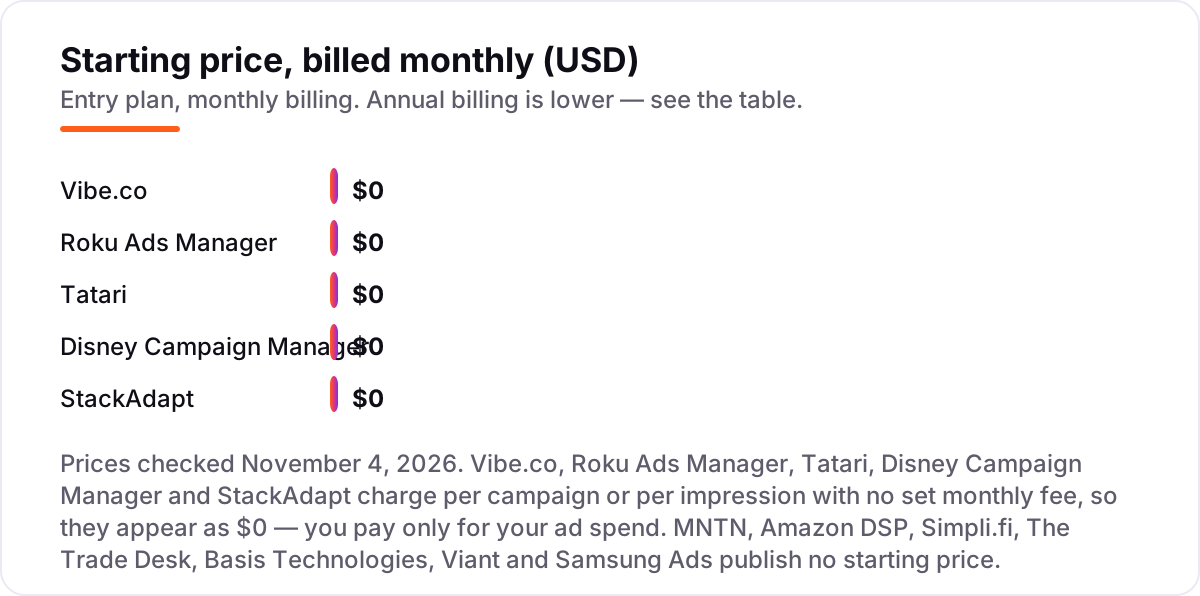
Take a $5,000 test budget for one month, split across the three cheapest entry points. Vibe.co at $50 a day for 28 days costs $1,400; at the vendor's $20 CPM example that buys 70,000 impressions. A $500 Roku Ads Manager campaign at a typical $28 CPM buys about 17,857 impressions. A $500 Disney Campaign Manager campaign buys Hulu and Disney+ reach at the same $500 floor. The three together cost $2,400, leaving $2,600 of the $5,000 for a second Vibe flight or a StackAdapt line item — and StackAdapt's own page says most teams hit their stride around $5,000 a month, so the whole test is one month of a DSP's stride point.
Run the same buys for a year and the gap widens. Vibe.co at $50 a day costs $18,250 a year. MNTN at its $5,000-a-month calculator figure costs $60,000 a year. The Trade Desk at the reported entry near $100,000 a quarter costs about $400,000 a year — a third-party report, not a vendor price, and before the platform fee of 15 to 20 percent of media spend on top.
The CPM sets what the money buys. eMarketer puts blended streaming CPMs at about $26 to $27; Vibe's own help page quotes $15 to $35; Simpli.fi's ZTV runs $10 to $12. At a $26 CPM, $5,000 buys about 192,000 impressions; at a $12 CPM it buys about 417,000. That is why the cheapest entry point and the cheapest CPM are different questions — and why a $500 campaign at a $28 CPM is a thin read, not a verdict.
Know the difference: self-serve CTV platforms vs programmatic DSPs
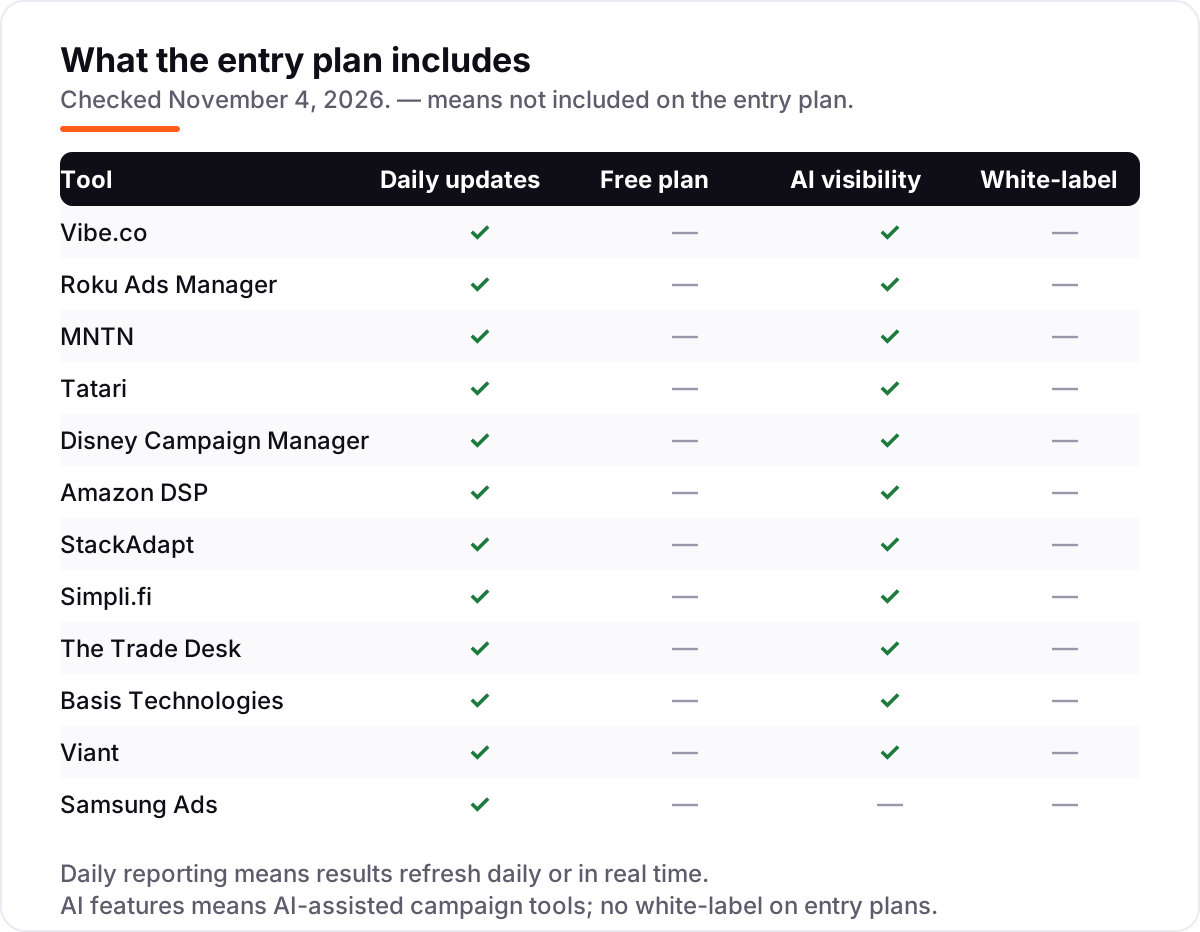
The confusion in this category is between two layers that both sell you the TV screen. A self-serve CTV platform sells its own or directly-sourced inventory through a campaign builder: Vibe.co, Roku Ads Manager, MNTN, Tatari and Disney Campaign Manager work this way. You pick the audience, upload the video, set the budget, and the ad runs the same day. The targeting is built on the platform's own data, and the minimums are published.
A demand-side platform, or DSP, sells you everyone else's inventory. StackAdapt, Simpli.fi, The Trade Desk, Basis Technologies, Viant and Amazon DSP buy display, video and connected TV across thousands of publishers through real-time auctions, using third-party data and their own identity graphs. They own no media of their own — or, in Amazon's case, they sell their own inventory alongside everyone else's — and the price is usually a percentage of media spend rather than a list price.
Then there is the managed-service layer, which is people, not software. MNTN, Simpli.fi, Basis and the DSPs all offer it: a team runs the campaigns for you, typically for 10 to 20 percent of media spend on top. Buying a DSP when you only need one streaming audience, or buying a self-serve platform when you need twenty publishers, is the most expensive mistake in this category.
Quick comparison: tool type by need
| Buyer | Best pick | Why |
|---|---|---|
| First CTV test, under $100 a day | Vibe.co | $50 a day, no contract, no platform fee |
| Roku households only | Roku Ads Manager | $500 a campaign, Action Ads, Shopify app |
| Premium streaming, no agency | Disney Campaign Manager | $500 a campaign on Hulu and Disney+ |
| TV measured on visits and sales | MNTN or Tatari | Verified Visits and incrementality; no-minimum self-serve on Tatari |
| CTV inside a wider programmatic plan | StackAdapt | No minimum spend, seven channels in one login |
| Local and multi-location campaigns | Simpli.fi | ZIP-code targeting at $10 to $12 CPMs |
| Amazon sellers | Amazon DSP | Shopping signals and closed-loop measurement |
| Enterprise programmatic | The Trade Desk | Independent DSP, custom quote only |
| Agency workflow across clients | Basis Technologies | Planning, buying and billing in one system |
Mistakes to avoid
- Budgeting on the floor instead of the learning phase. A $500 campaign delivers ads; it does not buy enough impressions for the platform's optimization to learn. Price the test that exits learning, not the minimum that turns the campaign on.
- Comparing CPMs across different inventory. A $12 ZTV CPM and a $28 Roku CPM are not the same product: one is ZIP-code-targeted streaming, the other is a premium living-room placement. Compare cost per visit or per sale, not cost per thousand.
- Trusting a minimum spend you read in a roundup. MNTN's reported minimums have ranged from $500 a campaign to $25,000 a month depending on the year and the source. Always confirm the current floor with the vendor before planning a budget around it.
- Buying a DSP for a single-channel job. The Trade Desk is built for omnichannel programmatic at scale. If you only need Hulu and Disney+, Disney Campaign Manager costs a fraction and needs no sales conversation.
- Forgetting the creative. Every platform here is an auction, and the creative is what wins it. A weak ad on the cheapest platform still loses to a strong ad on the dearest one — test the creative before you blame the platform.
How we chose
We ranked the twelve tools by fit for the most common buyer — a small team spending its first real TV budget — not by brand size. Prices are the platforms' own published figures, confirmed November 4, 2026: Vibe.co's $50-a-day minimum comes from its own help centre, Roku's $500 campaign start and Disney's $500 campaign start from their own getting-started pages, StackAdapt's no-minimum policy from its own plans page, and the seven custom-quote platforms publish no price at all. Three honest caveats: MNTN publishes no price and the figures reported for it conflict — its homepage calculator starts at $5,000 a month while its chief executive has said minimums fell to $500 a campaign — so we list it as custom quote; Tatari's older third-party minimums ($350 a week retargeting, $5,000 a week prospecting) conflict with the vendor's current no-minimums wording, so we follow the vendor; and The Trade Desk's reported entry near $100,000 a quarter is a market report, not a vendor price. Ratings come from G2 pages opened November 4, 2026; Roku Ads Manager, Tatari, Disney Campaign Manager and Samsung Ads have no G2 rating, so none is shown for them. No vendor paid for a place in this list, and none of the links here are affiliate links.
What to do next
Start with the platform where your buyers already watch — Vibe.co for a first test, Roku Ads Manager if they are Roku households, Disney Campaign Manager if they are on Hulu and Disney+. Run a $50-a-day test for four weeks before you commit to a channel: $1,400 buys a real read on whether streaming TV moves your numbers. If the cost per visit or per sale fits what a customer is worth, scale the budget; if it does not, the creative or the targeting is wrong, not necessarily the channel. Our monthly SEO service handles the organic side while the ads run. Once your tools are in place, find out what's holding your rankings back.
Your stack only works if people find you
SerpAstra fixes what keeps your site off page one and makes it easy for AI assistants to recommend.
Get a free audit→Sources we checked (23)
- Vibe.co pricing — help.vibe.co (checked November 4, 2026)
- Vibe.co on G2 — 4.8/5, 181 reviews (checked November 4, 2026)
- Vibe.co enterprise CTV costs — vibe.co/blog (checked November 4, 2026)
- Roku Ads Manager getting started — help.ads.roku.com (checked November 4, 2026)
- Roku Ads Manager guide — advertising.roku.com (checked November 4, 2026)
- MNTN — mntn.com (checked November 4, 2026)
- MNTN Performance TV on G2 — 4.8/5, 61 reviews (checked November 4, 2026)
- MNTN Performance TV pricing on G2 — custom-quote model (checked November 4, 2026)
- Tatari Max — tatari.tv (checked November 4, 2026)
- Tatari vs StackAdapt — tatari.tv (checked November 4, 2026)
- Disney Campaign Manager getting started — disneycampaignmanager.com (checked November 4, 2026)
- Amazon DSP minimum spend — canopymanagement.com (checked November 4, 2026)
- Amazon DSP costs — amalytix.com (checked November 4, 2026)
- Amazon DSP on G2 — 4.2/5, 18 reviews (checked November 4, 2026)
- StackAdapt plans and packages — stackadapt.com (checked November 4, 2026)
- StackAdapt on G2 — 4.7/5, 924 reviews (checked November 4, 2026)
- Simpli.fi ZTV streaming TV — simpli.fi (checked November 4, 2026)
- Simpli.fi on G2 — 4.5/5, 154 reviews (checked November 4, 2026)
- The Trade Desk on G2 — 4.4/5, 194 reviews (checked November 4, 2026)
- Basis Technologies on G2 — 4.5/5, 291 reviews (checked November 4, 2026)
- Viant Technology on G2 — 4.2/5, 311 reviews (checked November 4, 2026)
- Samsung Ads home-screen programmatic launch — adexchanger.com (checked November 4, 2026)
- Samsung Ads — samsungads.com (checked November 4, 2026)
Shamim
Founder of SerpAstra
A full-stack SEO and digital marketer who spends most days on Local SEO for dental practices, AI search visibility and lead generation.
Frequently asked questions
What is the best CTV advertising platform?
Vibe.co is the best starting point for most advertisers: $50 a day, no contract, no platform fee, and the highest G2 score here at 4.8 out of 5. If your buyers are Roku households, Roku Ads Manager is the counterpart at $500 a campaign, and Disney Campaign Manager is the pick for Hulu and Disney+ audiences. The best platform is the one where your buyers already watch.
How much does CTV advertising cost?
It depends on the CPM and the minimum. Vibe.co quotes typical CPMs of $15 to $35, eMarketer puts blended streaming CPMs near $26 to $27, and Simpli.fi's ZTV runs $10 to $12. A four-week test at $50 a day costs $1,400; a $500 Roku or Disney campaign buys roughly 18,000 impressions at a $28 CPM. Creative production is the cost most first-time buyers forget.
What is the minimum budget for CTV advertising?
Vibe.co starts at $50 a day with no minimum spend and no contract. Roku Ads Manager and Disney Campaign Manager both start at $500 a campaign. Tatari and StackAdapt publish no minimum spend for self-serve. MNTN's homepage calculator starts at $5,000 a month, and the DSPs — The Trade Desk, Basis, Viant, Simpli.fi and Samsung Ads — are custom quote, so confirm the floor with sales.
What is the difference between a self-serve CTV platform and a DSP?
A self-serve CTV platform sells its own or directly-sourced inventory through a campaign builder: Vibe.co, Roku Ads Manager and Disney Campaign Manager work this way. A DSP like The Trade Desk or StackAdapt buys inventory across thousands of publishers through real-time auctions and owns no media of its own. Use a self-serve platform to reach one audience; use a DSP to buy many audiences at scale.
Can I run CTV ads with a small budget?
Yes. Vibe.co accepts $50 a day, Roku Ads Manager and Disney Campaign Manager accept $500 campaigns, and Tatari and StackAdapt publish no minimum spend for self-serve. Whatever the floor, budget for the learning phase, not the minimum: a $500 campaign buys roughly 18,000 impressions at a $28 CPM, which is a thin read. Four weeks at $50 a day is a better first test.
How is CTV advertising measured?
Most platforms report impressions, reach and frequency, then tie exposure to outcomes: MNTN's Verified Visits matches site visits to exposed households, Tatari runs incrementality tests and modeled ROAS, and Amazon DSP closes the loop to purchase through Amazon Marketing Cloud. Insist on a holdout or incrementality test before you believe a ROAS number — view-through attribution alone overstates results.
Do I need a video ad to run on CTV?
Yes — a 15- or 30-second video is the standard unit, and Roku Ads Manager accepts videos from 6 to 92 seconds. If you have no TV creative, several platforms will make it for you: MNTN bundles production through QuickFrame, Roku converts social posts into TV ads at no cost, and Disney's AI creative studio is in closed beta.
Free SEO and AI visibility audit
Find out what is holding your rankings back
Send us your site. Within 2 business days you get a written audit, an AI visibility check and a short fix list ranked by impact. Free, with no contract attached.
Request my free audit→Related guides
 Digital Marketing & Ads10 Best Digital Advertising Platforms in 2026, ComparedCompare the 10 best digital advertising platforms on price, minimum budgets, targeting and AI tools — every figure checked November 4, 2026.Read guide →
 Digital Marketing & Ads7 Best Advertising Platforms for Small Businesses in 2026, Compared7 best advertising platforms for small businesses compared on minimum budgets, cost per click and who each one fits — minimums checked on each vendor's page.Read guide →
 Digital Marketing & Ads10 Best Display Advertising Software in 2026, ComparedThe 10 best display advertising software tools compared on price, reach and ease of use, from Google Ads to The Trade Desk. Checked November 4, 2026.Read guide →