
8 Best Dental Practice Management Software in 2026, Compared
Compare the 8 best dental practice management software options on price, cloud vs server, and AI features, with every price checked November 7, 2026.
 Shamim Mia, Founder, SerpAstraLast verified November 7, 202612 min read
We compare pricing pages, documentation and public reviews. We never accept payment for rankings.

Key takeaways
- Open Dental is the best fit for most practices at $199/month per location in year one, then $149; Curve Dental is the best cloud system but quotes only, and tab32 is the cheapest cloud option at $125/month.
- Five tools publish a starting price: tab32 ($125/month), Open Dental ($199/month), Adit ($399/month), Denticon ($795/month) and CareStack ($829/month). Dentrix, Eaglesoft and Curve Dental all quote.
- The single most important buying factor is deployment: server tools need hardware, backups and IT support, while cloud tools remove that cost but charge per location or provider.
- Adit is an engagement layer, not a full practice system: it answers calls and books appointments, and most practices run it alongside Dentrix, Eaglesoft or Open Dental.
On this page
Quick comparison
| Tool | Best for | Starting price | Free plan |
|---|---|---|---|
| Open Dental | Solo and small practices that want full practice management at the lowest published price and control of their own data | $199/mo | No (trial version) |
| Curve Dental | Independent practices that want a cloud system with AI built in and no server to maintain | Custom quote | No (demo) |
| Dentrix | Established practices that want the industry-standard system their staff and accountants already know | Custom quote | No (demo) |
| Eaglesoft | Practices already buying Patterson equipment and supplies that want software, hardware and service from one vendor | Custom quote | No (demo) |
| tab32 | Solo dentists and small groups that want cloud software with a published price and a fast go-live | $125/mo | No (14-day trial) |
| CareStack | Growing groups and DSOs that want an all-in-one cloud suite with published plan prices | $829/mo | No (demo) |
| Denticon | DSOs and multi-location groups that need centralized scheduling, billing and reporting across offices | From $795/mo | No (demo) |
| Adit | Practices that miss after-hours calls and want an AI agent to answer, book and remind patients | $399/mo | No (demo) |
Make one of these tools?
We re-check this list every quarter. Send a correction, request a review, or ask about a clearly labeled sponsored spot.
Request a listingThe best dental practice management software

Open Dental
Best for: Solo and small practices that want full practice management at the lowest published price and control of their own data
Open Dental is the value pick because it publishes every fee: $199 a month per location for the first 12 months, then $149, covering all computers at the location for up to 3 providers, with extra providers at $20 a month each. No other full system in this list costs so little, and the price covers updates plus phone, chat and email support.
The trade-off is that the practice runs the server. Open Dental is self-hosted by default, so the office buys hardware, manages backups and handles security, and patient texting, online scheduling and reminders cost another $165 a month as eServices. Buy it when low cost and control of your own data matter more than a polished cloud interface.
What we like
- The lowest published price here: $199/month per location in year one, then $149/month
- Covers every computer at a location for up to 3 providers, with extra providers at $20/month each
- Converts data from more than 200 other dental systems and bridges to hundreds of tools
- Independent, family-owned company with a fast release cycle and an open API
Watch out for
- Self-hosted by default, so the practice buys and maintains its own server and backups
- The interface prioritizes function over looks and feels dated next to cloud tools
- Patient texting, online scheduling and reminders cost $165/month extra as eServices

Curve Dental
Best for: Independent practices that want a cloud system with AI built in and no server to maintain
Curve Dental has run entirely in the browser since 2004, which makes it the most proven cloud option here: scheduling, charting, imaging, insurance, billing, payments and patient engagement share one record, and there is no server to buy or maintain. CurveAI is woven through the work, answering patient questions, helping with scheduling and cutting front-desk manual work.
The catch is price opacity. Curve publishes no price and quotes by practice size, and there is no free trial, only a demo, so the practice cannot self-test before buying. Mobile access also needs the separate GRO subscription. Choose Curve when the practice wants modern cloud software with AI doing real work and is ready to buy through a demo.
What we like
- Cloud-native since 2004: no server, no backups and no IT contractor to retain
- CurveAI is built into scheduling, insurance and patient questions, not bolted on
- Runs in the browser on Mac, PC and Chromebook, so the front desk works from anywhere
- Curve says more than 100,000 active users work in the platform across 6,000-plus locations
Watch out for
- No published price: every quote comes from a sales conversation, so budgeting needs a demo
- No free trial is published, only a demo, so the practice cannot self-test before buying
- Mobile access needs the separate GRO subscription even though the platform is cloud-based

Dentrix
Best for: Established practices that want the industry-standard system their staff and accountants already know
Dentrix is the system most of US dentistry already runs on, and that familiarity is its biggest asset: the deepest third-party ecosystem, the widest pool of trained staff and temps, and Henry Schein One behind it. Scheduling, charting, imaging, billing and patient engagement run on one record, with Detect AI available to make diagnoses visible to patients.
The honest cost is architecture and opacity. Classic Dentrix is server-based, so the practice pays for hardware, backups and IT support, and modules are priced through the sales process, so the total only emerges in a quote. Dentrix Ascend offers the same brand in the cloud. Pick Dentrix when compatibility with the industry standard matters more than modern architecture.
What we like
- The most widely installed dental practice management system in US dentistry
- The deepest third-party ecosystem: almost any tool, consultant or temp already knows it
- Strong insurance and eClaims workflows with Henry Schein One behind it
- Dentrix Ascend offers the same brand in a cloud version for practices leaving the server model
Watch out for
- Classic Dentrix is server-based, so the practice pays for hardware, backups and IT support
- Pricing is quote-based and modules add up through the sales process, so the total is unclear upfront
- Detect AI and other newer features are add-ons, not part of the base platform

Eaglesoft
Best for: Practices already buying Patterson equipment and supplies that want software, hardware and service from one vendor
Eaglesoft is the other great incumbent, from Patterson Dental, and it suits practices already inside the Patterson world for supplies and equipment. Front-office, clinical and imaging workflows share one patient record, with six-point periodontal probing, treatment planning and eServices for online resources, backed by one of the industry's largest support organizations.
The trade-off mirrors Dentrix: server-based software with real IT needs and an interface that shows its age against browser tools, plus quote-only pricing with no public numbers. Younger associates increasingly expect cloud software. Choose Eaglesoft when the practice values Patterson's full-service relationship and deep clinical tools over a modern interface.
What we like
- Deep clinical and imaging integration, including six-point periodontal probing and charting
- One vendor for software, hardware, supplies and service through Patterson Dental
- eServices add online resources such as patient communication and web tools
- Long track record with loyal users and one of the industry's largest support organizations
Watch out for
- Server-based with real IT requirements, and the interface shows its age next to cloud tools
- Pricing is quote-based with no public numbers, so comparison shopping needs a sales call
- AI x-ray analysis comes through the Pearl add-on rather than built into the base product
tab32
Best for: Solo dentists and small groups that want cloud software with a published price and a fast go-live
tab32 stands out by publishing its prices: Alpine starts at $125 a month in year one for up to 3 providers, with a 14-day free trial and most offices live within days. The platform is fully cloud-based, covering scheduling, online booking, charting, imaging, eligibility, claims, billing and analytics in one login.
The price has a second line. Alpine rises to $225 a month from year two, and G2's vendor-provided listing shows $275, so confirm the renewal in writing, while claims cost $0.20 each, attachments $0.50 and eligibility checks $1.25. Texting, reminders and online booking cost extra. Pick tab32 when a solo or small practice wants cloud software with honest pricing and a fast start.
What we like
- The cheapest published cloud price here: Alpine starts at $125/month in year one
- Fully cloud-based with scheduling, charting, imaging, claims, billing and analytics in one login
- Standardized workflows proven with large groups, and most offices go live within days
- A 14-day free trial lets a practice test the real system before committing
Watch out for
- The price rises after year one: $125/month becomes $225/month, and G2's listing shows $275
- Claims at $0.20 each, attachments at $0.50 and eligibility checks at $1.25 add to the base price
- Texting, reminders and online booking engagement tools cost extra as add-ons

CareStack
Best for: Growing groups and DSOs that want an all-in-one cloud suite with published plan prices
CareStack is the cloud-native challenger built for growth, and it is unusually transparent for this category: Essentials starts at $829 a month and Intelligence at $1,299, both published on its own pricing page. The suite covers scheduling, clinical, billing, patient engagement and analytics in one system, with multi-location reporting made for scaling groups.
The price is the barrier for small practices: $829 a month is far above Open Dental or tab32, and the AI features, clinical notes, voice perio and x-ray AI, wait for the $1,299 Intelligence plan. The final figure still depends on locations, chairs and providers. Choose CareStack when the practice is growing into a group and wants one cloud system with published prices.
What we like
- One of the few cloud suites here with published plan prices: Essentials from $829/month
- Genuine all-in-one: scheduling, clinical, billing, patient engagement and analytics in one system
- Strong multi-location reporting and centralized workflows built for scaling groups
- Rated 4.7/5 on G2 across 200 reviews, the joint-highest score in this list
Watch out for
- Essentials starts at $829/month, so a solo practice pays far more than on Open Dental or tab32
- AI notes, voice perio and x-ray AI wait for the Intelligence plan at $1,299/month
- The final price still depends on locations, chairs and providers and is set after a demo

Denticon
Best for: DSOs and multi-location groups that need centralized scheduling, billing and reporting across offices
Denticon, from Planet DDS, is the cloud system built for scale: centralized scheduling, billing, reporting and imaging management across locations, inside the wider DentalOS platform with Apteryx imaging, Cloud 9, Payments+ and Patient+. Planet DDS says more than 13,000 practices run on its platform. For a group adding offices, onboarding each new location onto the same workflows is the whole pitch.
The fit is narrow. Pricing starts at $795 a month and is quoted by group size for larger deployments, implementation is an enterprise project, and a solo practice would pay for complexity it will never use. Reviewers also report steep price increases at renewal. Shortlist Denticon when the buyer is a DSO or a multi-location group planning to keep growing.
What we like
- The leading cloud system for DSOs, with centralized scheduling, billing and reporting across locations
- Part of Planet DDS DentalOS, alongside Apteryx imaging, Cloud 9, Payments+ and Patient+
- Onboarding a new office onto the same workflows is the core strength for growing groups
- Rated 4.7/5 on G2 across 74 reviews, with reviewers praising ease of use and support
Watch out for
- Starts at $795/month, and full pricing is quoted by group size, so small groups pay for DSO capability
- Overkill for a solo practice, which pays for complexity it will never use
- Implementation is an enterprise project, and reviewers report steep price increases at renewal

Adit
Best for: Practices that miss after-hours calls and want an AI agent to answer, book and remind patients
Adit takes a different angle: it is an AI-powered front desk as much as a practice system. Its AI voice agent answers after-hours and missed calls with human-like conversation, books appointments and delivers consistent care, while calls, texts, emails, forms, reminders, payments, reviews and analytics sit in one dashboard. Adit says the platform handles more than 2.4 million calls a month.
The trade-off is positioning. At $399 a month it costs more than basic engagement tools, practices needing deep clinical charting will pair it with a full PMS, and Adit publishes no price on its own site, so the $399 figure comes from directory listings. Pick Adit when missed calls are costing the practice patients and the phone needs answering first.
What we like
- An AI voice agent answers after-hours and missed calls with human-like conversation and books appointments
- Centralizes calls, texts, emails, forms, reminders, payments, reviews and analytics in one dashboard
- Adit says the platform handles more than 2.4 million calls a month across its practices
- Integrates with Dentrix, Dentrix Ascend, Eaglesoft, Open Dental, Denticon and Curve rather than forcing a switch
Watch out for
- At $399/month it costs more than basic engagement tools, before any add-on modules
- Practices needing deep clinical charting will pair it with a full PMS rather than replace one
- Adit publishes no price on its own site, so the $399 figure comes from directory listings
The best dental practice management software runs the whole practice from one patient record: scheduling, charting, imaging, billing and insurance claims. We compared the eight systems US practices actually buy, ranked for the most common buyer, a solo or small-group practice, and every price was checked on the vendor's own pricing page, or the vendor's own site where no price is published, on November 7, 2026.
How to choose the best dental practice management software
- Decide cloud or server first. Curve Dental, Denticon, CareStack, tab32 and Adit run in the browser with no server to buy; Dentrix, Eaglesoft and Open Dental run on an office server, so budget for hardware, backups and IT support.
- Count locations and providers, not just users. Open Dental charges per location for up to 3 providers, tab32 charges per provider band, and CareStack prices by locations, chairs and providers. The unit that scales is the unit that decides the bill.
- Separate published prices from quotes. Only tab32, Open Dental, Adit, Denticon and CareStack publish a starting price. For Dentrix, Eaglesoft and Curve Dental, the number comes from a demo and a written quote, so compare quotes for the same locations, providers and modules.
- Check imaging and claims depth. Charting and perio tools differ more than scheduling does, and claims, eligibility and attachment fees sit outside the base price on tab32 and Open Dental's eServices.
- Check who else has to learn it. Temps, associates and hygienists probably already know Dentrix or Eaglesoft; a newer system means training time. Ask for a trial or a demo with your own schedule and patient records before signing.
Software runs the practice; search brings the patients. Once the system is picked, the next job is visibility, and our local SEO service covers exactly that for dental practices. Before publishing new service pages, check them with the free local business schema generator, which builds the structured data Google uses for local results.
Whatever you shortlist, demo it with real work before you pay. Run one genuine week through the trial or the demo: your schedule, your insurance mix, your recall list. Check three things: that claims go out and come back clean, that the front desk can book and confirm without workarounds, and that reports show production and collections the way the owner reads them. A demo that only shows the vendor's data tells you nothing.
Dental practice management software pricing: what you will actually pay
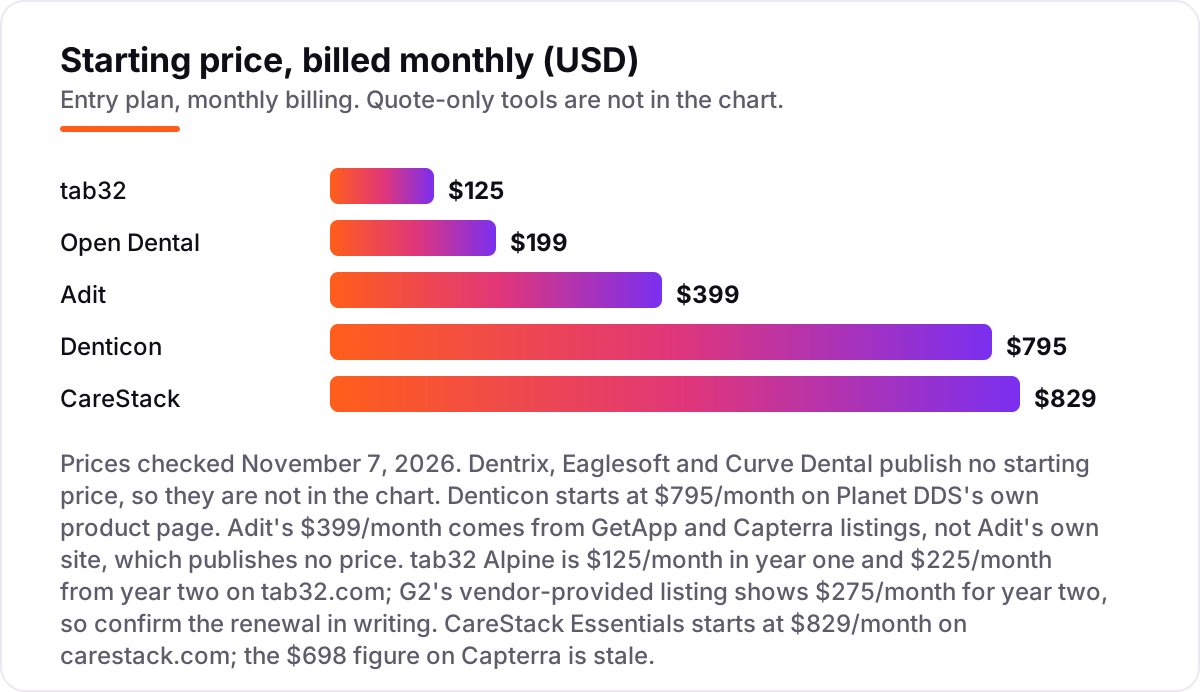
Take a single-location practice with 3 providers in its first year. On list prices, the subscription costs $1,500 a year on tab32 Alpine ($125 a month), $2,388 on Open Dental ($199 a month), $4,788 on Adit ($399 a month), $9,540 on Denticon ($795 a month) and $9,948 on CareStack Essentials ($829 a month). Dentrix, Eaglesoft and Curve Dental publish no price, so their number comes from a demo and a written quote, and server tools add hardware and IT support on top.
Three costs sit outside every number above. First, the per-transaction fees: tab32 charges $0.20 per claim, $0.50 per attachment and $1.25 per eligibility check, so a practice sending 150 claims a month pays about $30 a month in claims fees alone, plus attachments and checks. Second, the engagement add-ons: Open Dental's eServices bundle, texting, reminders and online scheduling, costs $165 a month, taking a fully equipped Open Dental setup to $364 a month in year one, or $4,368 for the year. Third, the year-two step: Open Dental drops to $149 a month, saving $600 a year, while tab32 rises to $225 a month, adding $1,200 a year, so the cheapest first-year price is not the cheapest second-year price.
The gap between the cheapest and dearest published options is wide: $1,500 a year on tab32 against $9,948 on CareStack Essentials, before claims fees and add-ons. That gap buys different things: tab32 buys a simple cloud system for a small practice, CareStack buys an all-in-one suite with multi-location reporting for a growing group. Price the quote-only tools on the same basis, with the same locations, providers and modules in writing, or the comparison is meaningless. If the practice is weighing cloud against server, our guide to cloud-based dental software compares the deployment question on its own.
Know the difference: practice management software vs patient engagement tools
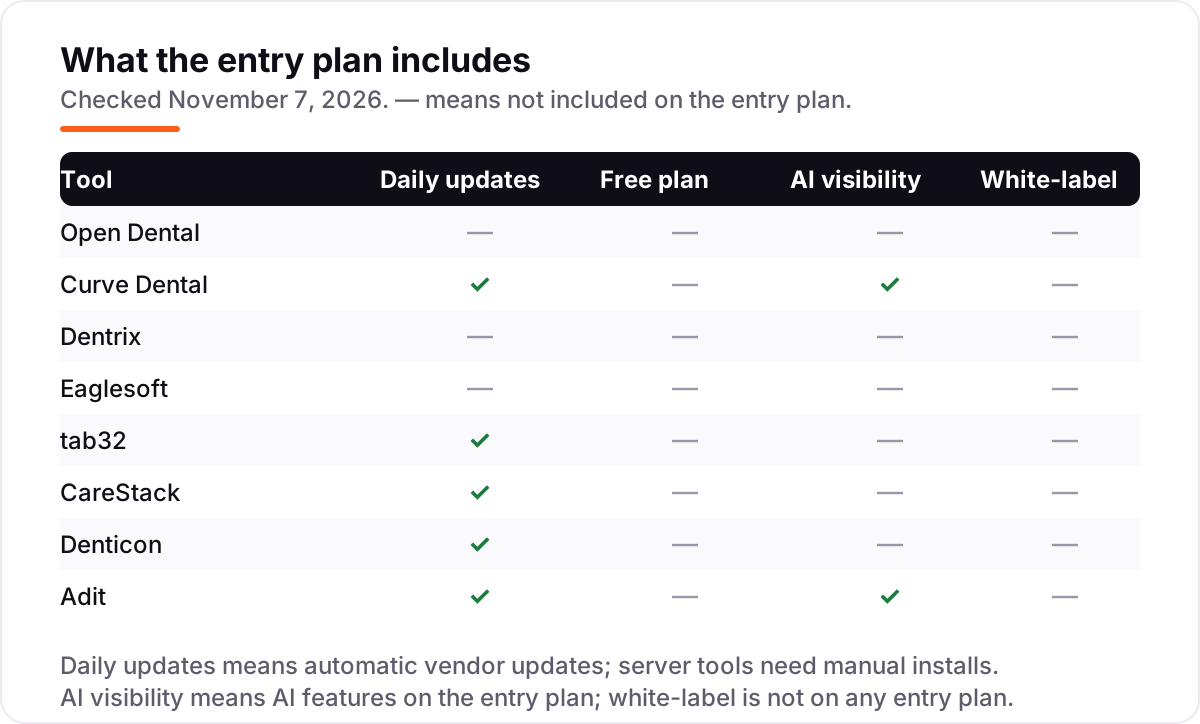
The confusion in this category is between the system of record and the layer on top of it. Practice management software holds the patient record, the schedule, the chart, the ledger and the claims; it is the system the practice cannot work without. Patient engagement tools handle the phone, the texts, the reminders, the reviews and the online booking; they sit on top of a practice system and make it friendlier.
Adit is the tool in this list that lives mostly in the second category. Its AI voice agent answers calls and books appointments, and it centralizes messaging, forms and payments, but practices needing deep clinical charting pair it with a full PMS such as Dentrix, Eaglesoft or Open Dental. Buying Adit instead of a practice system leaves the practice with no chart and no ledger.
The same split explains why some practices run two tools and pay twice. A server system with thin engagement features often gets a Weave, NexHealth or Adit layered on top, while a cloud all-in-one such as Curve Dental or CareStack already includes texting, reminders and online booking. When comparing prices, count the engagement layer in the total: a cheap PMS plus a $399-a-month engagement tool is not a cheap stack.
A practical test is the chart: if a tool cannot hold the clinical record, the perio chart and the treatment plan, it is not a practice system, whatever its marketing says. Ask the vendor to show a full patient journey, from booking to claim payment, inside one login, and count how many times the demo jumps to a different product. Every jump is a second subscription, a second login and a second support queue.
Quick comparison: tool type by need
| Buyer | Best pick | Why |
|---|---|---|
| Solo practice on a budget | Open Dental | Full system from $199/month in year one, then $149, per location |
| Practice going cloud-only | Curve Dental | Browser-based since 2004 with AI built in, no server to maintain |
| Established practice on the standard | Dentrix | Most widely installed system, deepest ecosystem, quote only |
| Patterson-equipment practice | Eaglesoft | One vendor for software, hardware, supplies and service |
| Small group wanting published cloud pricing | tab32 | Alpine from $125/month in year one, live within days |
| Growing group or DSO | CareStack | All-in-one cloud suite with published prices from $829/month |
Mistakes to avoid
- Comparing year-one prices only. Open Dental drops from $199 to $149 a month after a year, while tab32 rises from $125 to $225. The cheapest first-year price is not the cheapest second-year price.
- Budgeting on the base price alone. Claims, eligibility checks, attachments, texting and online scheduling sit outside the subscription on tab32 and Open Dental, and imaging AI is an add-on on Dentrix and Eaglesoft.
- Buying cloud or server on habit. A server means hardware, backups and an IT bill every year; a cloud system removes that but charges per location or provider, so the total depends on practice shape.
- Skipping the data-conversion check. Conversion is priced separately on most tools, and some history, images or notes may not transfer. Get the conversion scope and price in writing before signing.
- Choosing an engagement tool instead of a practice system. Adit answers the phone brilliantly, but it does not replace charting, billing and claims. If the practice has no PMS yet, buy that first.
How we chose
We checked each vendor's own pricing page on November 7, 2026 and recorded the starting price exactly as shown, or recorded "Custom quote" where the vendor publishes no price. One price is not vendor-verified: Adit publishes no price on its own site, so its $399/month comes from GetApp and Capterra listings and is shown as such. tab32's year-two price is $225/month on tab32.com, while G2's vendor-provided listing shows $275, so confirm the renewal in writing. CareStack's $829/month comes from its own pricing page; the $698 figure on Capterra is stale. Denticon starts at $795/month on Planet DDS's own product page; the $750 figure in marketplace listings is stale. Ratings are G2 scores from search-index copies of the G2 review pages crawled within the last four days. No vendor paid for a place in this list, and none of the links here are affiliate links.
What to do next
Shortlist two or three systems that fit the practice shape, then demo each one with your own schedule, insurance mix and recall list, and get the quote in writing with locations, providers, modules and conversion included. Check that claims, eligibility and reports work the way the practice already works before signing a year-long term. If the system is sorted but new patients are not finding the practice, our guide to local SEO for dentists covers the visibility side. Once your tools are in place, find out what's holding your rankings back.
Your stack only works if people find you
SerpAstra fixes what keeps your site off page one and makes it easy for AI assistants to recommend.
Get a free audit→Sources we checked (16)
- Open Dental fees — opendental.com/site/fees.html (checked November 7, 2026)
- Curve Dental pricing — curvedental.com/pricing (checked November 7, 2026)
- Dentrix — dentrix.com (checked November 7, 2026; no published price)
- Eaglesoft — eaglesoft.net (checked November 7, 2026; no published price)
- tab32 pricing — tab32.com (checked November 7, 2026)
- CareStack pricing — carestack.com/pricing (checked November 7, 2026)
- Denticon pricing — planetdds.com (starts at $795/month, checked November 7, 2026)
- Adit pricing — GetApp listing (checked November 7, 2026; Adit publishes no price)
- Open Dental reviews — G2 (checked November 7, 2026)
- Curve Dental reviews — G2 (checked November 7, 2026)
- Dentrix reviews — G2 (checked November 7, 2026)
- Eaglesoft reviews — G2 (checked November 7, 2026)
- tab32 reviews — G2 (checked November 7, 2026)
- CareStack reviews — G2 (checked November 7, 2026)
- Denticon reviews — G2 (checked November 7, 2026)
- Adit reviews — G2 (checked November 7, 2026)
Shamim
Founder of SerpAstra
A full-stack SEO and digital marketer who spends most days on Local SEO for dental practices, AI search visibility and lead generation.
Frequently asked questions
What is the best dental practice management software?
Open Dental is the best fit for most practices: the lowest published price at $199/month per location in year one, then $149, with full scheduling, charting, billing and claims. Curve Dental is the best cloud system, and Dentrix is the best pick when the industry standard matters most.
How much does dental practice management software cost?
Published prices run from $125/month (tab32) to $829/month (CareStack Essentials). Open Dental costs $199/month in year one, then $149, Adit starts at $399/month and Denticon starts at $795/month. Dentrix, Eaglesoft and Curve Dental quote only, so the total depends on locations, providers and modules.
Is there free dental practice management software?
No tool in this list has a free plan. Open Dental offers a free trial version capped at 30 patients, and tab32 offers a 14-day free trial. The rest sell by demo and quote. Expect to pay for the software itself plus claims fees, texting add-ons and, for server tools, hardware and IT support.
What is the difference between Dentrix and Dentrix Ascend?
Classic Dentrix is server-based software installed in the office, with hardware, backups and IT support to manage. Dentrix Ascend is Henry Schein One's cloud version of the same brand, accessed through a browser with no server. Ascend is a separate platform, not an upgrade path, so switching means a migration.
Can I switch dental practice management software later?
Yes, but plan the move carefully. Data conversion is priced separately on most tools, and some history, images or notes may not transfer cleanly. Open Dental converts from more than 200 systems. Run the new system in parallel for a few weeks, reconcile the schedule and the ledger, and switch at a quiet point in the month.
Do I need separate patient engagement software as well?
It depends on the system you pick. Cloud tools such as Curve Dental and CareStack include texting, reminders and online booking in the platform. Server tools often need an add-on or a separate tool, which is where Adit fits: it layers AI call handling and messaging on top of Dentrix, Eaglesoft or Open Dental.
Free SEO and AI visibility audit
Find out what is holding your rankings back
Send us your site. Within 2 business days you get a written audit, an AI visibility check and a short fix list ranked by impact. Free, with no contract attached.
Request my free audit→Related guides
 Local SEOLocal SEO for dentists: a practical patient growth guideA practical local SEO guide for dental practices: Google Business Profile, service pages, reviews, citations and tracking that turn searches into booked patients.Read guide →
 Local Business & Vertical Software9 Best Cloud Based Dental Software in 2026, ComparedCompare the 9 best cloud based dental software options for 2026 — real prices, G2 and Capterra ratings, and which cloud PMS fits solo practices and DSOs.Read guide →
 Digital Marketing & Ads8 Best Automation Tools for Marketing in Healthcare in 2026, ComparedThe 8 best automation tools for marketing in healthcare, compared on price, HIPAA readiness and patient-journey automation. Prices checked November 4, 2026.Read guide →